
Does the Best Astaxanthin Dose Depend on My Goal?
Keyora Research Q&A Library
This is part of the Keyora Research Q&A Series, derived from Keyora Astaxanthin Research Journal Series.
Within the Keyora Astaxanthin Researcn framework, this Q&A translates complex astaxanthin biology into reader-friendly, evidence-bound answers, focusing on natural astaxanthin identity, molecular structure, antioxidant and redox mechanisms, membrane lipid interaction, mitochondrial resilience, inflammatory signaling pathways, human evidence interpretation, and the scientific principles behind responsible supplementation.
First published by Keyora Research Journal: www.keyorahealth.com
Direct Answer
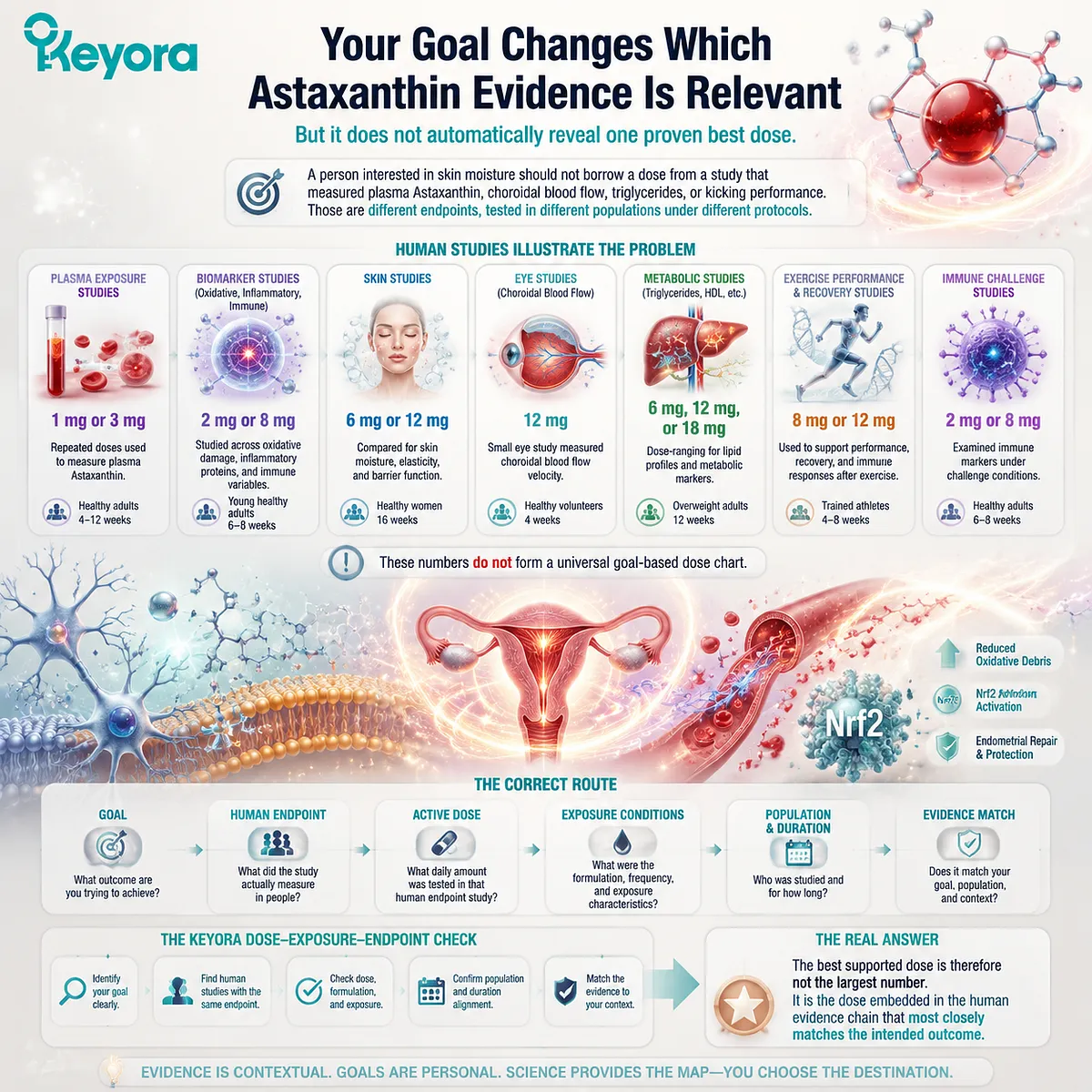
Your goal changes which Astaxanthin evidence is relevant, but it does not automatically reveal one proven best dose.
A person interested in skin moisture should not borrow a dose from a study that measured plasma Astaxanthin, choroidal blood flow, triglycerides, or kicking performance. Those are different endpoints, tested in different populations under different protocols.
Human studies illustrate the problem. Repeated doses of 1 mg or 3 mg have been used to measure plasma exposure. Doses of 2 mg and 8 mg have been studied across oxidative, inflammatory, and immune biomarkers. Skin research has compared 6 mg and 12 mg. A small eye study used 12 mg to measure choroidal blood flow. Metabolic research compared 6 mg, 12 mg, and 18 mg, while exercise trials have used 8 mg or 12 mg for different performance and recovery outcomes. These numbers do not form a universal goal based dose chart.
The correct route is:
Goal
-
Human endpoint
-
Active dose
-
Exposure conditions
-
Population and duration
-
Evidence match
The Keyora Dose – Exposure – Endpoint Check applies this route without turning it into a rigid dose calculator.
The best supported dose is therefore not the largest number. It is the dose embedded in the human evidence chain that most closely matches the intended outcome.
Start With the Outcome You Actually Want
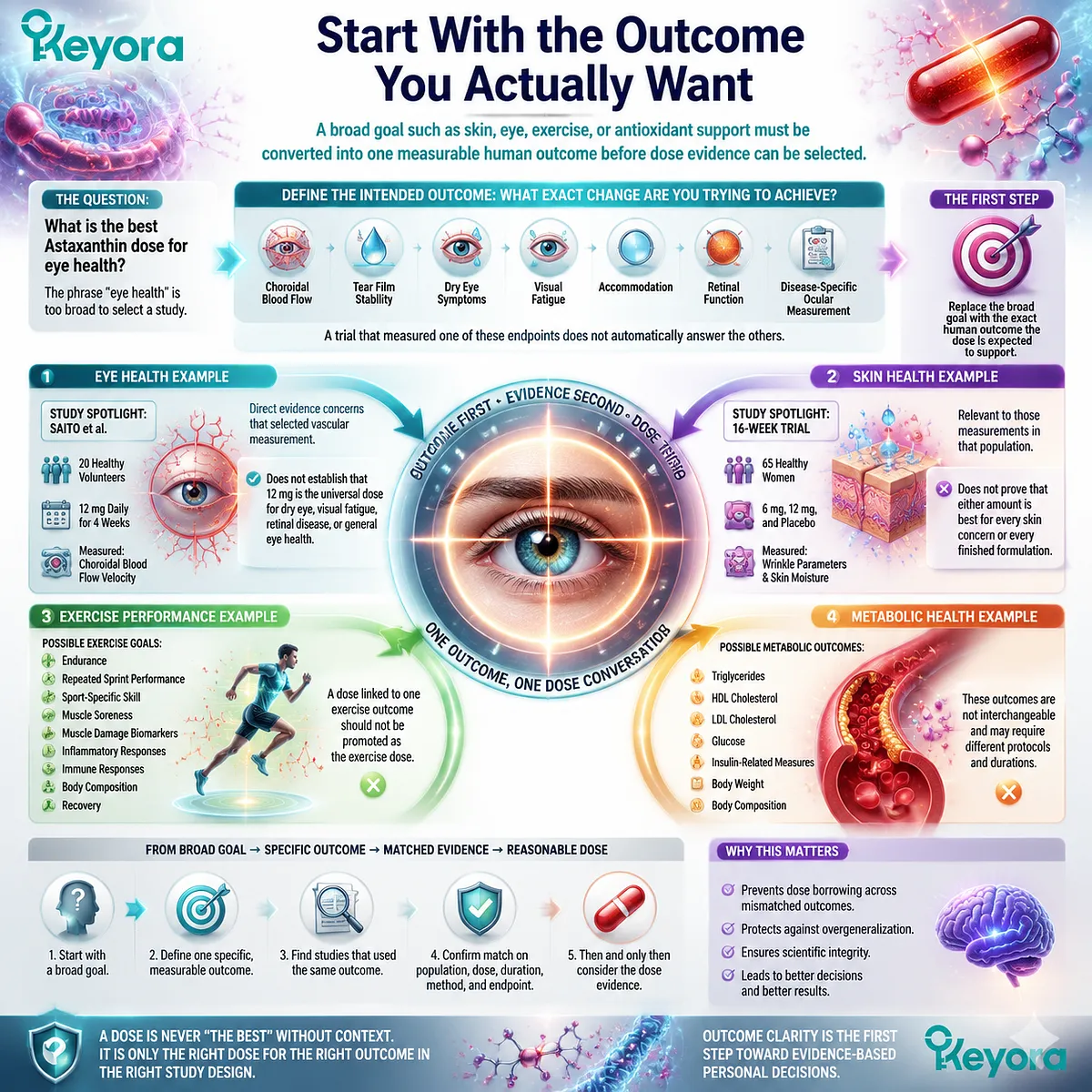
A broad goal such as skin, eye, exercise, or antioxidant support must be converted into one measurable human outcome before dose evidence can be selected
Consider the question:
What is the best Astaxanthin dose for eye health?
The phrase eye health is too broad to select a study.
The intended outcome might be:
-
choroidal blood flow
-
tear film stability
-
dry eye symptoms
-
visual fatigue
-
accommodation
-
retinal function
-
a disease specific ocular measurement
A trial that measured one of these endpoints does not automatically answer the others.
For example, the Saito study provided 12 mg daily for four weeks to 20 healthy volunteers and measured choroidal blood flow velocity at baseline and during supplementation. Its direct evidence concerns that selected vascular measurement. It does not establish that 12 mg is the universal dose for dry eye, visual fatigue, retinal disease, or general eye health.
The same clarification is required for skin.
A person may mean:
-
maintaining skin moisture
-
limiting wrinkle deterioration
-
supporting elasticity
-
changing a UV related measurement
-
improving subjective appearance
A 16 week study in 65 healthy women compared 6 mg, 12 mg, and placebo while assessing wrinkle parameters and skin moisture. That protocol is relevant to those measurements in that population. It does not prove that either amount is best for every skin concern or every finished formulation.
Exercise is even less specific.
Possible goals include:
-
endurance
-
repeated sprint performance
-
sport specific skill
-
muscle soreness
-
muscle damage biomarkers
-
inflammatory responses
-
immune responses
-
body composition
-
recovery
A dose linked to one exercise outcome should not be promoted as the exercise dose.
Metabolic health also needs an endpoint. Triglycerides, HDL cholesterol, LDL cholesterol, glucose, insulin related measures, body weight, and body composition are not interchangeable.
The first step is therefore not choosing a number.
It is replacing the broad goal with the exact human outcome the dose is expected to support.
Match the Goal to a Human Endpoint
The relevant dose comes from the study that measured the intended outcome, not from another paper that used the same ingredient name
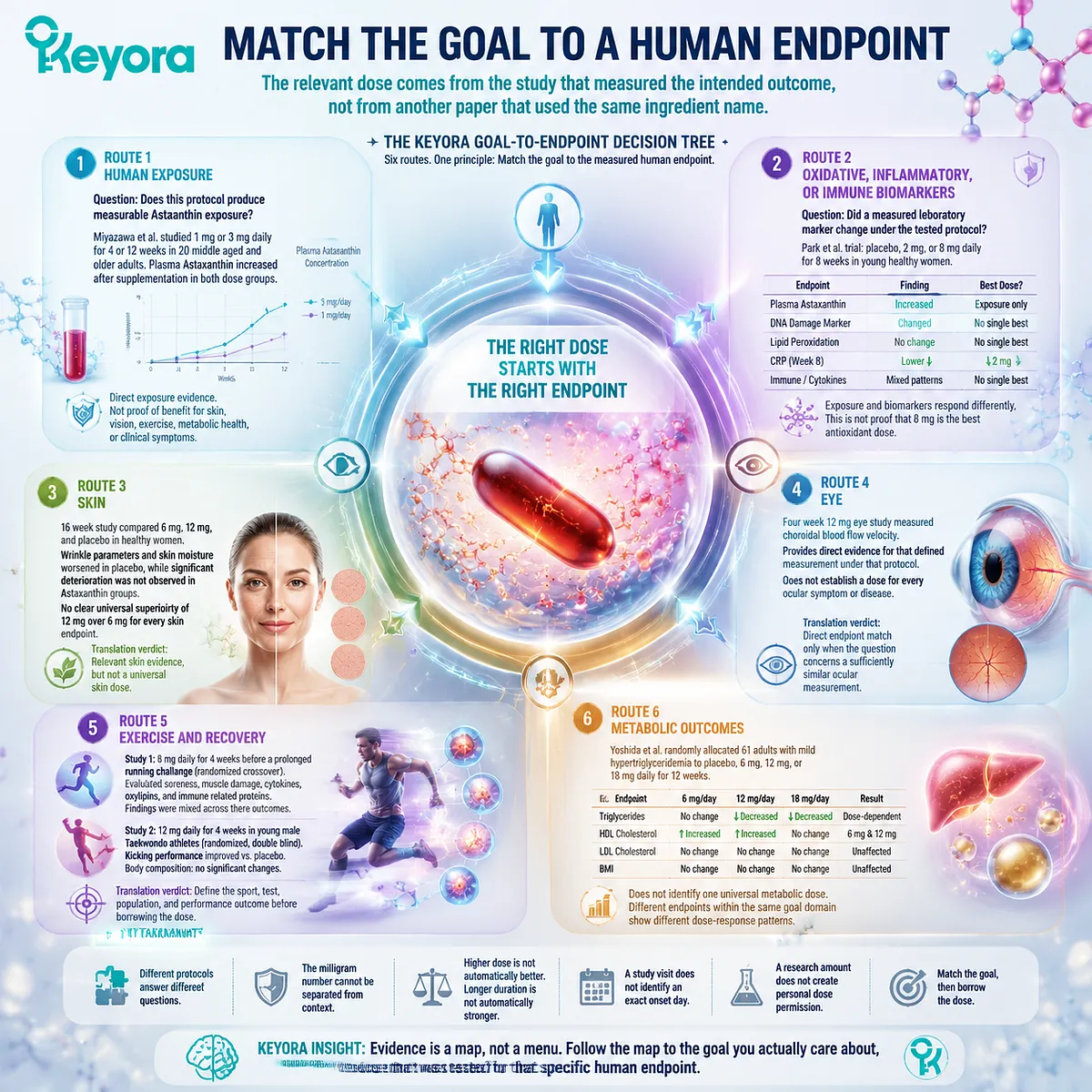
The Keyora Goal-to-Endpoint Decision Tree separates the evidence into six routes.
Route 1 – Human Exposure
The question is:
Does this protocol produce measurable Astaxanthin exposure?
Miyazawa and colleagues studied 1 mg or 3 mg daily for 4 or 12 weeks in 20 middle aged and older adults. Plasma Astaxanthin increased after supplementation in both dose groups. This is direct exposure evidence. It does not prove that either dose improves skin, vision, exercise performance, metabolic health, or a clinical symptom.
Route 2 – Oxidative, Inflammatory, or Immune Biomarkers
The question is:
Did a measured laboratory marker change under the tested protocol?
In the Park trial, young healthy women received placebo, 2 mg, or 8 mg daily for eight weeks. Plasma Astaxanthin increased with supplementation, but the other endpoints did not produce one simple dose ranking. A DNA damage marker changed, lipid peroxidation did not, CRP was lower in the 2 mg group at week eight, and several immune and cytokine measures followed different patterns.
The study therefore cannot be reduced to:
8 mg is the best antioxidant dose.
It shows that exposure and multiple biomarkers can respond differently within one protocol.
Route 3 – Skin
The 16 week skin study compared 6 mg, 12 mg, and placebo in healthy women. Wrinkle parameters and skin moisture worsened in the placebo group during the study, while significant deterioration was not observed in the Astaxanthin groups. The study did not establish a clear universal superiority of 12 mg over 6 mg for every skin endpoint.
The translation verdict is:
Relevant skin evidence, but not a universal skin dose.
Route 4 – Eye
The four week 12 mg eye study measured choroidal blood flow velocity. It provides direct evidence for that defined measurement under that protocol. It does not establish a dose for every ocular symptom or disease.
The translation verdict is:
Direct endpoint match only when the question concerns a sufficiently similar ocular measurement.
Route 5 – Exercise and Recovery
A randomized crossover study provided 8 mg daily for four weeks before a prolonged running challenge. The study evaluated soreness, muscle damage, cytokines, oxylipins, and immune related proteins. Its findings were mixed across these outcome families, so one protocol cannot be labelled simply as effective or ineffective for exercise.
A newer randomized, double blind trial provided 12 mg daily for four weeks to young male Taekwondo athletes. Sport specific kicking performance improved relative to placebo, while body composition measures did not show significant changes. The same dose therefore produced a positive result for one performance endpoint and a null result for another outcome family.
The translation verdict is:
Define the sport, test, population, and performance outcome before borrowing the dose.
Route 6 – Metabolic Outcomes
The Yoshida study randomly allocated 61 adults with mild hypertriglyceridemia to placebo, 6 mg, 12 mg, or 18 mg daily for 12 weeks. The reported patterns differed by endpoint. The 12 mg and 18 mg groups reduced triglycerides, while 6 mg and 12 mg increased HDL cholesterol. BMI and LDL cholesterol were unaffected across the tested doses.
This does not identify one universal metabolic dose.
It demonstrates that even within one goal domain, different endpoints may point toward different dose patterns.
Separate Exposure From Clinical Benefit
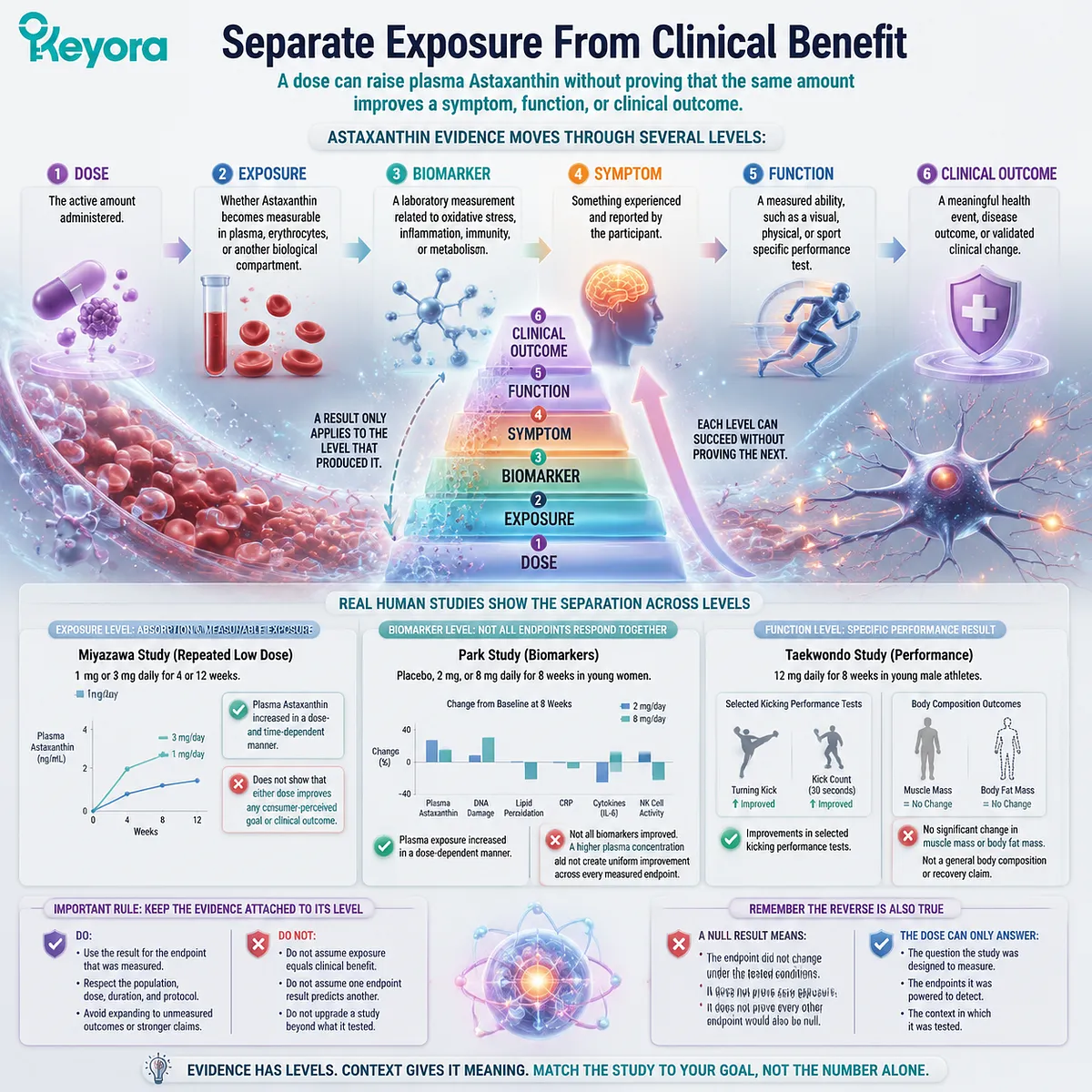
A dose can raise plasma Astaxanthin without proving that the same amount improves a symptom, function, or clinical outcome
Astaxanthin evidence moves through several levels:
Dose
The active amount administered.
Exposure
Whether Astaxanthin becomes measurable in plasma, erythrocytes, or another biological compartment.
Biomarker
A laboratory measurement related to oxidative stress, inflammation, immunity, or metabolism.
Symptom
Something experienced and reported by the participant.
Function
A measured ability, such as a visual, physical, or sport specific performance test.
Clinical outcome
A meaningful health event, disease outcome, or validated clinical change.
A dose can succeed at one level without proving the next.
The low dose Miyazawa study showed that 1 mg and 3 mg daily could increase plasma Astaxanthin under the tested conditions. This establishes absorption and measurable repeated exposure. It does not show that either amount improves a consumer perceived goal.
The Park study makes the separation even clearer. Plasma exposure increased dose dependently, but DNA damage, lipid peroxidation, CRP, cytokines, and immune measures did not all respond together. A higher plasma concentration did not create uniform improvement across every measured endpoint.
Exercise research provides the same lesson at the functional level.
In the Taekwondo trial, 12 mg daily was associated with improvements in selected kicking tests, but it did not significantly change muscle mass or body fat mass. The evidence supports the specific measured performance result in that young male athletic population. It does not establish a general body composition, endurance, recovery, or wellness effect.
This creates an important rule:
A positive result remains attached to the endpoint that produced it.
It should not be expanded sideways to unmeasured outcomes or upward to a stronger clinical claim.
The reverse is also true.
A null result for one endpoint does not prove that the dose created no exposure or that every other endpoint would also be null.
The dose can only answer the question the study was designed and powered to measure.
Complete the Keyora Dose – Exposure – Endpoint Check
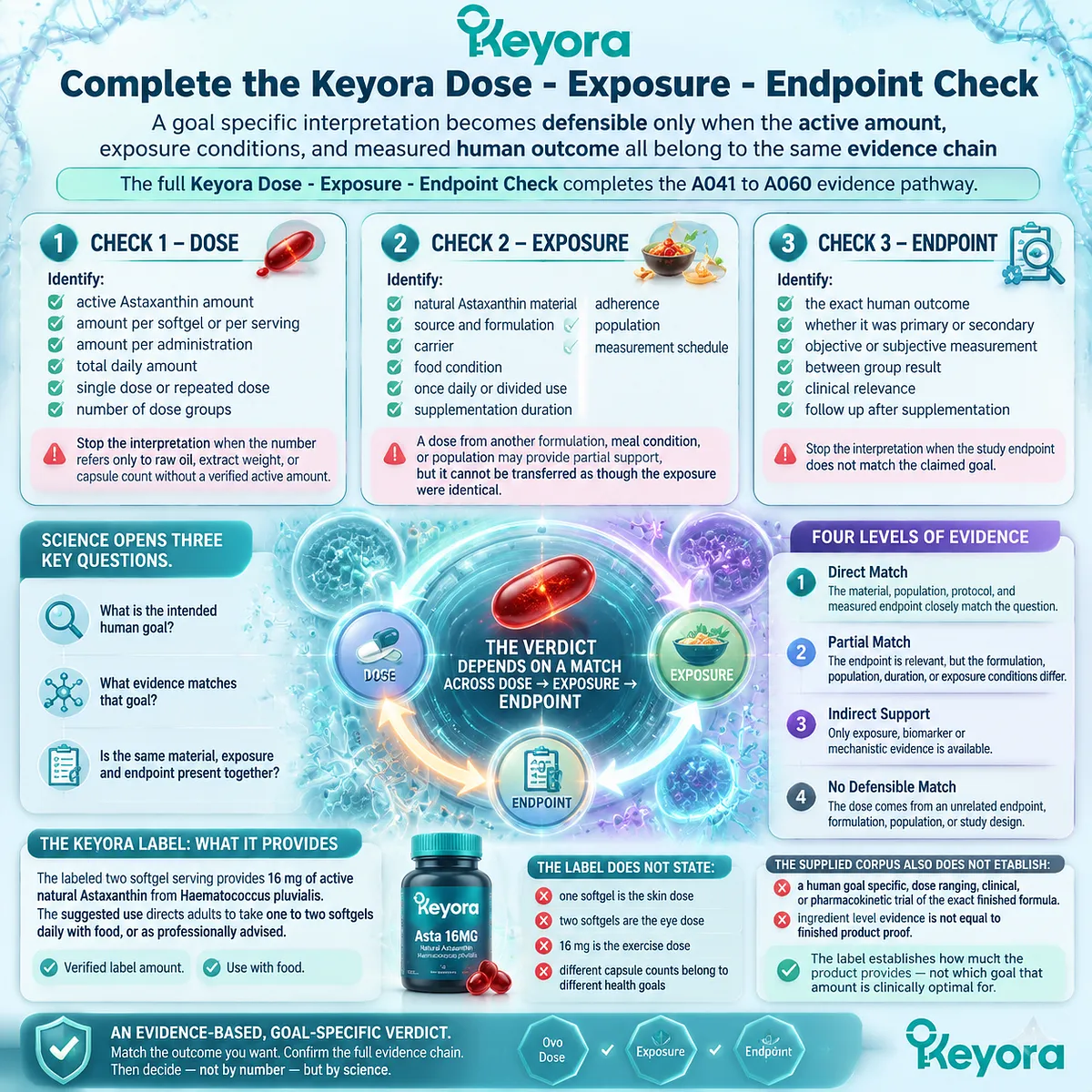
A goal specific interpretation becomes defensible only when the active amount, exposure conditions, and measured human outcome all belong to the same evidence chain
The full Keyora Dose – Exposure – Endpoint Check completes the A041 to A060 evidence pathway.
Check 1 – Dose
Identify:
-
active Astaxanthin amount
-
amount per softgel or per serving
-
amount per administration
-
total daily amount
-
single dose or repeated dose
-
number of dose groups
Stop the interpretation when the number refers only to raw oil, extract weight, or capsule count without a verified active amount.
Check 2 – Exposure
Identify:
-
natural Astaxanthin material
-
source and formulation
-
carrier
-
food condition
-
once daily or divided use
-
supplementation duration
-
adherence
-
population
-
measurement schedule
A dose from another formulation, meal condition, or population may provide partial support, but it cannot be transferred as though the exposure were identical.
Check 3 – Endpoint
Identify:
-
the exact human outcome
-
whether it was primary or secondary
-
objective or subjective measurement
-
between group result
-
clinical relevance
-
follow up after supplementation
Stop the interpretation when the study endpoint does not match the claimed goal.
The final verdict belongs to one of four levels.
Level 1 – Direct Match
The material, population, protocol, and measured endpoint closely match the question.
Level 2 – Partial Match
The endpoint is relevant, but the formulation, population, duration, or exposure conditions differ.
Level 3 – Indirect Support
Only exposure, biomarker, or mechanistic evidence is available.
Level 4 – No Defensible Match
The dose comes from an unrelated endpoint, formulation, population, or study design.
Apply this framework briefly to the Keyora label.
The labeled two softgel serving provides 16 mg of active natural Astaxanthin from Haematococcus pluvialis. The suggested use directs adults to take one to two softgels daily with food, or as professionally advised. These are verified label and use facts within the project record.
The label does not state:
-
one softgel is the skin dose
-
two softgels are the eye dose
-
16 mg is the exercise dose
-
different capsule counts belong to different health goals
The supplied Keyora corpus also does not establish a human goal specific, dose ranging, clinical, or pharmacokinetic trial of the exact finished formula. Ingredient evidence can support the scientific rationale, but it cannot be presented as finished product proof.
The label establishes how much the product provides.
It does not establish which goal that amount is clinically optimal for.
Closing Summary
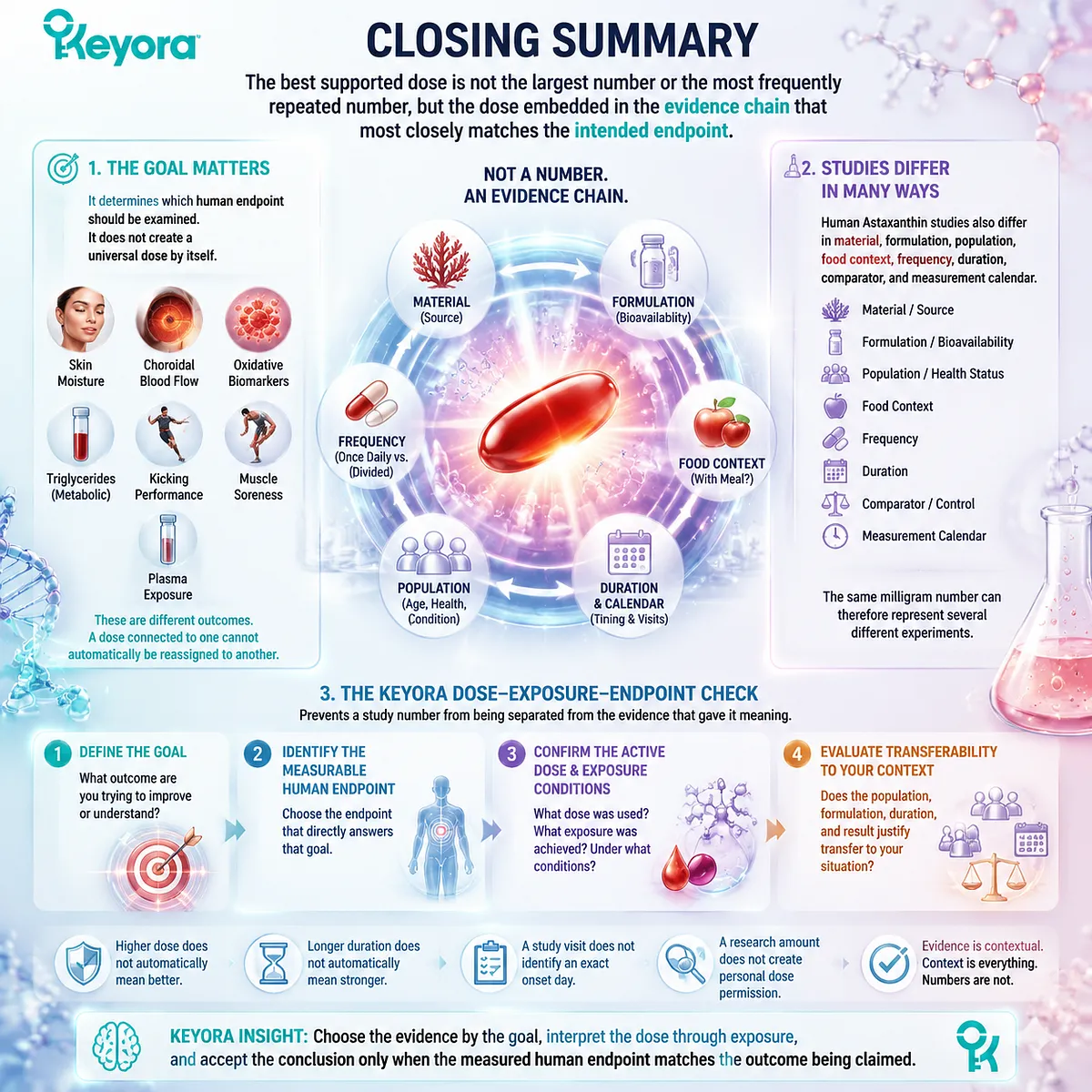
The best supported dose is not the largest number or the most frequently repeated number, but the dose embedded in the evidence chain that most closely matches the intended endpoint
The goal matters because it determines which human endpoint should be examined.
It does not create a universal dose by itself.
Skin moisture, choroidal blood flow, oxidative biomarkers, triglycerides, kicking performance, muscle soreness, and plasma exposure are different outcomes. A dose connected to one cannot automatically be reassigned to another.
Human Astaxanthin studies also differ in material, formulation, population, food context, frequency, duration, comparator, and measurement calendar. The same milligram number can therefore represent several different experiments.
The Keyora Dose – Exposure – Endpoint Check prevents a study number from being separated from the evidence that gave it meaning.
First define the goal.
Then identify the measurable human endpoint.
Next confirm the active dose and exposure conditions.
Finally, decide whether the population, formulation, duration, and result justify transfer.
Choose the evidence by the goal, interpret the dose through exposure, and accept the conclusion only when the measured human endpoint matches the outcome being claimed.
This article is for educational and informational purposes only. It does not provide medical advice, diagnosis, treatment, cure, prevention, disease outcome claims, hormone restoration claims, fertility outcome claims, or formula-specific clinical efficacy claims.