
Why Do Astaxanthin Studies Use Different Doses and Durations?
Keyora Research Q&A Library
This is part of the Keyora Research Q&A Series, derived from Keyora Astaxanthin Research Journal Series.
Within the Keyora Astaxanthin Researcn framework, this Q&A translates complex astaxanthin biology into reader-friendly, evidence-bound answers, focusing on natural astaxanthin identity, molecular structure, antioxidant and redox mechanisms, membrane lipid interaction, mitochondrial resilience, inflammatory signaling pathways, human evidence interpretation, and the scientific principles behind responsible supplementation.
First published by Keyora Research Journal: www.keyorahealth.com
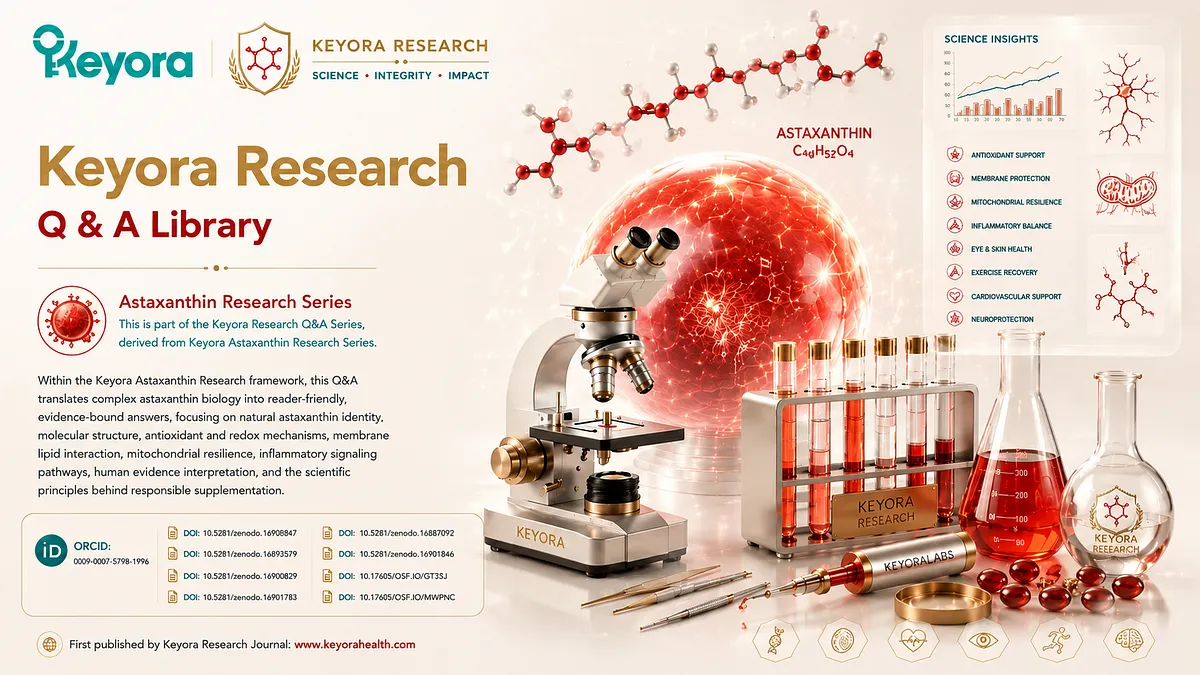
Direct Answer
Astaxanthin studies use different doses and durations because each trial is designed to answer a different scientific question.
A pharmacokinetic study may administer one relatively high research dose and collect blood repeatedly over several hours. Its purpose is to map plasma appearance, peak concentration, total measured exposure, and elimination under a specific formulation.
A repeated supplementation study may use a lower daily amount for several weeks to determine whether Astaxanthin becomes measurable in plasma or erythrocytes. A biomarker trial may choose several dose groups and scheduled visits. A skin, eye, metabolic, or exercise study may use another duration because its endpoint requires a different intervention and assessment calendar.
For example, human studies have examined:
-
40 mg once in a formulation pharmacokinetic experiment
-
5 mg or 20 mg daily for 3 weeks in an oxidative biomarker study
-
2 mg or 8 mg daily for 8 weeks in an immune and biomarker trial
-
6 mg or 12 mg daily for 16 weeks in a skin study
These protocols are not competing versions of one universal recommendation. They differ in material, formulation, population, frequency, measurement schedule, and endpoint.
A research number should therefore never be copied by itself. Dose and duration gain meaning only after the complete trial blueprint has been reconstructed.
One Ingredient Can Build Several Different Experiments
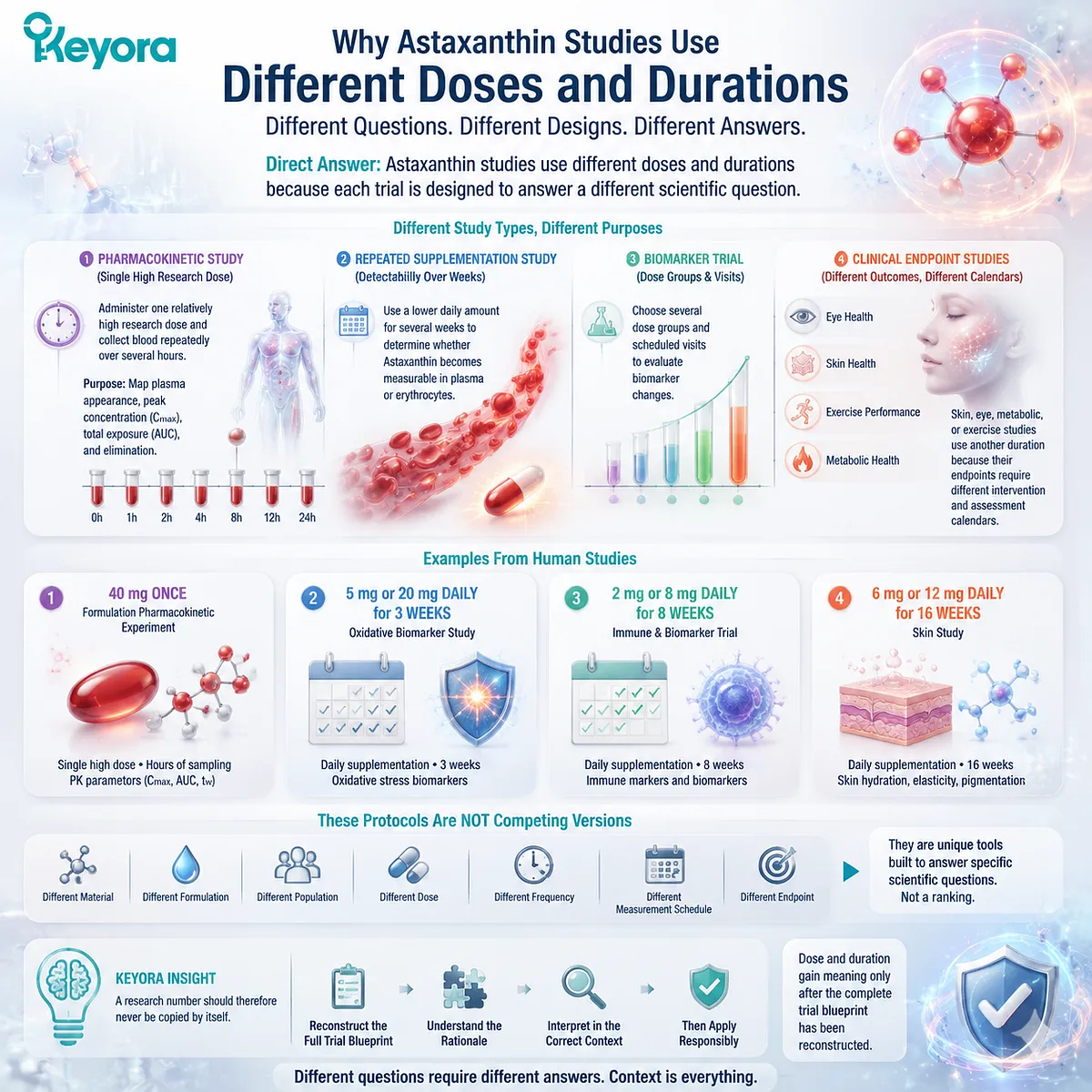
A pharmacokinetic trial, a biomarker trial, and a functional trial may all study Astaxanthin while requiring different protocols
Place three Astaxanthin papers on the same desk.
Paper One
Participants receive 40 mg once, followed by repeated blood sampling.
Paper Two
Participants receive 5 mg or 20 mg once daily for 3 weeks, followed by weekly oxidative biomarker measurements.
Paper Three
Participants receive 6 mg or 12 mg daily for 16 weeks, followed by skin assessments.
At first glance, the papers appear inconsistent. One uses a high amount once. Another compares two daily amounts over a short intervention. The third uses moderate daily amounts for a much longer period.
The correct question is not:
Which study chose the right dose?
The correct question is:
What was each experiment built to discover?
The 40 mg study by Odeberg and colleagues was an open human pharmacokinetic experiment comparing several lipid based formulations with a reference supplement. Researchers measured plasma exposure after one administration. The study showed that formulation affected the rate and extent of measured exposure. It did not test 40 mg as a daily wellness routine or establish that consumers should take that amount repeatedly.
The 3 week Choi study assigned 23 adults with a body mass index above 25 to 5 mg or 20 mg once daily. Oxidative stress biomarkers were measured at baseline and after weeks 1, 2, and 3. The repeated visits allowed the researchers to observe a short biomarker trajectory. The design did not compare skin, vision, exercise performance, long term use, or the superiority of 20 mg for every outcome.
The 16 week skin study enrolled 65 healthy women and compared 6 mg, 12 mg, and placebo. Its duration belonged to a specific skin protocol, population, seasonal context, and set of instrumented measurements. It did not establish that all skin goals require 16 weeks or that the same doses and calendar apply to another tissue or finished product.
All three can be scientifically purposeful because they are different experiments.
The ingredient name remains Astaxanthin, but the research question changes the entire protocol.
Read Dose and Duration as One Design Unit
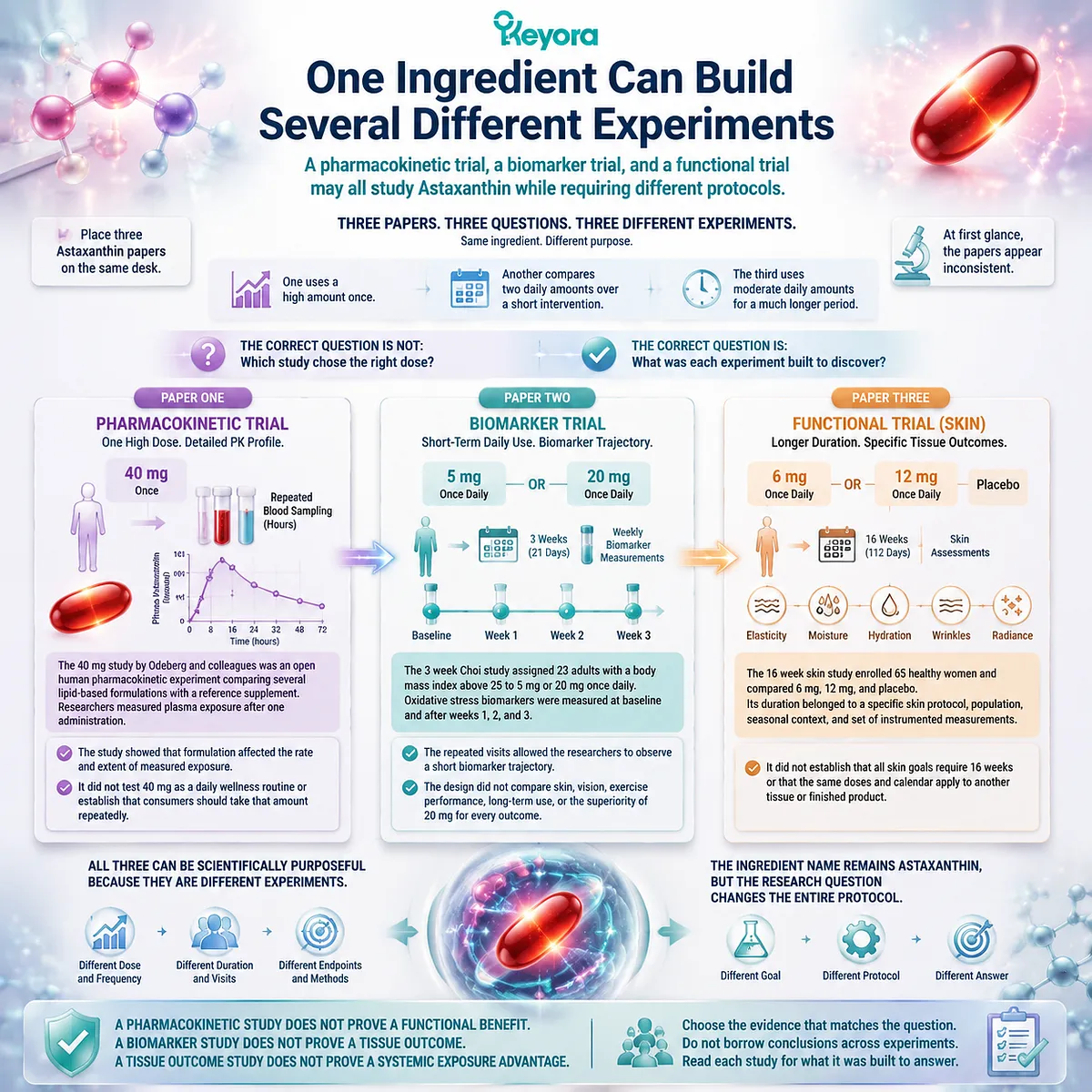
A milligram number becomes interpretable only when it is linked to frequency, formulation, population, study length, and measurement visits
The statement:
The study used 8 mg
is incomplete.
It leaves unanswered:
-
Was 8 mg administered once or every day?
-
Was it taken once daily or divided?
-
Which natural Astaxanthin material was used?
-
What formulation delivered it?
-
Was it taken with food?
-
Who participated?
-
How long did supplementation continue?
-
When were measurements collected?
-
What endpoint was assessed?
Dose and duration must be read as one design unit.
Single dose
A single dose study asks what happens after one administration.
Researchers may collect multiple blood samples across several hours or days to estimate:
-
concentration rise
-
measured peak
-
time to peak
-
total plasma exposure
-
subsequent decline
A larger research dose may help create a measurable concentration curve. That methodological purpose does not convert the amount into a daily recommendation.
Repeated daily dose
A repeated dose trial asks what happens when an amount is used consistently over days or weeks.
Miyazawa and colleagues studied 1 mg or 3 mg daily in 20 middle aged and older Japanese adults over 4 or 12 weeks. The primary research object was plasma carotenoid concentration during repeated low dose supplementation. This was not a single dose pharmacokinetic curve or a clinical trial establishing one universal wellness dose.
Dose ranging
A dose ranging study assigns different groups to different amounts to explore whether response patterns vary by dose.
Yoshida and colleagues used several daily dose groups over 12 weeks while measuring triglycerides, HDL cholesterol, adiponectin, and other metabolic variables. Different outcomes were associated with different dose patterns. This illustrates why a dose ranging study may not reveal one winner across all endpoints.
Supplementation duration
This is how long the intervention was administered.
Measurement calendar
This is when researchers collected blood, imaging, questionnaires, or functional tests.
Challenge calendar
An exercise study may provide supplementation for several weeks and then introduce a demanding running test. The supplementation period establishes the pre-challenge protocol, while the hours after exercise capture the acute response.
Follow-up period
This begins after the intervention ends and asks whether exposure or an endpoint persists.
A 4 week intervention with measurements only at baseline and week 4 cannot tell us the exact day an effect began. A 16 week trial is not automatically stronger than a 4 week trial. It may simply measure a slower, different, or more complex endpoint.
High dose plus short duration is also not mathematically interchangeable with low dose plus long duration. Biological exposure cannot be reduced to multiplying milligrams by days.
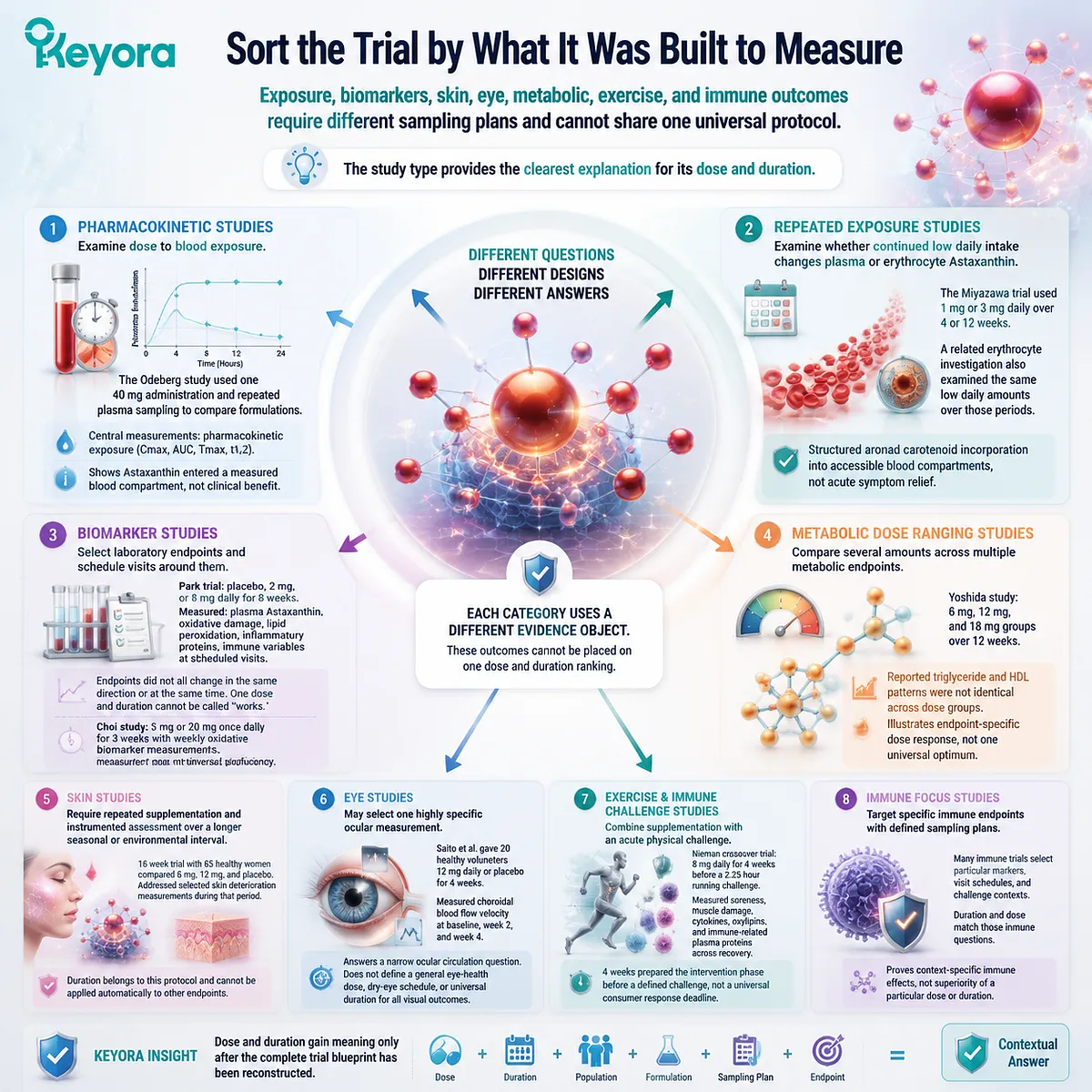
Sort the Trial by What It Was Built to Measure
Exposure, biomarkers, skin, eye, metabolic, exercise, and immune outcomes require different sampling plans and cannot share one universal protocol
The study type provides the clearest explanation for its dose and duration.
Pharmacokinetic studies
These trials examine dose to blood exposure.
The Odeberg study used one 40 mg administration and repeated plasma sampling to compare formulations. Its central measurements included pharmacokinetic exposure rather than a skin, visual, exercise, or symptom outcome.
A pharmacokinetic study can show that Astaxanthin entered a measured blood compartment. It cannot establish that a higher concentration produced greater clinical benefit.
Repeated exposure studies
These examine whether continued low daily intake changes plasma or erythrocyte Astaxanthin.
The Miyazawa trial used 1 mg or 3 mg daily over 4 or 12 weeks. A related erythrocyte investigation also examined the same low daily amounts over those periods. These studies were structured around carotenoid incorporation into accessible blood compartments, not acute symptom relief.
Biomarker studies
These select laboratory endpoints and schedule visits around them.
The Park trial assigned young healthy women to placebo, 2 mg, or 8 mg daily for 8 weeks. Plasma Astaxanthin, oxidative damage, lipid peroxidation, inflammatory proteins, and immune variables were evaluated at scheduled visits. The endpoints did not all change in the same direction or at the same time. This demonstrates why one dose and duration cannot be assigned a single meaning called “works.”
The Choi study used 5 mg or 20 mg once daily for 3 weeks and collected oxidative biomarker measurements weekly. Its shorter calendar reflected a dense laboratory measurement plan, not proof that three weeks is sufficient for all Astaxanthin goals.
Metabolic dose ranging studies
These compare several amounts across multiple metabolic endpoints.
In the Yoshida study, 6 mg, 12 mg, and 18 mg groups were used over 12 weeks. The reported triglyceride and HDL patterns were not identical across dose groups. The trial therefore illustrates endpoint-specific dose response rather than one universal optimum.
Skin studies
Skin outcomes may require repeated supplementation and instrumented assessment over a longer seasonal or environmental interval.
The 16 week trial involving 65 healthy women compared 6 mg, 12 mg, and placebo. Its design addressed selected skin deterioration measurements during that study period. The duration belongs to that protocol and cannot be applied automatically to visual, metabolic, or exercise endpoints.
Eye studies
An eye trial may select one highly specific ocular measurement.
Saito and colleagues gave 20 healthy volunteers 12 mg daily or placebo for 4 weeks and measured choroidal blood flow velocity before supplementation and at weeks 2 and 4. The protocol answered a narrow ocular circulation question. It did not define a general eye-health dose, a dry-eye treatment schedule, or the best duration for every visual outcome.
Exercise and immune challenge studies
These often combine a supplementation period with an acute physical challenge.
In the Nieman crossover trial, runners consumed 8 mg daily for 4 weeks before completing a 2.25 hour running challenge. Researchers then measured soreness, muscle damage, cytokines, oxylipins, and immune related plasma proteins across recovery. The 4 week duration prepared the intervention phase before a defined challenge. It was not selected as a universal consumer response deadline.
Each category uses a different evidence object.
Plasma exposure, a laboratory biomarker, skin moisture, choroidal blood flow, triglycerides, muscle soreness, and immune proteins cannot be placed on one dose and duration ranking.
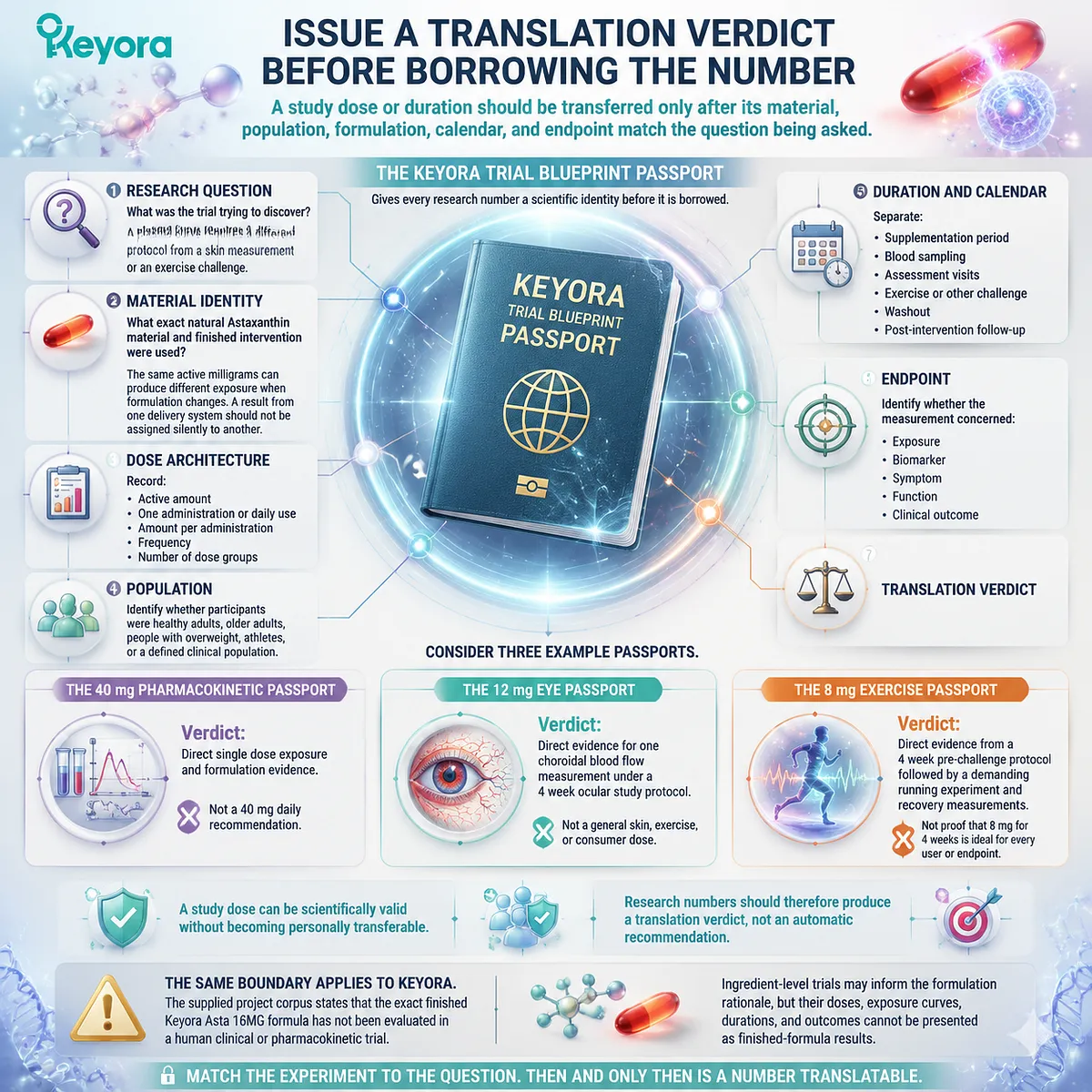
Issue a Translation Verdict Before Borrowing the Number
A study dose or duration should be transferred only after its material, population, formulation, calendar, and endpoint match the question being asked
The Keyora Trial Blueprint Passport gives every research number a scientific identity before it is borrowed.
Passport Field 1 – Research Question
What was the trial trying to discover?
A plasma curve requires a different protocol from a skin measurement or an exercise challenge.
Passport Field 2 – Material Identity
What exact natural Astaxanthin material and finished intervention were used?
The same active milligrams can produce different exposure when formulation changes. A result from one delivery system should not be assigned silently to another.
Passport Field 3 – Dose Architecture
Record:
-
active amount
-
one administration or daily use
-
amount per administration
-
frequency
-
number of dose groups
Passport Field 4 – Population
Identify whether participants were healthy adults, older adults, people with overweight, athletes, or a defined clinical population.
Passport Field 5 – Duration and Calendar
Separate:
-
supplementation period
-
blood sampling
-
assessment visits
-
exercise or other challenge
-
washout
-
post-intervention follow-up
Passport Field 6 – Endpoint
Identify whether the measurement concerned:
-
exposure
-
biomarker
-
symptom
-
function
-
clinical outcome
Passport Field 7 – Translation Verdict
Consider three example passports.
The 40 mg Pharmacokinetic Passport
Verdict:
Direct single dose exposure and formulation evidence.
Not a 40 mg daily recommendation.
The 12 mg Eye Passport
Verdict:
Direct evidence for one choroidal blood flow measurement under a 4 week ocular study protocol.
Not a general skin, exercise, or consumer dose.
The 8 mg Exercise Passport
Verdict:
Direct evidence from a 4 week pre-challenge protocol followed by a demanding running experiment and recovery measurements.
Not proof that 8 mg for 4 weeks is ideal for every user or endpoint.
A study dose can be scientifically valid without becoming personally transferable.
The same boundary applies to Keyora. The supplied project corpus states that the exact finished Keyora Asta 16MG formula has not been evaluated in a human clinical or pharmacokinetic trial. Ingredient-level trials may inform the formulation rationale, but their doses, exposure curves, durations, and outcomes cannot be presented as finished-formula results.
Research numbers should therefore produce a translation verdict, not an automatic recommendation.
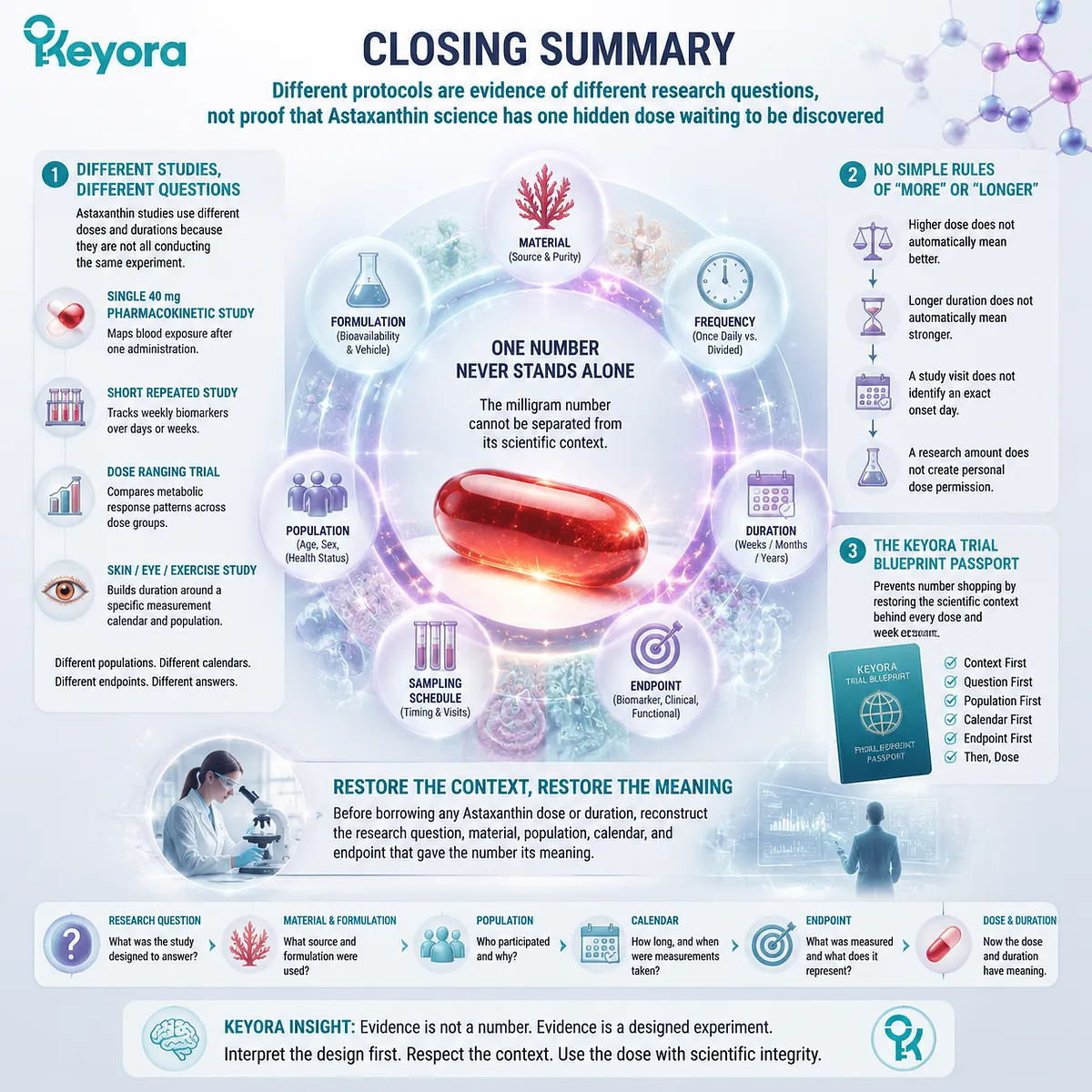
Closing Summary
Different protocols are evidence of different research questions, not proof that Astaxanthin science has one hidden dose waiting to be discovered
Astaxanthin studies use different doses and durations because they are not all conducting the same experiment.
A single 40 mg pharmacokinetic study maps blood exposure after one administration. A short repeated study can track weekly biomarkers. A dose ranging trial can compare metabolic response patterns. A skin, eye, or exercise study builds its duration around a different measurement calendar and population.
The milligram number cannot be separated from:
-
material
-
formulation
-
frequency
-
population
-
duration
-
sampling schedule
-
endpoint
Higher does not automatically mean better. Longer does not automatically mean stronger. A study visit does not identify an exact onset day, and a research amount does not create personal dose permission.
The Keyora Trial Blueprint Passport prevents number shopping by restoring the scientific context behind every dose and week count.
Before borrowing any Astaxanthin dose or duration, reconstruct the research question, material, population, calendar, and endpoint that gave the number its meaning.
This article is for educational and informational purposes only. It does not provide medical advice, diagnosis, treatment, cure, prevention, disease outcome claims, hormone restoration claims, fertility outcome claims, or formula-specific clinical efficacy claims.