
Do I Need to Cycle Astaxanthin?
Keyora Research Q&A Library
This is part of the Keyora Research Q&A Series, derived from Keyora Astaxanthin Research Journal Series.
Within the Keyora Astaxanthin Researcn framework, this Q&A translates complex astaxanthin biology into reader-friendly, evidence-bound answers, focusing on natural astaxanthin identity, molecular structure, antioxidant and redox mechanisms, membrane lipid interaction, mitochondrial resilience, inflammatory signaling pathways, human evidence interpretation, and the scientific principles behind responsible supplementation.
First published by Keyora Research Journal: www.keyorahealth.com
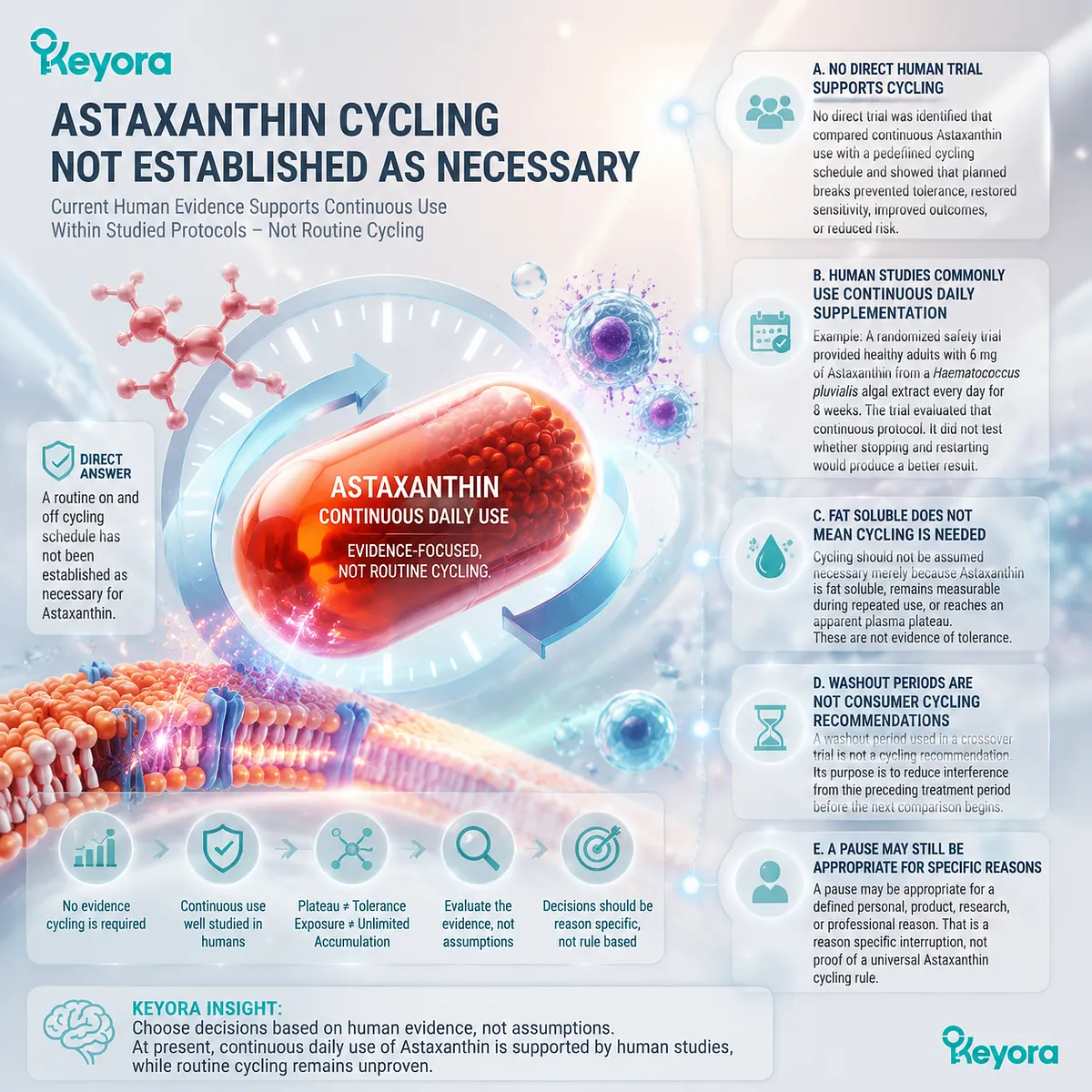
Direct Answer
A routine on and off cycling schedule has not been established as necessary for Astaxanthin.
Among the human sources reviewed for this article, no direct trial was identified that compared continuous Astaxanthin use with a predefined cycling schedule and showed that planned breaks prevented tolerance, restored sensitivity, improved outcomes, or reduced risk.
Human studies more commonly use continuous daily supplementation for a defined period.
For example, a randomized safety trial provided healthy adults with 6 mg of Astaxanthin from a Haematococcus pluvialis algal extract every day for eight weeks. The trial evaluated that continuous protocol. It did not test whether stopping and restarting would produce a better result.
Cycling should not be assumed necessary merely because Astaxanthin is fat soluble, remains measurable during repeated use, or reaches an apparent plasma plateau.
Repeated exposure is not the same as unlimited accumulation, and a plateau is not evidence that the body has become resistant.
A washout period used in a crossover trial is also not a consumer cycling recommendation. Its purpose is to reduce interference from the preceding treatment period before the next comparison begins.
A pause may still be appropriate for a defined personal, product, research, or professional reason. That is a reason specific interruption, not proof of a universal Astaxanthin cycling rule.
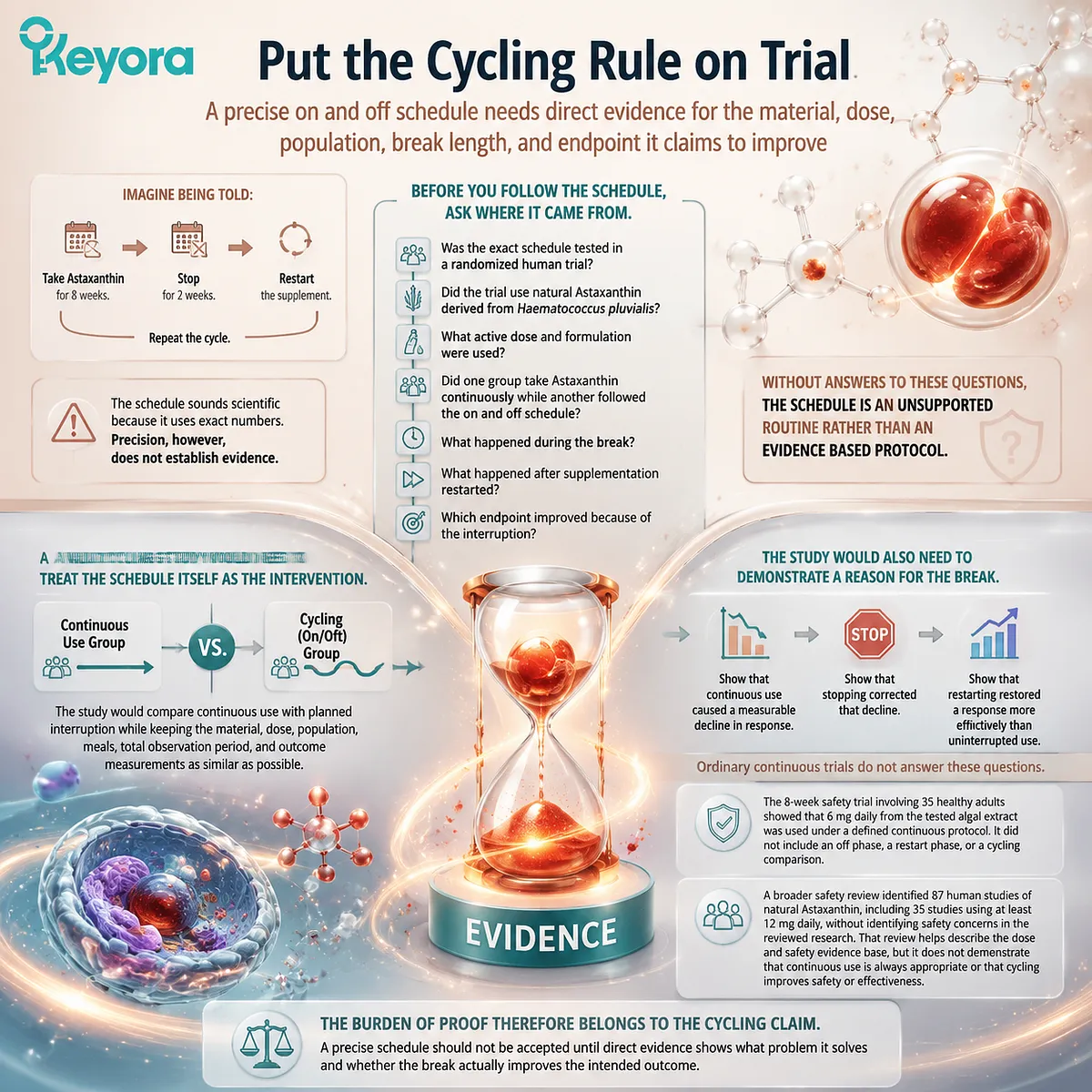
Put the Cycling Rule on Trial
A precise on and off schedule needs direct evidence for the material, dose, population, break length, and endpoint it claims to improve
Imagine being told:
Take Astaxanthin for eight weeks.
-
Stop for two weeks.
-
Restart the supplement.
-
Repeat the cycle.
The schedule sounds scientific because it uses exact numbers. Precision, however, does not establish evidence.
Before following such a schedule, ask where it came from.
Was the exact schedule tested in a randomized human trial?
Did the trial use natural Astaxanthin derived from Haematococcus pluvialis?
What active dose and formulation were used?
Did one group take Astaxanthin continuously while another followed the on and off schedule?
What happened during the break?
What happened after supplementation restarted?
Which endpoint improved because of the interruption?
Without answers to these questions, the schedule is an unsupported routine rather than an evidence based protocol.
A valid cycling study would need to treat the schedule itself as the intervention. It would compare continuous use with planned interruption while keeping the material, dose, population, meals, total observation period, and outcome measurements as similar as possible.
The study would also need to demonstrate a reason for the break.
For example, researchers would first need to show that continuous use caused a measurable decline in response. They would then need to show that stopping corrected that decline and that restarting restored a response more effectively than uninterrupted use.
Ordinary continuous trials do not answer those questions.
The eight week safety trial involving 35 healthy adults showed that 6 mg daily from the tested algal extract was used under a defined continuous protocol. It did not include an off phase, a restart phase, or a cycling comparison.
A broader safety review identified 87 human studies of natural Astaxanthin, including 35 studies using at least 12 mg daily, without identifying safety concerns in the reviewed research. That review helps describe the dose and safety evidence base, but it does not demonstrate that continuous use is always appropriate or that cycling improves safety or effectiveness.
The burden of proof therefore belongs to the cycling claim.
A precise schedule should not be accepted until direct evidence shows what problem it solves and whether the break actually improves the intended outcome.
Cross Examine the Four Reasons People Give
Accumulation, tolerance, safety, and restored effectiveness are separate claims, and each requires a different kind of proof
The Keyora Cycling Burden of Proof Hearing begins by separating four common reasons for cycling.
Claim 1 – Cycling prevents accumulation
This sounds plausible because Astaxanthin is fat soluble and can remain measurable during repeated supplementation.
The missing step is evidence that routine continuous use produces harmful or unlimited accumulation and that planned breaks prevent it.
Repeated use can increase exposure because a new dose may arrive before all earlier exposure has been distributed and removed. That does not mean that every swallowed milligram remains permanently stored.
Human studies have measured Astaxanthin in plasma, serum, erythrocytes, and lipoprotein associated compartments. They have not established that ordinary continuous supplementation fills every tissue until a scheduled break becomes necessary.
Verdict: Fear of accumulation does not establish a cycling requirement.
Claim 2 – Cycling resets tolerance
Tolerance means that a previously effective exposure produces a smaller response after continued use.
To establish Astaxanthin tolerance, a human study would need to document:
-
a clear response during early use
-
a reproducible decline during continuous use
-
evidence that the decline was not normal variation
-
recovery during the break
-
restoration after restarting
-
superiority over uninterrupted use
Among the human sources reviewed, no direct evidence establishing this sequence for Astaxanthin was identified.
Astaxanthin is not a stimulant whose effectiveness should be judged through an immediate energy sensation. It is also not established as a receptor agonist requiring periodic receptor resetting.
A person who no longer notices a subjective change has not demonstrated receptor downregulation. The initial impression may have reflected expectations, ordinary day to day variation, a changing health goal, or an outcome that was never directly measured.
Verdict: Astaxanthin tolerance and receptor resetting remain unestablished cycling explanations.
Claim 3 – Cycling makes continuous use safer
A break may reduce total exposure over a calendar period, but that does not mean an arbitrary cycle has been proven to improve safety.
Safety depends on:
the material
-
the daily dose
-
the complete product
-
duration
-
age
-
health status
-
medications
-
tolerance
-
adverse event monitoring
Cycling cannot convert an unsuitable dose into a suitable one. It cannot eliminate a medication interaction, resolve an adverse reaction, or substitute for review of a changed health context.
The available safety literature supports particular materials, doses, populations, and observation periods. It does not prove that one recurring break schedule prevents every possible risk.
Verdict: Safety review must address the actual risk rather than rely on ritual interruption.
Claim 4 – Cycling makes Astaxanthin work again
A stronger response after restarting would need to be demonstrated against both uninterrupted use and normal variability.
Without that comparison, a person may stop during one set of circumstances and restart during another. Sleep, diet, training, sunlight exposure, symptoms, stress, other supplements, and expectations may all change during the break.
An apparent difference after restarting cannot automatically be assigned to restored Astaxanthin sensitivity.
Verdict: A break has not been shown to renew Astaxanthin effectiveness as a general rule.

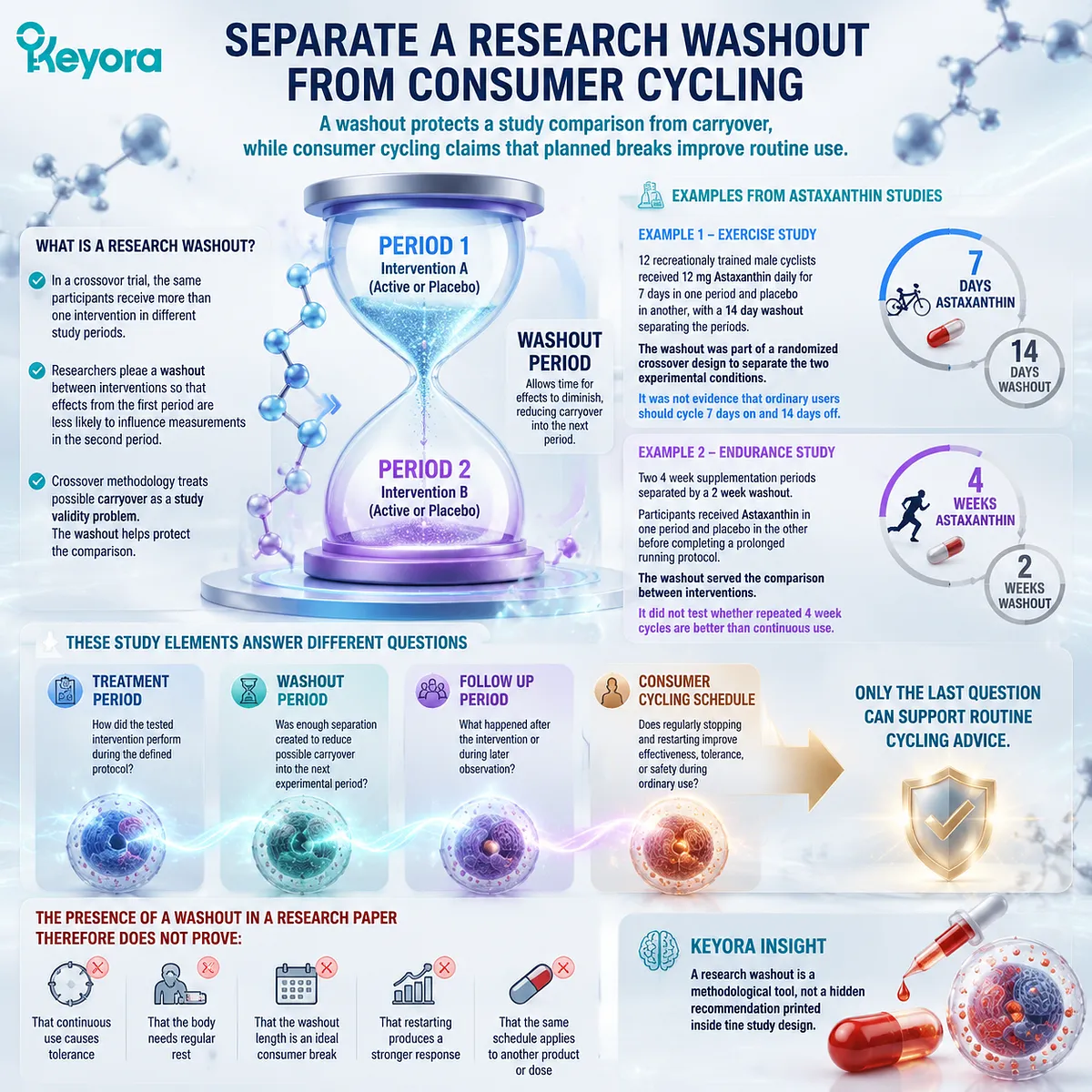
Separate a Research Washout From Consumer Cycling
A washout protects a study comparison from carryover, while consumer cycling claims that planned breaks improve routine use
The word washout appears in several Astaxanthin studies, but its research meaning must be preserved.
In a crossover trial, the same participants receive more than one intervention in different study periods. A participant might receive Astaxanthin first and placebo later, while another participant receives the reverse sequence.
Researchers may place a washout period between the interventions so that effects from the first period are less likely to influence measurements in the second period.
Crossover methodology treats possible carryover as a study validity problem. The washout helps protect the comparison.
An Astaxanthin exercise study illustrates the distinction.
Twelve recreationally trained male cyclists received 12 mg daily for seven days during one treatment period and placebo during another, with a 14 day washout separating the periods. The washout was part of a randomized crossover design intended to separate the two experimental conditions. It was not evidence that ordinary users should cycle Astaxanthin seven days on and fourteen days off.
Another randomized crossover study used two four week supplementation periods separated by a two week washout.
Participants received Astaxanthin in one period and placebo in the other before completing a prolonged running protocol.
Again, the washout served the comparison between interventions. It did not test whether repeated four week cycles provide better long term results than continuous use.
These study elements answer different questions:
Treatment period
How did the tested intervention perform during the defined protocol?
Washout period
Was enough separation created to reduce possible carryover into the next experimental period?
Follow up period
What happened after the intervention or during later observation?
Consumer cycling schedule
Does regularly stopping and restarting improve effectiveness, tolerance, or safety during ordinary use?
Only the last question can support routine cycling advice.
The presence of a washout in a research paper therefore does not prove:
that continuous use causes tolerance
-
that the body needs regular rest
-
that the washout length is an ideal consumer break
-
that restarting produces a stronger response
-
that the same schedule applies to another product or dose
A research washout is a methodological tool, not a hidden recommendation printed inside the study design.
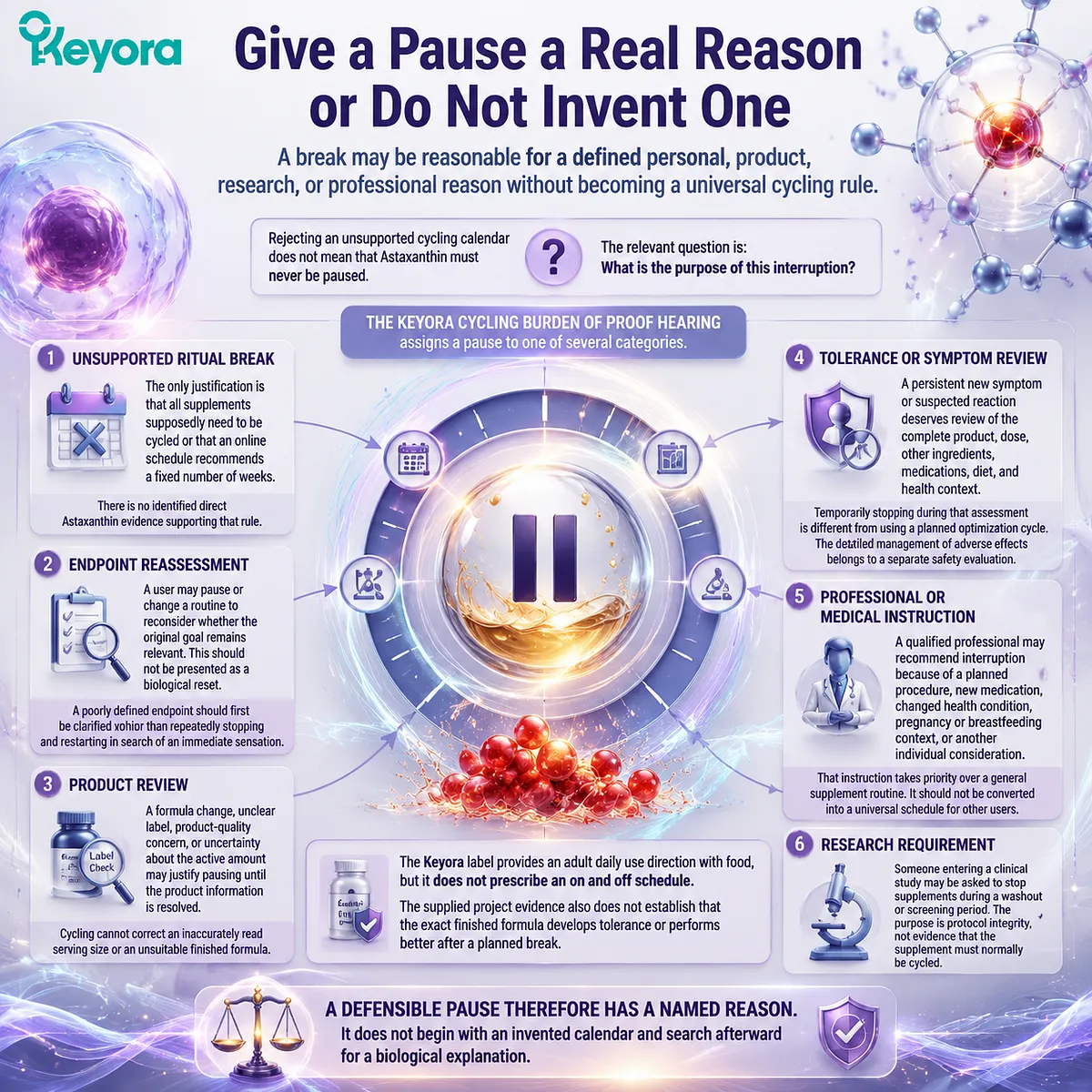
Give a Pause a Real Reason or Do Not Invent One
A break may be reasonable for a defined personal, product, research, or professional reason without becoming a universal cycling rule
Rejecting an unsupported cycling calendar does not mean that Astaxanthin must never be paused.
The relevant question is:
What is the purpose of this interruption?
The Keyora Cycling Burden of Proof Hearing assigns a pause to one of several categories.
Unsupported ritual break
The only justification is that all supplements supposedly need to be cycled or that an online schedule recommends a fixed number of weeks.
There is no identified direct Astaxanthin evidence supporting that rule.
Endpoint reassessment
A user may pause or change a routine to reconsider whether the original goal remains relevant. This should not be presented as a biological reset.
A poorly defined endpoint should first be clarified rather than repeatedly stopping and restarting in search of an immediate sensation.
Product review
A formula change, unclear label, product-quality concern, or uncertainty about the active amount may justify pausing until the product information is resolved.
Cycling cannot correct an inaccurately read serving size or an unsuitable finished formula.
Tolerance or symptom review
A persistent new symptom or suspected reaction deserves review of the complete product, dose, other ingredients, medications, diet, and health context.
Temporarily stopping during that assessment is different from using a planned optimization cycle. The detailed management of adverse effects belongs to a separate safety evaluation.
Professional or medical instruction
A qualified professional may recommend interruption because of a planned procedure, new medication, changed health condition, pregnancy or breastfeeding context, or another individual consideration.
That instruction takes priority over a general supplement routine. It should not be converted into a universal schedule for other users.
Research requirement
Someone entering a clinical study may be asked to stop supplements during a washout or screening period. The purpose is protocol integrity, not evidence that the supplement must normally be cycled.
The Keyora label provides an adult daily use direction with food, but it does not prescribe an on and off schedule. The supplied project evidence also does not establish that the exact finished formula develops tolerance or performs better after a planned break.
A defensible pause therefore has a named reason.
It does not begin with an invented calendar and search afterward for a biological explanation.
Closing Summary
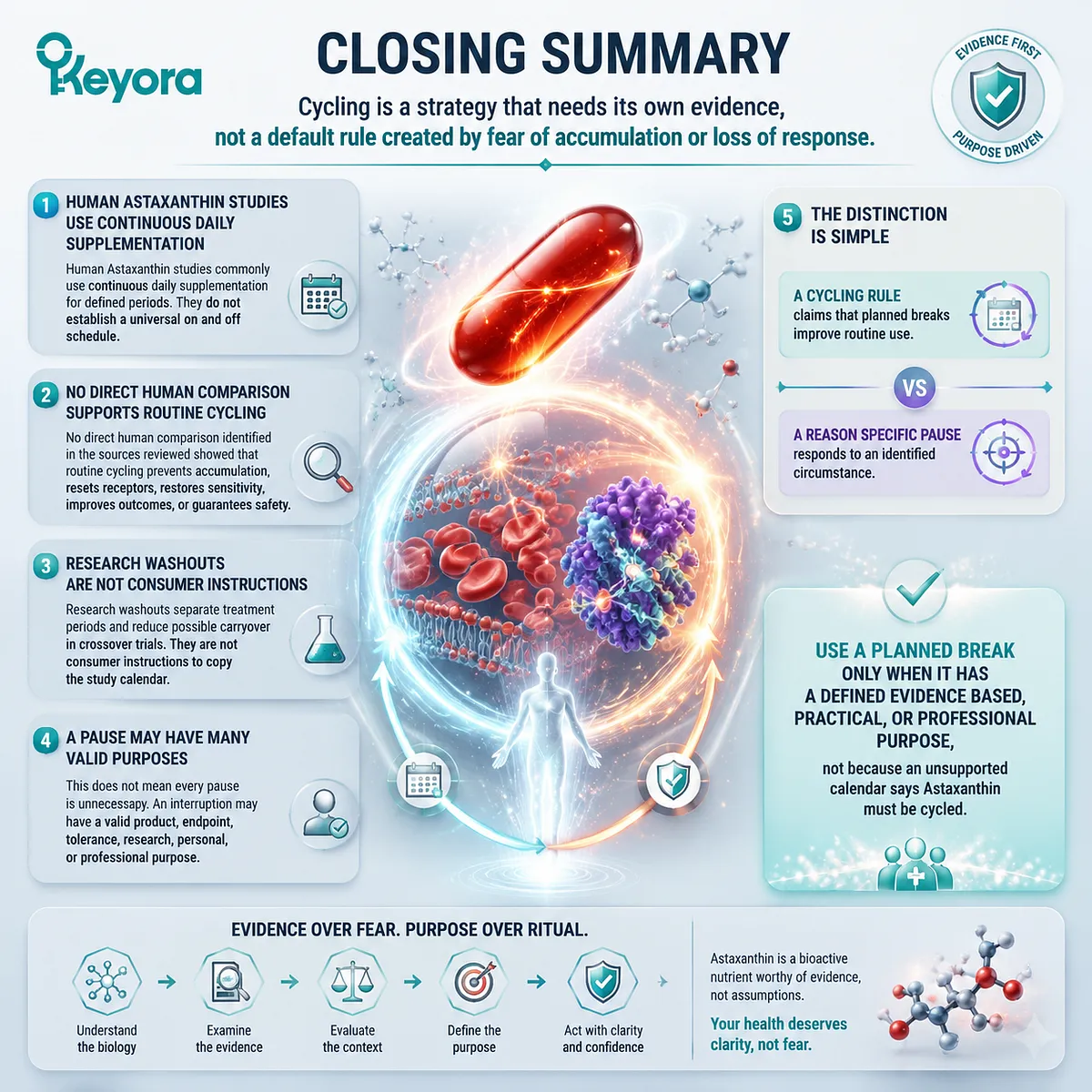
Cycling is a strategy that needs its own evidence, not a default rule created by fear of accumulation or loss of response
Human Astaxanthin studies commonly use continuous daily supplementation for defined periods. They do not establish a universal on and off schedule.
No direct human comparison identified in the sources reviewed showed that routine cycling prevents accumulation, resets receptors, restores sensitivity, improves outcomes, or guarantees safety.
Research washouts should also be interpreted correctly. They separate treatment periods and reduce possible carryover in crossover trials. They are not consumer instructions to copy the study calendar.
This does not mean every pause is unnecessary. An interruption may have a valid product, endpoint, tolerance, research, personal, or professional purpose.
The distinction is simple:
A cycling rule claims that planned breaks improve routine use.
A reason specific pause responds to an identified circumstance.
Use a planned break only when it has a defined evidence based, practical, or professional purpose, not because an unsupported calendar says Astaxanthin must be cycled.
This article is for educational and informational purposes only. It does not provide medical advice, diagnosis, treatment, cure, prevention, disease outcome claims, hormone restoration claims, fertility outcome claims, or formula-specific clinical efficacy claims.