
Can Astaxanthin Be Taken Every Day?
Keyora Research Q&A Library
This is part of the Keyora Research Q&A Series, derived from Keyora Astaxanthin Research Journal Series.
Within the Keyora Astaxanthin Researcn framework, this Q&A translates complex astaxanthin biology into reader-friendly, evidence-bound answers, focusing on natural astaxanthin identity, molecular structure, antioxidant and redox mechanisms, membrane lipid interaction, mitochondrial resilience, inflammatory signaling pathways, human evidence interpretation, and the scientific principles behind responsible supplementation.
First published by Keyora Research Journal: www.keyorahealth.com
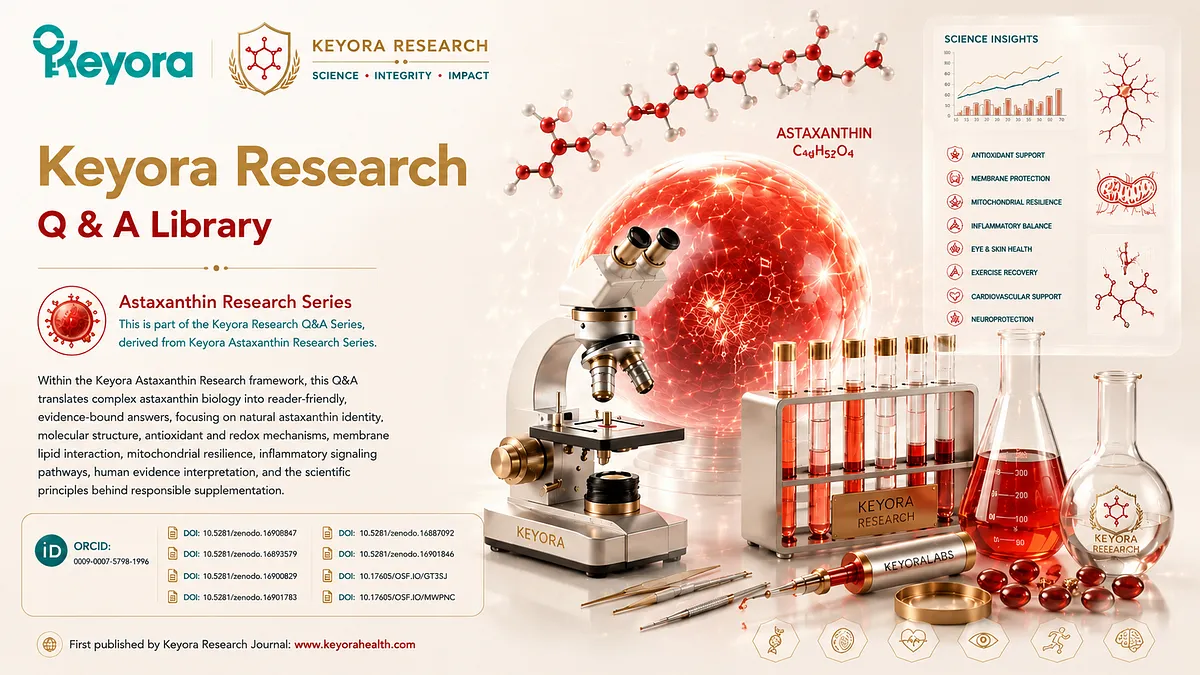
Direct Answer
Astaxanthin has been taken every day in many human studies, but that does not establish that every product, dose, person, or duration is suitable for uninterrupted daily use.
Controlled trials have administered natural Astaxanthin daily for defined periods such as 8, 12, and 16 weeks.
One dedicated safety trial studied 6 mg daily for 8 weeks in healthy adults, while other trials used daily protocols to measure plasma exposure, erythrocyte incorporation, oxidative biomarkers, skin outcomes, or other endpoints. These studies support daily use under their tested conditions. They do not provide unlimited duration evidence.
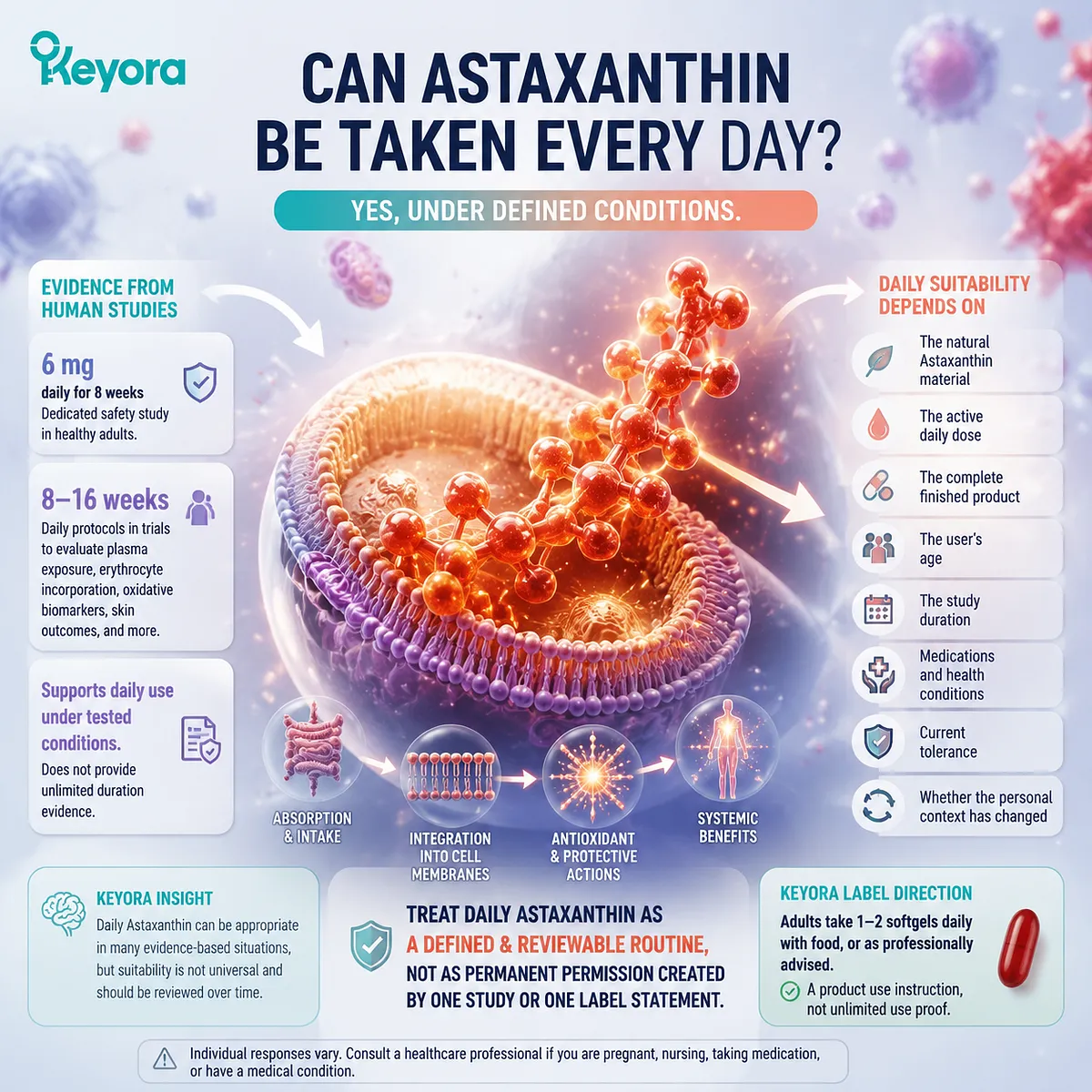
Daily suitability depends on more than frequency. It also depends on:
-
the natural Astaxanthin material
-
the active daily dose
-
the complete finished product
-
the user’s age
-
the study duration
-
medications and health conditions
-
current tolerance
-
whether the personal context has changed
The supplied Keyora label directs adults to take one to two softgels daily with food, or as professionally advised. That is a product use instruction, not proof that the full serving is appropriate for every adult or that the exact formula has been studied for unlimited continuous use.
Treat daily Astaxanthin as a defined and reviewable routine, not as permanent permission created by one study or one label statement.
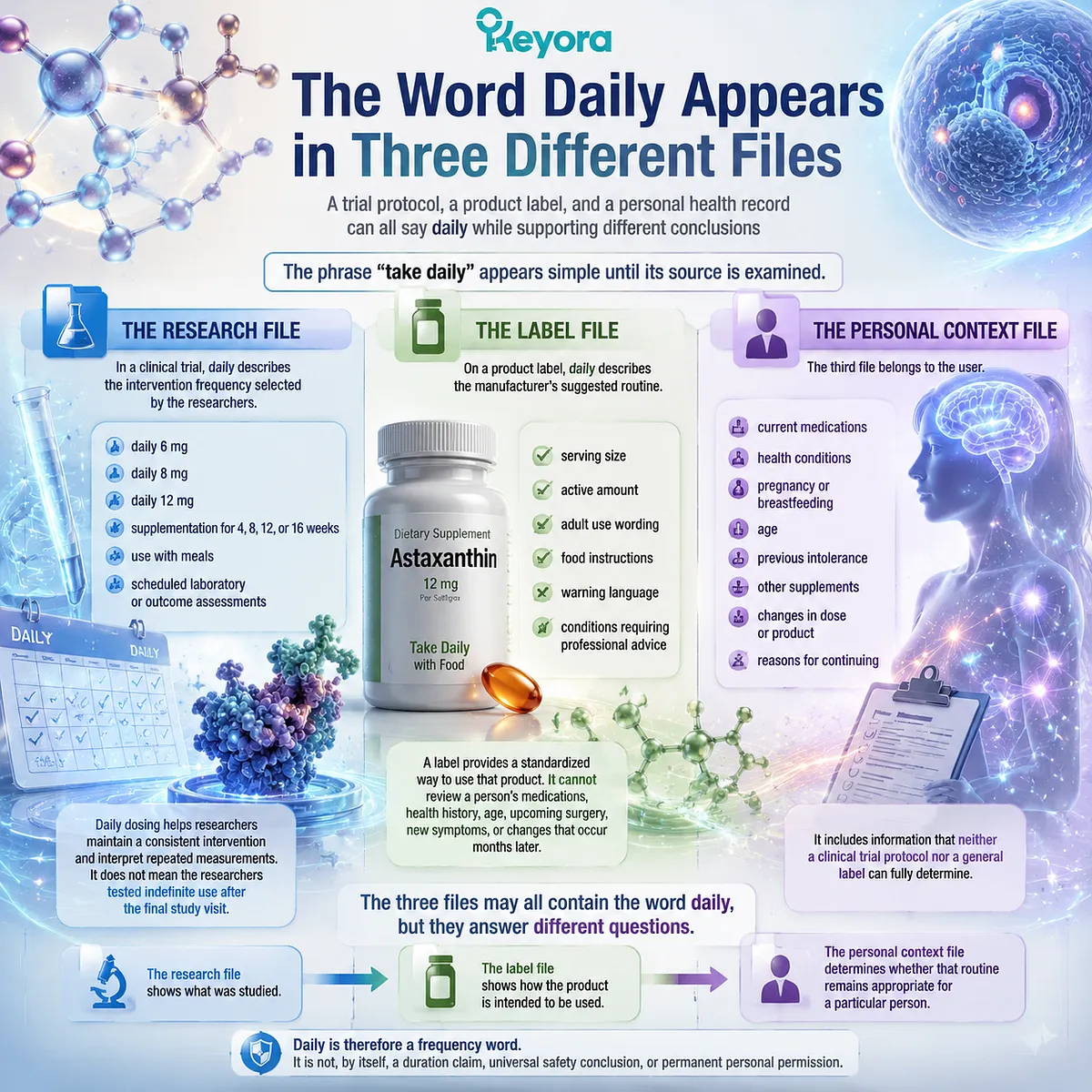
The Word Daily Appears in Three Different Files
A trial protocol, a product label, and a personal health record can all say daily while supporting different conclusions
The phrase “take daily” appears simple until its source is examined.
The Research File
In a clinical trial, daily describes the intervention frequency selected by the researchers.
The protocol may specify:
daily 6 mg
-
daily 8 mg
-
daily 12 mg
-
supplementation for 4, 8, 12, or 16 weeks
-
use with meals
-
scheduled laboratory or outcome assessments
Daily dosing helps researchers maintain a consistent intervention and interpret repeated measurements. It does not mean the researchers tested indefinite use after the final study visit.
The Label File
On a product label, daily describes the manufacturer’s suggested routine.
The label should also be read for:
serving size
-
active amount
-
adult use wording
-
food instructions
-
warning language
-
conditions requiring professional advice
A label provides a standardized way to use that product. It cannot review a person’s medications, health history, age, upcoming surgery, new symptoms, or changes that occur months later.
The Personal Context File
The third file belongs to the user.
It includes information that neither a clinical trial protocol nor a general label can fully determine:
current medications
-
health conditions
-
pregnancy or breastfeeding
-
age
-
previous intolerance
-
other supplements
-
changes in dose or product
-
reasons for continuing
The three files may all contain the word daily, but they answer different questions.
The research file shows what was studied.
The label file shows how the product is intended to be used.
The personal context file determines whether that routine remains appropriate for a particular person.
Daily is therefore a frequency word. It is not, by itself, a duration claim, universal safety conclusion, or permanent personal permission.
Follow the Trial Only as Far as Its Calendar Goes
A daily protocol supports the tested dose and duration, not an unlimited extension beyond the final study visit
Human research provides real support for daily Astaxanthin use, but every trial has a calendar boundary.
An 8 week randomized safety study enrolled 35 healthy adults and evaluated 6 mg daily from a natural Haematococcus pluvialis algal extract. The investigators reported no clinically important treatment related differences in the assessed safety measures. This directly supports that tested material, dose, adult population, monitoring plan, and 8 week duration.
Another 8 week trial gave healthy young women 2 mg or 8 mg daily. The study measured plasma exposure together with oxidative, inflammatory, and immune endpoints. It demonstrates daily repeated administration under that protocol, but its principal purpose was not to establish multi year safety for the general population.
A 12 week randomized trial used 6 mg or 12 mg daily and found higher erythrocyte Astaxanthin concentrations than placebo. This supports repeated exposure in middle aged and older adults during the studied period. It does not establish that all adults should use either dose continuously or that the same results apply to every finished formulation.
A 16 week placebo controlled skin trial assigned 65 healthy women to 6 mg, 12 mg, or placebo. It extends the range of studied daily protocols, but it remains one defined population, formulation, duration, and endpoint set.
A safety review collected 87 human studies and reported no identified safety concerns with natural Astaxanthin supplementation across the reviewed research, including studies using at least 12 mg daily. This broadens the evidence map, but a review of heterogeneous trials does not create an unlimited duration trial or guarantee that rare events, unstudied populations, or every complete product have been fully evaluated.
Study calendars must therefore be interpreted accurately:
An 8 week trial supports conclusions through its 8 week protocol.
A 12 week trial supports conclusions through its 12 week protocol.
A 16 week trial supports conclusions through its 16 week protocol.
Placing these studies next to one another does not produce a controlled multi year study.
The final visit is not a signal that harm begins afterward. It is simply the point beyond which that particular trial no longer provides direct observations.

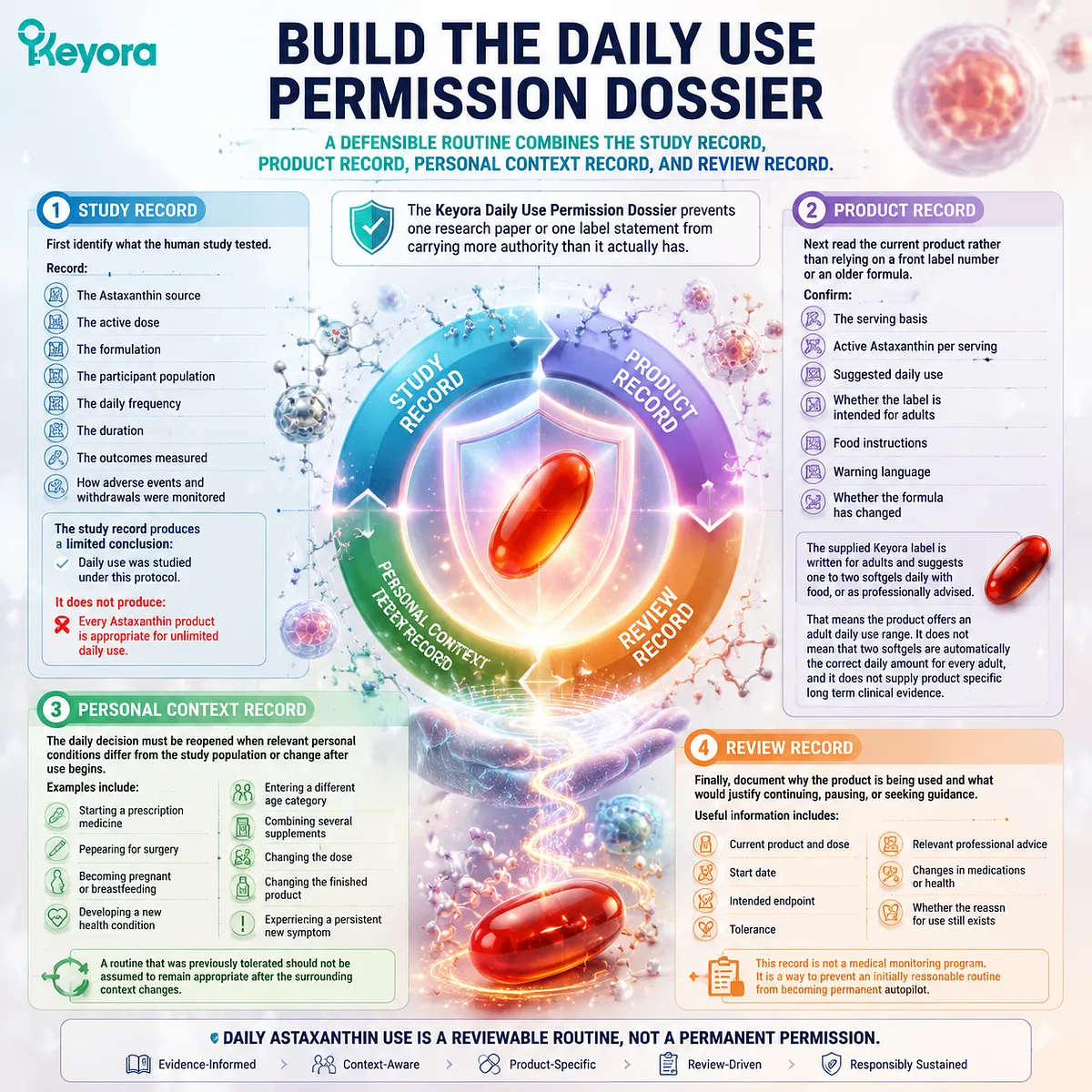
Build the Daily Use Permission Dossier
A defensible routine combines the study record, product record, personal context record, and review record
The Keyora Daily Use Permission Dossier prevents one research paper or one label statement from carrying more authority than it actually has.
Study Record
First identify what the human study tested.
Record:
the Astaxanthin source
-
the active dose
-
the formulation
-
the participant population
-
the daily frequency
-
the duration
-
the outcomes measured
-
how adverse events and withdrawals were monitored
The study record produces a limited conclusion:
Daily use was studied under this protocol.
It does not produce:
Every Astaxanthin product is appropriate for unlimited daily use.
Product Record
Next read the current product rather than relying on a front label number or an older formula.
Confirm:
the serving basis
-
active Astaxanthin per serving
-
suggested daily use
-
whether the label is intended for adults
-
food instructions
-
warning language
-
whether the formula has changed
The supplied Keyora label is written for adults and suggests one to two softgels daily with food, or as professionally advised.
That means the product offers an adult daily use range. It does not mean that two softgels are automatically the correct daily amount for every adult, and it does not supply product specific long term clinical evidence.
Personal Context Record
The daily decision must be reopened when relevant personal conditions differ from the study population or change after use begins.
Examples include:
starting a prescription medicine
-
preparing for surgery
-
becoming pregnant or breastfeeding
-
developing a new health condition
-
entering a different age category
-
combining several supplements
-
changing the dose
-
changing the finished product
-
experiencing a persistent new symptom
A routine that was previously tolerated should not be assumed to remain appropriate after the surrounding context changes.
Review Record
Finally, document why the product is being used and what would justify continuing, pausing, or seeking guidance.
Useful information includes:
current product and dose
-
start date
-
intended endpoint
-
tolerance
-
relevant professional advice
-
changes in medications or health
-
whether the reason for use still exists
This record is not a medical monitoring program. It is a way to prevent an initially reasonable routine from becoming permanent autopilot.
Keep Daily Use Open to Review
A routine can remain reasonable while the evidence and personal context still require an exit, pause, or reassessment point
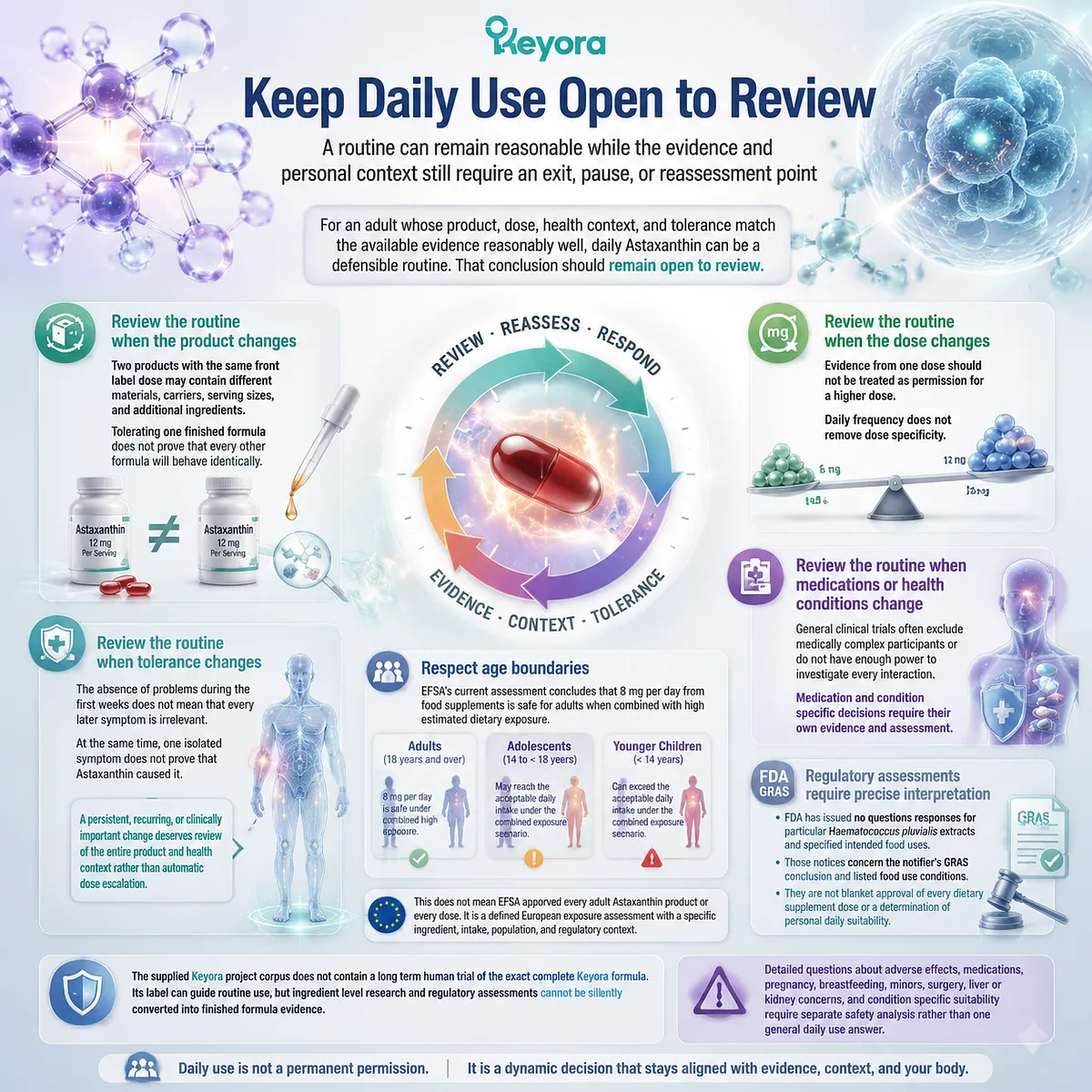
For an adult whose product, dose, health context, and tolerance match the available evidence reasonably well, daily Astaxanthin can be a defensible routine.
That conclusion should remain open to review.
Review the routine when the product changes
Two products with the same front label dose may contain different materials, carriers, serving sizes, and additional ingredients. Tolerating one finished formula does not prove that every other formula will behave identically.
Review the routine when the dose changes
Evidence from one dose should not be treated as permission for a higher dose. Daily frequency does not remove dose specificity.
Review the routine when medications or health conditions change
General clinical trials often exclude medically complex participants or do not have enough power to investigate every interaction. Medication and condition specific decisions require their own evidence and assessment.
Review the routine when tolerance changes
The absence of problems during the first weeks does not mean that every later symptom is irrelevant. At the same time, one isolated symptom does not prove that Astaxanthin caused it.
A persistent, recurring, or clinically important change deserves review of the entire product and health context rather than automatic dose escalation.
Respect age boundaries
EFSA’s current assessment concludes that 8 mg per day from food supplements is safe for adults when combined with high estimated dietary exposure. The same assessment does not transfer that adult conclusion unchanged to younger groups. It notes that adolescents aged 14 to under 18 may reach the acceptable daily intake under the combined exposure scenario, while younger children can exceed it.
This does not mean that EFSA approved every adult Astaxanthin product or every dose. It is a defined European exposure assessment with a specific ingredient, intake, population, and regulatory context.
FDA GRAS notices also require precise interpretation. FDA has issued no questions responses for particular Haematococcus pluvialis extracts and specified intended food uses. Those notices concern the notifier’s GRAS conclusion and listed food use conditions. They are not blanket approval of every dietary supplement dose or a determination of personal daily suitability.
The supplied Keyora project corpus does not contain a long term human trial of the exact complete Keyora formula. Its label can guide routine use, but ingredient level research and regulatory assessments cannot be silently converted into finished formula evidence.
Detailed questions about adverse effects, medications, pregnancy, breastfeeding, minors, surgery, liver or kidney concerns, and condition specific suitability require separate safety analysis rather than one general daily use answer.
Closing Summary
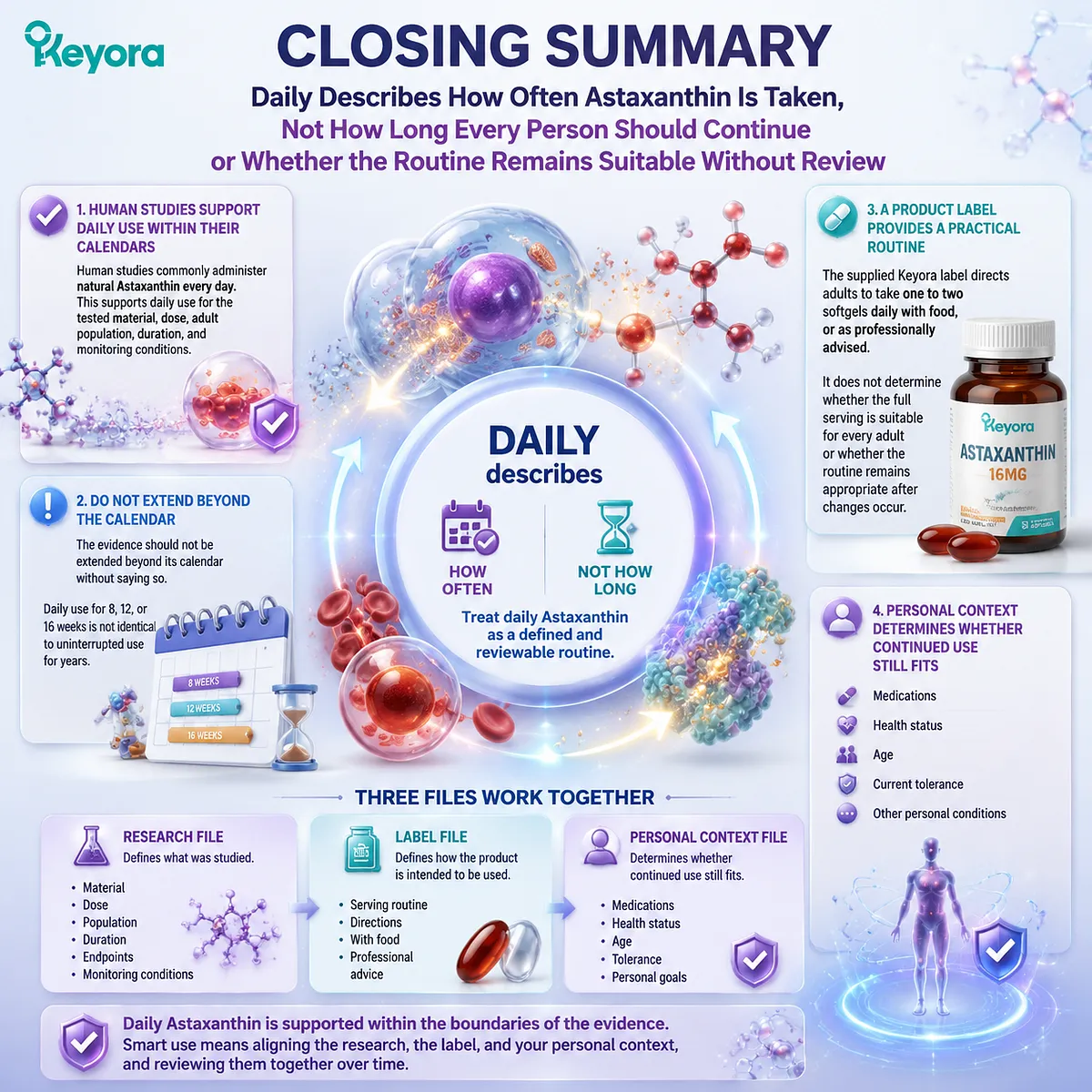
Daily describes how often Astaxanthin is taken, not how long every person should continue or whether the routine remains suitable without review
Human studies commonly administer natural Astaxanthin every day. This supports daily use for the tested material, dose, adult population, duration, and monitoring conditions.
The evidence should not be extended beyond its calendar without saying so. Daily use for 8, 12, or 16 weeks is not identical to uninterrupted use for years.
A product label provides a practical routine. The supplied Keyora label directs adults to take one to two softgels daily with food, or as professionally advised. It does not determine whether the full serving is suitable for every adult or whether the routine remains appropriate after medications, health status, age, tolerance, or other personal conditions change.
The research file defines what was studied.
The label file defines how the product is intended to be used.
The personal context file determines whether continued use still fits.
Treat daily Astaxanthin as a defined and reviewable routine, not as permanent permission created by one study or one label instruction.
This article is for educational and informational purposes only. It does not provide medical advice, diagnosis, treatment, cure, prevention, disease outcome claims, hormone restoration claims, fertility outcome claims, or formula-specific clinical efficacy claims.