
Does Astaxanthin Build Up in the Body With Continued Use?
Keyora Research Q&A Library
This is part of the Keyora Research Q&A Series, derived from Keyora Astaxanthin Research Journal Series.
Within the Keyora Astaxanthin Researcn framework, this Q&A translates complex astaxanthin biology into reader-friendly, evidence-bound answers, focusing on natural astaxanthin identity, molecular structure, antioxidant and redox mechanisms, membrane lipid interaction, mitochondrial resilience, inflammatory signaling pathways, human evidence interpretation, and the scientific principles behind responsible supplementation.
First published by Keyora Research Journal: www.keyorahealth.com
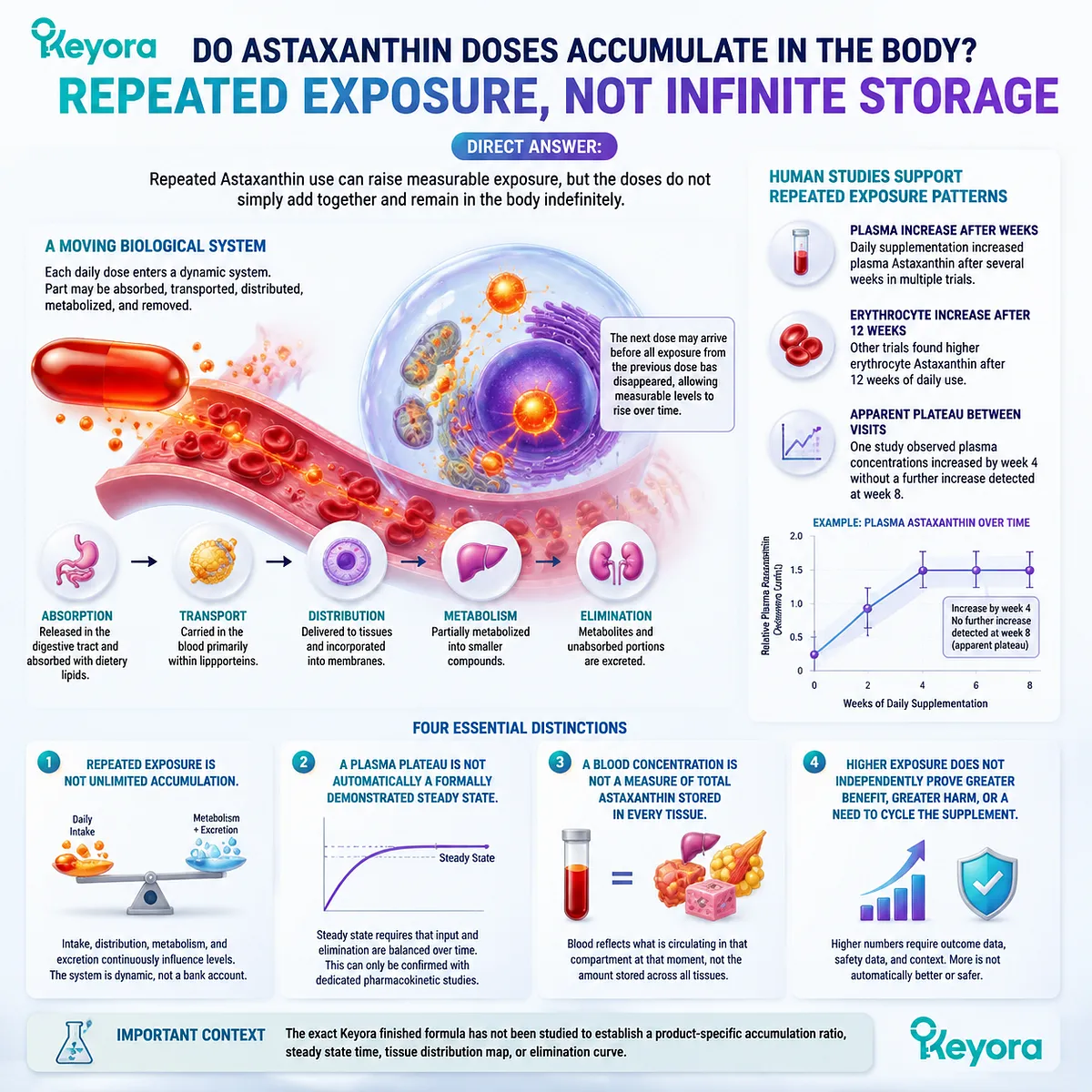
Direct Answer
Repeated Astaxanthin use can raise measurable exposure, but the doses do not simply add together and remain in the body indefinitely.
Each daily dose enters a moving biological system.
Part of the swallowed amount may be absorbed, transported in the blood, distributed between compartments, metabolized, and removed. The next dose may arrive before all exposure from the previous dose has disappeared, allowing plasma, serum, or erythrocyte measurements to rise during continued supplementation.
Human studies support this repeated exposure pattern.
Daily supplementation has increased plasma Astaxanthin after several weeks, while other trials have found higher erythrocyte Astaxanthin after 12 weeks.
One study observed that plasma concentrations increased by week 4 without a further increase detected at week 8. This is evidence of an apparent plateau between scheduled visits, not proof that the entire body became saturated at week 4.
Four distinctions are essential:
Repeated exposure is not unlimited accumulation.
A plasma plateau is not automatically a formally demonstrated steady state.
A blood concentration is not a measure of total Astaxanthin stored in every tissue.
Higher exposure does not independently prove greater benefit, greater harm, or a need to cycle the supplement.
The exact Keyora finished formula has not been studied to establish a product specific accumulation ratio, steady state time, tissue distribution map, or elimination curve.
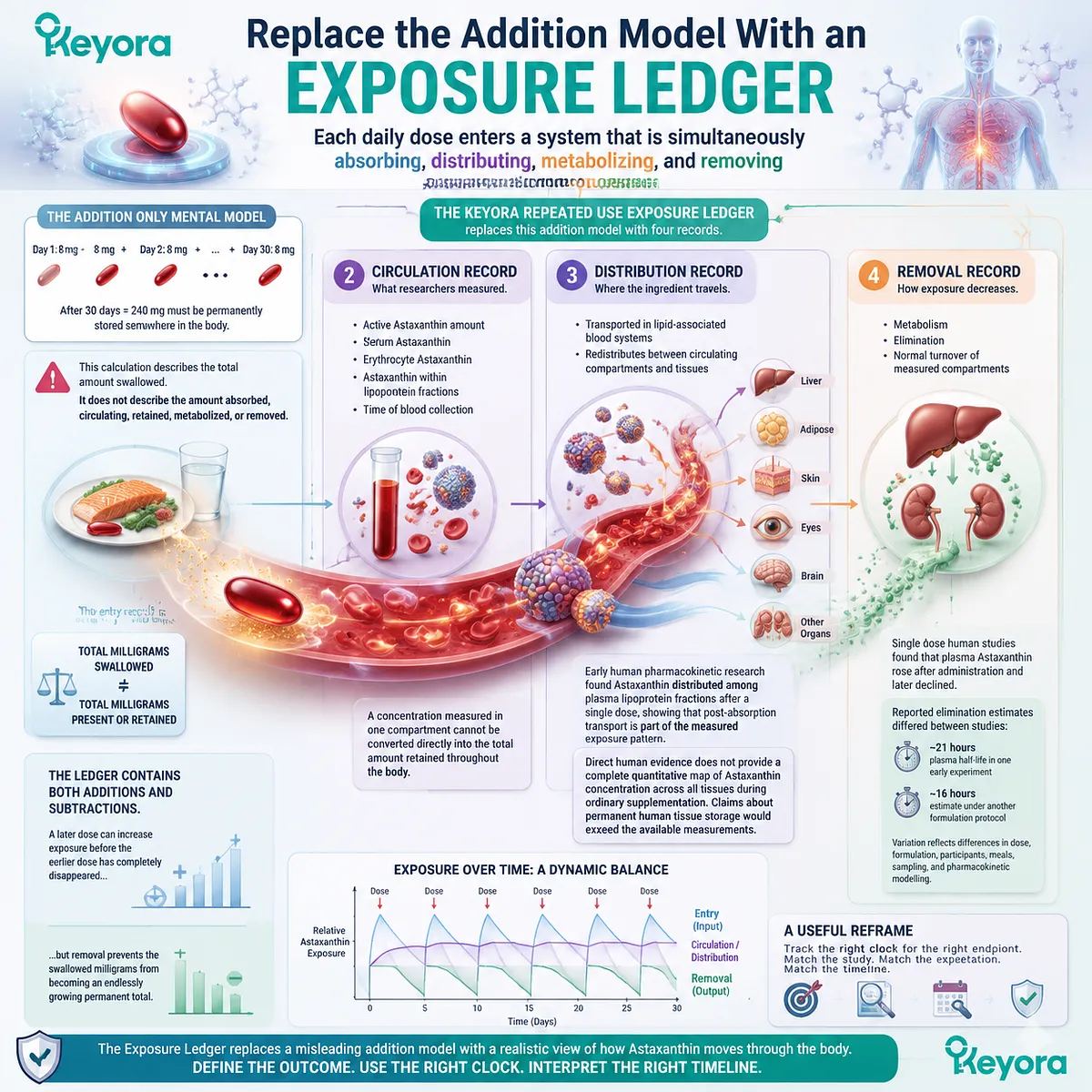
Replace the Addition Model With an Exposure Ledger
Each daily dose enters a system that is simultaneously absorbing, distributing, metabolizing, and removing Astaxanthin
A common mental model treats daily supplementation like an addition only calculation.
A person takes 8 mg on day 1.
Another 8 mg is taken on day 2.
After 30 days, the person imagines that 240 mg must be permanently stored somewhere in the body.
That calculation describes the total amount swallowed. It does not describe the amount absorbed, circulating, retained, metabolized, or removed.
The Keyora Repeated Use Exposure Ledger replaces this addition model with four records.
Entry Record
This records what was actually taken:
the active Astaxanthin amount
-
the material and formulation
-
the meal context
-
whether the dose was taken consistently
The entry record is not the body burden. It is only the starting input.
Circulation Record
This records what researchers measured:
plasma Astaxanthin
-
serum Astaxanthin
-
erythrocyte Astaxanthin
-
Astaxanthin within lipoprotein fractions
-
the time of blood collection
A concentration measured in one compartment cannot be converted directly into the total amount retained throughout the body.
Distribution Record
After absorption, Astaxanthin is transported through lipid associated blood systems and may redistribute between circulating compartments and tissues.
Early human pharmacokinetic research found Astaxanthin distributed among plasma lipoprotein fractions after a single dose, showing that post absorption transport is part of the measured exposure pattern.
Direct human evidence does not provide a complete quantitative map of Astaxanthin concentration across the liver, adipose tissue, skin, eyes, brain, and other organs during ordinary supplementation.
Claims about permanent human tissue storage would therefore exceed the available measurements.
Removal Record
Exposure also decreases through metabolism, elimination, and normal turnover of the measured compartments.
Single dose human studies found that plasma Astaxanthin rose after administration and later declined. Reported elimination estimates differed between studies, including an approximately 21 hour plasma half life in one early experiment and an approximately 16 hour estimate under another formulation protocol. The variation reflects differences in dose, formulation, participants, meals, sampling, and pharmacokinetic modelling.
The ledger therefore contains both additions and subtractions.
A later dose can increase exposure before the earlier dose has completely disappeared, but removal prevents the swallowed milligrams from becoming an endlessly growing permanent total.
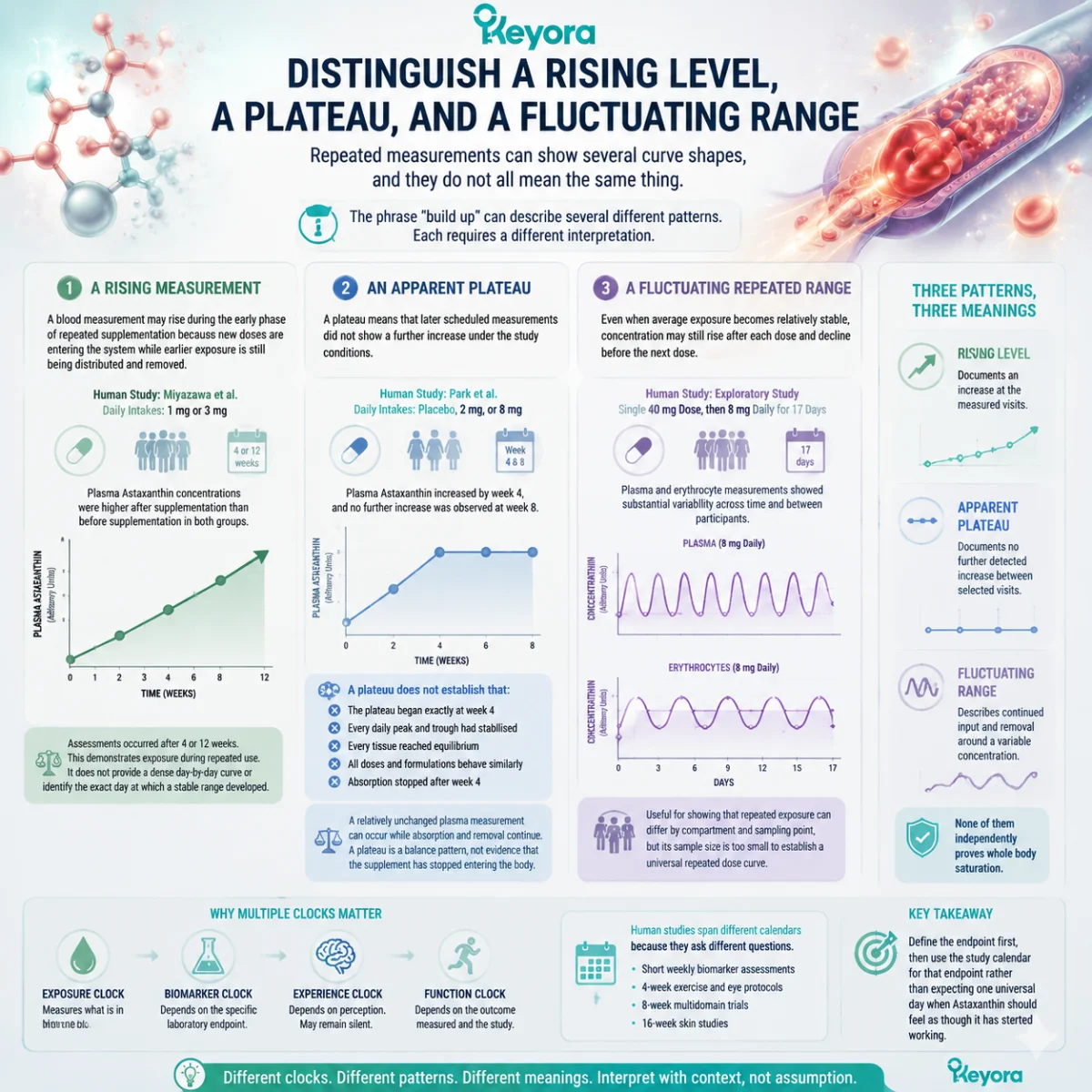
Distinguish a Rising Level, a Plateau, and a Fluctuating Range
Repeated measurements can show several curve shapes, and they do not all mean the same thing
The phrase “build up” can describe several different patterns. Each requires a different interpretation.
A Rising Measurement
A blood measurement may rise during the early phase of repeated supplementation because new doses are entering the system while earlier exposure is still being distributed and removed.
Miyazawa and colleagues studied daily intakes of 1 mg or 3 mg and found that plasma Astaxanthin concentrations were higher after supplementation than before supplementation in both groups.
The assessments occurred after 4 or 12 weeks, so the study demonstrates exposure during repeated use. It does not provide a dense day by day curve or identify the exact day at which a stable range developed.
An Apparent Plateau
A plateau means that later scheduled measurements did not show a further increase under the study conditions.
In the Park trial, healthy young women received placebo, 2 mg, or 8 mg daily. Plasma Astaxanthin increased by week 4, and no further increase was observed at week 8. This supports an apparent plateau between those two study visits.
It does not establish that:
the plateau began exactly at week 4
-
every daily peak and trough had stabilized
-
every tissue reached equilibrium
-
all doses and formulations behave similarly
-
absorption stopped after week 4
A relatively unchanged plasma measurement can occur while absorption and removal continue. A plateau is a balance pattern, not evidence that the supplement has stopped entering the body.
A Fluctuating Repeated Range
Even when average exposure becomes relatively stable, concentration may still rise after each dose and decline before the next dose.
The result can be a repeating range rather than one perfectly flat number.
A small exploratory study followed four healthy adults after a single 40 mg dose and then during 17 days of 8 mg daily supplementation.
Plasma and erythrocyte measurements showed substantial variability across time and between participants. The study is useful for showing that repeated exposure can differ by compartment and sampling point, but its sample size is too small to establish a universal repeated dose curve.
These three patterns should not be merged.
A rising level documents an increase at the measured visits.
An apparent plateau documents no further detected increase between selected visits.
A fluctuating range describes continued input and removal around a variable concentration.
None of them independently proves whole body saturation.
Audit What Human Repeated Dose Studies Actually Measured
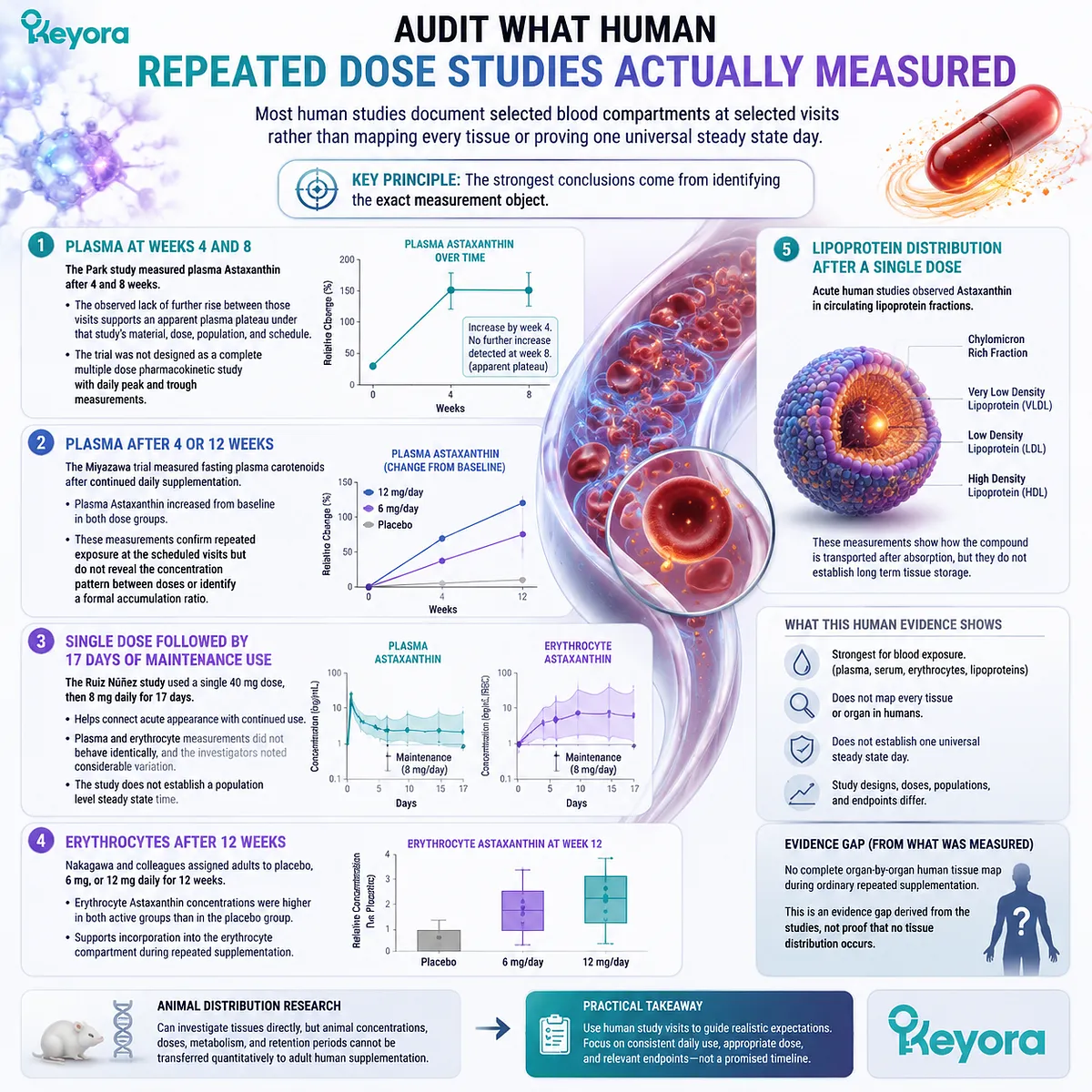
Most human studies document selected blood compartments at selected visits rather than mapping every tissue or proving one universal steady state day
The strongest conclusions come from identifying the exact measurement object.
Plasma at Weeks 4 and 8
The Park study measured plasma Astaxanthin after 4 and 8 weeks. The observed lack of further rise between those visits supports an apparent plasma plateau under that study’s material, dose, population, and schedule. The trial was not designed as a complete multiple dose pharmacokinetic study with daily peak and trough measurements.
Plasma After 4 or 12 Weeks
The Miyazawa trial measured fasting plasma carotenoids after continued daily supplementation.
Plasma Astaxanthin increased from baseline in both dose groups. These measurements confirm repeated exposure at the scheduled visits but do not reveal the concentration pattern between doses or identify a formal accumulation ratio.
Single Dose Followed by 17 Days of Maintenance Use
The Ruiz Núñez study is unusual because it examined plasma and erythrocyte kinetics after a single 40 mg dose and then followed a daily 8 mg maintenance phase.
This design helps connect acute appearance with continued use. It also demonstrates how unstable interpretation can become in a very small sample. Plasma and erythrocyte measurements did not behave identically, and the investigators noted considerable variation.
The study does not establish a population level steady state time.
Erythrocytes After 12 Weeks
Nakagawa and colleagues assigned adults to placebo, 6 mg, or 12 mg daily for 12 weeks. Erythrocyte Astaxanthin concentrations were higher in both active groups than in the placebo group.
This supports incorporation into the erythrocyte compartment during repeated supplementation.
It does not show:
the total amount stored throughout the body
-
permanent retention in red blood cells
-
identical concentration in organs
-
a universal relationship between erythrocyte exposure and clinical benefit
Lipoprotein Distribution After a Single Dose
Acute human studies observed Astaxanthin in circulating lipoprotein fractions. These measurements show how the compound is transported after absorption, but they do not establish long term tissue storage.
Taken together, the human evidence is strongest for blood exposure.
The research has measured plasma, serum, erythrocytes, and lipoprotein related distribution. It has not produced a complete organ by organ human tissue map during ordinary repeated supplementation. This is an evidence gap derived from what the human studies measured, not proof that no tissue distribution occurs.
Animal distribution research can investigate tissues directly, but animal concentrations, doses, metabolism, and retention periods cannot be transferred quantitatively to adult human supplementation.
Interpret Continued Exposure Without Calling It Unlimited Storage
A stable blood range can document continued exposure without proving whole body saturation, permanent tissue retention, greater benefit, or greater harm
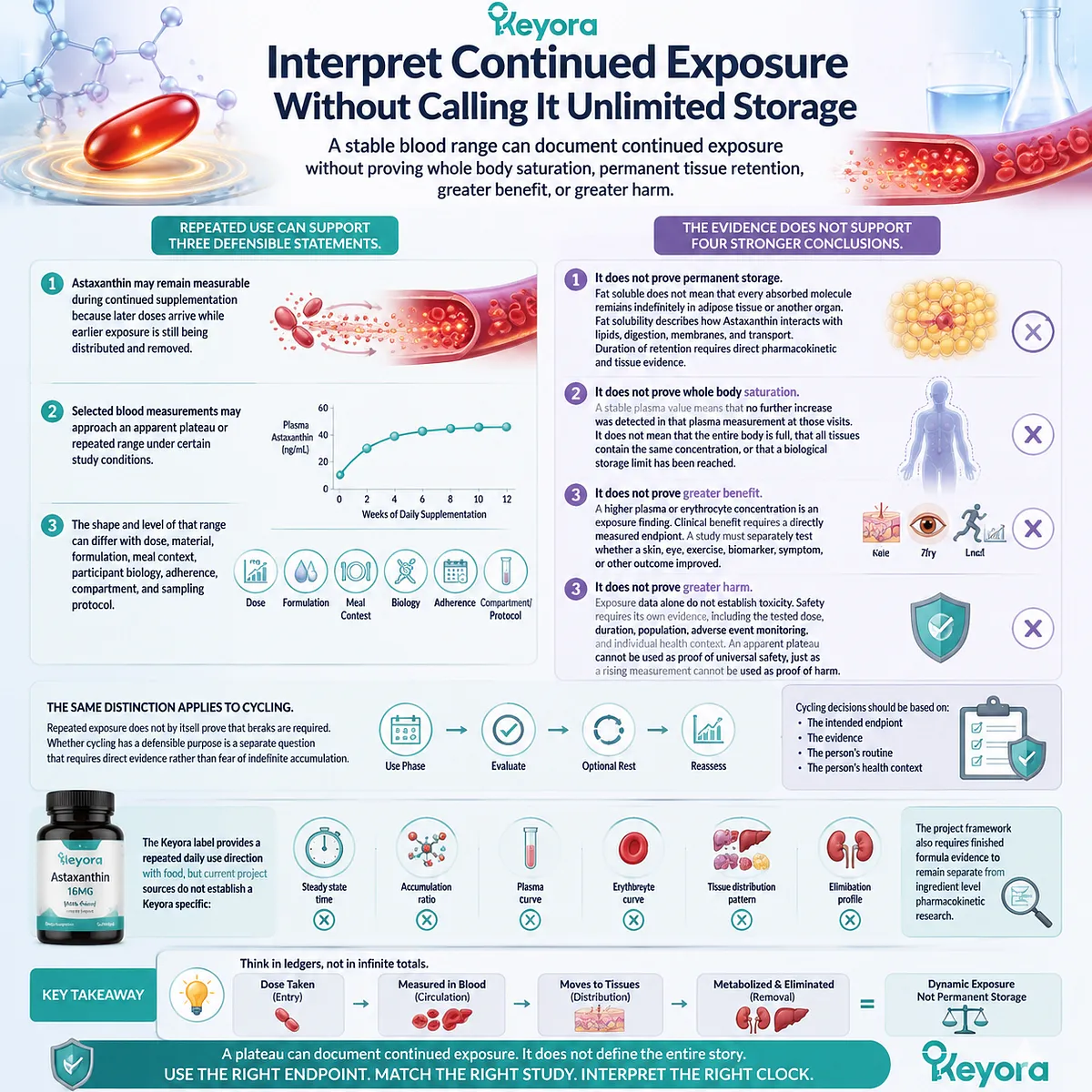
Repeated use can support three defensible statements.
First, Astaxanthin may remain measurable during continued supplementation because later doses arrive while earlier exposure is still being distributed and removed.
Second, selected blood measurements may approach an apparent plateau or repeated range under certain study conditions.
Third, the shape and level of that range can differ with dose, material, formulation, meal context, participant biology, adherence, compartment, and sampling protocol.
The evidence does not support four stronger conclusions.
It does not prove permanent storage
Fat soluble does not mean that every absorbed molecule remains indefinitely in adipose tissue or another organ.
Fat solubility describes how Astaxanthin interacts with lipids, digestion, membranes, and transport. Duration of retention requires direct pharmacokinetic and tissue evidence.
It does not prove whole body saturation
A stable plasma value means that no further increase was detected in that plasma measurement at those visits.
It does not mean that the entire body is full, that all tissues contain the same concentration, or that a biological storage limit has been reached.
It does not prove greater benefit
A higher plasma or erythrocyte concentration is an exposure finding. Clinical benefit requires a directly measured endpoint.
A study must separately test whether a skin, eye, exercise, biomarker, symptom, or other outcome improved.
It does not prove greater harm
The word accumulation can sound dangerous, but exposure data alone do not establish toxicity.
Safety requires its own evidence, including the tested dose, duration, population, adverse event monitoring, and individual health context.
An apparent plateau cannot be used as proof of universal safety, just as a rising measurement cannot be used as proof of harm.
The same distinction applies to cycling.
Repeated exposure does not by itself prove that breaks are required. Whether cycling has a defensible purpose is a separate question that requires direct evidence rather than fear of indefinite accumulation.
The Keyora label provides a repeated daily use direction with food, but current project sources do not establish a Keyora specific steady state time, accumulation ratio, plasma curve, erythrocyte curve, tissue distribution pattern, or elimination profile.
The project framework also requires finished formula evidence to remain separate from ingredient level pharmacokinetic research.
Closing Summary
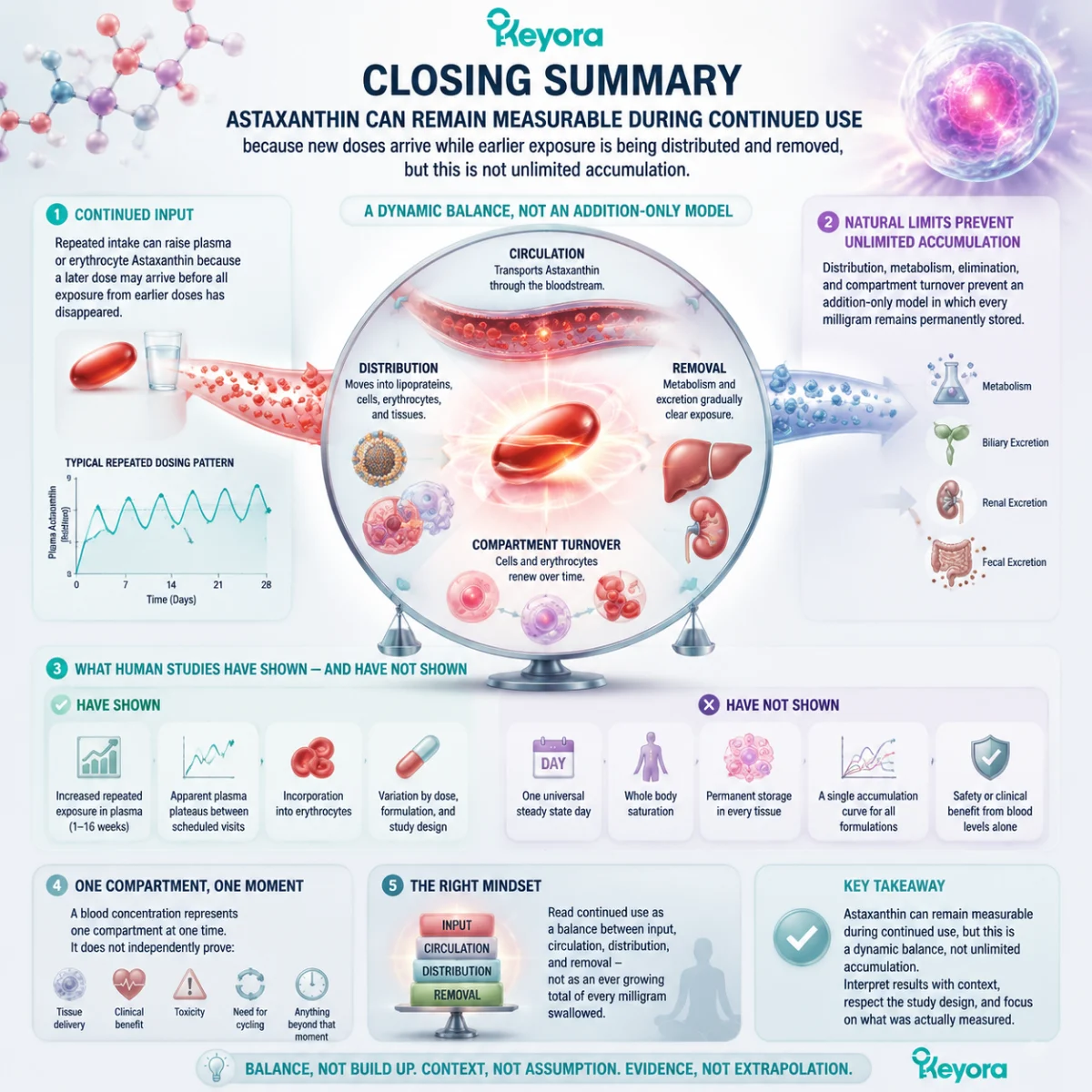
Astaxanthin can remain measurable during continued use because new doses arrive while earlier exposure is being distributed and removed, but this is not unlimited accumulation
Repeated intake can raise plasma or erythrocyte Astaxanthin because a later dose may arrive before all exposure from earlier doses has disappeared.
At the same time, distribution, metabolism, elimination, and compartment turnover prevent an addition only model in which every swallowed milligram remains permanently stored.
Human studies have documented increased repeated exposure, apparent plasma plateaus between scheduled visits, and incorporation into erythrocytes. They have not established one universal steady state day, whole body saturation, permanent storage in every tissue, or a single accumulation curve for all formulations.
A blood concentration represents one compartment at one time. It does not independently prove tissue delivery, clinical benefit, toxicity, or the need for cycling.
Read continued use as a balance between input, circulation, distribution, and removal – not as an ever growing total of every milligram swallowed.
This article is for educational and informational purposes only. It does not provide medical advice, diagnosis, treatment, cure, prevention, disease outcome claims, hormone restoration claims, fertility outcome claims, or formula-specific clinical efficacy claims.