
Why Can the Same Astaxanthin Dose Produce Different Blood Levels?
Keyora Research Q&A Library
This is part of the Keyora Research Q&A Series, derived from Keyora Astaxanthin Research Journal Series.
Within the Keyora Astaxanthin Researcn framework, this Q&A translates complex astaxanthin biology into reader-friendly, evidence-bound answers, focusing on natural astaxanthin identity, molecular structure, antioxidant and redox mechanisms, membrane lipid interaction, mitochondrial resilience, inflammatory signaling pathways, human evidence interpretation, and the scientific principles behind responsible supplementation.
First published by Keyora Research Journal: www.keyorahealth.com
Direct Answer
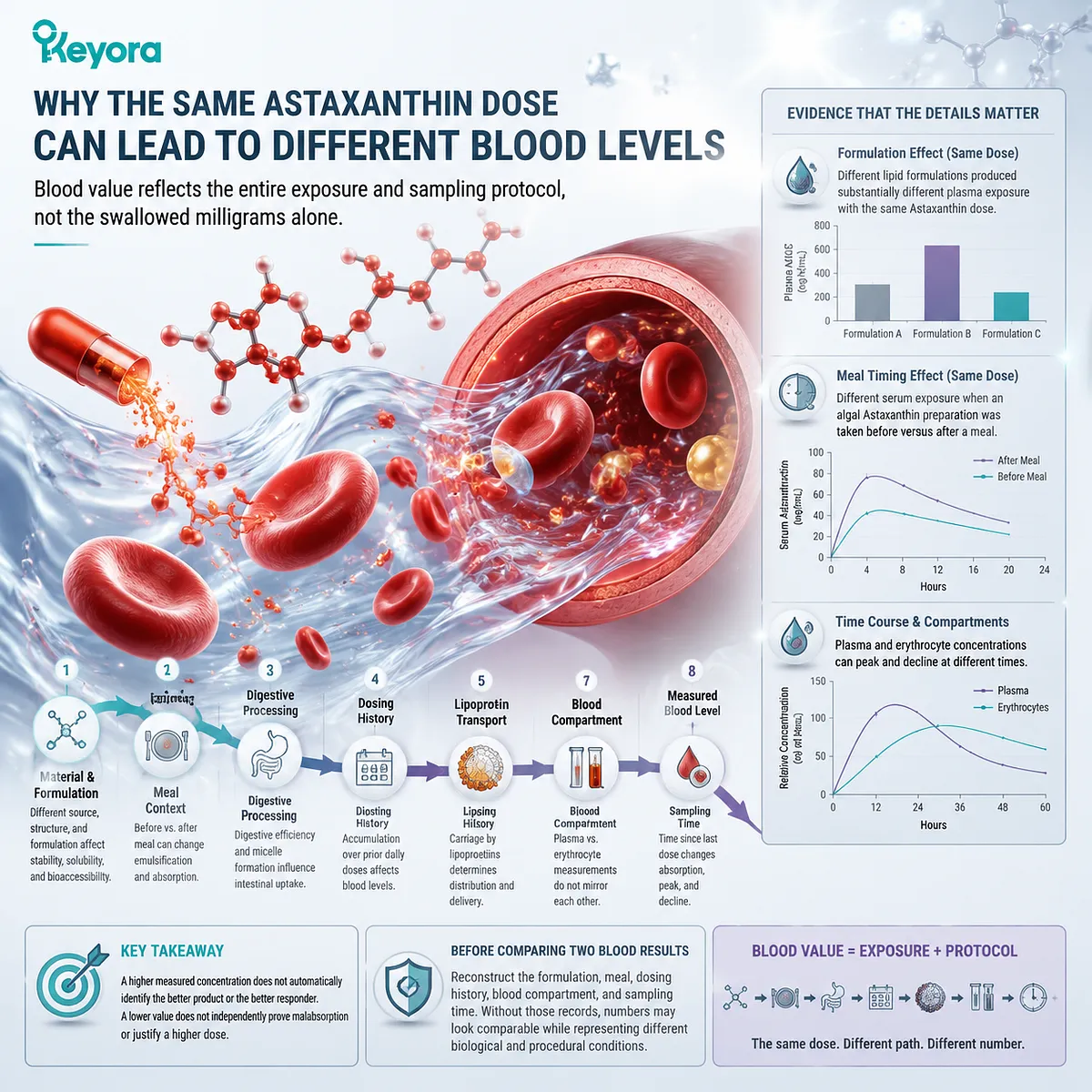
The same labeled Astaxanthin dose can produce different blood levels because a blood value reflects the entire exposure and sampling protocol, not the swallowed milligrams alone.
Two people may each take 8 mg, yet differ in:
-
the Astaxanthin material and formulation
-
whether the dose was taken before or after a meal
-
digestive processing and intestinal uptake
-
the number of previous daily doses
-
transport through circulating lipoproteins
-
the blood compartment being measured
-
the time between supplementation and blood collection
Human studies demonstrate why these details matter.
A single dose study found that different lipid formulations produced substantially different plasma exposure despite providing the same Astaxanthin dose.
Another study found different serum exposure when an algal Astaxanthin preparation was taken before versus after a meal.
Small time course studies also show that plasma and erythrocyte concentrations can peak and decline at different times.
A higher measured concentration does not automatically identify the better product or the better responder.
A lower value does not independently prove malabsorption or justify a higher dose.
Before comparing two Astaxanthin blood results, reconstruct the formulation, meal, dosing history, blood compartment, and sampling time.
Without those records, the numbers may look comparable while representing different biological and procedural conditions.
Start With the Blood Draw, Not the Capsule
A blood value is a timestamped measurement from one compartment, not a permanent score of absorption
When two Astaxanthin results differ, the first question should not be:
How many milligrams did each person take?
The first question should be:
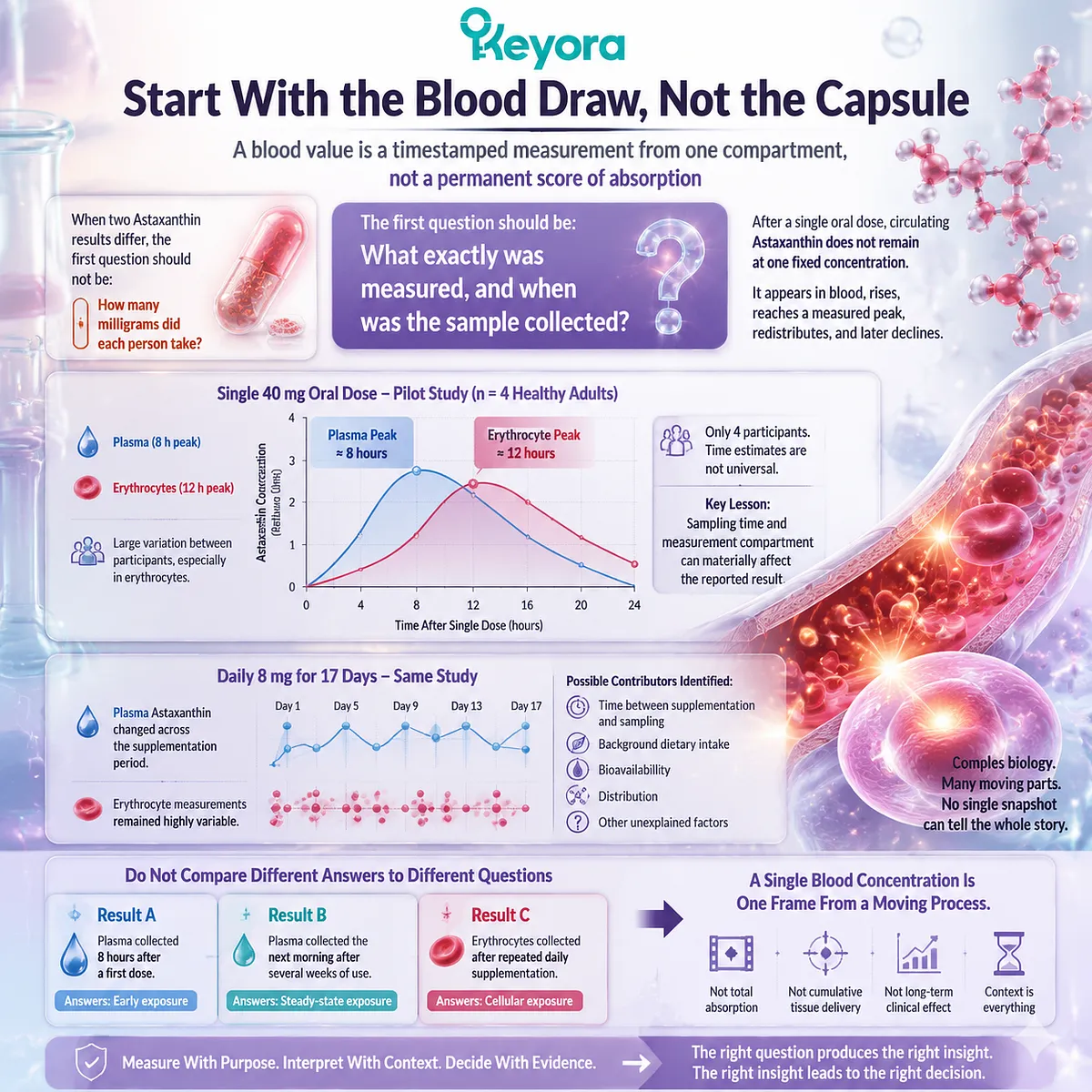
What exactly was measured, and when was the sample collected?
After a single oral dose, circulating Astaxanthin does not remain at one fixed concentration. It appears in blood, rises, reaches a measured peak, redistributes, and later declines. A blood sample collected near the rising or peak phase may therefore show a different concentration from a sample collected much later.
A pilot study followed plasma and erythrocyte Astaxanthin in four healthy adults after a single 40 mg oral dose. Median plasma Astaxanthin peaked at approximately 8 hours, while the erythrocyte measurement peaked later at approximately 12 hours. The investigators reported large variation between participants, particularly in erythrocytes. Because the study contained only four people, its precise time estimates should not be treated as universal values. Its more defensible lesson is that sampling time and measurement compartment can materially affect the reported result.
The same study then provided 8 mg daily for 17 days. Plasma Astaxanthin changed across the supplementation period, while erythrocyte measurements remained highly variable. The authors identified several possible contributors, including differences between the time of supplementation and sampling, background dietary intake, bioavailability, distribution, and other unexplained factors.
This means that the following results should not be compared as though they were identical:
Result A
Plasma collected 8 hours after a first dose.
Result B
Plasma collected the next morning after several weeks of use.
Result C
Erythrocytes collected after repeated daily supplementation.
Each result answers a different exposure question.
A single blood concentration is therefore one frame from a moving process. It does not independently reveal total absorption, cumulative tissue delivery, or long term clinical effect.
Reconstruct Two Exposure Histories
The same labeled milligrams can diverge through formulation, meal context, digestive handling, previous doses, and sampling conditions
Consider two hypothetical people. These are illustrative cases, not participants from one clinical trial.
Person A
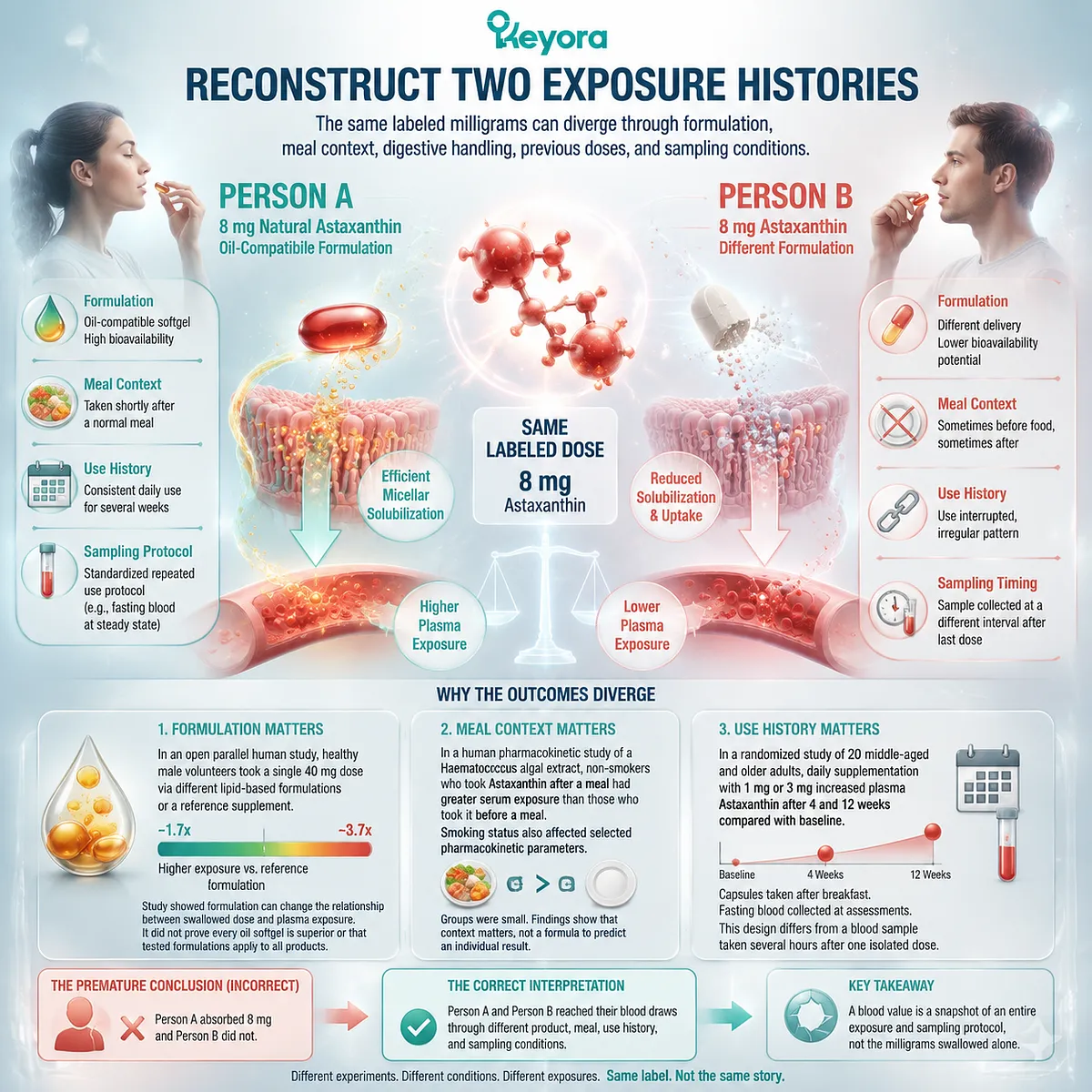
Person A takes 8 mg of natural Astaxanthin in an oil compatible formulation. The dose is taken shortly after a normal meal. Person A has used the product consistently for several weeks, and the blood sample is collected using a standardized repeated use protocol.
Person B
Person B also takes a label stating 8 mg. However, the Astaxanthin is delivered through a different formulation. The dose is sometimes taken before food and sometimes after food. Use has been interrupted, and the sample is collected at a different interval after the most recent dose.
If Person A has the higher plasma measurement, it may be tempting to conclude that Person A naturally absorbs Astaxanthin better.
That conclusion is premature.
The two people swallowed the same declared amount, but they did not complete the same exposure experiment.
First, the formulations may not deliver Astaxanthin in the same way. In an open parallel human study, healthy male volunteers received a single 40 mg dose through one of several lipid based formulations or a reference supplement. The lipid formulations produced exposure estimates approximately 1.7 to 3.7 times those of the reference formulation. The study therefore showed that formulation can change the relationship between swallowed dose and plasma exposure. It did not establish that every oil based softgel is superior or that its tested formulations apply to an untested finished product.
Second, the meal conditions may differ. In a human pharmacokinetic study of a Haematococcus algal extract, nonsmokers who received Astaxanthin after a meal had greater serum exposure than nonsmokers who received it before a meal. Smoking status also affected selected pharmacokinetic parameters. The groups were small, so these findings should be interpreted as evidence that context matters rather than as a formula for predicting an individual result.
Third, the recent dosing histories may differ. A first dose, several interrupted doses, and twelve weeks of consistent use are not equivalent exposure states. In a randomized study of 20 middle aged and older adults, daily supplementation with 1 mg or 3 mg increased plasma Astaxanthin after 4 and 12 weeks compared with each group’s baseline. The participants took their capsules after breakfast, and fasting blood was collected at the scheduled assessments. This design differs fundamentally from a blood sample collected several hours after one isolated dose.
The correct interpretation is therefore not:
Person A absorbed 8 mg and Person B did not.
It is:
Person A and Person B reached their blood draws through different product, meal, use history, and sampling conditions.
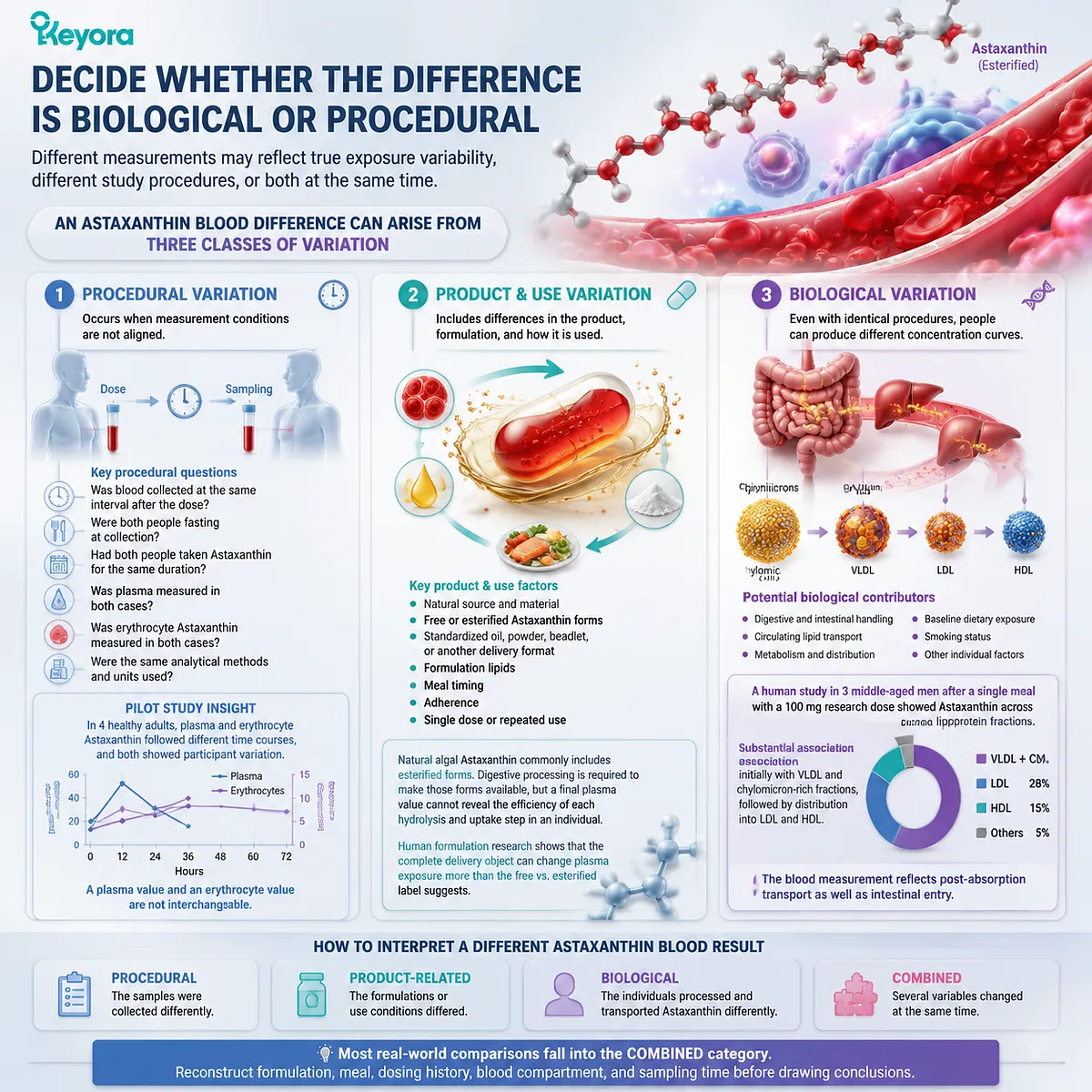
Decide Whether the Difference Is Biological or Procedural
Different measurements may reflect true exposure variability, different study procedures, or both at the same time
An Astaxanthin blood difference can be investigated through three classes of variation.
Procedural variation
This occurs when the measurement conditions are not aligned.
Relevant questions include:
-
Was blood collected at the same interval after the dose?
-
Were both people fasting at collection?
-
Had both people taken Astaxanthin for the same duration?
-
Was plasma measured in both cases?
-
Was erythrocyte Astaxanthin measured in both cases?
-
Were the same analytical methods and units used?
The pilot study involving four healthy adults illustrates why these details matter. Plasma and erythrocyte Astaxanthin followed different time courses, and both showed participant variation. A difference between one plasma result and one erythrocyte result should therefore not be interpreted as a simple difference in total absorption.
Product and use variation
This includes:
-
natural source and material
-
free or esterified Astaxanthin forms
-
standardized oil, powder, beadlet, or another delivery format
-
formulation lipids
-
meal timing
-
adherence
-
single dose or repeated use
Natural algal Astaxanthin commonly includes esterified forms. Digestive processing is relevant to making those forms available, but a final plasma value cannot reveal how efficiently each individual hydrolysis and uptake step occurred. Formulation can also influence exposure more strongly than a simplified free versus esterified label suggests. The direct human formulation study demonstrates that the complete delivery object matters, not only the active milligrams.
Biological variation
Even when procedures are standardized, people may still produce different concentration curves.
Potential contributors include:
-
digestive and intestinal handling
-
circulating lipid transport
-
metabolism and distribution
-
baseline dietary exposure
-
smoking status
-
other individual factors not captured by the study
Astaxanthin does not circulate as though it were freely dissolved in the watery portion of blood. A human study involving three middle aged men examined Astaxanthin after a single meal containing a 100 mg research dose. Astaxanthin appeared across lipoprotein fractions, with a substantial proportion initially associated with very low density lipoprotein and chylomicron rich fractions, followed by distribution involving LDL and HDL. This small study shows that the blood measurement reflects post absorption transport as well as intestinal entry.
The high research doses and small samples used in several early pharmacokinetic studies limit their transfer to ordinary daily supplementation. They remain useful for identifying sources of variation, but not for creating a universal expected blood concentration.
A different result can therefore be:
procedural
The samples were collected differently.
product related
The formulations or use conditions differed.
biological
The individuals processed and transported Astaxanthin differently.
combined
Several variables changed at the same time.
Most real world comparisons fall into the combined category.
Read the Number Without Turning It Into a Verdict
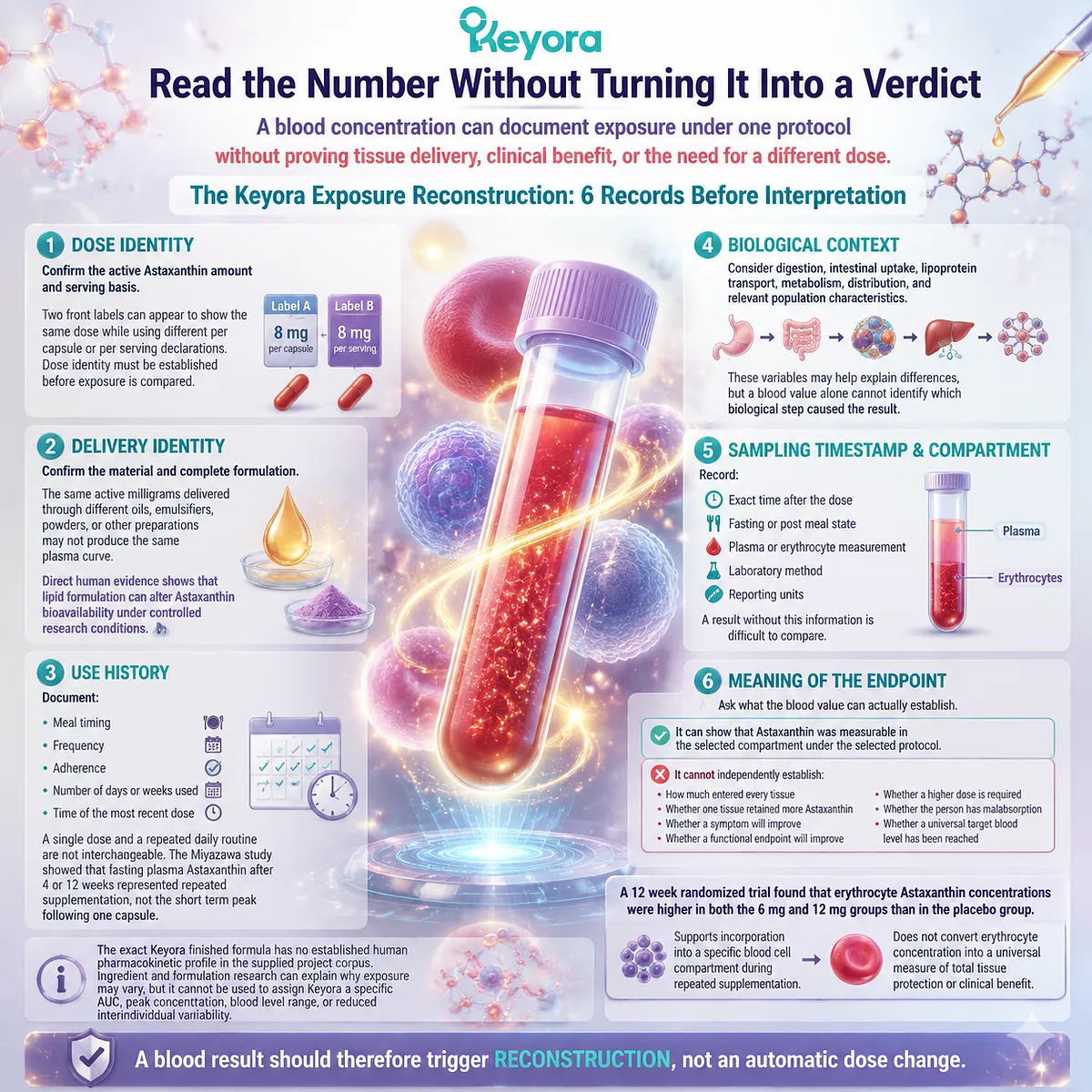
A blood concentration can document exposure under one protocol without proving tissue delivery, clinical benefit, or the need for a different dose
The Keyora Exposure Reconstruction organizes six records before any interpretation is attempted.
Record 1 – Dose identity
Confirm the active Astaxanthin amount and serving basis.
Two front labels can appear to show the same dose while using different per capsule or per serving declarations. Dose identity must be established before exposure is compared.
Record 2 – Delivery identity
Confirm the material and complete formulation.
The same active milligrams delivered through different oils, emulsifiers, powders, or other preparations may not produce the same plasma curve. Direct human evidence shows that lipid formulation can alter Astaxanthin bioavailability under controlled research conditions.
Record 3 – Use history
Document:
-
meal timing
-
frequency
-
adherence
-
number of days or weeks used
-
time of the most recent dose
A single dose and a repeated daily routine are not interchangeable. The Miyazawa study showed that fasting plasma Astaxanthin after 4 or 12 weeks represented repeated supplementation, not the short term peak following one capsule.
Record 4 – Biological context
Consider digestion, intestinal uptake, lipoprotein transport, metabolism, distribution, and relevant population characteristics.
These variables may help explain differences, but a blood value alone cannot identify which biological step caused the result.
Record 5 – Sampling timestamp and compartment
Record:
-
exact time after the dose
-
fasting or post meal state
-
plasma or erythrocyte measurement
-
laboratory method
-
reporting units
A result without this information is difficult to compare.
Record 6 – Meaning of the endpoint
Ask what the blood value can actually establish.
It can show that Astaxanthin was measurable in the selected compartment under the selected protocol.
It cannot independently establish:
-
how much entered every tissue
-
whether one tissue retained more Astaxanthin
-
whether a symptom will improve
-
whether a functional endpoint will improve
-
whether a higher dose is required
-
whether the person has malabsorption
-
whether a universal target blood level has been reached
A 12 week randomized trial found that erythrocyte Astaxanthin concentrations were higher in both the 6 mg and 12 mg groups than in the placebo group. That supports incorporation into a specific blood cell compartment during repeated supplementation. It does not convert erythrocyte concentration into a universal measure of total tissue protection or clinical benefit.
The exact Keyora finished formula has no established human pharmacokinetic profile in the supplied project corpus. Ingredient and formulation research can explain why exposure may vary, but it cannot be used to assign Keyora a specific AUC, peak concentration, blood level range, or reduced interindividual variability.
A blood result should therefore trigger reconstruction, not an automatic dose change.
Closing Summary
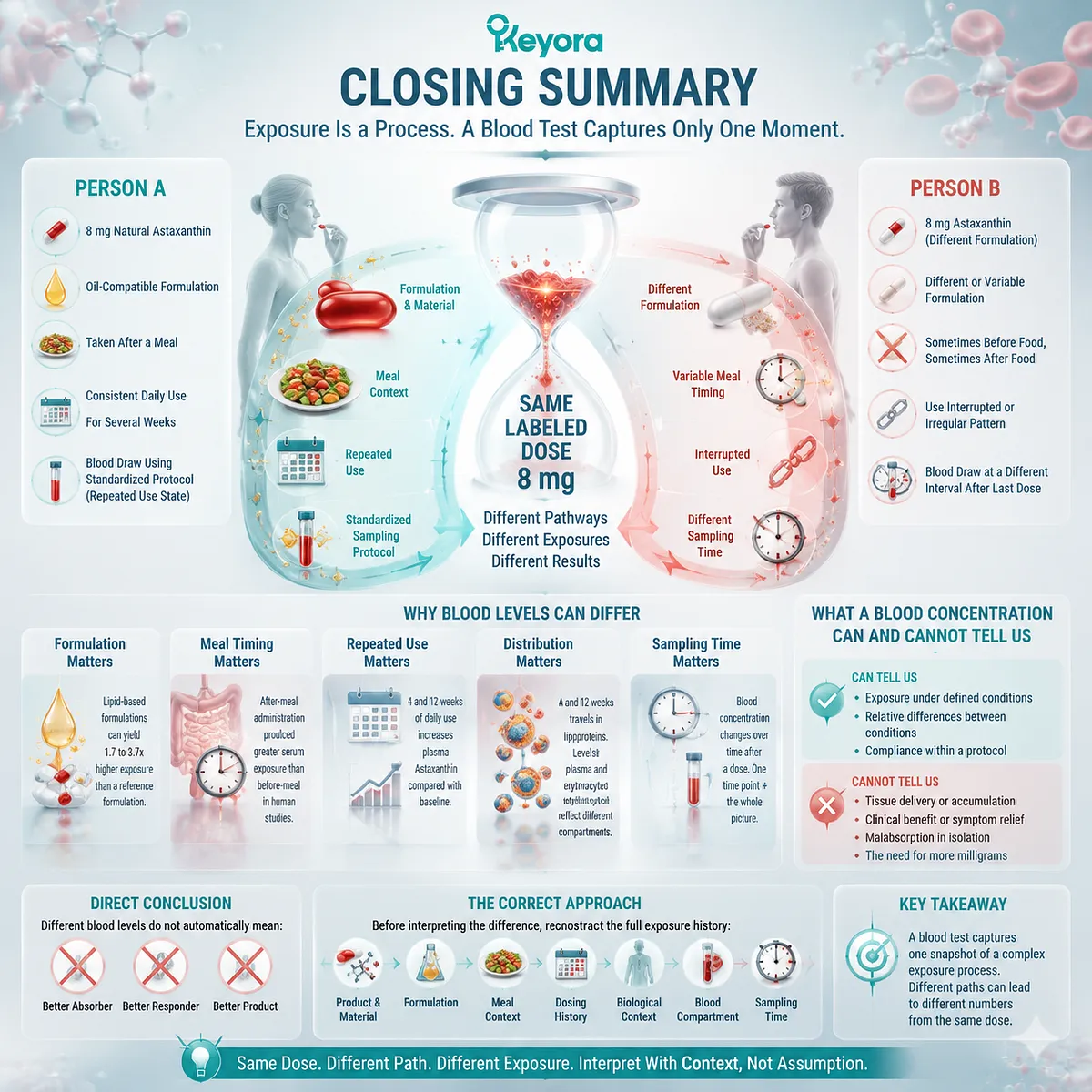
The same dose can produce different blood levels because exposure is a process and a blood test captures only one part of that process at one moment
Return to Person A and Person B.
Both took 8 mg, but that fact alone did not establish that they used the same material, formulation, meal condition, supplementation history, blood compartment, or sampling schedule.
Their different blood levels do not automatically identify the better absorber, better responder, or better product. The difference may be biological, procedural, product related, or created by several variables acting together.
Human studies show that formulation, meal timing, repeated use, lipoprotein distribution, and sampling time can change the Astaxanthin measurement. They also show that plasma and erythrocyte values represent different exposure compartments.
A blood concentration documents exposure under defined conditions. It does not independently prove tissue delivery, clinical benefit, malabsorption, or the need for more milligrams.
Before interpreting the difference, reconstruct the product, meal, dosing history, biological context, blood compartment, and sampling time.
This article is for educational and informational purposes only. It does not provide medical advice, diagnosis, treatment, cure, prevention, disease outcome claims, hormone restoration claims, fertility outcome claims, or formula-specific clinical efficacy claims.