
Does the Type of Meal Affect Astaxanthin Absorption?
Keyora Research Q&A Library
This is part of the Keyora Research Q&A Series, derived from Keyora Astaxanthin Research Journal Series.
Within the Keyora Astaxanthin Researcn framework, this Q&A translates complex astaxanthin biology into reader-friendly, evidence-bound answers, focusing on natural astaxanthin identity, molecular structure, antioxidant and redox mechanisms, membrane lipid interaction, mitochondrial resilience, inflammatory signaling pathways, human evidence interpretation, and the scientific principles behind responsible supplementation.
First published by Keyora Research Journal: www.keyorahealth.com
Direct Answer
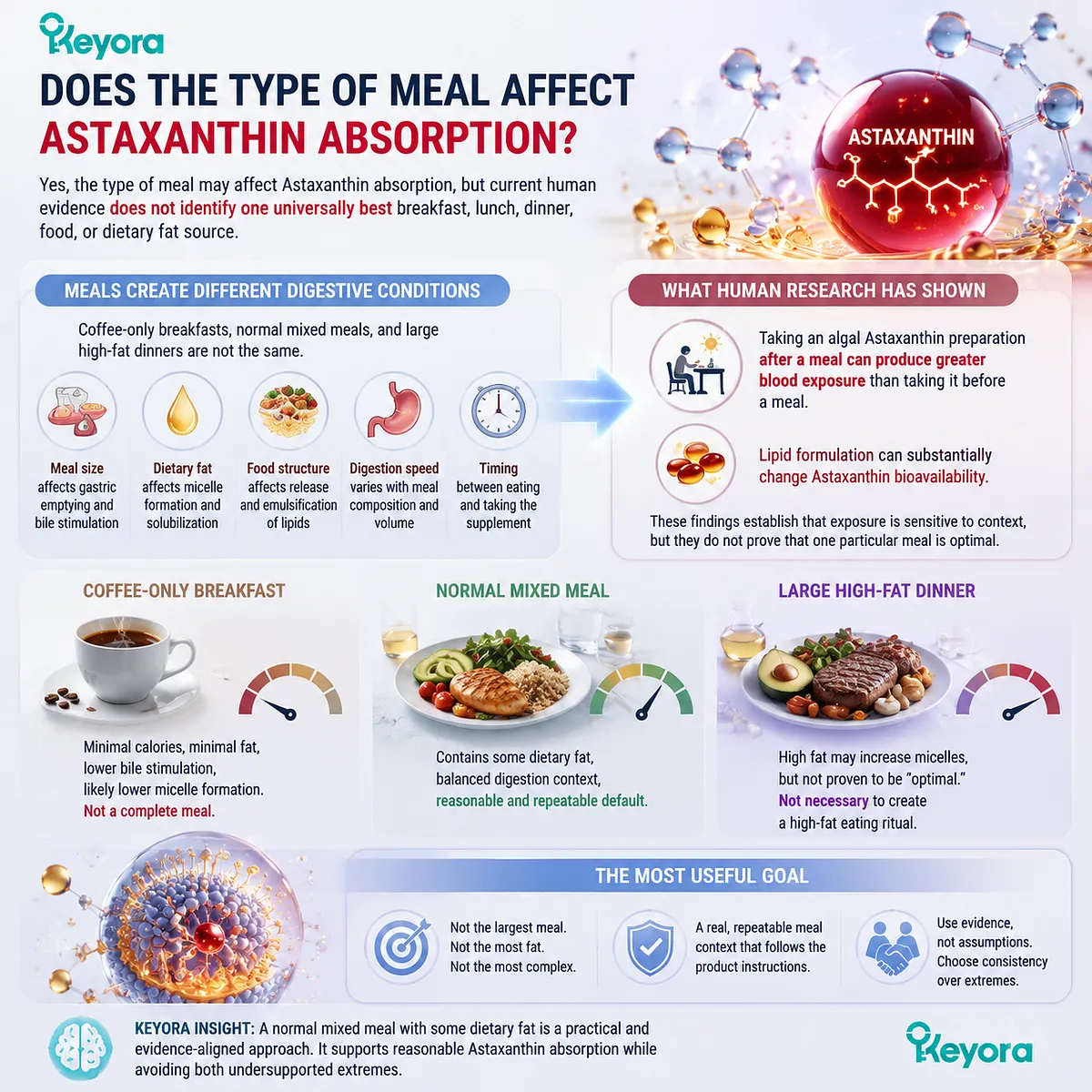
Yes, the type of meal may affect Astaxanthin absorption, but current human evidence does not identify one universally best breakfast, lunch, dinner, food, or dietary fat source.
A coffee only breakfast, a normal mixed meal, and a large high fat dinner do not create identical digestive conditions. They differ in meal size, dietary fat, food structure, digestion speed, and the timing between eating and taking the supplement.
Human Astaxanthin research has shown that taking an algal Astaxanthin preparation after a meal can produce greater blood exposure than taking it before a meal. Separate human research has shown that lipid formulation can substantially change Astaxanthin bioavailability. These findings establish that exposure is sensitive to context, but they do not prove that one particular meal is optimal.
A normal mixed meal containing some dietary fat is therefore a reasonable practical default. It is more defensible than treating coffee or another nearly calorie free drink as a complete meal, and it avoids turning supplementation into a high fat eating ritual.
The useful goal is not the largest meal. It is a real, repeatable meal context that follows the product instructions without claiming more certainty than the evidence provides.
Enter the Three Meal Test
A coffee only breakfast, a normal mixed lunch, and a large dinner present three different exposure environments
Imagine that the same person plans to take the same Astaxanthin softgel during one of three daily windows.
Meal Window A – The minimal breakfast
Breakfast consists of black coffee, tea, juice, fruit, or a very small snack. The person considers this “taking Astaxanthin with breakfast,” but the digestive context may still resemble a near fasting condition.
The question is not whether absorption becomes zero. The question is whether this window provides the type of meal associated lipid environment that the label instruction “with food” is intended to create.
Meal Window B – The normal mixed meal
Lunch includes ordinary food with carbohydrate, protein, and some dietary fat. It is not designed around the supplement and does not require a special recipe.
This window offers a more complete and repeatable meal context. It also avoids the unsupported idea that Astaxanthin must be paired with a specific food such as eggs, yogurt, nuts, avocado, or a spoonful of oil.
Meal Window C – The large dinner
Dinner is the largest and fattiest meal of the day. The person assumes that more food and more fat must create maximum absorption.
That conclusion is not established. A large meal may change gastric processing, supplement release, digestion time, and the point at which Astaxanthin appears in blood. More fat does not automatically mean proportionally greater exposure, and greater exposure does not automatically mean a better health outcome.
The three windows are therefore not identical, but they cannot be ranked simply by meal size.

Watch What Changes Between the Meals
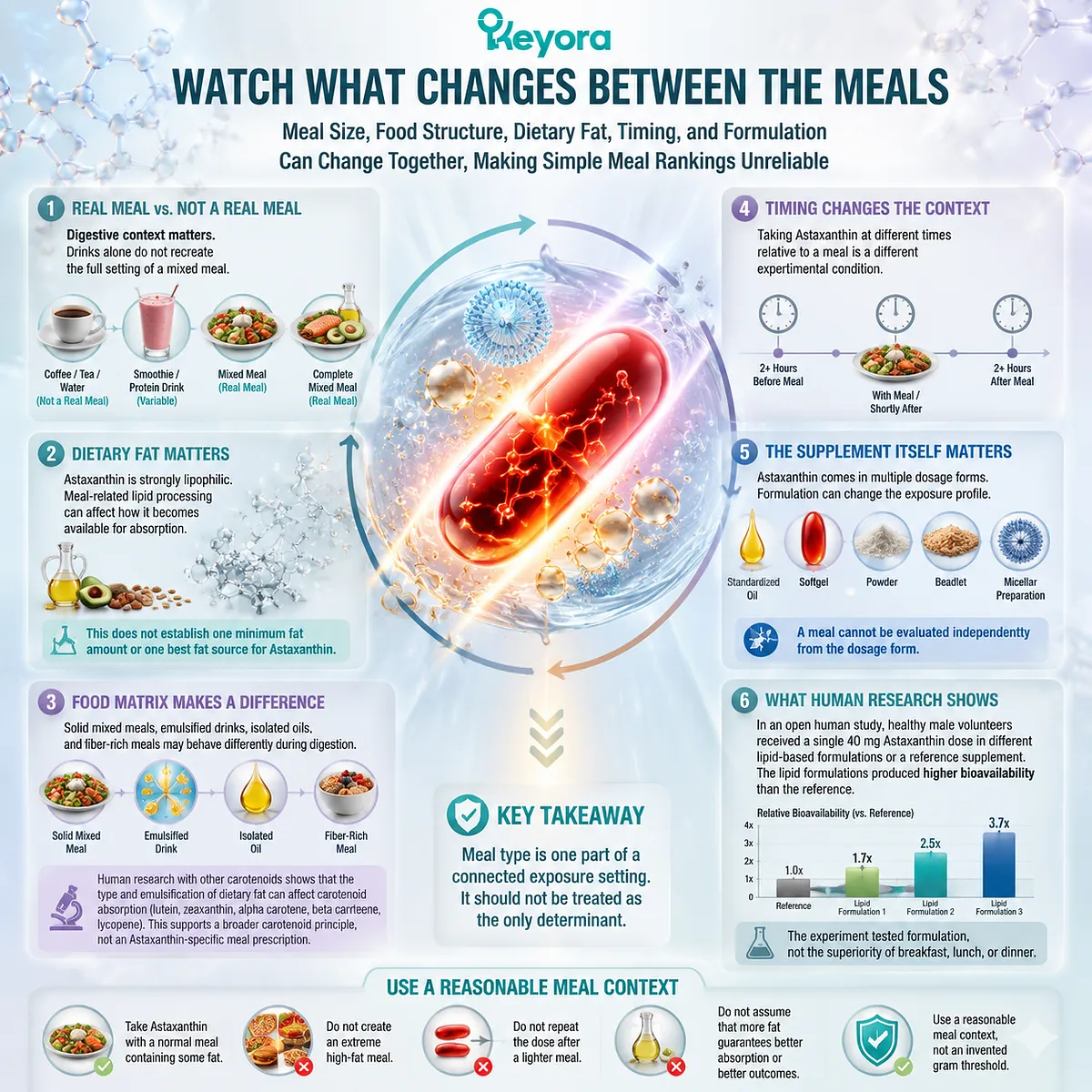
Meal size, food structure, dietary fat, timing, and formulation can change together, making simple meal rankings unreliable
The first difference is whether the supplement is being taken with a real meal.
Coffee, tea, or water may be part of breakfast, but these drinks alone do not recreate the full digestive setting of a mixed meal. A smoothie or protein drink may be more substantial, yet its composition can vary from almost fat free to a complete mixed meal.
The second difference is dietary fat. Astaxanthin is strongly lipophilic, and meal related lipid processing can affect how it becomes available for absorption. That does not establish one minimum fat amount or one best fat source for Astaxanthin.
The third difference is the food matrix. A solid mixed meal, an emulsified drink, an isolated oil, and a fiber rich meal may behave differently during digestion. Human research with other carotenoids has shown that the type and emulsification of dietary fat can affect carotenoid absorption, but that trial measured lutein, zeaxanthin, alpha carotene, beta carotene, and lycopene rather than Astaxanthin. It therefore supports a broader carotenoid principle, not an Astaxanthin specific meal prescription.
The fourth difference is timing. Taking Astaxanthin shortly after eating is not the same experimental condition as taking it two hours before a meal or several hours after one.
The fifth difference is the supplement itself. Astaxanthin may be delivered in a standardized oil, conventional softgel, powder, beadlet, micellar preparation, or another formulation. A meal cannot be evaluated independently from the dosage form because formulation can change the exposure profile.
In an open human study, healthy male volunteers received a single 40 mg Astaxanthin dose in different lipid based formulations or a reference supplement. The lipid formulations produced higher bioavailability than the reference, demonstrating that delivery design can materially affect blood exposure. The experiment tested formulation, not the superiority of breakfast, lunch, or dinner.
Meal type is therefore one part of a connected exposure setting. It should not be treated as the only determinant.
Put Human Evidence in the Correct Meal Window
A meal timing study can support an exposure conclusion without proving that one breakfast or dinner is clinically superior
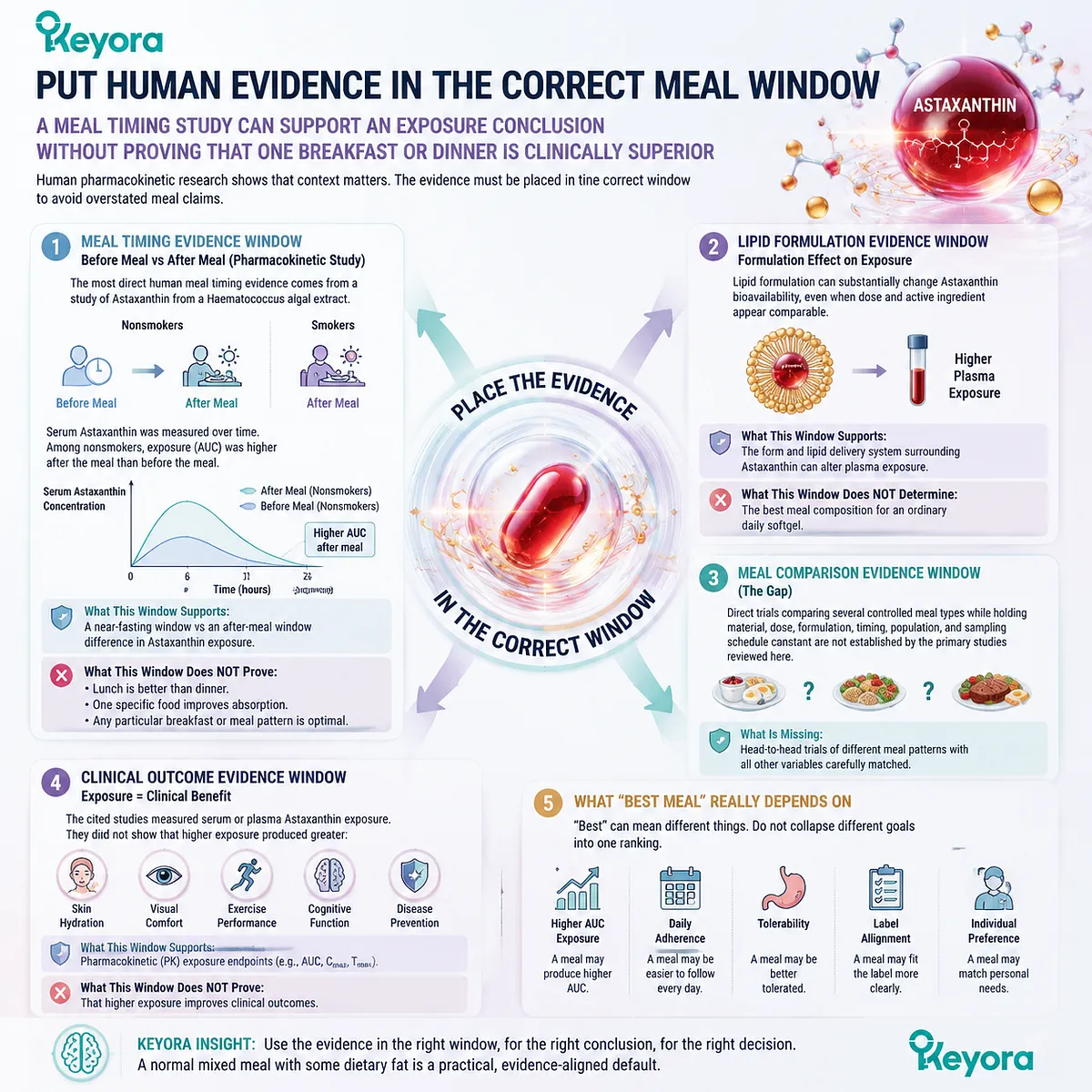
The most direct human meal timing evidence comes from a pharmacokinetic study of Astaxanthin from a Haematococcus algal extract.
The study included nonsmokers who took the preparation before a meal, nonsmokers who took it after a meal, and smokers who took it after a meal. Serum Astaxanthin was measured over time. Among nonsmokers, exposure represented by the area under the concentration curve was higher after the meal than before the meal.
This evidence belongs in the comparison between a near fasting window and an after meal window.
It does not belong in a claim that lunch is better than dinner. The study did not compare ordinary breakfasts, mixed lunches, and large dinners as distinct meal patterns.
It also does not establish that one specific food improved absorption. The meal condition was part of the pharmacokinetic design, but the result should not be rewritten as proof that eggs, yogurt, nuts, olive oil, or another food is required.
The lipid formulation study belongs in a different evidence window. It shows that the form surrounding Astaxanthin can alter plasma exposure, even when the active ingredient name and dose appear comparable. It does not determine the best meal composition for an ordinary daily softgel.
A third evidence window remains comparatively empty. Direct Astaxanthin trials comparing several carefully controlled meal types while holding the material, dose, formulation, timing, population, and blood sampling schedule constant are not established by the primary studies reviewed here.
The clinical outcome window is also separate. The cited studies measured serum or plasma Astaxanthin exposure. They did not show that the higher exposure condition produced greater skin hydration, visual comfort, exercise performance, cognitive function, or disease prevention.
This distinction matters because the “best meal” depends on what best means.
A meal may produce higher AUC.
A meal may be easier to follow every day.
A meal may be better tolerated.
A meal may fit the label more clearly.
These are different outcomes and should not be collapsed into one ranking.
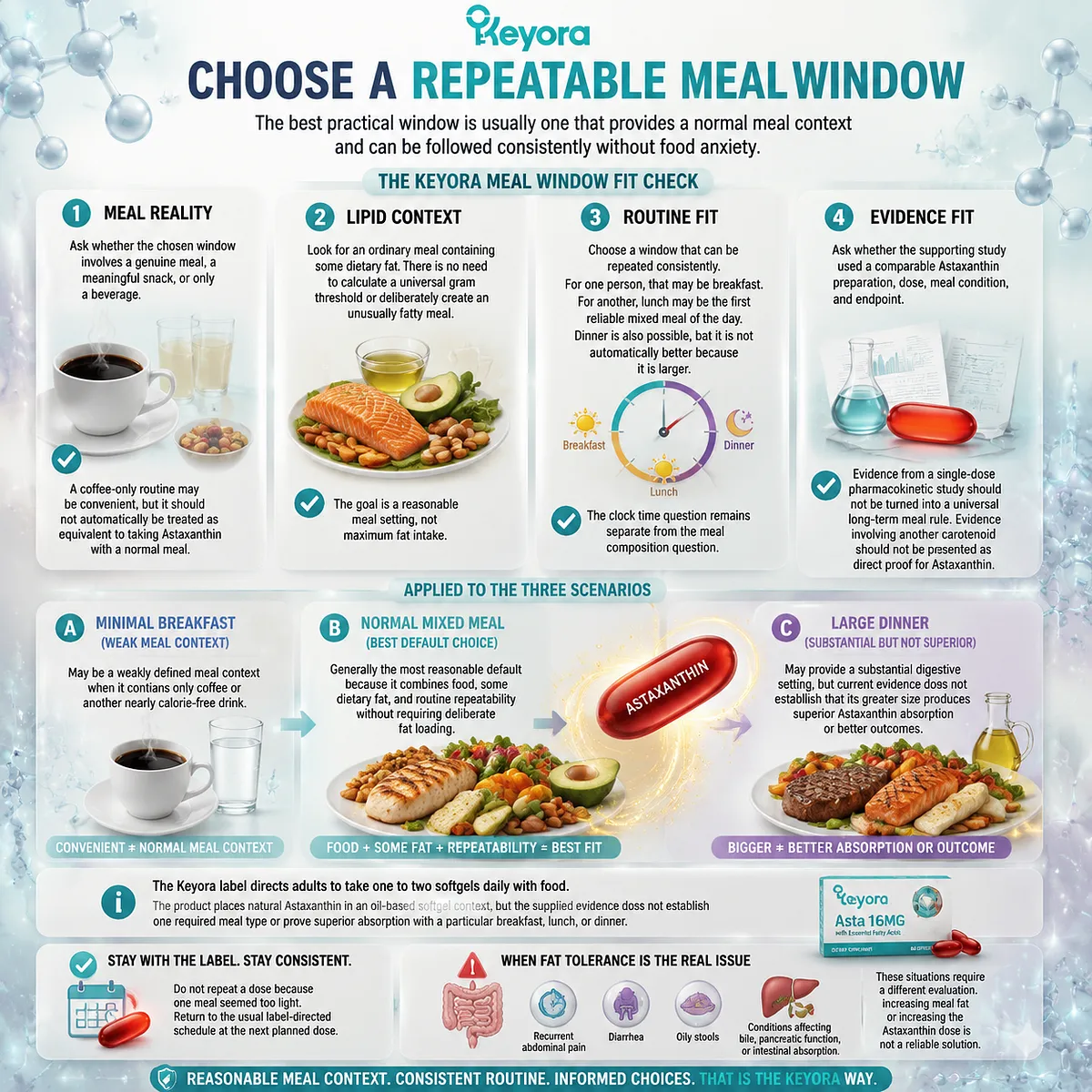
Choose a Repeatable Meal Window
The best practical window is usually one that provides a normal meal context and can be followed consistently without food anxiety
The Keyora Meal Window Fit Check evaluates four features.
Meal Reality
Ask whether the chosen window involves a genuine meal, a meaningful snack, or only a beverage.
A coffee only routine may be convenient, but it should not automatically be treated as equivalent to taking Astaxanthin with a normal meal.
Lipid Context
Look for an ordinary meal containing some dietary fat. There is no need to calculate a universal gram threshold or deliberately create an unusually fatty meal.
The goal is a reasonable meal setting, not maximum fat intake.
Routine Fit
Choose a window that can be repeated consistently. For one person, that may be breakfast. For another, lunch may be the first reliable mixed meal of the day.
Dinner is also possible, but it is not automatically better because it is larger. The clock time question remains separate from the meal composition question.
Evidence Fit
Ask whether the supporting study used a comparable Astaxanthin preparation, dose, meal condition, and endpoint.
Evidence from a single dose pharmacokinetic study should not be turned into a universal long term meal rule. Evidence involving another carotenoid should not be presented as direct proof for Astaxanthin.
Applied to the three scenarios, the conclusions are practical rather than absolute.
The minimal breakfast may be a weakly defined meal context when it contains only coffee or another nearly calorie free drink.
The normal mixed meal is generally the most reasonable default because it combines food, some dietary fat, and routine repeatability without requiring deliberate fat loading.
The large dinner may provide a substantial digestive setting, but current evidence does not establish that its greater size produces superior Astaxanthin absorption or better outcomes.
The Keyora label directs adults to take one to two softgels daily with food. The product places natural Astaxanthin in an oil based softgel context, but the supplied evidence does not establish one required meal type or prove superior absorption with a particular breakfast, lunch, or dinner.
Do not repeat a dose because one meal seemed too light. Return to the usual label directed schedule at the next planned dose.
Persistent problems tolerating dietary fat, recurrent abdominal pain, diarrhea, oily stools, or known conditions affecting bile, pancreatic function, or intestinal absorption require a different evaluation. Increasing meal fat or increasing the Astaxanthin dose is not a reliable solution.
Closing Summary
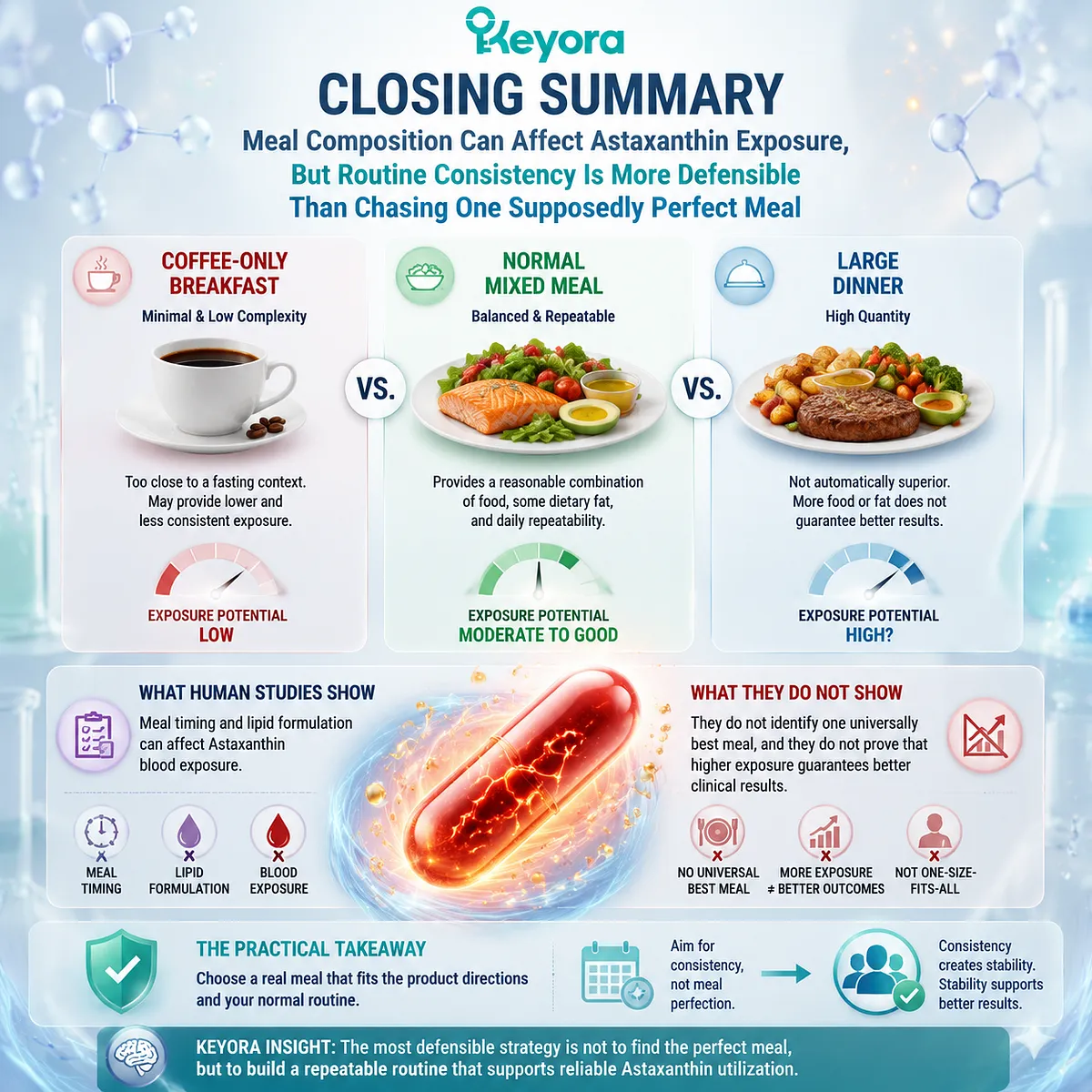
Meal composition can affect Astaxanthin exposure, but routine consistency is more defensible than chasing one supposedly perfect meal
A coffee only breakfast, a normal mixed meal, and a large dinner do not provide identical exposure conditions.
The minimal breakfast may be too close to a fasting context to represent a strong default routine. The mixed meal provides a reasonable combination of food, some dietary fat, and daily repeatability. The large dinner is not automatically superior simply because it contains more food or fat.
Human studies support the broader conclusion that meal timing and lipid formulation can affect Astaxanthin blood exposure. They do not identify one universally best meal, and they do not prove that higher exposure guarantees better clinical results.
Choose a real meal that fits the product directions and your normal routine. Aim for consistency, not meal perfection.
This article is for educational and informational purposes only. It does not provide medical advice, diagnosis, treatment, cure, prevention, disease outcome claims, hormone restoration claims, fertility outcome claims, or formula-specific clinical efficacy claims.