
Is a Higher Astaxanthin Dose Always Better?
Keyora Research Q&A Library
This is part of the Keyora Research Q&A Series, derived from Keyora Astaxanthin Research Journal Series.
Within the Keyora Astaxanthin Researcn framework, this Q&A translates complex astaxanthin biology into reader-friendly, evidence-bound answers, focusing on natural astaxanthin identity, molecular structure, antioxidant and redox mechanisms, membrane lipid interaction, mitochondrial resilience, inflammatory signaling pathways, human evidence interpretation, and the scientific principles behind responsible supplementation.
First published by Keyora Research Journal: www.keyorahealth.com
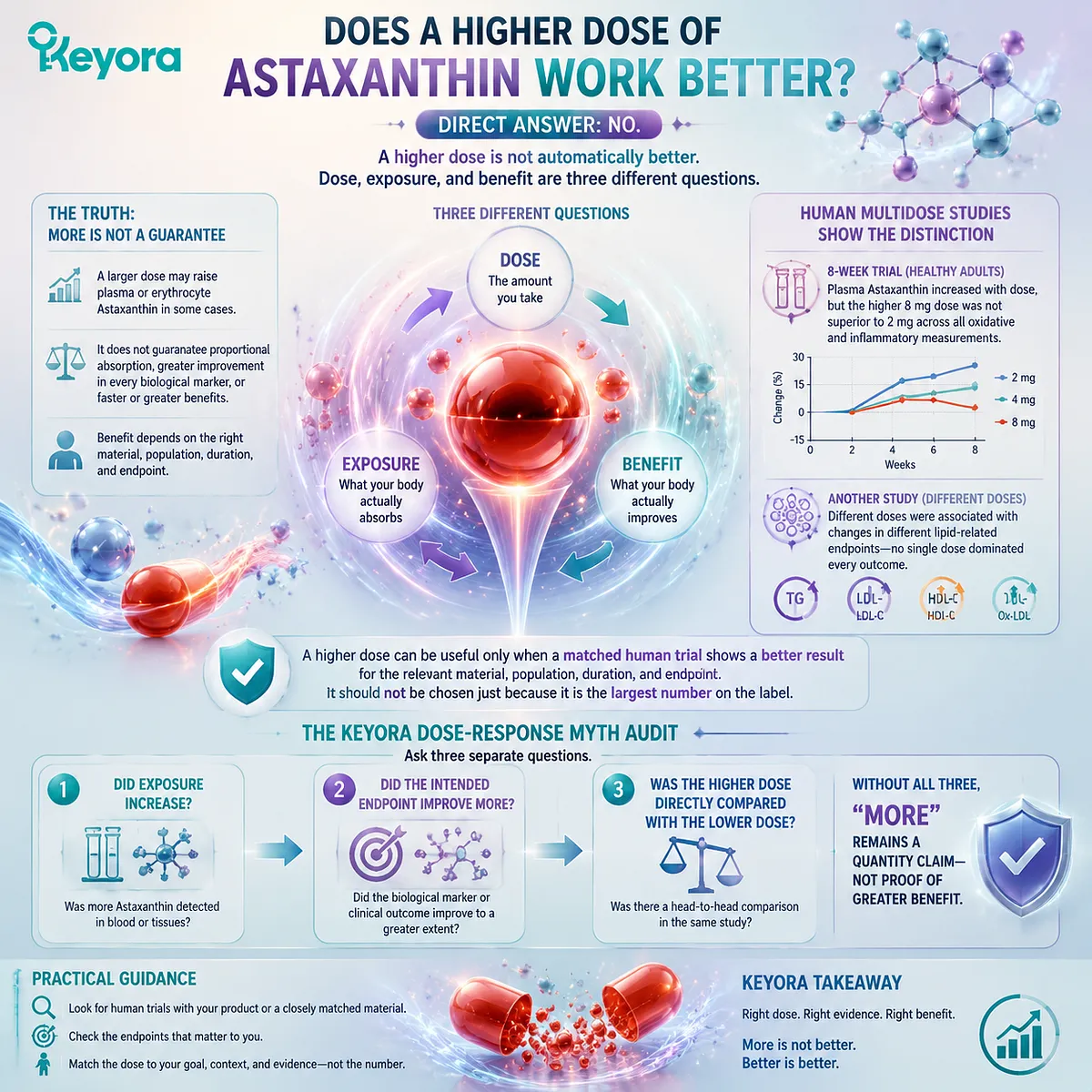
Direct Answer
No.
A higher Astaxanthin dose is not automatically better.
Increasing the amount swallowed may raise plasma or erythrocyte Astaxanthin under some conditions, but dose, exposure, and benefit are three different questions.
A larger dose does not guarantee that absorption rises in the same proportion, that every biological marker improves further, or that a person will notice faster or greater benefits.
Human multidose studies illustrate this distinction. In one eight-week trial, plasma Astaxanthin increased with dose, but the higher 8 mg dose was not superior to 2 mg across all oxidative and inflammatory measurements.
In another study, different doses were associated with changes in different lipid-related endpoints rather than producing one dose that clearly dominated every outcome.
A higher dose can therefore be useful when a matched human trial demonstrates a better result for the relevant material, population, duration, and endpoint. It should not be chosen merely because it is the largest number on the label.
The Keyora Dose-Response Myth Audit asks three separate questions:
-
Did exposure increase?
-
Did the intended endpoint improve more?
-
Was the higher dose directly compared with the lower dose?
Without all three, “more” remains a quantity claim—not proof of greater benefit.
Why More Milligrams Feel More Convincing
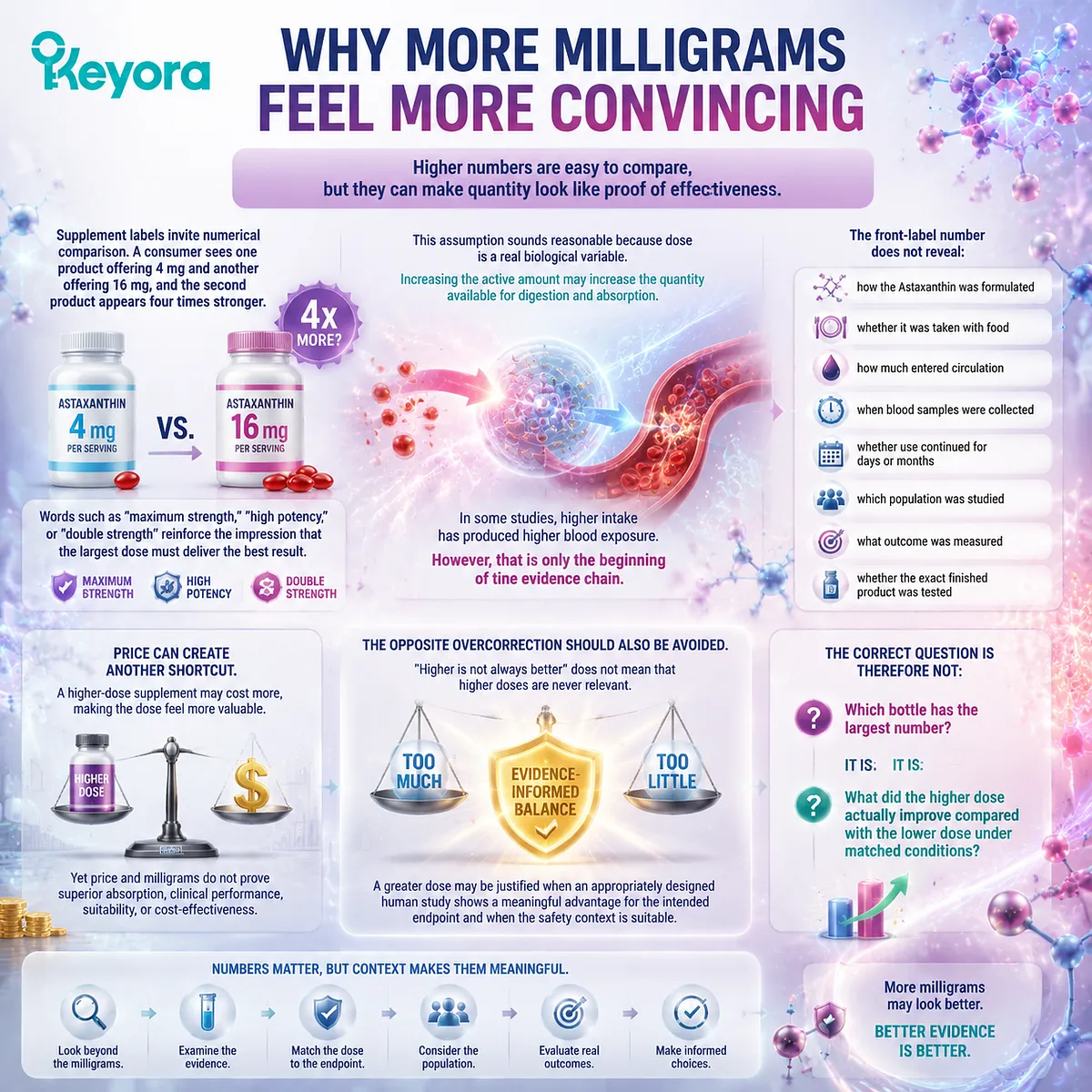
Higher numbers are easy to compare, but they can make quantity look like proof of effectiveness
Supplement labels invite numerical comparison. A consumer sees one product offering 4 mg and another offering 16 mg, and the second product appears four times stronger. Words such as “maximum strength,” “high potency,” or “double strength” reinforce the impression that the largest dose must deliver the best result.
This assumption sounds reasonable because dose is a real biological variable. Increasing the active amount may increase the quantity available for digestion and absorption. In some studies, higher intake has produced higher blood exposure. However, that is only the beginning of the evidence chain.
The front-label number does not reveal:
-
how the Astaxanthin was formulated
-
whether it was taken with food
-
how much entered circulation
-
when blood samples were collected
-
whether use continued for days or months
-
which population was studied
-
what outcome was measured
-
whether the exact finished product was tested
Price can create another shortcut. A higher-dose supplement may cost more, making the dose feel more valuable. Yet price and milligrams do not prove superior absorption, clinical performance, suitability, or cost-effectiveness.
The opposite overcorrection should also be avoided. “Higher is not always better” does not mean that higher doses are never relevant. A greater dose may be justified when an appropriately designed human study shows a meaningful advantage for the intended endpoint and when the safety context is suitable.
The correct question is therefore not:
Which bottle has the largest number?
It is:
What did the higher dose actually improve compared with the lower dose under matched conditions?
Dose, Exposure, and Benefit Are Different Curves
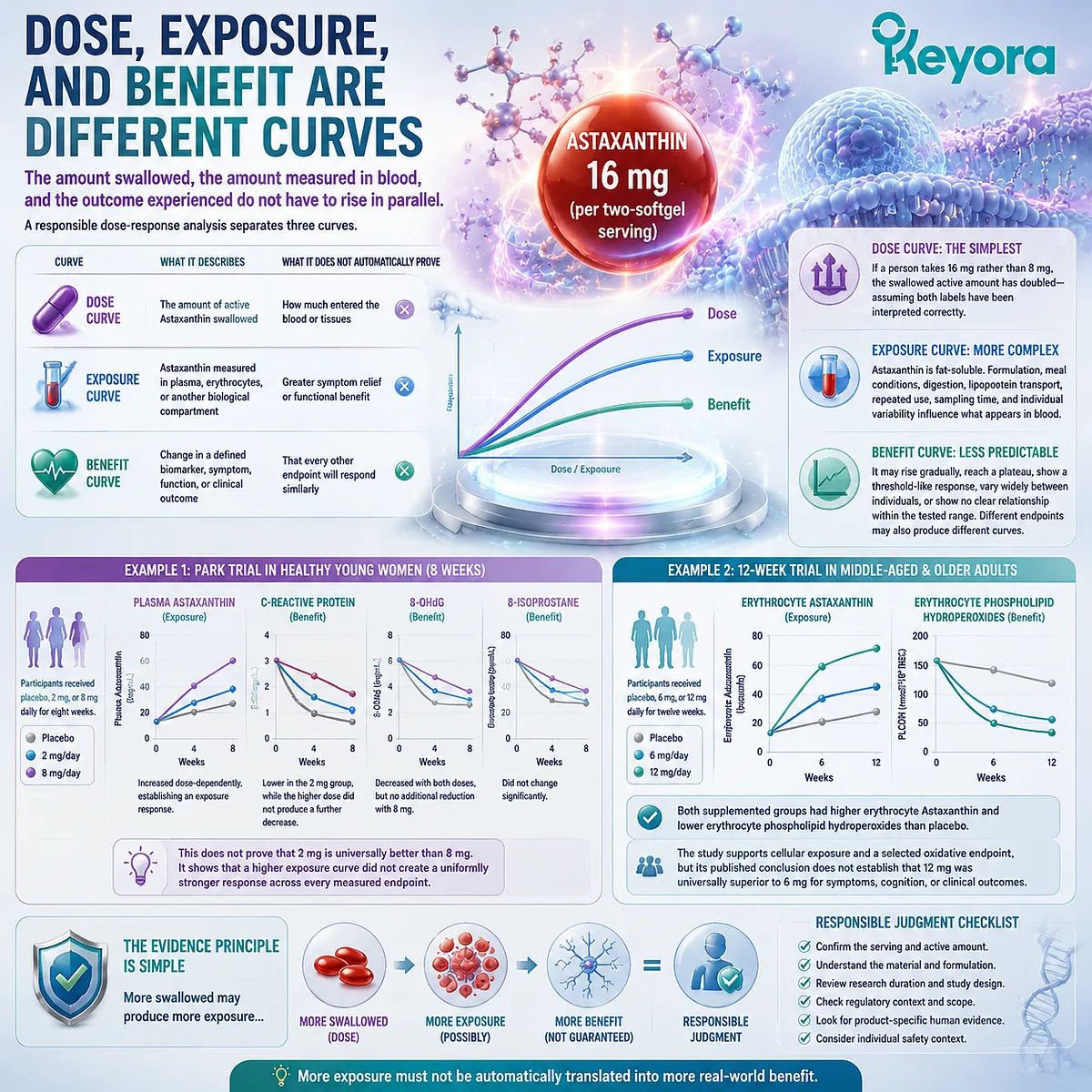
The amount swallowed, the amount measured in blood, and the outcome experienced do not have to rise in parallel
A responsible dose-response analysis separates three curves.
Evidence CurveWhat It DescribesWhat It Does Not Automatically Prove Dose Curve The amount of active Astaxanthin swallowedHow much entered the blood or tissues Exposure Curve Astaxanthin measured in plasma, erythrocytes, or another biological compartmentGreater symptom relief or functional benefit Benefit Curve Change in a defined biomarker, symptom, function, or clinical outcomeThat every other endpoint will respond similarly
The dose curve is the simplest. If a person takes 16 mg rather than 8 mg, the swallowed active amount has doubled – assuming both labels have been interpreted correctly.
The exposure curve is more complex. Astaxanthin is fat-soluble, so formulation, meal conditions, digestion, lipoprotein transport, repeated use, sampling time, and individual variability can influence what appears in blood. A doubled swallowed dose should not be assumed to produce exactly double the plasma concentration.
The benefit curve is even less predictable. It may rise gradually, reach a plateau, show a threshold-like response, vary widely between individuals, or show no clear relationship within the tested range. Different endpoints may also produce different curves.
The Park trial demonstrates this separation.
Healthy young women received placebo, 2 mg, or 8 mg daily for eight weeks.
Plasma Astaxanthin increased dose-dependently, establishing an exposure response.
However, plasma C-reactive protein was lower in the 2 mg group, while the higher dose did not produce a further decrease. The oxidative DNA marker 8-OHdG decreased with both doses, but the study reported no additional reduction with 8 mg.
Plasma 8-isoprostane did not change significantly.
This does not prove that 2 mg is universally better than 8 mg. It shows that a higher exposure curve did not create a uniformly stronger response across every measured endpoint.
Another example comes from a 12-week trial involving 30 middle-aged and older adults. Participants received placebo, 6 mg, or 12 mg daily.
Both supplemented groups had higher erythrocyte Astaxanthin and lower erythrocyte phospholipid hydroperoxides than placebo.
The study supports cellular exposure and a selected oxidative endpoint, but its published conclusion does not establish that 12 mg was universally superior to 6 mg for symptoms, cognition, or clinical outcomes.
The evidence principle is simple:
More swallowed may produce more exposure, but more exposure must not be automatically translated into more real-world benefit.
What Human Trials Need to Show
A higher dose is better only when a matched trial directly demonstrates superiority for the same endpoint
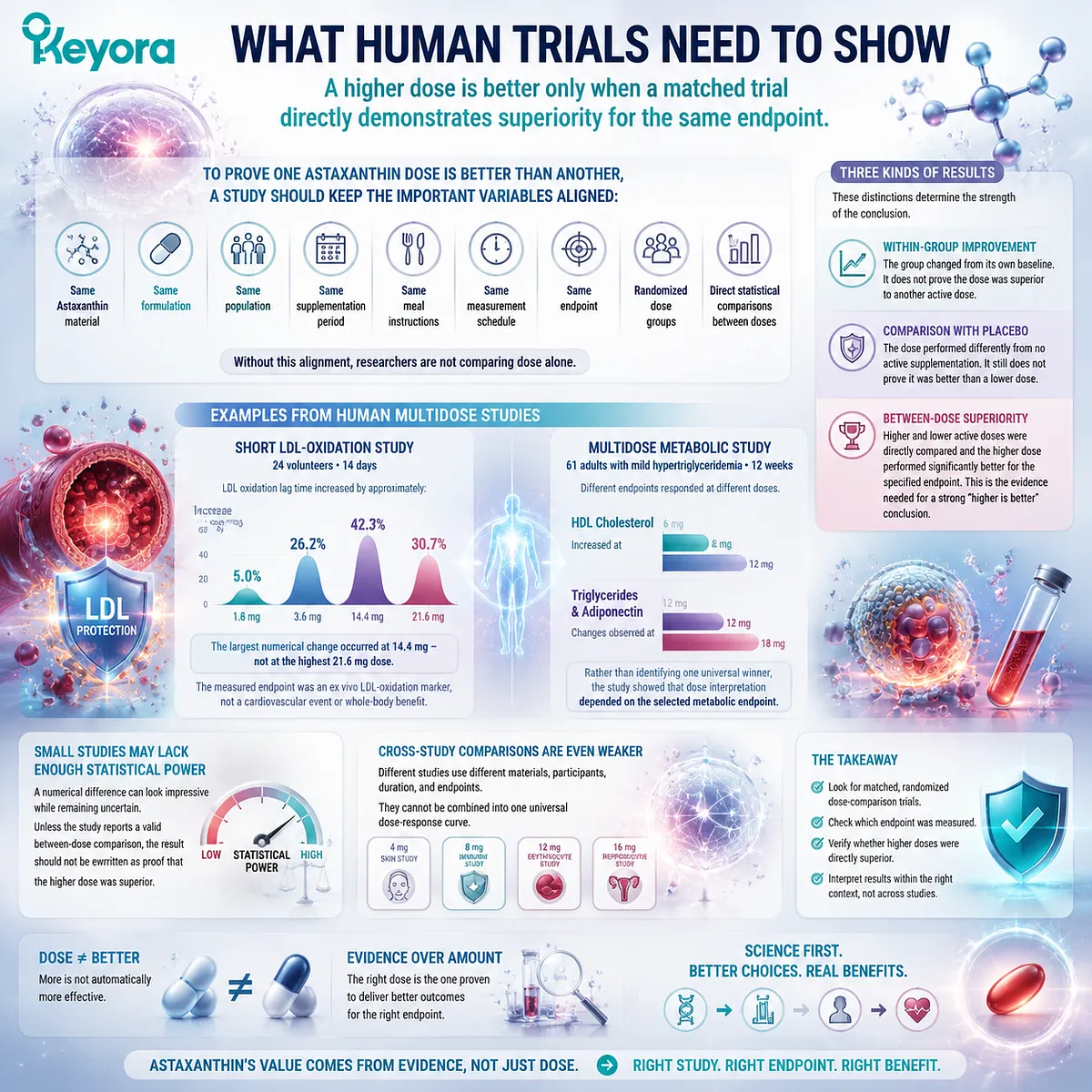
To prove that one Astaxanthin dose is better than another, a study should keep the important variables aligned:
-
the same Astaxanthin material
-
the same formulation
-
the same population
-
the same supplementation period
-
the same meal instructions
-
the same measurement schedule
-
the same endpoint
-
randomized dose groups
-
direct statistical comparisons between doses
Without this alignment, researchers are not comparing dose alone.
Three kinds of results must also be distinguished.
-
Within-group improvement means a group changed from its own baseline. It does not prove that the dose was superior to another active dose.
-
Comparison with placebo means a dose performed differently from no active supplementation. It still does not prove that it was better than a lower dose.
-
Between-dose superiority means the higher and lower active doses were directly compared and the higher dose performed significantly better for the specified endpoint. This is the evidence needed for a strong “higher is better” conclusion.
A short LDL-oxidation study illustrates why visual dose trends require caution.
Twenty-four volunteers used 1.8, 3.6, 14.4, or 21.6 mg daily for 14 days. LDL oxidation lag time increased by approximately 5.0%, 26.2%, 42.3%, and 30.7%, respectively.
The largest numerical change occurred at 14.4 mg – not at the highest 21.6 mg dose.
The measured endpoint was an ex vivo LDL-oxidation marker, not a cardiovascular event or whole-body benefit.
A different multidose trial assigned 61 adults with mild hypertriglyceridemia to placebo, 6 mg, 12 mg, or 18 mg daily for 12 weeks. HDL cholesterol increased at 6 and 12 mg, while triglyceride and adiponectin findings appeared at 12 and 18 mg. Rather than identifying one universal winner, the study showed that dose interpretation depended on the selected metabolic endpoint.
Small studies may also lack enough statistical power to distinguish active doses reliably.
A numerical difference can look impressive while remaining uncertain. Unless a study reports a valid between-dose comparison, the result should not be rewritten as proof that the higher dose was superior.
Cross-study comparisons are even weaker.
A 4 mg skin study, an 8 mg immune study, a 12 mg erythrocyte study, and a 16 mg reproductive study cannot be combined into one universal dose-response curve. The materials, participants, duration, and endpoints are too different.
Recognize Higher-Dose Marketing Without Overcorrecting
The largest dose is not automatically the best product, but a higher dose should not be dismissed when evidence and context genuinely support it
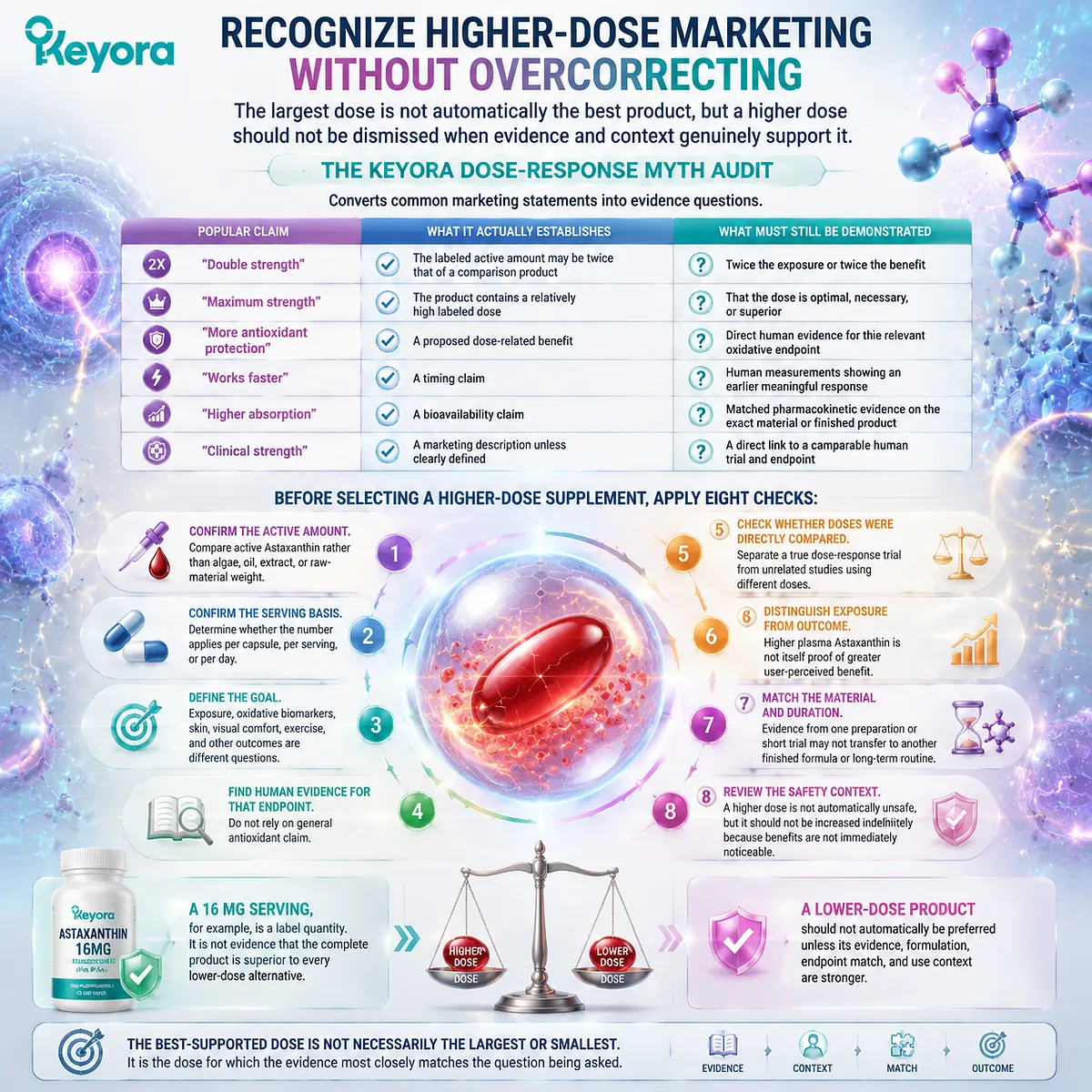
The Keyora Dose-Response Myth Audit converts common marketing statements into evidence questions.
Popular ClaimWhat It Actually EstablishesWhat Must Still Be Demonstrated“Double strength”The labeled active amount may be twice that of a comparison productTwice the exposure or twice the benefit“Maximum strength”The product contains a relatively high labeled doseThat the dose is optimal, necessary, or superior“More antioxidant protection”A proposed dose-related benefitDirect human evidence for the relevant oxidative endpoint“Works faster”A timing claimHuman measurements showing an earlier meaningful response“Higher absorption”A bioavailability claimMatched pharmacokinetic evidence on the exact material or finished product“Clinical strength”A marketing description unless clearly definedA direct link to a comparable human trial and endpoint
Before selecting a higher-dose supplement, apply eight checks:
-
Confirm the active amount.
Compare active Astaxanthin rather than algae, oil, extract, or raw-material weight. -
Confirm the serving basis.
Determine whether the number applies per capsule, per serving, or per day. -
Define the goal.
Exposure, oxidative biomarkers, skin, visual comfort, exercise, and other outcomes are different questions. -
Find human evidence for that endpoint.
Do not rely on a general antioxidant claim. -
Check whether doses were directly compared.
Separate a true dose-response trial from unrelated studies using different doses. -
Distinguish exposure from outcome.
Higher plasma Astaxanthin is not itself proof of greater user-perceived benefit. -
Match the material and duration.
Evidence from one preparation or short trial may not transfer to another finished formula or long-term routine. -
Review the safety context.
A higher dose is not automatically unsafe, but it should not be increased indefinitely because benefits are not immediately noticeable.
A 16 mg serving, for example, is a label quantity. It is not evidence that the complete product is superior to every lower-dose alternative. Conversely, a lower-dose product should not automatically be preferred unless its evidence, formulation, endpoint match, and use context are stronger.
The best-supported dose is not necessarily the largest or smallest. It is the dose for which the evidence most closely matches the question being asked.
Closing Summary
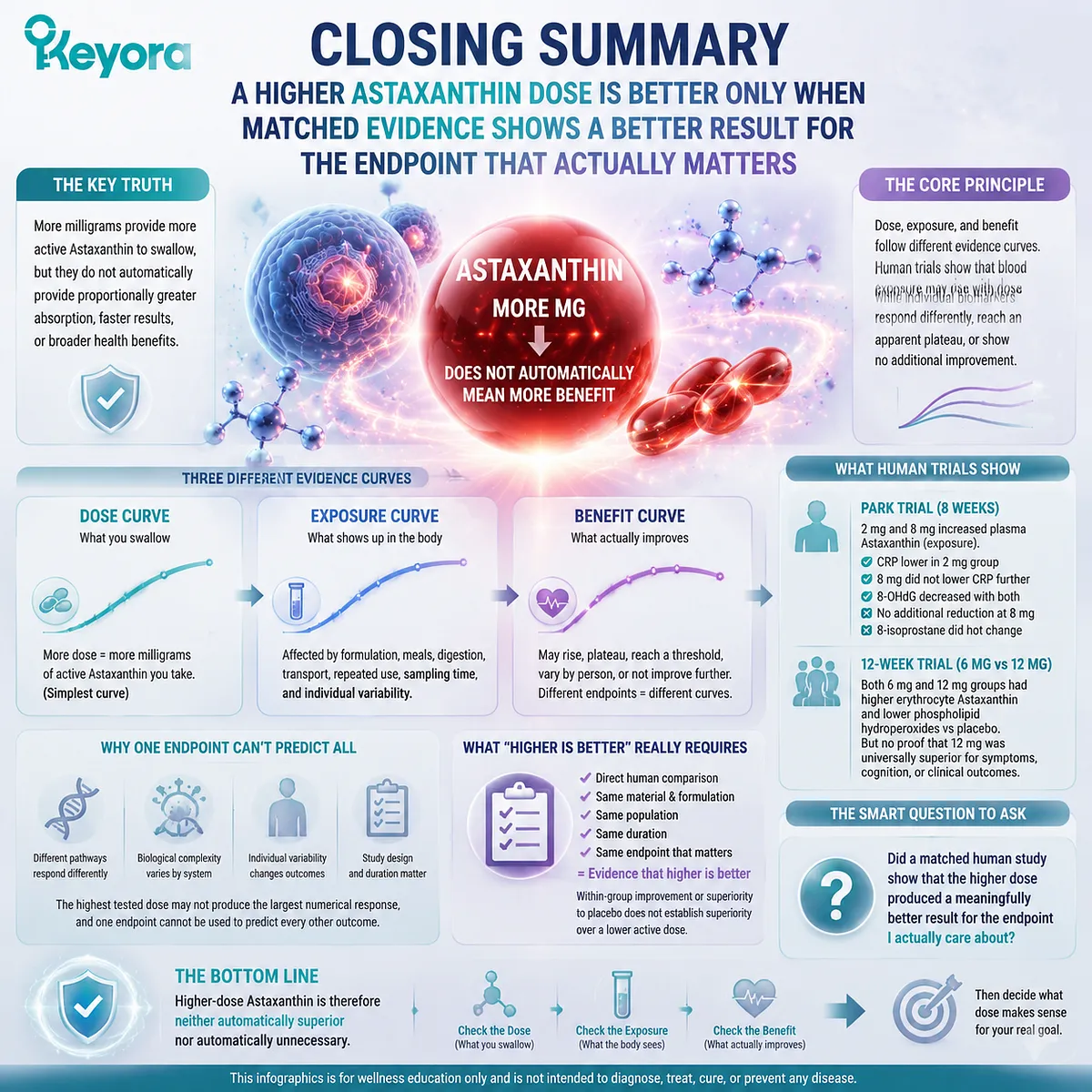
A higher Astaxanthin dose is better only when matched evidence shows a better result for the endpoint that actually matters
More milligrams provide more active Astaxanthin to swallow, but they do not automatically provide proportionally greater absorption, faster results, or broader health benefits.
Dose, exposure, and benefit follow different evidence curves.
Human trials show that blood exposure may rise with dose while individual biomarkers respond differently, reach an apparent plateau, or show no additional improvement.
The highest tested dose may not produce the largest numerical response, and one endpoint cannot be used to predict every other outcome.
A valid “higher is better” conclusion requires a direct, matched human comparison using the same material, formulation, population, duration, and endpoint. Within-group improvement or superiority to placebo does not by itself establish superiority over a lower active dose.
Higher-dose Astaxanthin is therefore neither automatically superior nor automatically unnecessary.
Before paying for more milligrams or increasing a routine, ask one decisive question:
Did a matched human study show that the higher dose produced a meaningfully better result for the endpoint I actually care about?
This article is for educational and informational purposes only. It does not provide medical advice, diagnosis, treatment, cure, prevention, disease outcome claims, hormone restoration claims, fertility outcome claims, or formula-specific clinical efficacy claims.