
What Is Lipid Peroxidation – and How May Astaxanthin Help Limit It?
Keyora Research Q&A Library
This is part of the Keyora Research Q&A Series, derived from Keyora Astaxanthin Research Journal Series.
Within the Keyora Astaxanthin Researcn framework, this Q&A translates complex astaxanthin biology into reader-friendly, evidence-bound answers, focusing on natural astaxanthin identity, molecular structure, antioxidant and redox mechanisms, membrane lipid interaction, mitochondrial resilience, inflammatory signaling pathways, human evidence interpretation, and the scientific principles behind responsible supplementation.
First published by Keyora Research Journal: www.keyorahealth.com
Direct Answer
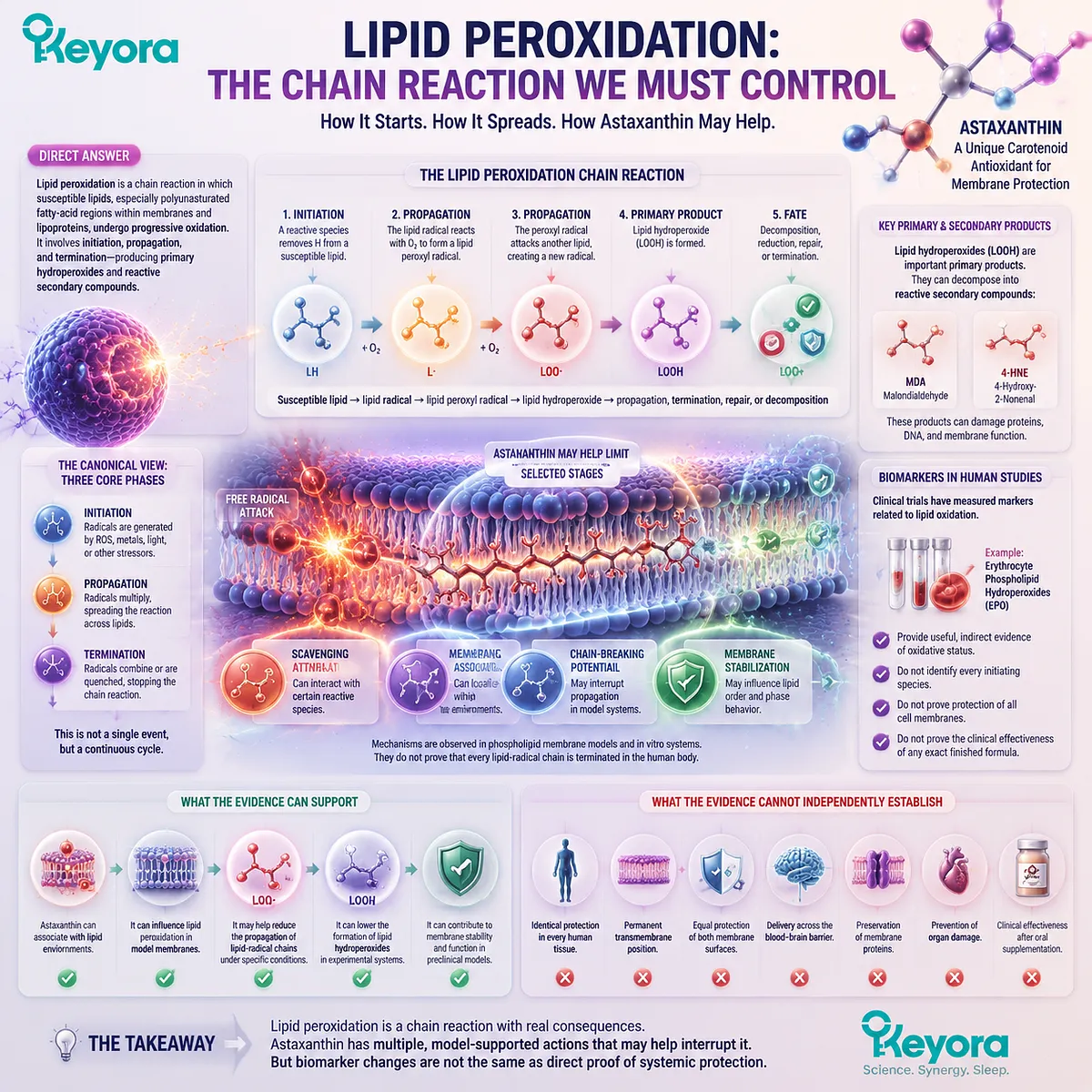
Lipid peroxidation is a chain reaction in which susceptible lipids, especially polyunsaturated fatty-acid regions within membranes and lipoproteins, undergo progressive oxidation. In the canonical nonenzymatic pathway, an initiating reaction removes hydrogen from a lipid and creates a lipid radical. Oxygen then converts that radical into a lipid peroxyl radical, which can oxidize a neighboring lipid and begin another cycle.
The process can be summarized as:
Susceptible lipid
→ lipid radical
→ lipid peroxyl radical
→ lipid hydroperoxide
→ propagation, termination, repair, or decomposition
Lipid hydroperoxides are important primary products. They may be reduced or removed, but they can also decompose into fragmented lipids and secondary compounds such as malondialdehyde, or MDA, and 4-hydroxy-2-nonenal, or 4-HNE. Canonical lipid peroxidation is therefore described through initiation, propagation, and termination rather than as one isolated oxidation event.
Astaxanthin may help limit selected stages because it can associate with lipid environments, interact with certain reactive species, and influence oxidation in phospholipid membrane models. These mechanisms do not show that astaxanthin terminates every lipid-radical chain in the human body.
Human trials have measured markers related to lipid oxidation, including erythrocyte phospholipid hydroperoxides. Such biomarkers provide useful but indirect evidence. They do not identify every initiating species, establish protection of all cell membranes, or prove the clinical effectiveness of an exact finished formula.
What Lipid Peroxidation Actually Is
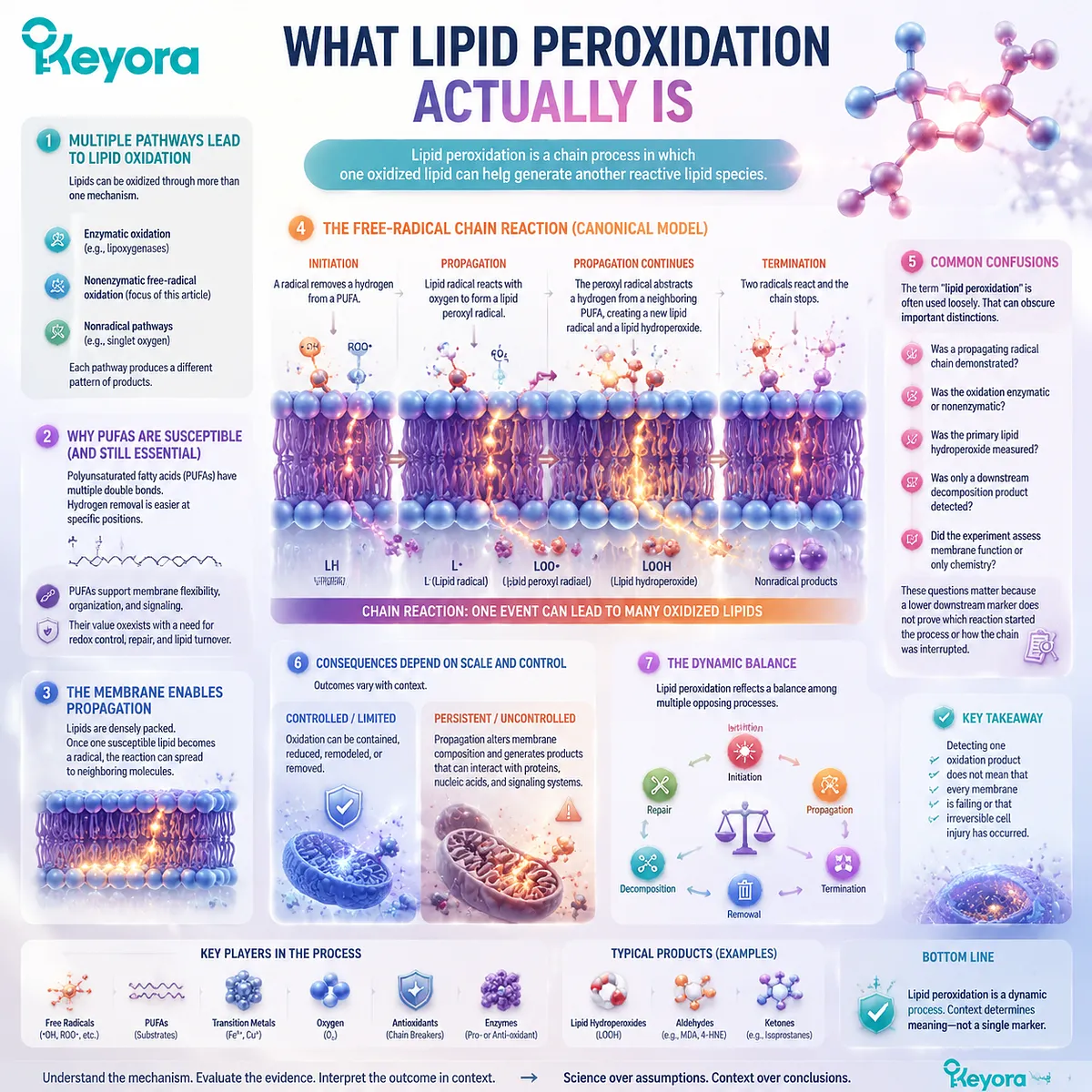
Lipid peroxidation is a chain process in which one oxidized lipid can help generate another reactive lipid species
Lipids can be oxidized through more than one mechanism. These include enzymatic oxidation, nonenzymatic free-radical oxidation, and nonradical pathways such as reactions involving singlet oxygen. Each pathway produces a different pattern of products. This article focuses on the canonical free-radical chain because it explains how oxidation can propagate through neighboring membrane lipids.
Polyunsaturated fatty acids, or PUFAs, are important substrates in this process. Their multiple double bonds create molecular positions from which hydrogen can be removed more readily than from many saturated lipid structures.
This susceptibility does not make PUFAs unwanted or inherently harmful. They contribute to membrane flexibility, organization, and signaling. Their biological value coexists with a need for effective redox control, repair, and lipid turnover.
A membrane makes propagation possible because large numbers of lipid molecules are packed closely together. Once one susceptible lipid becomes a radical, the resulting reaction can affect nearby molecules rather than ending at the original site.
The term lipid peroxidation is sometimes used loosely for any oxidized lipid measurement. That can obscure several distinctions:
-
Was a propagating radical chain demonstrated?
-
Was the oxidation enzymatic or nonenzymatic?
-
Was the primary lipid hydroperoxide measured?
-
Was only a downstream decomposition product detected?
-
Did the experiment assess membrane function or only chemistry?
These questions matter because a lower downstream marker does not prove which reaction started the process or how the chain was interrupted.
The consequences also vary with scale. A limited oxidation event may be contained, reduced, remodeled, or removed. Persistent propagation can change membrane composition and generate products capable of interacting with proteins, nucleic acids, and signaling systems.
Lipid peroxidation should therefore be understood as a dynamic balance among initiation, chain propagation, termination, repair, decomposition, and removal. Detecting one oxidation product does not mean that every membrane is failing or that irreversible cell injury has occurred.
How the Radical Chain Starts and Spreads
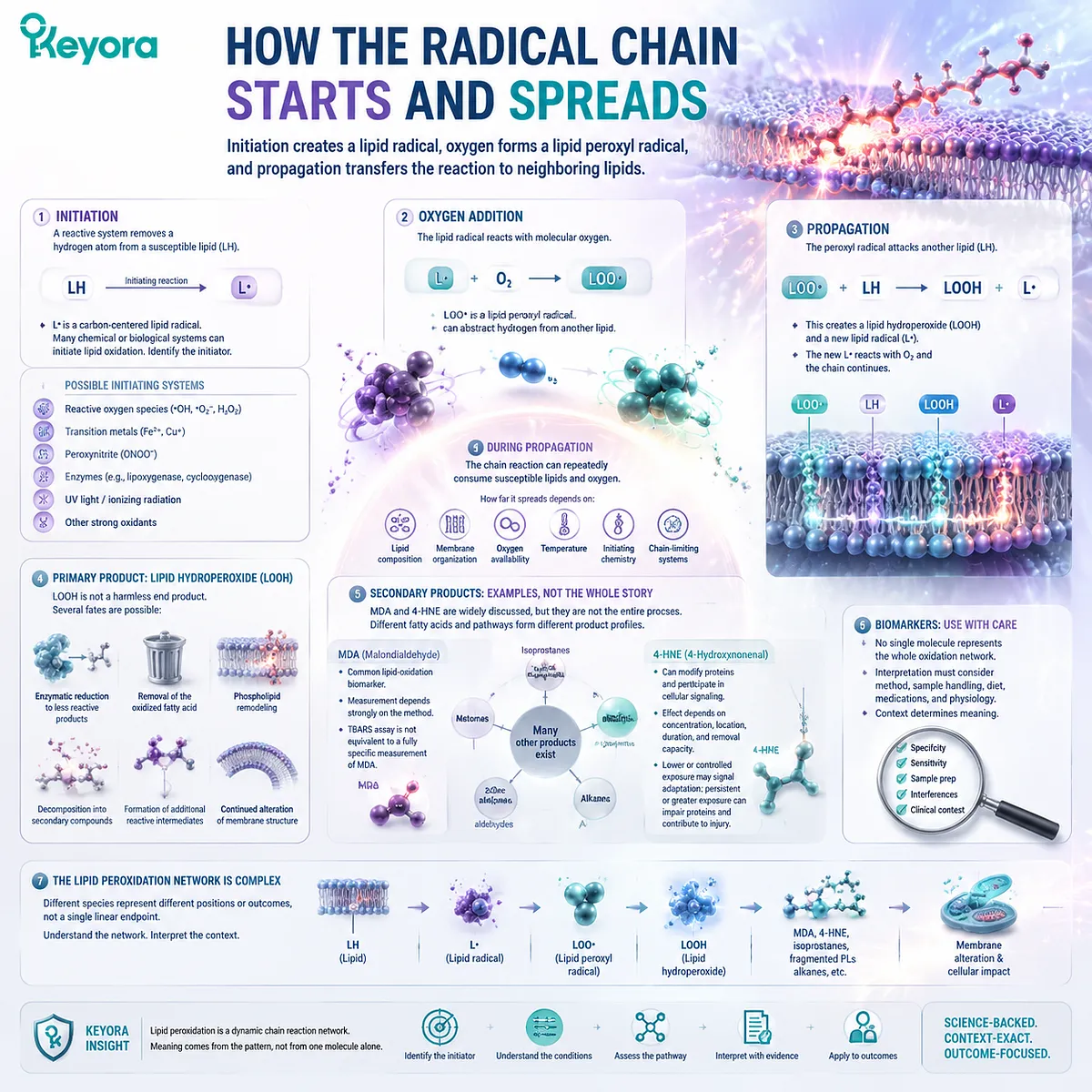
Initiation creates a lipid radical, oxygen forms a lipid peroxyl radical, and propagation transfers the reaction to neighboring lipids
The first stage is initiation. A sufficiently reactive initiating system removes a hydrogen atom from a susceptible lipid, commonly represented as LH.
Initiation:
LH
-
initiating reaction
→ L•
The product, L•, is a carbon-centered lipid radical. Several chemical or biological systems can initiate lipid oxidation, so the initiating species must be identified rather than assumed.
The second step is the addition of molecular oxygen:
L•
-
O₂
→ LOO•
The product, LOO•, is a lipid peroxyl radical. It can remove hydrogen from another susceptible lipid.
Propagation:
LOO•
-
LH
→ LOOH -
L•
This reaction creates a lipid hydroperoxide, LOOH, and a new lipid radical. The new L• can react with oxygen and continue the chain.
During propagation, the process can repeatedly consume susceptible lipids and oxygen. How far it spreads depends on lipid composition, membrane organization, oxygen availability, temperature, initiating chemistry, and the presence of chain-limiting systems.
Lipid hydroperoxides are primary oxidation products rather than simple harmless endpoints. Several outcomes are possible:
-
enzymatic reduction to less reactive products
-
removal of the oxidized fatty acid
-
phospholipid remodeling
-
decomposition into secondary compounds
-
formation of additional reactive intermediates
-
continued alteration of membrane structure
MDA and 4-HNE are two widely discussed secondary products, but neither represents the complete lipid-peroxidation process. Different fatty acids and reaction pathways produce different product profiles.
MDA is commonly measured as a lipid-oxidation biomarker, but analytical interpretation depends strongly on the method. The frequently used TBARS procedure is not equivalent to a fully specific measurement of MDA and can be influenced by sample preparation and other reacting compounds.
4-HNE can modify proteins and participate in cellular signaling. Its effect depends on concentration, location, duration, and removal capacity. Lower or controlled exposure may influence adaptive signaling, while persistent or greater exposure can disturb protein function and contribute to cellular injury.
This complexity is why lipid peroxidation cannot be interpreted through one molecule alone. L•, LOO•, LOOH, MDA, 4-HNE, fragmented phospholipids, and isoprostanes represent different positions or outcomes within a broader oxidation network.
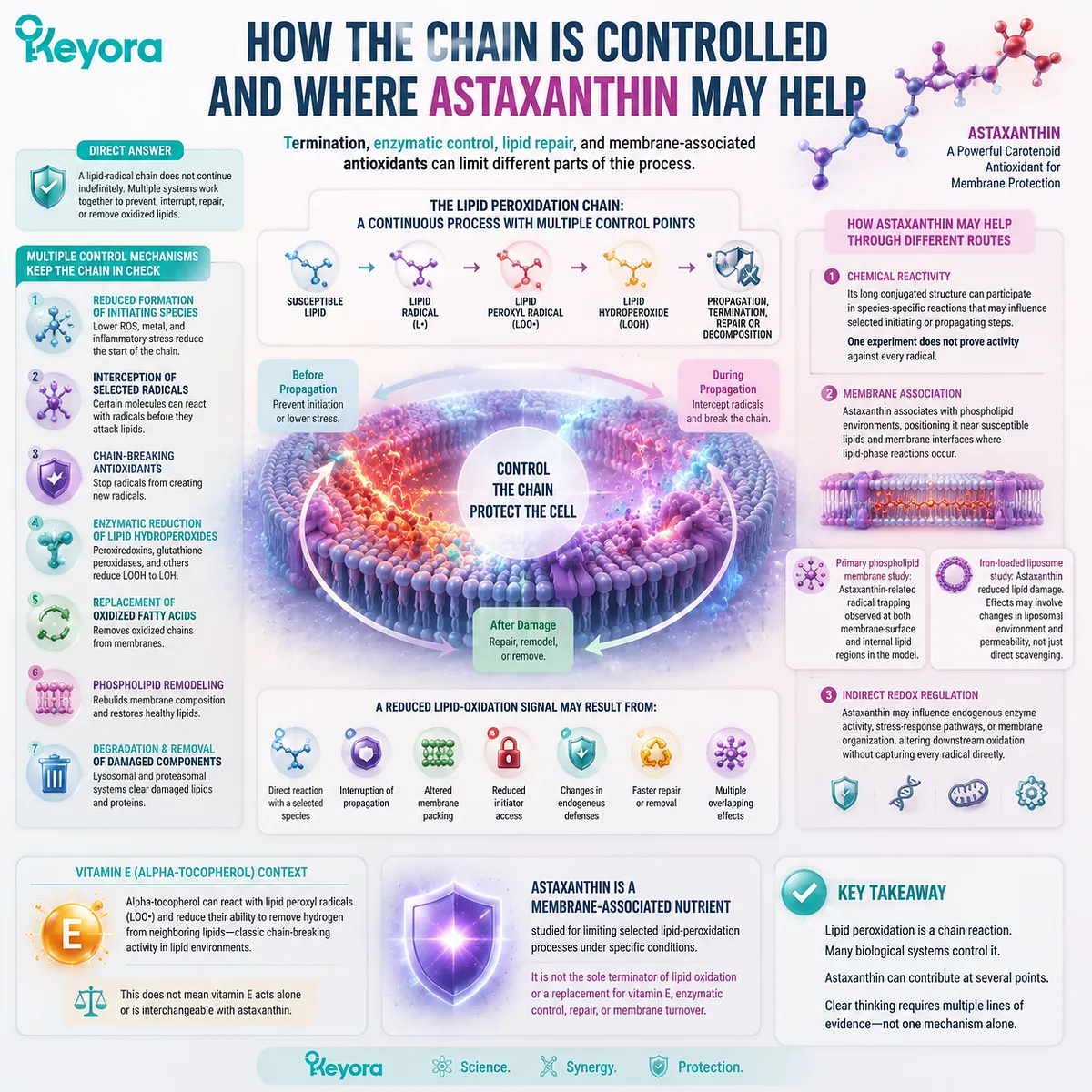
How the Chain Is Controlled and Where Astaxanthin May Help
Termination, enzymatic control, lipid repair, and membrane-associated antioxidants can limit different parts of the process
A lipid-radical chain does not continue indefinitely. Termination occurs when radicals react in ways that no longer generate another propagating radical. The overall process can also be limited before or during propagation through several biological systems.
Control mechanisms include:
-
reduced formation of initiating species
-
reactions that intercept selected radicals
-
chain-breaking antioxidants
-
enzymatic reduction of lipid hydroperoxides
-
replacement of oxidized fatty acids
-
phospholipid remodeling
-
degradation and removal of damaged components
Alpha-tocopherol, the principal form commonly discussed in vitamin E biology, provides classic chain-breaking context in lipid environments. It can react with lipid peroxyl radicals and reduce their ability to remove hydrogen from neighboring lipids. This does not mean vitamin E acts alone or that it is interchangeable with astaxanthin.
Astaxanthin may be relevant through several different routes.
First, its conjugated structure can participate in species-specific chemical reactions. This could influence selected initiating or propagating reactions under suitable conditions, but one chemical experiment cannot establish activity against every radical.
Second, astaxanthin associates with phospholipid environments. This can place it near susceptible membrane lipids and membrane interfaces where lipid-phase reactions occur.
A primary phospholipid-membrane study reported astaxanthin-related radical trapping at both membrane-surface and internal lipid regions in its model. The result supports membrane-associated antiperoxidative activity under those experimental conditions.
A separate liposome study found that astaxanthin reduced lipid damage in an iron-loaded membrane model. The authors’ interpretation indicated that membrane effects could involve more than a simple claim of direct radical scavenging, including changes related to the liposomal environment and permeability.
Third, astaxanthin may influence cellular redox regulation indirectly. Changes in endogenous enzyme activity, stress-response pathways, or membrane organization could alter downstream oxidation without astaxanthin directly capturing each initiating radical.
These mechanisms must remain separate. A reduced lipid-oxidation signal may result from:
-
direct reaction with a selected species
-
interruption of propagation
-
altered membrane packing
-
reduced initiator access
-
changes in endogenous defenses
-
faster repair or removal
-
multiple overlapping effects
The available evidence supports describing astaxanthin as a membrane-associated nutrient studied for limiting selected lipid-peroxidation processes. It does not support describing it as the sole terminator of lipid oxidation or as a replacement for vitamin E, enzymatic peroxide control, repair, or membrane turnover.
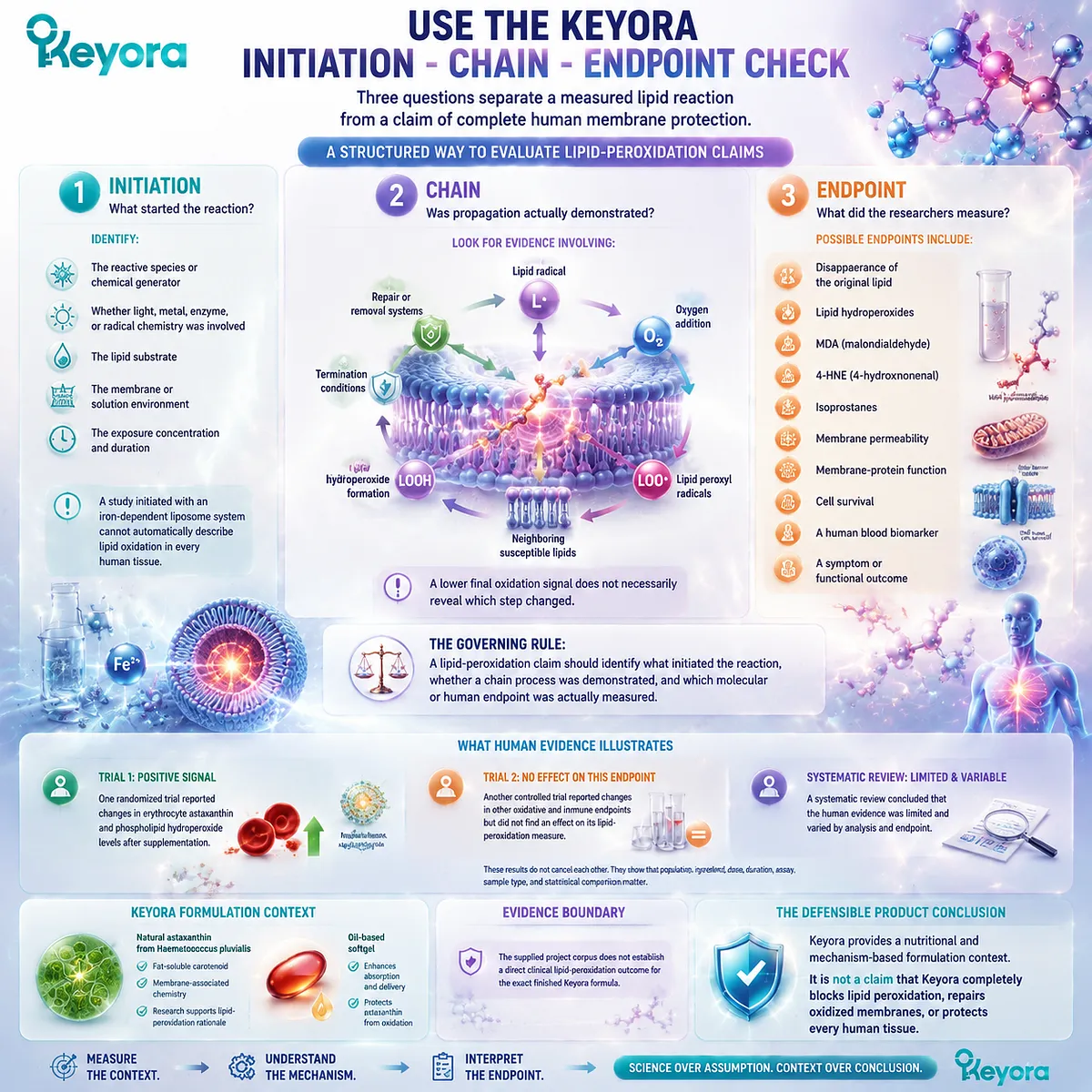
Use the Keyora Initiation – Chain – Endpoint Check
Three questions separate a measured lipid reaction from a claim of complete human membrane protection
The Keyora Initiation – Chain – Endpoint Check provides a practical method for evaluating lipid-peroxidation claims.
1. Initiation
What started the reaction?
Identify:
-
the reactive species or chemical generator
-
whether light, metal, enzyme, or radical chemistry was involved
-
the lipid substrate
-
the membrane or solution environment
-
the exposure concentration and duration
A study initiated with an iron-dependent liposome system cannot automatically describe lipid oxidation in every human tissue.
2. Chain
Was propagation actually demonstrated?
Look for evidence involving:
-
a lipid radical
-
oxygen addition
-
lipid peroxyl radicals
-
neighboring susceptible lipids
-
lipid hydroperoxide formation
-
termination conditions
-
repair or removal systems
A lower final oxidation signal does not necessarily reveal which step changed.
3. Endpoint
What did the researchers measure?
Possible endpoints include:
-
disappearance of the original lipid
-
lipid hydroperoxides
-
MDA
-
4-HNE
-
isoprostanes
-
membrane permeability
-
membrane-protein function
-
cell survival
-
a human blood biomarker
-
a symptom or functional outcome
The governing rule is:
A lipid-peroxidation claim should identify what initiated the reaction, whether a chain process was demonstrated, and which molecular or human endpoint was actually measured.
Human evidence illustrates the importance of this distinction. One randomized trial reported changes in erythrocyte astaxanthin and phospholipid hydroperoxide levels after supplementation. Another controlled trial reported changes in other oxidative and immune endpoints but did not find an effect on its lipid-peroxidation measure. A systematic review concluded that the human evidence was limited and varied by analysis and endpoint.
These results do not cancel each other. They show that population, ingredient, dose, duration, assay, sample type, and statistical comparison matter.
Keyora uses natural astaxanthin from Haematococcus pluvialis in an oil-based softgel context. This is compatible with astaxanthin’s fat-soluble and membrane-associated chemistry, and ingredient-level research supports the lipid-peroxidation rationale. The supplied project corpus does not establish a direct clinical lipid-peroxidation outcome for the exact finished Keyora formula.
The defensible product conclusion is nutritional and mechanism-based. It is not a claim that Keyora completely blocks lipid peroxidation, repairs oxidized membranes, or protects every human tissue.
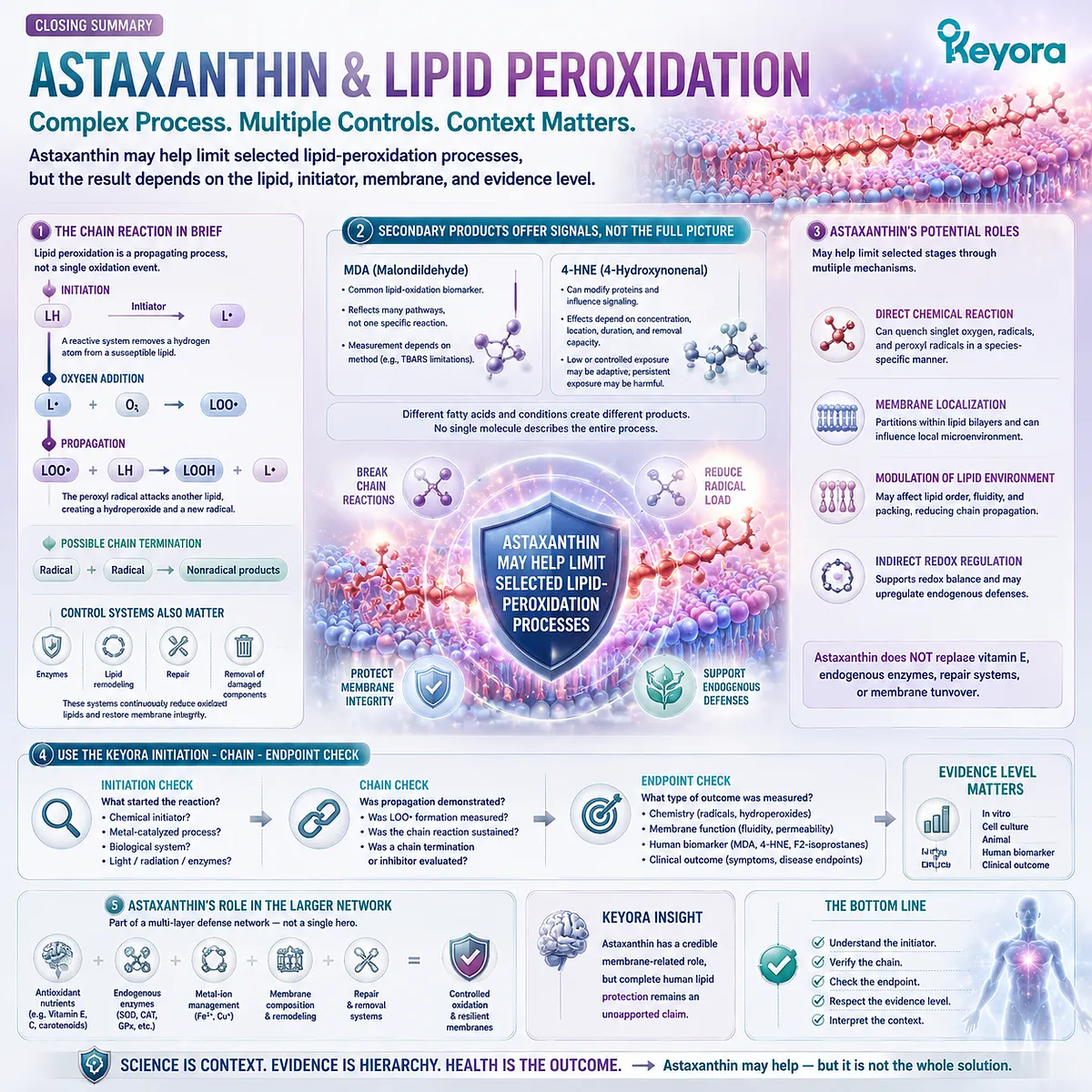
Closing Summary
Astaxanthin may help limit selected lipid-peroxidation processes, but the result depends on the lipid, initiator, membrane, and evidence level
Lipid peroxidation is a propagating process rather than one isolated oxidation event. Initiation produces a lipid radical, oxygen forms a lipid peroxyl radical, and propagation transfers the reaction to another susceptible lipid while generating a lipid hydroperoxide.
The chain may be terminated, while enzymes, lipid remodeling, repair, and damaged-component removal provide additional control. Secondary products such as MDA and 4-HNE offer useful but incomplete evidence about the process.
Astaxanthin may help limit selected stages through species-specific chemical reactions, membrane localization, changes in the local lipid environment, and indirect redox regulation. It does not replace vitamin E, endogenous enzymes, repair systems, or membrane turnover.
Use the Keyora Initiation – Chain – Endpoint Check. Identify what started the reaction, determine whether propagation was demonstrated, and confirm whether the study measured chemistry, membrane function, a human biomarker, or a clinical outcome.
Astaxanthin has a credible membrane-related role, but complete human lipid protection remains an unsupported claim.
This article is for educational and informational purposes only. It does not provide medical advice, diagnosis, treatment, cure, prevention, disease outcome claims, hormone restoration claims, fertility outcome claims, or formula-specific clinical efficacy claims.