
Do Extraction Method, Carrier Oil, and Softgel Form Affect Astaxanthin Quality?
Keyora Research Q&A Library
This is part of the Keyora Research Q&A Series, derived from Keyora Nutritional Neurology Series .
Within the Keyora Nutritional Neurology framework, this Q&A translates complex nutrient–brain mechanisms into reader-friendly, evidence-bound answers, focusing on stress resilience, sleep quality, calm mood support, cognitive wellness, and the broader interaction between nutrition, neurochemistry, and daily nervous-system function.
First published by Keyora Research Journal: www.keyorahealth.com

Direct Answer
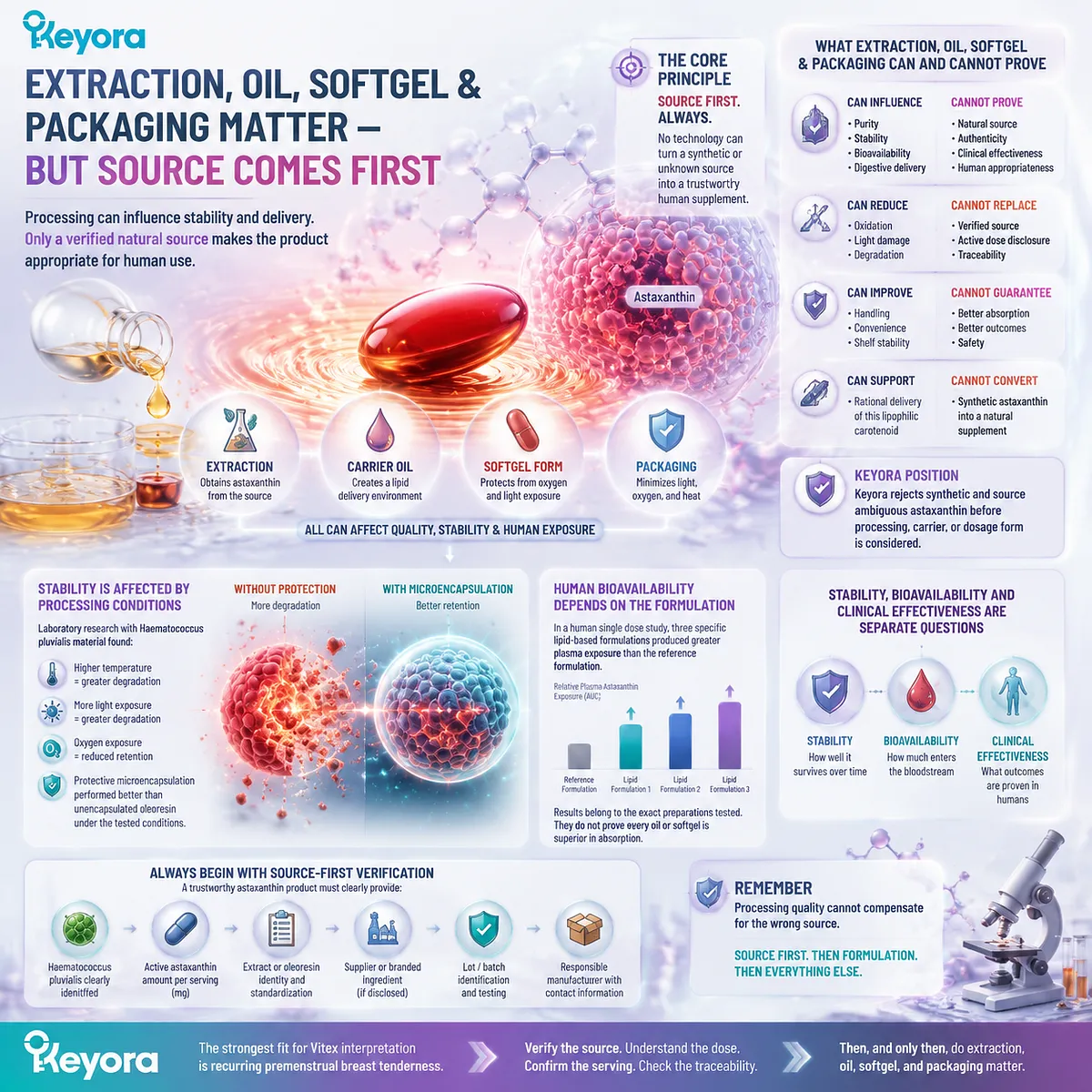
Extraction method, carrier oil, softgel form, and packaging can affect astaxanthin quality, stability, digestive delivery, and human exposure.
However, none of these features can independently prove that a product is natural, well preserved, better absorbed, clinically effective, or appropriate for human ingestion.
The assessment must begin with a verified natural source.
The product should identify Haematococcus pluvialis, state the active astaxanthin amount, and provide traceable supplier and batch information.
Processing or formulation technology cannot repair a synthetic or source ambiguous ingredient.
Manufacturing conditions matter because astaxanthin can be affected by temperature, oxygen, light, processing time, and storage.
Laboratory research with Haematococcus pluvialis material found greater degradation under increased temperature and illumination, while oxygen exposure reduced retention.
Protective microencapsulation performed better than the unencapsulated oleoresin under the tested conditions.
A lipid carrier can create a rational delivery environment for this highly lipophilic carotenoid. In a human single dose study, three specific lipid based formulations produced greater plasma exposure than the reference formulation, but those results belonged to the exact preparations tested. They do not prove that every oil or softgel provides superior absorption.
Stability, bioavailability, and clinical effectiveness remain separate questions.
A better delivery system cannot convert synthetic astaxanthin into an appropriate human supplement. Keyora rejects synthetic and source ambiguous astaxanthin before processing, carrier, or dosage form is considered.
Processing Conditions Can Affect Quality Without Proving Superiority
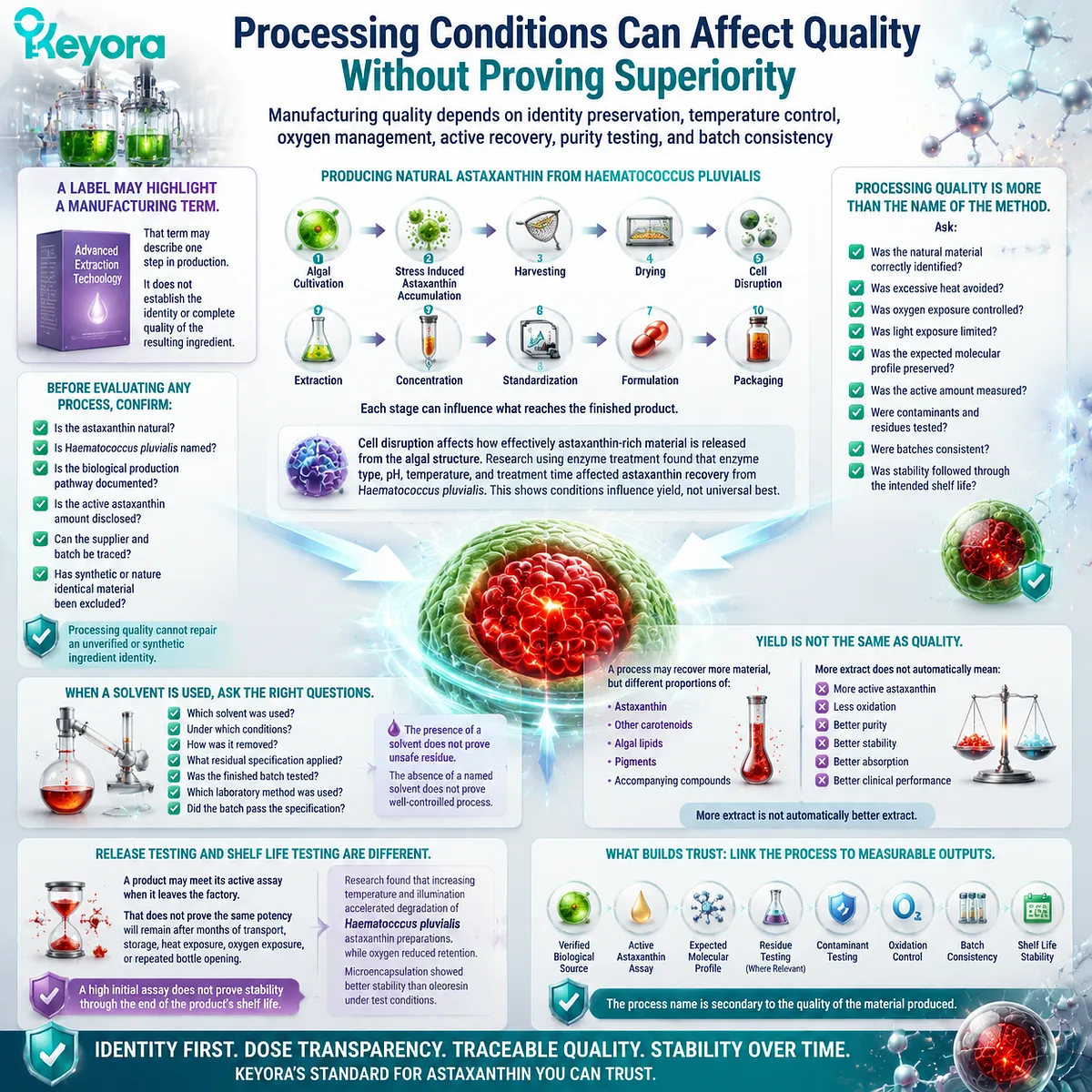
Manufacturing quality depends on identity preservation, temperature control, oxygen management, active recovery, purity testing, and batch consistency
A label may place a manufacturing term prominently on the front of the package.
That term may describe one step in production. It does not establish the identity or complete quality of the resulting ingredient.
Before evaluating any extraction or manufacturing process, confirm:
-
Is the astaxanthin natural?
-
Is Haematococcus pluvialis named?
-
Is the biological production pathway documented?
-
Is the active astaxanthin amount disclosed?
-
Can the supplier and batch be traced?
-
Has synthetic or nature identical material been excluded?
Processing quality cannot repair an unverified or synthetic ingredient identity
Producing natural astaxanthin from Haematococcus pluvialis may involve:
-
algal cultivation
-
stress induced astaxanthin accumulation
-
harvesting
-
drying
-
cell disruption
-
extraction
-
concentration
-
standardization
-
formulation
-
packaging
Each stage can influence what reaches the finished product.
Cell disruption affects how effectively astaxanthin rich material is released from the algal structure. Research using enzyme treatment found that the enzyme type, pH, temperature, and treatment time affected astaxanthin recovery from Haematococcus pluvialis. This demonstrates that processing conditions influence yield, but it does not establish that one technique is universally best.
The relevant quality questions are not limited to the name of the method.
Ask:
-
Was the natural material correctly identified?
-
Was excessive heat avoided?
-
Was oxygen exposure controlled?
-
Was light exposure limited?
-
Was the expected molecular profile preserved?
-
Was the active amount measured?
-
Were contaminants and residues tested?
-
Were batches consistent?
-
Was stability followed through the intended shelf life?
The same discipline applies when a solvent is used during processing.
The presence of a solvent during manufacturing does not prove that an unsafe residue remains in the finished ingredient. The absence of a clearly named solvent also does not prove that the process was well controlled.
The useful questions are:
-
Which solvent was used?
-
Under which conditions?
-
How was it removed?
-
What residual specification applied?
-
Was the finished batch tested?
-
Which laboratory method was used?
-
Did the batch pass the specification?
The meaningful question is whether processing preserved the verified natural ingredient and whether the finished batch met its identity, potency, purity, and stability requirements
Yield must also remain separate from quality.
A process that recovers more material may recover different proportions of:
-
astaxanthin
-
other carotenoids
-
algal lipids
-
pigments
-
accompanying compounds
A larger amount of extract does not automatically mean:
-
more active astaxanthin
-
less oxidation
-
better purity
-
better stability
-
better absorption
-
better clinical performance
More extract is not automatically better extract
Release testing and shelf life testing must also be separated.
A product may meet its active assay when it leaves the factory. That does not prove that the same potency will remain after months of transport, storage, heat exposure, oxygen exposure, or repeated bottle opening.
Laboratory research found that increasing temperature and illumination accelerated degradation of Haematococcus pluvialis astaxanthin preparations, while exposure to oxygen reduced retention. The same study found better stability for microencapsulated material than for the tested oleoresin under its experimental conditions.
This supports a practical conclusion:
A high initial assay does not prove stability through the end of the product’s shelf life
A trustworthy company should connect its manufacturing statements to measurable outputs:
-
verified biological source
-
active astaxanthin assay
-
expected molecular profile
-
residue testing where relevant
-
contaminant testing
-
oxidation control
-
batch consistency
-
shelf life stability
The process name is secondary to the quality of the material produced.
Carrier Oil, Softgel Form, and Packaging Shape the Delivery Context
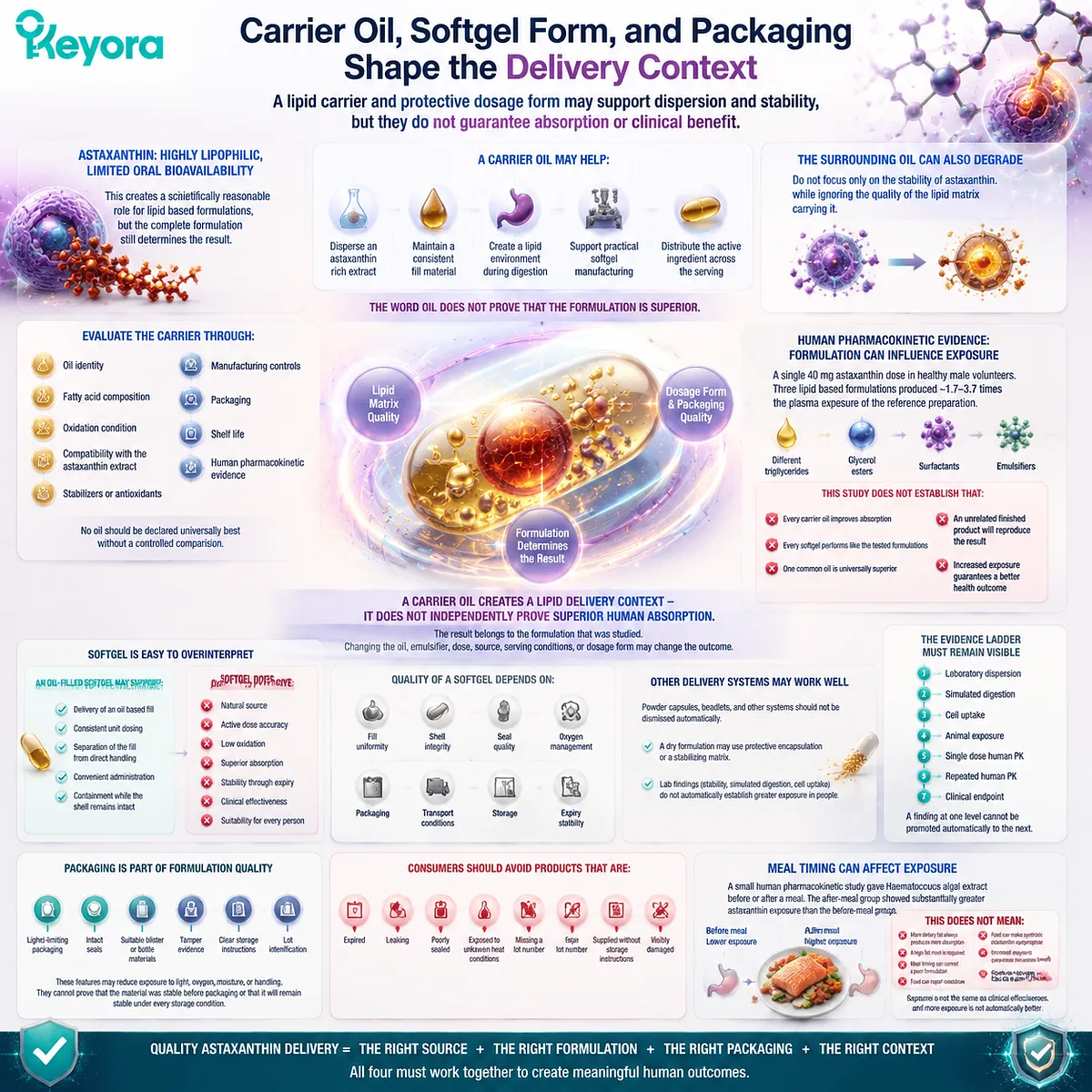
A lipid carrier and protective dosage form may support dispersion and stability, but they do not guarantee absorption or clinical benefit
Astaxanthin is highly lipophilic and has limited oral bioavailability. This creates a scientifically reasonable role for lipid based formulations, but the complete formulation still determines the result.
A carrier oil may help:
-
disperse an astaxanthin rich extract
-
maintain a consistent fill material
-
create a lipid environment during digestion
-
support practical softgel manufacturing
-
distribute the active ingredient across the serving
The word oil does not prove that the formulation is superior.
The carrier should be evaluated through:
-
oil identity
-
fatty acid composition
-
oxidation condition
-
compatibility with the astaxanthin extract
-
stabilizers or antioxidants
-
manufacturing controls
-
packaging
-
shelf life
-
human pharmacokinetic evidence
The surrounding oil can also degrade.
A product should not focus only on the stability of astaxanthin while ignoring the quality of the lipid matrix carrying it.
No oil should be declared universally best without a controlled comparison.
An appropriate comparison would need to hold constant:
-
natural astaxanthin source
-
active dose
-
molecular form
-
dosage form
-
serving conditions
-
participant population
-
blood sampling schedule
-
pharmacokinetic endpoints
A human comparative study tested a single 40 mg astaxanthin dose in healthy male volunteers. Three specifically designed lipid based formulations produced approximately 1.7 to 3.7 times the plasma exposure of the reference preparation. The formulations included different triglycerides, glycerol esters, surfactants, and emulsifiers.
This study establishes that formulation can influence exposure.
It does not establish that:
-
every carrier oil improves absorption
-
every softgel performs like the tested formulations
-
one common oil is universally superior
-
an unrelated finished product will reproduce the result
-
increased exposure guarantees a better health outcome
A carrier oil creates a lipid delivery context – it does not independently prove superior human absorption
The result belongs to the formulation that was studied.
Changing the oil, emulsifier, dose, astaxanthin source, serving conditions, or dosage form may change the outcome.
Softgel is similarly easy to overinterpret.
An oil filled softgel may support:
-
delivery of an oil based fill
-
consistent unit dosing
-
separation of the fill from direct handling
-
convenient administration
-
containment while the shell remains intact
A softgel does not prove:
-
natural source
-
active dose accuracy
-
low oxidation
-
superior absorption
-
stability through expiry
-
clinical effectiveness
-
suitability for every person
Softgel is a delivery format – not an automatic bioavailability claim
The quality of a softgel depends on:
-
fill uniformity
-
shell integrity
-
seal quality
-
oxygen management
-
packaging
-
transport conditions
-
storage
-
expiry stability
Powder capsules, beadlets, and other delivery systems should not be dismissed automatically.
A dry formulation may use protective encapsulation or a stabilizing matrix. Laboratory findings can show improved stability or simulated digestive release, but those results do not automatically establish greater exposure in people.
The evidence ladder must remain visible:
Laboratory dispersion
↓
Simulated digestion
↓
Cell uptake
↓
Animal exposure
↓
Single dose human pharmacokinetics
↓
Repeated human pharmacokinetics
↓
Clinical endpoint
A finding at one level cannot be promoted automatically to the next.
Packaging is also part of formulation quality.
Useful protective features may include:
-
light limiting packaging
-
intact seals
-
suitable blister or bottle materials
-
tamper evidence
-
clear storage instructions
-
lot identification
-
packaging appropriate for the expected use period
These features may reduce exposure to light, oxygen, moisture, or handling.
They cannot prove that the material was stable before packaging or that it will remain stable under every storage condition.
Consumers should avoid products that are:
-
expired
-
leaking
-
poorly sealed
-
exposed to unknown heat conditions
-
missing a lot number
-
supplied without storage instructions
-
visibly damaged
Meal timing can also affect exposure.
A small human pharmacokinetic study gave Haematococcus algal extract before or after a meal. The after meal group showed substantially greater astaxanthin exposure than the before meal group, although the study groups were small and the result belongs to the tested preparation and meal conditions.
This supports taking the labeled product in a food context when its instructions recommend that approach.
It does not mean:
-
more dietary fat always produces more absorption
-
a high fat meal is required
-
meal timing can correct a poor formulation
-
food can repair oxidation
-
food can make synthetic astaxanthin appropriate
-
increased exposure guarantees increased benefit
Exposure is not the same as clinical effectiveness, and more exposure is not automatically better
Use the Source – Process – Carrier – Protection – Proof Check
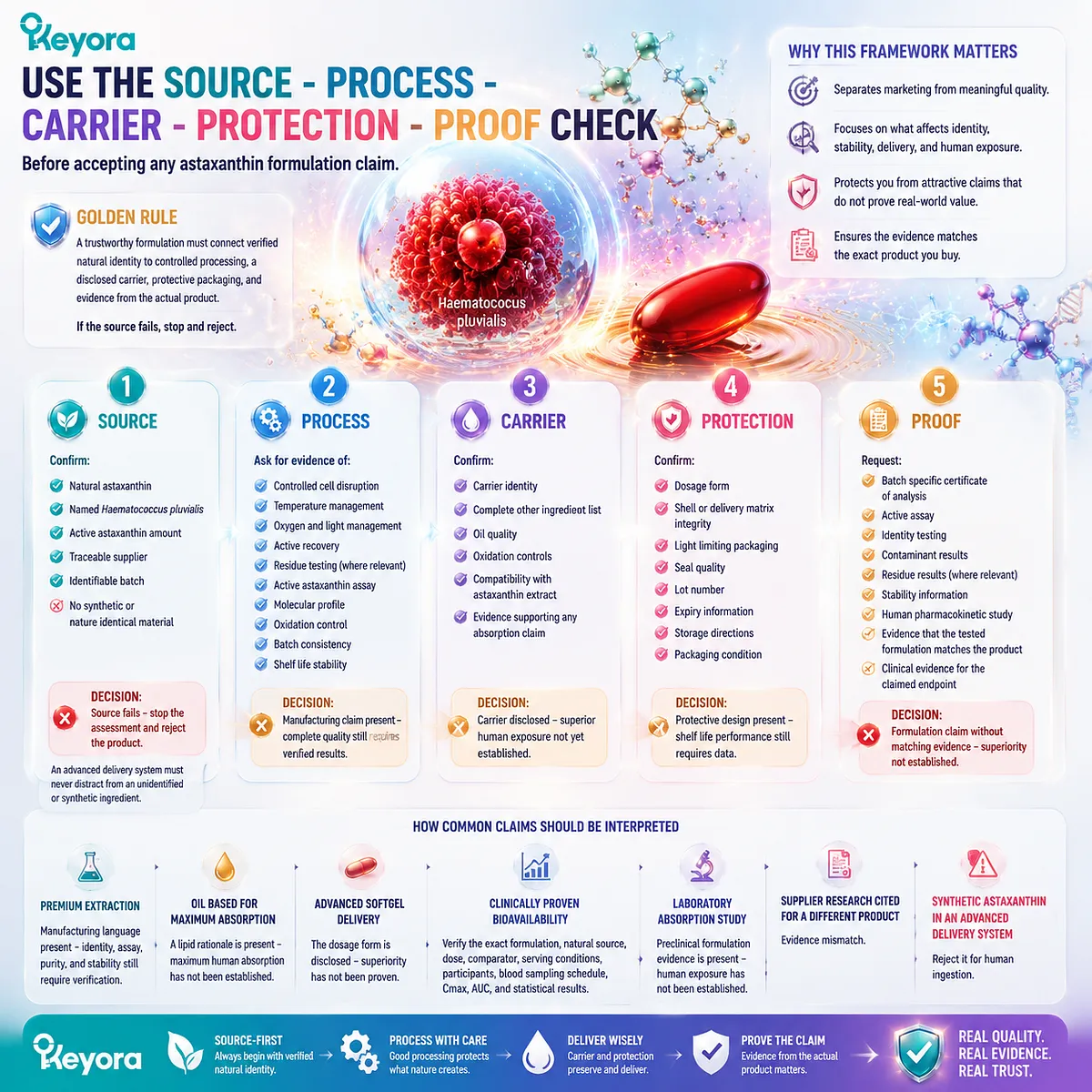
A trustworthy formulation must connect verified natural identity to controlled processing, a disclosed carrier, protective packaging, and evidence from the actual product
Use the Source – Process – Carrier – Protection – Proof Check before accepting a formulation claim.
1. Source
Confirm:
-
natural astaxanthin
-
named Haematococcus pluvialis
-
active astaxanthin amount
-
traceable supplier
-
identifiable batch
-
no synthetic or nature identical material
Decision:
Source fails – stop the assessment and reject the product
An advanced delivery system must never distract from an unidentified or synthetic ingredient.
2. Process
Ask for evidence of:
-
controlled cell disruption
-
temperature management
-
oxygen and light management
-
active recovery
-
residue testing where relevant
-
active astaxanthin assay
-
molecular profile
-
oxidation control
-
batch consistency
-
shelf life stability
Decision:
Manufacturing claim present – complete quality still requires verified results
3. Carrier
Confirm:
-
carrier identity
-
complete other ingredient list
-
oil quality
-
oxidation controls
-
compatibility with the astaxanthin extract
-
evidence supporting any absorption claim
Decision:
Carrier disclosed – superior human exposure not yet established
4. Protection
Confirm:
-
dosage form
-
shell or delivery matrix integrity
-
light limiting packaging
-
seal quality
-
lot number
-
expiry information
-
storage directions
-
packaging condition
Decision:
Protective design present – shelf life performance still requires data
5. Proof
Request:
-
batch specific certificate of analysis
-
active assay
-
identity testing
-
contaminant results
-
residue results where relevant
-
stability information
-
human pharmacokinetic study
-
evidence that the tested formulation matches the product
-
clinical evidence for the claimed endpoint
Decision:
Formulation claim without matching evidence – superiority not established
Common claims should be interpreted as follows:
Premium extraction
Manufacturing language present – identity, assay, purity, and stability still require verification.
Oil based for maximum absorption
A lipid rationale is present – maximum human absorption has not been established.
Advanced softgel delivery
The dosage form is disclosed – superiority has not been proven.
Clinically proven bioavailability
Verify the exact formulation, natural source, dose, comparator, serving conditions, participants, blood sampling schedule, Cmax, AUC, and statistical results.
Laboratory absorption study
Preclinical formulation evidence is present – human exposure has not been established.
Supplier research cited for a different finished product
Evidence mismatch.
Synthetic astaxanthin in an advanced delivery system
Reject it for human ingestion.
Increasing exposure to an inadequately supported synthetic material would not resolve its identity, human evidence, or safety problems.
What This Means When Choosing Astaxanthin
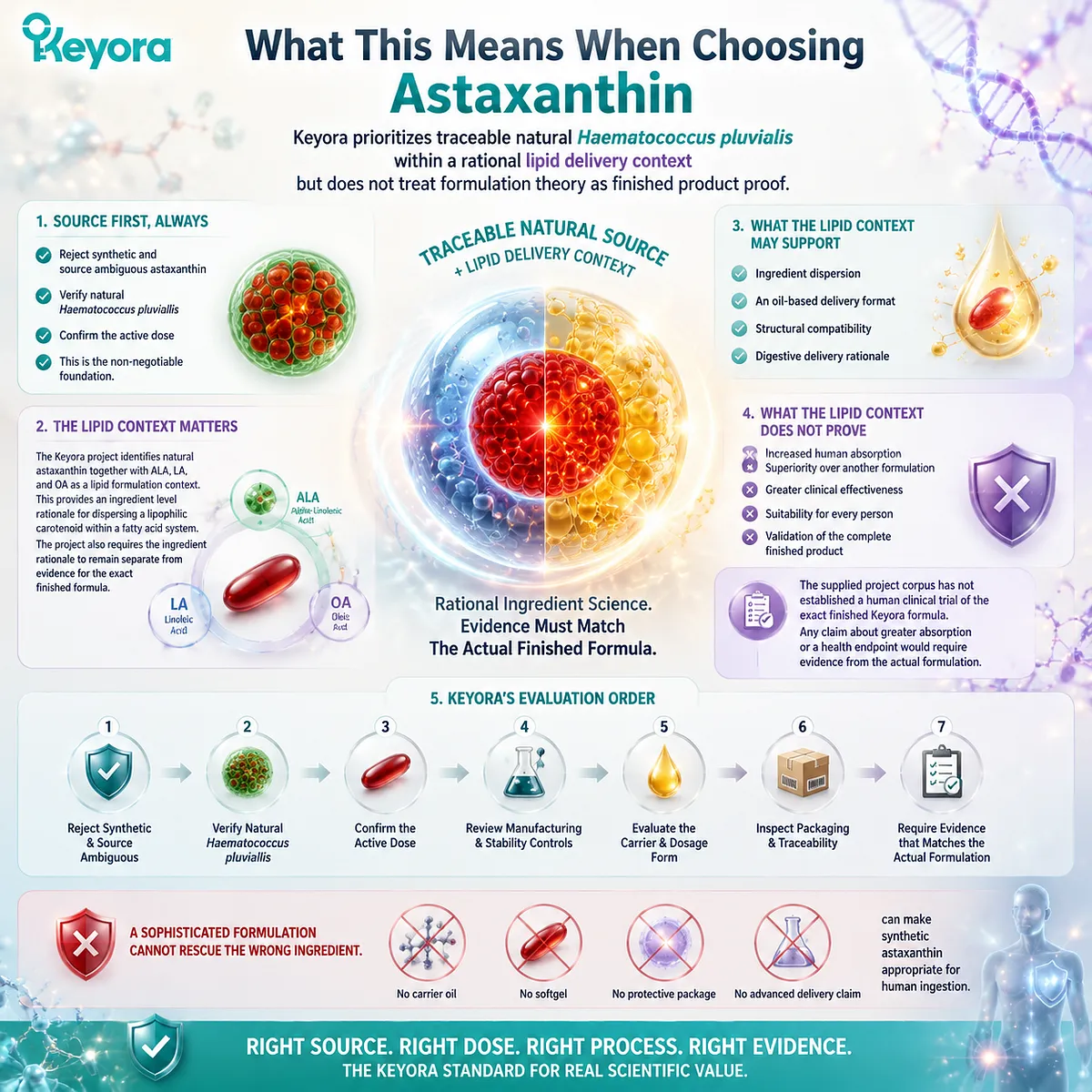
Keyora prioritizes traceable natural Haematococcus pluvialis within a rational lipid delivery context but does not treat formulation theory as finished product proof
Keyora evaluates formulation only after the natural source has been verified.
The Keyora project identifies natural astaxanthin together with ALA, LA, and OA as a lipid formulation context. This provides an ingredient level rationale for dispersing a lipophilic carotenoid within a fatty acid system. The project also requires the ingredient rationale to remain separate from evidence for the exact finished formula.
This lipid context may support:
-
ingredient dispersion
-
an oil based delivery format
-
structural compatibility
-
digestive delivery rationale
It does not independently prove:
-
increased human absorption
-
superiority over another formulation
-
greater clinical effectiveness
-
suitability for every person
-
validation of the complete finished product
The supplied project corpus has not established a human clinical trial of the exact finished Keyora formula. Any claim about greater absorption or a health endpoint would require evidence from the actual formulation.
Keyora’s evaluation order is:
-
Reject synthetic and source ambiguous astaxanthin
-
Verify natural Haematococcus pluvialis
-
Confirm the active dose
-
Review manufacturing and stability controls
-
Evaluate the carrier and dosage form
-
Inspect packaging and traceability
-
Require evidence that matches the actual formulation
A sophisticated formulation cannot rescue the wrong ingredient.
No carrier oil, softgel, protective package, or advanced delivery claim can make synthetic astaxanthin appropriate for human ingestion
Closing Summary
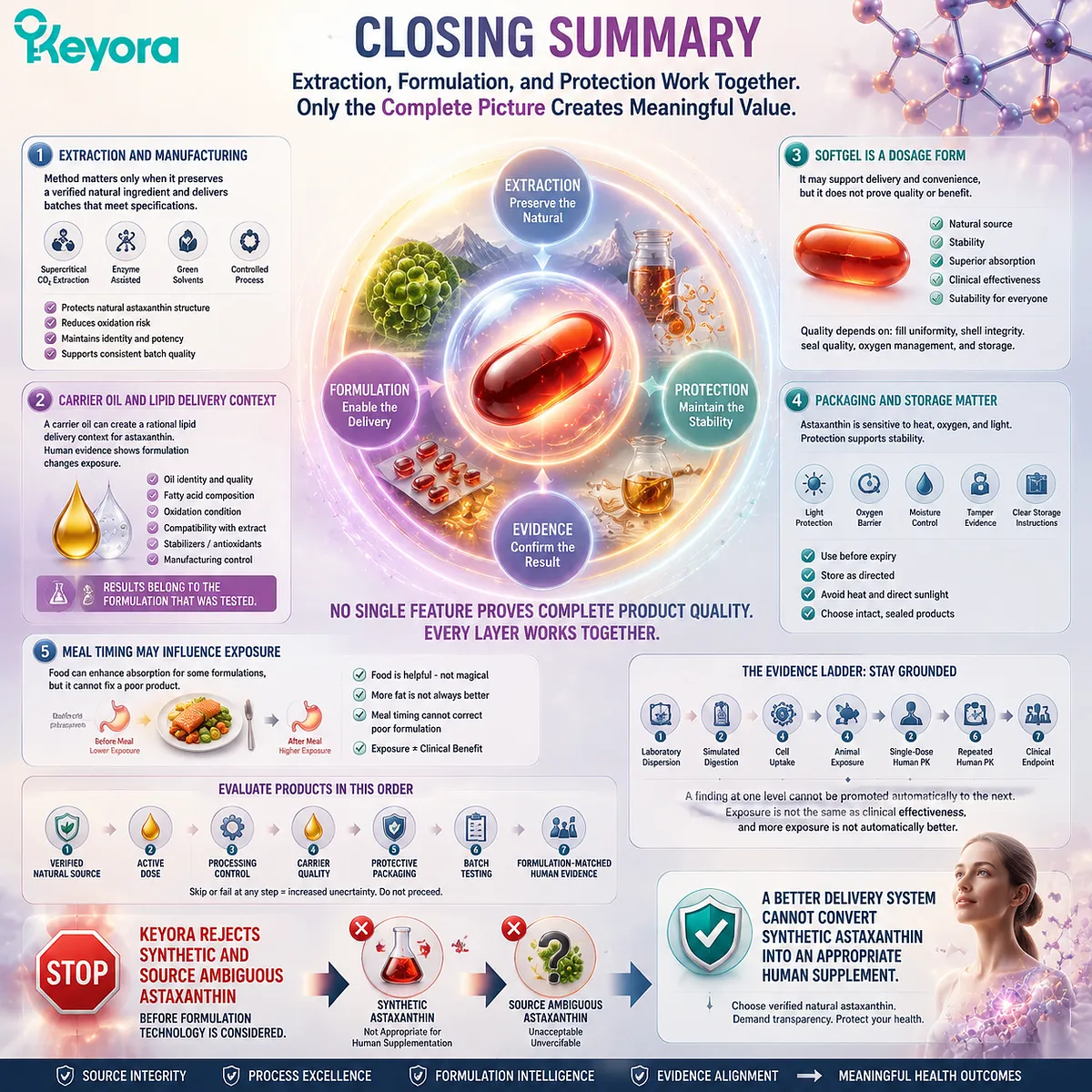
Extraction method, carrier oil, softgel form, and packaging can influence astaxanthin stability, delivery, and exposure, but no single feature proves complete product quality.
Manufacturing should be judged by whether it preserves a verified natural ingredient and produces batches that meet identity, potency, purity, and stability specifications. The method name alone is not enough.
A carrier oil can create a rational lipid delivery context. Human evidence confirms that specific lipid based formulations can change astaxanthin exposure, but the result remains attached to the exact formulation tested.
Softgel is a dosage form, not proof of natural origin, stability, superior absorption, or clinical effectiveness. Packaging and storage also matter because temperature, oxygen, and light can accelerate astaxanthin degradation.
Meal timing may influence exposure, but food cannot repair an oxidized, poorly documented, synthetic, or source ambiguous product.
Evaluate products in this order:
Verified natural source – active dose – processing control – carrier quality – protective packaging – batch testing – formulation matched human evidence
Keyora rejects synthetic and source ambiguous astaxanthin before formulation technology is considered.
A better delivery system cannot convert synthetic astaxanthin into an appropriate human supplement
This article is for educational and informational purposes only. It does not provide medical advice, diagnosis, treatment, cure, prevention, disease outcome claims, hormone restoration claims, fertility outcome claims, or formula-specific clinical efficacy claims.