
What Should a High-Quality Natural Astaxanthin Label Show?
Keyora Research Q&A Library
This is part of the Keyora Research Q&A Series, derived from Keyora Nutritional Neurology Series .
Within the Keyora Nutritional Neurology framework, this Q&A translates complex nutrient–brain mechanisms into reader-friendly, evidence-bound answers, focusing on stress resilience, sleep quality, calm mood support, cognitive wellness, and the broader interaction between nutrition, neurochemistry, and daily nervous-system function.
First published by Keyora Research Journal: www.keyorahealth.com
Direct Answer
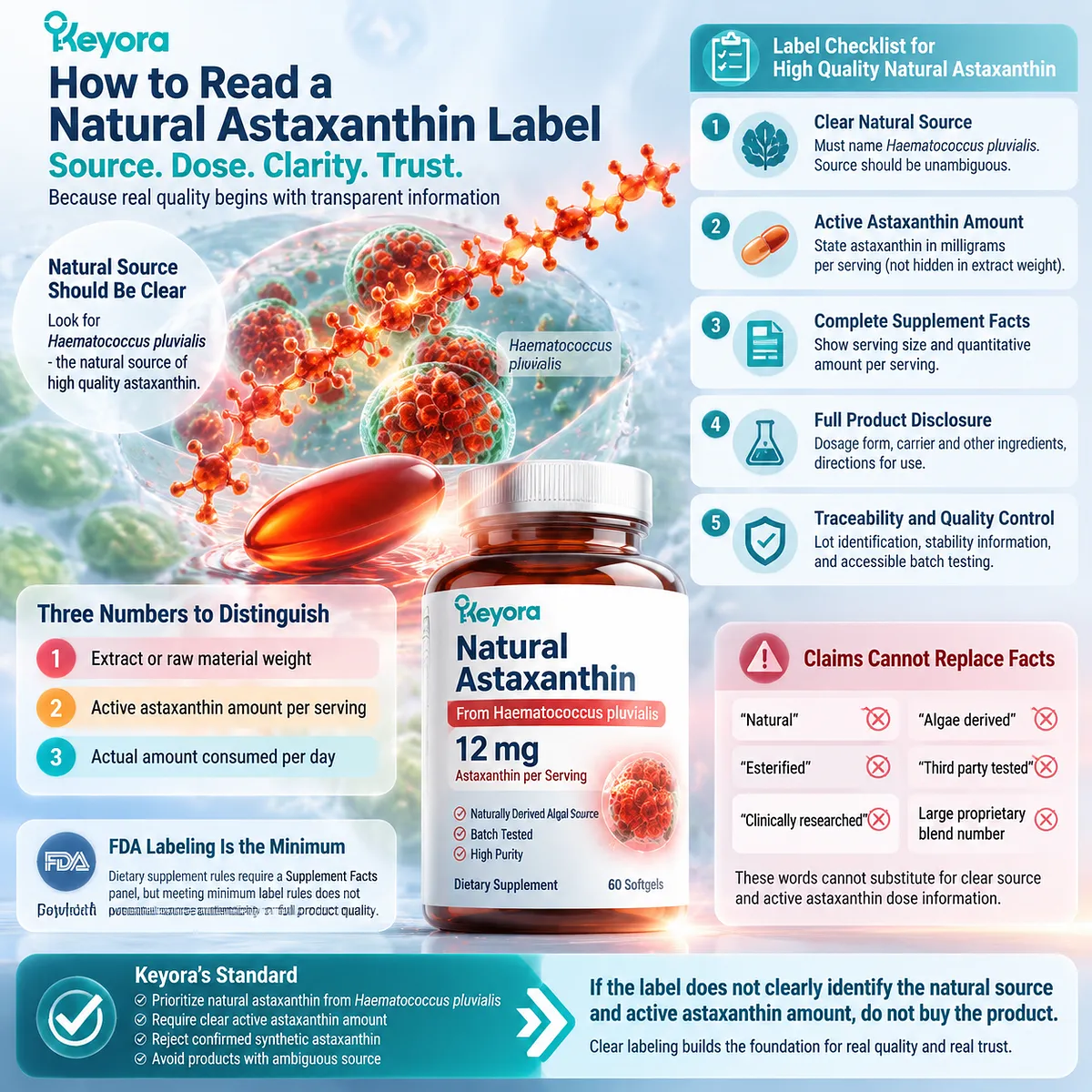
A high quality natural astaxanthin label should identify what the ingredient is, where it comes from, how much active astaxanthin the serving provides, how the serving is calculated, and which company is responsible for the product.
For Keyora’s natural source standard, the label should clearly name Haematococcus pluvialis.
The active amount should be stated as astaxanthin in milligrams per serving rather than hidden inside the larger weight of an algae extract, oleoresin, biomass, beadlet, or proprietary blend.
FDA dietary supplement labeling rules require a Supplement Facts presentation that identifies the serving size, dietary ingredients, and quantitative amount per serving, but meeting minimum label rules does not prove natural source authenticity or complete product quality.
Consumers must distinguish three numbers:
-
extract or raw material weight
-
active astaxanthin amount per serving
-
actual amount consumed per day
The label should also disclose the dosage form, carrier and other ingredients, responsible manufacturer, packer, or distributor, and clear directions for use. Lot identification, stability information, and accessible batch testing strengthen traceability.
The words natural, algae derived, esterified, third party tested, or clinically researched cannot replace these disclosures. A large proprietary blend number also cannot substitute for the active astaxanthin dose.
If the label does not clearly identify the natural source and active astaxanthin amount, do not buy the product. Keyora rejects confirmed synthetic astaxanthin and products whose source remains ambiguous.
A High Quality Label Should Identify the Source and Active Dose
Natural astaxanthin should be connected to Haematococcus pluvialis and expressed as an active amount rather than hidden inside an extract or blend total
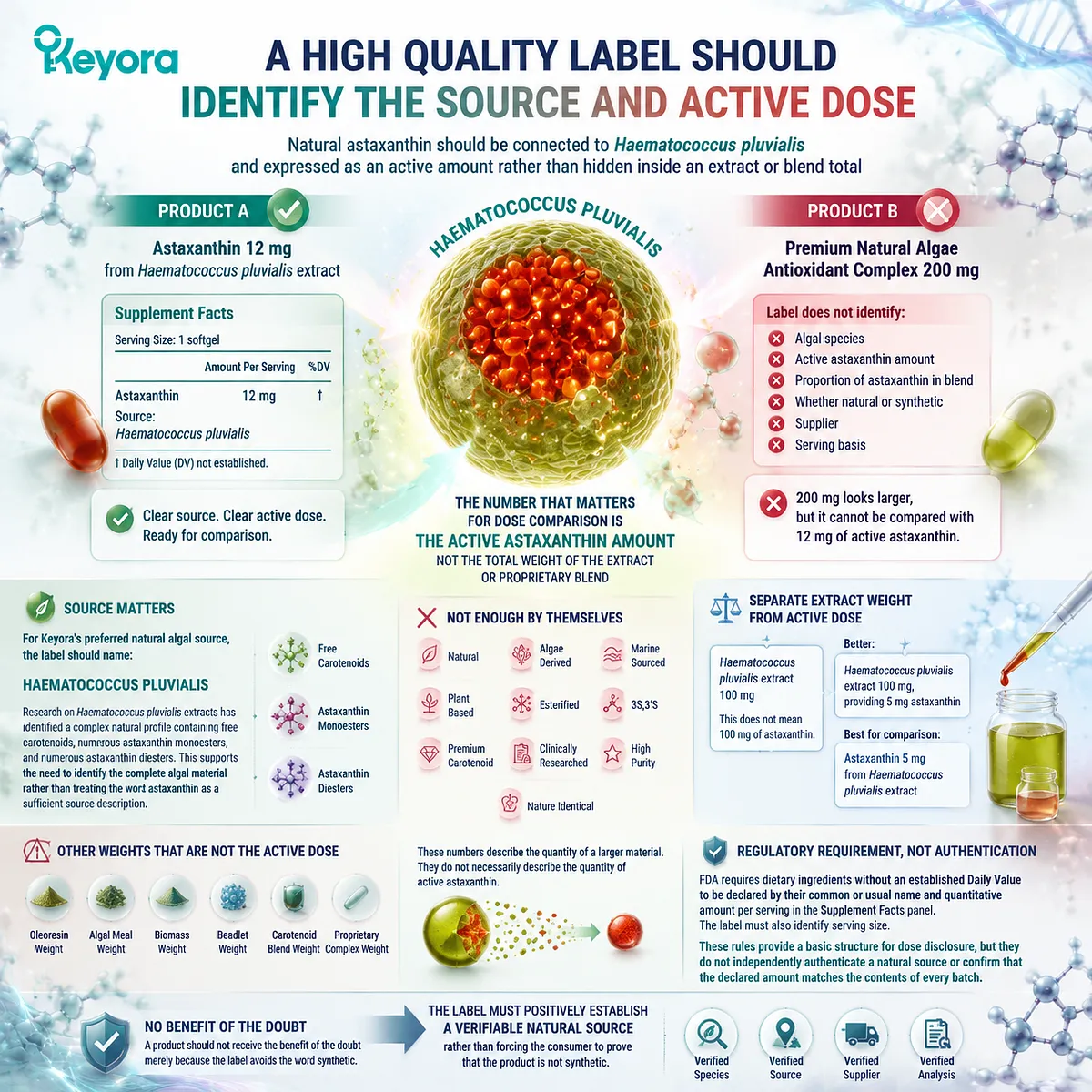
Consider two hypothetical labels.
Product A states:
Astaxanthin 12 mg from Haematococcus pluvialis extract
Its Supplement Facts panel says:
-
Serving Size: 1 softgel
-
Astaxanthin: 12 mg
-
Source: Haematococcus pluvialis
Product B states:
Premium Natural Algae Antioxidant Complex 200 mg
Its label does not identify:
-
the algal species
-
the active astaxanthin amount
-
the proportion of astaxanthin in the blend
-
whether the ingredient is natural or synthetic
-
the supplier
-
the serving basis
The 200 mg number may appear larger, but it cannot be compared with 12 mg of active astaxanthin.
The blend could contain algae biomass, carrier material, stabilizers, other carotenoids, or an extract containing only a small amount of astaxanthin.
The number that matters for dose comparison is the active astaxanthin amount – not the total weight of the algae extract or proprietary blend
The first source question is equally important.
A label that says only natural astaxanthin has made a claim, but it has not fully identified the biological origin.
For Keyora’s preferred natural algal source, the label should name:
Haematococcus pluvialis
Research on Haematococcus pluvialis extracts has identified a complex natural profile containing free carotenoids, numerous astaxanthin monoesters, and numerous astaxanthin diesters. This supports the need to identify the complete algal material rather than treating the word astaxanthin as a sufficient source description.
The following front label terms are not enough by themselves:
-
natural
-
algae derived
-
marine sourced
-
plant based
-
esterified
-
3S,3′S
-
premium carotenoid
-
clinically researched
-
high purity
-
nature identical
The phrase algae derived is more informative than a generic natural claim, but it still leaves important questions.
Which algae?
Did the algae produce the astaxanthin?
Is the product an actual algal extract?
Was synthetic astaxanthin added to an algae based carrier or blend?
A high trust label should make the source organism clear enough that the claim can be tested against supplier and analytical records.
The active dose must also be separated from raw material weight.
A label may state:
Haematococcus pluvialis extract 100 mg
That does not mean the serving contains 100 mg of astaxanthin.
The extract includes a wider material matrix. The active amount depends on the extract’s astaxanthin concentration and standardization.
A transparent presentation might state:
Haematococcus pluvialis extract 100 mg, providing 5 mg astaxanthin
An even clearer presentation for product comparison is:
Astaxanthin 5 mg from Haematococcus pluvialis extract
Consumers should not be forced to calculate the active dose from a percentage that is missing, ambiguous, or unsupported.
The same rule applies to:
-
oleoresin weight
-
algal meal weight
-
biomass weight
-
beadlet weight
-
carotenoid blend weight
-
proprietary complex weight
These numbers describe the quantity of a larger material. They do not necessarily describe the quantity of active astaxanthin.
FDA requires dietary ingredients without an established Daily Value to be declared by their common or usual name and quantitative amount per serving in the Supplement Facts panel. The label must also identify serving size. These rules provide a basic structure for dose disclosure, but they do not independently authenticate a natural source or confirm that the declared amount matches the contents of every batch.
A product should not receive the benefit of the doubt merely because the label avoids the word synthetic.
The label must positively establish a verifiable natural source rather than forcing the consumer to prove that the product is not synthetic
Serving Size, Formulation, and Traceability Must Be Clear
The consumer should be able to determine the actual daily amount, delivery form, responsible company, and identifiable product batch
A milligram number has little meaning until the serving basis is understood.
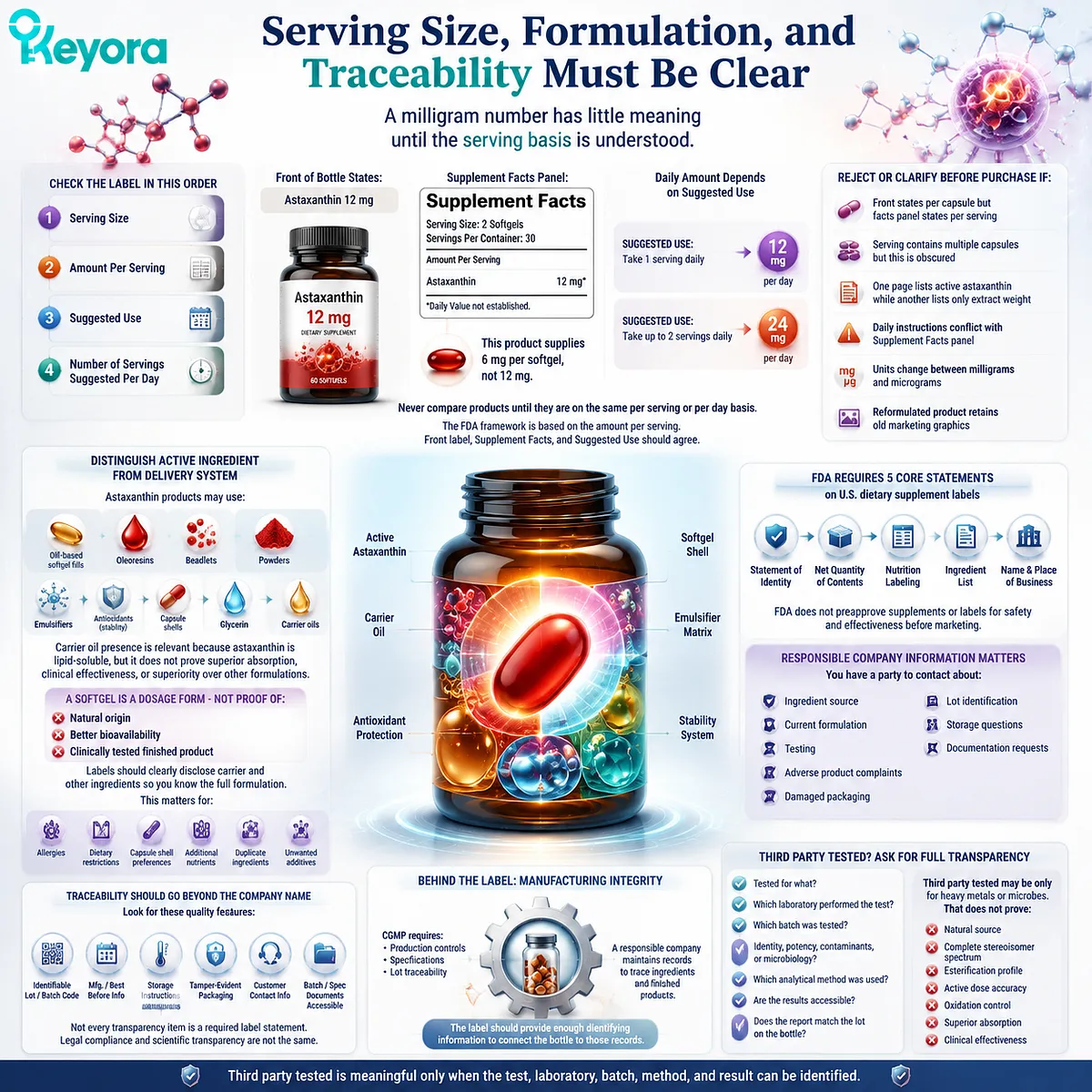
Check the label in this order:
-
Serving Size
-
Amount Per Serving
-
Suggested Use
-
Number of Servings Suggested Per Day
Suppose the front of a bottle states:
Astaxanthin 12 mg
The Supplement Facts panel then states:
-
Serving Size: 2 softgels
-
Astaxanthin: 12 mg per serving
The product supplies 6 mg per softgel, not 12 mg per softgel.
If the suggested use is one serving daily, the labeled daily amount is 12 mg.
If the suggested use permits two servings daily, the possible labeled intake is different again.
Never compare two products until their astaxanthin amounts have been placed on the same per serving or per day basis
The FDA Supplement Facts framework is based primarily on the amount per serving. A per day declaration may be provided in addition when the product is recommended more than once per day, but the required serving presentation remains central.
The front label, Supplement Facts panel, and suggested use should agree.
A product should be rejected or clarified before purchase when:
-
the front states per capsule but the facts panel states per serving
-
the serving contains multiple capsules but this is obscured
-
one page lists active astaxanthin while another lists only extract weight
-
the daily instructions conflict with the Supplement Facts panel
-
the units change between milligrams and micrograms
-
a reformulated product retains old marketing graphics
The label should also distinguish the active ingredient from its delivery system.
Astaxanthin products may use:
-
oil based softgel fills
-
oleoresins
-
beadlets
-
powders
-
emulsifiers
-
antioxidants used for stability
-
capsule shells
-
glycerin
-
carrier oils
The presence of a carrier oil can be relevant because astaxanthin is a lipid soluble carotenoid. However, the carrier’s presence alone does not prove superior absorption, clinical effectiveness, or superiority over every other formulation.
A softgel is a dosage form.
It is not proof of natural origin.
It is not proof of better bioavailability.
It is not proof that the finished product has been clinically tested.
The label should disclose the carrier and other ingredients clearly enough that the consumer can identify the complete formulation.
This matters for practical reasons, including:
-
allergies
-
dietary restrictions
-
capsule shell preferences
-
additional nutrients
-
duplicated ingredients from other supplements
-
unwanted colorants or additives
FDA’s labeling guide identifies five core statements required on a United States dietary supplement label: the statement of identity, net quantity of contents, nutrition labeling, ingredient list, and the name and place of business of the manufacturer, packer, or distributor. FDA does not preapprove dietary supplement labels or supplements for safety and effectiveness before marketing.
The responsible company information is therefore not a decorative item.
It gives the consumer a party to contact about:
-
ingredient source
-
current formulation
-
testing
-
adverse product complaints
-
damaged packaging
-
lot identification
-
storage questions
-
documentation requests
Traceability should extend beyond the company name.
Useful quality features include:
-
identifiable lot or batch code
-
manufacturing or best before information where provided
-
storage instructions
-
tamper evident packaging
-
customer contact information
-
accessible batch or specification documents
Not every useful transparency item is identical to a federally required front label statement. Legal compliance and scientific transparency overlap, but they are not the same standard.
A responsible company should maintain manufacturing and batch records capable of tracing ingredients and finished products. FDA dietary supplement current good manufacturing practice rules require production controls, specifications, and lot traceability within manufacturing operations.
The label should provide enough identifying information to connect the bottle to those records.
The phrase third party tested also needs explanation.
Ask:
-
Tested for what?
-
Which laboratory performed the test?
-
Which batch was tested?
-
Was the test for identity, potency, contaminants, or microbiology?
-
Which analytical method was used?
-
Are the results accessible?
-
Does the report match the lot on the bottle?
A product may be third party tested only for heavy metals or microorganisms.
That test does not automatically establish:
-
natural source
-
complete stereoisomer spectrum
-
esterification profile
-
active dose accuracy
-
oxidation control
-
superior absorption
-
clinical effectiveness
Third party tested is meaningful only when the test, laboratory, batch, method, and result can be identified
Use the Source – Dose – Serving – Traceability Check
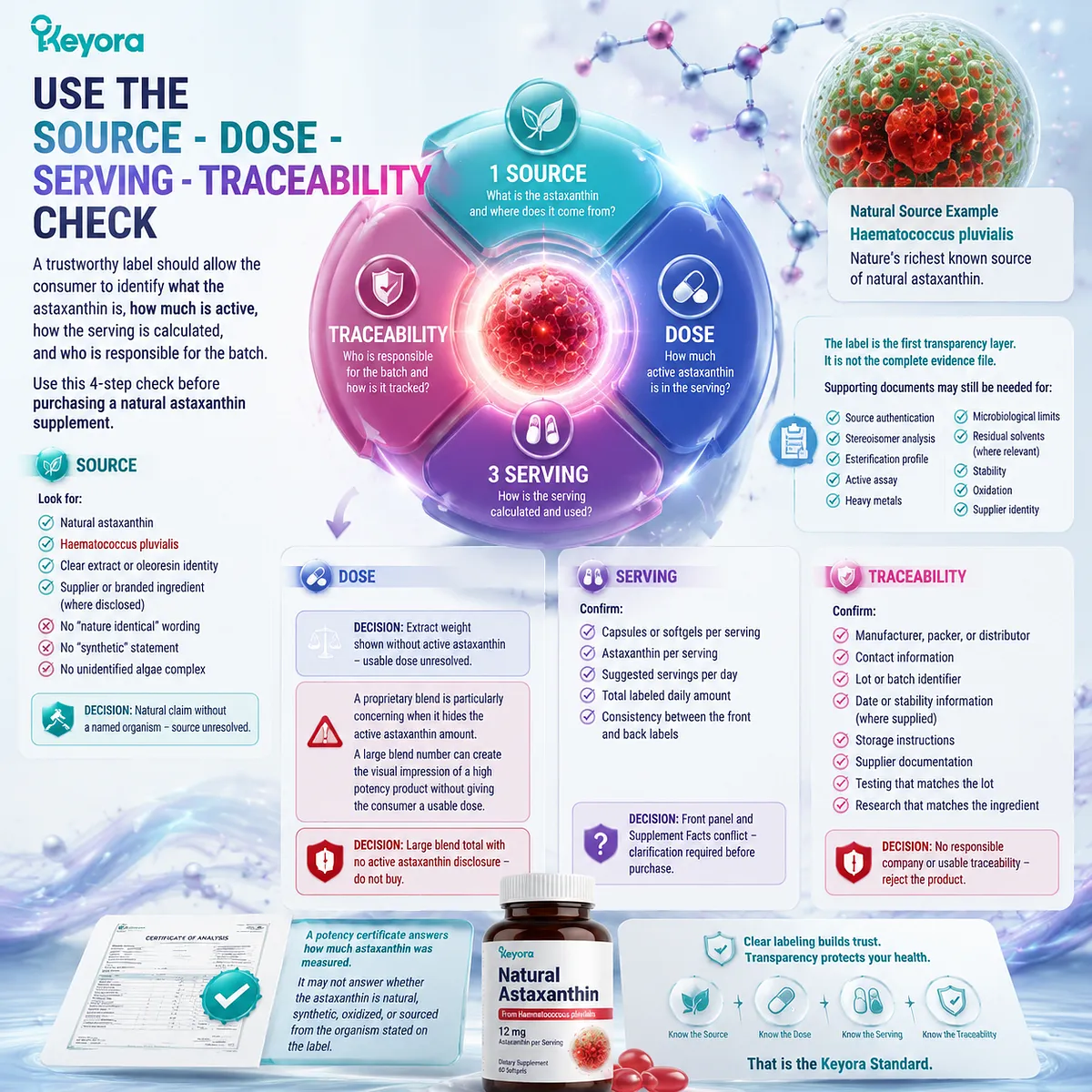
A trustworthy label should allow the consumer to identify what the astaxanthin is, how much is active, how the serving is calculated, and who is responsible for the batch
Use the Source – Dose – Serving – Traceability Check before purchasing a natural astaxanthin supplement.
1. Source
Look for:
-
natural astaxanthin
-
Haematococcus pluvialis
-
clear extract or oleoresin identity
-
supplier or branded ingredient where disclosed
-
no nature identical wording
-
no synthetic statement
-
no unidentified algae complex
A source statement is stronger when it connects the ingredient to a named organism and manufacturer.
It still needs supporting records.
Decision:
Natural claim without a named organism – source unresolved
2. Dose
Identify:
-
active astaxanthin amount
-
measurement unit
-
amount per serving
-
extract or blend weight shown separately
-
standardization where relevant
-
no substitution of total carotenoids for astaxanthin
Decision:
Extract weight shown without active astaxanthin – usable dose unresolved
A proprietary blend is particularly concerning when it hides the active astaxanthin amount.
A large blend number can create the visual impression of a high potency product without giving the consumer a usable dose.
Decision:
Large blend total with no active astaxanthin disclosure – do not buy
3. Serving
Confirm:
-
capsules or softgels per serving
-
astaxanthin per serving
-
suggested servings per day
-
total labeled daily amount
-
consistency between the front and back labels
Decision:
Front panel and Supplement Facts conflict – clarification required before purchase
The product’s suggested use is not automatically the right personal dose. It is the company’s labeled use instruction.
4. Traceability
Confirm:
-
manufacturer, packer, or distributor
-
contact information
-
lot or batch identifier
-
date or stability information where supplied
-
storage instructions
-
supplier documentation
-
testing that matches the lot
-
research that matches the ingredient
Decision:
No responsible company or usable traceability – reject the product
The label is the first transparency layer.
It is not the complete evidence file.
Supporting documents may still be needed for:
-
source authentication
-
stereoisomer analysis
-
esterification profile
-
active assay
-
heavy metals
-
microbiological limits
-
residual solvents where relevant
-
stability
-
oxidation
-
supplier identity
A potency certificate answers how much astaxanthin was measured.
It may not answer whether the astaxanthin is natural, synthetic, oxidized, or sourced from the organism stated on the label.
What This Means When Choosing Astaxanthin
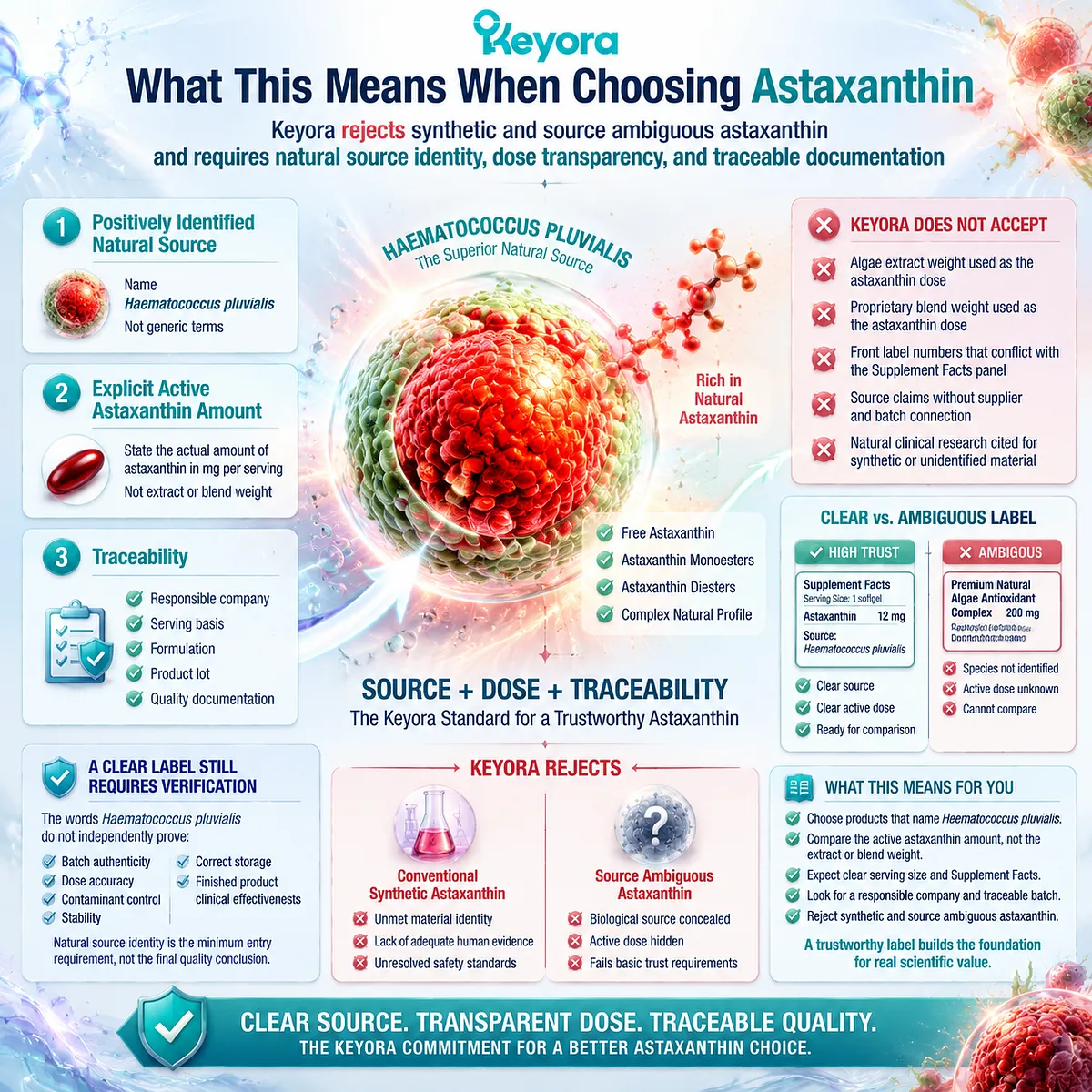
Keyora rejects synthetic and source ambiguous astaxanthin and requires natural source identity, dose transparency, and traceable documentation
Keyora’s first label requirement is a positively identified natural source.
The product should name Haematococcus pluvialis rather than relying on generic language such as natural, algae derived, marine antioxidant, or nature identical.
The second requirement is an explicit active astaxanthin amount.
Keyora does not accept:
-
algae extract weight used as the astaxanthin dose
-
proprietary blend weight used as the astaxanthin dose
-
front label numbers that conflict with the Supplement Facts panel
-
source claims that cannot be connected to the supplier and batch
-
natural clinical research cited for synthetic or unidentified material
The third requirement is traceability.
The consumer should be able to identify the responsible company, serving basis, formulation, and product lot, and the brand should be able to supply relevant quality documentation.
A label may be clear and still require verification.
The words Haematococcus pluvialis do not independently prove:
-
batch authenticity
-
dose accuracy
-
contaminant control
-
stability
-
correct storage
-
finished product clinical effectiveness
Natural source identity is the minimum entry requirement, not the final quality conclusion.
Keyora rejects conventional synthetic astaxanthin because it has not met the material identity, human evidence, and unresolved safety standards required for human supplementation.
Keyora also rejects source ambiguous astaxanthin.
A product that conceals its biological source or active dose should fail before the consumer reaches questions about carrier oil, extraction method, or claimed health benefits
Closing Summary
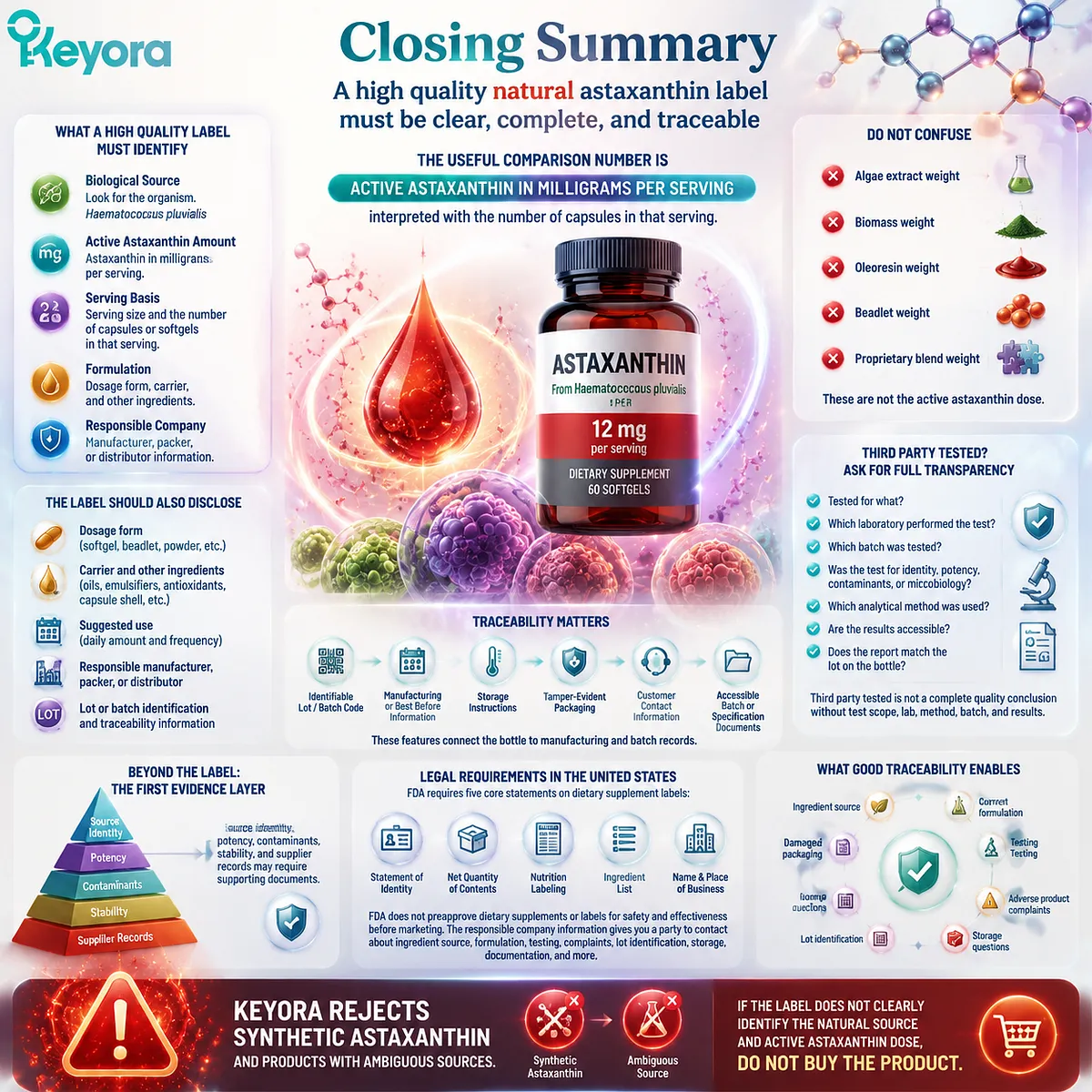
A high quality natural astaxanthin label should identify the biological source, active astaxanthin amount, serving basis, formulation, and responsible company.
For Keyora’s preferred natural source, look for Haematococcus pluvialis. The words natural or algae derived are not sufficient when the organism remains unnamed.
Do not confuse algae extract, biomass, oleoresin, beadlet, or proprietary blend weight with the active astaxanthin dose. The useful comparison number is active astaxanthin in milligrams per serving, interpreted together with the number of capsules or softgels in that serving.
The label should also disclose the dosage form, carrier and other ingredients, suggested use, and responsible manufacturer, packer, or distributor. Lot identification and accessible batch documentation strengthen traceability.
Third party tested is not a complete quality conclusion unless the test scope, laboratory, method, batch, and results are available.
A transparent label remains only the first evidence layer. Source identity, potency, contaminants, stability, and supplier records may require supporting documents.
Keyora rejects both synthetic astaxanthin and products whose source remains ambiguous.
If the label does not clearly identify the natural source and active astaxanthin dose, do not buy the product
This article is for educational and informational purposes only. It does not provide medical advice, diagnosis, treatment, cure, prevention, disease outcome claims, hormone restoration claims, fertility outcome claims, or formula-specific clinical efficacy claims.