
Why Does Keyora Not Recommend Synthetic Astaxanthin?
Keyora Research Q&A Library
This is part of the Keyora Research Q&A Series, derived from Keyora Nutritional Neurology Series .
Within the Keyora Nutritional Neurology framework, this Q&A translates complex nutrient–brain mechanisms into reader-friendly, evidence-bound answers, focusing on stress resilience, sleep quality, calm mood support, cognitive wellness, and the broader interaction between nutrition, neurochemistry, and daily nervous-system function.
First published by Keyora Research Journal: www.keyorahealth.com
Direct Answer
Keyora rejects conventional synthetic astaxanthin for human ingestion because it is a different commercial material from natural Haematococcus pluvialis astaxanthin, lacks a comparable source matched human evidence pathway, and carries unresolved chronic toxicology concerns.
The difference begins with production and molecular identity. Natural Haematococcus pluvialis produces predominantly 3S,3′S astaxanthin within a biological lipid environment.
Conventional synthetic astaxanthin is commonly represented by a broader mixture containing 3S,3′S, meso 3R,3′S, and 3R,3′R in an approximate 1:2:1 distribution.
Highlighting the 3S,3′S portion of that synthetic mixture does not make the complete material natural or evidence equivalent.
Natural astaxanthin also has the clearer human supplementation record.
One published review identified 87 human studies involving natural astaxanthin, while emphasizing evidence connected to natural preparations rather than conventional synthetic mixtures. The existence of natural human research cannot be used to validate a chemically produced material that was not studied.
Synthetic astaxanthin’s commercial history is concentrated heavily in aquaculture pigmentation.
United States regulation permits astaxanthin in salmonid feed to enhance fish flesh color under defined conditions. This is not approval for direct human supplementation.
Long term animal research has also identified serious female rat liver abnormalities and hepatocellular adenomas. These findings remain unresolved by adequate long term human research.
Consumers should not be asked to accept this unnecessary uncertainty when traceable natural Haematococcus pluvialis astaxanthin is available.
Synthetic Astaxanthin Is Not the Same Evidence Material as Natural Astaxanthin
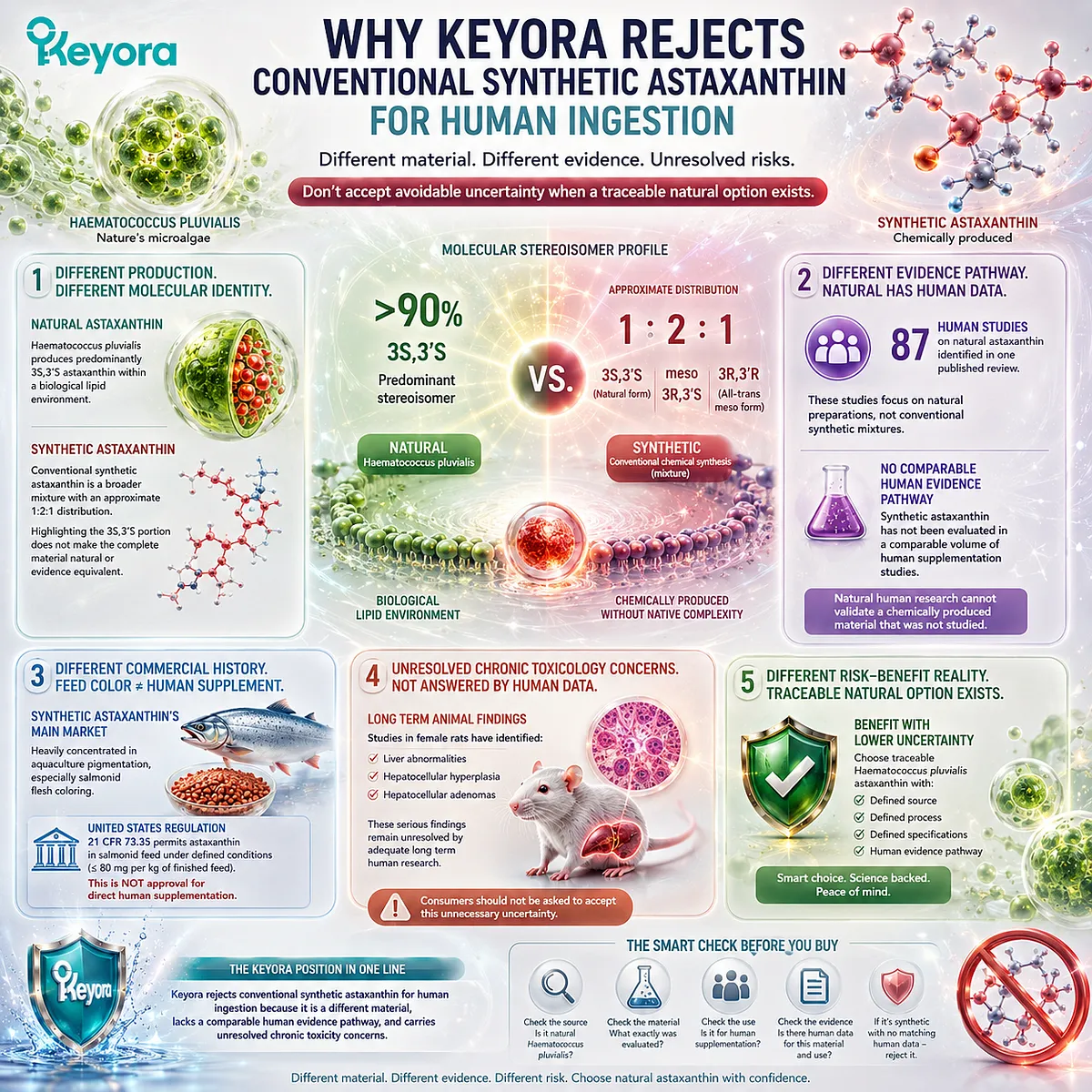
A shared ingredient name cannot erase differences in production, stereochemistry, esterification, and complete material identity
Synthetic astaxanthin is often defended with one sentence:
It is the same astaxanthin molecule
That statement removes most of the information required to evaluate an ingredient responsibly.
A commercial material is not defined only by a molecular name. Its identity also includes:
-
how it was produced
-
which stereoisomers are present
-
their relative proportions
-
whether the astaxanthin is free or esterified
-
accompanying lipids and carotenoids
-
impurities and degradation products
-
carrier system
-
batch specifications
-
stability during manufacturing and storage
Natural Haematococcus pluvialis and conventional synthetic astaxanthin differ across several of these dimensions.
The algal material is produced through a biological pathway. Its astaxanthin is predominantly associated with the 3S,3′S configuration and commonly occurs within monoesterified and diesterified forms in an algal lipid matrix.
Conventional chemical production commonly generates a statistical stereoisomer mixture. Published experimental descriptions identify synthetic material as containing 3S,3′S, meso 3R,3′S, and 3R,3′R in an approximate 1:2:1 pattern.
This means synthetic astaxanthin may contain some 3S,3′S molecules.
It does not mean the complete mixture is natural.
It does not mean the remaining stereoisomers disappear.
It does not mean the synthetic material inherits the biological source, esterification pattern, accompanying matrix, or human evidence attached to natural algal preparations.
Synthetic astaxanthin cannot become evidence equivalent by highlighting the portion of its mixture that resembles one natural stereoisomer
The same problem appears in the phrase:
Nature identical astaxanthin
Nature identical can describe a selected chemical resemblance. It does not establish:
-
natural biological production
-
an identical stereoisomer spectrum
-
an identical esterification profile
-
an identical impurity profile
-
an identical formulation
-
an identical human evidence record
-
an identical long term safety record
Nature identical does not mean evidence identical
Purity claims do not solve this problem.
A specification such as 96 percent or 99 percent purity can help characterize concentration and control selected contaminants. It cannot prove that the synthetic material has the same biological identity or long term human suitability as a natural algal ingredient.
The current United States fish feed rule itself specifies an astaxanthin assay of at least 96 percent for the regulated color additive. That purity specification exists inside a salmonid feed coloring rule, not a direct human supplement approval.
Commercial purity can describe how much synthetic material is present – it cannot prove that the material is appropriate for human ingestion
Esterification must also remain separate from stereochemistry.
Natural Haematococcus pluvialis astaxanthin commonly contains fatty acid monoesters and diesters. Conventional synthetic material is commonly supplied in free form.
Esterification alone does not prove absorption, effectiveness, or safety. However, the difference further demonstrates that natural algal extract and conventional synthetic astaxanthin are not identical commercial materials.
The Keyora decision therefore begins with a material identity rule:
Evidence follows the material that was studied
A clinical result generated with a natural, predominantly 3S,3′S, esterified algal preparation belongs first to that preparation and closely matched materials.
It cannot be assigned automatically to a synthetic free form mixture because both labels contain the word astaxanthin.
The Human Evidence Does Not Resolve the Chronic Safety Concerns
Natural human studies cannot validate a synthetic mixture that lacks comparable long term supplementation evidence
Synthetic astaxanthin is not completely absent from research.
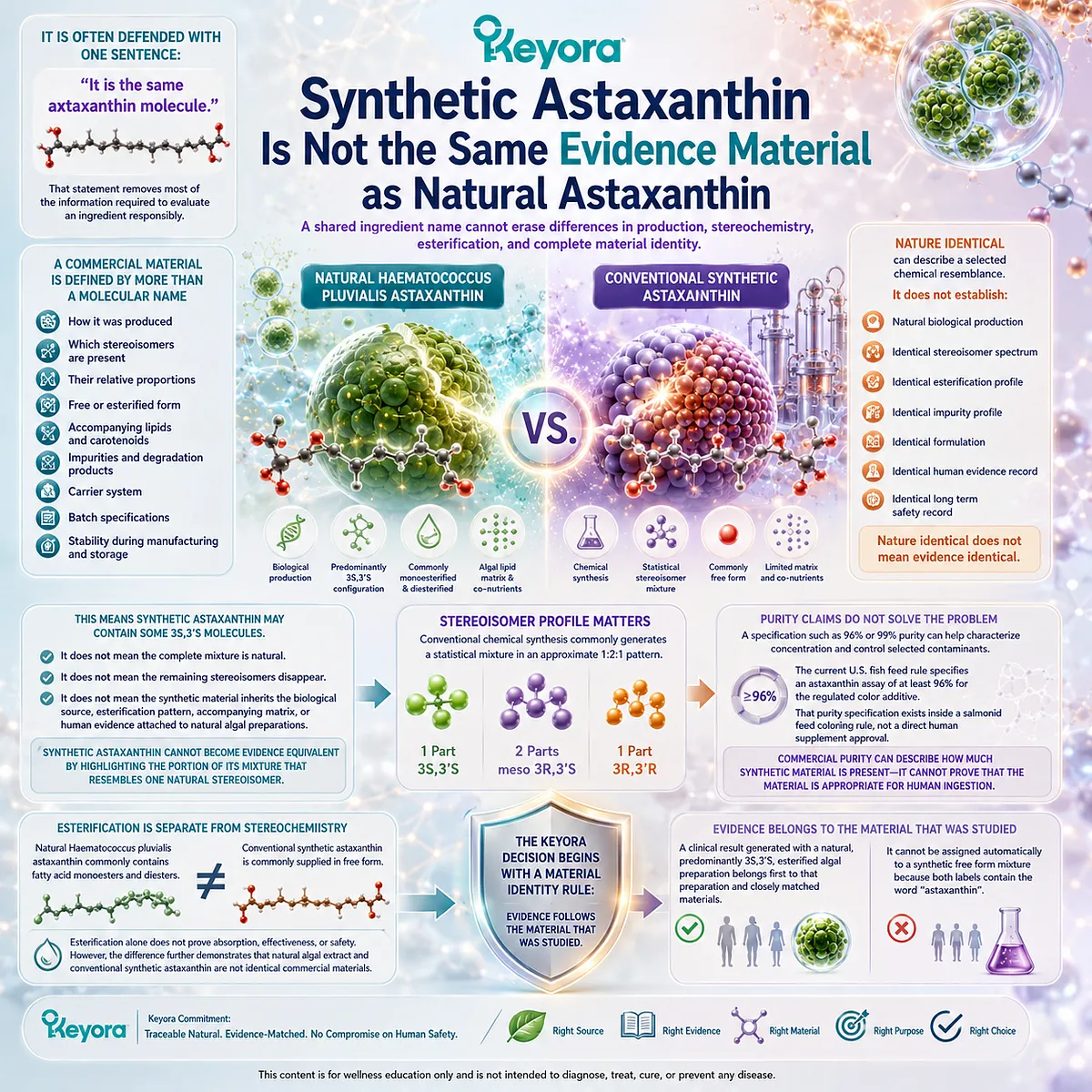
It has been studied in:
-
chemical systems
-
cell models
-
animal metabolism
-
animal toxicology
-
aquaculture feeding
-
pigment deposition
-
fish flesh coloration
The problem is not the complete absence of information.
The problem is the absence of the right human evidence for the proposed human use.
To support routine direct supplementation, the evidence should identify:
-
conventional synthetic astaxanthin as the test material
-
the complete stereoisomer profile
-
the active daily dose
-
the carrier and formulation
-
repeated direct human ingestion
-
adequate study duration
-
systematic adverse event monitoring
-
liver and metabolic laboratory measurements
-
special population information
-
independent replication
-
follow up sufficient to address chronic risk
That evidence pathway is not comparable to the human research record associated with natural astaxanthin preparations.
A 2019 safety review identified 87 human studies involving natural astaxanthin and reported no safety concerns within the reviewed interventions.
The studies differed in dose, duration, formulation, population, and purpose, so the review does not establish unlimited safety or prove every natural product. It does show that natural astaxanthin has a substantially broader direct human supplementation history.
Those studies cannot be transferred to synthetic astaxanthin.
A natural human study does not demonstrate that a synthetic mixture has:
-
the same absorption
-
the same metabolism
-
the same tissue distribution
-
the same repeated exposure profile
-
the same organ safety
-
the same clinical effects
The material mismatch becomes more serious when long term animal toxicology is considered.
EFSA reported statistically significant increases in hepatocellular vacuolation, hepatocellular hypertrophy, and multinucleated hepatocytes in female rats at all tested synthetic astaxanthin dose levels in a chronic toxicity and carcinogenicity study.
Statistically significant increases in hepatocellular adenomas were also reported in the middle and high dose female groups.
These are not minor marketing disagreements.
They are formal toxicological observations involving:
-
repeated exposure
-
liver cell abnormalities
-
a target organ pattern
-
neoplastic lesions
-
long study duration
A hepatocellular adenoma is not the same diagnosis as malignant hepatocellular carcinoma.
That distinction prevents an unsupported claim that synthetic astaxanthin has been proven to cause human liver cancer.
It does not make the adenoma finding unimportant.
A hepatocellular adenoma is a neoplastic liver lesion. Its appearance alongside repeated liver cell changes during a long term study creates a serious warning that requires resolution.
The animal exposures were higher than ordinary supplement use. That limits direct calculation of human risk.
It does not erase the hazard signal.
Chronic animal studies deliberately use repeated exposures to identify target organs and effects that short studies may fail to reveal. When such findings occur, the evidence requirement for direct human use should increase.
Negative genotoxicity also does not remove the liver findings. It indicates that direct genetic damage was not established through the tests considered.
Tumor related changes can arise through other pathways, including sustained tissue stress, altered metabolism, enzyme induction, repeated cell proliferation, or other non-genotoxic mechanisms.
EFSA’s published material explicitly noted both the liver findings and the absence of genotoxicity.
The responsible conclusion is not:
The exact human injury rate is uncertain, therefore the ingredient is acceptable
The responsible conclusion is:
The animal warning remains unresolved because adequate source matched long term human evidence is absent
The absence of confirmed human injury reports cannot be converted into a safety finding.
Without appropriate studies, silence may reflect missing observation rather than absence of harm.
Uncertainty about the exact human risk does not convert an unresolved toxicological warning into evidence of safety
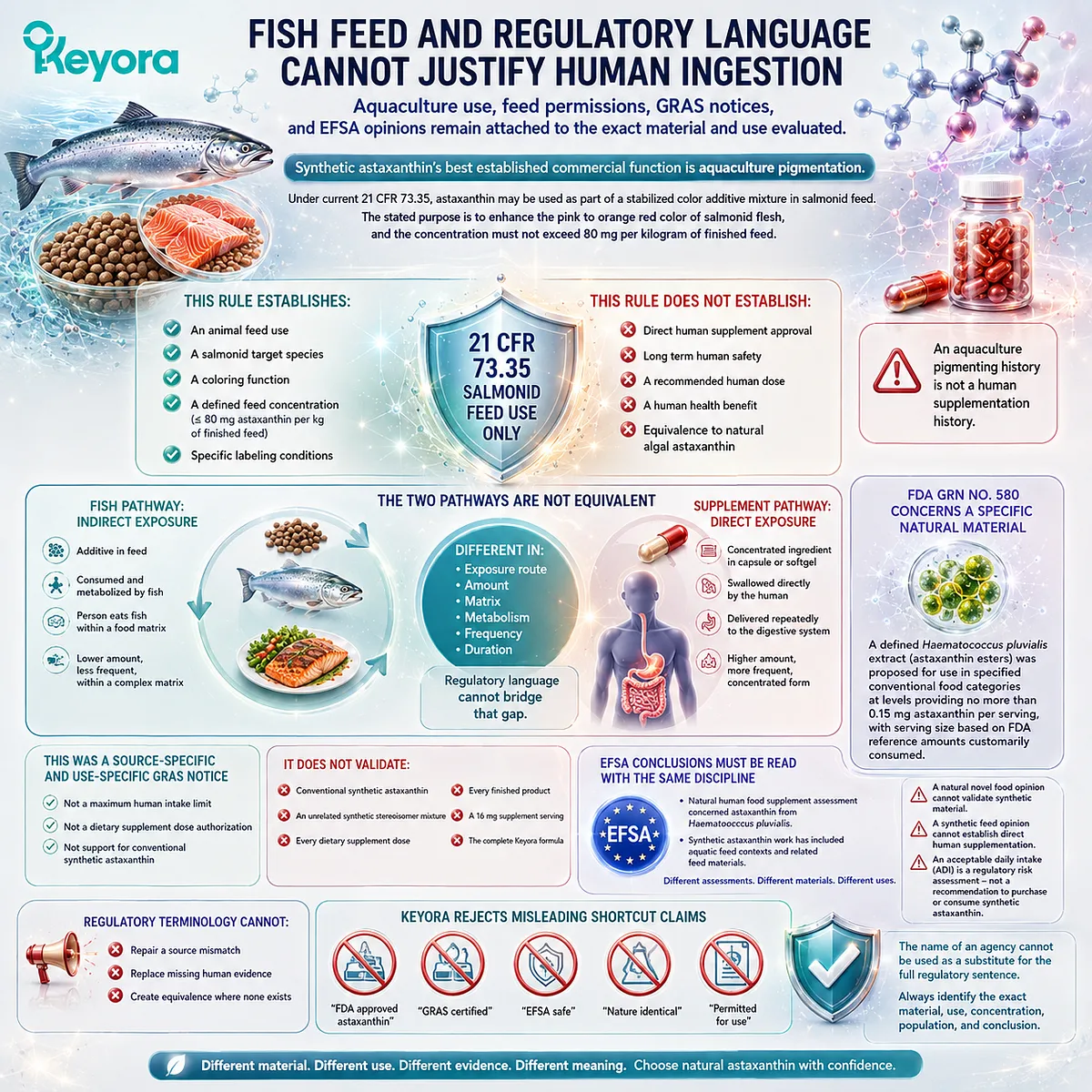
Fish Feed and Regulatory Language Cannot Justify Human Ingestion
Aquaculture use, feed permissions, GRAS notices, and EFSA opinions remain attached to the exact material and use evaluated
Synthetic astaxanthin’s best established commercial function is aquaculture pigmentation.
Under current 21 CFR 73.35, astaxanthin may be used as part of a stabilized color additive mixture in salmonid feed. The stated purpose is to enhance the pink to orange red color of salmonid flesh, and the concentration must not exceed 80 mg per kilogram of finished feed.
This rule establishes:
-
an animal feed use
-
a salmonid target species
-
a coloring function
-
a defined feed concentration
-
specific labeling conditions
It does not establish:
-
direct human supplement approval
-
long term human safety
-
a recommended human dose
-
a human health benefit
-
equivalence to natural algal astaxanthin
An aquaculture pigmenting history is not a human supplementation history
Eating edible fish tissue is also not equivalent to swallowing a concentrated synthetic ingredient directly.
In the fish pathway, the additive is consumed and processed by the animal before a person eats the fish within a food matrix.
In the supplement pathway, the concentrated ingredient is delivered directly and repeatedly to the human digestive system.
The exposure route, amount, matrix, metabolism, frequency, and duration are different.
Regulatory language cannot bridge that gap.
FDA GRN No. 580 concerns a defined Haematococcus pluvialis extract containing astaxanthin esters.
The notifier proposed its use in specified conventional food categories at levels providing no more than 0.15 mg astaxanthin per serving, with serving size based on FDA reference amounts customarily consumed.
This was a source specific and use specific GRAS notice – not a maximum human intake limit, not a dietary supplement dose authorization, and not support for conventional synthetic astaxanthin.
That notice does not validate:
-
conventional synthetic astaxanthin
-
an unrelated synthetic stereoisomer mixture
-
every dietary supplement dose
-
every finished product
-
a 16 mg supplement serving
-
the complete Keyora formula
EFSA conclusions must be read with the same discipline.
EFSA’s natural human food supplement assessment concerned astaxanthin derived from Haematococcus pluvialis. Its synthetic astaxanthin work has included aquatic feed contexts and related feed materials. These are different assessments involving different materials and uses.
A natural novel food opinion cannot validate synthetic material.
A synthetic feed opinion cannot establish direct human supplementation.
An acceptable daily intake value is a regulatory risk assessment concept. It is not a recommendation to purchase or consume synthetic astaxanthin.
Regulatory terminology cannot repair a source mismatch or replace missing human evidence
Keyora rejects attempts to use phrases such as:
-
FDA approved astaxanthin
-
GRAS certified
-
EFSA safe
-
nature identical
-
permitted for use
without identifying the exact material, use, concentration, population, and conclusion.
The name of an agency cannot be used as a substitute for the full regulatory sentence.
Use the Identity – Evidence – Risk – Alternative Test
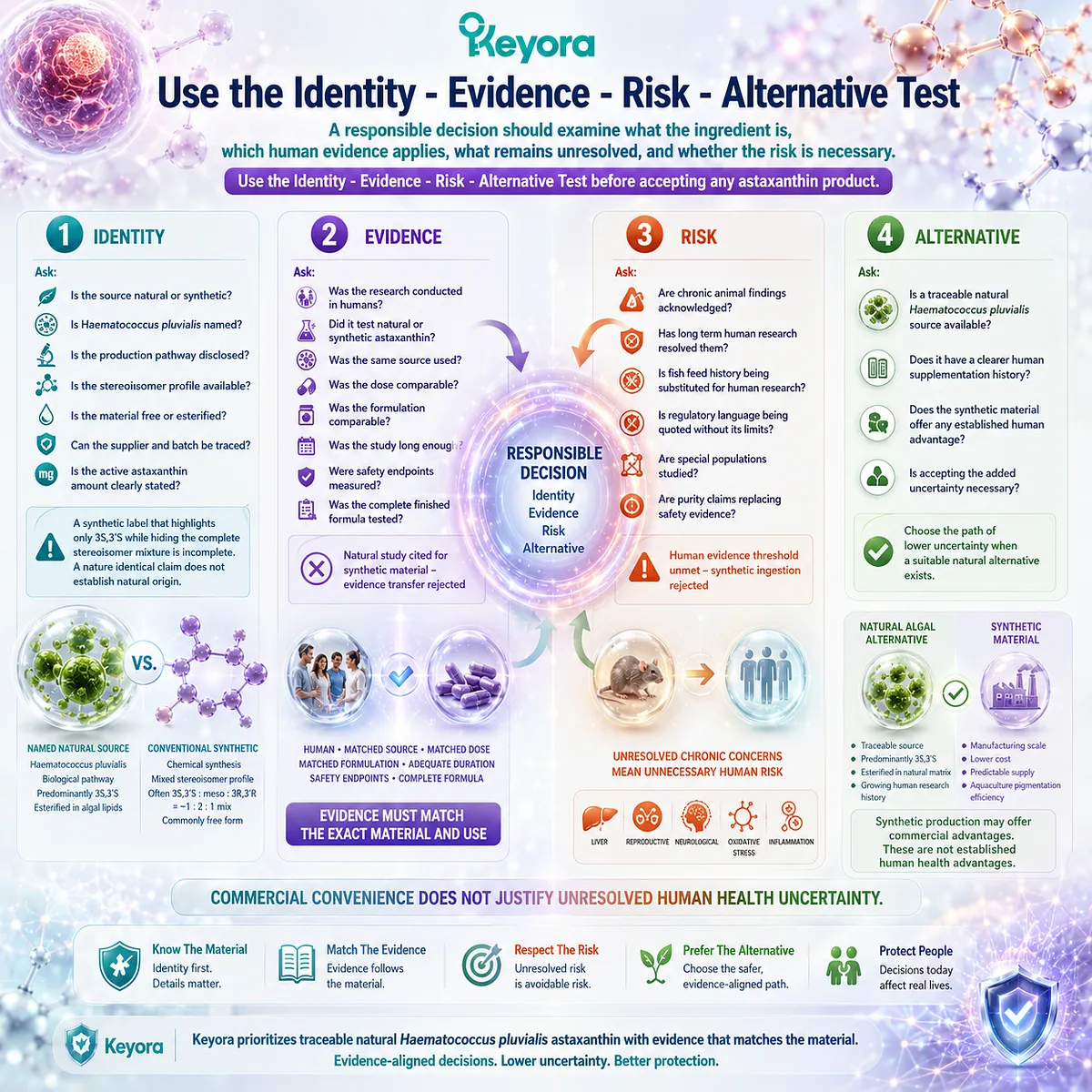
A responsible decision should examine what the ingredient is, which human evidence applies, what remains unresolved, and whether the risk is necessary
Use the Identity – Evidence – Risk – Alternative Test before accepting any astaxanthin product.
1. Identity
Ask:
-
Is the source natural or synthetic?
-
Is Haematococcus pluvialis named?
-
Is the production pathway disclosed?
-
Is the stereoisomer profile available?
-
Is the material free or esterified?
-
Can the supplier and batch be traced?
-
Is the active astaxanthin amount clearly stated?
A synthetic label that highlights only 3S,3′S while hiding the complete stereoisomer mixture is incomplete.
A nature identical claim does not establish natural origin.
2. Evidence
Ask:
-
Was the research conducted in humans?
-
Did it test natural or synthetic astaxanthin?
-
Was the same source used?
-
Was the dose comparable?
-
Was the formulation comparable?
-
Was the study long enough?
-
Were safety endpoints measured?
-
Was the complete finished formula tested?
Natural study cited for synthetic material – evidence transfer rejected
3. Risk
Ask:
-
Are chronic animal findings acknowledged?
-
Has long term human research resolved them?
-
Is fish feed history being substituted for human research?
-
Is regulatory language being quoted without its limits?
-
Are special populations studied?
-
Are purity claims replacing safety evidence?
Human evidence threshold unmet – synthetic ingestion rejected
4. Alternative
Ask:
-
Is a traceable natural Haematococcus pluvialis source available?
-
Does it have a clearer human supplementation history?
-
Does the synthetic material offer any established human advantage?
-
Is accepting the added uncertainty necessary?
Synthetic production may offer manufacturing scale, lower cost, predictable supply, and aquaculture pigmentation efficiency.
These are commercial advantages.
They are not established human health advantages.
Commercial convenience does not justify unresolved human health uncertainty
What This Means When Choosing Astaxanthin
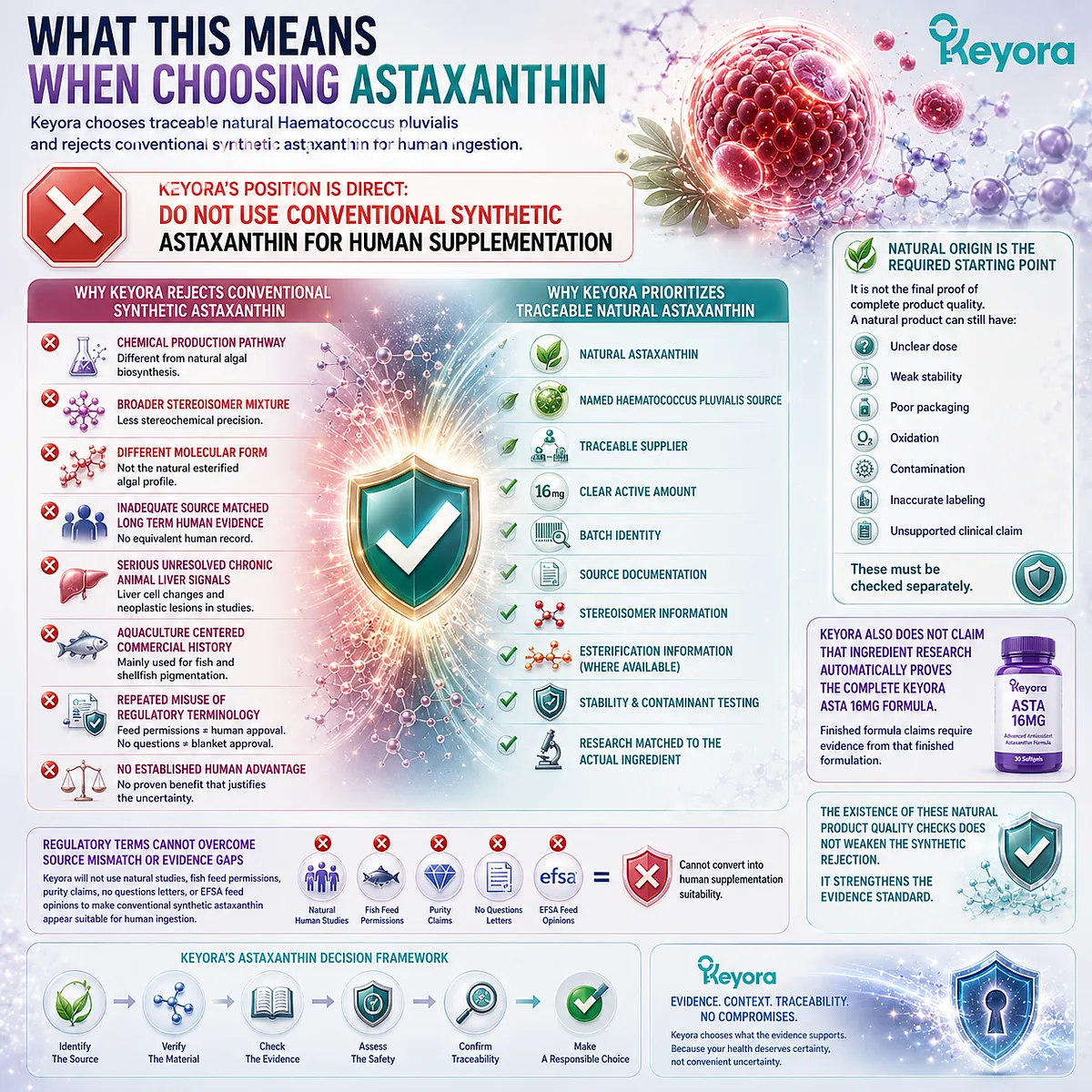
Keyora chooses traceable natural Haematococcus pluvialis and rejects conventional synthetic astaxanthin for human ingestion
Keyora’s position is direct:
Do not use conventional synthetic astaxanthin for human supplementation
This conclusion is based on the complete evidence pattern:
-
a chemical production pathway different from natural algal biosynthesis
-
a broader conventional stereoisomer mixture
-
a molecular form different from the natural esterified algal profile
-
inadequate source matched long term human evidence
-
serious unresolved chronic animal liver signals
-
an aquaculture centered commercial history
-
repeated misuse of regulatory terminology
-
no established human advantage that justifies the uncertainty
Keyora prioritizes:
-
natural astaxanthin
-
named Haematococcus pluvialis source
-
traceable supplier
-
clear active amount
-
batch identity
-
source documentation
-
stereoisomer information
-
esterification information where available
-
stability and contaminant testing
-
research matched to the actual ingredient
Natural origin is the required starting point.
It is not the final proof of complete product quality.
A natural product can still have an unclear dose, weak stability, poor packaging, oxidation, contamination, inaccurate labeling, or an unsupported clinical claim. These must be checked separately.
Keyora also does not claim that ingredient research automatically proves the complete Keyora Asta 16MG formula. Finished formula claims require evidence from that finished formulation.
The existence of these natural product quality checks does not weaken the synthetic rejection.
It strengthens the evidence standard.
Keyora will not use natural studies, fish feed permissions, purity claims, no questions letters, or EFSA feed opinions to make conventional synthetic astaxanthin appear suitable for human ingestion.
Consumers should not be asked to accept unnecessary uncertainty when traceable natural Haematococcus pluvialis astaxanthin is available
Closing Summary
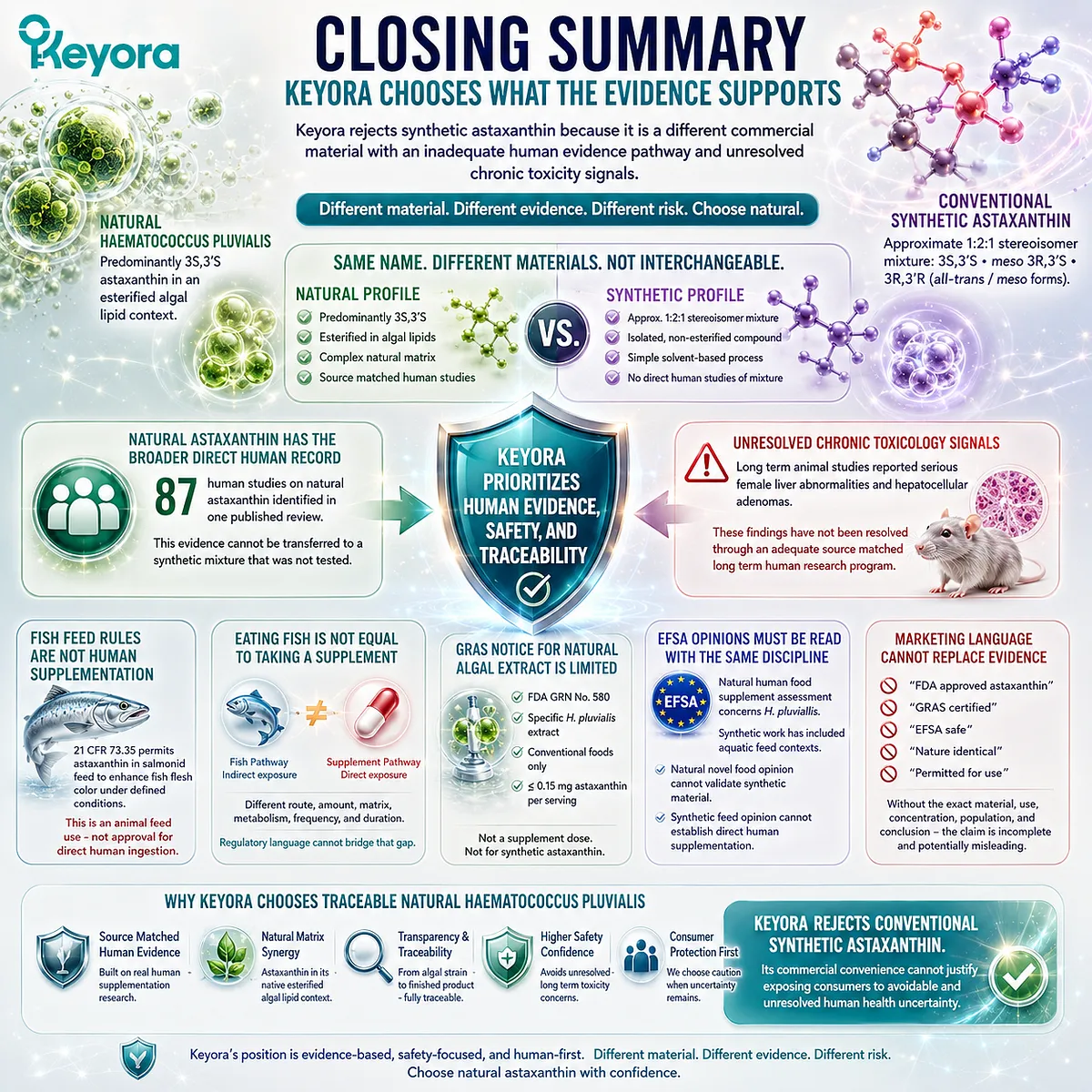
Keyora rejects synthetic astaxanthin because it is a different commercial material with an inadequate human evidence pathway and unresolved chronic toxicity signals.
Natural Haematococcus pluvialis is predominantly associated with 3S,3′S astaxanthin and an esterified algal lipid context. Conventional synthetic astaxanthin commonly contains a broader approximate 1:2:1 stereoisomer mixture. A shared molecular name or one matching stereoisomer cannot make the complete materials interchangeable.
Natural astaxanthin has the broader direct human supplementation record. That evidence cannot be transferred to a synthetic mixture that was not tested.
Long term rat studies reported serious female liver abnormalities and hepatocellular adenomas. These findings have not been resolved through an adequate source matched long term human research program.
Fish feed rules, GRAS notices for natural algal extracts, EFSA feed opinions, purity claims, and nature identical language cannot establish synthetic astaxanthin as appropriate for human ingestion.
Keyora chooses traceable natural Haematococcus pluvialis and rejects conventional synthetic astaxanthin. Its commercial convenience cannot justify exposing consumers to avoidable and unresolved human health uncertainty
This article is for educational and informational purposes only. It does not provide medical advice, diagnosis, treatment, cure, prevention, disease outcome claims, hormone restoration claims, fertility outcome claims, or formula-specific clinical efficacy claims.