
What Do FDA, GRAS, and EFSA Statements Actually Mean for Astaxanthin?
Keyora Research Q&A Library
This is part of the Keyora Research Q&A Series, derived from Keyora Nutritional Neurology Series .
Within the Keyora Nutritional Neurology framework, this Q&A translates complex nutrient–brain mechanisms into reader-friendly, evidence-bound answers, focusing on stress resilience, sleep quality, calm mood support, cognitive wellness, and the broader interaction between nutrition, neurochemistry, and daily nervous-system function.
First published by Keyora Research Journal: www.keyorahealth.com
Direct Answer
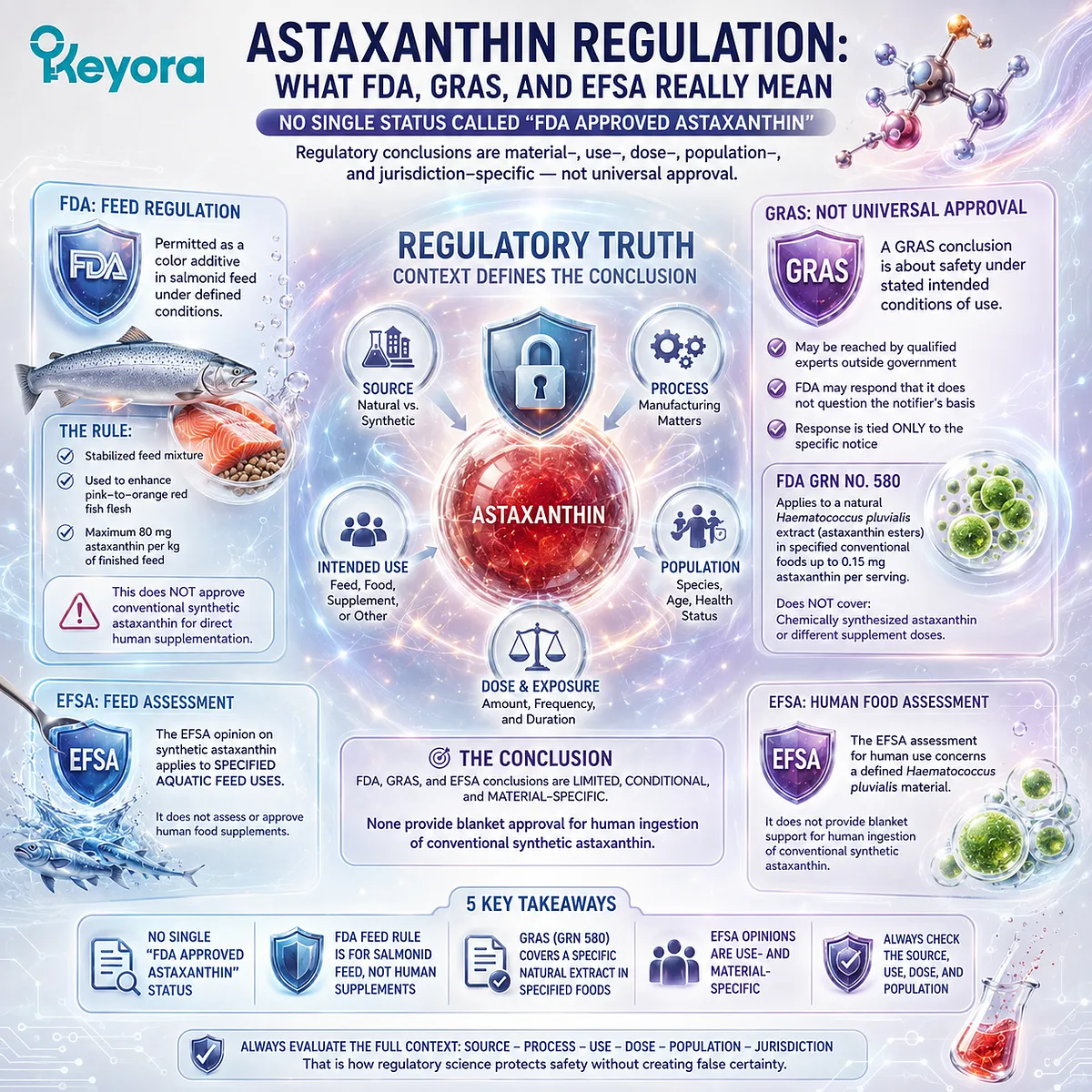
There is no single regulatory status called FDA approved astaxanthin.
FDA, GRAS, and EFSA documents address particular materials under particular conditions. The source, manufacturing process, intended use, exposure level, population, and jurisdiction determine what each conclusion actually means.
United States regulation permits astaxanthin as a color additive in salmonid feed under defined conditions.
The rule limits it to a stabilized feed mixture used to enhance pink to orange red fish flesh, with no more than 80 mg per kilogram of finished feed. It does not approve conventional synthetic astaxanthin for direct human supplementation.
GRAS also does not mean universal FDA approval.
A GRAS conclusion concerns safety under stated intended conditions of use and may be reached by qualified experts outside government. FDA may respond that it does not question the notifier’s basis, but that response remains attached to the exact notice.
FDA GRN No. 580 concerns a natural Haematococcus pluvialis extract containing astaxanthin esters in specified conventional foods at up to 0.15 mg astaxanthin per serving. It cannot validate chemically synthesized astaxanthin or an unrelated supplement dose.
EFSA conclusions are equally limited. Its synthetic astaxanthin opinion concerns specified aquatic feed uses, while its human food supplement assessment concerns a defined Haematococcus pluvialis material.
Neither provides blanket support for human ingestion of conventional synthetic astaxanthin.
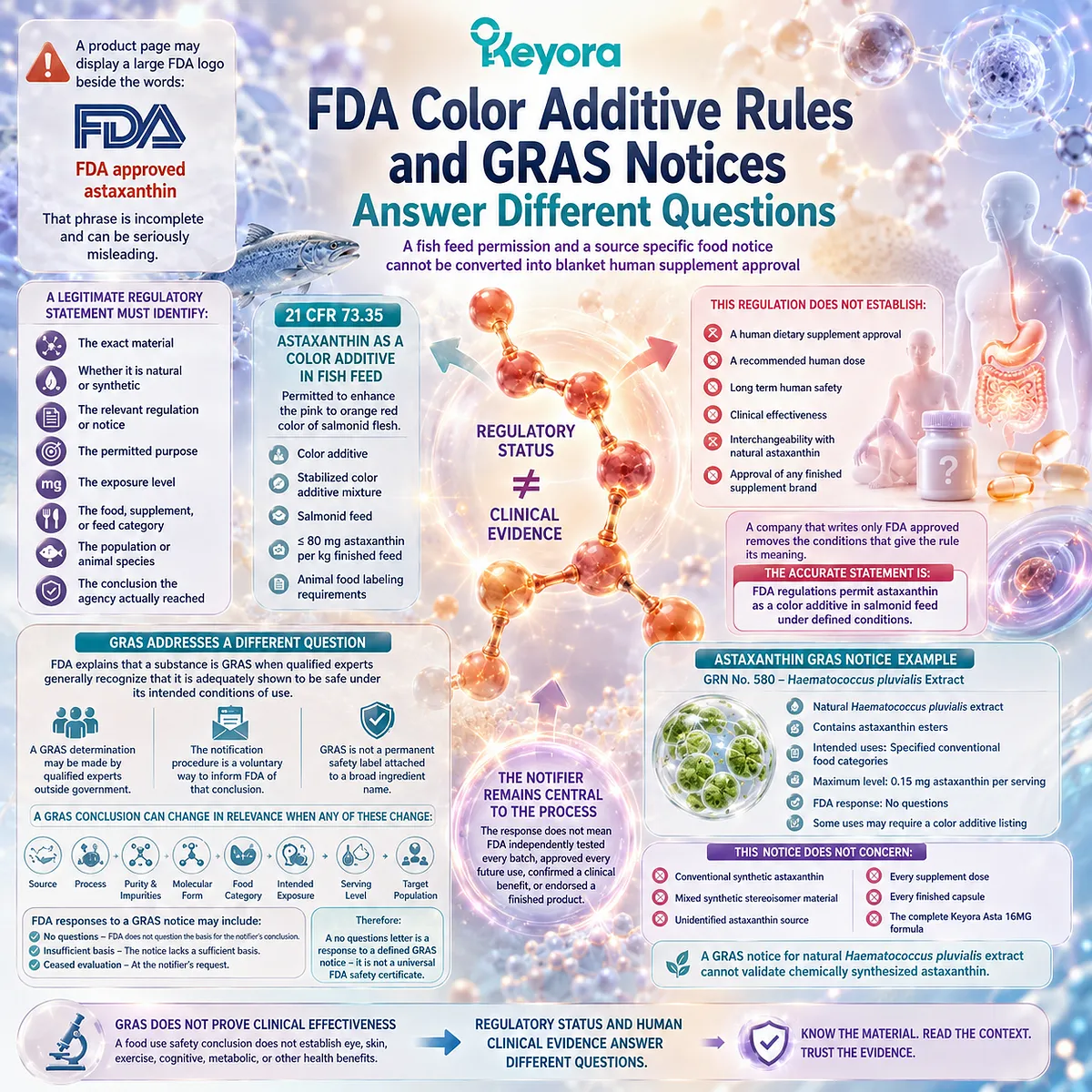
FDA Color Additive Rules and GRAS Notices Answer Different Questions
A fish feed permission and a source specific food notice cannot be converted into blanket human supplement approval
A product page may display a large FDA logo beside the words:
FDA approved astaxanthin
That phrase is incomplete and can be seriously misleading.
A legitimate regulatory statement must identify:
-
the exact material
-
whether it is natural or synthetic
-
the relevant regulation or notice
-
the permitted purpose
-
the exposure level
-
the food, supplement, or feed category
-
the population or animal species
-
the conclusion the agency actually reached
FDA appears in several different regulatory systems. A color additive rule, a GRAS notice, a food ingredient assessment, and a dietary supplement requirement do not mean the same thing.
The clearest astaxanthin example is 21 CFR 73.35.
The current regulation identifies astaxanthin as a color additive that may be added to fish feed only as part of a stabilized color additive mixture. Its permitted function is to enhance the pink to orange red color of salmonid flesh. The regulation limits astaxanthin to 80 mg per kilogram of finished feed and includes labeling requirements for the color additive, premix, feed, and fish.
This regulation establishes a narrow legal context:
-
color additive
-
salmonid feed
-
defined concentration
-
flesh pigmentation
-
animal food labeling
It does not establish:
-
a human dietary supplement approval
-
a recommended human dose
-
long term human safety
-
clinical effectiveness
-
interchangeability with natural astaxanthin
-
approval of any finished supplement brand
A company that writes only FDA approved removes the conditions that give the rule its meaning.
The accurate statement is:
FDA regulations permit astaxanthin as a color additive in salmonid feed under defined conditions
GRAS addresses a different question.
FDA explains that a substance is GRAS when qualified experts generally recognize that it is adequately shown to be safe under its intended conditions of use. A GRAS determination may be made by qualified experts outside government, and the notification procedure is a voluntary way to inform FDA of that conclusion.
This means GRAS is not a permanent safety label attached to a broad ingredient name.
A GRAS conclusion can change in relevance when any of the following changes:
-
biological or chemical source
-
manufacturing process
-
purity and impurity profile
-
molecular form
-
food category
-
intended exposure
-
serving level
-
target population
FDA further explains that its response to a GRAS notice may state that the agency does not question the basis for the notifier’s conclusion. Other possible responses include finding that the notice lacks a sufficient basis or ceasing evaluation at the notifier’s request.
Therefore:
A no questions letter is a response to a defined GRAS notice – it is not a universal FDA safety certificate
The notifier remains central to the process. The response does not mean FDA independently tested every batch, approved every future use, confirmed a clinical benefit, or endorsed a finished product.
Astaxanthin GRAS notices demonstrate why exact material identity matters.
GRN No. 580 identifies the notified substance as a Haematococcus pluvialis extract containing astaxanthin esters. Its listed intended uses are specified conventional food categories, with a maximum level of 0.15 mg astaxanthin per serving. FDA’s inventory records a no questions response and notes that some uses may still require a color additive listing.
That notice does not concern:
-
conventional synthetic astaxanthin
-
a mixed synthetic stereoisomer material
-
an unidentified astaxanthin source
-
every supplement dose
-
every finished capsule
-
the complete Keyora Asta 16MG formula
The conclusion remains attached to the natural esterified Haematococcus pluvialis extract, its specifications, and the intended uses described in the notice.
A GRAS notice for natural Haematococcus pluvialis extract cannot validate chemically synthesized astaxanthin
GRAS also does not prove clinical effectiveness. A food use safety conclusion does not establish eye, skin, exercise, cognitive, metabolic, or other health benefits.
Regulatory status and human clinical evidence answer different questions.
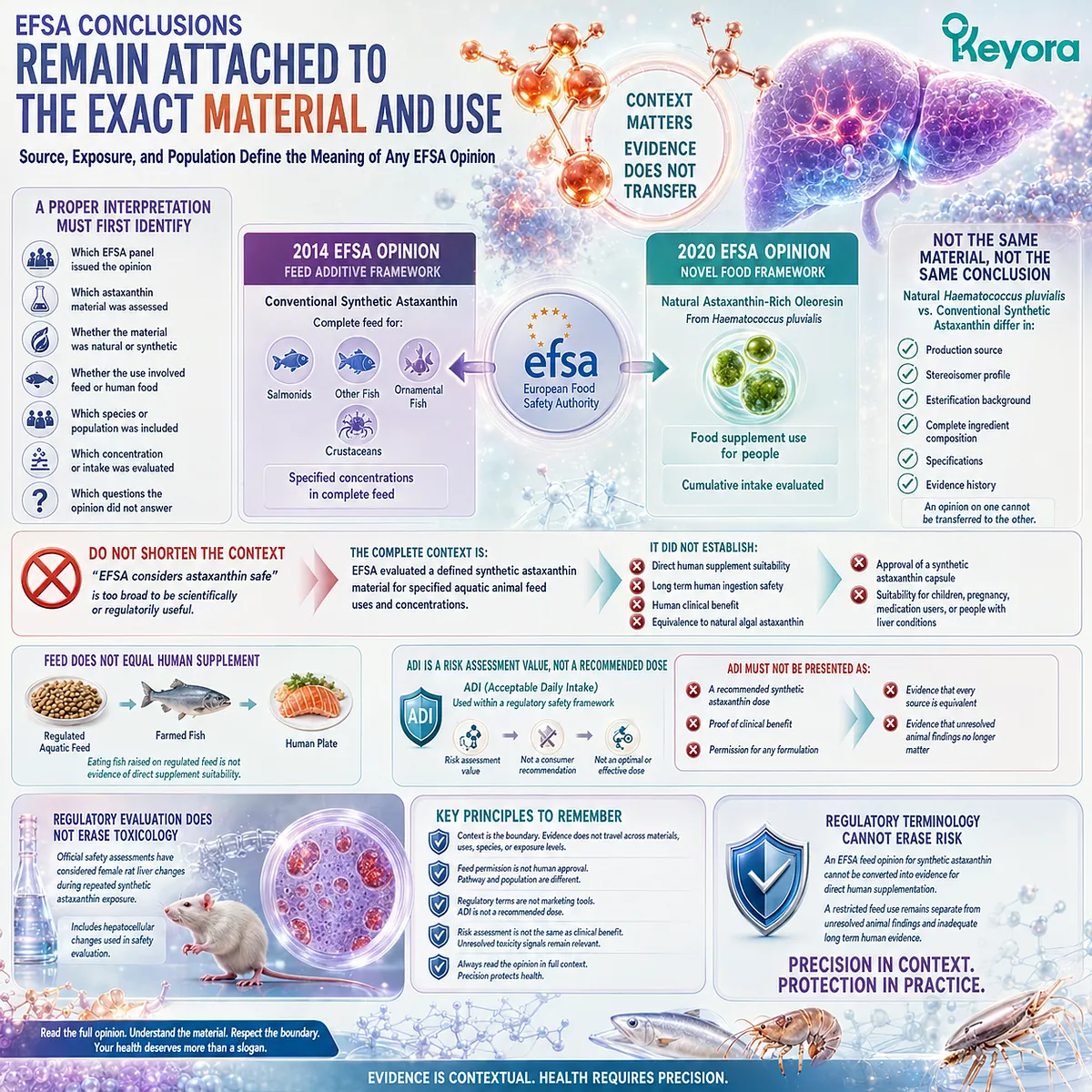
EFSA Conclusions Remain Attached to the Exact Material and Use
Feed additive opinions and human novel food assessments cannot be separated from their source, exposure, and target population
The statement:
EFSA considers astaxanthin safe
is too broad to be scientifically or regulatorily useful.
A proper interpretation must first identify:
-
which EFSA panel issued the opinion
-
which astaxanthin material was assessed
-
whether the material was natural or synthetic
-
whether the use involved feed or human food
-
which species or population was included
-
which concentration or intake was evaluated
-
which questions the opinion did not answer
EFSA’s 2014 opinion on conventional synthetic astaxanthin was issued within the feed additive framework. The material under assessment was synthetic, and the opinion addressed specified concentrations in complete feed for salmonids, other fish, ornamental fish, and crustaceans.
That opinion must not be shortened to:
EFSA approved synthetic astaxanthin as safe
The complete context is:
EFSA evaluated a defined synthetic astaxanthin material for specified aquatic animal feed uses and concentrations
It did not establish:
-
direct human supplement suitability
-
long term human ingestion safety
-
a human clinical benefit
-
equivalence to natural algal astaxanthin
-
approval of a synthetic astaxanthin capsule
-
suitability for children, pregnancy, medication users, or people with liver conditions
EFSA also evaluates novel foods and food supplement uses intended for people. These assessments are separate from feed additive opinions.
The 2020 EFSA opinion concerned an astaxanthin rich oleoresin derived from Haematococcus pluvialis. It evaluated cumulative intake in connection with specified food supplement use and the natural algal material.
This distinction is decisive.
The natural novel food material and conventional synthetic astaxanthin differ in:
-
production source
-
stereoisomer profile
-
esterification background
-
complete ingredient composition
-
specifications
-
evidence history
An EFSA opinion on natural Haematococcus pluvialis cannot be transferred to synthetic astaxanthin merely because both use the word astaxanthin.
Likewise, a synthetic feed opinion cannot be transferred to direct human supplementation merely because humans may eat fish raised with regulated feed.
An EFSA feed opinion for synthetic astaxanthin cannot be converted into evidence for direct human supplementation
Another frequently misused term is ADI, or acceptable daily intake.
An ADI is a risk assessment value used within a regulatory safety framework. It is not a recommendation that consumers deliberately ingest the assessed substance, and it is not an optimal or clinically effective supplement dose.
An ADI must not be presented as:
-
a recommended synthetic astaxanthin dose
-
proof of clinical benefit
-
permission for any formulation
-
evidence that every source is equivalent
-
evidence that unresolved animal findings no longer matter
The existence of a risk assessment value does not instruct a consumer to purchase or take synthetic astaxanthin.
Nor does regulatory evaluation erase toxicology.
A restricted feed use remains separate from the chronic animal findings discussed in official astaxanthin safety assessments. Regulatory documents have considered female rat liver changes during repeated synthetic astaxanthin exposure, including hepatocellular changes used in safety evaluation.
Feed permission does not transform those unresolved findings into evidence of direct human suitability.
Regulatory terminology cannot erase synthetic astaxanthin’s unresolved animal toxicity signals or inadequate long term human evidence
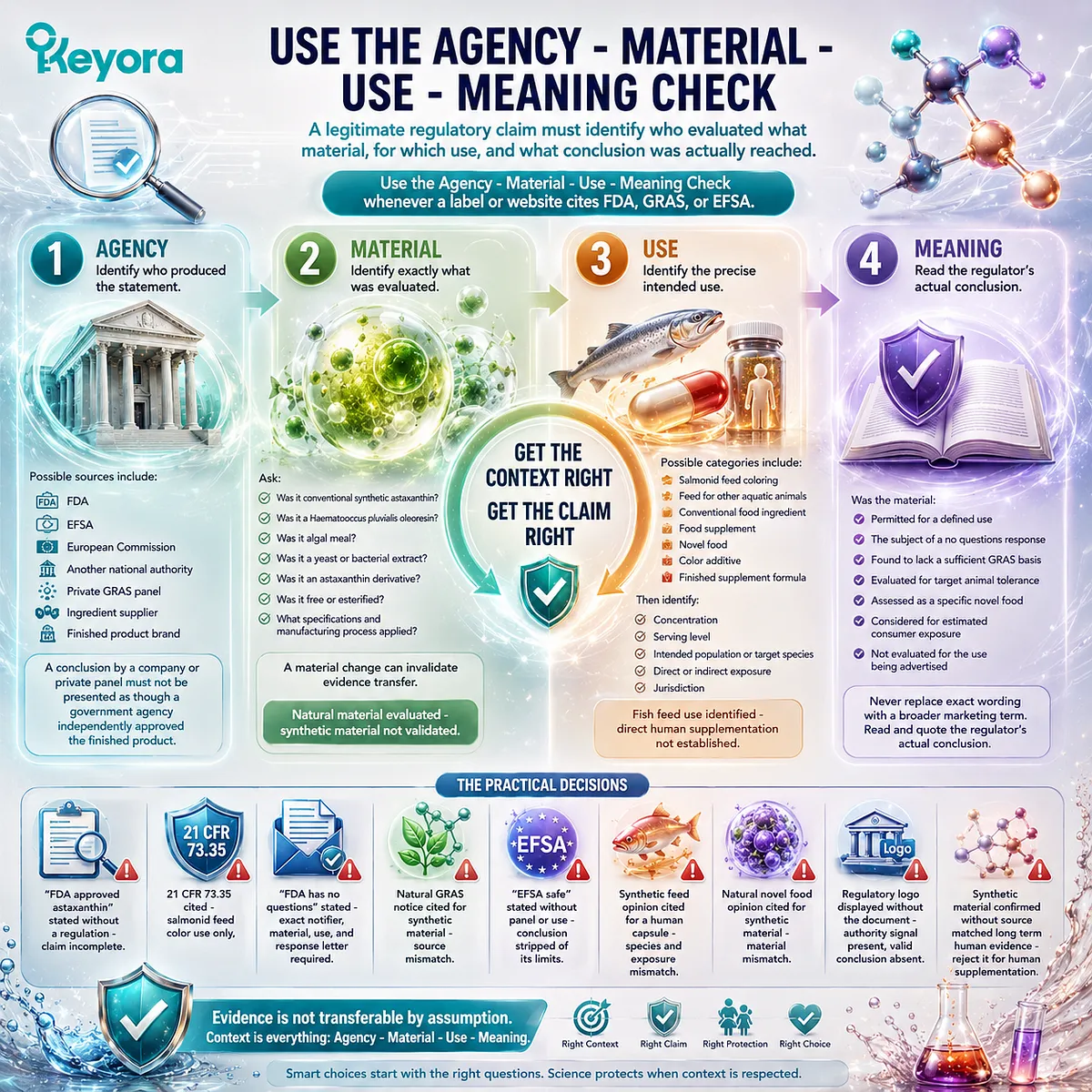
Use the Agency – Material – Use – Meaning Check
A legitimate regulatory claim must identify who evaluated what material, for which use, and what conclusion was actually reached
Use the Agency – Material – Use – Meaning Check whenever a label or website cites FDA, GRAS, or EFSA.
1. Agency
Identify who produced the statement.
Possible sources include:
-
FDA
-
EFSA
-
the European Commission
-
another national authority
-
a private GRAS panel
-
the ingredient supplier
-
the finished product brand
A conclusion reached by a company or private expert panel must not be presented as though a government agency independently approved the finished product.
2. Material
Identify exactly what was evaluated.
Ask:
-
Was it conventional synthetic astaxanthin?
-
Was it a Haematococcus pluvialis oleoresin?
-
Was it algal meal?
-
Was it a yeast or bacterial extract?
-
Was it an astaxanthin derivative?
-
Was it free or esterified?
-
What specifications and manufacturing process applied?
A material change can invalidate evidence transfer.
Natural material evaluated – synthetic material not validated
3. Use
Identify the precise intended use.
Possible categories include:
-
salmonid feed coloring
-
feed for other aquatic animals
-
conventional food ingredient
-
food supplement
-
novel food
-
color additive
-
finished supplement formula
Then identify:
-
concentration
-
serving level
-
intended population or target species
-
direct or indirect exposure
-
jurisdiction
Fish feed use identified – direct human supplementation not established
4. Meaning
Read the regulator’s actual conclusion.
Was the material:
-
permitted for a defined use
-
the subject of a no questions response
-
found to lack a sufficient GRAS basis
-
evaluated for target animal tolerance
-
assessed as a specific novel food
-
considered for estimated consumer exposure
-
not evaluated for the use being advertised
Never replace exact wording with a broader marketing term.
The practical decisions are:
FDA approved astaxanthin stated without a regulation – claim incomplete
21 CFR 73.35 cited – salmonid feed color use only
FDA has no questions stated – exact notifier, material, use, and response letter required
Natural GRAS notice cited for synthetic material – source mismatch
EFSA safe stated without panel or use – conclusion stripped of its limits
Synthetic feed opinion cited for a human capsule – species and exposure mismatch
Natural novel food opinion cited for synthetic material – material mismatch
Regulatory logo displayed without the document – authority signal present, valid conclusion absent
Synthetic material confirmed without source matched long term human evidence – reject it for human supplementation
What This Means When Choosing Astaxanthin
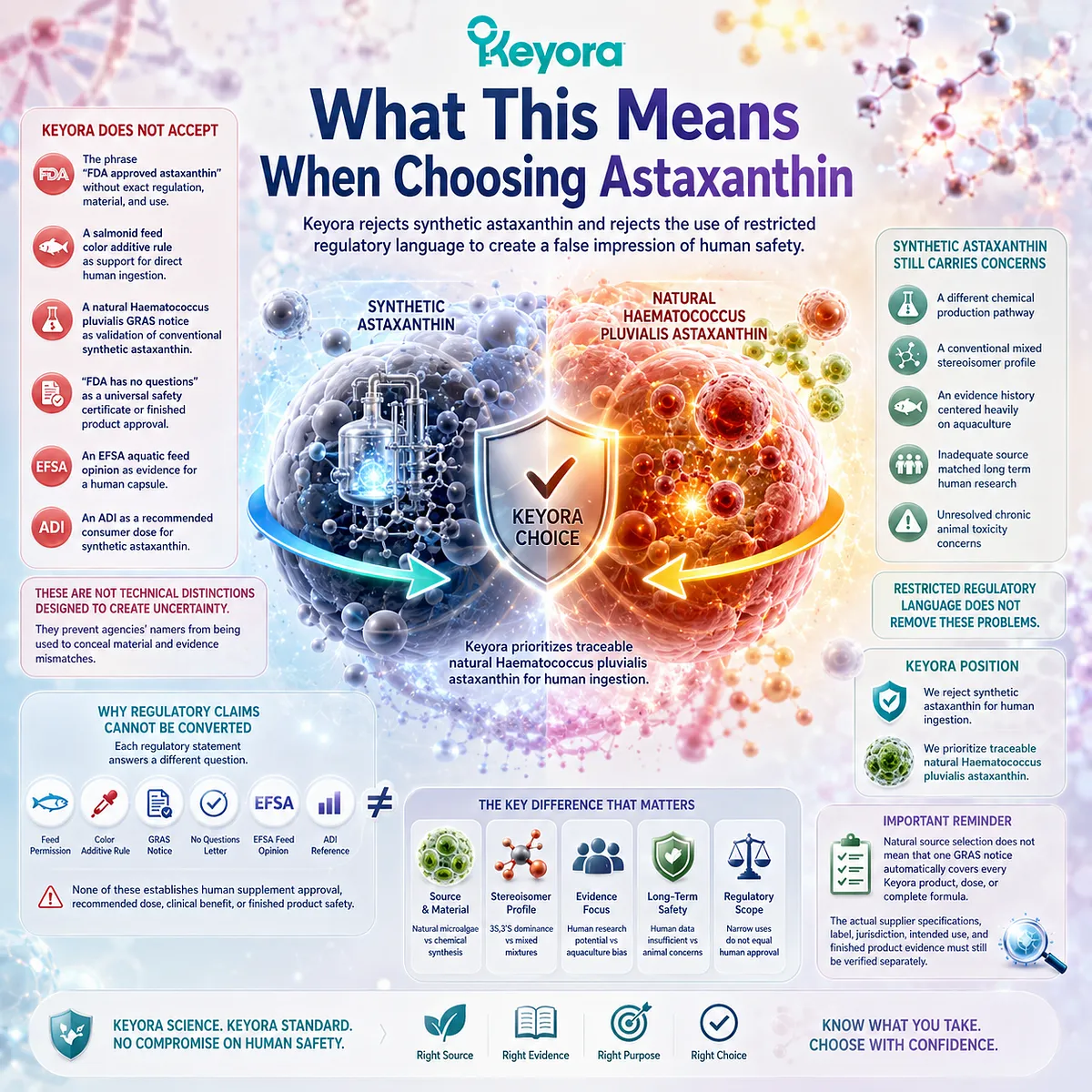
Keyora rejects synthetic astaxanthin and rejects the use of restricted regulatory language to create a false impression of human safety
Keyora does not accept the phrase FDA approved astaxanthin without the exact regulation, material, and use.
Keyora does not accept a salmonid feed color additive rule as support for direct human ingestion.
Keyora does not accept a natural Haematococcus pluvialis GRAS notice as validation of conventional synthetic astaxanthin.
Keyora does not accept FDA has no questions as a universal safety certificate or finished product approval.
Keyora does not accept an EFSA aquatic feed opinion as evidence for a human capsule.
Keyora also does not accept an ADI as a recommended consumer dose for synthetic astaxanthin.
These are not technical distinctions designed to create uncertainty. They prevent agencies’ names from being used to conceal material and evidence mismatches.
Conventional synthetic astaxanthin still carries:
-
a different chemical production pathway
-
a conventional mixed stereoisomer profile
-
an evidence history centered heavily on aquaculture
-
inadequate source matched long term human research
-
unresolved chronic animal toxicity concerns
Restricted regulatory language does not remove those problems.
Keyora therefore rejects synthetic astaxanthin for human ingestion and prioritizes traceable natural Haematococcus pluvialis astaxanthin.
Natural source selection does not mean that one GRAS notice automatically covers every Keyora product, dose, or complete formula. The actual supplier specifications, label, jurisdiction, intended use, and finished product evidence must still be verified separately.
Closing Summary
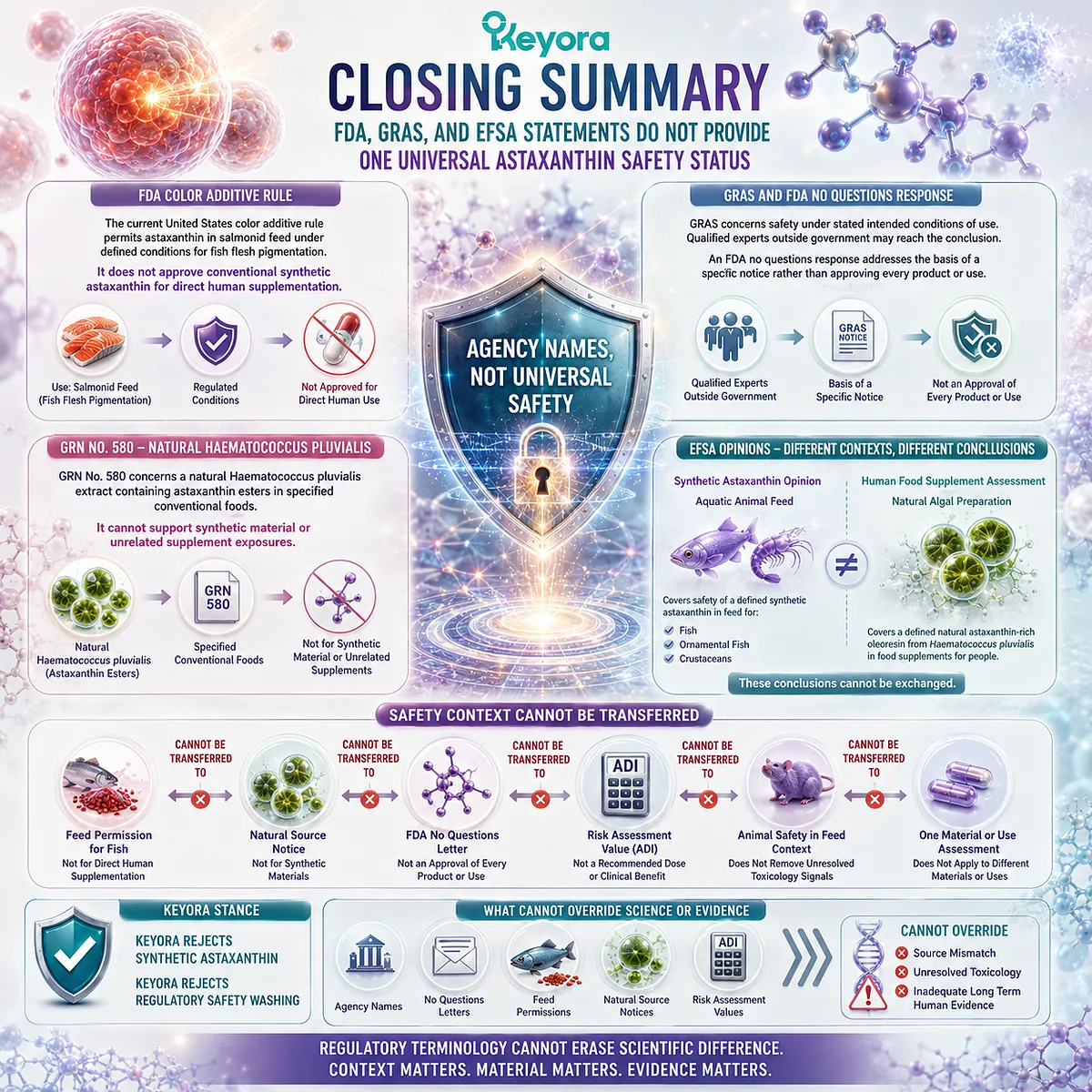
FDA, GRAS, and EFSA statements do not provide one universal astaxanthin safety status.
The current United States color additive rule permits astaxanthin in salmonid feed under defined conditions for fish flesh pigmentation. It does not approve conventional synthetic astaxanthin for direct human supplementation.
GRAS concerns safety under stated intended conditions of use. Qualified experts outside government may reach the conclusion, and an FDA no questions response addresses the basis of a specific notice rather than approving every product or use.
GRN No. 580 concerns a natural Haematococcus pluvialis extract containing astaxanthin esters in specified conventional foods. It cannot support synthetic material or unrelated supplement exposures.
EFSA’s synthetic astaxanthin opinion concerns aquatic animal feed, while its human food supplement assessment concerns a defined natural algal preparation. These conclusions cannot be exchanged.
Keyora rejects synthetic astaxanthin and rejects regulatory safety washing. Agency names, no questions letters, feed permissions, natural source notices, and risk assessment values cannot override source mismatch, unresolved toxicology, or inadequate long term human evidence
This article is for educational and informational purposes only. It does not provide medical advice, diagnosis, treatment, cure, prevention, disease outcome claims, hormone restoration claims, fertility outcome claims, or formula-specific clinical efficacy claims.