
Why Is Synthetic Astaxanthin Used in Fish Feed – and Does That Make It Suitable for Humans?
Keyora Research Q&A Library
This is part of the Keyora Research Q&A Series, derived from Keyora Nutritional Neurology Series.
Within the Keyora Nutritional Neurology framework, this Q&A translates complex nutrient–brain mechanisms into reader-friendly, evidence-bound answers, focusing on stress resilience, sleep quality, calm mood support, cognitive wellness, and the broader interaction between nutrition, neurochemistry, and daily nervous-system function.
First published by Keyora Research Journal: www.keyorahealth.com
Direct Answer
Synthetic astaxanthin is added to aquaculture feed primarily to create or intensify the pink to orange red color of farmed salmonid flesh. It is an industrial pigmenting use, not evidence that concentrated synthetic astaxanthin is suitable for direct human ingestion.
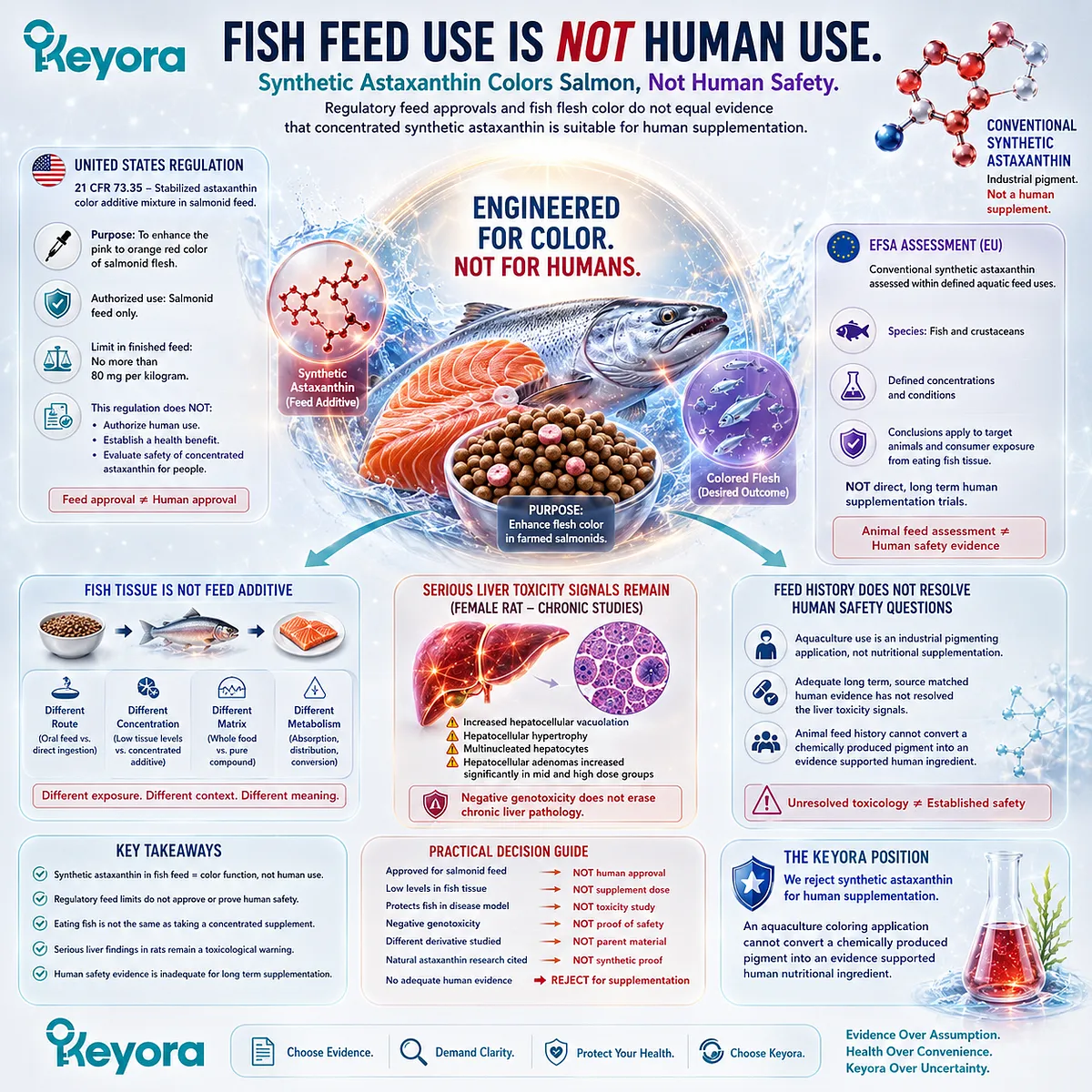
United States regulation limits astaxanthin under 21 CFR 73.35 to a stabilized color additive mixture in salmonid feed. Its stated purpose is to enhance flesh color, and the finished feed may contain no more than 80 mg per kilogram. This regulation does not authorize synthetic astaxanthin as a general human supplement ingredient or establish a human health benefit.
EFSA has also assessed conventional synthetic astaxanthin within defined aquatic feed uses, species, and concentrations. Those conclusions concern target animals and indirect consumer exposure from eating fish tissue. They are not direct, long term human supplementation trials and cannot be presented as proof that people should swallow concentrated synthetic material.
Eating edible fish tissue is not equivalent to ingesting the feed additive itself. The exposure route, concentration, food matrix, metabolism, serving pattern, and duration are different.
Fish feed history also does not erase the serious liver toxicity signals and hepatocellular adenomas reported during chronic synthetic astaxanthin exposure in female rats.
Adequate long term human evidence has not resolved those findings.
Keyora therefore rejects synthetic astaxanthin for human supplementation.
An aquaculture coloring application cannot convert a chemically produced pigment into an evidence supported human nutritional ingredient.
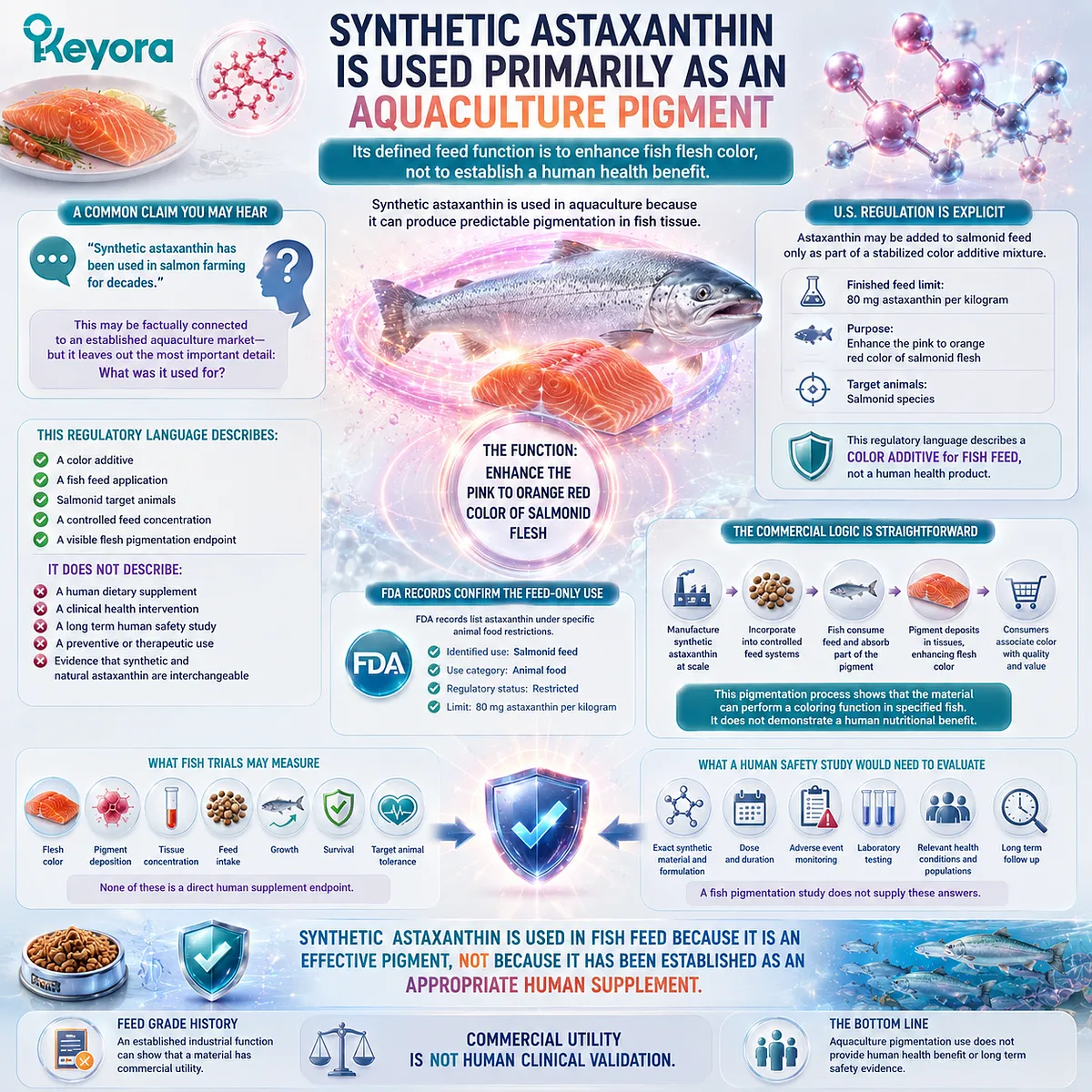
Synthetic Astaxanthin Is Used Primarily as an Aquaculture Pigment
Its defined feed function is to enhance fish flesh color, not to establish a human health benefit
A consumer may encounter a statement such as:
Synthetic astaxanthin has been used in salmon farming for decades
The sentence may be factually connected to an established aquaculture market, but it leaves out the most important detail:
What was it used for?
Synthetic astaxanthin is used in aquaculture because it can produce predictable pigmentation in fish tissue.
The United States regulation is explicit. Astaxanthin may be added to salmonid feed only as part of a stabilized color additive mixture. Its stated use is to enhance the pink to orange red color of salmonid flesh. The finished feed limit is 80 mg of astaxanthin per kilogram.
This regulatory language describes:
-
a color additive
-
a fish feed application
-
salmonid target animals
-
a controlled feed concentration
-
a visible flesh pigmentation endpoint
It does not describe:
-
a human dietary supplement
-
a clinical health intervention
-
a long term human safety study
-
a preventive or therapeutic use
-
evidence that synthetic and natural astaxanthin are interchangeable
FDA records also list astaxanthin under specific animal food restrictions rather than as an unrestricted human food color or general human supplement authorization. The FDA database identifies its use as salmonid feed with a limit of 80 mg per kilogram.
The commercial logic is straightforward.
Synthetic astaxanthin can be manufactured at scale and incorporated into controlled feed systems. Fish consume the feed, absorb part of the pigment, and deposit astaxanthin in their tissues. The resulting color has commercial value because consumers associate pink or orange red flesh with salmon.
That pigmentation process establishes only that the material can perform a coloring function in specified fish.
It does not demonstrate that concentrated synthetic astaxanthin provides a human nutritional benefit.
A fish trial may measure:
-
flesh color
-
pigment deposition
-
tissue concentration
-
feed intake
-
growth
-
survival
-
target animal tolerance
None of these is a direct human supplement endpoint.
A human safety study would need to evaluate people ingesting the exact synthetic material directly. It would need to identify the formulation, dose, duration, adverse event monitoring, laboratory testing, and relevant health conditions.
A fish pigmentation study does not supply those answers.
Synthetic astaxanthin is used in fish feed because it is an effective pigment, not because it has been established as an appropriate human supplement
The distinction becomes especially important when companies use the phrase feed grade history to create a broader impression of safety.
An established industrial function can show that a material has commercial utility.
Commercial utility is not human clinical validation.
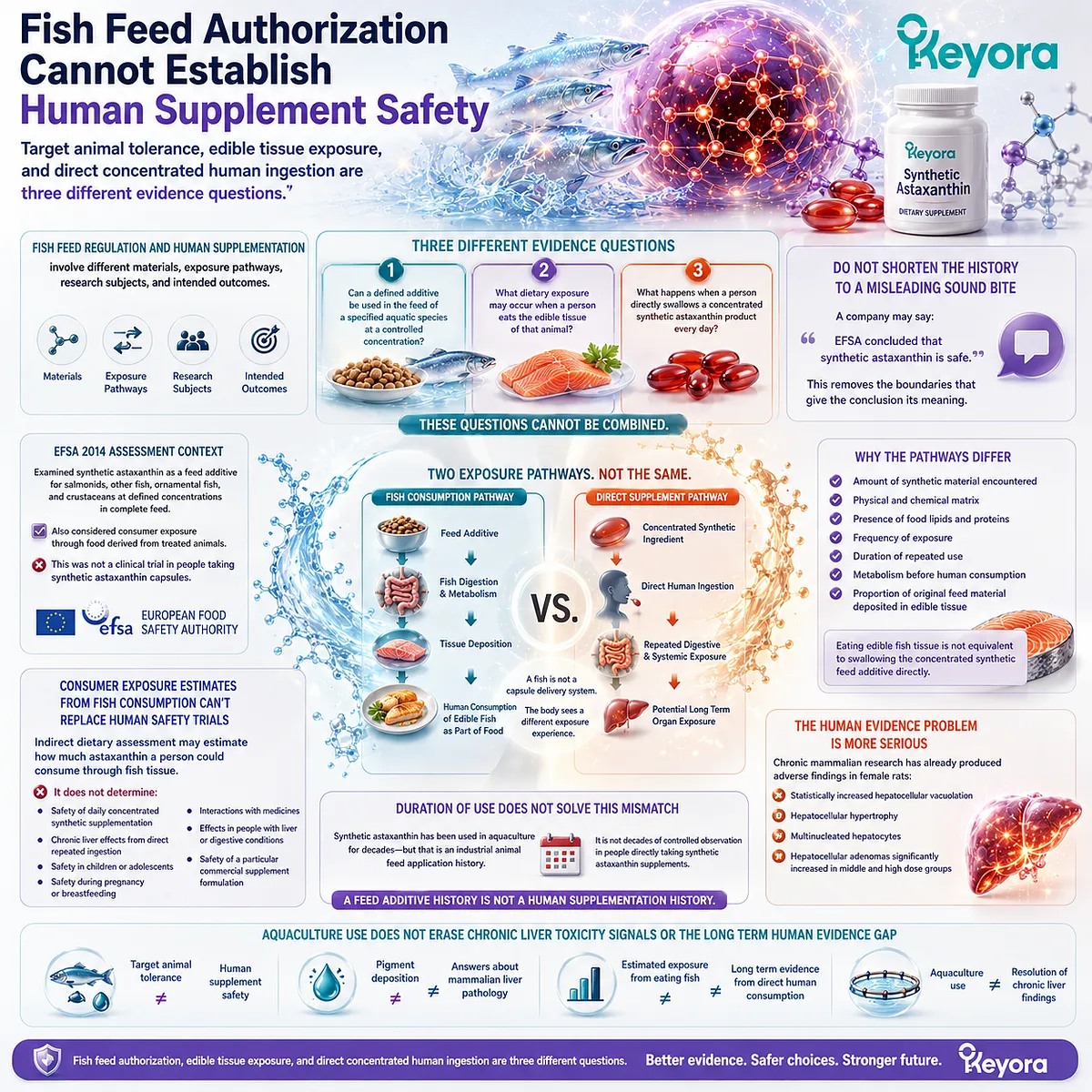
Fish Feed Authorization Cannot Establish Human Supplement Safety
Target animal tolerance, edible tissue exposure, and direct concentrated human ingestion are three different evidence questions
Fish feed regulation and direct human supplementation involve different materials, exposure pathways, research subjects, and intended outcomes.
The first question is:
Can a defined additive be used in the feed of a specified aquatic species at a controlled concentration?
The second question is:
What dietary exposure may occur when a person eats the edible tissue of that animal?
The third question is:
What happens when a person directly swallows a concentrated synthetic astaxanthin product every day?
These questions cannot be combined.
EFSA’s 2014 assessment examined synthetic astaxanthin as a feed additive for salmonids, other fish, ornamental fish, and crustaceans at defined concentrations in complete feed. It also considered consumer exposure through food derived from treated animals. The assessment was not a clinical trial in people taking synthetic astaxanthin capsules.
A company may shorten that regulatory history to:
EFSA concluded that synthetic astaxanthin is safe
That wording removes the boundaries that give the conclusion its meaning.
The complete context must include:
-
which synthetic preparation was assessed
-
which animal species received it
-
how much was placed in complete feed
-
why it was used
-
how indirect consumer exposure was estimated
-
which questions were not studied
The EFSA conclusion cannot be detached from aquatic feed use and converted into support for routine direct human ingestion.
The same problem occurs when a company says:
People already consume synthetic astaxanthin when they eat farmed salmon
This statement creates a false equivalence between two exposure pathways.
The fish consumption pathway is:
Feed additive
↓
Fish digestion and metabolism
↓
Tissue deposition
↓
Human consumption of edible fish as part of food
The direct supplement pathway is:
Concentrated synthetic ingredient
↓
Direct human ingestion
↓
Repeated digestive and systemic exposure
↓
Potential long term organ exposure
A fish is not a capsule delivery system.
Before the fish reaches the consumer, the additive has entered an animal feed matrix, passed through fish digestion, undergone biological distribution, and become associated with edible tissue.
The person then consumes the tissue within a complex food matrix.
Direct supplementation removes that intermediate animal processing stage and delivers a concentrated ingredient directly to the human digestive system.
Differences may include:
-
the amount of synthetic material encountered
-
the physical and chemical matrix
-
the presence of food lipids and proteins
-
the frequency of exposure
-
the duration of repeated use
-
metabolism before human consumption
-
the proportion of the original feed material deposited in edible tissue
Eating edible fish tissue is not equivalent to swallowing the concentrated synthetic feed additive directly
Consumer exposure estimates from fish consumption also cannot replace direct human safety trials.
An indirect dietary assessment may estimate how much astaxanthin a person could consume through fish tissue under specified assumptions.
It does not determine:
-
the safety of daily concentrated synthetic supplementation
-
chronic liver effects from direct repeated ingestion
-
safety in children or adolescents
-
safety during pregnancy or breastfeeding
-
interactions with medicines
-
effects in people with liver or digestive conditions
-
safety of a particular commercial supplement formulation
Duration of use does not solve this mismatch.
A company may say that synthetic astaxanthin has been used in aquaculture for decades.
That statement describes the duration of an industrial animal feed application.
It does not describe decades of controlled observation in people directly taking synthetic astaxanthin supplements.
A feed additive history is not a human supplementation history
The human evidence problem becomes more serious because chronic mammalian research has already produced adverse findings.
EFSA’s published background describes statistically increased hepatocellular vacuolation, hepatocellular hypertrophy, and multinucleated hepatocytes in female rats at the tested synthetic astaxanthin dose levels. Hepatocellular adenomas were also significantly increased in the middle and high dose female groups.
A fish coloring application does not resolve those findings.
Target animal tolerance does not invalidate chronic rat toxicology.
Pigment deposition does not answer questions about mammalian liver pathology.
Estimated exposure from eating fish does not provide the missing long term evidence from people directly consuming the synthetic material.
Aquaculture use does not erase the chronic liver toxicity signals or long term human evidence gap associated with synthetic astaxanthin
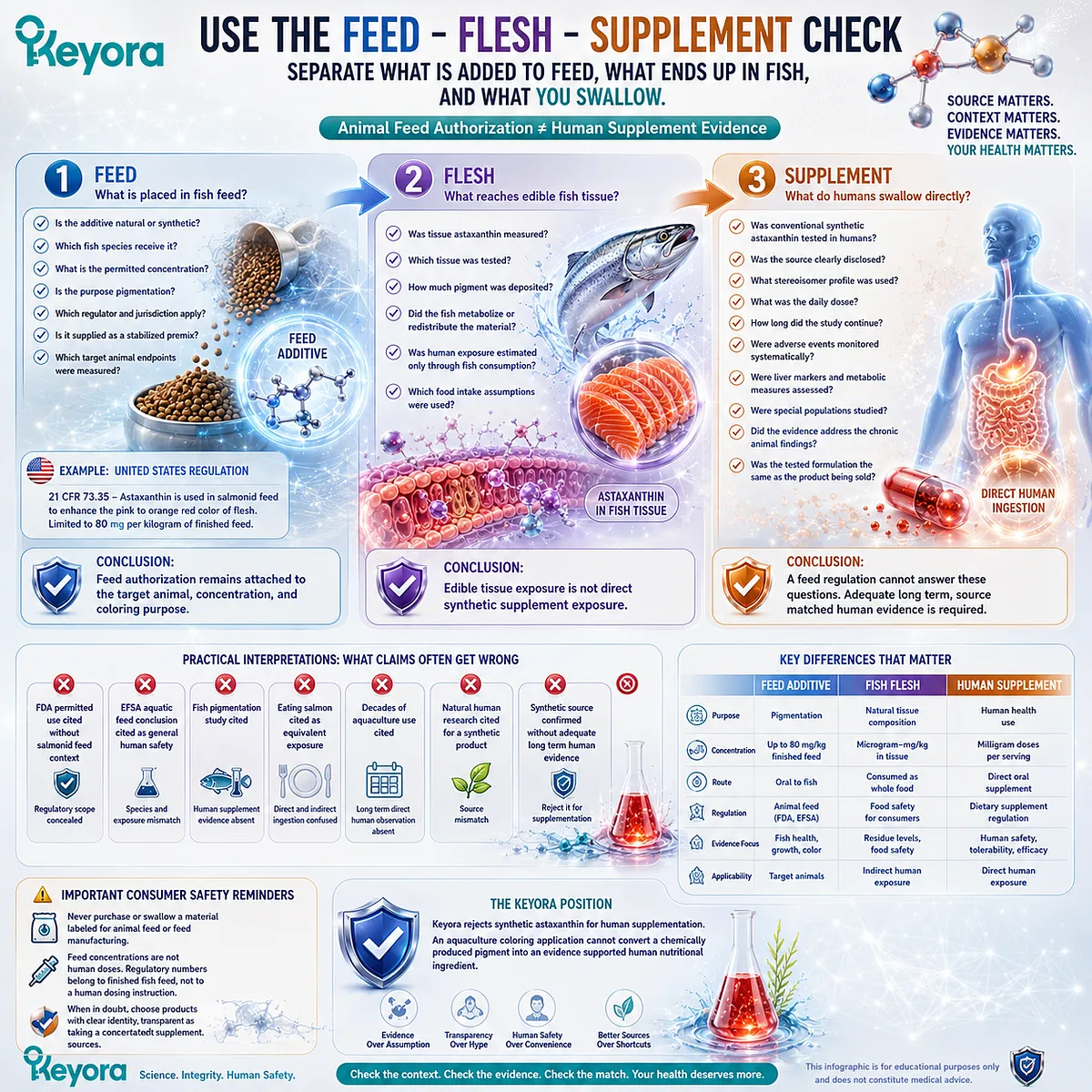
Use the Feed – Flesh – Supplement Check
A responsible claim should separate the additive placed in feed, the astaxanthin present in edible fish, and the ingredient swallowed directly by humans
The Feed – Flesh – Supplement Check prevents an animal feed authorization from being misrepresented as human supplement evidence.
1. Feed
Identify the exact feed application.
Ask:
-
Is the additive natural or synthetic?
-
Which fish species receive it?
-
What is the permitted concentration?
-
Is the purpose pigmentation?
-
Which regulator and jurisdiction apply?
-
Is it supplied as a stabilized premix?
-
Which target animal endpoints were measured?
Under current United States regulation, astaxanthin is used in salmonid feed to enhance the pink to orange red color of flesh and is limited to 80 mg per kilogram of finished feed.
The conclusion at this stage is:
Feed authorization remains attached to the target animal, concentration, and coloring purpose
2. Flesh
Identify what reaches edible fish tissue.
Ask:
-
Was tissue astaxanthin measured?
-
Which tissue was tested?
-
How much pigment was deposited?
-
Did the fish metabolize or redistribute the material?
-
Was human exposure estimated only through fish consumption?
-
Which food intake assumptions were used?
This stage concerns an edible animal product.
It does not concern a person taking the original concentrated additive directly.
The conclusion is:
Edible tissue exposure is not direct synthetic supplement exposure
3. Supplement
Demand human evidence for the material actually swallowed.
Ask:
-
Was conventional synthetic astaxanthin tested directly in humans?
-
Was the source clearly disclosed?
-
What stereoisomer profile was used?
-
What was the daily dose?
-
How long did the study continue?
-
Were adverse events monitored systematically?
-
Were liver markers and metabolic measures assessed?
-
Were special populations studied?
-
Did the evidence address the chronic animal findings?
-
Was the tested formulation the same as the product being sold?
A feed regulation cannot answer these questions.
The practical interpretations are:
FDA permitted use cited without salmonid feed context – regulatory scope concealed
EFSA aquatic feed conclusion cited as general human safety – species and exposure mismatch
Fish pigmentation study cited – human supplement evidence absent
Eating salmon cited as equivalent exposure – direct and indirect ingestion confused
Decades of aquaculture use cited – long term direct human observation absent
Natural human research cited for a synthetic product – source mismatch
Synthetic source confirmed without adequate long term human evidence – reject it for supplementation
Consumers should never purchase or swallow a material labeled for animal feed or feed manufacturing.
Feed concentrations should not be converted into a self selected human dose. The regulatory numbers belong to finished fish feed, not to a human dosing instruction.
What This Means When Choosing Astaxanthin
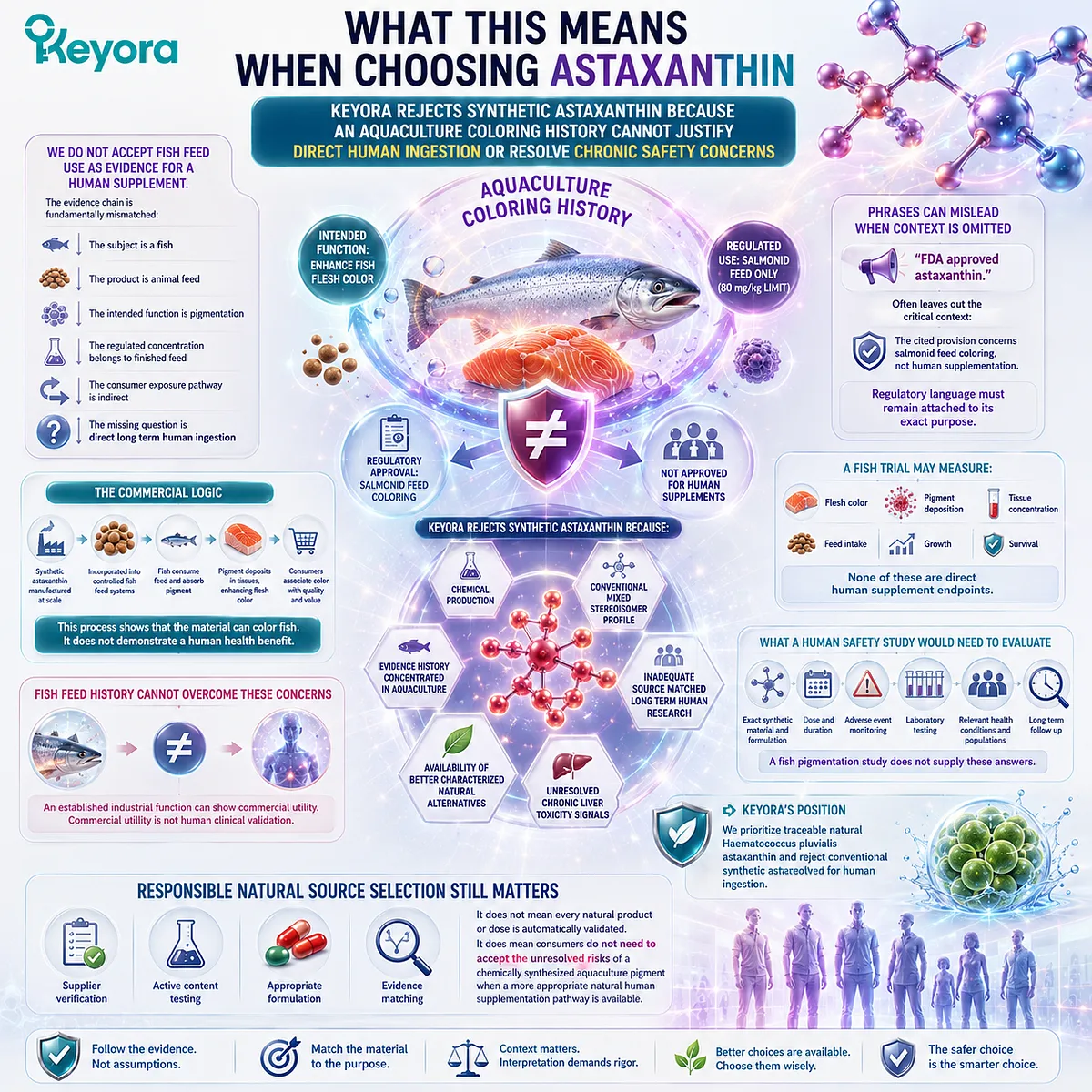
Keyora rejects synthetic astaxanthin because an aquaculture coloring history cannot justify direct human ingestion or resolve chronic safety concerns
Keyora does not accept fish feed use as evidence for a human supplement.
The evidence chain is fundamentally mismatched:
-
the subject is a fish
-
the product is animal feed
-
the intended function is pigmentation
-
the regulated concentration belongs to finished feed
-
the consumer exposure pathway is indirect
-
the missing question is direct long term human ingestion
Keyora also rejects phrases such as FDA approved astaxanthin when the speaker omits that the cited provision concerns salmonid feed coloring.
Regulatory language must remain attached to its exact purpose.
Keyora’s rejection of synthetic astaxanthin is strengthened by the combination of:
-
chemical production
-
a conventional mixed stereoisomer profile
-
an evidence history concentrated in aquaculture
-
inadequate source matched long term human research
-
unresolved chronic liver toxicity signals
-
the availability of better characterized natural alternatives
Fish feed history cannot provide the evidence required to overcome these concerns.
Keyora therefore prioritizes traceable natural Haematococcus pluvialis astaxanthin and rejects conventional synthetic astaxanthin for human ingestion.
Natural source selection must still be supported by supplier verification, active content testing, appropriate formulation, and evidence matching. It does not mean every natural product or dose is automatically validated.
It does mean consumers do not need to accept the unresolved risks of a chemically synthesized aquaculture pigment when a more appropriate natural human supplementation pathway is available.
Closing Summary
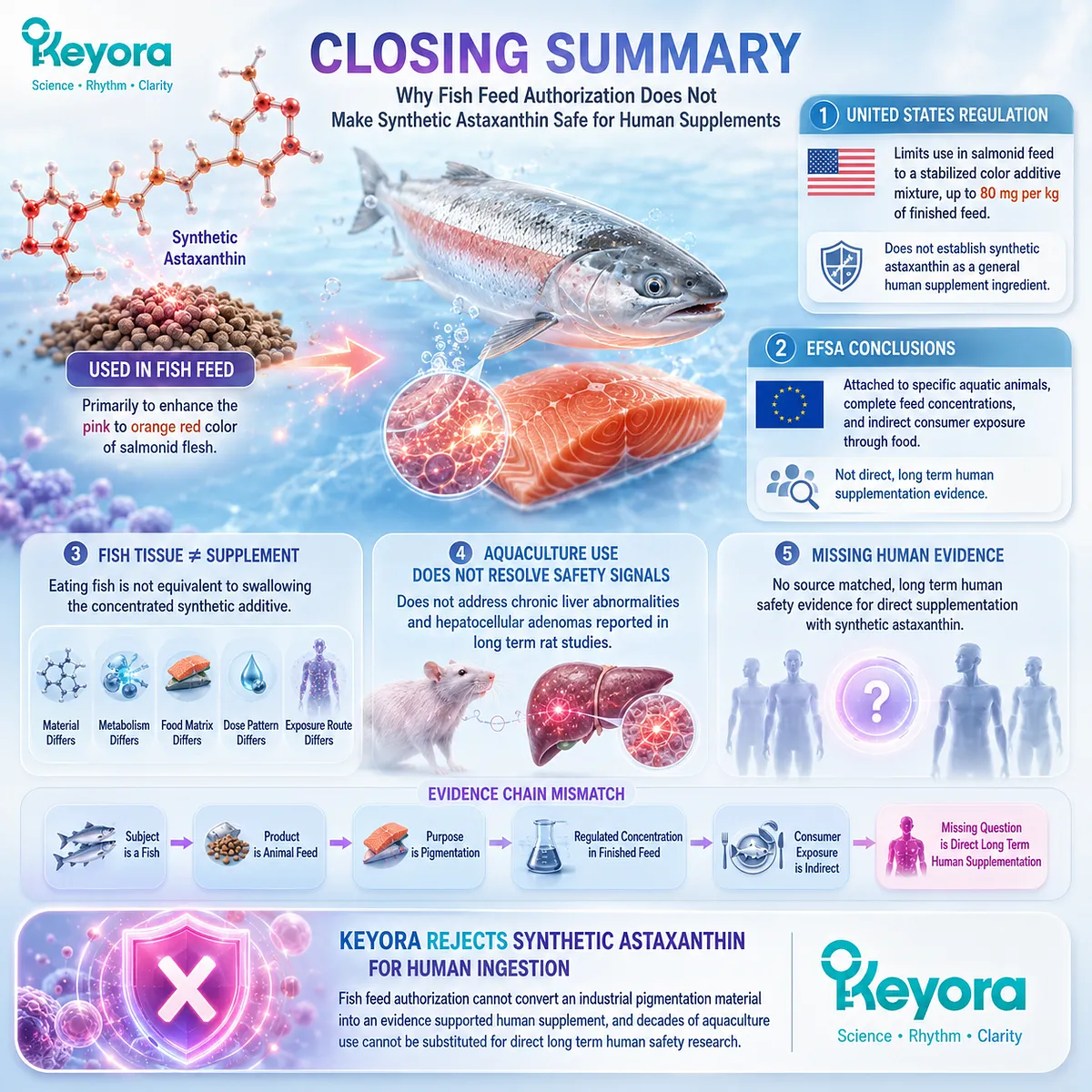
Synthetic astaxanthin is used in fish feed primarily to enhance the pink to orange red color of salmonid flesh.
United States regulation limits this use to a stabilized color additive mixture in salmonid feed, with no more than 80 mg per kilogram of finished feed. It does not establish synthetic astaxanthin as a general human supplement ingredient.
EFSA’s synthetic astaxanthin conclusions are likewise attached to specified aquatic animals, complete feed concentrations, and indirect consumer exposure through food. They are not direct, long term human supplementation evidence.
Eating fish tissue is not equivalent to swallowing the concentrated synthetic additive. The material, metabolism, food matrix, dose pattern, and exposure route differ.
Aquaculture use also does not resolve the chronic liver abnormalities and hepatocellular adenomas reported in long term rat research or replace the missing source matched human evidence.
Keyora rejects synthetic astaxanthin for human ingestion. Fish feed authorization cannot convert an industrial pigmentation material into an evidence supported human supplement, and decades of aquaculture use cannot be substituted for direct long term human safety research
This article is for educational and informational purposes only. It does not provide medical advice, diagnosis, treatment, cure, prevention, disease outcome claims, hormone restoration claims, fertility outcome claims, or formula-specific clinical efficacy claims.