
Is Esterified Astaxanthin More Stable – and Does That Mean It Is Better Absorbed?
Keyora Research Q&A Library
This is part of the Keyora Research Q&A Series, derived from Keyora Nutritional Neurology Series .
Within the Keyora Nutritional Neurology framework, this Q&A translates complex nutrient–brain mechanisms into reader-friendly, evidence-bound answers, focusing on stress resilience, sleep quality, calm mood support, cognitive wellness, and the broader interaction between nutrition, neurochemistry, and daily nervous-system function.
First published by Keyora Research Journal: www.keyorahealth.com
Direct Answer
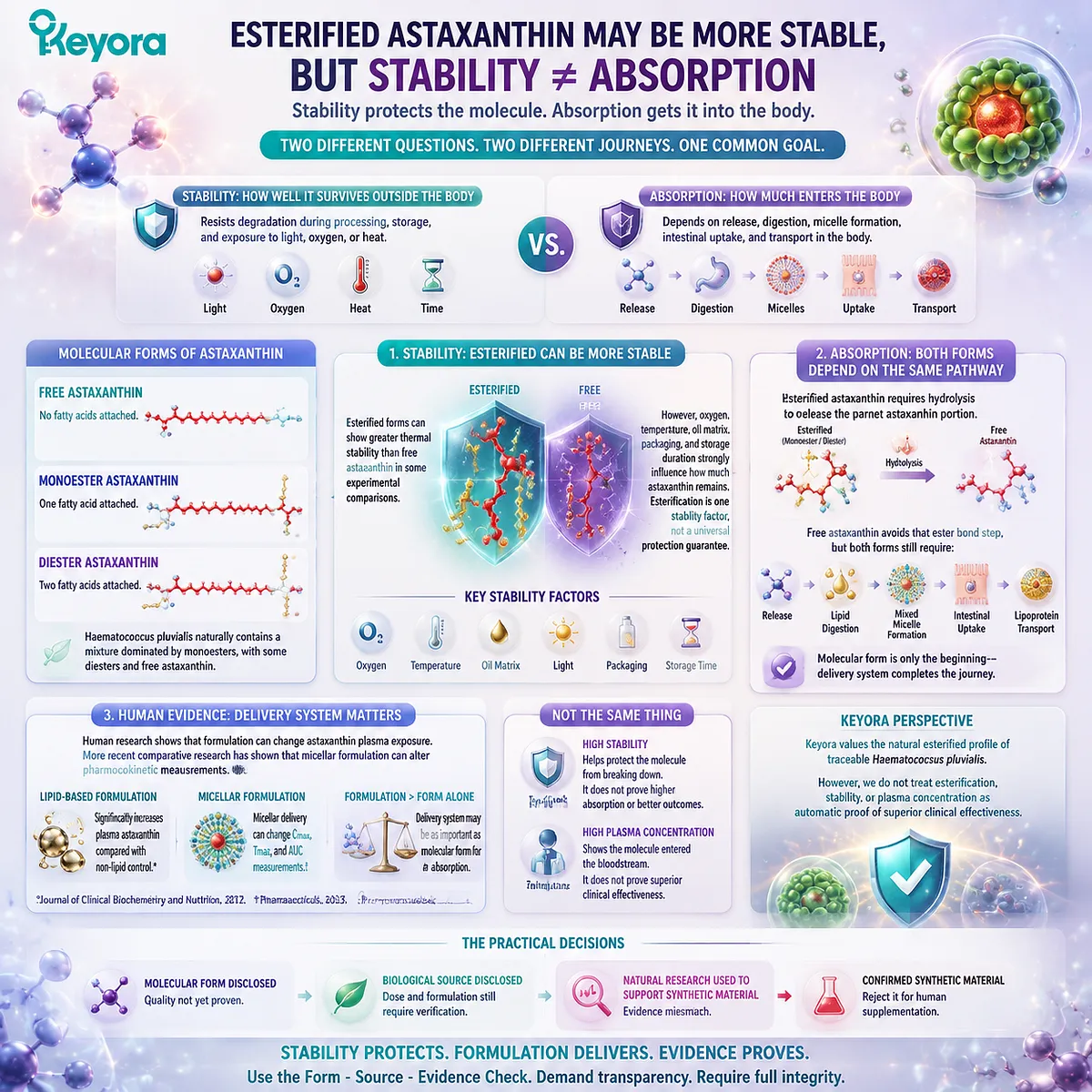
Esterified astaxanthin may be more stable than free astaxanthin under some defined conditions, but that does not automatically mean it is better absorbed. Stability describes how well an ingredient resists degradation during processing, storage, and exposure to light, oxygen, or heat. Absorption describes how much astaxanthin enters the body after the finished product has been released and digested.
Astaxanthin esters contain one or two attached fatty acids. These esterified forms can show greater thermal stability than free astaxanthin in some experimental comparisons. However, studies of Haematococcus pluvialis materials also show that oxygen, temperature, oil matrix, packaging, and storage duration can strongly influence how much astaxanthin remains. Esterification is therefore one stability factor, not a universal protection guarantee.
Before absorption, esterified astaxanthin generally requires hydrolysis to release the parent astaxanthin portion. Free astaxanthin avoids that ester bond step, but both forms still depend on release from the product, lipid digestion, mixed micelle formation, intestinal uptake, and lipoprotein transport.
Human research shows that lipid based formulation can substantially change astaxanthin plasma exposure, and more recent comparative research has also shown that micellar formulation can alter pharmacokinetic measurements. These findings demonstrate that the delivery system may be as important as the molecular form.
Keyora values the natural esterified profile of traceable Haematococcus pluvialis, but does not treat esterification, stability, or plasma concentration as automatic proof of superior clinical effectiveness.
Greater Stability Does Not Automatically Mean Greater Absorption
Stability measures how well astaxanthin survives defined conditions, while absorption measures how much reaches the body
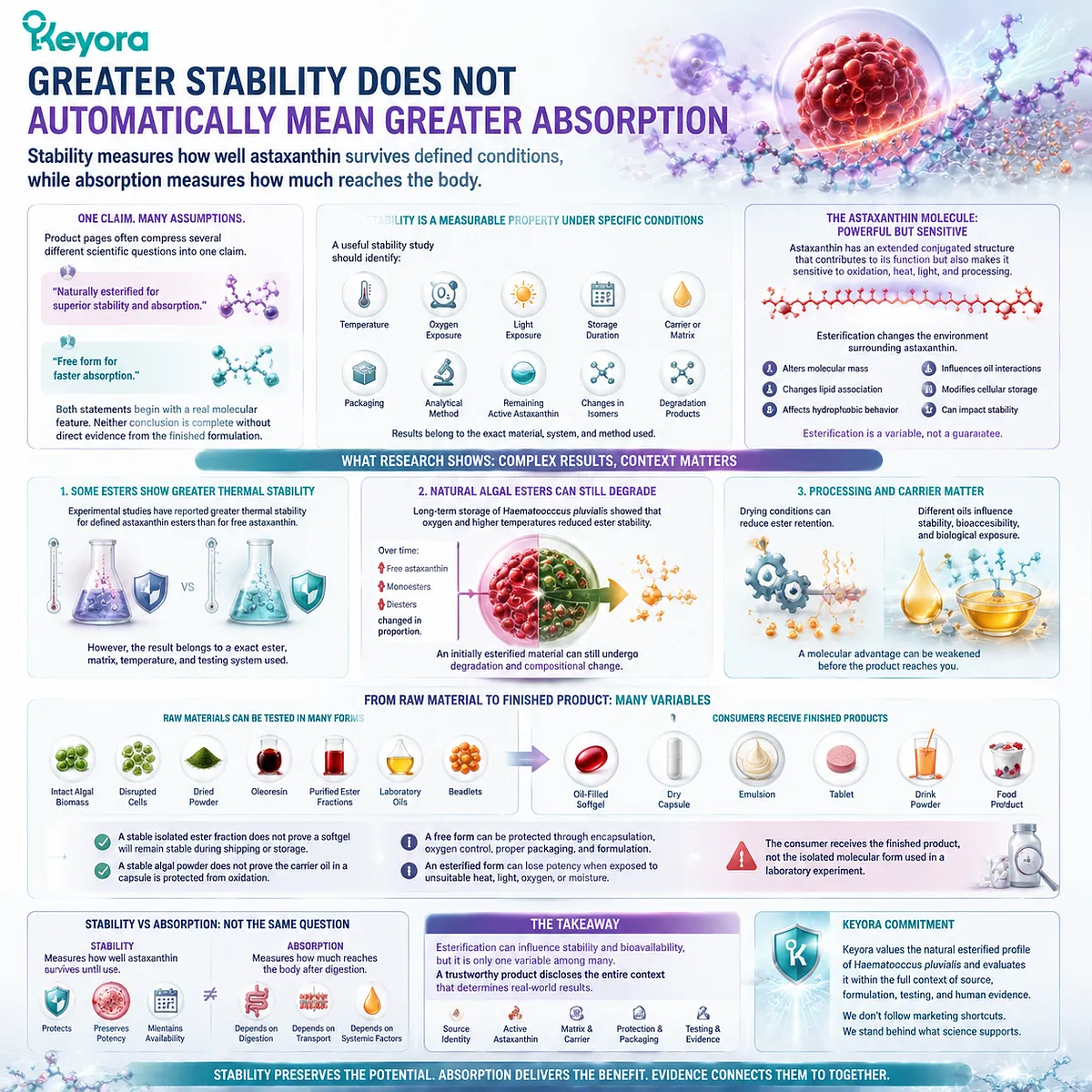
Product pages often compress several different scientific questions into one claim.
A brand may say:
Naturally esterified for superior stability and absorption
Another may say:
Free form for faster absorption
Both statements begin with a real molecular feature. Neither conclusion is complete without direct evidence from the finished formulation.
Stability refers to how well astaxanthin retains its identity and potency under specified conditions.
A useful stability study should identify:
-
the material tested
-
temperature
-
oxygen exposure
-
light exposure
-
storage duration
-
carrier or matrix
-
packaging
-
analytical method
-
remaining active astaxanthin
-
changes in isomers or degradation products
Astaxanthin contains an extended conjugated structure that contributes to its chemical behavior but also makes it sensitive to oxidation, heat, light, and processing.
Esterification can change the molecular environment surrounding the astaxanthin portion. The attached fatty acids alter molecular mass, lipid association, hydrophobic behavior, and interactions within oils or biological storage structures.
Some experimental studies have reported greater thermal stability for defined astaxanthin esters than for free astaxanthin. However, the result belongs to the exact ester, matrix, temperature, and testing system used. It cannot be transferred automatically to every natural algal extract or finished supplement.
Research on Haematococcus pluvialis also demonstrates why esterification cannot be treated as a complete stability guarantee.
In a long term storage study, oxygen and higher storage temperatures reduced the stability of algal astaxanthin esters. The proportions of free astaxanthin, monoesters, and diesters changed during storage, showing that an initially esterified material can still undergo degradation and compositional change.
Drying conditions can also influence the retention of different astaxanthin forms. One experimental analysis reported substantial losses among individual esters during different drying processes, reinforcing that processing can weaken a potential molecular advantage before the ingredient reaches the consumer.
The carrier matrix adds another variable.
A study evaluating astaxanthin ester in different oils found that the oil system influenced stability, antioxidant measurements, bioaccessibility, and biological exposure. The important conclusion is not that one oil guarantees better absorption. It is that astaxanthin ester cannot be evaluated separately from the material surrounding it.
This distinction becomes even more important when moving from raw material to finished product.
Raw material stability may be tested in:
-
intact algal biomass
-
disrupted cells
-
dried powder
-
oleoresin
-
purified ester fractions
-
laboratory oils
-
beadlets
Consumers may instead receive:
-
an oil filled softgel
-
a dry capsule
-
an emulsion
-
a tablet
-
a drink powder
-
a food product
A stable isolated ester fraction does not prove that a finished softgel will remain stable during shipping or storage.
A stable algal powder does not prove that the carrier oil in a capsule is protected from oxidation.
A free form can be protected through encapsulation, oxygen control, appropriate packaging, and formulation technology.
An esterified form can lose potency when exposed to unsuitable heat, light, oxygen, or moisture.
The consumer receives the finished product, not the isolated molecular form used in a laboratory experiment
Stability can preserve the amount available for digestion. It does not measure digestion or absorption itself.
Digestion and Formulation Determine Plasma Exposure
Esterified forms require hydrolysis, while every form still depends on release, mixed micelles, intestinal uptake, and transport
Astaxanthin is highly lipid soluble.
Before it can appear in the circulation, it must move through several connected steps.
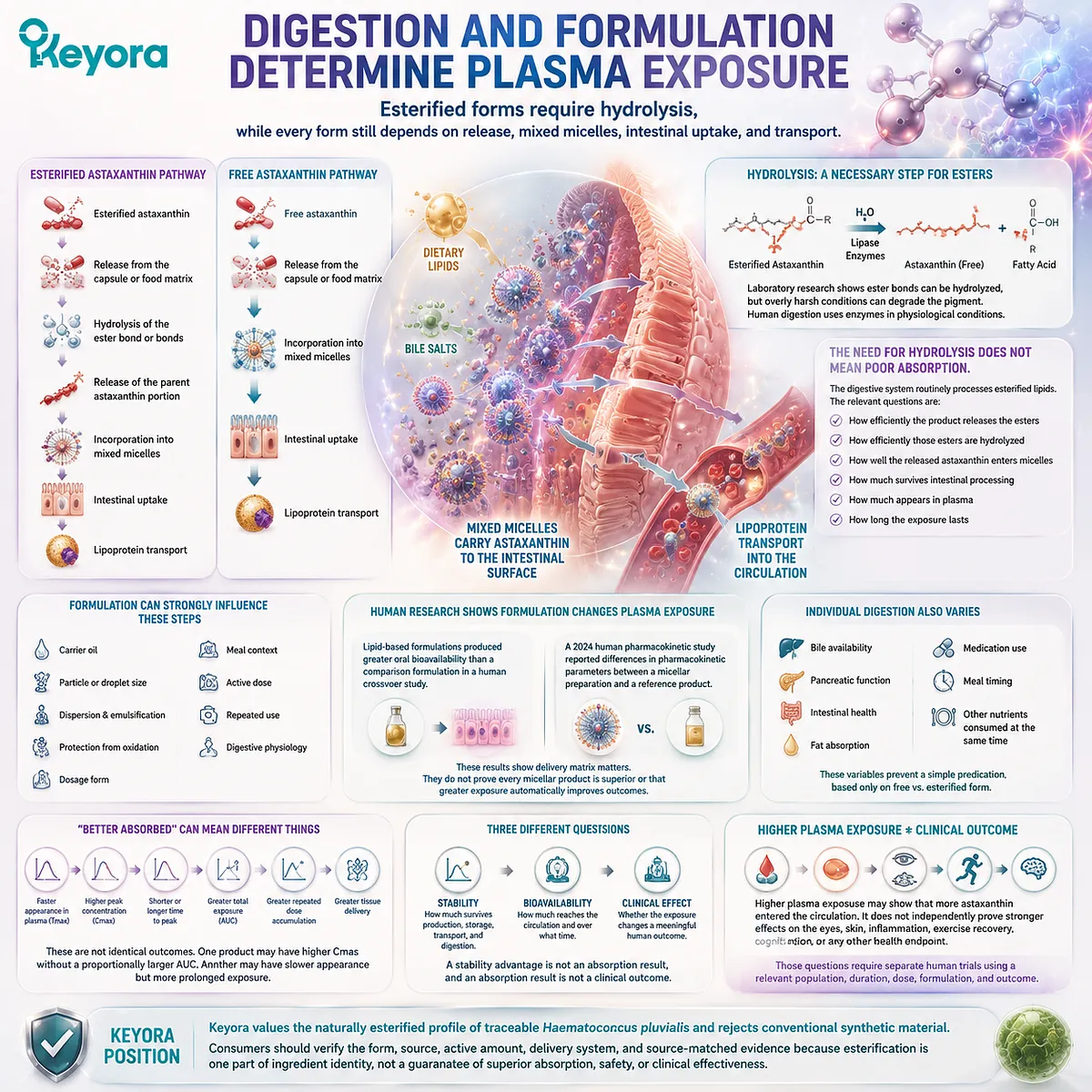
A simplified esterified route is:
Esterified astaxanthin
↓
Release from the capsule or food matrix
↓
Hydrolysis of the ester bond or bonds
↓
Release of the parent astaxanthin portion
↓
Incorporation into mixed micelles
↓
Intestinal uptake
↓
Lipoprotein transport
A simplified free form route is:
Free astaxanthin
↓
Release from the capsule or food matrix
↓
Incorporation into mixed micelles
↓
Intestinal uptake
↓
Lipoprotein transport
Free astaxanthin avoids ester bond hydrolysis.
That does not mean it avoids digestion.
It still needs to be released from the surrounding product, dispersed in the intestinal contents, associated with lipids and bile components, incorporated into mixed micelles, and transferred through intestinal and lipoprotein pathways.
Ester hydrolysis is a genuine additional step for monoesters and diesters. Laboratory research has demonstrated that astaxanthin ester bonds can be hydrolyzed and has also shown that unsuitable hydrolysis conditions can degrade the released pigment. This experiment did not reproduce normal human digestion, but it establishes why ester breakdown and astaxanthin preservation are separate chemical events.
The need for hydrolysis does not prove poor absorption.
The digestive system routinely processes esterified lipids. The relevant questions are:
-
how efficiently the product releases the esters
-
how efficiently those esters are hydrolyzed
-
how well the released astaxanthin enters mixed micelles
-
how much survives intestinal processing
-
how much appears in plasma
-
how long the exposure lasts
The formulation can strongly influence these steps.
In a human crossover study, lipid based astaxanthin formulations produced greater oral bioavailability than a comparison formulation. The result showed that the delivery matrix can change human plasma exposure even when the active carotenoid remains astaxanthin.
A 2024 human pharmacokinetic study comparing a micellar preparation with a reference astaxanthin product also reported differences in pharmacokinetic parameters. This again supports the principle that formulation technology can alter exposure. It does not prove that every micellar product is superior or that greater exposure automatically improves a health outcome.
Important formulation variables include:
-
carrier oil
-
particle or droplet size
-
dispersion
-
emulsification
-
protection from oxidation
-
dosage form
-
meal context
-
active dose
-
repeated use
-
digestive physiology
Meal composition may matter because dietary lipids can support bile release, micelle formation, and the handling of lipid soluble carotenoids. However, the evidence does not justify one universal meal or fixed fat amount for every product and every person.
Individual digestion also varies.
Relevant factors may include:
-
bile availability
-
pancreatic function
-
intestinal health
-
fat absorption
-
medication use
-
meal timing
-
other nutrients consumed at the same time
These variables prevent a simple prediction based only on whether the astaxanthin begins in free or esterified form.
The phrase better absorbed also needs clarification.
It might refer to:
-
faster appearance in plasma
-
a higher peak concentration
-
a shorter or longer time to peak
-
greater total exposure
-
greater repeated dose accumulation
-
greater tissue delivery
These are not identical outcomes.
Cmax refers to the observed peak plasma concentration.
Tmax refers to the time required to reach that peak.
AUC reflects total measured plasma exposure over a defined period.
One product could produce a higher Cmax without producing a proportionally larger AUC.
Another could produce slower appearance but more prolonged exposure.
A single phrase such as better absorbed does not explain which result occurred.
Most importantly:
A stability advantage is not an absorption result, and an absorption result is not a clinical outcome
Higher plasma exposure may show that more astaxanthin entered the circulation. It does not independently prove stronger effects on the eyes, skin, inflammation, exercise recovery, cognition, or any other health endpoint.
Those questions require separate human trials using a relevant population, duration, dose, formulation, and outcome.
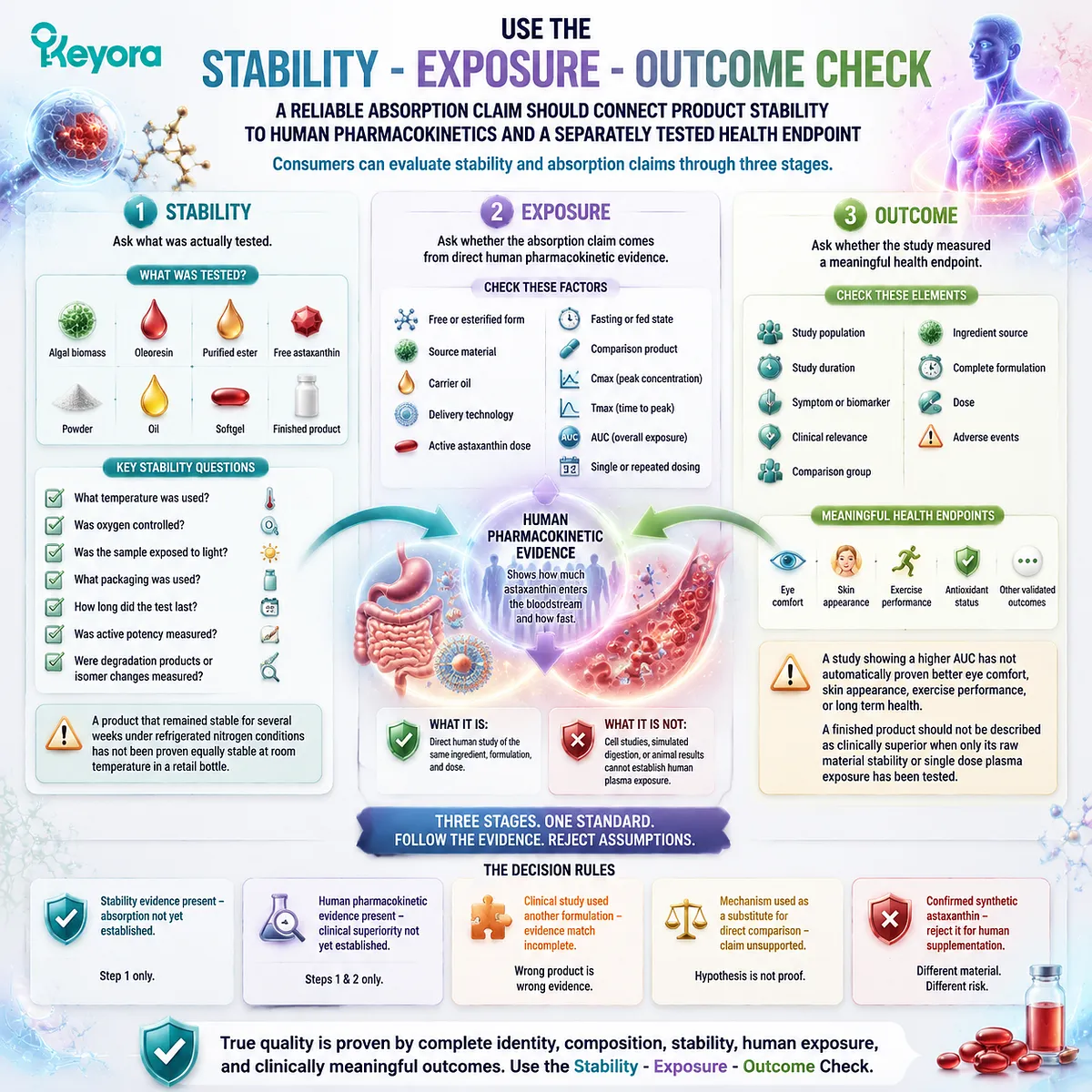
Use the Stability – Exposure – Outcome Check
A reliable absorption claim should connect product stability to human pharmacokinetics and a separately tested health endpoint
Consumers can evaluate stability and absorption claims through three stages.
Use the Stability – Exposure – Outcome Check.
1. Stability
Ask what was actually tested.
Was the material:
-
algal biomass
-
oleoresin
-
purified ester
-
free astaxanthin
-
powder
-
oil
-
softgel
-
complete finished product
Then ask:
-
What temperature was used?
-
Was oxygen controlled?
-
Was the sample exposed to light?
-
What packaging was used?
-
How long did the test last?
-
Was active potency measured?
-
Were degradation products or isomer changes measured?
A product that remained stable for several weeks under refrigerated nitrogen conditions has not been proven equally stable at room temperature in a retail bottle.
Stability under one condition does not mean stability under every condition
2. Exposure
Ask whether the absorption claim comes from direct human pharmacokinetic evidence.
Check:
-
free or esterified form
-
source material
-
carrier oil
-
delivery technology
-
active astaxanthin dose
-
fasting or fed state
-
comparison product
-
Cmax
-
Tmax
-
AUC
-
single or repeated dosing
A cell experiment or simulated digestion study can help explain a mechanism. It cannot establish human plasma exposure by itself.
A rodent result cannot be presented as though it were a human pharmacokinetic trial.
Research on encapsulated carotenoids has shown that formulation can improve simulated bioaccessibility and intestinal cell uptake, but such findings remain preclinical until tested directly in humans.
Human absorption claims require human formulation matched evidence
3. Outcome
Ask whether the study measured a meaningful health endpoint.
Check:
-
study population
-
study duration
-
symptom or biomarker
-
clinical relevance
-
comparison group
-
ingredient source
-
complete formulation
-
dose
-
adverse events
A study showing a higher AUC has not automatically proven better eye comfort, skin appearance, exercise performance, or long term health.
A finished product should not be described as clinically superior when only its raw material stability or single dose plasma exposure has been tested.
The decision rules are:
Stability evidence present – absorption not yet established
Human pharmacokinetic evidence present – clinical superiority not yet established
Clinical study used another formulation – evidence match incomplete
Mechanism used as a substitute for direct comparison – claim unsupported
Confirmed synthetic astaxanthin – reject it for human supplementation
What This Means When Choosing Astaxanthin
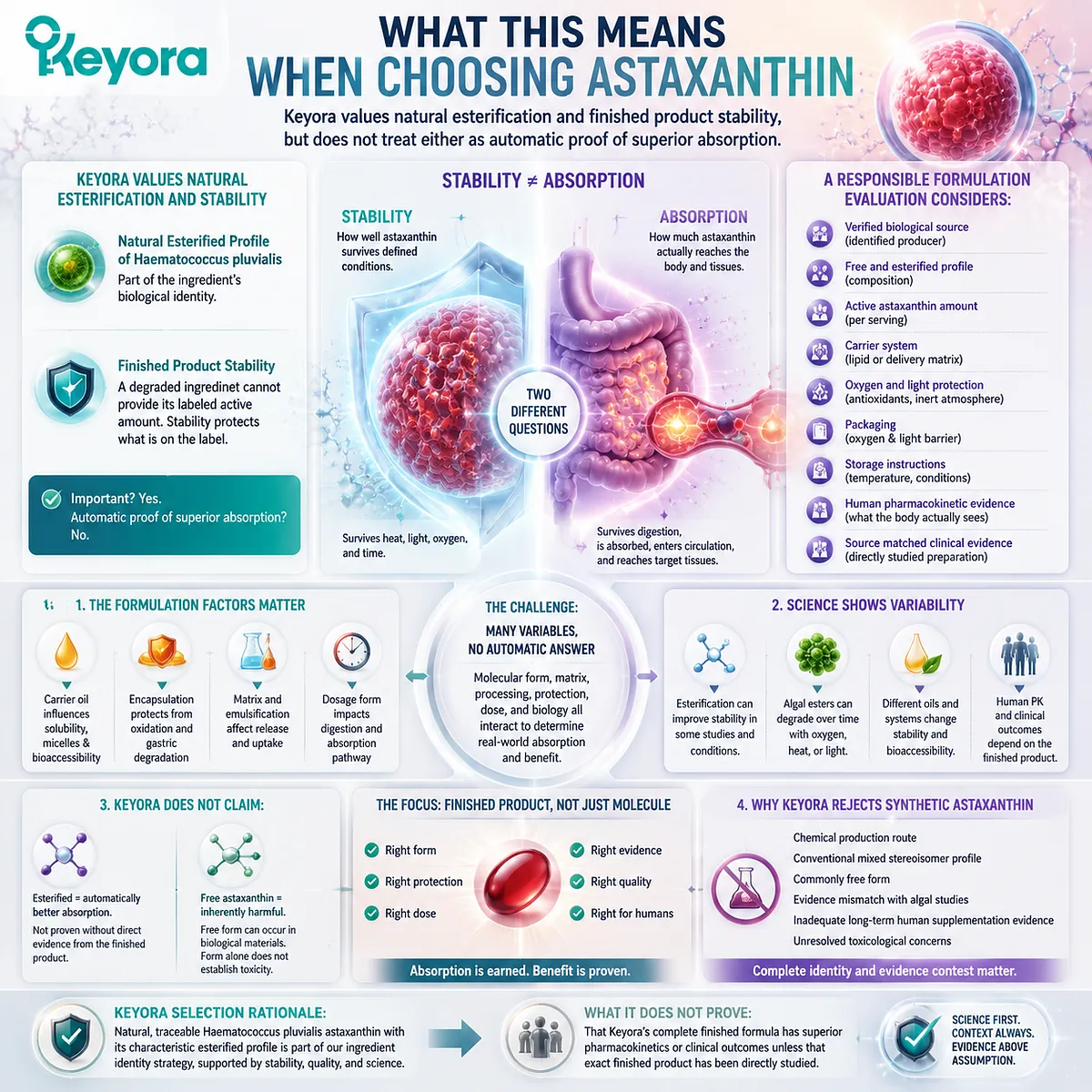
Keyora values natural esterification and finished product stability but does not treat either as automatic proof of superior absorption
Keyora values the naturally esterified profile of traceable Haematococcus pluvialis because it is part of the ingredient’s biological identity.
Keyora also considers stability important. A degraded ingredient cannot provide its labeled active amount simply because the original raw material once met specification.
However, Keyora does not use the word esterified as an automatic absorption claim.
A responsible formulation assessment should consider:
-
verified biological source
-
free and esterified profile
-
active astaxanthin amount
-
carrier system
-
oxygen and light protection
-
packaging
-
storage instructions
-
human pharmacokinetic evidence
-
source matched clinical evidence
Keyora also does not claim that free astaxanthin is inherently harmful. Free material can occur in biological sources, and the absence of an ester bond does not establish toxicity.
Keyora rejects conventional synthetic astaxanthin because of its complete identity and evidence context, including chemical production, the conventional mixed stereoisomer profile, different molecular form, inadequate long term human supplementation evidence, and unresolved toxicological concerns.
The natural esterified profile supports the Keyora ingredient selection rationale. It does not prove that Keyora’s complete finished formula has superior pharmacokinetics or clinical outcomes unless that exact finished product has been directly studied.
Closing Summary
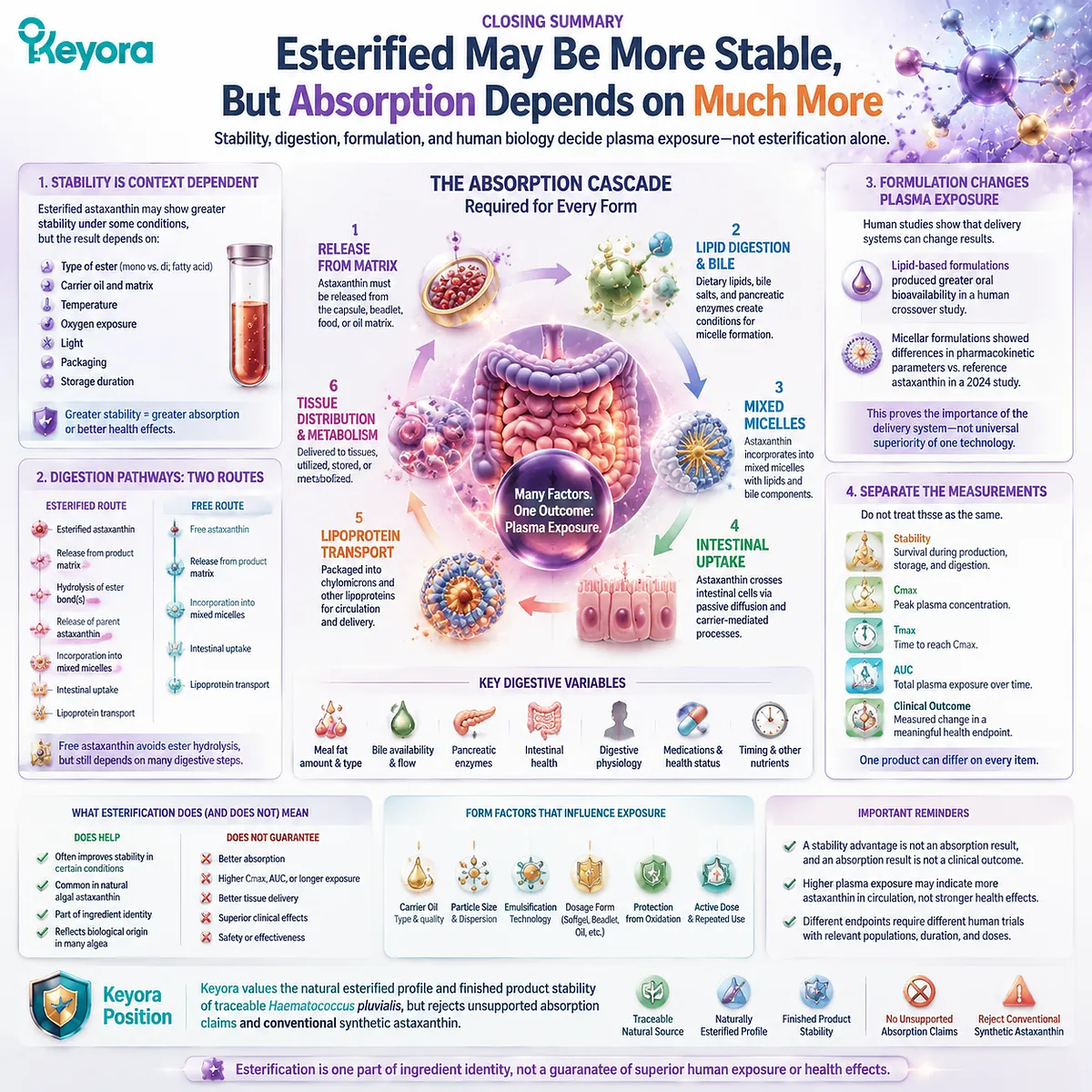
Esterified astaxanthin may show greater stability than free astaxanthin under some experimental conditions, but the result depends on the exact ester, carrier, temperature, oxygen exposure, packaging, and storage period.
Greater stability does not automatically mean greater absorption.
Esterified forms generally require hydrolysis before the parent astaxanthin portion becomes available for micellar incorporation and intestinal uptake. Free astaxanthin avoids ester bond hydrolysis, but it still depends on product release, lipid digestion, bile, mixed micelles, formulation, and transport.
Human studies show that lipid based and micellar formulations can alter plasma exposure. Those results demonstrate the importance of the delivery system, not universal superiority of every product using the same technology.
Consumers should separate stability, Cmax, Tmax, AUC, and clinical outcomes rather than treating them as one measurement.
Keyora values the natural esterified profile and finished product stability of traceable Haematococcus pluvialis, but rejects unsupported absorption claims and conventional synthetic astaxanthin. Esterification is one part of ingredient identity, not a guarantee of superior human exposure or health effects
This article is for educational and informational purposes only. It does not provide medical advice, diagnosis, treatment, cure, prevention, disease outcome claims, hormone restoration claims, fertility outcome claims, or formula-specific clinical efficacy claims.