
What Is the Difference Between Esterified and Free Astaxanthin?
Keyora Research Q&A Library
This is part of the Keyora Research Q&A Series, derived from Keyora Nutritional Neurology Series.
Within the Keyora Nutritional Neurology framework, this Q&A translates complex nutrient–brain mechanisms into reader-friendly, evidence-bound answers, focusing on stress resilience, sleep quality, calm mood support, cognitive wellness, and the broader interaction between nutrition, neurochemistry, and daily nervous-system function.
First published by Keyora Research Journal: www.keyorahealth.com
Direct Answer
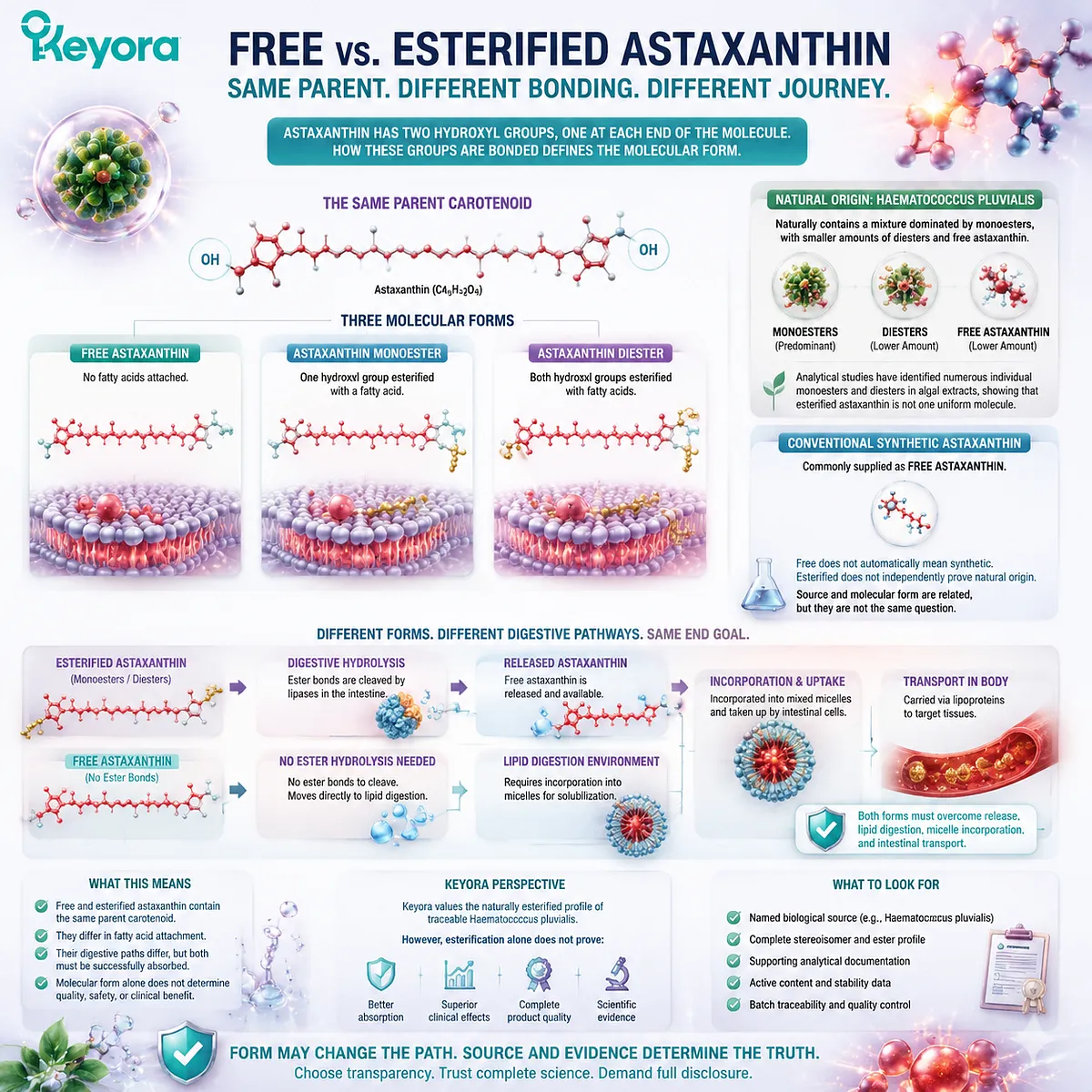
Free astaxanthin and esterified astaxanthin contain the same parent carotenoid, but they differ in whether fatty acids are attached to the molecule. Astaxanthin has two hydroxyl groups, one at each end. When neither hydroxyl group is bonded to a fatty acid, the molecule is called free astaxanthin. When one hydroxyl group forms an ester bond with a fatty acid, it becomes an astaxanthin monoester. When both hydroxyl groups are esterified, it becomes an astaxanthin diester.
Natural Haematococcus pluvialis astaxanthin commonly contains a mixture dominated by monoesters, with smaller amounts of diesters and free astaxanthin. Analytical studies have identified numerous individual monoesters and diesters in algal extracts, showing that esterified astaxanthin is not one uniform molecule.
Conventional synthetic astaxanthin is commonly supplied as free astaxanthin. However, free does not automatically mean synthetic, and esterified does not independently prove natural origin. Source and molecular form are related questions, but they are not the same question.
Esterified forms generally require digestive hydrolysis before the astaxanthin portion becomes available for intestinal uptake. Free astaxanthin does not require ester bond hydrolysis, but it still must be released from the product, incorporated into a lipid digestion environment, and transported through the intestine.
Keyora values the naturally esterified profile of traceable Haematococcus pluvialis, but esterification alone does not prove better absorption, superior clinical effects, or complete product quality.
Free and Esterified Describe Fatty Acid Bonding
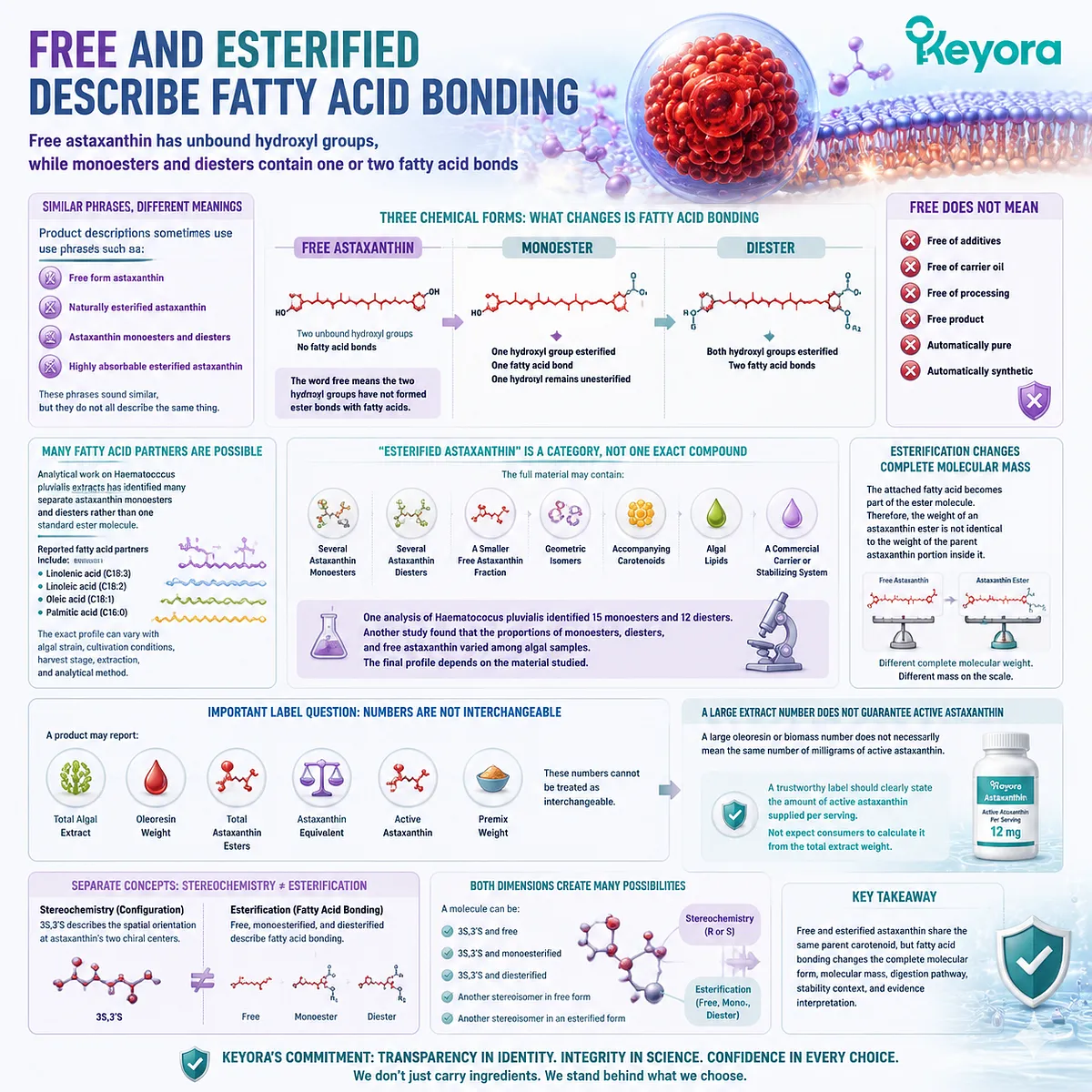
Free astaxanthin has unbound hydroxyl groups, while monoesters and diesters contain one or two fatty acid bonds
Product descriptions sometimes use phrases such as:
Free form astaxanthin
Naturally esterified astaxanthin
Astaxanthin monoesters and diesters
Highly absorbable esterified astaxanthin
These phrases sound similar, but they do not all describe the same thing.
The word free has a precise chemical meaning in this context. It means that the two hydroxyl groups on the astaxanthin molecule have not formed ester bonds with fatty acids.
It does not mean:
-
free of additives
-
free of carrier oil
-
free of processing
-
free product
-
automatically pure
-
automatically synthetic
A monoester contains one attached fatty acid. One hydroxyl group has formed an ester bond, while the other remains unesterified.
A diester contains two attached fatty acids. Both hydroxyl groups have formed ester bonds.
The attached fatty acids may differ. Analytical work on Haematococcus pluvialis extracts has identified many separate astaxanthin monoesters and diesters rather than one standard ester molecule. Reported fatty acid partners include linolenic acid, linoleic acid, oleic acid, and palmitic acid, although the exact profile can vary with the algal strain, cultivation conditions, harvest stage, extraction, and analytical method.
This means that the term esterified astaxanthin describes a category.
It does not identify one exact compound.
The full material may contain:
-
several astaxanthin monoesters
-
several astaxanthin diesters
-
a smaller free astaxanthin fraction
-
geometric isomers
-
accompanying carotenoids
-
algal lipids
-
a commercial carrier or stabilizing system
One analysis of Haematococcus pluvialis identified 15 monoesters and 12 diesters. Another study found that the proportions of monoesters, diesters, and free astaxanthin varied among algal samples, reinforcing that the final profile depends on the material studied.
Esterification also changes the complete molecular mass.
The attached fatty acid becomes part of the ester molecule. Therefore, the weight of an astaxanthin ester is not identical to the weight of the parent astaxanthin portion inside it.
This creates an important label question.
A product may report:
-
total algal extract
-
oleoresin weight
-
total astaxanthin esters
-
astaxanthin equivalent
-
active astaxanthin
-
premix weight
These numbers cannot be treated as interchangeable.
A large oleoresin or biomass number does not necessarily mean the same number of milligrams of active astaxanthin. A trustworthy label should clearly state the amount of active astaxanthin supplied per serving rather than expecting consumers to calculate it from the total extract weight.
Esterification must also be separated from stereochemistry.
The designation 3S,3′S describes the spatial orientation at astaxanthin’s two chiral centers.
Free, monoesterified, and diesterified describe fatty acid bonding.
A molecule can therefore be:
-
3S,3′S and free
-
3S,3′S and monoesterified
-
3S,3′S and diesterified
-
another stereoisomer in free form
-
another stereoisomer in an esterified form
Free and esterified astaxanthin share the same parent carotenoid, but fatty acid bonding changes the complete molecular form, molecular mass, digestion pathway, stability context, and evidence interpretation
Digestion Must Release Astaxanthin From Its Molecular Form
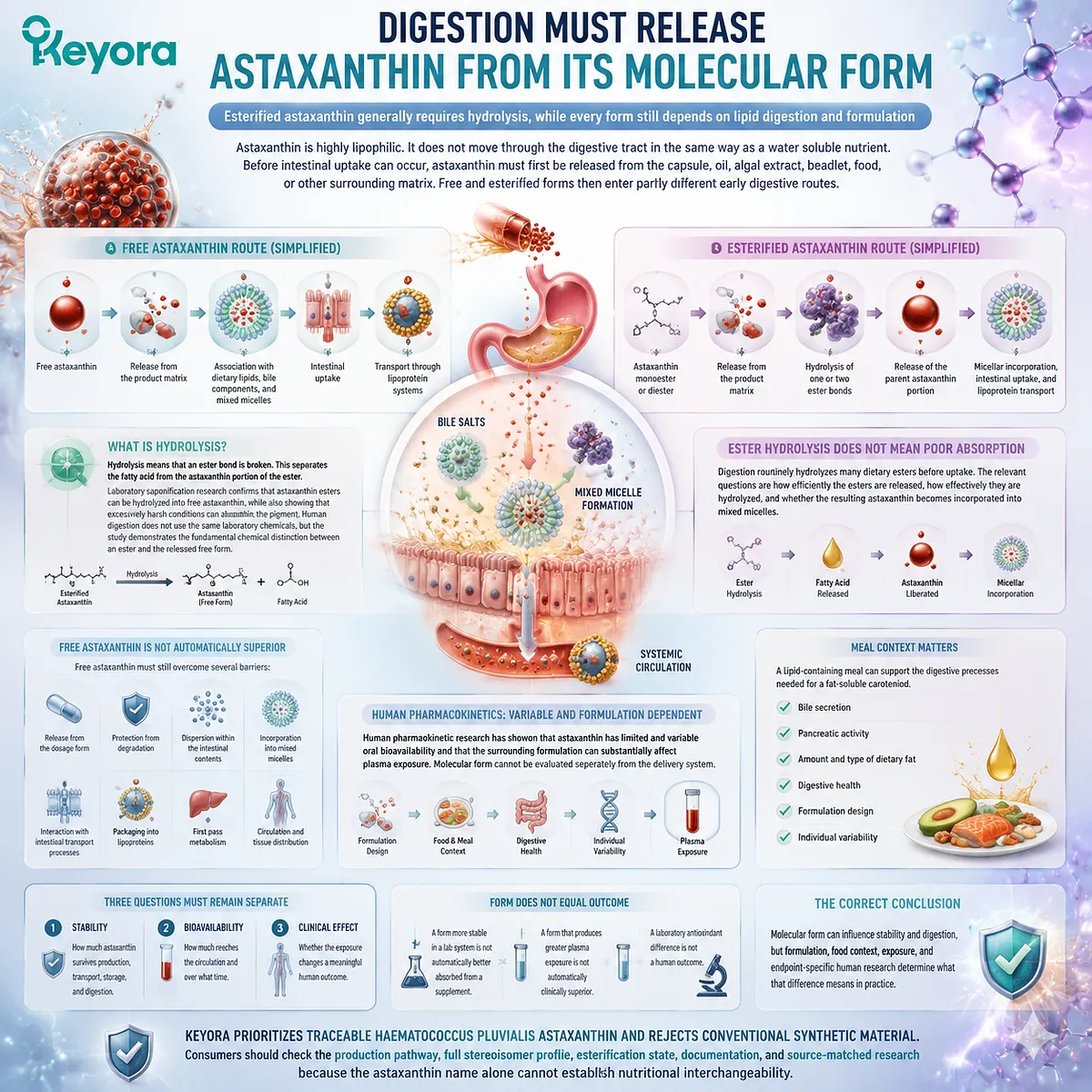
Esterified astaxanthin generally requires hydrolysis, while every form still depends on lipid digestion and formulation
Astaxanthin is highly lipophilic. It does not move through the digestive tract in the same way as a water soluble nutrient.
Before intestinal uptake can occur, astaxanthin must first be released from the capsule, oil, algal extract, beadlet, food, or other surrounding matrix.
Free and esterified forms then enter partly different early digestive routes.
A simplified free astaxanthin route is:
Free astaxanthin
↓
Release from the product matrix
↓
Association with dietary lipids, bile components, and mixed micelles
↓
Intestinal uptake
↓
Transport through lipoprotein systems
A simplified esterified route is:
Astaxanthin monoester or diester
↓
Release from the product matrix
↓
Hydrolysis of one or two ester bonds
↓
Release of the parent astaxanthin portion
↓
Micellar incorporation, intestinal uptake, and lipoprotein transport
The term hydrolysis means that an ester bond is broken. This separates the fatty acid from the astaxanthin portion of the ester.
Laboratory saponification research confirms that astaxanthin esters can be hydrolyzed into free astaxanthin, while also showing that excessively harsh conditions can degrade the pigment. Human digestion does not use the same laboratory chemicals, but the study demonstrates the fundamental chemical distinction between an ester and the released free form.
The need for hydrolysis does not prove poor absorption.
Digestion routinely hydrolyzes many dietary esters before uptake. The relevant questions are how efficiently the esters are released, how effectively they are hydrolyzed, and whether the resulting astaxanthin becomes incorporated into mixed micelles.
The absence of an ester bond also does not guarantee superior absorption.
Free astaxanthin must still overcome several barriers:
-
release from the dosage form
-
protection from degradation
-
dispersion within the intestinal contents
-
incorporation into mixed micelles
-
interaction with intestinal transport processes
-
packaging into lipoproteins
-
first pass metabolism
-
circulation and tissue distribution
Human pharmacokinetic research has shown that astaxanthin has limited and variable oral bioavailability and that the surrounding formulation can substantially affect plasma exposure. This means that molecular form cannot be evaluated separately from the delivery system.
Meal context matters for the same reason.
A lipid containing meal can support the digestive processes needed for a fat soluble carotenoid. Bile secretion, pancreatic activity, the amount and type of dietary fat, digestive health, formulation design, and individual variability may all influence exposure.
This is why three separate questions must remain separate:
-
Stability – how much astaxanthin survives production, transport, storage, and digestion
-
Bioavailability – how much reaches the circulation and over what time
-
Clinical effect – whether the exposure changes a meaningful human outcome
A form that is more stable in an algal cell or laboratory system is not automatically better absorbed from a finished supplement.
A form that produces greater plasma exposure is not automatically clinically superior.
A laboratory antioxidant difference is not a human outcome.
Studies of algal fractions have reported different antioxidant behavior among free astaxanthin, monoesters, and diesters, but those experiments do not prove universal differences in human absorption or health effects.
The correct conclusion is narrower:
Molecular form can influence stability and digestion, but formulation, food context, exposure, and endpoint specific human research determine what that difference means in practice
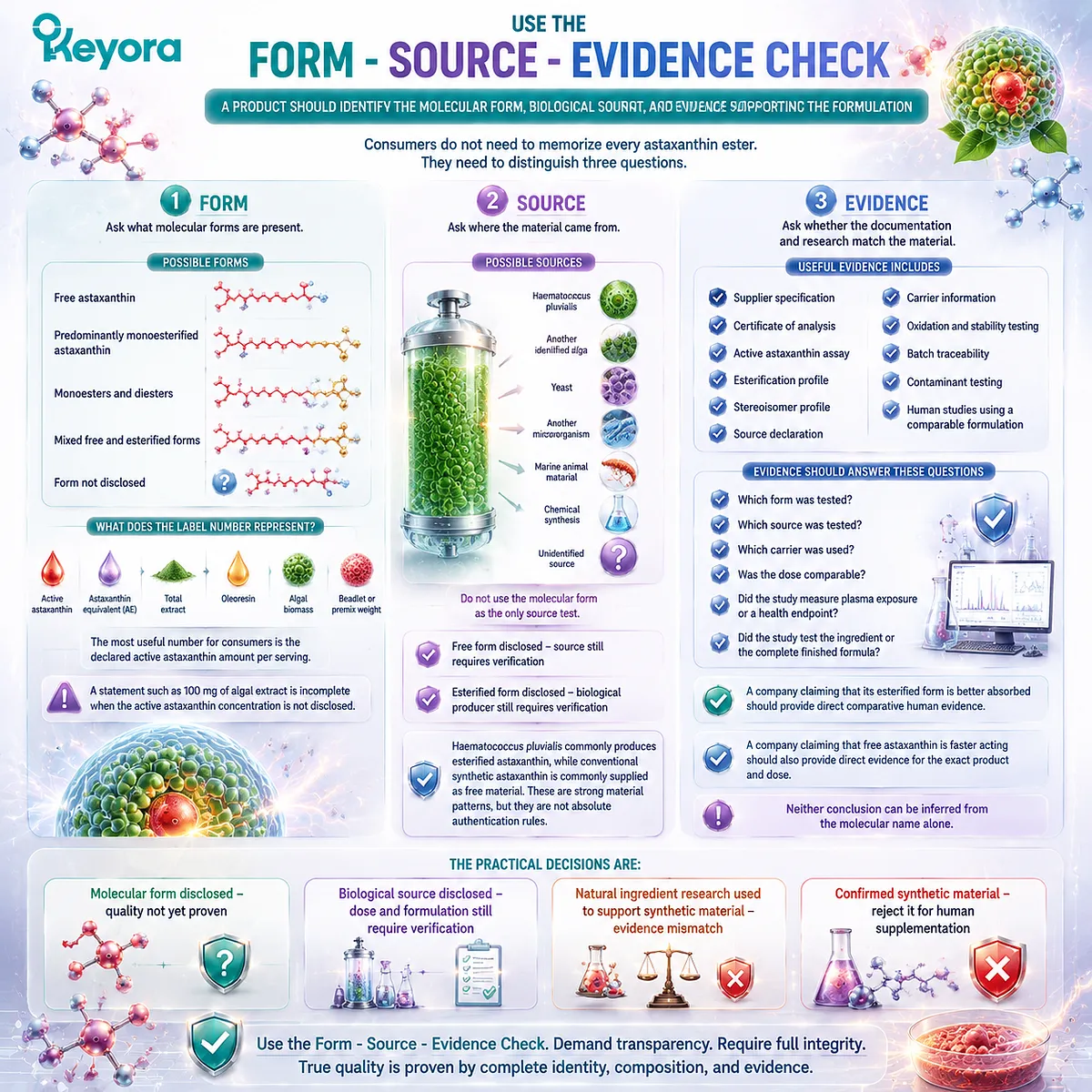
Use the Form – Source – Evidence Check
A product should identify the molecular form, biological source, active amount, and evidence supporting the formulation
Consumers do not need to memorize every astaxanthin ester.
They need to distinguish three questions.
Use the Form – Source – Evidence Check.
1. Form
Ask what molecular forms are present.
Possible answers include:
-
free astaxanthin
-
predominantly monoesterified astaxanthin
-
monoesters and diesters
-
mixed free and esterified forms
-
form not disclosed
Then check what the label number represents.
Does it describe:
-
active astaxanthin
-
astaxanthin equivalent
-
total extract
-
oleoresin
-
algal biomass
-
beadlet or premix weight
The most useful number for consumers is the declared active astaxanthin amount per serving.
A statement such as 100 mg of algal extract is incomplete when the active astaxanthin concentration is not disclosed.
2. Source
Ask where the material came from.
Relevant source categories include:
-
Haematococcus pluvialis
-
another identified alga
-
yeast
-
another microorganism
-
marine animal material
-
chemical synthesis
-
unidentified source
Do not use the molecular form as the only source test.
Free form disclosed – source still requires verification
Esterified form disclosed – biological producer still requires verification
Haematococcus pluvialis commonly produces esterified astaxanthin, while conventional synthetic astaxanthin is commonly supplied as free material. These are strong material patterns, but they are not absolute authentication rules.
3. Evidence
Ask whether the documentation and research match the material.
Useful evidence includes:
-
supplier specification
-
certificate of analysis
-
active astaxanthin assay
-
esterification profile
-
stereoisomer profile
-
source declaration
-
carrier information
-
oxidation and stability testing
-
batch traceability
-
contaminant testing
-
human studies using a comparable formulation
A company claiming that its esterified form is better absorbed should provide direct comparative human evidence.
A company claiming that free astaxanthin is faster acting should also provide direct evidence for the exact product and dose.
Neither conclusion can be inferred from the molecular name alone.
The evidence should identify:
-
which form was tested
-
which source was tested
-
which carrier was used
-
whether the dose was comparable
-
whether the study measured plasma exposure or a health endpoint
-
whether the study tested the ingredient or the complete finished formula
The practical decisions are:
Molecular form disclosed – quality not yet proven
Biological source disclosed – dose and formulation still require verification
Natural ingredient research used to support synthetic material – evidence mismatch
Confirmed synthetic material – reject it for human supplementation
What This Means When Choosing Astaxanthin
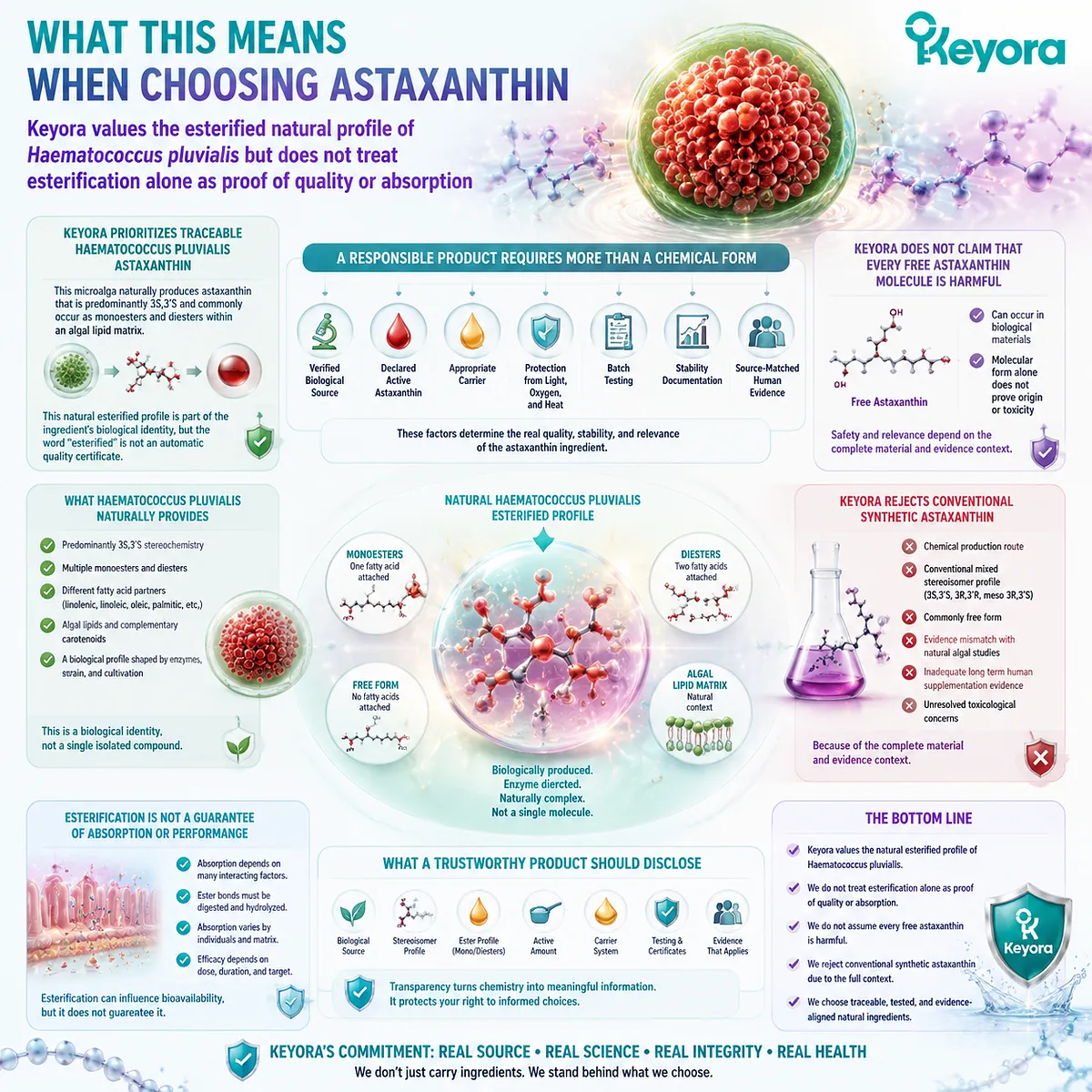
Keyora values the esterified natural profile of Haematococcus pluvialis but does not treat esterification alone as proof of quality or absorption
Keyora prioritizes traceable Haematococcus pluvialis astaxanthin, which commonly contains natural monoesters and diesters within an algal lipid extract.
That profile is part of the ingredient’s biological identity, but Keyora does not treat the word esterified as an automatic quality certificate.
A responsible product still needs:
-
verified biological source
-
declared active astaxanthin
-
appropriate carrier
-
protection from light, oxygen, and heat
-
batch testing
-
stability documentation
-
source matched human evidence
Keyora also does not claim that every free astaxanthin molecule is harmful.
Free astaxanthin can occur in biological materials, and molecular form alone does not prove origin or toxicity.
Keyora rejects conventional synthetic astaxanthin because of the complete material and evidence context. That context includes chemical production, the conventional mixed stereoisomer profile, the commonly free form, evidence mismatch with natural algal studies, inadequate long term human supplementation evidence, and unresolved toxicological concerns.
The preference for natural esterified Haematococcus pluvialis supports ingredient selection. It does not prove that esterification alone guarantees absorption or that the complete finished Keyora formula has been clinically tested.
Closing Summary
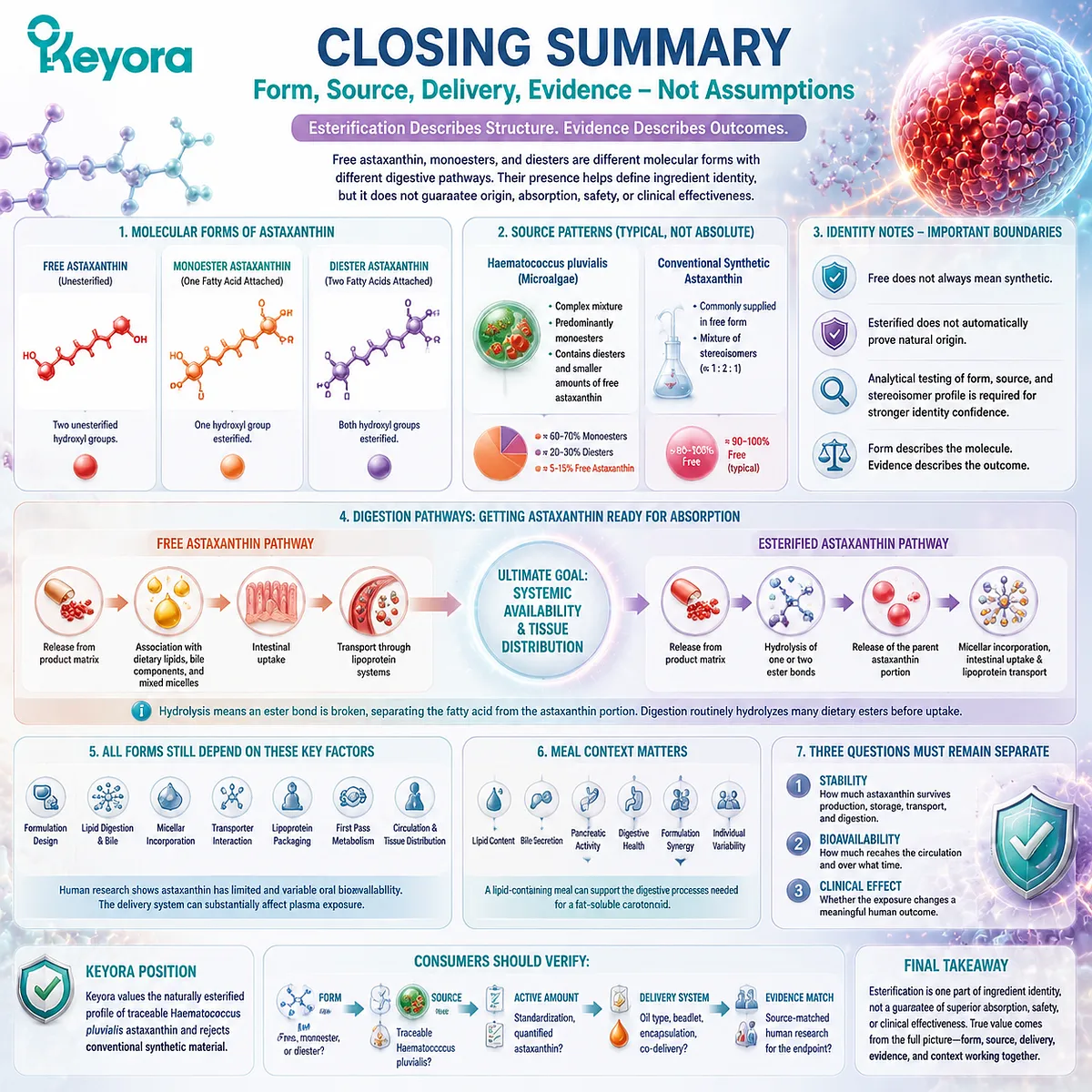
Free astaxanthin has two unesterified hydroxyl groups. A monoester has one fatty acid attached, while a diester has two.
Haematococcus pluvialis commonly stores astaxanthin as a complex mixture dominated by monoesters, with diesters and smaller amounts of free astaxanthin also present. Conventional synthetic astaxanthin is commonly supplied in free form.
These patterns help describe ingredient identity, but they do not provide absolute source authentication. Free does not always mean synthetic, and esterified does not automatically prove natural origin.
Esterified astaxanthin generally requires digestive hydrolysis before the parent astaxanthin portion becomes available for uptake. Free astaxanthin avoids that ester bond step, but it still depends on formulation, lipid digestion, micellar incorporation, and transport.
Keyora values the naturally esterified profile of traceable Haematococcus pluvialis and rejects conventional synthetic material. Consumers should verify the form, source, active amount, delivery system, and source matched evidence because esterification is one part of ingredient identity, not a guarantee of superior absorption, safety, or clinical effectiveness
This article is for educational and informational purposes only. It does not provide medical advice, diagnosis, treatment, cure, prevention, disease outcome claims, hormone restoration claims, fertility outcome claims, or formula-specific clinical efficacy claims.