
What Does 3S,3′S Astaxanthin Mean?
Keyora Research Q&A Library
This is part of the Keyora Research Q&A Series, derived from Keyora Nutritional Neurology Series.
Within the Keyora Nutritional Neurology framework, this Q&A translates complex nutrient–brain mechanisms into reader-friendly, evidence-bound answers, focusing on stress resilience, sleep quality, calm mood support, cognitive wellness, and the broader interaction between nutrition, neurochemistry, and daily nervous-system function.
First published by Keyora Research Journal: www.keyorahealth.com
Direct Answer
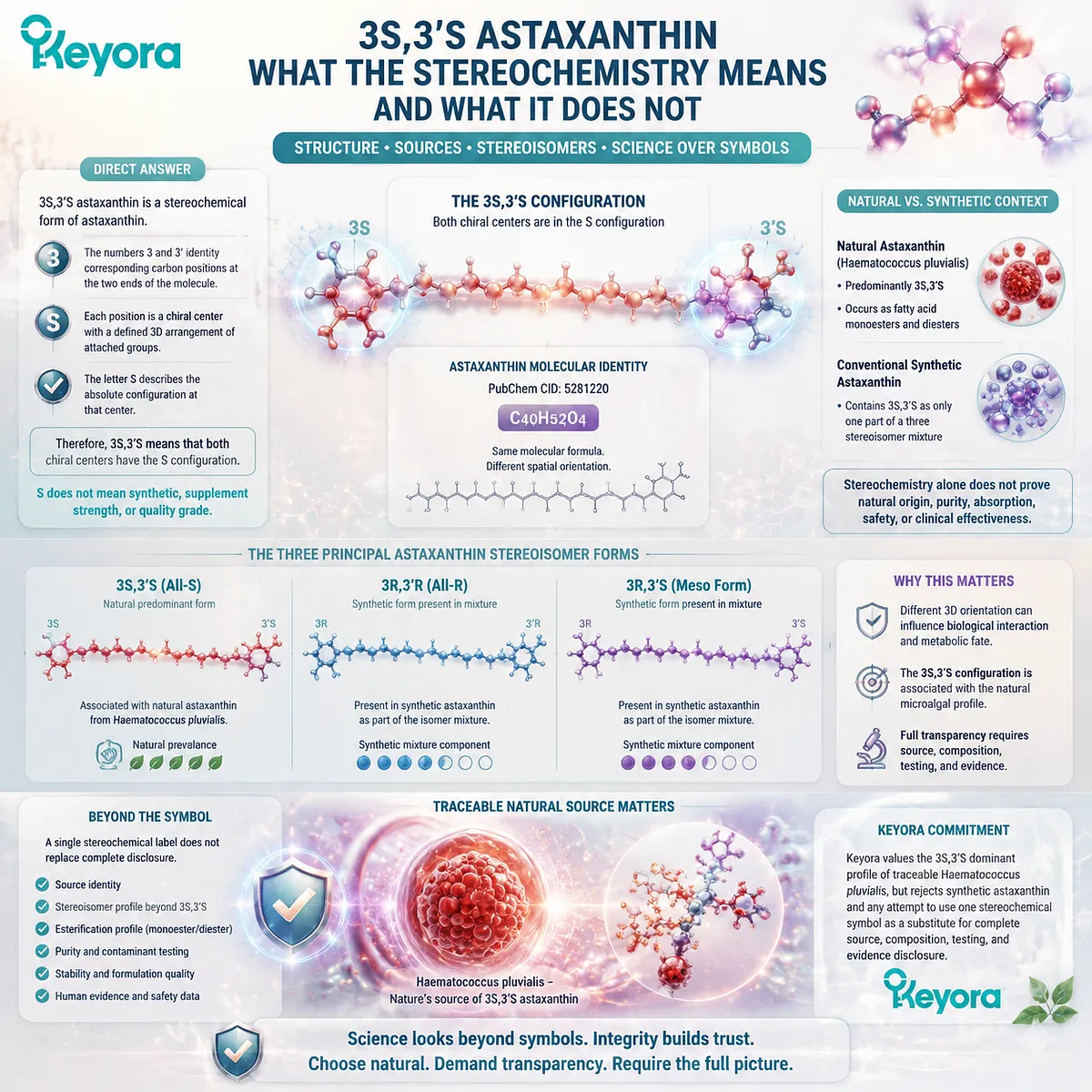
3S,3′S astaxanthin is a stereochemical form of astaxanthin. The numbers 3 and 3′ identify corresponding carbon positions at the two ends of the molecule. Each position is a chiral center, meaning that the attached groups can have a defined three dimensional arrangement. The letter S describes the absolute configuration at that center. Therefore, 3S,3′S means that both chiral centers have the S configuration. S does not mean synthetic, supplement strength, or quality grade.
Astaxanthin has three principal stereoisomer forms: 3S,3′S, 3R,3′R, and the meso form 3R,3′S. These forms share the astaxanthin molecular formula and basic atomic connections, but their spatial orientations differ. PubChem identifies astaxanthin as C40H52O4 and records its defined stereochemical structure.
Natural astaxanthin from Haematococcus pluvialis is predominantly associated with the 3S,3′S configuration and commonly occurs as fatty acid monoesters and diesters. Conventional synthetic astaxanthin normally contains 3S,3′S as only one part of a three stereoisomer mixture.
This means that finding the words 3S,3′S does not independently prove that an ingredient is natural, pure, well absorbed, safe, or clinically effective. Keyora values the 3S,3′S dominant profile of traceable Haematococcus pluvialis, but rejects synthetic astaxanthin and any attempt to use one stereochemical symbol as a substitute for complete source, composition, testing, and evidence disclosure.
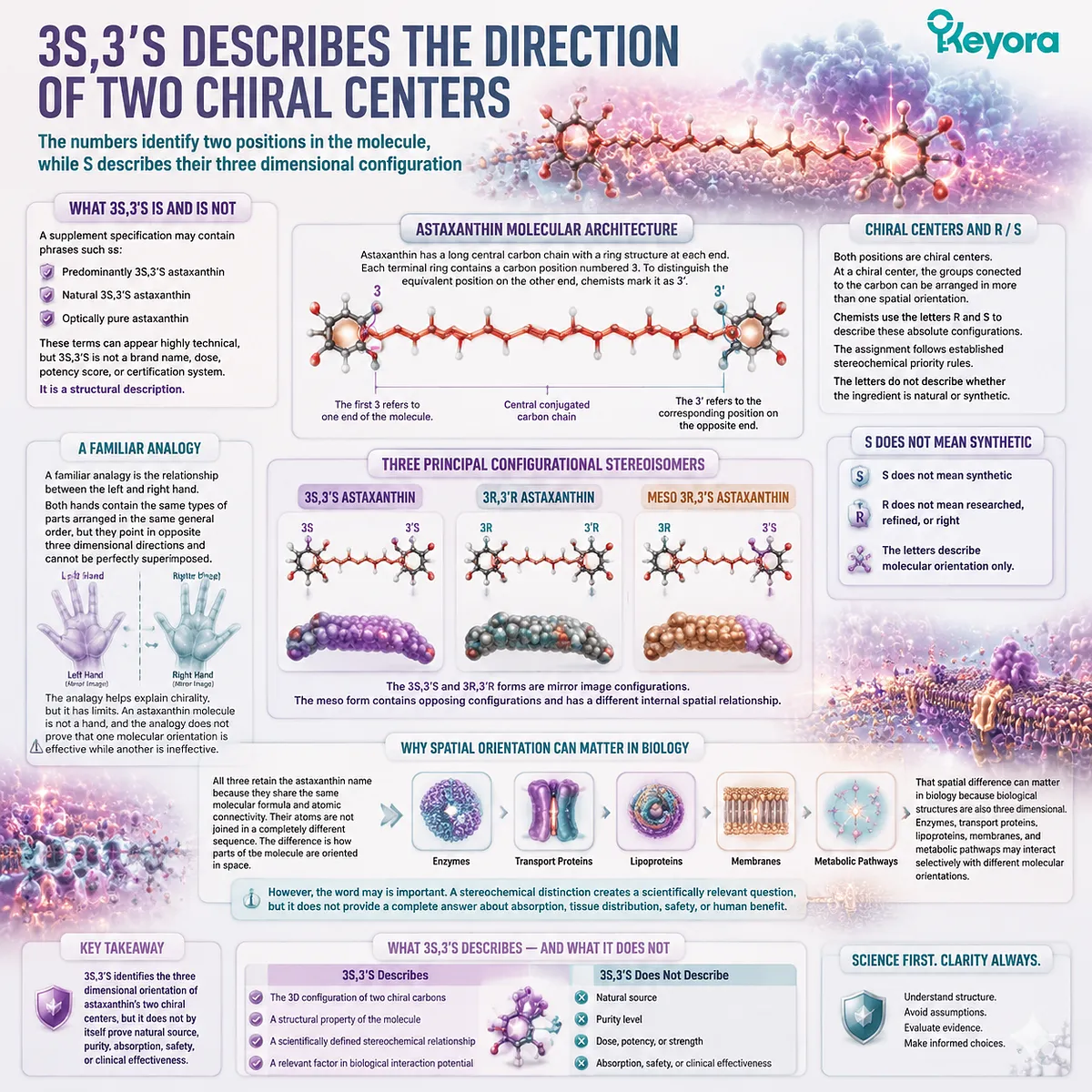
3S,3′S Describes the Direction of Two Chiral Centers
The numbers identify two positions in the molecule, while S describes their three dimensional configuration
A supplement specification may contain phrases such as:
Predominantly 3S,3′S astaxanthin
Natural 3S,3′S astaxanthin
Optically pure astaxanthin
These terms can appear highly technical, but 3S,3′S is not a brand name, dose, potency score, or certification system.
It is a structural description.
Astaxanthin has a long central carbon chain with a ring structure at each end. Each terminal ring contains a carbon position numbered 3. To distinguish the equivalent position on the other end of the molecule, chemists mark it as 3′.
The first 3 therefore refers to one end of the molecule.
The 3′ refers to the corresponding position on the opposite end.
Both positions are chiral centers. At a chiral center, the groups connected to the carbon can be arranged in more than one spatial orientation.
Chemists use the letters R and S to describe these absolute configurations. The assignment follows established stereochemical priority rules. The letters do not describe whether the ingredient is natural or synthetic.
S does not mean synthetic
R does not mean researched, refined, or right
The letters describe molecular orientation only.
A familiar analogy is the relationship between the left and right hand. Both hands contain the same types of parts arranged in the same general order, but they point in opposite three dimensional directions and cannot be perfectly superimposed.
The analogy helps explain chirality, but it has limits. An astaxanthin molecule is not a hand, and the analogy does not prove that one molecular orientation is effective while another is ineffective.
Because astaxanthin has two chiral centers, it has three principal configurational stereoisomers:
-
3S,3′S astaxanthin
-
3R,3′R astaxanthin
-
meso 3R,3′S astaxanthin
The 3S,3′S and 3R,3′R forms are mirror image configurations. The meso form contains opposing configurations and has a different internal spatial relationship.
All three retain the astaxanthin name because they share the same molecular formula and atomic connectivity. Their atoms are not joined in a completely different sequence. The difference is how parts of the molecule are oriented in space.
That spatial difference can matter in biology because biological structures are also three dimensional.
Enzymes, transport proteins, lipoproteins, membranes, and metabolic pathways may interact selectively with different molecular orientations. However, the word may is important. A stereochemical distinction creates a scientifically relevant question, but it does not provide a complete answer about absorption, tissue distribution, safety, or human benefit.
The correct definition is:
3S,3′S identifies the three dimensional orientation of astaxanthin’s two chiral centers, but it does not by itself prove natural source, purity, absorption, safety, or clinical effectiveness
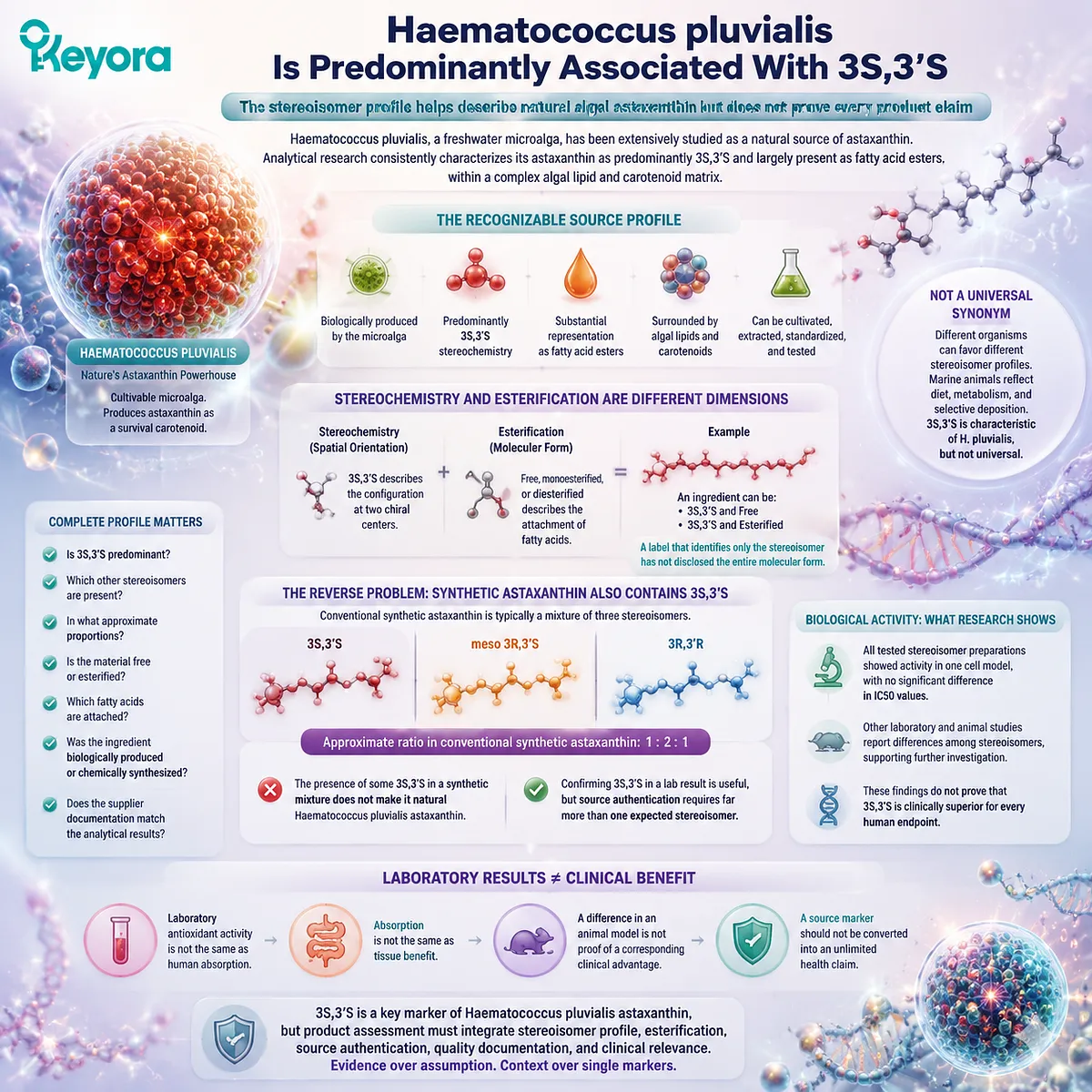
Haematococcus pluvialis Is Predominantly Associated With 3S,3′S
The stereoisomer profile helps describe natural algal astaxanthin but does not prove every product claim
The reason 3S,3′S appears frequently in natural astaxanthin discussions is its close association with Haematococcus pluvialis.
Early analytical research examining astaxanthin from this microalga found the 3S,3′S configuration and identified much of the pigment in esterified forms. Later analytical work has continued to characterize Haematococcus pluvialis extracts as complex materials containing astaxanthin monoesters, diesters, minor free astaxanthin, and other carotenoid components.
This creates a recognizable source profile:
-
astaxanthin produced biologically by the microalga
-
predominantly 3S,3′S stereochemistry
-
substantial representation as fatty acid esters
-
a surrounding algal lipid and carotenoid environment
-
a source that can be cultivated, extracted, standardized, and tested
However, stereochemistry and esterification are separate classification dimensions.
3S,3′S tells us the spatial orientation at two chiral centers.
Free, monoesterified, and diesterified tell us whether one or both hydroxyl groups are connected to fatty acids.
An ingredient can therefore be 3S,3′S and free.
It can also be 3S,3′S and esterified.
A label that identifies only the stereoisomer has not disclosed the entire molecular form.
Natural biological sources also do not all produce the same dominant stereoisomer profile. Different organisms can favor different configurations, and the distribution found in marine animals can reflect food intake, metabolism, and selective tissue deposition. Analytical comparisons of astaxanthin sources have shown that stereoisomer patterns can help distinguish biological and synthetic pigment histories.
This means that 3S,3′S is characteristic of Haematococcus pluvialis, but it is not a universal synonym for every form of natural astaxanthin.
The reverse problem is equally important.
Conventional synthetic astaxanthin also contains 3S,3′S.
A typical synthetic mixture includes:
-
3S,3′S
-
meso 3R,3′S
-
3R,3′R
The three forms are commonly represented in an approximate 1:2:1 pattern in conventional synthetic material. A cell study comparing astaxanthin stereoisomers used 3S,3′S from Haematococcus pluvialis, 3R,3′R from a yeast source, and the 1:2:1 synthetic mixture.
Therefore:
The presence of some 3S,3′S in a synthetic mixture does not transform that mixture into natural Haematococcus pluvialis astaxanthin
A laboratory result identifying 3S,3′S can be useful, but source authentication requires more than confirming that one expected stereoisomer is present.
The complete profile matters:
-
Is 3S,3′S predominant?
-
Which other stereoisomers are present?
-
In what approximate proportions?
-
Is the material free or esterified?
-
Which fatty acids are attached?
-
Was the ingredient biologically produced or chemically synthesized?
-
Does the supplier documentation match the analytical results?
Biological activity also requires careful interpretation.
Research does not support the absolute claim that only 3S,3′S has biological activity. In one cell model, all three tested stereoisomer preparations showed activity, and the reported half maximal inhibitory values did not differ significantly. That experiment cannot establish equal effects in humans, but it directly contradicts the claim that the other stereoisomers are automatically inactive.
Other laboratory and animal studies have reported differences among astaxanthin stereoisomers. Such findings support continued investigation into stereochemistry, metabolism, and biological behavior. They do not prove that 3S,3′S is clinically superior for every human endpoint.
Laboratory antioxidant activity is not the same as human absorption.
Absorption is not the same as tissue benefit.
A difference in an animal model is not proof of a corresponding clinical advantage.
A source marker should not be converted into an unlimited health claim.
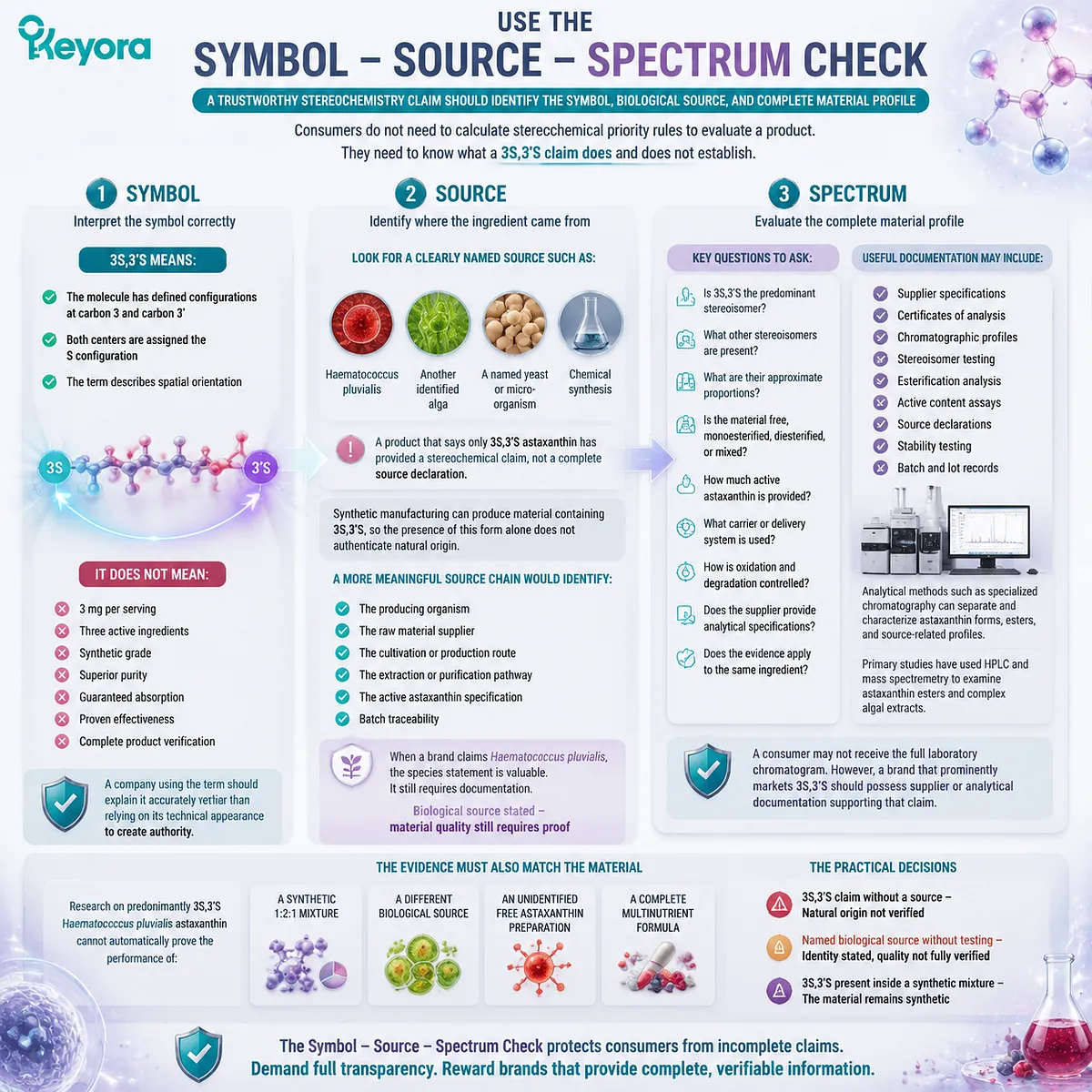
Use the Symbol – Source – Spectrum Check
A trustworthy stereochemistry claim should identify the symbol, biological source, and complete material profile
Consumers do not need to calculate stereochemical priority rules to evaluate a product.
They need to know what a 3S,3′S claim does and does not establish.
Use the Symbol – Source – Spectrum Check.
1. Symbol
Begin by interpreting the symbol correctly.
3S,3′S means:
-
the molecule has defined configurations at carbon 3 and carbon 3′
-
both centers are assigned the S configuration
-
the term describes spatial orientation
It does not mean:
-
3 mg per serving
-
three active ingredients
-
synthetic grade
-
superior purity
-
guaranteed absorption
-
proven effectiveness
-
complete product verification
A company using the term should explain it accurately rather than relying on its technical appearance to create authority.
2. Source
Next identify where the ingredient came from.
Look for a clearly named source such as:
-
Haematococcus pluvialis
-
another identified alga
-
a named yeast or microorganism
-
chemical synthesis
A product that says only 3S,3′S astaxanthin has provided a stereochemical claim, not a complete source declaration.
Synthetic manufacturing can produce material containing 3S,3′S, so the presence of this form alone does not authenticate natural origin.
A more meaningful source chain would identify:
-
the producing organism
-
the raw material supplier
-
the cultivation or production route
-
the extraction or purification pathway
-
the active astaxanthin specification
-
batch traceability
When a brand claims Haematococcus pluvialis, the species statement is valuable. It still requires documentation.
Biological source stated – material quality still requires proof
3. Spectrum
Finally, evaluate the complete material profile.
Relevant questions include:
-
Is 3S,3′S the predominant stereoisomer?
-
What other stereoisomers are present?
-
What are their approximate proportions?
-
Is the material free, monoesterified, diesterified, or mixed?
-
How much active astaxanthin is provided?
-
What carrier or delivery system is used?
-
How is oxidation and degradation controlled?
-
Does the supplier provide analytical specifications?
-
Does the evidence apply to the same ingredient?
Useful documentation may include:
-
supplier specifications
-
certificates of analysis
-
chromatographic profiles
-
stereoisomer testing
-
esterification analysis
-
active content assays
-
source declarations
-
stability testing
-
batch and lot records
Analytical methods such as specialized chromatography can separate and characterize astaxanthin forms, esters, and source related profiles. Primary studies have used high performance liquid chromatography and mass spectrometry to examine astaxanthin esters and complex algal extracts.
A consumer may not receive the full laboratory chromatogram. However, a brand that prominently markets 3S,3′S should possess supplier or analytical documentation supporting that claim.
The evidence must also match the material.
Research on predominantly 3S,3′S Haematococcus pluvialis astaxanthin cannot automatically prove the performance of:
-
a synthetic 1:2:1 mixture
-
a different biological source
-
an unidentified free astaxanthin preparation
-
a complete multinutrient formula
The practical decisions are:
3S,3′S claim without a source – natural origin not verified
Named biological source without testing – identity stated, quality not fully verified
3S,3′S present inside a synthetic mixture – the material remains synthetic
What This Means When Choosing Astaxanthin
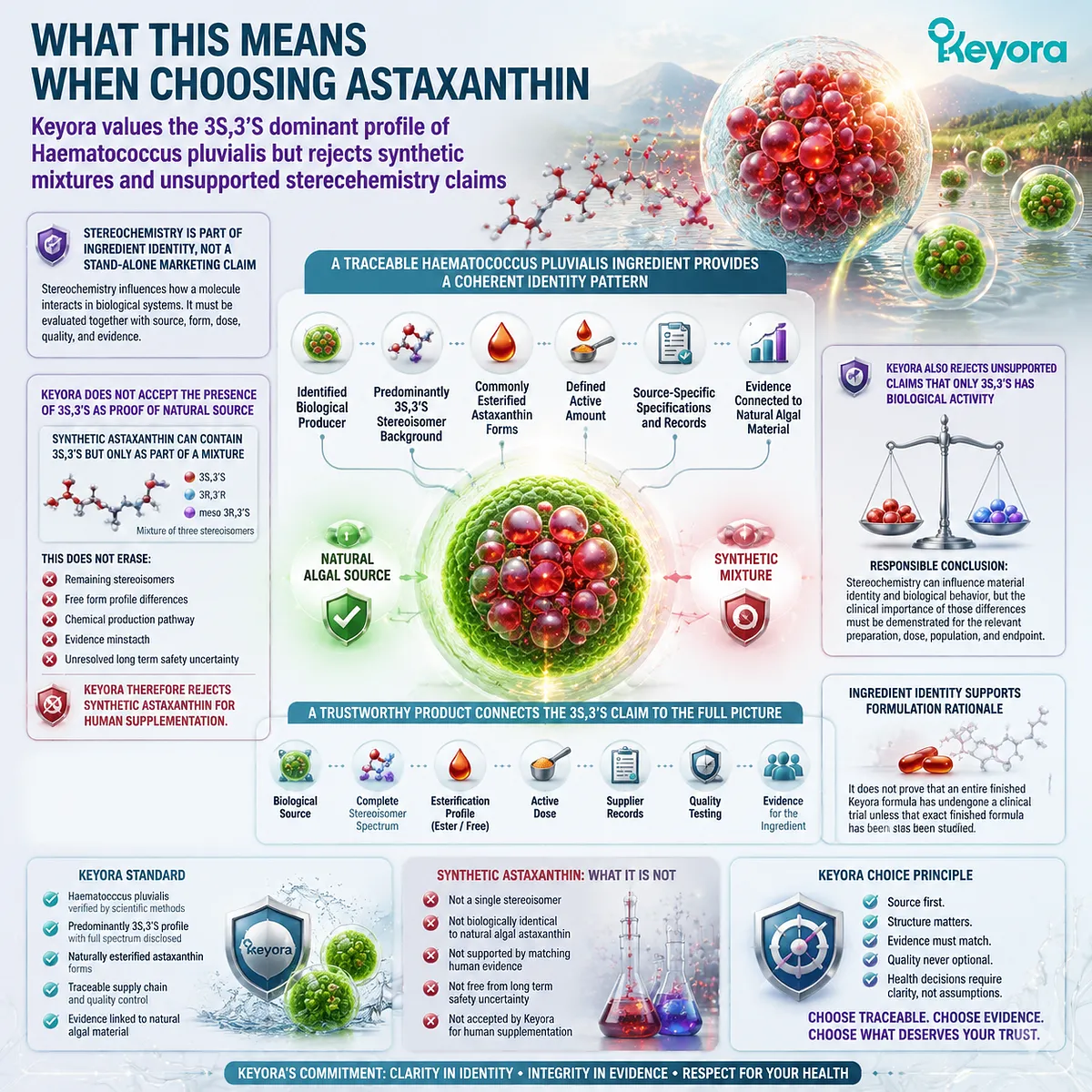
Keyora values the 3S,3′S dominant profile of Haematococcus pluvialis but rejects synthetic mixtures and unsupported stereochemistry claims
Keyora treats stereochemistry as an important part of ingredient identity, not as an isolated marketing claim.
A traceable Haematococcus pluvialis ingredient provides a coherent identity pattern:
-
an identified biological producer
-
a predominantly 3S,3′S stereoisomer background
-
commonly esterified astaxanthin forms
-
a defined active amount
-
source specific specifications
-
evidence connected to natural algal material
Keyora does not accept the presence of 3S,3′S as proof that a source is natural.
Synthetic astaxanthin can contain the same stereoisomer as one part of its mixture. That does not erase the remaining stereoisomers, free form profile, chemical production pathway, evidence mismatch, or unresolved long term safety uncertainty.
Keyora therefore rejects synthetic astaxanthin for human supplementation.
Keyora also rejects unsupported claims that only 3S,3′S has biological activity. The responsible conclusion is narrower: stereochemistry can influence material identity and biological behavior, but the clinical importance of those differences must be demonstrated for the relevant preparation, dose, population, and endpoint.
A trustworthy product should connect the 3S,3′S claim to its biological source, complete stereoisomer spectrum, esterification profile, active dose, supplier records, and quality testing.
Ingredient identity supports formulation rationale. It does not prove that an entire finished Keyora formula has undergone a clinical trial unless that exact finished formula has been studied.
Closing Summary
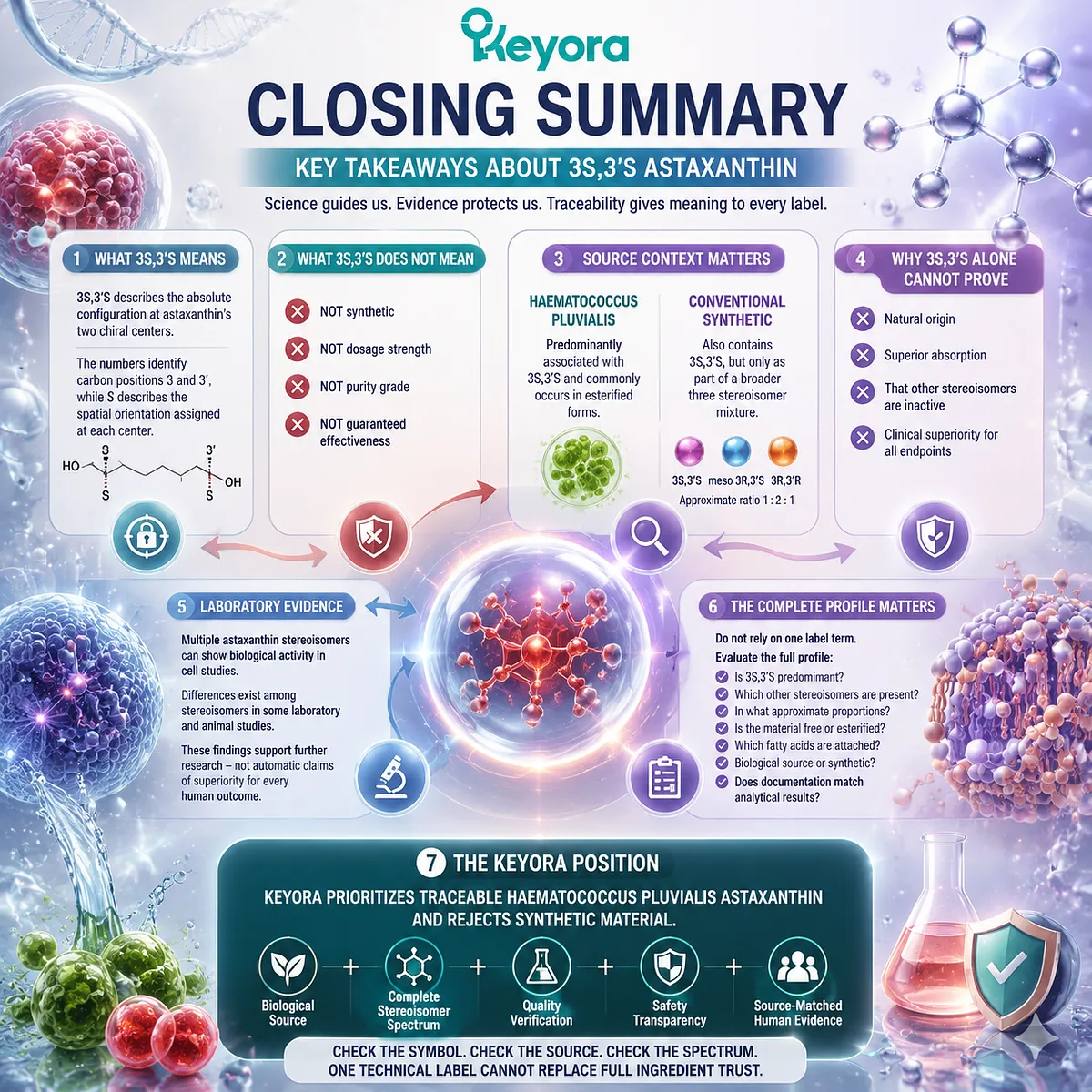
3S,3′S describes the absolute configuration at astaxanthin’s two chiral centers. The numbers identify carbon positions 3 and 3′, while S describes the spatial orientation assigned at each center.
The term does not mean synthetic, dosage strength, purity grade, or guaranteed effectiveness.
Haematococcus pluvialis astaxanthin is predominantly associated with the 3S,3′S configuration and commonly occurs in esterified forms. Conventional synthetic astaxanthin also contains 3S,3′S, but only as part of a broader three stereoisomer mixture.
This is why the presence of 3S,3′S cannot independently prove natural origin.
It also cannot prove superior absorption or establish that every other stereoisomer is inactive. Laboratory evidence indicates that multiple astaxanthin stereoisomers can show biological activity, while their comparative importance in human health remains endpoint specific.
Keyora prioritizes traceable Haematococcus pluvialis astaxanthin and rejects synthetic material. Consumers should check the symbol, source, and complete stereoisomer spectrum because one technical label cannot replace full ingredient identity, quality verification, and source matched human evidence
This article is for educational and informational purposes only. It does not provide medical advice, diagnosis, treatment, cure, prevention, disease outcome claims, hormone restoration claims, fertility outcome claims, or formula-specific clinical efficacy claims.