
What Is Synthetic Astaxanthin and How Is It Made?
Keyora Research Q&A Library
This is part of the Keyora Research Q&A Series, derived from Keyora Nutritional Neurology Series.
Within the Keyora Nutritional Neurology framework, this Q&A translates complex nutrient–brain mechanisms into reader-friendly, evidence-bound answers, focusing on stress resilience, sleep quality, calm mood support, cognitive wellness, and the broader interaction between nutrition, neurochemistry, and daily nervous-system function.
First published by Keyora Research Journal: www.keyorahealth.com
Direct Answer
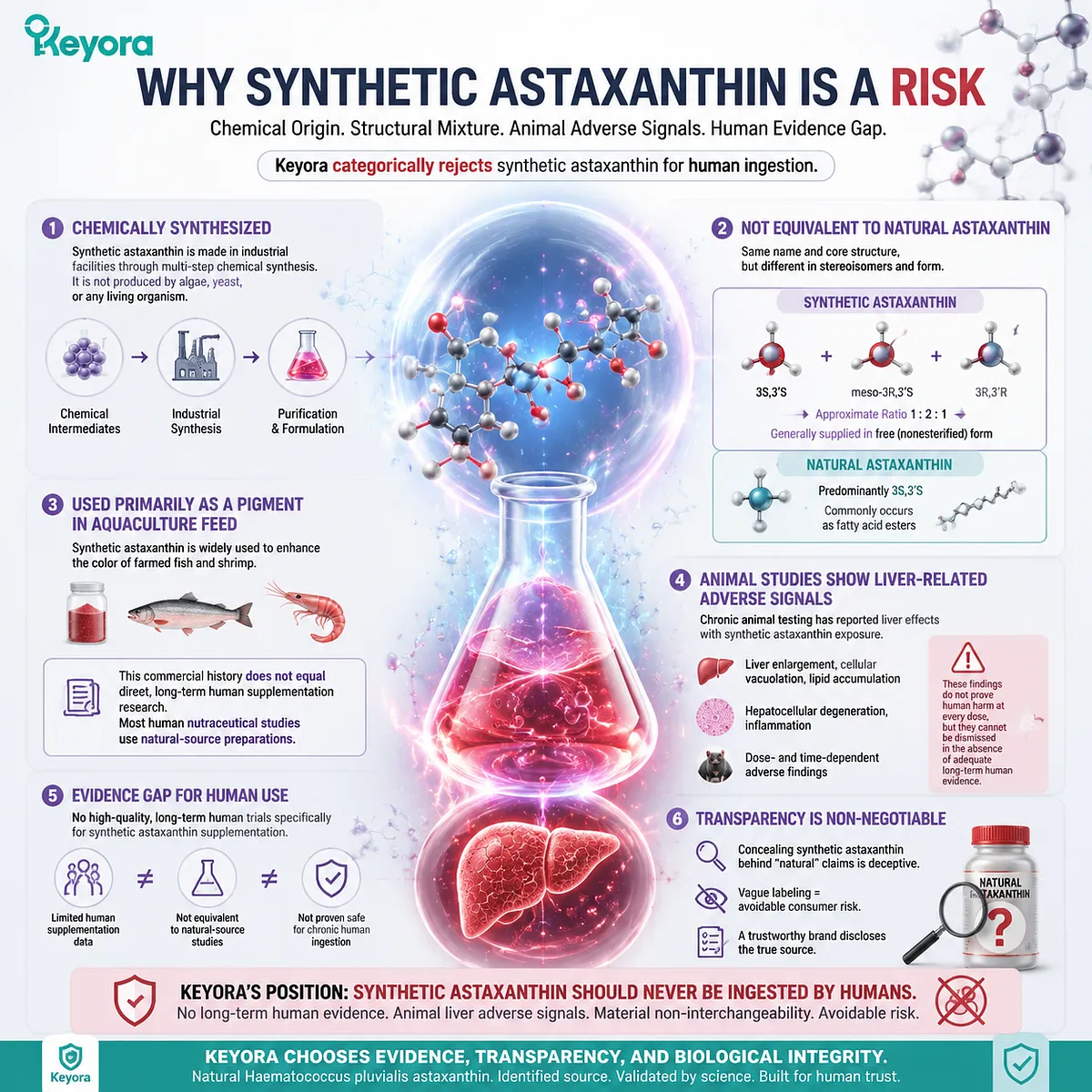
Synthetic astaxanthin is an industrially manufactured carotenoid produced through chemical synthesis rather than biological production by algae, yeast, or another living organism. Manufacturers assemble the astaxanthin structure from chemical intermediates, then purify and formulate the resulting pigment for commercial use.
Although synthetic and natural materials share the astaxanthin name and core molecular structure, they are not equivalent ingredients. Conventional synthetic astaxanthin normally contains a mixture of the 3S,3′S, meso-3R,3′S, and 3R,3′R stereoisomers in an approximate 1:2:1 distribution. It is generally supplied in a free, nonesterified form. Natural Haematococcus pluvialis astaxanthin is predominantly associated with 3S,3′S astaxanthin and commonly occurs as fatty acid esters.
Synthetic astaxanthin has been used primarily as a pigmenting additive in aquaculture feed. That commercial history does not provide the same evidence as direct, long-term human supplementation research. Much of the published human nutraceutical literature instead concerns natural-source preparations.
Chronic animal testing has also produced liver-related adverse signals. These findings do not prove that every human dose causes the same harm, but they cannot be dismissed while adequate long-term human evidence remains absent.
Keyora therefore categorically rejects synthetic astaxanthin for human ingestion and rejects any attempt to conceal it behind vague, natural-sounding marketing.
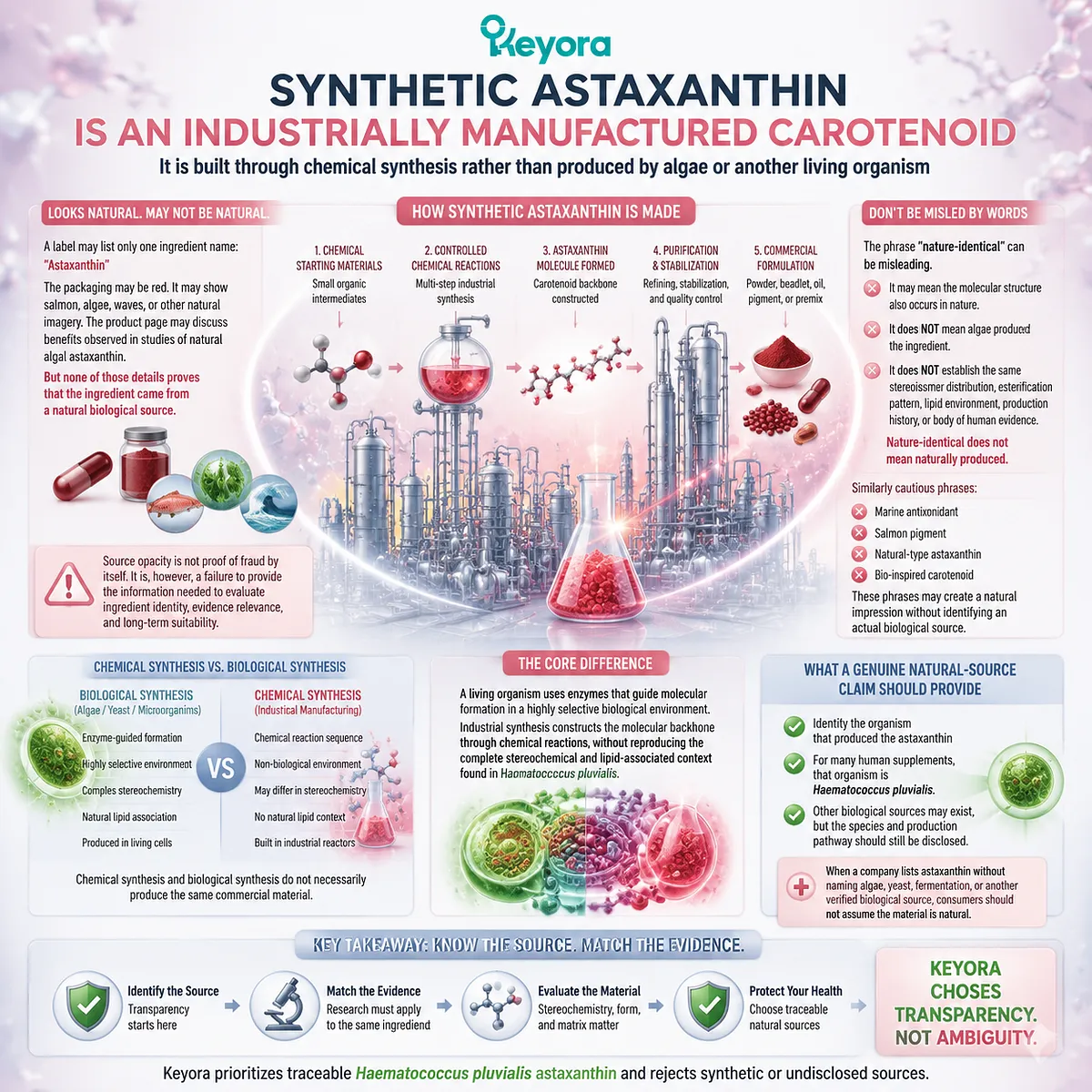
Synthetic Astaxanthin Is an Industrially Manufactured Carotenoid
It is built through chemical synthesis rather than produced by algae or another living organism
A supplement label may list only one ingredient name:
“Astaxanthin”
The packaging may be red. It may show salmon, algae, waves, or other natural imagery. The product page may discuss the benefits observed in studies of natural algal astaxanthin.
But none of those details proves that the ingredient itself came from a natural biological source.
Synthetic astaxanthin is produced through an industrial chemical pathway. Rather than cultivating an organism that naturally biosynthesizes astaxanthin, manufacturers begin with smaller chemical intermediates and use a sequence of controlled reactions to construct the carotenoid structure.
The resulting material must then be purified, stabilized, and placed into a commercially usable form. Depending on its intended application, it may be prepared as a powder, beadlet, oil dispersion, pigment concentrate, or feed premix. Reviews of astaxanthin production distinguish this chemical manufacturing pathway from biological production using microalgae, yeast, or other microorganisms.
The exact industrial reaction sequence is not the most important issue for consumers.
The important issue is that chemical synthesis and biological synthesis do not necessarily produce the same commercial material.
A living organism uses enzymes that guide molecular formation in a highly selective biological environment. Industrial synthesis constructs the molecular backbone through chemical reactions, without reproducing the complete stereochemical and lipid-associated context found in Haematococcus pluvialis.
This is why the phrase “nature-identical” can be misleading.
It may be used to suggest that a manufactured compound contains a molecular structure also found in nature. It does not mean that algae produced the ingredient. It does not establish the same stereoisomer distribution, esterification pattern, accompanying lipid environment, production history, or body of human evidence.
Nature-identical does not mean naturally produced
The same caution applies to phrases such as:
“Marine antioxidant”
“Salmon pigment”
“Natural-type astaxanthin”
“Bio-inspired carotenoid”
These phrases may create a natural impression without identifying an actual biological source.
A genuine natural-source claim should identify the organism that produced the astaxanthin. For many human supplements, that organism is Haematococcus pluvialis. Other biological sources may exist, but the species and production pathway should still be disclosed.
When a company lists astaxanthin without naming algae, yeast, fermentation, or another verified biological source, consumers should not assume the material is natural.
Source opacity is not proof of fraud by itself. It is, however, a failure to provide the information needed to evaluate ingredient identity, evidence relevance, and long-term suitability.
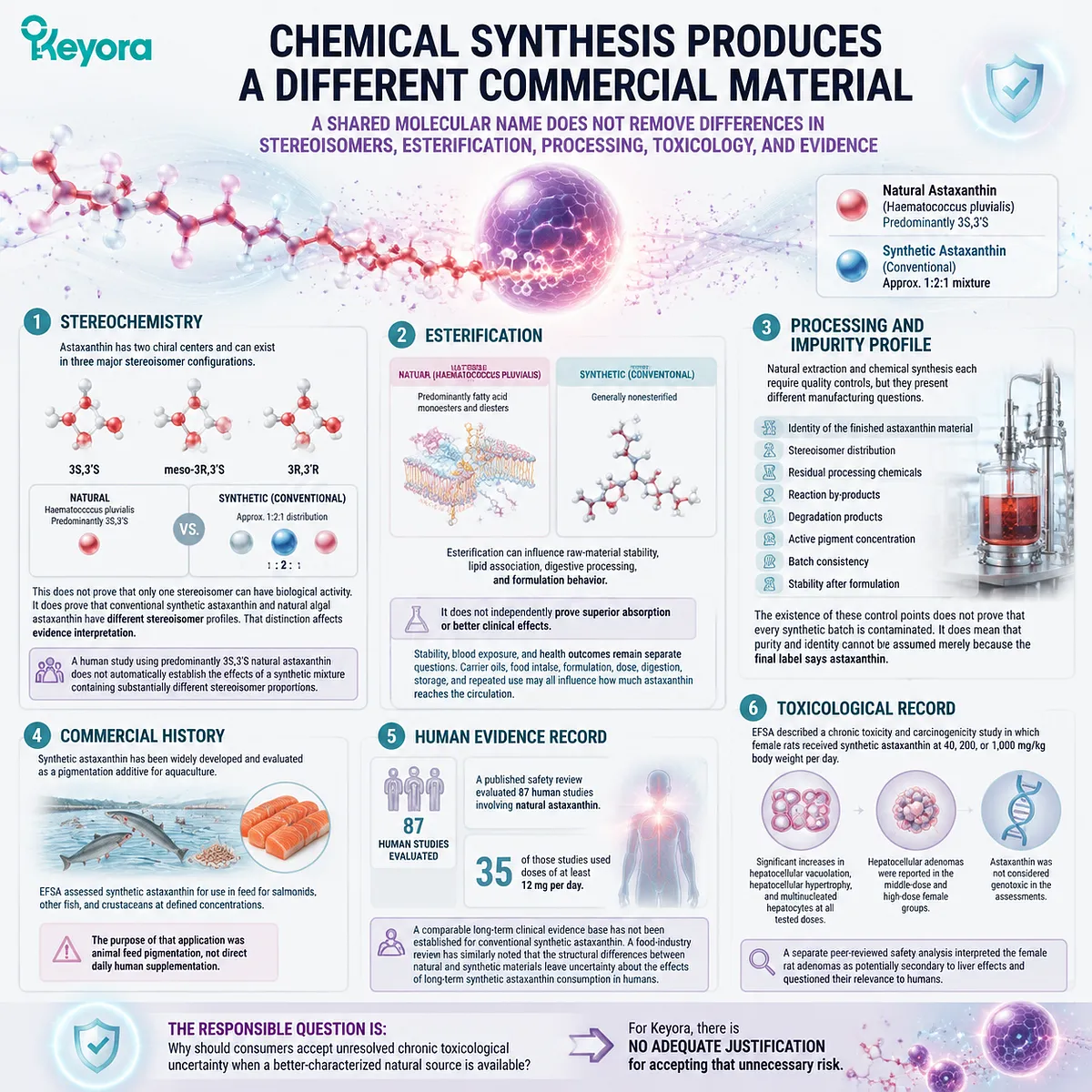
Chemical Synthesis Produces a Different Commercial Material
A shared molecular name does not remove differences in stereoisomers, esterification, processing, toxicology, and evidence
The first important difference is stereochemistry.
Astaxanthin contains two chiral centers. This allows it to exist in three major stereoisomer configurations:
3S,3′S
meso-3R,3′S
3R,3′R
Conventional synthetic astaxanthin is commonly described as containing these forms in an approximate 1:2:1 distribution. Astaxanthin from Haematococcus pluvialis is predominantly associated with the 3S,3′S configuration.
This does not prove that only one stereoisomer can have biological activity. It does prove that conventional synthetic astaxanthin and natural algal astaxanthin have different stereoisomer profiles.
That distinction affects evidence interpretation.
A human study using predominantly 3S,3′S natural algal astaxanthin does not automatically establish the effects of a synthetic mixture containing substantially different stereoisomer proportions.
The second difference is esterification.
Natural astaxanthin in Haematococcus pluvialis commonly occurs as fatty acid monoesters and diesters. Conventional synthetic astaxanthin is generally nonesterified. Reviews comparing astaxanthin structures identify this as a major compositional difference between the two commercial material categories.
Esterification can influence raw-material stability, lipid association, digestive processing, and formulation behavior.
It does not independently prove superior absorption or better clinical effects.
Stability, blood exposure, and health outcomes remain separate questions. Carrier oils, food intake, formulation, dose, digestion, storage, and repeated use may all influence how much astaxanthin reaches the circulation.
The third difference is the processing and impurity profile.
Natural extraction and chemical synthesis each require quality controls, but they present different manufacturing questions.
For a chemically synthesized ingredient, relevant controls may include:
-
Identity of the finished astaxanthin material
-
Stereoisomer distribution
-
Residual processing chemicals
-
Reaction by-products
-
Degradation products
-
Active pigment concentration
-
Batch consistency
-
Stability after formulation
The existence of these control points does not prove that every synthetic batch is contaminated. It does mean that purity and identity cannot be assumed merely because the final label says astaxanthin.
The fourth difference is commercial history.
Synthetic astaxanthin has been widely developed and evaluated as a pigmentation additive for aquaculture. EFSA assessed synthetic astaxanthin for use in feed for salmonids, other fish, and crustaceans at defined concentrations. The purpose of that application was animal feed pigmentation, not direct daily human supplementation.
These evidence categories must not be confused.
Fish coloration is not a human health endpoint.
Pigment deposition in salmon flesh is not proof of human nutraceutical efficacy.
Safety at a defined concentration in animal feed is not the same as evidence supporting direct, prolonged human ingestion.
Indirect exposure through food is not equivalent to taking a concentrated synthetic ingredient every day.
The fifth difference is the human evidence record.
A published safety review evaluated 87 human studies involving natural astaxanthin. Thirty-five of those studies used doses of at least 12 mg per day. This provides a substantial natural-source human literature, although individual trials still differ in quality, duration, preparation, and endpoint.
A comparable long-term clinical evidence base has not been established for conventional synthetic astaxanthin. A food-industry review has similarly noted that the structural differences between natural and synthetic materials leave uncertainty about the effects of long-term synthetic astaxanthin consumption in humans.
The sixth difference is the toxicological record.
EFSA described a chronic toxicity and carcinogenicity study in which female rats received synthetic astaxanthin at 40, 200, or 1,000 mg per kilogram of body weight per day.
The study reported statistically significant increases in hepatocellular vacuolation, hepatocellular hypertrophy, and multinucleated hepatocytes at all tested doses. Hepatocellular adenomas were reported in the middle-dose and high-dose female groups. EFSA also noted that astaxanthin was not considered genotoxic in the assessments.
A separate peer-reviewed safety analysis interpreted the female rat adenomas as potentially secondary to liver effects and questioned their relevance to humans.
That interpretation does not erase the findings.
The animal doses were much higher than ordinary supplement exposures, and the results cannot be translated into a claim that a normal human dose causes liver tumors. But the study still identified adverse liver-related signals during chronic exposure.
The responsible question is not:
“Does this prove that every person will be harmed?”
The responsible question is:
“Why should consumers accept unresolved chronic toxicological uncertainty when a better-characterized natural source is available?”
For Keyora, there is no adequate justification for accepting that unnecessary risk.
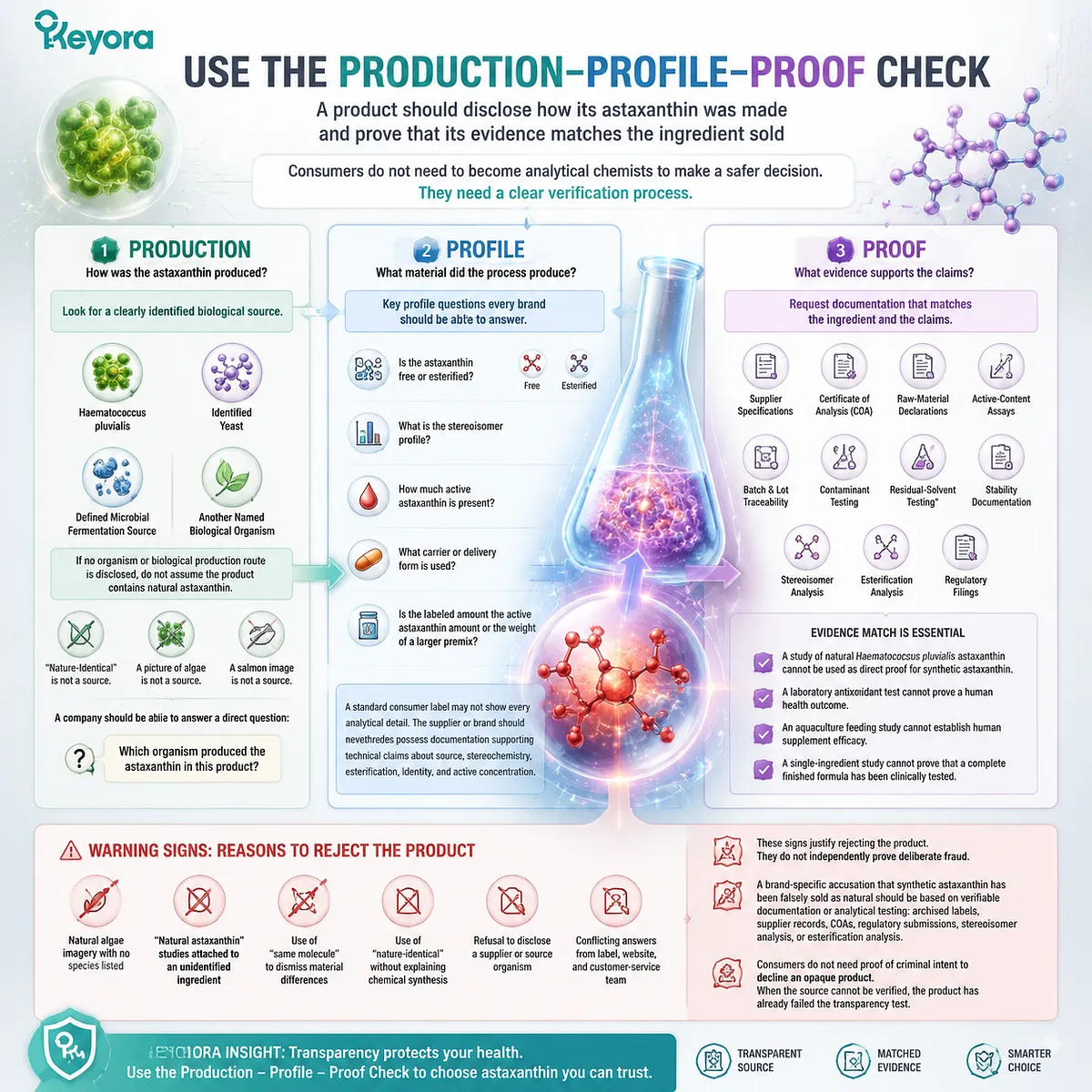
Use the Production – Profile – Proof Check
A product should disclose how its astaxanthin was made and prove that its evidence matches the ingredient sold
Consumers do not need to become analytical chemists to make a safer decision.
They need a clear verification process.
Use the Production – Profile – Proof Check.
1. Production
Ask how the astaxanthin was produced.
Look for a clearly identified source such as:
Haematococcus pluvialis
An identified yeast
A defined microbial fermentation source
Another named biological organism
If no organism or biological production route is disclosed, do not assume the product contains natural astaxanthin.
The phrase “nature-identical” is not a biological source declaration.
A picture of algae is not a source declaration.
A salmon image is not a source declaration.
A company should be able to answer a direct question:
Which organism produced the astaxanthin in this product?
2. Profile
Ask what material the manufacturing process produced.
Relevant questions include:
Is the astaxanthin free or esterified?
What is the stereoisomer profile?
How much active astaxanthin is present?
What carrier or delivery form is used?
Is the labeled amount the active astaxanthin amount or the weight of a larger premix?
A standard consumer label may not show every analytical detail. The supplier or brand should nevertheless possess documentation supporting technical claims about source, stereochemistry, esterification, identity, and active concentration.
3. Proof
Ask the company to support its claims with evidence.
Useful records may include:
Supplier specifications
Certificates of analysis
Raw-material declarations
Active-content assays
Batch and lot traceability
Contaminant testing
Residual-solvent testing where relevant
Stability documentation
Stereoisomer analysis
Esterification analysis
Regulatory filings
The research cited by the brand must also match the ingredient sold.
A study of natural Haematococcus pluvialis astaxanthin cannot be used as direct proof for synthetic astaxanthin.
A laboratory antioxidant test cannot prove a human health outcome.
An aquaculture feeding study cannot establish human supplement efficacy.
A single-ingredient study cannot prove that a complete finished formula has been clinically tested.
Brands should also be challenged when their marketing creates a natural impression without providing natural-source documentation.
Warning signs include:
Natural algae imagery with no species listed
Natural astaxanthin studies attached to an unidentified ingredient
Use of “same molecule” to dismiss material differences
Use of “nature-identical” without explaining chemical synthesis
Refusal to disclose a supplier or source organism
Conflicting answers from the label, website, and customer-service team
These signs justify rejecting the product. They do not independently prove deliberate fraud.
A brand-specific accusation that synthetic astaxanthin has been falsely sold as natural should be based on verifiable documentation or analytical testing. Evidence may include archived labels, supplier records, COAs, regulatory submissions, stereoisomer analysis, or esterification analysis.
Consumers do not need proof of criminal intent to decline an opaque product.
When the source cannot be verified, the product has already failed the transparency test.
What This Means When Choosing Astaxanthin
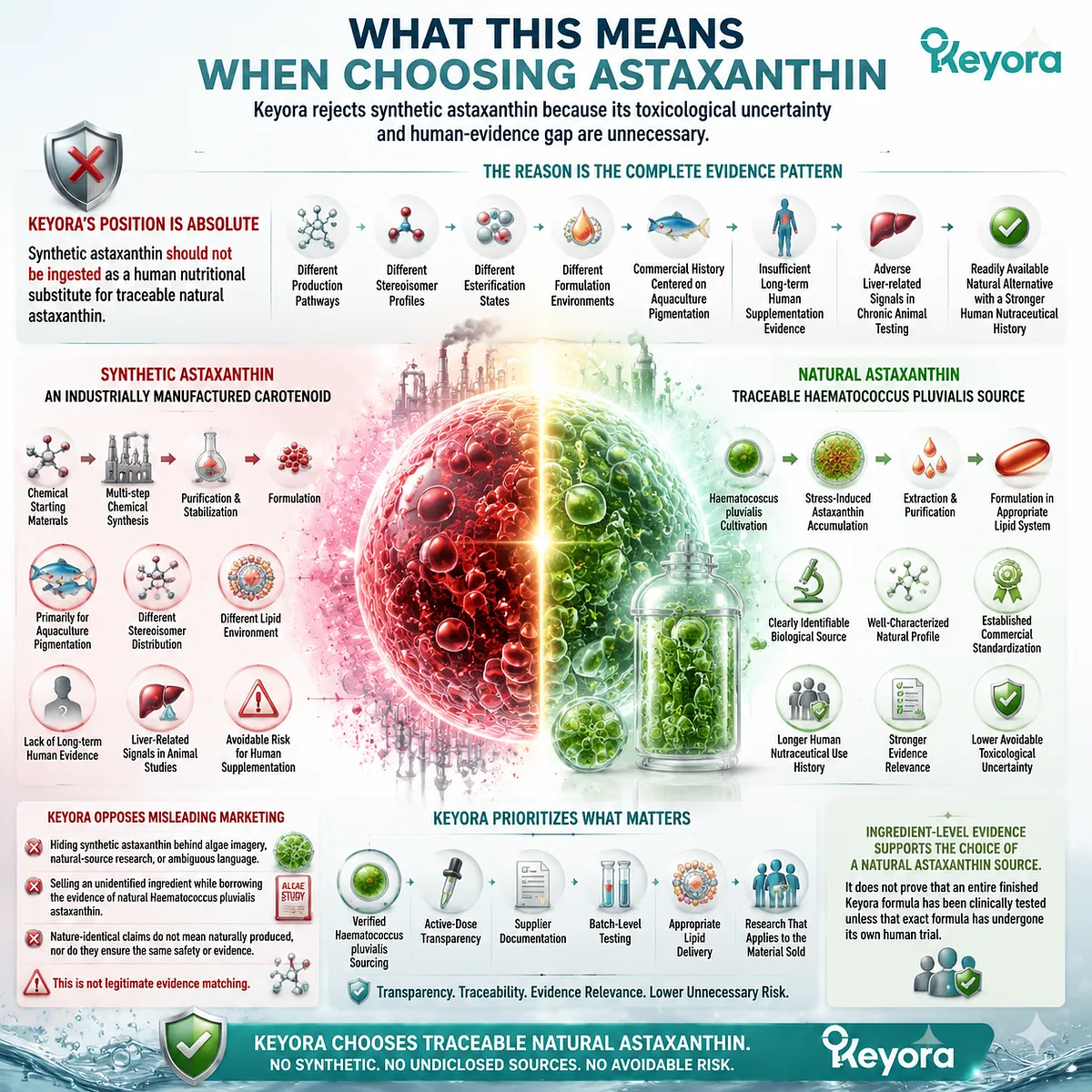
Keyora rejects synthetic astaxanthin because its toxicological uncertainty and human-evidence gap are unnecessary
Keyora’s position is absolute:
Synthetic astaxanthin should not be ingested as a human nutritional substitute for traceable natural astaxanthin
The reason is not simply that one material is natural and the other is manufactured.
The reason is the complete evidence pattern:
Different production pathways
Different stereoisomer profiles
Different esterification states
Different formulation environments
A commercial history centered on aquaculture pigmentation
Insufficient long-term human supplementation evidence
Adverse liver-related signals in chronic animal testing
A readily available natural alternative with a stronger human nutraceutical history
Keyora also opposes any brand that knowingly hides synthetic astaxanthin behind algae imagery, natural-source research, or ambiguous language.
Selling an unidentified ingredient while borrowing the evidence of natural Haematococcus pluvialis astaxanthin is not legitimate evidence matching.
Keyora prioritizes verified Haematococcus pluvialis sourcing, active-dose transparency, supplier documentation, batch-level testing, appropriate lipid delivery, and research that applies to the material actually sold.
Ingredient-level evidence supports the choice of a natural astaxanthin source. It does not prove that an entire finished Keyora formula has been clinically tested unless that exact formula has undergone its own human trial.
Closing Summary
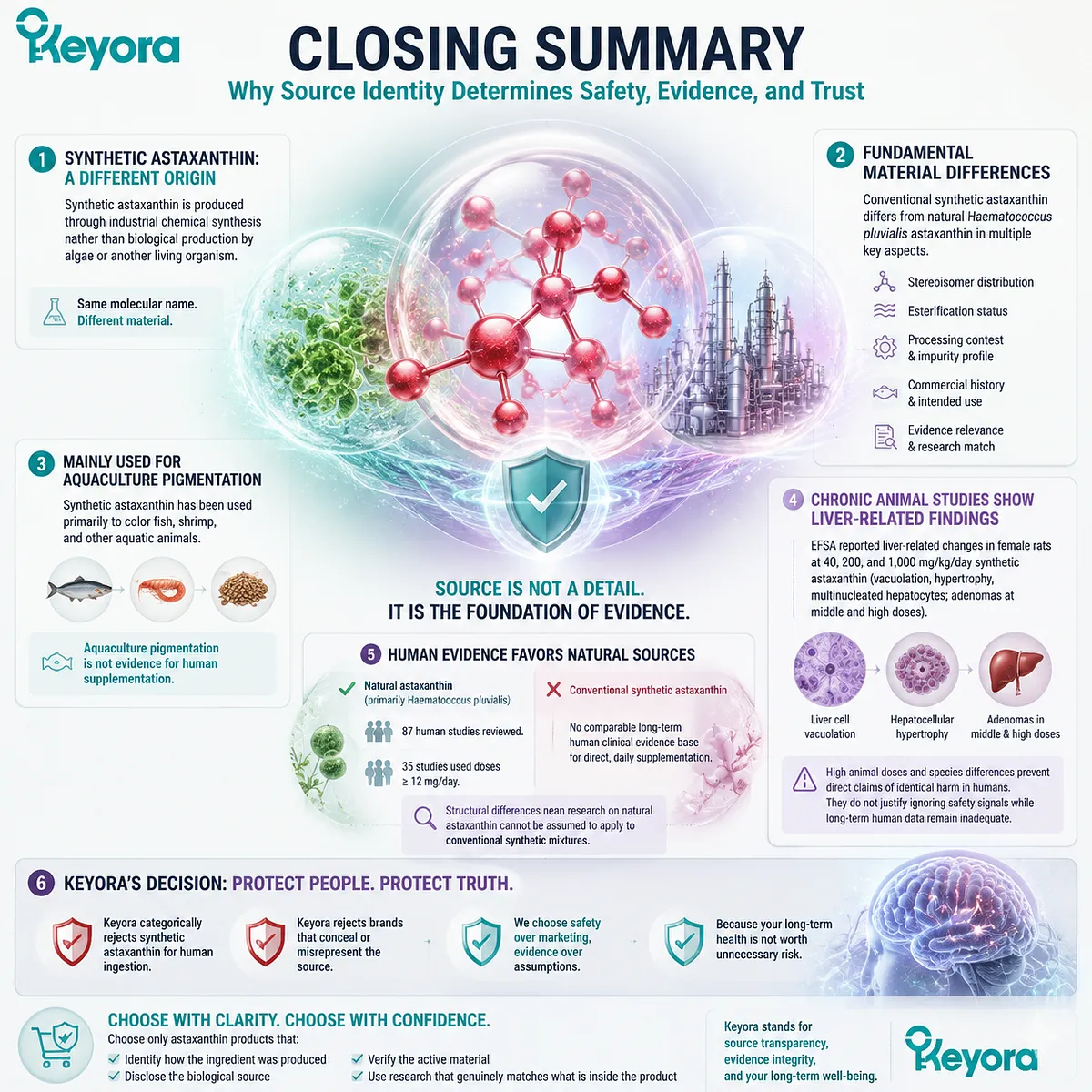
Synthetic astaxanthin is produced through industrial chemical synthesis rather than biological production by algae or another living organism.
It shares the astaxanthin molecular name, but conventional synthetic material differs from natural Haematococcus pluvialis astaxanthin in stereoisomer distribution, esterification status, processing context, commercial history, and evidence relevance.
Synthetic astaxanthin has been used mainly for aquaculture pigmentation. That use does not establish its suitability for direct, long-term human supplementation. Human nutraceutical research is much more closely associated with natural-source preparations.
Chronic animal testing has also produced adverse liver-related findings. The high rat doses and species differences prevent direct claims that ordinary human doses cause identical harm. They do not justify ignoring the safety signals while long-term human data remain inadequate.
Keyora therefore categorically rejects synthetic astaxanthin for human ingestion and rejects brands that conceal or misrepresent its source.
Choose only astaxanthin products that identify how the ingredient was produced, disclose the biological source, verify the active material, and use research that genuinely matches what is inside the product
This article is for educational and informational purposes only. It does not provide medical advice, diagnosis, treatment, cure, prevention, disease outcome claims, hormone restoration claims, fertility outcome claims, or formula-specific clinical efficacy claims.