
Why Do My Thoughts Feel Clear in My Head but Messy When I Write Them Down?
Keyora Research Q&A Library
This is part of the Keyora Research Q&A Series, derived from Keyora Nutritional Neurology Series .
Within the Keyora Nutritional Neurology framework, this Q&A translates complex nutrient–brain mechanisms into reader-friendly, evidence-bound answers, focusing on stress resilience, sleep quality, calm mood support, cognitive wellness, and the broader interaction between nutrition, neurochemistry, and daily nervous-system function.
First published by Keyora Research Journal: www.keyorahealth.com

Direct Answer
Your thoughts may feel clear internally but become messy in writing because the mind can hold ideas as compressed associations, while written language must make each connection, order, and assumption explicit.
The mismatch is this: you can see the whole idea using your own memories and context, but the reader can only follow the words and relationships that actually reached the page.
This can involve compressed internal representation, associative-to-linear translation, implicit-link omission, the writer–reader knowledge gap, perspective taking, working-memory externalization, sequencing, language retrieval, prefrontal control, attention filtering, internal noise, GABA/NMDA activation balance, Mg-ATP energy background, B vitamin cofactor context, cognitive resilience, and recovery readiness.
In the Keyora MoodFlow framework, this is understood as a cognitive-resilience and stress-readiness question, not a medical treatment, writing-enhancement, or performance claim.
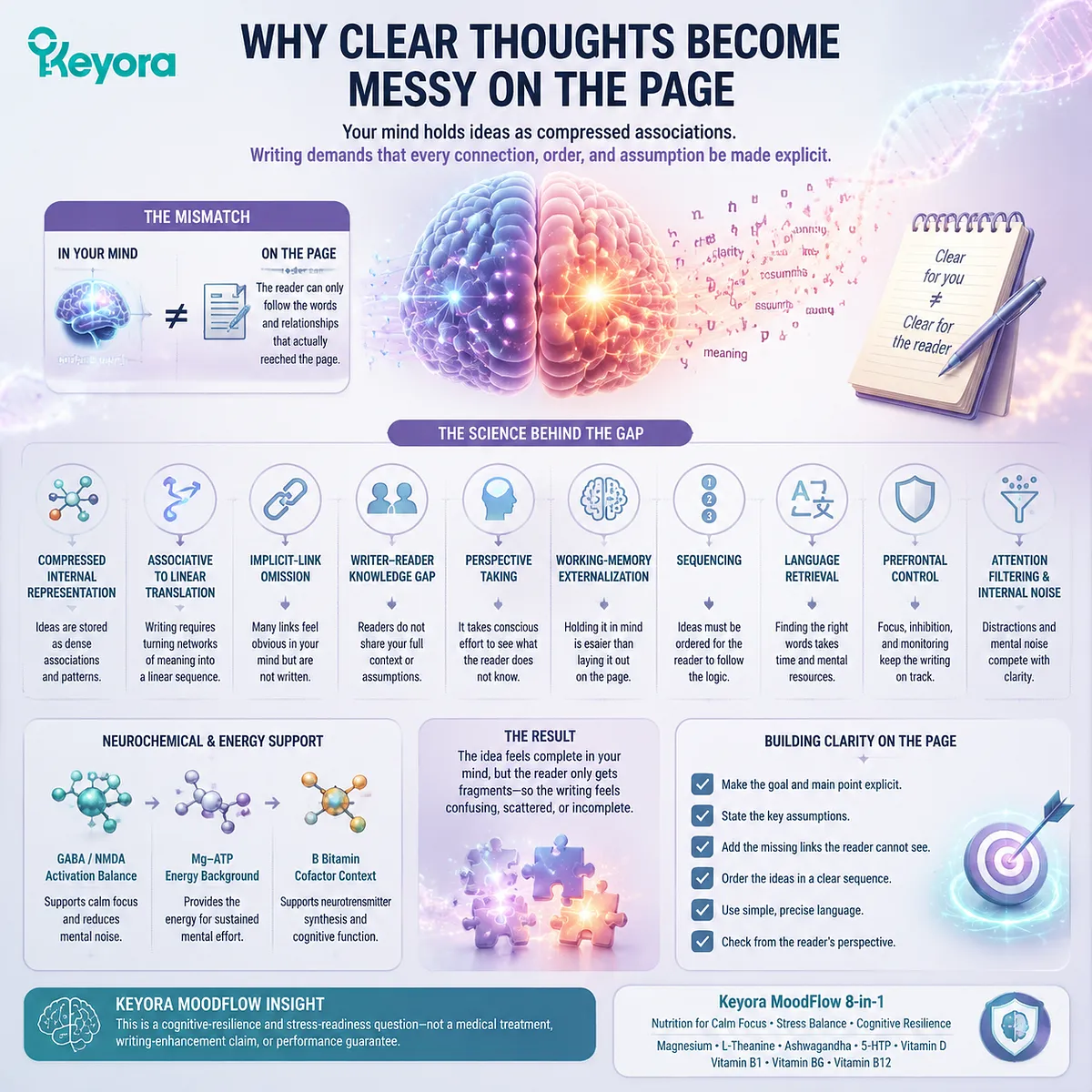
Why an Idea Can Feel Complete Before It Reaches the Page
Your mind can hold a whole network of meaning at once, while writing must reveal that network one sentence at a time.
The idea feels clear in your head.
You know what happened.
You know why it matters.
You know how the first problem led to the second.
You know which detail is background, which part is the main conclusion, and which exception needs to be mentioned.
Then you begin writing.
The first sentence states the conclusion.
The next sentence adds some background.
Then you remember an exception and insert it.
After that, you return to the original point.
When you read the paragraph, it still makes sense to you.
You can see the missing links because they are still present in your mind.
Then someone else reads it and asks:
“Who does ‘they’ refer to?”
“What caused this change?”
“How does this sentence connect to the one before it?”
“What is the main point of the paragraph?”
The thought may have been clear.
But some of its structure never reached the page.
This can feel confusing because you are not inventing the clarity afterward. The idea may genuinely feel organized internally.
You may be able to picture the people involved, remember the earlier conversation, feel the importance of the problem, and understand how each detail connects.
But internal understanding does not always arrive in sentences.
It may exist as a compressed whole.
One memory brings several facts with it.
One image contains a sequence.
One emotional reaction signals why something matters.
One familiar name activates a large amount of background knowledge.
Your mind does not always need to explain every connection to itself.
It already knows the context.
Writing works differently.
A reader cannot see your memory.
They cannot automatically know which earlier event you are referring to, why one detail matters, or what relationship connects two statements.
They receive the information in a line:
Sentence one.
Then sentence two.
Then sentence three.
Each sentence has to provide enough structure for the next one to make sense.
This is why thoughts can feel broader and faster than writing.
In your mind, several ideas can be present at the same time.
On the page, they must stand in an order.
You have to decide:
What comes first?
What background is necessary?
Which relationship must be explained?
Which detail belongs later?
What can be left out?
That translation is a real cognitive task.
Many people blame themselves when the page does not match the clarity they felt internally.
They think:
“Maybe I was never clear at all.”
“Maybe my logic is weak.”
“Why can I understand this but not explain it?”
“Why does the paragraph look nothing like the idea in my head?”
But a messy paragraph does not automatically prove that the thought itself was empty or disorganized.
It may show that the thought was still compressed.
A better question is not:
“Was my idea actually clear?”
It is:
“What connections did my mind automatically supply that the page has not yet made visible?”

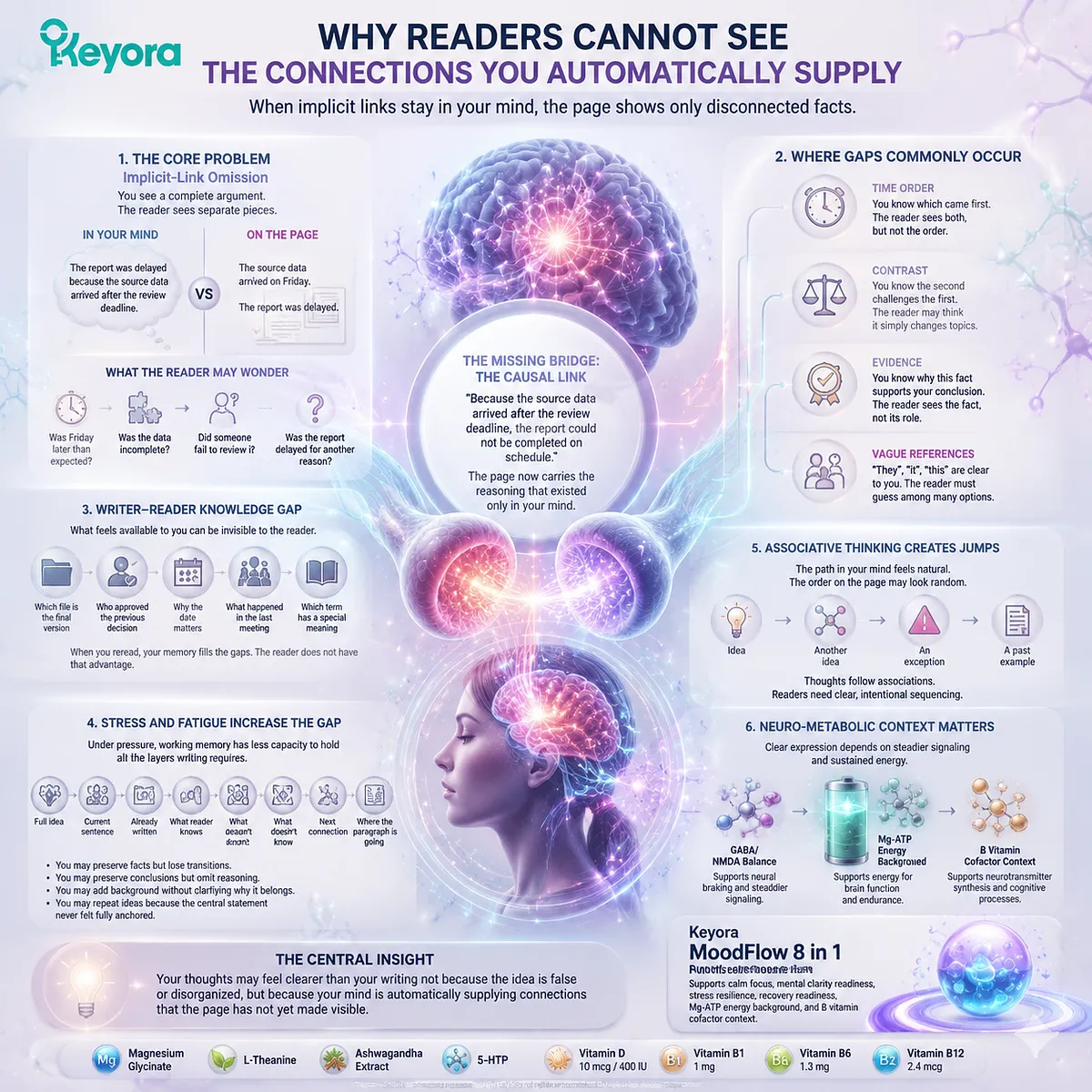
Why Readers Cannot See the Connections You Automatically Supply
When assumptions, causes, references, and transitions remain implicit, the writer may see a complete argument while the reader sees disconnected sentences.
One common problem is implicit-link omission.
Suppose the idea in your mind is:
“The report was delayed because the source data arrived after the review deadline.”
You may write:
“The source data arrived on Friday. The report was delayed.”
To you, the relationship feels obvious.
The late data caused the delay.
But the page has only placed two facts beside each other.
It has not stated the connection.
A reader may wonder:
Was Friday later than expected?
Was the data incomplete?
Did someone fail to review it?
Was the report delayed for another reason?
The missing bridge is the causal link:
“Because the source data arrived after the review deadline, the report could not be completed on schedule.”
The page now carries the reasoning that previously existed only in your mind.
The same problem can happen with time.
You know that one event happened before another.
The reader sees both events but does not know the order.
It can happen with contrast.
You know that the second sentence challenges the first.
The reader may think it simply changes topics.
It can happen with evidence.
You know why one fact supports your conclusion.
The reader sees the fact but not its role in the argument.
Vague references create another kind of gap.
You may write:
“They changed it, and this created a problem.”
In your mind, “they” refers to the finance team.
“It” refers to the submission process.
“This” refers to the removal of the review stage.
But the reader may have several possible nouns to choose from.
The sentence feels clear to you because your private context resolves every pronoun automatically.
The reader has only the words on the page.
The writer–reader knowledge gap also affects how much background is included.
You may know:
-
which file is the final version;
-
who approved the previous decision;
-
why the date matters;
-
what happened in the last meeting;
-
which term has a special meaning in this project.
Because that knowledge feels available and familiar, it can become invisible to you.
You may not notice that the reader lacks it.
This is why your own rereading may not reveal the problem.
When you see a vague phrase, your memory fills it in.
When a causal step is missing, your mind supplies it.
When the timeline is unclear, you already know the order.
You are not reading only the page.
You are reading the page plus everything you meant.
Stress and fatigue can increase this externalization gap.
Writing requires working memory to hold several layers at once:
-
the full idea;
-
the current sentence;
-
what has already been written;
-
what the reader knows;
-
what the reader does not know;
-
which connection must come next;
-
where the paragraph is going.
Under pressure, some of these layers may drop out.
You may preserve the facts but lose the transitions.
You may preserve the conclusion but omit the reasoning.
You may add background without clarifying why it belongs.
You may repeat the same idea in different words because the central statement never felt fully anchored.
Associative thinking can also lead to jumps.
One idea reminds you of another.
That second idea reminds you of an exception.
The exception reminds you of a past example.
In your mind, the route feels natural because each thought triggered the next.
For the reader, however, the written order may look arbitrary.
The order in which thoughts appear is not always the order in which another person can understand them most easily.
At the nervous-system level, heightened internal activation can increase cognitive noise and reduce the spare capacity available for sequencing, perspective taking, and language monitoring. GABA/NMDA activation balance can be understood as part of the broader context for steadier signaling and neural braking.
Mg-ATP energy background and B vitamin cofactor context also belong to the wider neuro-metabolic picture because language production, working-memory maintenance, sequencing, and attention control require sustained energy.
The central insight is this:
Your thoughts may feel clearer than your writing not because the idea is false or disorganized, but because your mind is automatically supplying connections that the page has not yet made visible.
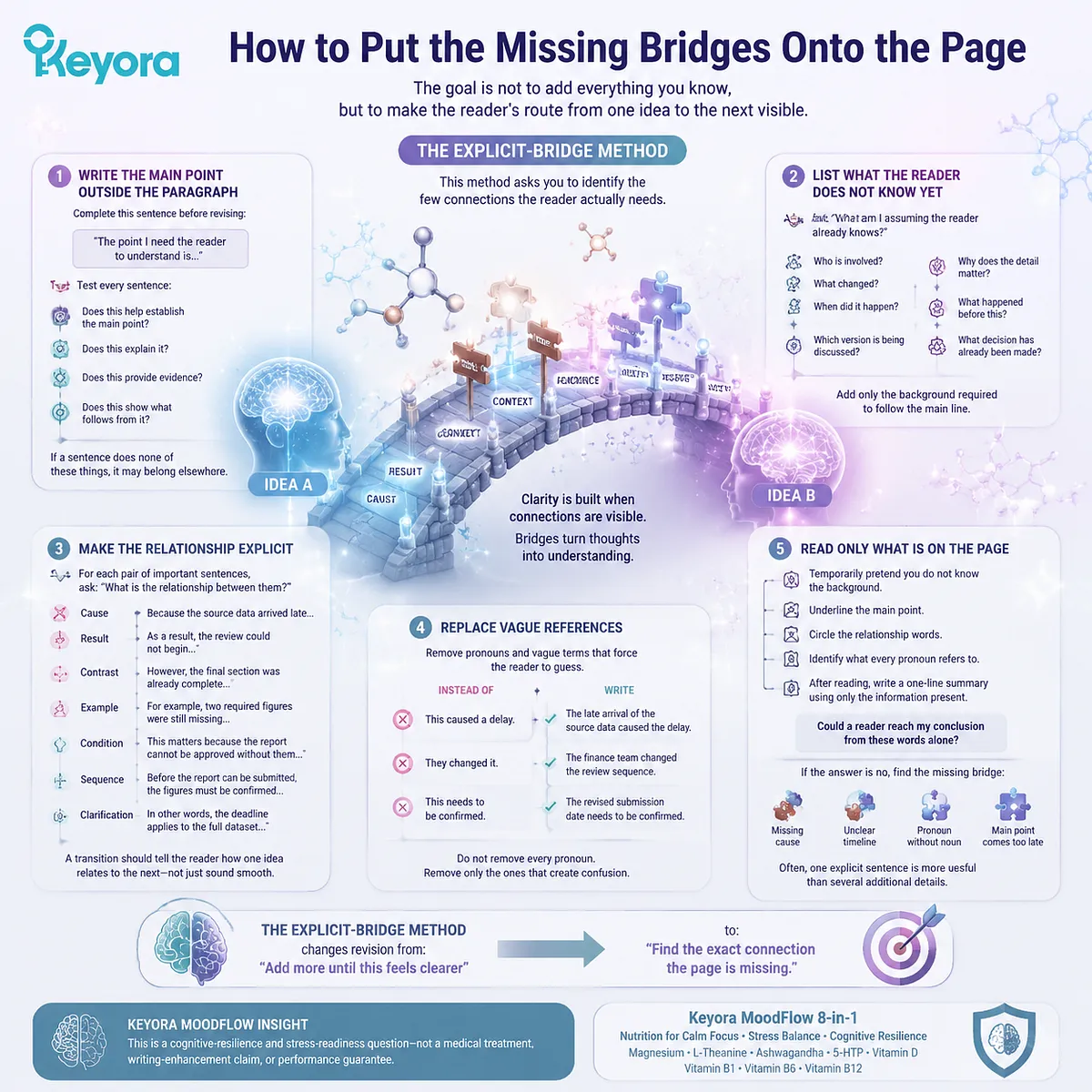
How to Put the Missing Bridges Onto the Page
The goal is not to add everything you know, but to make the reader’s route from one idea to the next visible.
A helpful approach is The Explicit-Bridge Method.
This method does not ask you to expand every thought into a long explanation.
It asks you to identify the few connections the reader actually needs.
Step one: write the main point outside the paragraph.
Before revising, complete this sentence:
“The point I need the reader to understand is…”
For example:
“The point is that the report was delayed because the source data arrived after the review deadline.”
This sentence may or may not appear in the final version.
Its purpose is to give the paragraph a center.
Now each sentence can be tested:
Does this help establish the main point?
Does this explain it?
Does this provide evidence?
Does this show what follows from it?
If a sentence does none of these things, it may belong elsewhere.
Step two: list what the reader does not know yet.
Ask:
“What am I assuming the reader already knows?”
Check for:
Who is involved?
What changed?
When did it happen?
Which version is being discussed?
Why does the detail matter?
What happened before this?
What decision has already been made?
Add only the background required to follow the main line.
The goal is not to include the complete history.
Too much background can bury the point just as easily as too little background can make it confusing.
Step three: make the relationship explicit.
Look at each pair of important sentences.
Ask:
“What is the relationship between them?”
Is it cause?
Result?
Contrast?
Example?
Condition?
Sequence?
Clarification?
Then name that relationship.
“Because the source data arrived late…”
“As a result, the review could not begin…”
“However, the final section was already complete…”
“For example, two required figures were still missing…”
“This matters because the report cannot be approved without them…”
“Before the report can be submitted, the figures must be confirmed…”
A transition should do more than make the writing sound smooth.
It should tell the reader how one idea relates to the next.
Step four: replace vague references.
Search for words such as:
This.
That.
It.
They.
The issue.
The situation.
The problem.
Ask:
“Could the reader identify the exact noun without using my private background?”
Instead of:
“This caused a delay,”
write:
“The late arrival of the source data caused the delay.”
Instead of:
“They changed it,”
write:
“The finance team changed the review sequence.”
Instead of:
“This needs to be confirmed,”
write:
“The revised submission date needs to be confirmed.”
You do not need to remove every pronoun.
You only need to remove the ones that force the reader to guess.
Step five: read only what is on the page.
Temporarily pretend that you do not know the background.
Underline the main point.
Circle the relationship words.
Identify what every pronoun refers to.
After reading the paragraph, write a one-line summary using only the information present.
Then ask:
“Could a reader reach my conclusion from these words alone?”
If the answer is no, do not automatically add another full paragraph.
Look for the missing bridge.
Perhaps one cause is unstated.
Perhaps the timeline is unclear.
Perhaps a pronoun has no obvious noun.
Perhaps the main point appears too late.
Often, one explicit sentence is more useful than several additional details.
The Explicit-Bridge Method changes revision from:
“Add more until this feels clearer”
to:
“Find the exact connection the page is missing.”
That is a smaller and more precise task.
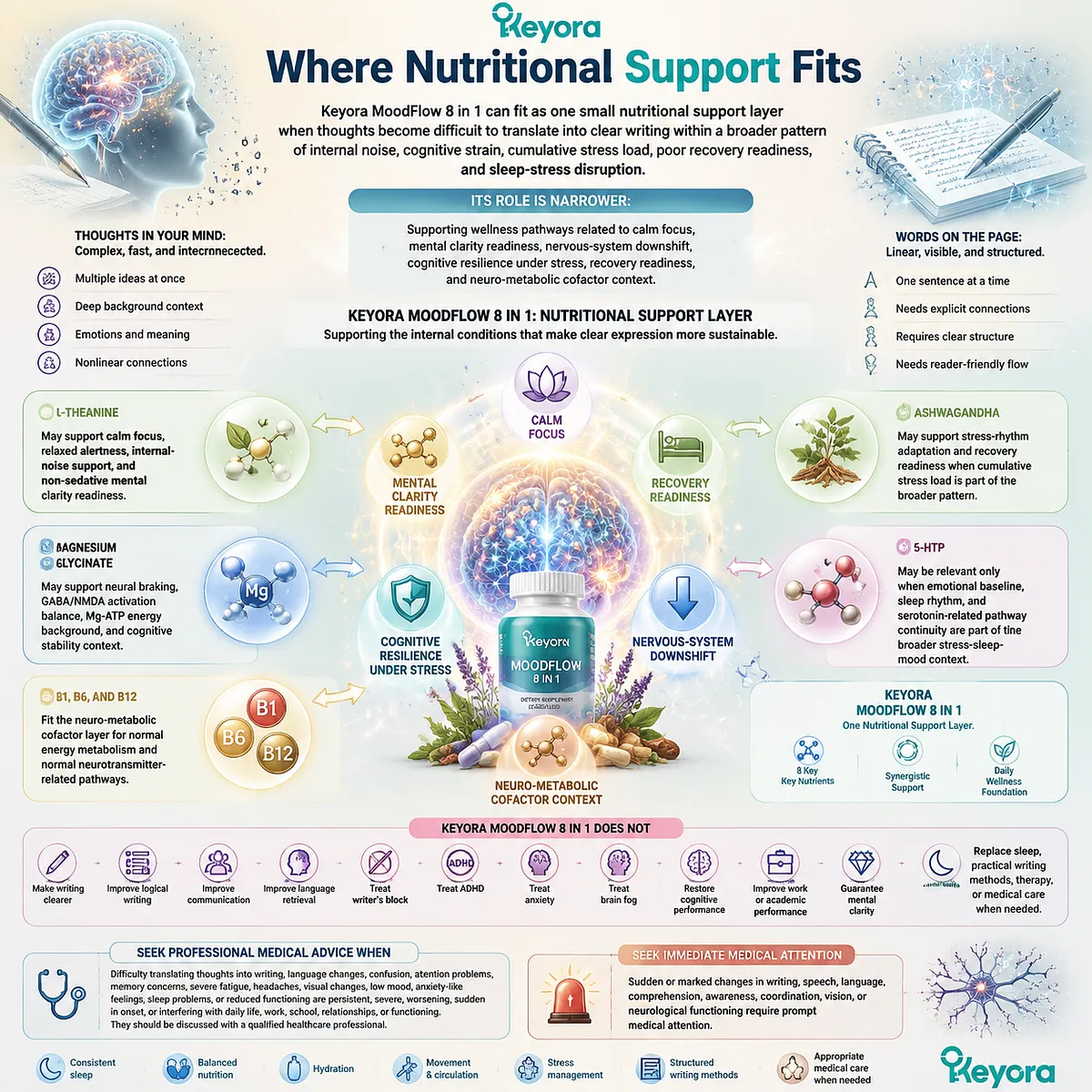
Where Nutritional Support Fits
Keyora MoodFlow 8 in 1 can fit as one small nutritional support layer when thoughts become difficult to translate into clear writing within a broader pattern of internal noise, cognitive strain, cumulative stress load, poor recovery readiness, and sleep-stress disruption.
Its role is narrower: supporting wellness pathways related to calm focus, mental clarity readiness, nervous-system downshift, cognitive resilience under stress, recovery readiness, and neuro-metabolic cofactor context.
-
L-Theanine may support calm focus, relaxed alertness, internal-noise support, and non-sedative mental clarity readiness.
-
Magnesium glycinate may support neural braking, GABA/NMDA activation balance, Mg-ATP energy background, and cognitive stability context.
-
B1, B6, and B12 fit the neuro-metabolic cofactor layer for normal energy metabolism and normal neurotransmitter-related pathways.
-
Ashwagandha may support stress-rhythm adaptation and recovery readiness when cumulative stress load is part of the broader pattern.
-
5-HTP may be relevant only when emotional baseline, sleep rhythm, and serotonin-related pathway continuity are part of the broader stress-sleep-mood context.
Keyora MoodFlow 8 in 1 does not make writing clearer, improve logical writing, improve communication, improve language retrieval, treat writer’s block, treat ADHD, treat anxiety, treat brain fog, restore cognitive performance, improve work or academic performance, guarantee mental clarity, or replace sleep, practical writing methods, therapy, or medical care when needed.
If difficulty translating thoughts into writing, language changes, confusion, attention problems, memory concerns, severe fatigue, headaches, visual changes, low mood, anxiety-like feelings, sleep problems, or reduced functioning are persistent, severe, worsening, sudden in onset, or interfering with daily life, work, school, relationships, or functioning, they should be discussed with a qualified healthcare professional.
Sudden or marked changes in writing, speech, language, comprehension, awareness, coordination, vision, or neurological functioning require prompt medical attention.
Closing Summary
Your thoughts may feel clear internally but become messy in writing because the mind can hold ideas as compressed networks of memory, context, emotion, and association, while written language must reveal those connections in a linear form.
You may understand the whole idea using background that never reached the page. The reader, however, can only follow the stated subjects, transitions, causes, conditions, and sequence.
The practical path is The Explicit-Bridge Method: define the main point, identify what the reader does not yet know, state the relationship between ideas, replace vague references, and judge the paragraph using only what is actually written.
Keyora MoodFlow 8 in 1 belongs only as a small nutritional support layer for calm focus, mental clarity readiness, stress resilience, nervous-system downshift, cognitive resilience, recovery readiness, Mg-ATP energy background, and B vitamin cofactor context.
When the page looks messier than the idea in your head, the answer is not always to add more content. Sometimes clarity appears when you find the one connection your mind supplied silently and place that missing bridge into words.

This article is for educational and informational purposes only. It does not provide medical advice, diagnosis, treatment, cure, prevention, disease outcome claims, hormone restoration claims, fertility outcome claims, or formula-specific clinical efficacy claims.