
Why Is It Hard to Filter What Matters When I’m Under Stress?
Keyora Research Q&A Library
This is part of the Keyora Research Q&A Series, derived from Keyora Nutritional Neurology Series .
Within the Keyora Nutritional Neurology framework, this Q&A translates complex nutrient–brain mechanisms into reader-friendly, evidence-bound answers, focusing on stress resilience, sleep quality, calm mood support, cognitive wellness, and the broader interaction between nutrition, neurochemistry, and daily nervous-system function.
First published by Keyora Research Journal: www.keyorahealth.com

Direct Answer
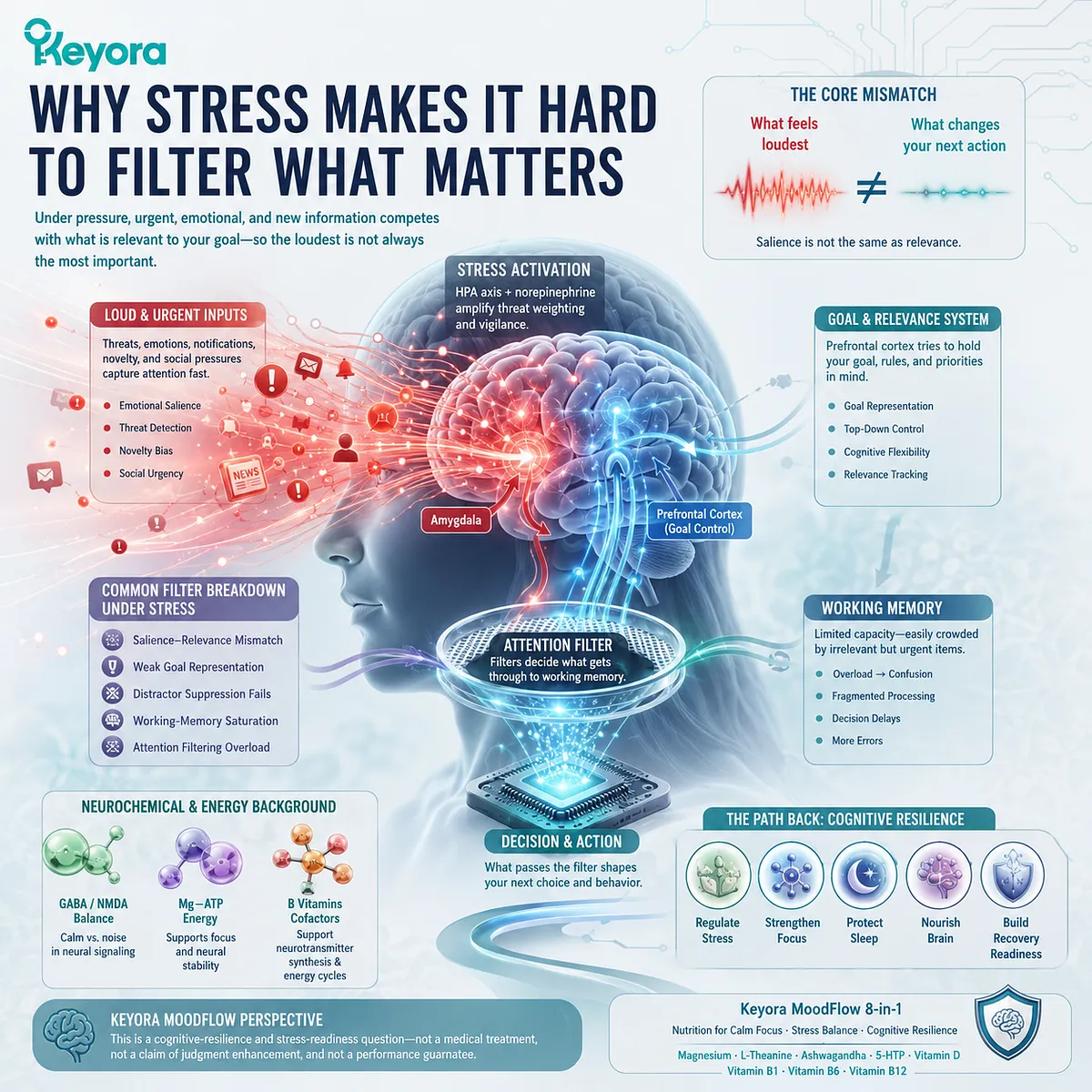
It can be hard to filter what matters under stress because pressure can make urgent, emotional, and newly arriving information compete with the details that are actually relevant to your current goal.
The mismatch is this: the information that feels loudest may not be the information that changes your next decision or action.
This can involve salience–relevance mismatch, threat weighting, weak goal representation, distractor suppression, working-memory saturation, attention filtering, prefrontal control, cognitive flexibility, signal-to-noise balance, GABA/NMDA activation balance, Mg-ATP energy background, B vitamin cofactor context, cognitive resilience, and recovery readiness.
In the Keyora MoodFlow framework, this is understood as a cognitive-resilience and stress-readiness question, not a medical treatment, judgment-enhancement, or performance claim.
Why Everything Can Start Feeling Equally Important Under Stress
Pressure can make emotional intensity, urgency, and novelty feel like proof that information deserves immediate attention.
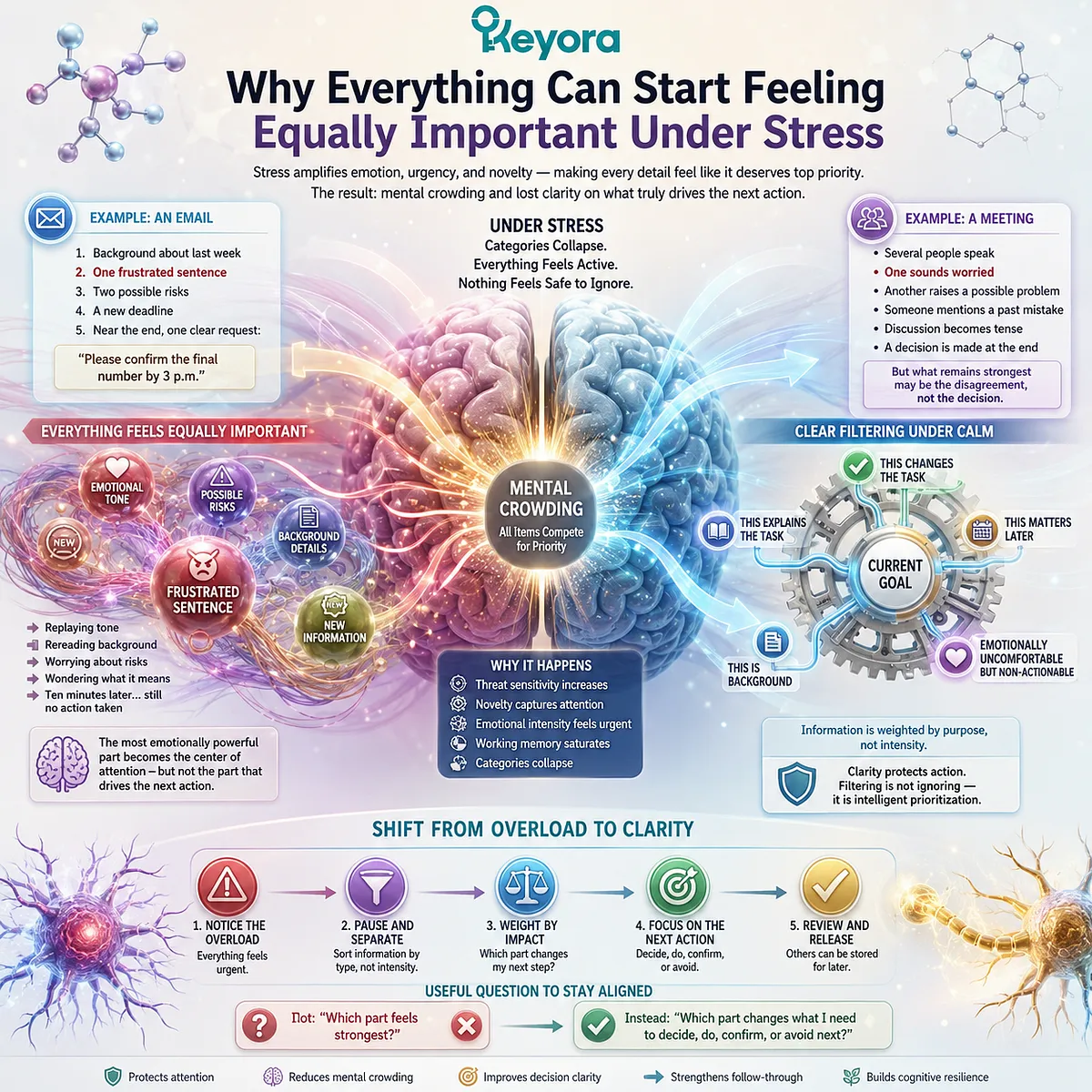
You open an email with several paragraphs.
There is background about what happened last week.
There is one frustrated sentence from the sender.
There are two possible risks.
There is a new deadline.
Near the end, there is one clear request:
“Please confirm the final number by 3 p.m.”
You finish reading.
What stays loudest is the frustrated sentence.
You begin wondering whether the sender is unhappy.
You reread the background.
You think about the possible risks.
You replay the tone of the message.
Ten minutes later, you still have not confirmed the number.
The most emotionally powerful part of the email became the center of your attention.
But it was not the part that changed your next action.
This can happen in meetings too.
Several people speak. One person sounds worried. Another raises a possible problem. Someone mentions a past mistake. The discussion becomes tense.
At the end, a decision is made.
But afterward, what remains strongest in your mind may be the disagreement rather than the decision.
You remember who sounded frustrated.
You remember the risk that was mentioned.
You remember one uncomfortable sentence.
You may not remember who is responsible for the next step or when it is due.
This does not necessarily mean you failed to listen.
It may mean stress changed how the information was weighted.
When people are calm, they can often separate different kinds of information:
This changes the task.
This explains the task.
This is background.
This matters later.
This is emotionally uncomfortable but does not alter what I need to do now.
Under stress, those categories can begin to collapse.
Everything feels active.
Every detail seems potentially dangerous to ignore.
Every new message feels as though it may require an immediate response.
Every concern feels like it belongs at the top of the list.
This can create a form of mental crowding in which nothing is clearly unimportant enough to set aside.
You may think:
“What if that detail matters later?”
“What if I miss a warning?”
“What if the person’s tone means something serious?”
“What if I focus on the wrong part?”
“What if the smallest detail causes a larger problem?”
The desire not to miss anything is understandable.
But when every item receives equal priority, the information that actually controls the next action can become harder to see.
Filtering is sometimes misunderstood as ignoring.
It is not.
Filtering means deciding how much mental space information should occupy right now.
A background detail can still be useful.
A risk can still deserve attention.
An emotional reaction can still matter.
But none of those automatically needs to control the current task.
A useful question is not:
“Which part feels strongest?”
It is:
“Which part changes what I need to decide, do, confirm, or avoid next?”
Why the Loudest Information Can Push Out the Most Useful Signal
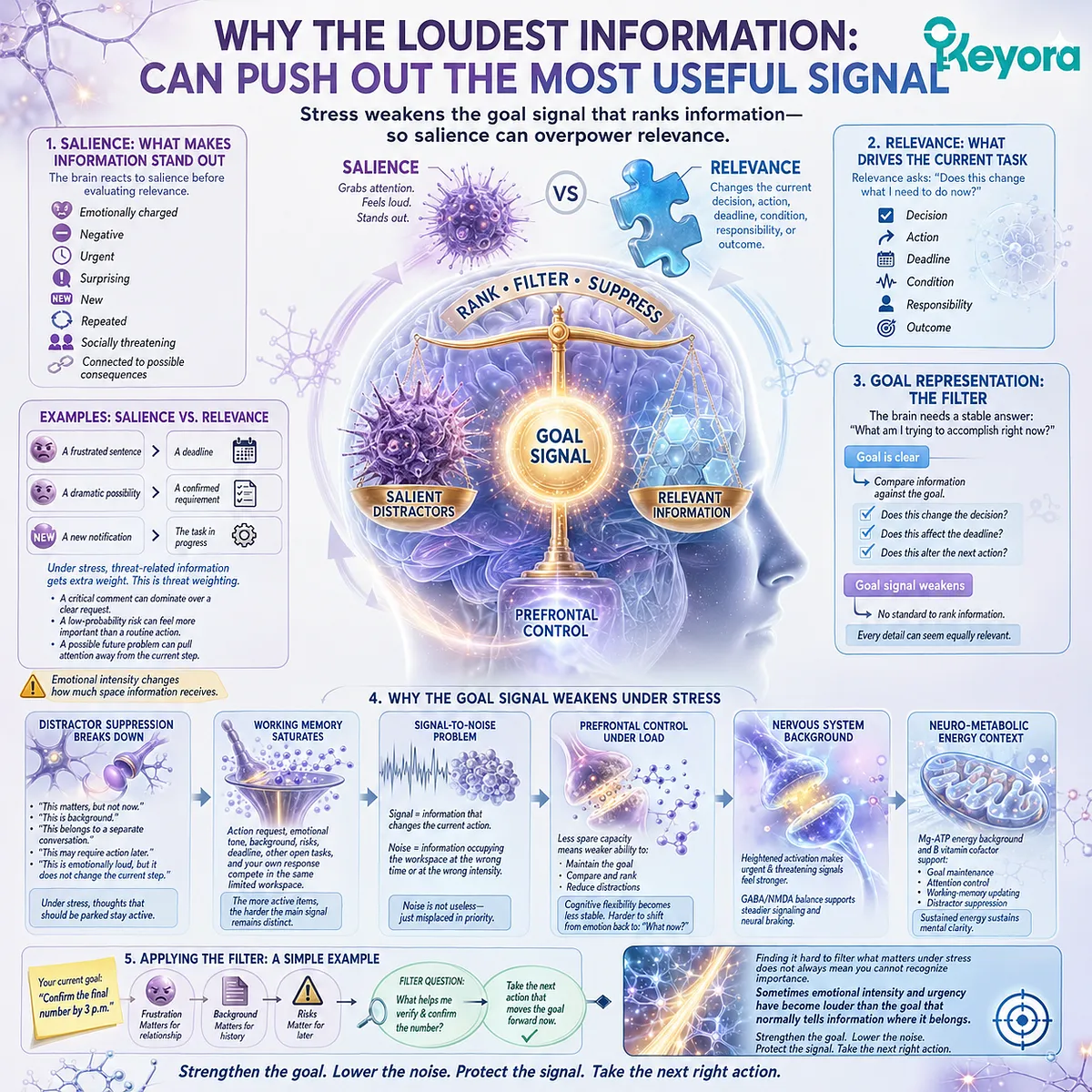
Stress can weaken the goal signal that normally helps the brain rank information and suppress what does not belong to the current task.
The brain does not rank information only by importance.
It also responds to salience.
Salience is the quality that makes something stand out.
Information can become salient because it is:
-
emotionally charged;
-
negative;
-
urgent;
-
surprising;
-
new;
-
repeated;
-
socially threatening;
-
connected to possible consequences.
Relevance is different.
Relevance asks whether the information changes the current:
-
decision;
-
action;
-
deadline;
-
condition;
-
responsibility;
-
outcome.
A frustrated sentence may be highly salient.
A deadline may be more relevant.
A dramatic possibility may be highly salient.
A confirmed requirement may be more relevant.
A new notification may be highly salient.
The task already in progress may still be more relevant.
Under stress, the brain may give extra weight to threat-related information.
This is threat weighting.
A critical comment can occupy more attention than a clear request.
A low-probability risk can feel more important than a routine action that needs to happen now.
A possible future problem can pull attention away from a current task that would reduce the risk.
This does not mean the threat is imaginary.
It means emotional intensity may change how much cognitive space it receives.
Goal representation is also important.
To filter information, the brain needs a stable answer to:
“What am I trying to accomplish right now?”
If the goal is clear, information can be compared against it.
Does this change the decision?
Does this affect the deadline?
Does this alter the next action?
If the goal signal weakens, the brain loses the standard used to rank the information.
Then every detail can seem equally relevant.
Suppose your goal is:
“Confirm the final number by 3 p.m.”
The sender’s frustration may matter for the wider relationship.
The background may matter for understanding the project history.
The risks may matter for later discussion.
But the current goal provides a filter:
What helps me verify and confirm the number?
Without that goal, attention may follow whichever detail produces the strongest reaction.
Distractor suppression is another part of filtering.
The brain does not only select what matters.
It also temporarily lowers the priority of what does not belong to the current task.
It says:
“This matters, but not now.”
“This is background.”
“This belongs to a separate conversation.”
“This may require action later.”
“This is emotionally loud, but it does not change the current step.”
Stress can make this suppression harder.
A thought that should have been parked remains active.
A notification stays mentally open.
A concern continues repeating.
A possible risk keeps returning even after the next action has already been identified.
Working memory then becomes saturated.
The action request, the emotional tone, the background, the risks, the deadline, the other open tasks, and your own response all compete inside the same limited workspace.
The more information stays active, the harder it becomes for the main signal to remain distinct.
This is a signal-to-noise problem.
The signal is the information that changes the current action.
The noise is not necessarily useless information.
It is information occupying the active workspace at the wrong time or at the wrong intensity.
Prefrontal control normally helps maintain the goal, compare information against it, and reduce the influence of distractions.
Under stress load, this system may have less spare capacity.
Cognitive flexibility can also become less stable. The brain may struggle to shift from an emotional reaction back to the practical question:
“What now?”
At the nervous-system level, heightened activation can make urgent and threatening signals feel especially strong. GABA/NMDA activation balance can be understood as part of the broader background for steadier signaling and neural braking.
Mg-ATP energy background and B vitamin cofactor context also belong to the wider neuro-metabolic picture because goal maintenance, attention control, working-memory updating, and distractor suppression all require sustained energy.
The central insight is this:
Finding it hard to filter what matters under stress does not always mean you cannot recognize importance. Sometimes emotional intensity and urgency have become louder than the goal that normally tells information where it belongs.
How to Separate the Main Signal From the Surrounding Noise
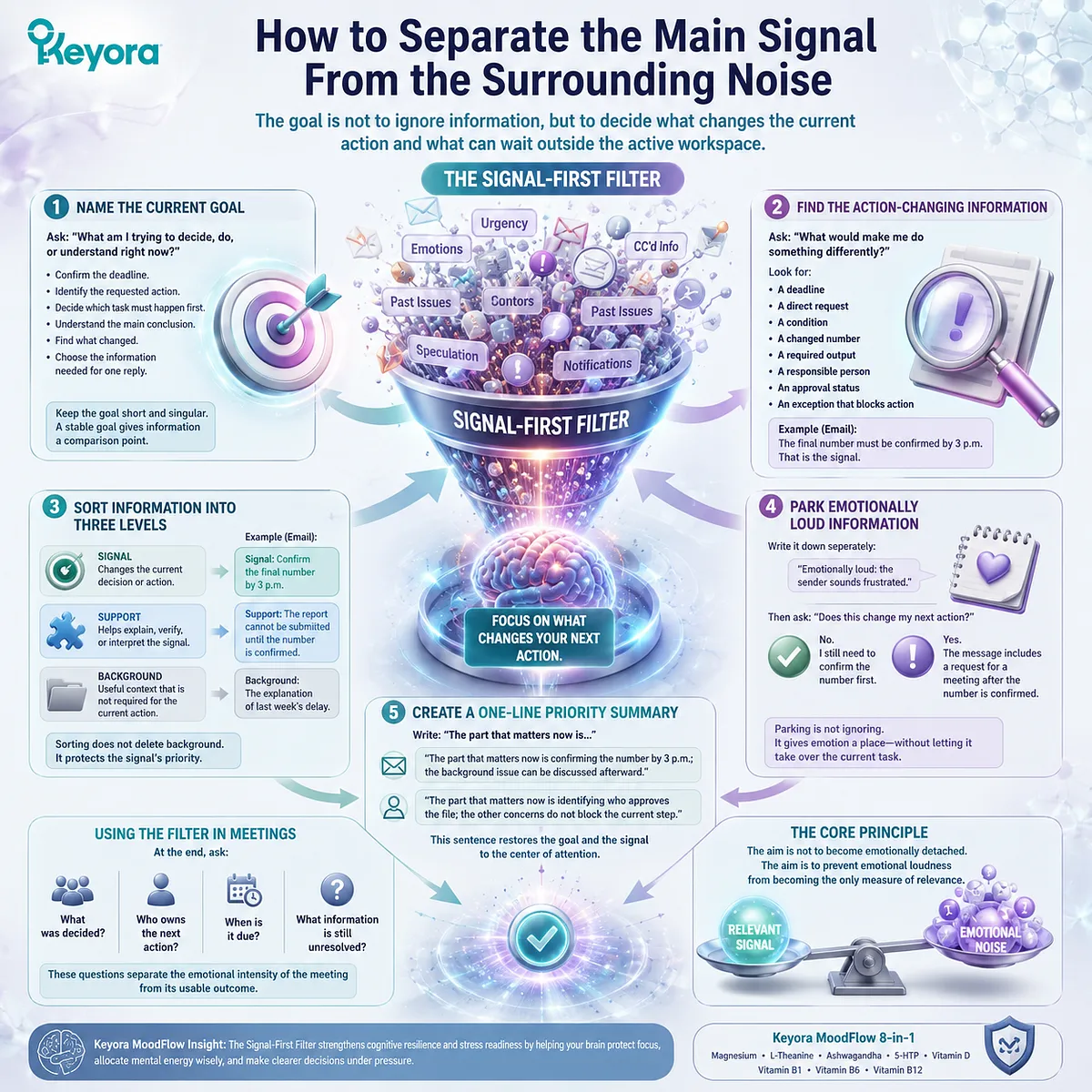
The goal is not to ignore information, but to decide what changes the current action and what can wait outside the active workspace.
A helpful approach is The Signal-First Filter.
This method does not ask you to decide the permanent importance of every detail.
It helps you identify what matters for the current decision or action.
Step one: name the current goal.
Ask:
“What am I trying to decide, do, or understand right now?”
The goal may be:
Confirm the deadline.
Identify the requested action.
Decide which task must happen first.
Understand the main conclusion.
Find what changed from the previous version.
Choose the information needed for one reply.
Keep the goal short.
If the goal contains several different decisions, separate them.
For example, instead of:
“I need to understand the whole project problem and the relationship with the sender and all possible future risks,”
use:
“Right now, I need to confirm the number and reply by 3 p.m.”
A stable goal gives information a comparison point.
Step two: find the action-changing information.
Ask:
“What would make me do something differently?”
Look for:
-
a deadline;
-
a direct request;
-
a condition;
-
a changed number;
-
a required output;
-
a responsible person;
-
an approval status;
-
an exception that blocks action.
In the email example, the action-changing information is:
The final number must be confirmed by 3 p.m.
That is the signal.
The sender’s tone may matter, but it does not change the immediate action unless the message explicitly contains another request.
Step three: sort the information into three levels.
Use three simple categories:
Signal: changes the current decision or action.
Support: helps explain, verify, or interpret the signal.
Background: useful context that is not required for the current action.
For example:
Signal: Confirm the final number by 3 p.m.
Support: The report cannot be submitted until the number is confirmed.
Background: The explanation of last week’s delay.
This sorting does not delete the background.
It simply keeps the background from occupying the same priority level as the signal.
Step four: park emotionally loud information.
Sometimes one part of the message continues pulling attention because it produces a strong emotional response.
Write it down separately:
“Emotionally loud: the sender sounds frustrated.”
Then ask:
“Does this change my next action?”
The answer may be:
“No. I still need to confirm the number first.”
Or:
“Yes. The message includes a request for a meeting after the number is confirmed.”
Parking emotional information is not pretending it does not matter.
It gives the emotional issue a place without allowing it to take over the current task.
You can return to it when the immediate action is complete.
Step five: create a one-line priority summary.
Write:
“The part that matters now is…”
For example:
“The part that matters now is confirming the number by 3 p.m.; the background issue can be discussed afterward.”
Or:
“The part that matters now is identifying who approves the file; the other concerns do not block the current step.”
This sentence restores the goal and the signal to the center of attention.
The Signal-First Filter can also be used in meetings.
At the end, ask:
“What was decided?”
“Who owns the next action?”
“When is it due?”
“What information is still unresolved?”
These questions help separate the emotional or conversational intensity of the meeting from its usable outcome.
The aim is not to become emotionally detached.
The aim is to prevent emotional loudness from becoming the only measure of relevance.
Where Nutritional Support Fits
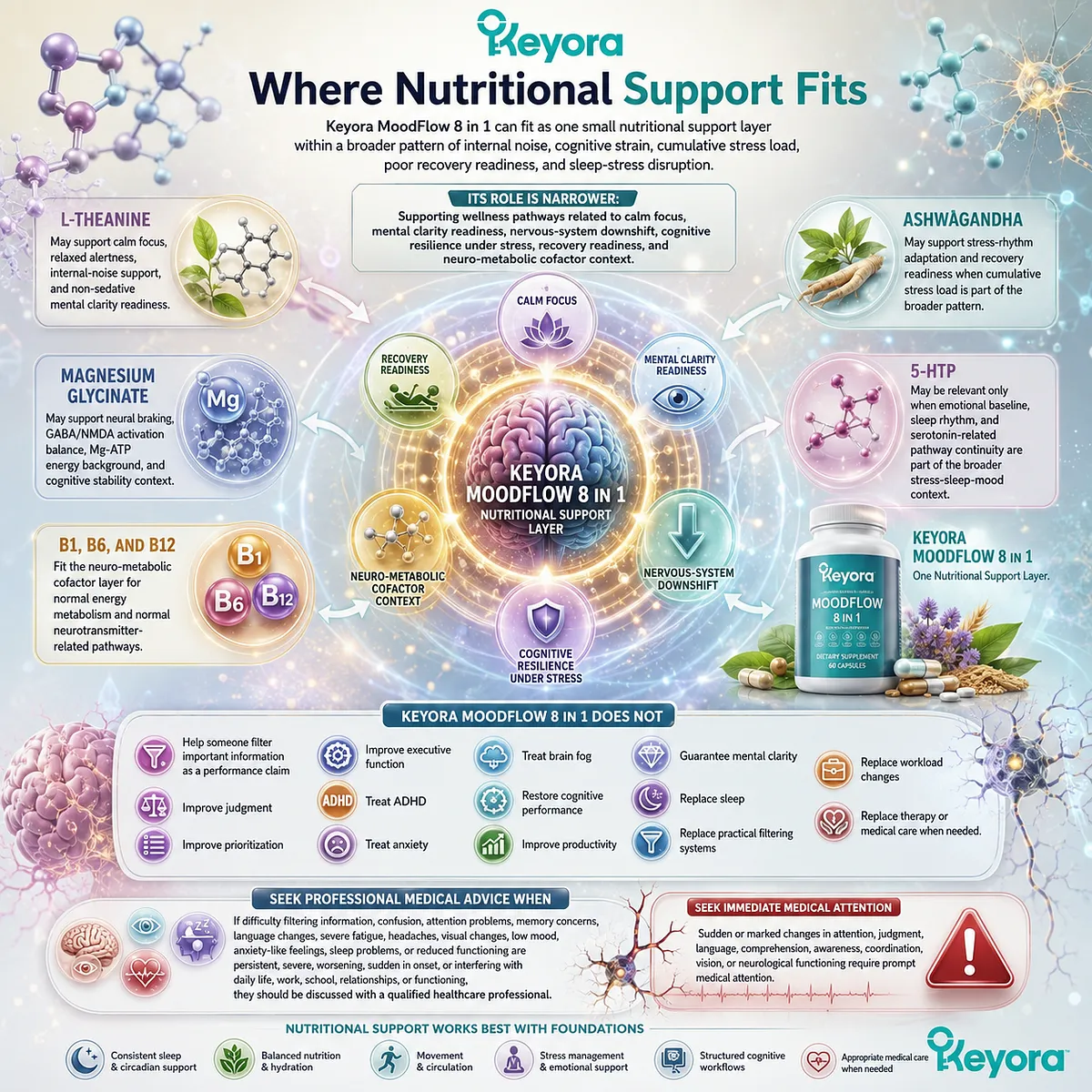
Keyora MoodFlow 8 in 1 can fit as one small nutritional support layer when difficulty filtering what matters under stress appears within a broader pattern of internal noise, cognitive strain, cumulative stress load, poor recovery readiness, and sleep-stress disruption.
Its role is narrower: supporting wellness pathways related to calm focus, mental clarity readiness, nervous-system downshift, cognitive resilience under stress, recovery readiness, and neuro-metabolic cofactor context.
-
L-Theanine may support calm focus, relaxed alertness, internal-noise support, and non-sedative mental clarity readiness.
-
Magnesium glycinate may support neural braking, GABA/NMDA activation balance, Mg-ATP energy background, and cognitive stability context.
-
B1, B6, and B12 fit the neuro-metabolic cofactor layer for normal energy metabolism and normal neurotransmitter-related pathways.
-
Ashwagandha may support stress-rhythm adaptation and recovery readiness when cumulative stress load is part of the broader pattern.
-
5-HTP may be relevant only when emotional baseline, sleep rhythm, and serotonin-related pathway continuity are part of the broader stress-sleep-mood context.
Keyora MoodFlow 8 in 1 does not help someone filter important information as a performance claim, improve judgment, improve prioritization, improve executive function, treat ADHD, treat anxiety, treat brain fog, restore cognitive performance, improve productivity, guarantee mental clarity, or replace sleep, practical filtering systems, workload changes, therapy, or medical care when needed.
If difficulty filtering information, confusion, attention problems, memory concerns, language changes, severe fatigue, headaches, visual changes, low mood, anxiety-like feelings, sleep problems, or reduced functioning are persistent, severe, worsening, sudden in onset, or interfering with daily life, work, school, relationships, or functioning, they should be discussed with a qualified healthcare professional.
Sudden or marked changes in attention, judgment, language, comprehension, awareness, coordination, vision, or neurological functioning require prompt medical attention.
Closing Summary
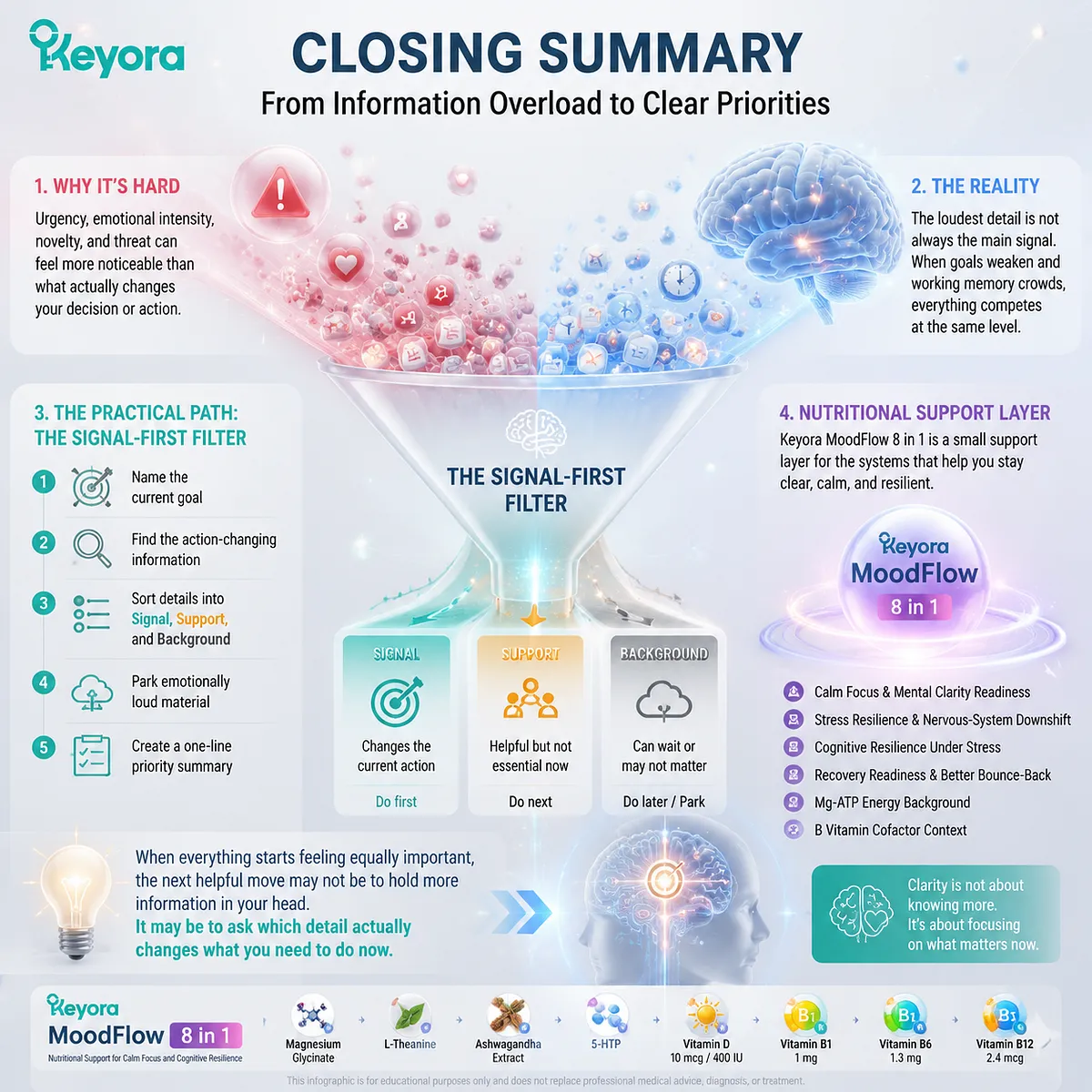
It can be hard to filter what matters under stress because urgency, emotional intensity, novelty, and threat can become more noticeable than the information that actually changes the current decision or action.
The loudest detail is not always the main signal. When the current goal becomes weak and working memory becomes crowded, background information, possible risks, and emotional reactions can all compete at the same priority level.
The practical path is The Signal-First Filter: name the current goal, find the action-changing information, sort details into Signal, Support, and Background, park emotionally loud material, and create a one-line priority summary.
Keyora MoodFlow 8 in 1 belongs only as a small nutritional support layer for calm focus, mental clarity readiness, stress resilience, nervous-system downshift, cognitive resilience, recovery readiness, Mg-ATP energy background, and B vitamin cofactor context.
When everything starts feeling equally important, the next helpful move may not be to hold more information in your head. It may be to ask which detail actually changes what you need to do now.
This article is for educational and informational purposes only. It does not provide medical advice, diagnosis, treatment, cure, prevention, disease outcome claims, hormone restoration claims, fertility outcome claims, or formula-specific clinical efficacy claims.