
Why Do I Forget What I Just Read When I’m Stressed?
Keyora Research Q&A Library
This is part of the Keyora Research Q&A Series, derived from Keyora Nutritional Neurology Series .
Within the Keyora Nutritional Neurology framework, this Q&A translates complex nutrient–brain mechanisms into reader-friendly, evidence-bound answers, focusing on stress resilience, sleep quality, calm mood support, cognitive wellness, and the broader interaction between nutrition, neurochemistry, and daily nervous-system function.
First published by Keyora Research Journal: www.keyorahealth.com

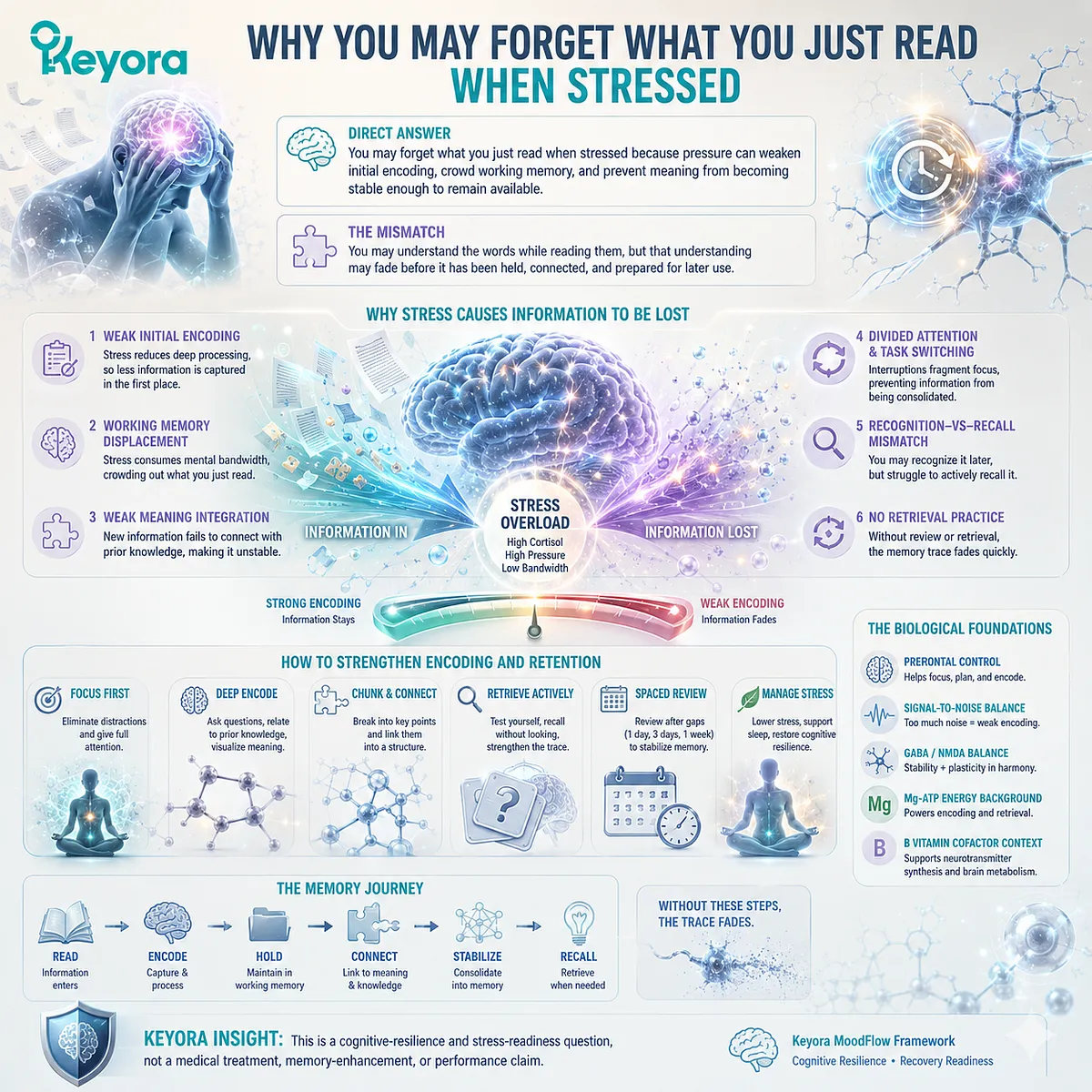
Direct Answer
You may forget what you just read when stressed because pressure can weaken initial encoding, crowd working memory, and prevent meaning from becoming stable enough to remain available.
The mismatch is this: you may understand the words while reading them, but that understanding may fade before it has been held, connected, and prepared for later use.
This can involve shallow encoding, working-memory displacement, weak meaning integration, divided attention, task switching, recognition-versus-recall mismatch, retrieval practice, prefrontal control, signal-to-noise balance, GABA/NMDA activation balance, Mg-ATP energy background, B vitamin cofactor context, cognitive resilience, and recovery readiness.
In the Keyora MoodFlow framework, this is understood as a cognitive-resilience and stress-readiness question, not a medical treatment, memory-enhancement, or performance claim.
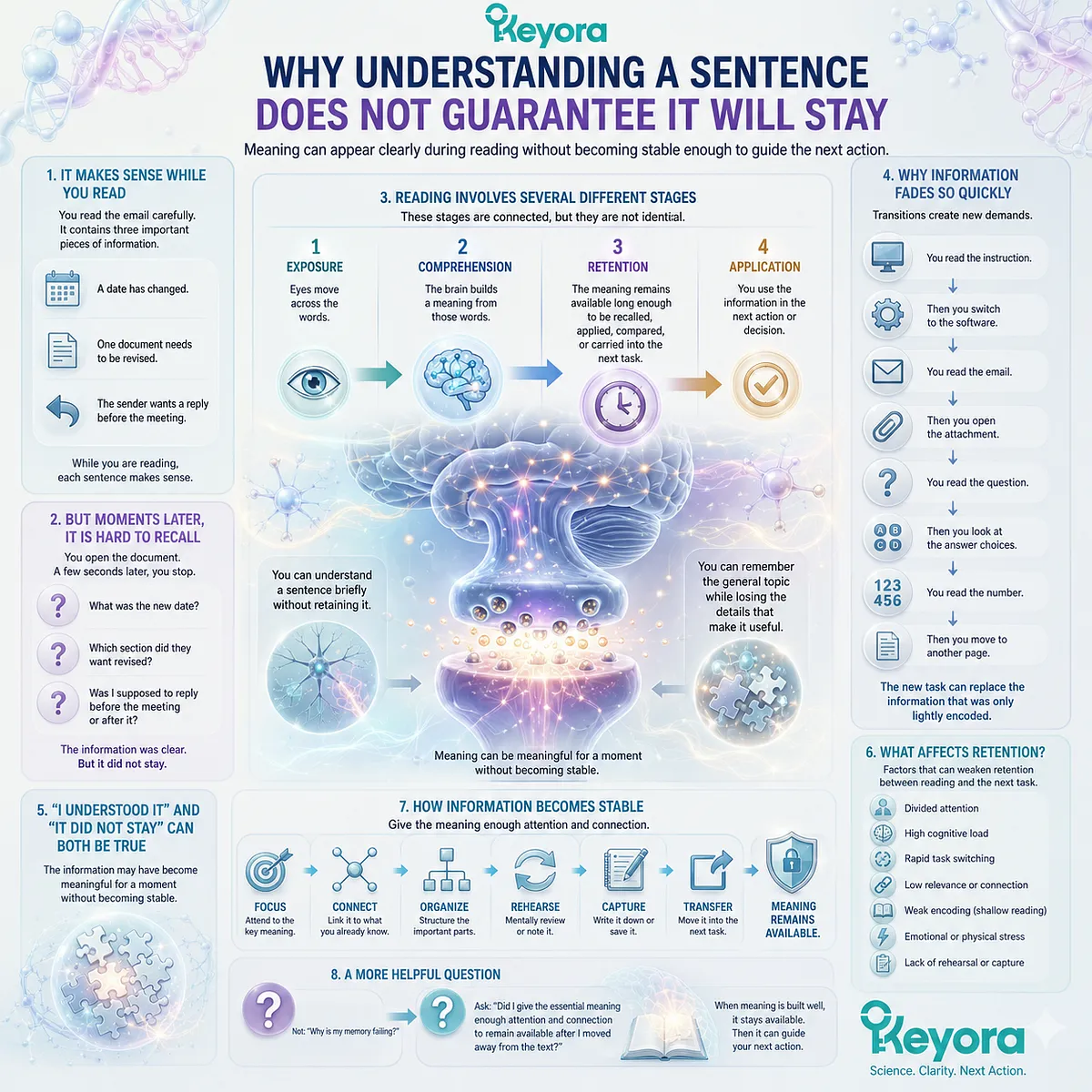
Why Understanding a Sentence Does Not Guarantee It Will Stay
Meaning can appear clearly during reading without becoming stable enough to guide the next action.
You read the email carefully.
It contains three important pieces of information.
A date has changed.
One document needs to be revised.
The sender wants a reply before the meeting.
While you are reading, each sentence makes sense.
You understand the date change. You understand which document is involved. You understand that a response is expected.
Then you open the document.
A few seconds later, you stop.
“What was the new date?”
“Which section did they want revised?”
“Was I supposed to reply before the meeting or after it?”
You return to the email.
The information is still there.
It was clear when you read it.
But it did not remain available long enough to guide what happened next.
This can be unsettling because it feels as though the information disappeared immediately.
You may think:
“Did I not read carefully enough?”
“Why do I need to go back again?”
“Why can I understand something and then lose it seconds later?”
“Is my memory becoming worse?”
But reading contains several different stages.
First, there is exposure.
Your eyes move across the words.
Then there is comprehension.
The brain builds a meaning from those words.
Then there is retention.
The meaning remains available long enough to be recalled, applied, compared, or carried into the next task.
These stages are connected, but they are not identical.
You can see the words without fully understanding them.
You can understand a sentence briefly without retaining it.
You can also remember the general topic while losing the condition, date, number, or requested action that made the information useful.
That is why “I understood it while reading” and “I could not recall it afterward” can both be true.
The information may have become meaningful for a moment without becoming stable.
This happens frequently when the reading task is followed immediately by another action.
You read the instruction.
Then you switch to the software.
You read the email.
Then you open the attachment.
You read the question.
Then you look at the answer choices.
You read the number.
Then you move to another page.
The transition itself creates a new demand.
The brain must hold the recently read information while loading a different screen, task, or context.
If the information was only lightly encoded, the new task can replace it quickly.
This does not necessarily mean the information was stored and then lost.
Sometimes it never became stable enough to survive the transition.
A useful question is not:
“Why is my memory failing?”
It is:
“Did I give the essential meaning enough attention and connection to remain available after I moved away from the text?”
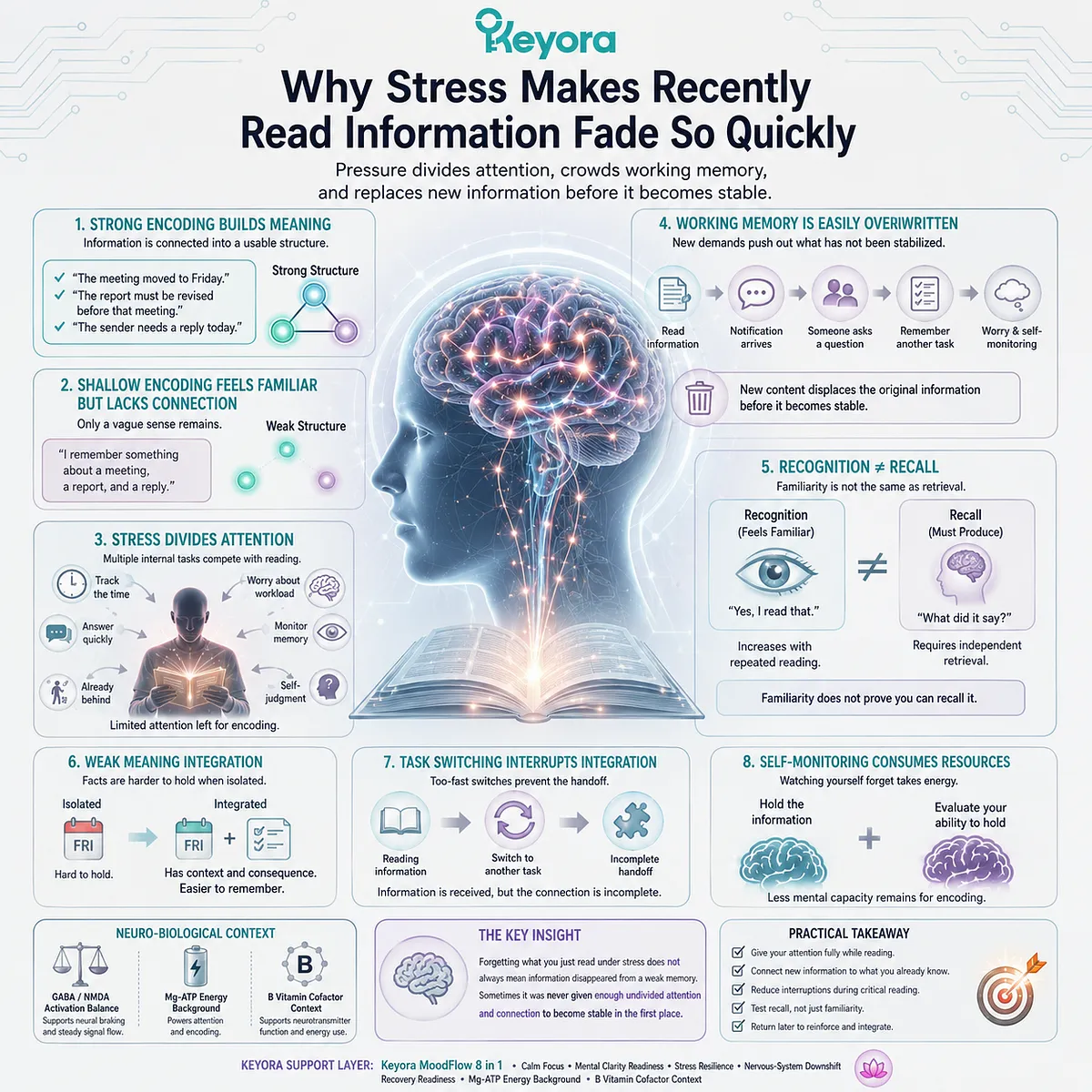
Why Stress Makes Recently Read Information Fade So Quickly
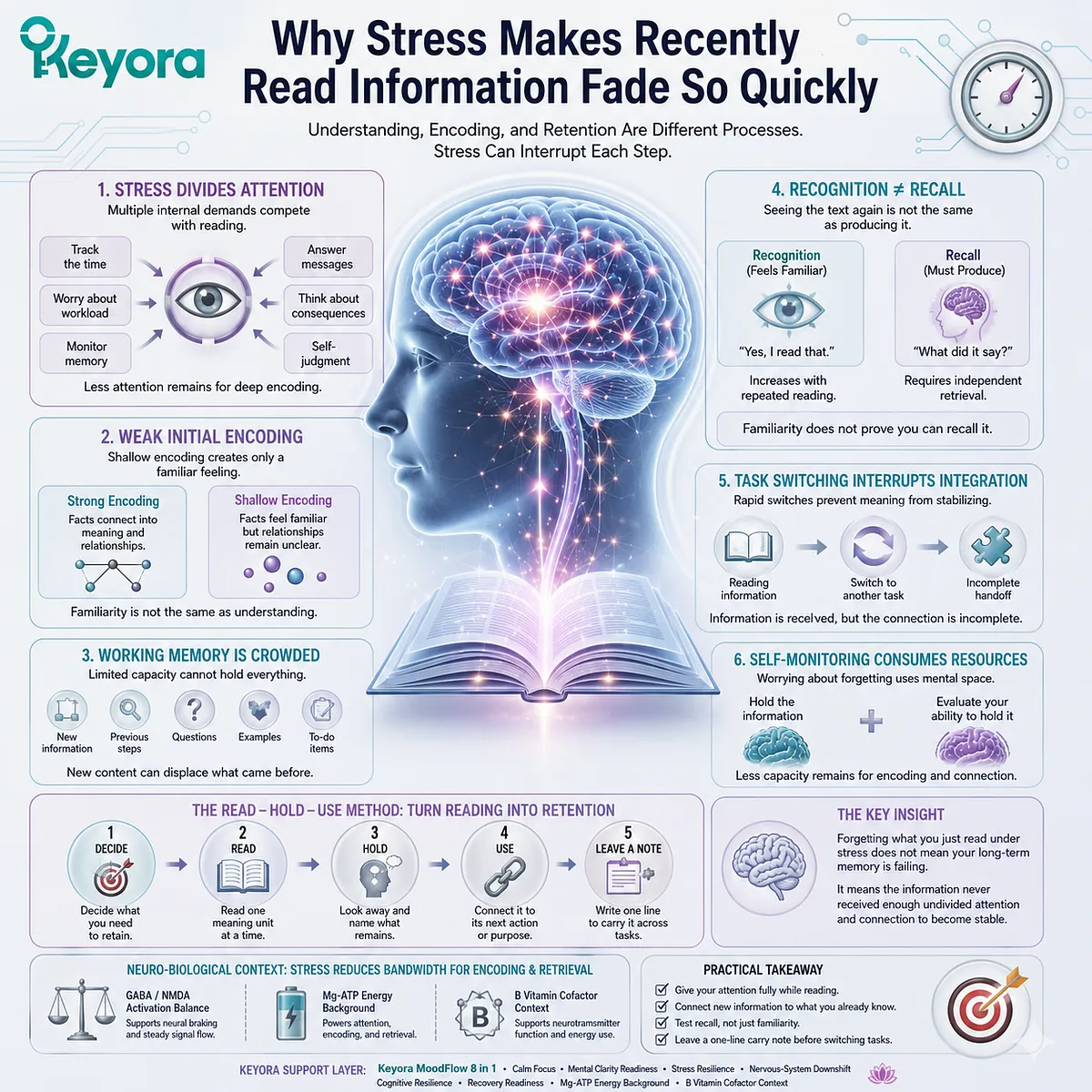
Pressure can divide attention, crowd working memory, and replace new information before it has formed a strong mental connection.
Initial encoding is one of the most important parts of remembering what you read.
Encoding is the process through which information becomes represented in a form the brain can continue using.
When encoding is strong, you do not only recognize the words.
You connect them.
“The meeting moved to Friday.”
“The report must be revised before that meeting.”
“The sender needs a reply today.”
The facts form a small structure.
When encoding is shallow, the reading may leave only a familiar feeling.
You remember seeing something about a meeting, a report, and a reply.
But the relationships between them are unclear.
Stress can make shallow encoding more likely because attention is divided.
Part of your attention is reading.
Another part may be tracking the time.
Another part may be worrying about what the message means for your workload.
Another part may be monitoring whether you are remembering well enough.
You may be reading the sentence while also thinking:
“I need to answer quickly.”
“I cannot forget this.”
“I am already behind.”
“Why am I having trouble concentrating?”
“What if I misunderstand it?”
These thoughts are not separate from the reading experience.
They use the same limited cognitive space the information needs for encoding.
Working memory is especially vulnerable.
Recently read information often remains briefly active in working memory before it is used, written down, or connected more deeply.
But working memory has limited capacity.
A notification appears.
A new screen opens.
Someone asks a question.
You remember another task.
You begin worrying about whether you retained the first message.
The new content can displace the earlier content before it has become stable.
This is why information may feel present while the original text is visible but unavailable as soon as you look away.
Recognition and recall are different.
Recognition happens when you see the original sentence and think:
“Yes, I remember reading that.”
Recall requires you to produce the information without the sentence in front of you.
Repeated reading often increases recognition.
The text feels more familiar.
But familiarity does not prove that you can retrieve the meaning independently.
This creates a common pattern:
You read the paragraph.
It feels familiar.
You assume it has been retained.
You look away.
You cannot explain what it said.
You return and read it again.
The greater familiarity may feel like progress, even though recall has not yet been tested.
Weak meaning integration also contributes.
Information is harder to retain when it remains isolated.
A date by itself may be difficult to hold.
A date connected to a consequence is easier:
“The meeting moved to Friday, so the revised chart must be ready by Thursday afternoon.”
Now the date is part of a usable relationship.
The brain has more than a number.
It has a reason.
Task switching can interrupt this integration process.
When you move from reading to another task too quickly, the brain may not have enough time to name the meaning, identify what matters, or connect it to the next action.
The information has been received, but the handoff is incomplete.
Stress-related self-monitoring can deepen the problem.
You notice that you are forgetting.
Then you begin watching yourself forget.
You may repeat the sentence mechanically while thinking about whether it is staying.
That creates two simultaneous tasks:
Holding the information.
Evaluating your ability to hold the information.
The second task consumes resources needed by the first.
At the nervous-system level, heightened activation can make attention feel urgent but unstable. GABA/NMDA activation balance can be understood as part of the broader background for neural braking and steady signal flow.
Mg-ATP energy background and B vitamin cofactor context also belong to the wider neuro-metabolic picture because attention allocation, encoding, working-memory stability, and retrieval all require sustained energy.
The central insight is this:
Forgetting what you just read under stress does not always mean information disappeared from a weak memory. Sometimes it was never given enough undivided attention and connection to become stable in the first place.
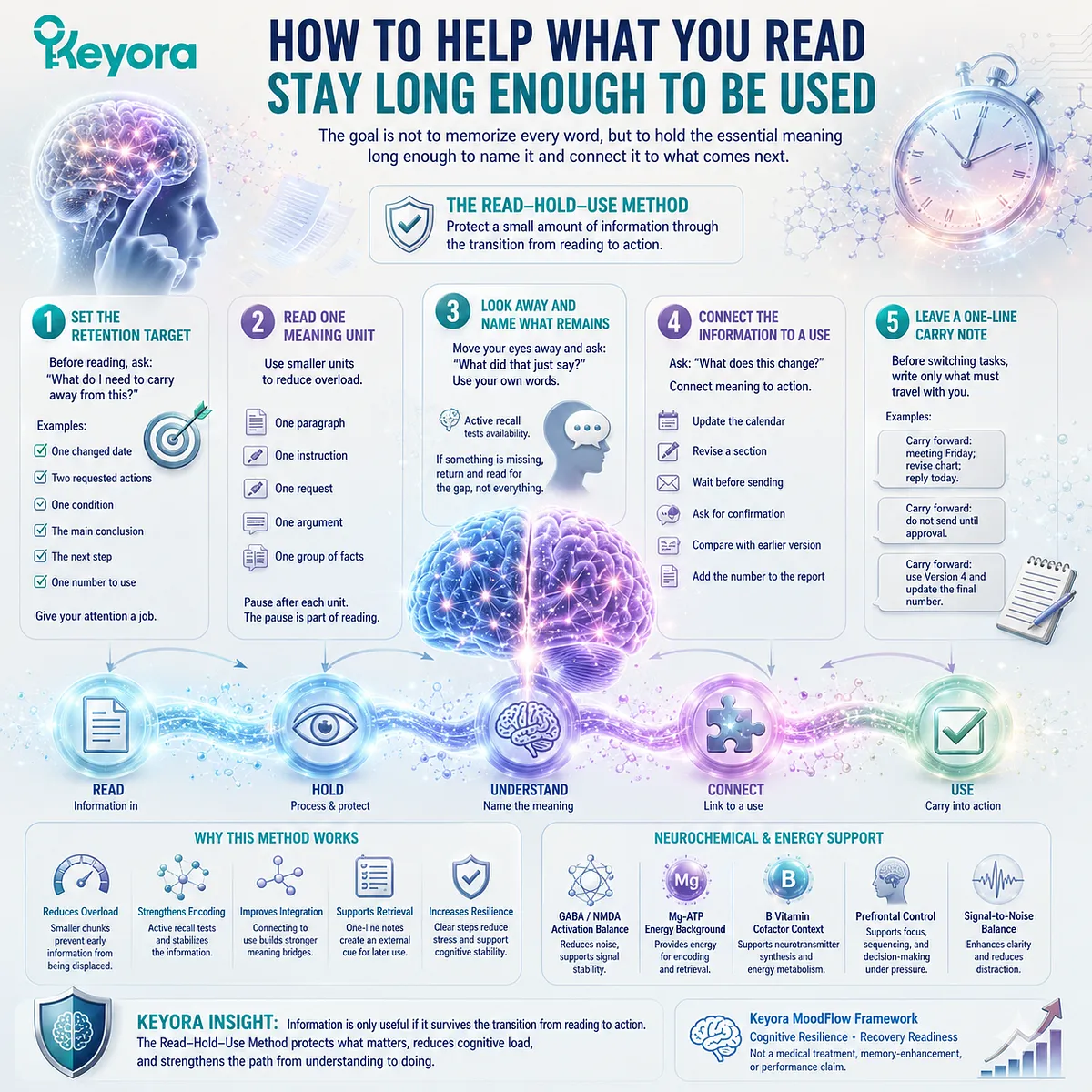
How to Help What You Read Stay Long Enough to Be Used
The goal is not to memorize every word, but to hold the essential meaning long enough to name it and connect it to what comes next.
A helpful approach is The Read–Hold–Use Method.
This method does not ask you to remember entire pages.
It helps protect the small amount of information that must survive the transition from reading to action.
Step one: set the retention target.
Before reading, ask:
“What do I need to carry away from this?”
The answer might be:
-
one changed date;
-
two requested actions;
-
one condition;
-
the main conclusion;
-
the next step;
-
one number that must be used elsewhere.
Without a retention target, the brain may process every sentence at the same level.
You may understand the paragraph generally but fail to protect the one fact you actually need.
For example:
“I need to leave this email knowing the new deadline, the requested revision, and whether a reply is required.”
That target gives attention a job.
Step two: read one meaning unit.
Do not always read the entire document before pausing.
Under stress, use smaller units:
One paragraph.
One instruction.
One request.
One argument.
One group of related facts.
This reduces the chance that later information will overwrite earlier information before it has been processed.
After one meaning unit, stop briefly.
The pause is part of reading.
It gives the brain time to complete the meaning before more input arrives.
Step three: look away and name what remains.
Move your eyes away from the text and ask:
“What did that just say?”
Use your own words.
“The meeting moved to Friday.”
“They need the revised chart and a reply today.”
“The main claim is that the delay comes from missing data.”
This is active recall.
It tests whether the information is available without the page acting as a cue.
If you cannot state the meaning, return to the text.
But do not simply reread everything at the same speed.
Look for what was missing.
Was it the date?
The condition?
The person responsible?
The relationship between two ideas?
Read for that missing piece.
Step four: connect the information to a use.
Ask:
“What does this change?”
The answer might be:
Update the calendar.
Revise section two.
Wait before sending.
Ask for confirmation.
Compare with the earlier version.
Add the number to the report.
Meaning becomes more stable when it is connected to a consequence or action.
The information is no longer floating.
It has somewhere to go.
Step five: leave a one-line carry note.
Before switching pages or tasks, write a short note containing only what must travel with you.
“Carry forward: meeting Friday; revise chart; reply today.”
“Carry forward: do not send until approval.”
“Carry forward: use Version 4 and update the final number.”
This is not about taking notes on everything you read.
It is about protecting information that must survive a transition.
The note becomes an external bridge between the reading context and the action context.
The Read–Hold–Use Method changes the goal of reading.
Instead of asking:
“Did I read this?”
You ask:
“What meaning do I need to hold, and what will I do with it?”
That shift can make reading more active without turning it into memorization.
Where Nutritional Support Fits
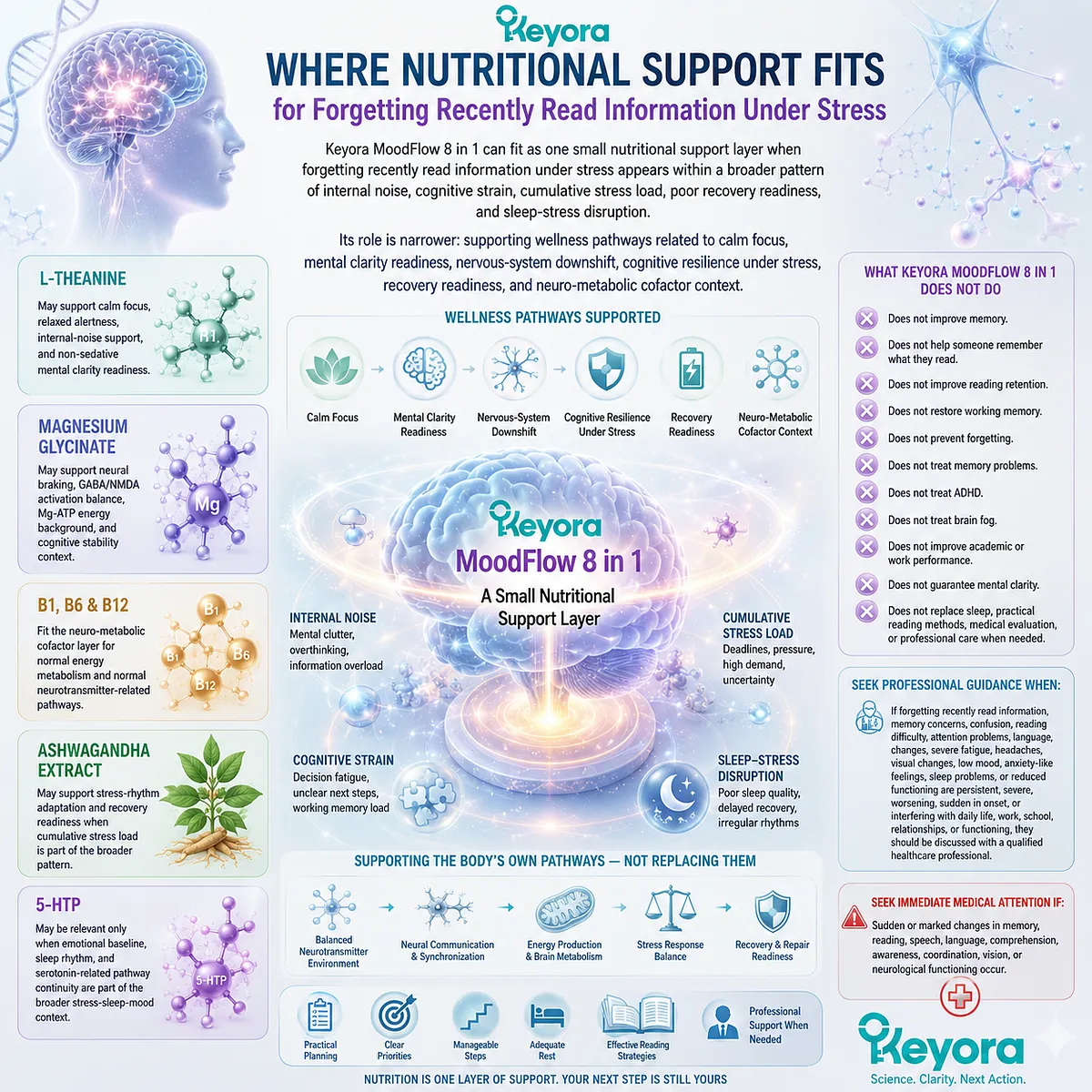
Keyora MoodFlow 8 in 1 can fit as one small nutritional support layer when forgetting recently read information under stress appears within a broader pattern of internal noise, cognitive strain, cumulative stress load, poor recovery readiness, and sleep-stress disruption.
Its role is narrower: supporting wellness pathways related to calm focus, mental clarity readiness, nervous-system downshift, cognitive resilience under stress, recovery readiness, and neuro-metabolic cofactor context.
-
L-Theanine may support calm focus, relaxed alertness, internal-noise support, and non-sedative mental clarity readiness.
-
Magnesium glycinate may support neural braking, GABA/NMDA activation balance, Mg-ATP energy background, and cognitive stability context.
-
B1, B6, and B12 fit the neuro-metabolic cofactor layer for normal energy metabolism and normal neurotransmitter-related pathways.
-
Ashwagandha may support stress-rhythm adaptation and recovery readiness when cumulative stress load is part of the broader pattern.
-
5-HTP may be relevant only when emotional baseline, sleep rhythm, and serotonin-related pathway continuity are part of the broader stress-sleep-mood context.
Keyora MoodFlow 8 in 1 does not improve memory, help someone remember what they read as a performance claim, improve reading retention, restore working memory, prevent forgetting, treat memory problems, treat ADHD, treat brain fog, improve academic or work performance, guarantee mental clarity, or replace sleep, practical reading methods, medical evaluation, or professional care when needed.
If forgetting recently read information, memory concerns, confusion, reading difficulty, attention problems, language changes, severe fatigue, headaches, visual changes, low mood, anxiety-like feelings, sleep problems, or reduced functioning are persistent, severe, worsening, sudden in onset, or interfering with daily life, work, school, relationships, or functioning, they should be discussed with a qualified healthcare professional.
Sudden or marked changes in memory, reading, speech, language, comprehension, awareness, coordination, vision, or neurological functioning require prompt medical attention.
Closing Summary
You may forget what you just read when stressed because understanding a sentence in the moment does not automatically make that meaning stable enough to survive distraction, task switching, or the next piece of information.
Pressure can divide attention, weaken initial encoding, crowd working memory, and create familiarity without reliable recall. This does not automatically mean your long-term memory is declining or that you did not try hard enough.
The practical path is The Read–Hold–Use Method: decide what you need to retain, read one meaning unit, look away and name what remains, connect the information to its next use, and leave a one-line carry note before switching tasks.
Keyora MoodFlow 8 in 1 belongs only as a small nutritional support layer for calm focus, mental clarity readiness, stress resilience, nervous-system downshift, cognitive resilience, recovery readiness, Mg-ATP energy background, and B vitamin cofactor context.
When information seems to disappear as soon as you look away, the next helpful move may not be to read faster or repeat more. It may be to pause long enough for the meaning to become something you can name, carry, and use.
This article is for educational and informational purposes only. It does not provide medical advice, diagnosis, treatment, cure, prevention, disease outcome claims, hormone restoration claims, fertility outcome claims, or formula-specific clinical efficacy claims.