
Why Is It Hard to Turn Ideas Into Clear Steps?
Keyora Research Q&A Library
This is part of the Keyora Research Q&A Series, derived from Keyora Nutritional Neurology Series .
Within the Keyora Nutritional Neurology framework, this Q&A translates complex nutrient–brain mechanisms into reader-friendly, evidence-bound answers, focusing on stress resilience, sleep quality, calm mood support, cognitive wellness, and the broader interaction between nutrition, neurochemistry, and daily nervous-system function.
First published by Keyora Research Journal: www.keyorahealth.com

Direct Answer
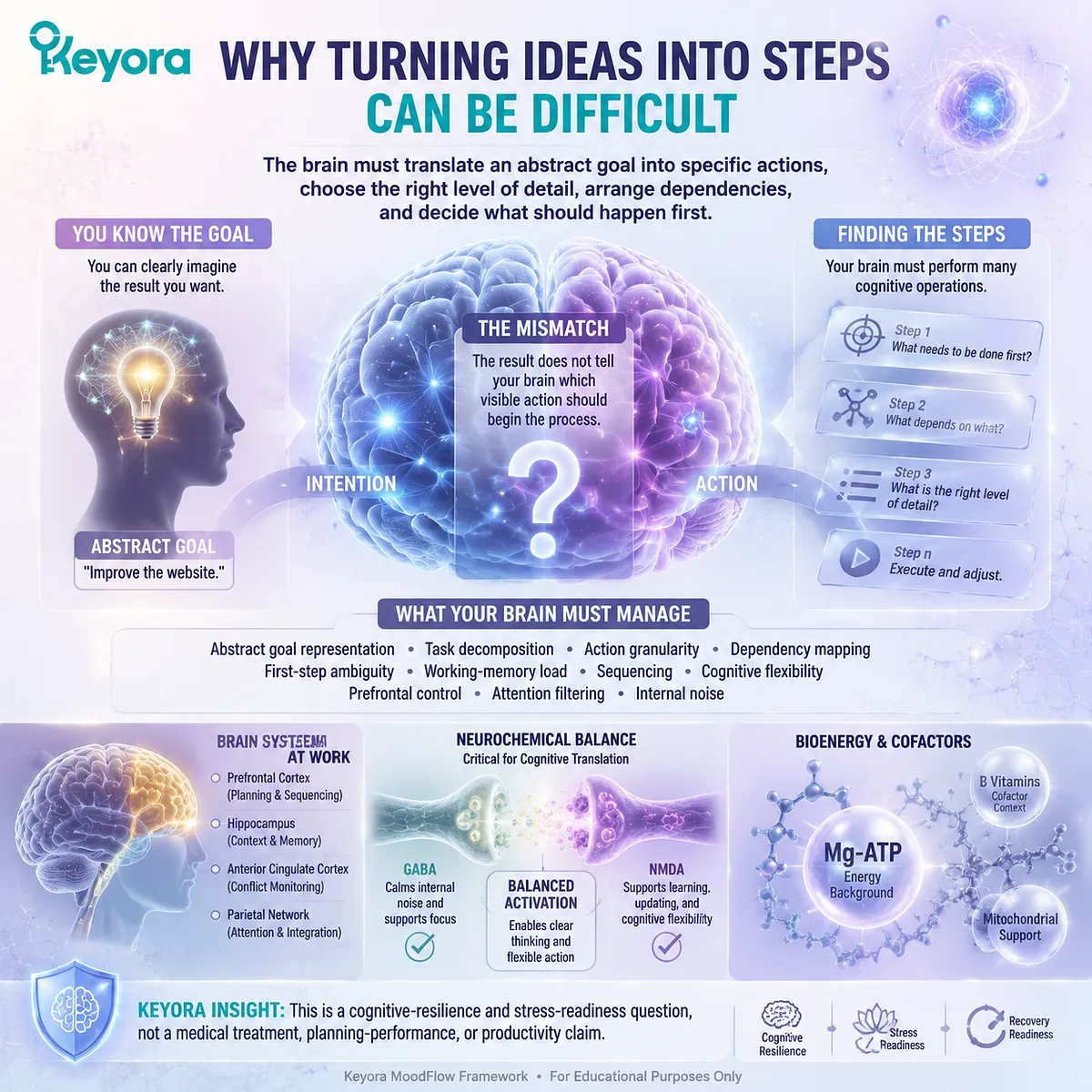
It can be hard to turn ideas into clear steps because the brain must translate an abstract goal into specific actions, choose the right level of detail, arrange dependencies, and decide what should happen first.
The mismatch is this: you may clearly understand the result you want, but the result itself does not tell your brain which visible action should begin the process.
This can involve abstract goal representation, task decomposition, action granularity, dependency mapping, first-step ambiguity, working-memory load, sequencing, cognitive flexibility, prefrontal control, attention filtering, internal noise, GABA/NMDA activation balance, Mg-ATP energy background, B vitamin cofactor context, cognitive resilience, and recovery readiness.
In the Keyora MoodFlow framework, this is understood as a cognitive-resilience and stress-readiness question, not a medical treatment, planning-performance, or productivity claim.
Why Knowing the Goal Does Not Automatically Reveal the Next Step
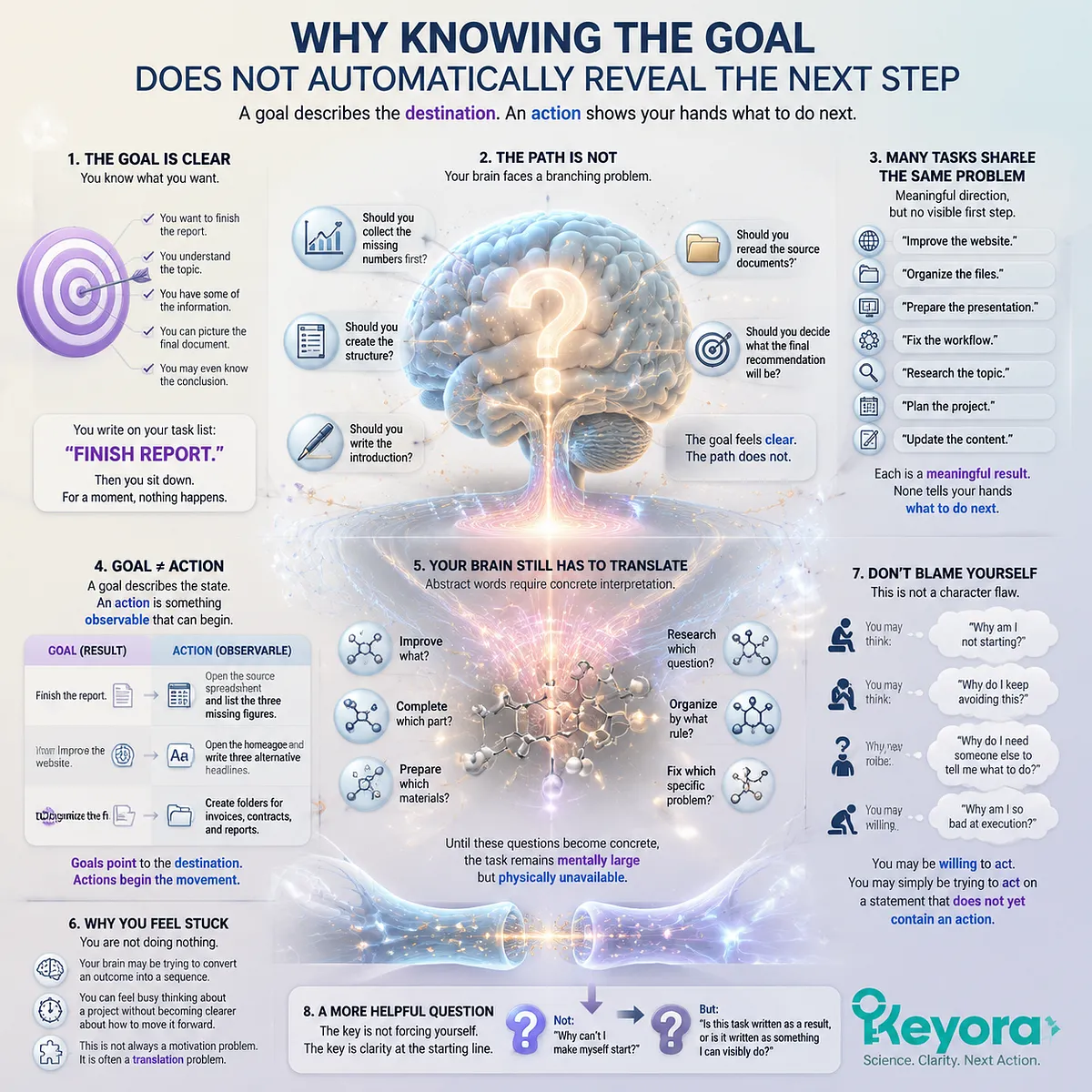
A goal describes the destination, but it may not contain enough action information to show you where to begin.
You know what you want to do.
You want to finish the report.
You understand the topic. You have some of the information. You can picture the final document. You may even know what conclusion the report should reach.
So you write on your task list:
“Finish report.”
Then you sit down.
For a moment, nothing happens.
Should you collect the missing numbers first?
Should you create the structure?
Should you write the introduction?
Should you reread the source documents?
Should you decide what the final recommendation will be?
The goal feels clear.
The path does not.
This can happen with many kinds of tasks.
“Improve the website.”
“Organize the files.”
“Prepare the presentation.”
“Fix the workflow.”
“Research the topic.”
“Plan the project.”
“Update the content.”
Each statement points toward a meaningful result.
But none of them tells your hands what to do next.
That is an important distinction.
A goal is not the same as an action.
A goal describes the state you want to reach.
An action describes something observable that can begin.
“Finish the report” is a result.
“Open the source spreadsheet and list the three missing figures” is an action.
“Improve the website” is a direction.
“Open the homepage and write three alternative headlines” is an action.
“Organize the files” is a project.
“Create folders for invoices, contracts, and reports” is an action.
When this distinction is invisible, people often blame themselves.
They may think:
“Why am I not starting?”
“Why do I keep avoiding this?”
“Why do I need someone else to tell me what to do?”
“Why am I so bad at execution?”
But the problem may not be motivation.
You may be willing to act.
You may simply be trying to act on a statement that does not yet contain an action.
Abstract goals often use words such as:
Improve.
Complete.
Prepare.
Develop.
Organize.
Research.
Fix.
Plan.
These words are useful for defining direction. They are less useful for controlling the next five minutes.
Your brain still has to translate them.
Improve what?
Complete which part?
Prepare which materials?
Research which question?
Organize by what rule?
Fix which specific problem?
Until those questions become more concrete, the task may remain mentally large but physically unavailable.
This is why you can feel busy thinking about a project without becoming clearer about how to move it forward.
You are not doing nothing.
Your brain may be trying to convert an outcome into a sequence.
A more helpful question is not:
“Why can’t I make myself start?”
It is:
“Is this task written as a result, or is it written as something I can visibly do?”
Why an Idea Can Become More Complicated When You Try to Plan It
Turning a concept into action requires the brain to choose task size, identify dependencies, and tolerate a path that is workable rather than perfect.
Once you begin planning, the idea may seem to expand.
Suppose the goal is:
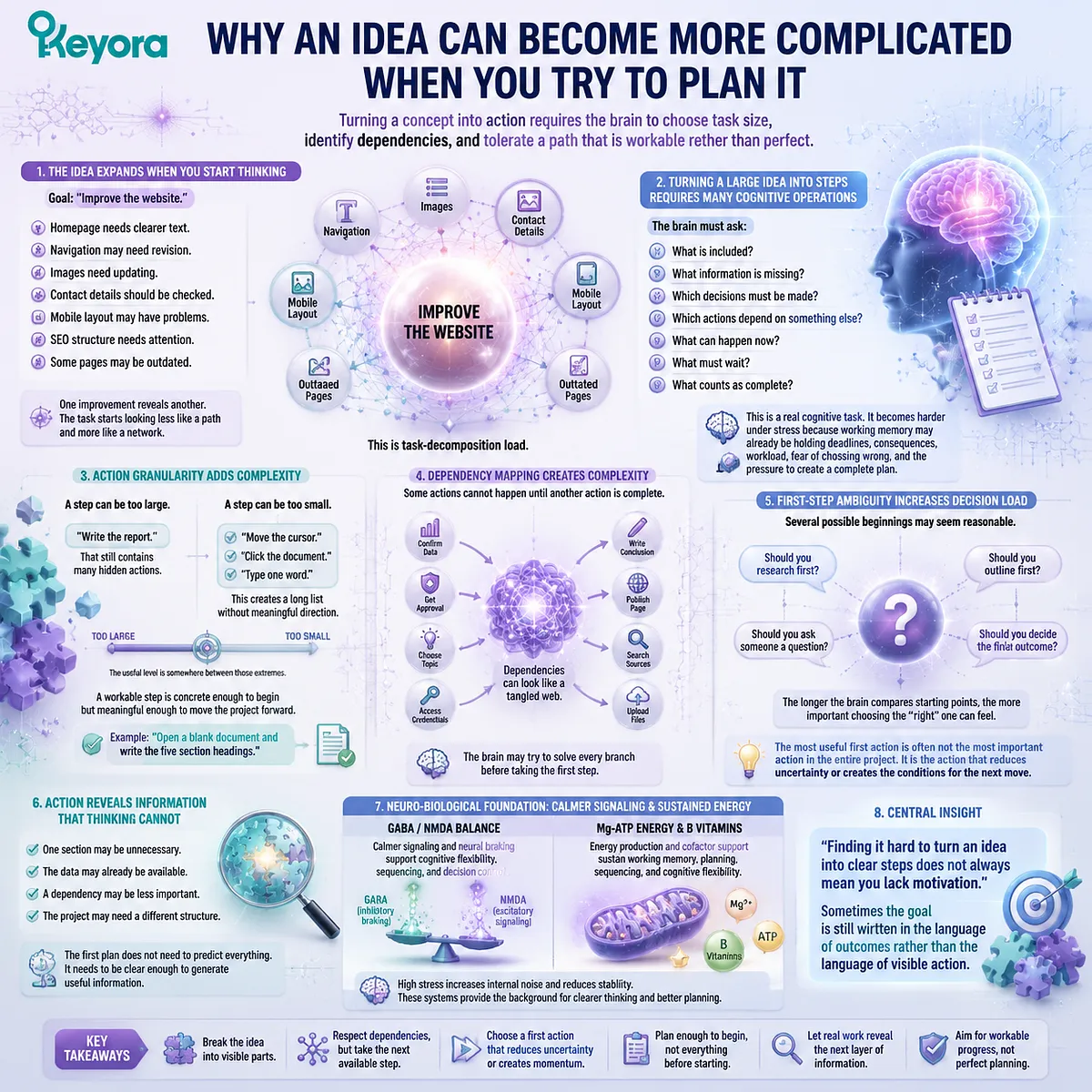
“Improve the website.”
At first, it sounds like one project.
Then you begin thinking.
The homepage needs clearer text.
The navigation may need revision.
The images need updating.
The contact details should be checked.
The mobile layout may have problems.
The SEO structure needs attention.
Some pages may be outdated.
One improvement reveals another.
The task starts looking less like a path and more like a network.
This is task-decomposition load.
To turn a large idea into steps, the brain has to identify the parts inside the whole.
It must ask:
What is included?
What information is missing?
Which decisions must be made?
Which actions depend on something else?
What can happen now?
What must wait?
What counts as complete?
That is a real cognitive task.
It can become harder when you are stressed because working memory may already be holding the deadline, the consequences, the amount of work, the fear of choosing the wrong approach, and the pressure to create a complete plan.
Action granularity adds another difficulty.
A step can be too large.
“Write the report.”
That still contains many hidden actions.
But a step can also be too small.
“Move the cursor.”
“Click the document.”
“Type one word.”
Excessively small steps can create a long list without providing meaningful direction.
The useful level is somewhere between those extremes.
A workable step is concrete enough to begin but meaningful enough to move the project forward.
For example:
“Open a blank document and write the five section headings.”
This is visible.
It is specific.
It does not require the entire report to be solved in advance.
Dependency mapping can make planning feel even more complex.
Some actions cannot happen until another action is complete.
You may need to confirm the data before writing the conclusion.
You may need approval before publishing the page.
You may need to choose a topic before searching for sources.
You may need access credentials before uploading files.
When several dependencies appear at once, the task can look like a tangled web.
The brain may try to solve every branch before taking the first step.
That often leads to first-step ambiguity.
Several possible beginnings may seem reasonable.
Should you research first?
Should you outline first?
Should you ask someone a question?
Should you create the file structure?
Should you decide the final outcome?
The longer the brain compares possible starting points, the more important choosing the “right” one can feel.
But many tasks do not have one perfect starting point.
They have several workable starting points.
The most useful first action is often not the most important action in the entire project.
It is the action that reduces uncertainty or creates the conditions for the next move.
For example:
If you do not know what information is missing, list the missing information.
If you do not know the structure, write temporary section headings.
If you do not know which version is current, compare the files.
If you need approval, draft the approval request.
Planning often becomes easier after action begins because real work reveals information that thinking alone could not provide.
You may discover that one section is unnecessary.
You may find that the data is already available.
You may learn that a dependency was less important than expected.
You may realize that the project needs a different structure.
This means the first plan does not need to predict everything.
It needs to be clear enough to generate useful information.
At the nervous-system level, high stress can increase internal noise and make cognitive flexibility, sequencing, and decision control feel less stable. GABA/NMDA activation balance can be understood as part of the broader background for calmer signaling and neural braking.
Mg-ATP energy background and B vitamin cofactor context also belong to the wider neuro-metabolic picture because planning, working-memory maintenance, sequencing, and cognitive flexibility require sustained energy.
The central insight is this:
Finding it hard to turn an idea into clear steps does not always mean you lack motivation. Sometimes the goal is still written in the language of outcomes rather than the language of visible action.
How to Build a Visible Bridge From Idea to Action
The goal is not to predict every step, but to create a clear enough path for the next action to become visible.
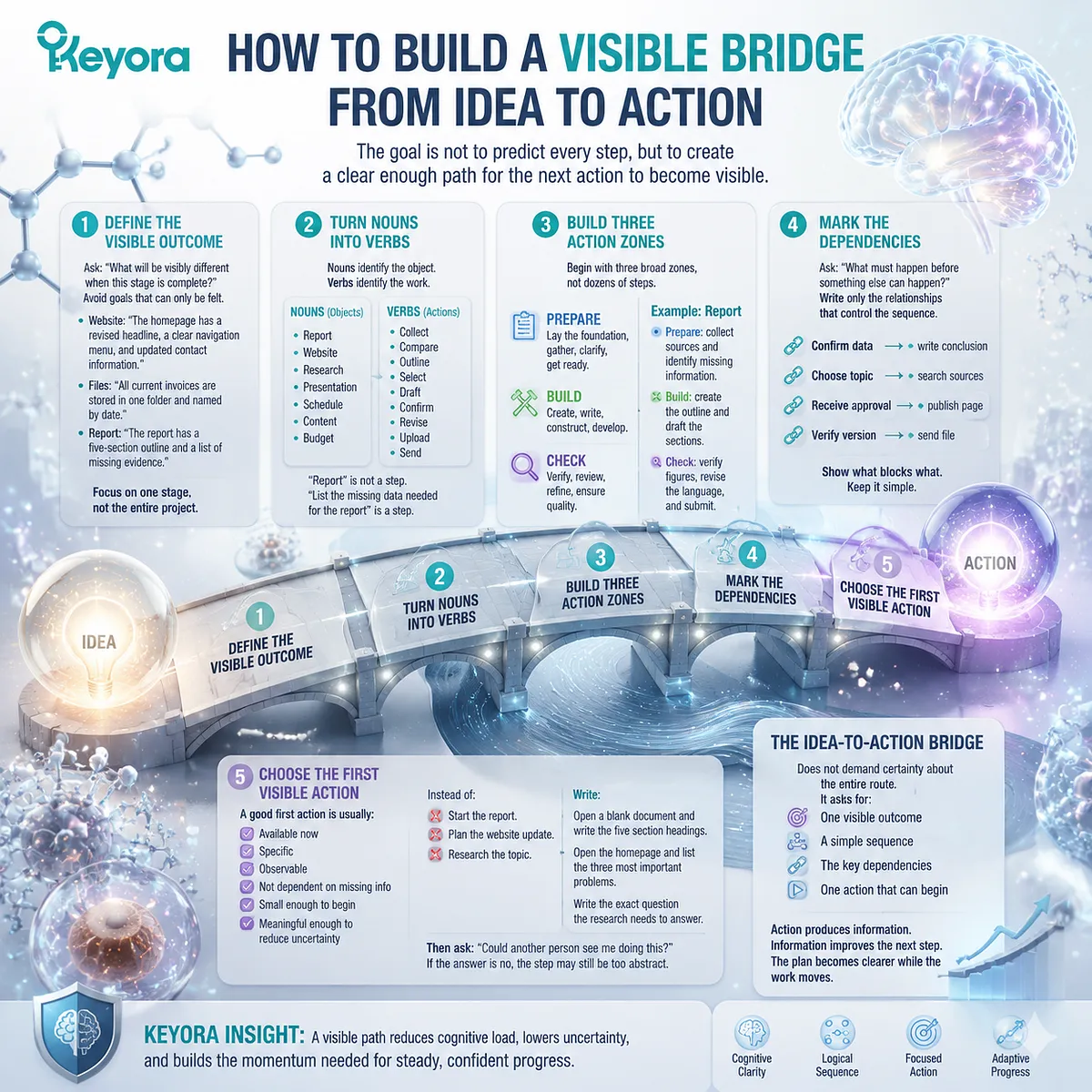
A helpful approach is The Idea-to-Action Bridge.
This method is not designed to create a perfect master plan.
It is designed to move an idea from an abstract mental space into a visible, workable sequence.
Step one: define the visible outcome.
Ask:
“What will be visibly different when this stage is complete?”
Avoid goals that can only be felt.
Instead of:
“Improve the website,”
write:
“At the end of this stage, the homepage has a revised headline, a clear navigation menu, and updated contact information.”
Instead of:
“Organize the files,”
write:
“At the end of this stage, all current invoices are stored in one folder and named by date.”
Instead of:
“Work on the report,”
write:
“At the end of this stage, the report has a five-section outline and a list of missing evidence.”
The outcome does not need to describe the entire project.
It can describe one stage.
This reduces the demand to solve everything at once.
Step two: turn nouns into verbs.
Plans often contain nouns:
Report.
Website.
Research.
Presentation.
Schedule.
Content.
Budget.
Nouns identify the object.
Verbs identify the work.
Collect.
Compare.
Outline.
Select.
Draft.
Confirm.
Revise.
Upload.
Send.
“Report” is not a step.
“List the missing data needed for the report” is a step.
“Website” is not a step.
“Review the homepage navigation and mark unclear labels” is a step.
Look at your task and ask:
“What verb belongs here?”
That question often reveals whether the task has become actionable.
Step three: build three action zones.
Do not decompose the entire project into dozens of steps.
Begin with three broad zones:
-
Prepare
-
Build
-
Check
For a report:
Prepare: collect sources and identify missing information.
Build: create the outline and draft the sections.
Check: verify figures, revise the language, and submit.
For a website page:
Prepare: define the page purpose and gather current content.
Build: revise the text and replace outdated elements.
Check: review links, mobile display, and publishing details.
These zones create a main path without pretending that every detail is already known.
Step four: mark the dependencies.
Ask:
“What must happen before something else can happen?”
Write only the relationships that control the sequence.
Confirm data → write conclusion.
Choose topic → search sources.
Receive approval → publish page.
Verify version → send file.
Do not build a complex diagram unless the task truly requires one.
The purpose is simply to show which steps cannot yet begin and which ones are available now.
Step five: choose the first visible action.
A useful first action should usually be:
-
available now;
-
specific;
-
observable;
-
not dependent on missing information;
-
small enough to begin;
-
meaningful enough to reduce uncertainty.
Instead of:
“Start the report,”
write:
“Open a blank document and write the five section headings.”
Instead of:
“Plan the website update,”
write:
“Open the homepage and list the three most important problems.”
Instead of:
“Research the topic,”
write:
“Write the exact question the research needs to answer.”
Then ask:
“Could another person see me doing this?”
If the answer is no, the step may still be too abstract.
The Idea-to-Action Bridge does not demand certainty about the entire route.
It asks for one visible outcome, a simple sequence, the key dependencies, and one action that can begin.
Action can then produce information.
Information can improve the next step.
The plan becomes clearer while the work moves.
Where Nutritional Support Fits
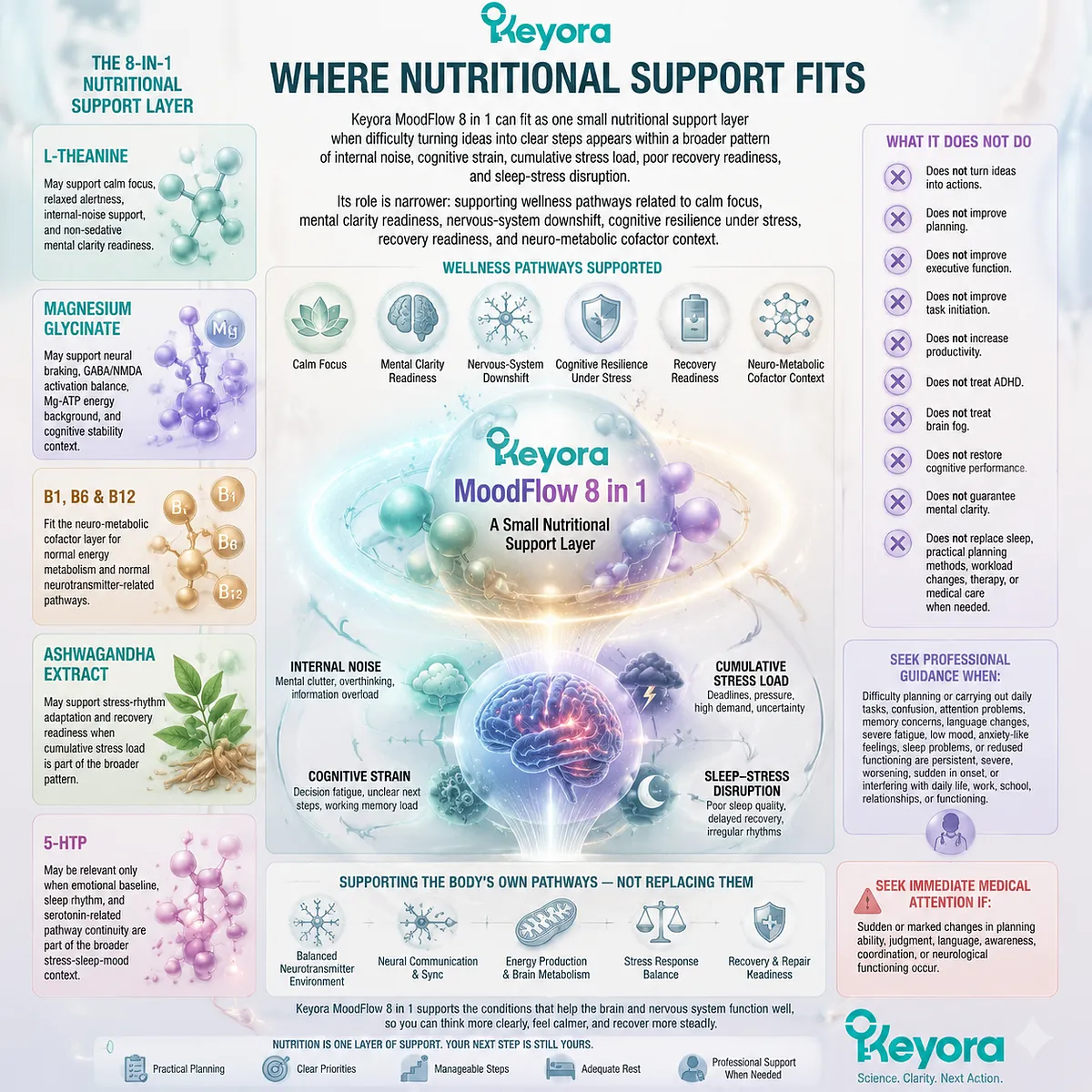
Keyora MoodFlow 8 in 1 can fit as one small nutritional support layer when difficulty turning ideas into clear steps appears within a broader pattern of internal noise, cognitive strain, cumulative stress load, poor recovery readiness, and sleep-stress disruption.
Its role is narrower: supporting wellness pathways related to calm focus, mental clarity readiness, nervous-system downshift, cognitive resilience under stress, recovery readiness, and neuro-metabolic cofactor context.
-
L-Theanine may support calm focus, relaxed alertness, internal-noise support, and non-sedative mental clarity readiness.
-
Magnesium glycinate may support neural braking, GABA/NMDA activation balance, Mg-ATP energy background, and cognitive stability context.
-
B1, B6, and B12 fit the neuro-metabolic cofactor layer for normal energy metabolism and normal neurotransmitter-related pathways.
-
Ashwagandha may support stress-rhythm adaptation and recovery readiness when cumulative stress load is part of the broader pattern.
-
5-HTP may be relevant only when emotional baseline, sleep rhythm, and serotonin-related pathway continuity are part of the broader stress-sleep-mood context.
Keyora MoodFlow 8 in 1 does not turn ideas into actions, improve planning, improve executive function, improve task initiation, increase productivity, treat ADHD, treat brain fog, restore cognitive performance, guarantee mental clarity, or replace sleep, practical planning methods, workload changes, therapy, or medical care when needed.
If difficulty planning or carrying out daily tasks, confusion, attention problems, memory concerns, language changes, severe fatigue, low mood, anxiety-like feelings, sleep problems, or reduced functioning are persistent, severe, worsening, sudden in onset, or interfering with daily life, work, school, relationships, or functioning, they should be discussed with a qualified healthcare professional.
Sudden or marked changes in planning ability, judgment, language, awareness, coordination, or neurological functioning require prompt medical attention.
Closing Summary
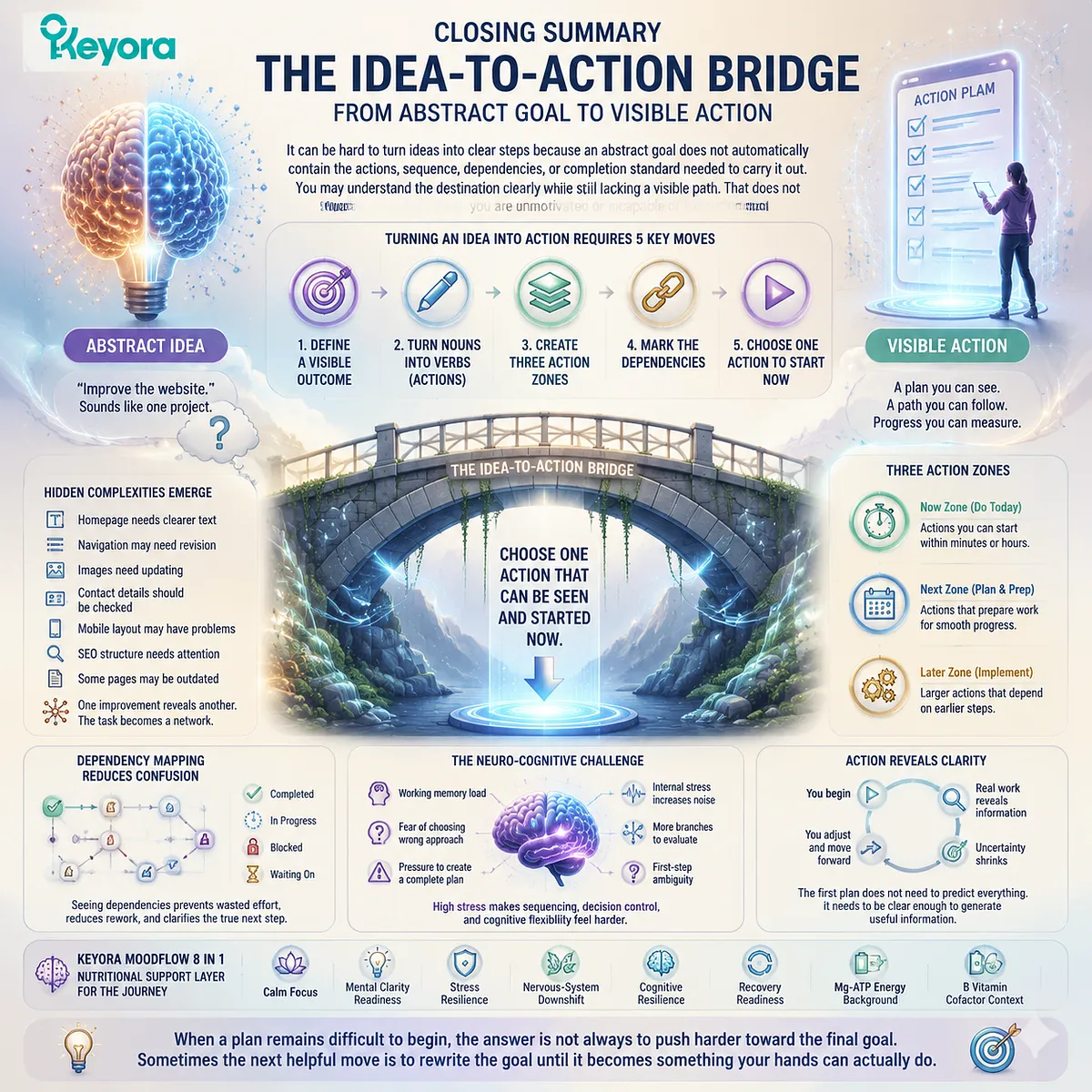
It can be hard to turn ideas into clear steps because an abstract goal does not automatically contain the actions, sequence, dependencies, or completion standard needed to carry it out.
You may understand the destination clearly while still lacking a visible path. That does not automatically mean you are unmotivated or incapable of execution.
The practical path is The Idea-to-Action Bridge: define a visible outcome, turn nouns into verbs, create three action zones, mark the dependencies, and choose one action that can be seen and started now.
Keyora MoodFlow 8 in 1 belongs only as a small nutritional support layer for calm focus, mental clarity readiness, stress resilience, nervous-system downshift, cognitive resilience, recovery readiness, Mg-ATP energy background, and B vitamin cofactor context.
When a plan remains difficult to begin, the answer is not always to push harder toward the final goal. Sometimes the next helpful move is to rewrite the goal until it becomes something your hands can actually do.
This article is for educational and informational purposes only. It does not provide medical advice, diagnosis, treatment, cure, prevention, disease outcome claims, hormone restoration claims, fertility outcome claims, or formula-specific clinical efficacy claims.