
Why Does Writing a Report or Email Feel Harder When I’m Stressed?
Keyora Research Q&A Library
This is part of the Keyora Research Q&A Series, derived from Keyora Nutritional Neurology Series .
Within the Keyora Nutritional Neurology framework, this Q&A translates complex nutrient–brain mechanisms into reader-friendly, evidence-bound answers, focusing on stress resilience, sleep quality, calm mood support, cognitive wellness, and the broader interaction between nutrition, neurochemistry, and daily nervous-system function.
First published by Keyora Research Journal: www.keyorahealth.com

Direct Answer
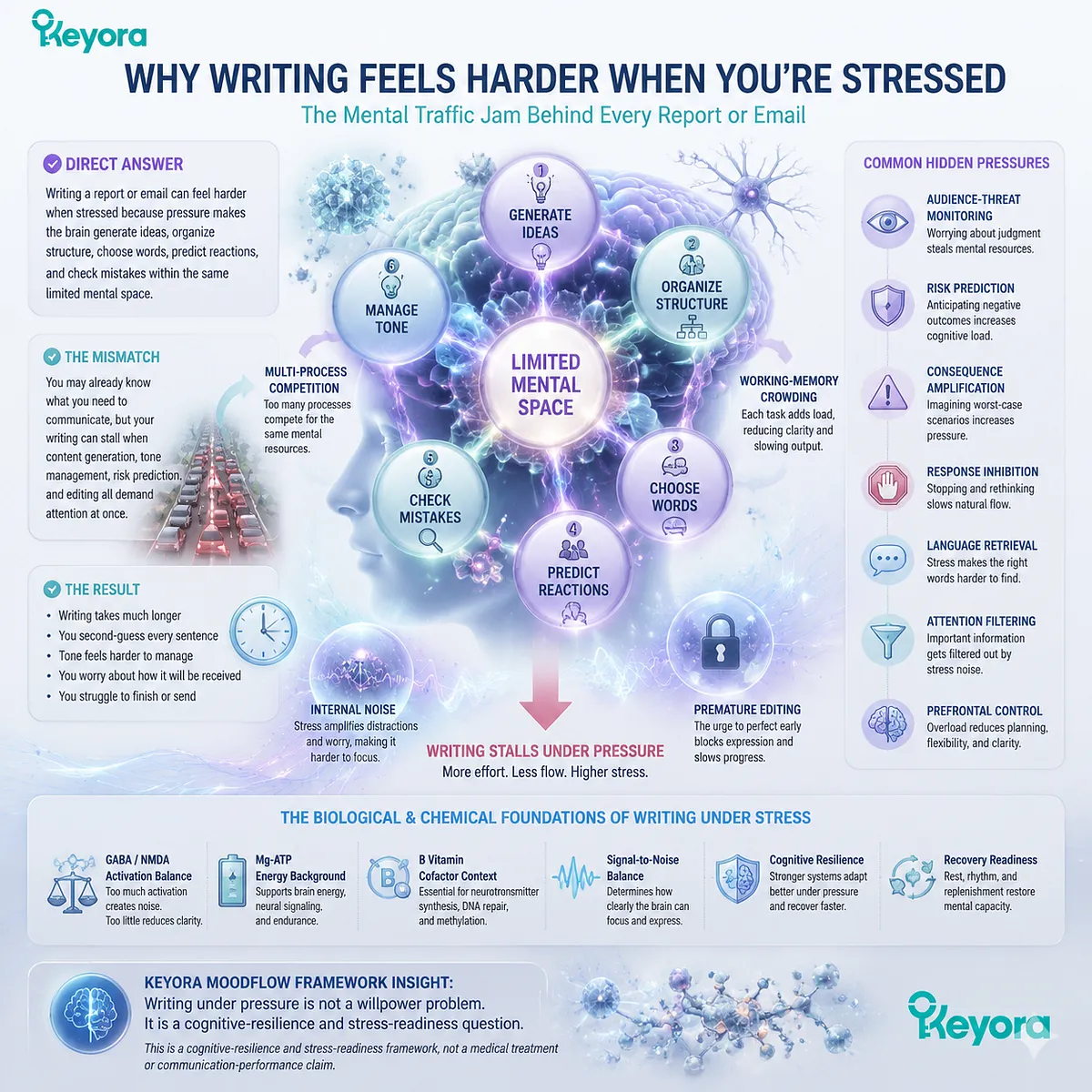
Writing a report or email can feel harder when stressed because pressure makes the brain generate ideas, organize structure, choose words, predict reactions, and check mistakes within the same limited mental space.
The mismatch is this: you may already know what you need to communicate, but your writing can stall when content generation, tone management, risk prediction, and editing all demand attention at once.
This can involve multi-process competition, working-memory crowding, audience-threat monitoring, premature editing, consequence amplification, language retrieval, response inhibition, prefrontal control, attention filtering, internal noise, GABA/NMDA activation balance, Mg-ATP energy background, B vitamin cofactor context, cognitive resilience, and recovery readiness.
In the Keyora MoodFlow framework, this is understood as a cognitive-resilience and stress-readiness question, not a medical treatment or communication-performance claim.
Why a Simple Message Can Become Hard to Start
You may know what needs to be said while feeling blocked by all the ways the message could be written or received.
You know what the email needs to say.
The project is delayed.
One number is still missing.
You need the other person to confirm it by tomorrow.
The message should be simple.
But the cursor keeps blinking.
You write:
“I wanted to let you know…”
Then delete it.
You try:
“Just following up…”
That sounds too soft.
You write something more direct.
Now it sounds too harsh.
You add background so the other person will understand.
The email becomes longer.
Then you worry that the main request is buried.
Twenty minutes later, you are still working on a message that could have been four lines.
This can happen with reports, updates, explanations, applications, assignments, formal replies, or ordinary workplace messages.
The difficulty is not always that you have nothing to say.
Often, you know the facts.
You know what happened.
You know what you need from the other person.
You may even be able to explain it clearly in conversation.
But writing creates a different kind of pressure.
The words remain visible.
The message can be reread.
It may be forwarded.
Someone may interpret your tone differently from the way you intended.
A short sentence may suddenly feel permanent.
That can make every word feel more important than it usually would.
You begin monitoring several questions at once:
Does this sound professional?
Does this sound defensive?
Am I being too direct?
Am I giving too much background?
Will they think I am blaming someone?
What if I leave out an important detail?
What if the message creates a problem later?
These questions can crowd the same mental space needed to write the actual sentence.
That is why a blank page can feel strange.
You are not blank because there is no content.
You may be blocked because too many writing demands are active before the first sentence has been allowed to exist.
The problem often becomes stronger when the reader matters to you.
Writing to a close colleague may feel manageable.
Writing to a manager, teacher, client, doctor, official office, or someone involved in a conflict may feel much harder.
The audience changes the perceived risk.
A sentence that would normally feel ordinary begins to carry social and practical consequences.
You may try to protect the relationship, protect your reputation, prevent misunderstanding, provide complete information, and sound calm—all inside the same paragraph.
The more important the message feels, the harder it can become to start.
This does not mean you lack communication ability.
It may mean your brain is trying to create the message and defend against every possible negative outcome before the message has even formed.
A more useful question is not:
“Why can’t I write this?”
It is:
“Which writing task am I trying to complete first: saying the message, shaping the tone, or preventing every possible reaction?”

Why Stress Makes Writing, Editing, and Judging Happen at Once
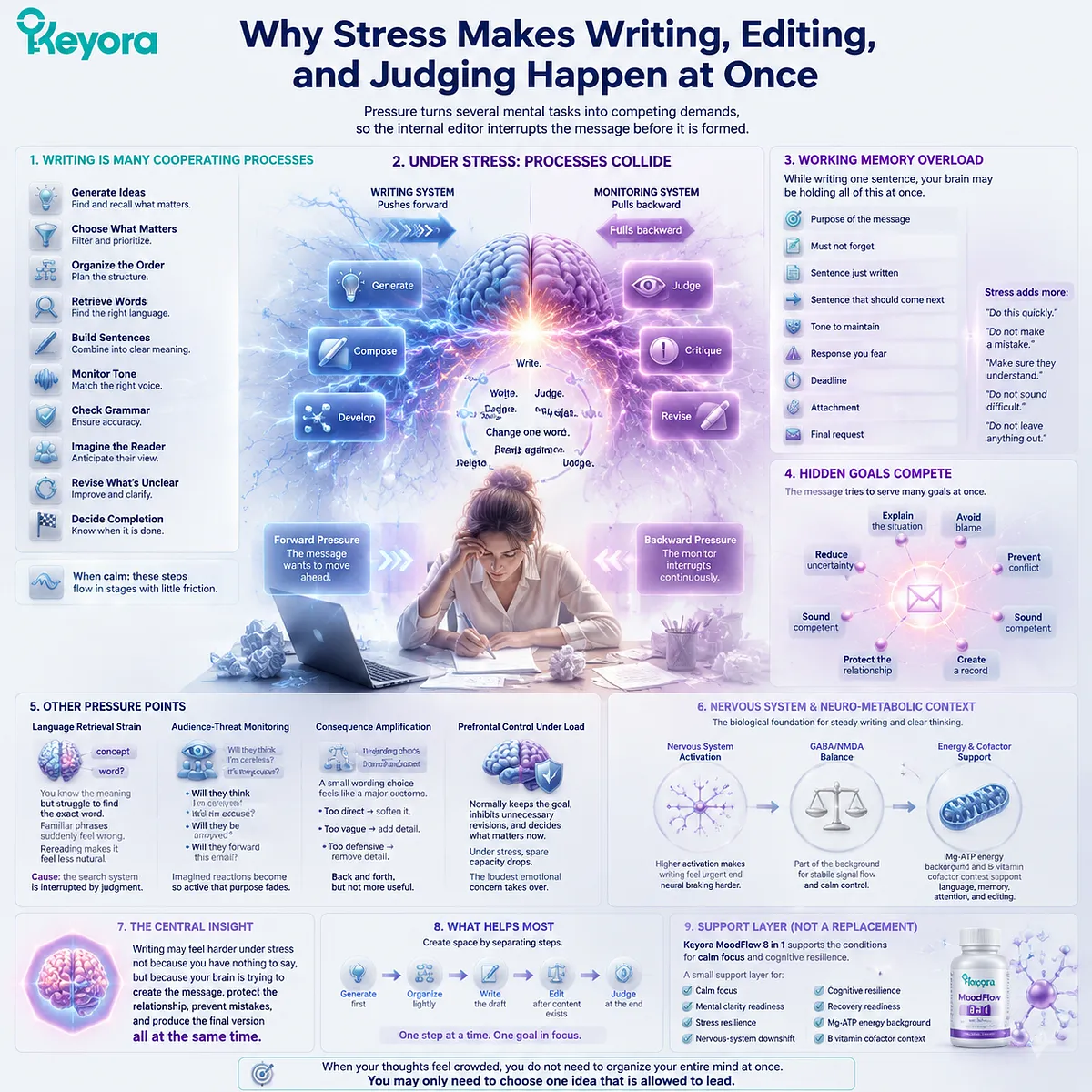
Pressure can turn writing into several competing tasks, causing the internal editor to interrupt the message before it has fully formed.
Writing is not one mental action.
It is a group of actions that usually cooperate.
You generate ideas.
You choose what matters.
You organize the order.
You retrieve words.
You build sentences.
You monitor tone.
You check grammar.
You imagine the reader.
You revise what is unclear.
You decide when the message is complete.
When you are relatively calm, these processes may happen in stages without much difficulty.
Under stress, they can collide.
You try to generate the first sentence while also judging whether it is polished enough.
You try to explain the delay while also predicting whether the reader will think you are making excuses.
You try to finish a paragraph while also correcting every word before the paragraph has a chance to develop.
This is multi-process competition.
The writing system is trying to move forward.
The monitoring system keeps pulling it backward.
The result can look like:
Write.
Judge.
Delete.
Rewrite.
Judge again.
Change one word.
Read the whole sentence.
Delete it again.
The problem is not that editing is bad.
Editing is necessary.
The problem is timing.
If the internal editor interrupts every sentence before enough content has accumulated, the message never develops a stable shape.
Working memory becomes crowded too.
While writing one sentence, your brain may be holding:
-
the purpose of the message;
-
the fact you must not forget;
-
the sentence you just wrote;
-
the sentence that should come next;
-
the tone you are trying to maintain;
-
the response you fear;
-
the deadline;
-
the attachment;
-
the final request.
That is a large load.
Stress adds more:
“Do this quickly.”
“Do not make a mistake.”
“Make sure they understand.”
“Do not sound difficult.”
“Do not leave anything out.”
The sentence then has to compete with all of that internal noise.
Language retrieval can become less smooth.
You may know the concept but struggle to find the exact word.
A familiar phrase may suddenly feel wrong.
You may reread a simple sentence until it no longer sounds natural.
This does not always mean your language ability has changed.
It may mean that the system searching for words is being interrupted by the system judging them.
Audience-threat monitoring makes this especially intense.
You are not only writing what happened.
You are simulating how the reader might react.
Will they think I am careless?
Will they think I am demanding?
Will they think I am avoiding responsibility?
Will they be annoyed by this request?
Will they forward this message?
These imagined reactions can become so active that the actual purpose of the message grows less clear.
The message starts serving several hidden goals:
Explain the situation.
Avoid blame.
Prevent conflict.
Sound competent.
Protect the relationship.
Create a record.
Reduce uncertainty.
No short email can perfectly satisfy all of these goals.
Consequence amplification adds another layer.
A small wording choice may begin to feel as if it could produce a major outcome.
One sentence sounds too direct, so you soften it.
Then it sounds vague, so you add detail.
Then it sounds defensive, so you remove the detail.
The message moves back and forth without becoming more useful.
Prefrontal control usually helps keep the writing goal active, inhibit unnecessary revisions, and decide which concerns matter now.
Under stress, that control may have less spare capacity.
The most emotionally charged concern can take over.
At the nervous-system level, elevated activation can make writing feel urgent while making neural braking and steady sequencing harder. GABA/NMDA activation balance can be understood as part of the broader background for stable signal flow.
Mg-ATP energy background and B vitamin cofactor context also belong to the wider neuro-metabolic picture because language production, working-memory maintenance, attention control, and editing all require sustained energy.
The central insight is this:
Writing may feel harder under stress not because you have nothing to say, but because your brain is trying to create the message, protect the relationship, prevent mistakes, and produce the final version all at the same time.
How to Separate Drafting From Shaping the Final Message
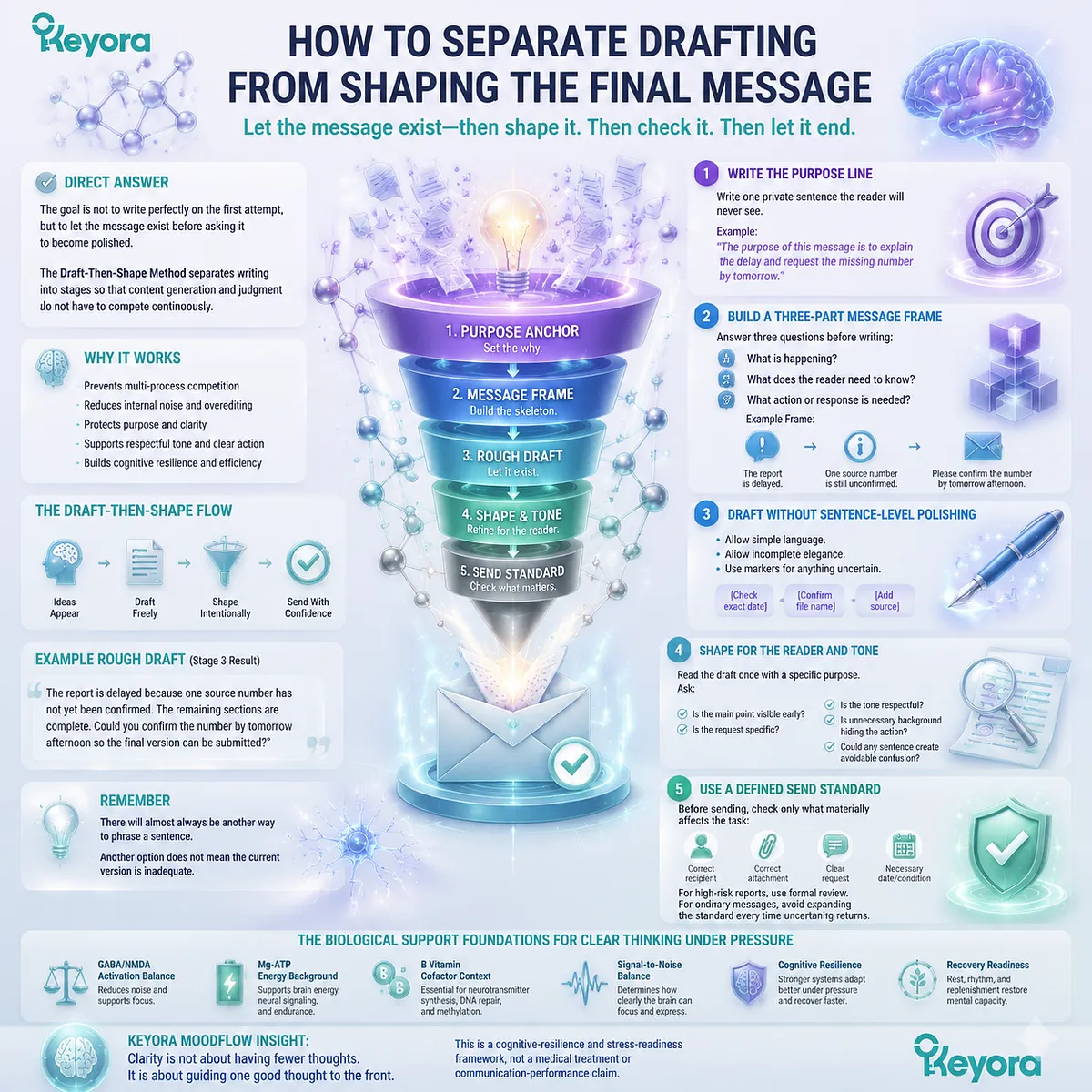
The goal is not to write perfectly on the first attempt, but to let the message exist before asking it to become polished.
A helpful approach is The Draft-Then-Shape Method.
This method separates writing into stages so that content generation and judgment do not have to compete continuously.
Step one: write the purpose line.
Before drafting the actual message, write one sentence that the reader will never see:
“The purpose of this message is…”
For example:
“The purpose of this message is to explain the delay and request the missing number by tomorrow.”
Or:
“The purpose of this report is to summarize the problem, show what has been completed, and identify the next decision.”
This sentence becomes a private anchor.
When the draft starts growing too long, return to it.
Does this paragraph serve the purpose?
Does this background help the reader act?
Is this sentence necessary for the decision?
The purpose line protects the message from expanding into every concern at once.
Step two: build a three-part message frame.
Before worrying about elegance, answer three questions:
-
What is happening?
-
What does the reader need to know?
-
What action or response is needed?
For example:
The report is delayed.
One source number is still unconfirmed.
Please confirm the number by tomorrow afternoon.
That is the skeleton.
It may not yet sound polished.
It does not need to.
A useful structure is more important than a beautiful first sentence.
Step three: draft without sentence-level polishing.
Now turn the frame into a rough message.
Allow simple language.
Allow incomplete elegance.
Allow a sentence that is clear but not impressive.
Do not stop for every synonym.
Do not rewrite the opening repeatedly before the middle exists.
If you need to verify something, leave a marker:
“[Check exact date]”
“[Confirm file name]”
“[Add source]”
This keeps uncertainty from stopping the whole draft.
A rough version might say:
“The report is delayed because one source number has not yet been confirmed. The remaining sections are complete. Could you confirm the number by tomorrow afternoon so the final version can be submitted?”
That message now exists.
Only after it exists should you ask it to become more polished.
Step four: shape for the reader and tone.
Read the completed draft once with a specific purpose.
Ask:
Is the main point visible early?
Is the request specific?
Is the tone respectful?
Is unnecessary background hiding the action?
Could any sentence create avoidable confusion?
This is reader-focused editing.
It is different from repeatedly changing words because none of them feels completely safe.
You may decide to shorten the background.
You may make the request clearer.
You may adjust one sentence that sounds unnecessarily sharp.
But the editing now has a defined goal.
Step five: use a defined send standard.
Before sending, check only the elements that materially affect the task:
Correct recipient.
Correct attachment.
Clear request.
Necessary date or condition.
For a longer or higher-risk report, use the formal review process required by the work.
For an ordinary message, avoid letting the standard expand every time uncertainty returns.
Once the message serves its purpose, respects the reader, and meets the checking standard, it can be complete even if another possible wording still exists.
There will almost always be another way to phrase a sentence.
The existence of another option does not mean the current version is inadequate.
The Draft-Then-Shape Method works because it lets the writing process move forward before the internal judge is invited to refine it.
First, let the message exist.
Then shape it.
Then check it.
Then allow it to end.
Where Nutritional Support Fits
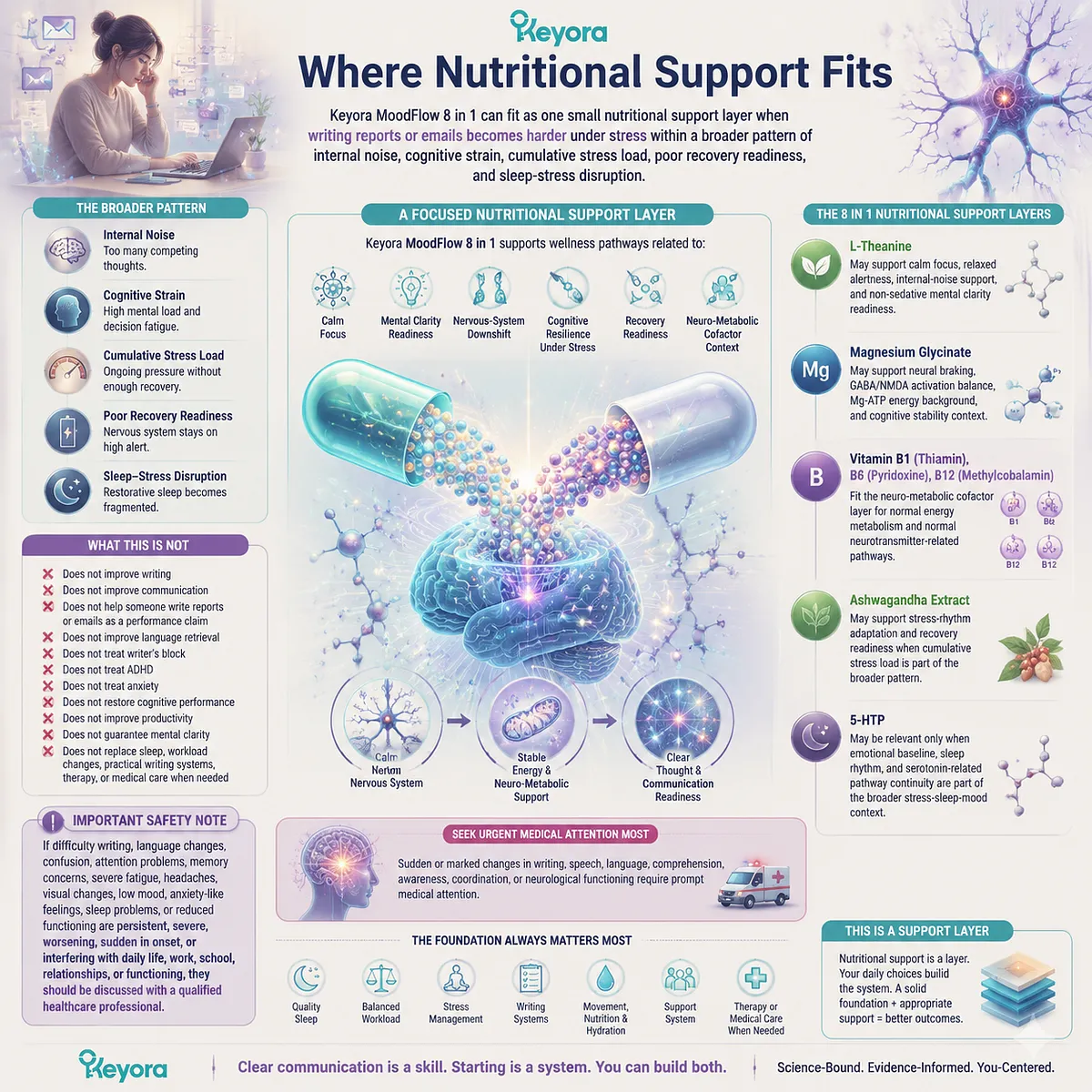
Keyora MoodFlow 8 in 1 can fit as one small nutritional support layer when writing reports or emails becomes harder under stress within a broader pattern of internal noise, cognitive strain, cumulative stress load, poor recovery readiness, and sleep-stress disruption.
Its role is narrower: supporting wellness pathways related to calm focus, mental clarity readiness, nervous-system downshift, cognitive resilience under stress, recovery readiness, and neuro-metabolic cofactor context.
-
L-Theanine may support calm focus, relaxed alertness, internal-noise support, and non-sedative mental clarity readiness.
-
Magnesium glycinate may support neural braking, GABA/NMDA activation balance, Mg-ATP energy background, and cognitive stability context.
-
B1, B6, and B12 fit the neuro-metabolic cofactor layer for normal energy metabolism and normal neurotransmitter-related pathways.
-
Ashwagandha may support stress-rhythm adaptation and recovery readiness when cumulative stress load is part of the broader pattern.
-
5-HTP may be relevant only when emotional baseline, sleep rhythm, and serotonin-related pathway continuity are part of the broader stress-sleep-mood context.
Keyora MoodFlow 8 in 1 does not improve writing, improve communication, help someone write reports or emails as a performance claim, improve language retrieval, treat writer’s block, treat ADHD, treat anxiety, restore cognitive performance, improve productivity, guarantee mental clarity, or replace sleep, workload changes, practical writing systems, therapy, or medical care when needed.
If difficulty writing, language changes, confusion, attention problems, memory concerns, severe fatigue, headaches, visual changes, low mood, anxiety-like feelings, sleep problems, or reduced functioning are persistent, severe, worsening, sudden in onset, or interfering with daily life, work, school, relationships, or functioning, they should be discussed with a qualified healthcare professional.
Sudden or marked changes in writing, speech, language, comprehension, awareness, coordination, or neurological functioning require prompt medical attention.
Closing Summary
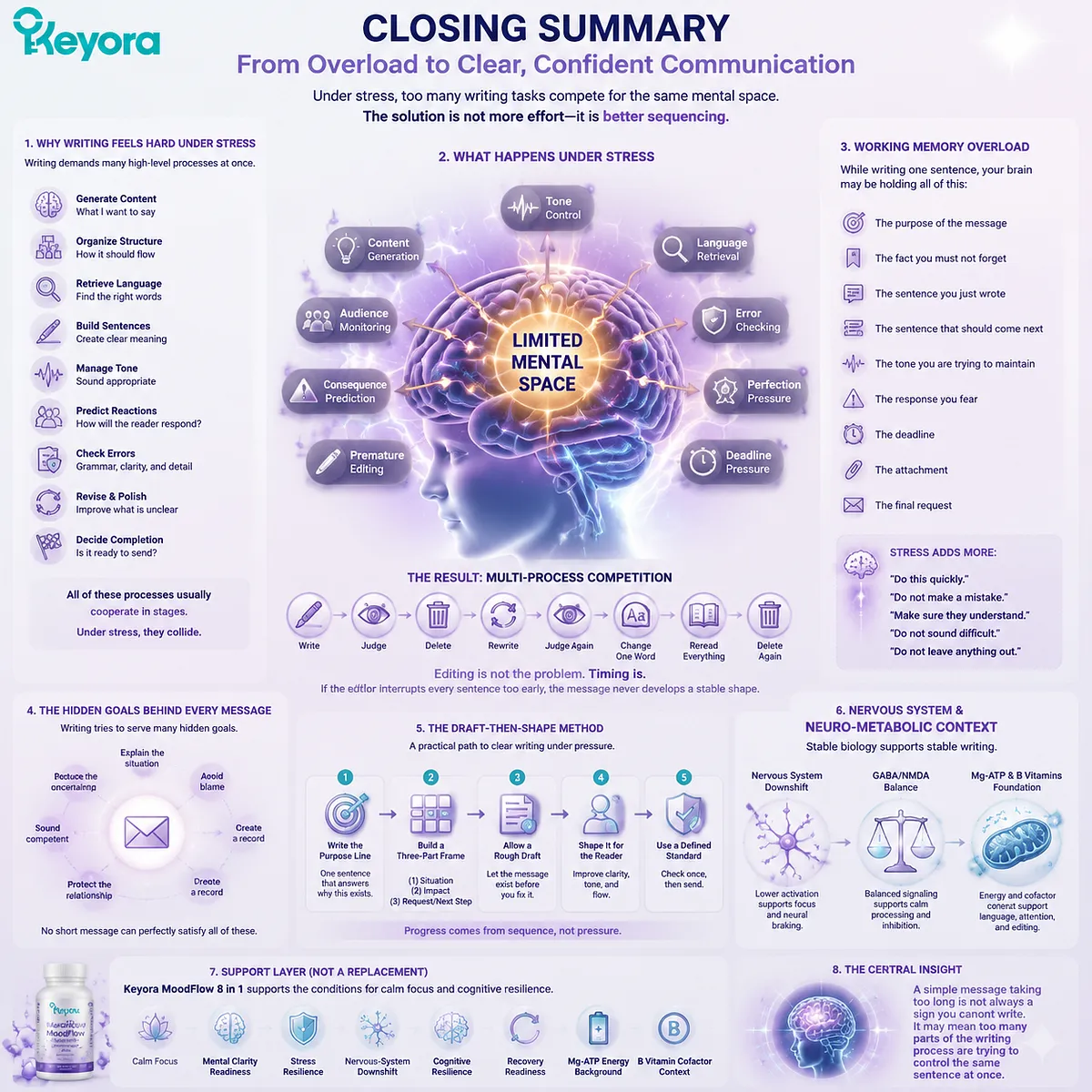
Writing a report or email can feel harder under stress because writing asks the brain to generate content, organize structure, retrieve language, manage tone, predict reactions, and check errors at the same time.
You may already know what needs to be communicated. The difficulty may begin when content generation, audience monitoring, consequence prediction, and premature editing compete for the same limited mental space.
The practical path is The Draft-Then-Shape Method: write the purpose line, build a three-part frame, allow a rough draft to exist, shape it for the reader, and use a defined standard before sending.
Keyora MoodFlow 8 in 1 belongs only as a small nutritional support layer for calm focus, mental clarity readiness, stress resilience, nervous-system downshift, cognitive resilience, recovery readiness, Mg-ATP energy background, and B vitamin cofactor context.
When a simple message takes much longer than expected, it may not mean you have lost the ability to write. It may mean too many parts of the writing process are trying to control the same sentence at once.
This article is for educational and informational purposes only. It does not provide medical advice, diagnosis, treatment, cure, prevention, disease outcome claims, hormone restoration claims, fertility outcome claims, or formula-specific clinical efficacy claims.