
Why Is It Hard to Organize My Thoughts When I’m Under Pressure?
Keyora Research Q&A Library
This is part of the Keyora Research Q&A Series, derived from Keyora Nutritional Neurology Series .
Within the Keyora Nutritional Neurology framework, this Q&A translates complex nutrient–brain mechanisms into reader-friendly, evidence-bound answers, focusing on stress resilience, sleep quality, calm mood support, cognitive wellness, and the broader interaction between nutrition, neurochemistry, and daily nervous-system function.
First published by Keyora Research Journal: www.keyorahealth.com

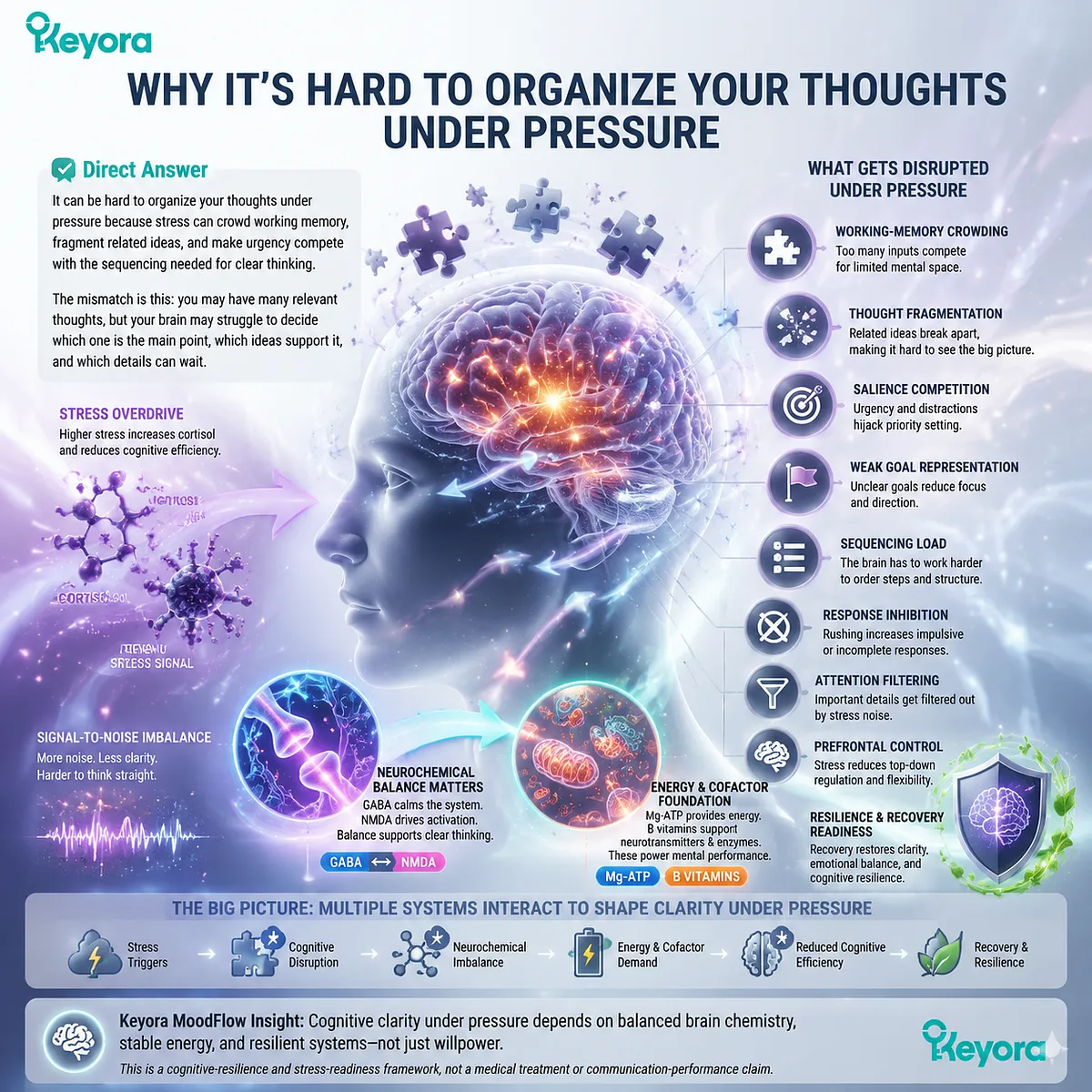
Direct Answer
It can be hard to organize your thoughts under pressure because stress can crowd working memory, fragment related ideas, and make urgency compete with the sequencing needed for clear thinking.
The mismatch is this: you may have many relevant thoughts, but your brain may struggle to decide which one is the main point, which ideas support it, and which details can wait.
This can involve working-memory crowding, thought fragmentation, salience competition, weak goal representation, sequencing load, response inhibition, attention filtering, prefrontal control, signal-to-noise balance, GABA/NMDA activation balance, Mg-ATP energy background, B vitamin cofactor context, cognitive resilience, and recovery readiness.
In the Keyora MoodFlow framework, this is understood as a cognitive-resilience and stress-readiness question, not a medical treatment or communication-performance claim.
Why Having More Thoughts Can Make the Main Point Harder to Find
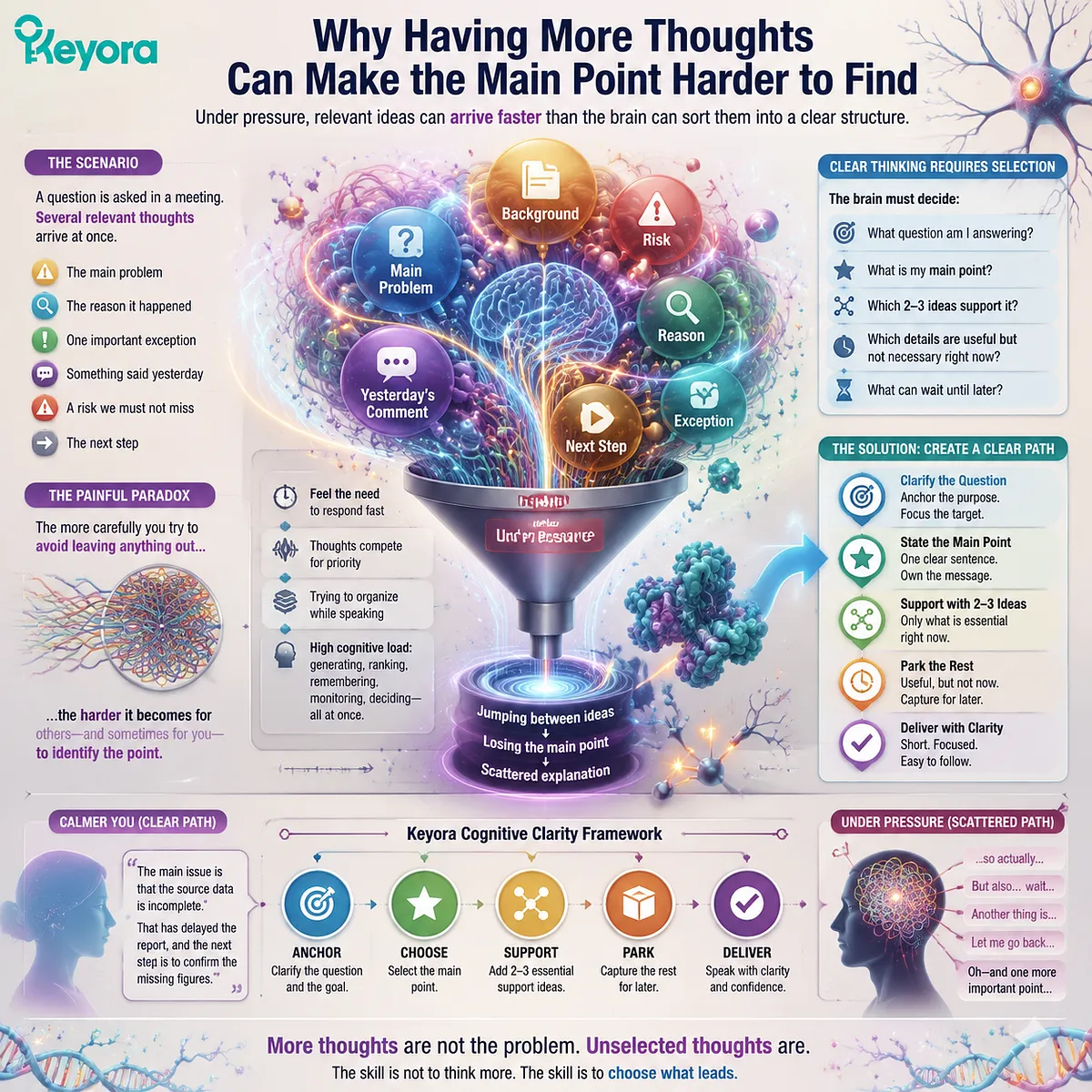
Under pressure, relevant ideas can arrive faster than the brain can sort them into a clear structure.
Someone asks you a question in a meeting.
You do have an answer.
In fact, several thoughts arrive at once.
There is the main problem.
There is the reason it happened.
There is one important exception.
There is something someone said yesterday.
There is a risk you do not want the team to miss.
You begin speaking.
But instead of forming a clear path, the thoughts compete.
You start with the background. Then you jump to the risk. Then you return to the original question. Then another detail appears, and you interrupt yourself to include it.
Halfway through, you are no longer sure what your main point was.
This can feel deeply frustrating because your mind is not empty.
You are not searching for something to say.
You may have too much to say, all at once.
That difference matters.
When people struggle to organize their thoughts under pressure, they often assume they lack logic. They may think:
“Why can’t I explain this properly?”
“Why do I always go off track?”
“Why do other people sound clear while I sound scattered?”
“Why does everything make sense in my head until someone waits for an answer?”
But the problem may not be the quality of the ideas.
It may be the lack of space available to sort them.
Clear thinking requires selection.
The brain has to decide:
What question am I answering?
What is my main point?
Which two or three ideas support it?
Which details are useful but not necessary right now?
What can wait until later?
Under pressure, that selection process can become unstable.
Every thought may feel important.
The background feels necessary because it explains the context.
The exception feels necessary because you do not want to sound inaccurate.
The risk feels necessary because you do not want anyone to miss it.
The history feels necessary because it explains how the problem developed.
The next step feels necessary because people need to know what to do.
So you try to include everything.
But including everything can make the central line harder to see.
This creates a painful paradox:
The more carefully you try to avoid leaving anything out, the harder it becomes for another person—and sometimes for you—to identify the point.
Pressure can make this worse because silence starts to feel dangerous.
You may feel that you need to respond immediately. You may begin speaking before the thoughts have formed a structure. Once you start, you try to organize while continuing to talk.
That is difficult.
You are generating ideas, ranking them, remembering what you already said, watching the listener’s reaction, and deciding what should come next—all at the same time.
A calmer version of you might have said:
“The main issue is that the source data is incomplete. That has delayed the report, and the next step is to confirm the missing figures.”
Under pressure, the same answer may become a long journey through every related detail before reaching the conclusion.
This does not mean you have no logic.
It may mean the logic has not yet been given a stable path.
A more useful question is not:
“Why is my mind so disorganized?”
It is:
“Do I lack ideas, or do I need to choose which idea is allowed to lead?”
Why Pressure Turns Related Ideas Into Competing Fragments
Stress can weaken the mental control needed to hold the question, rank ideas, and delay details that do not belong to the current answer.
Thought organization depends heavily on working memory.
Working memory helps keep the current question active while you sort possible answers. It holds your main point, tracks what you have already said, and keeps the next idea ready.
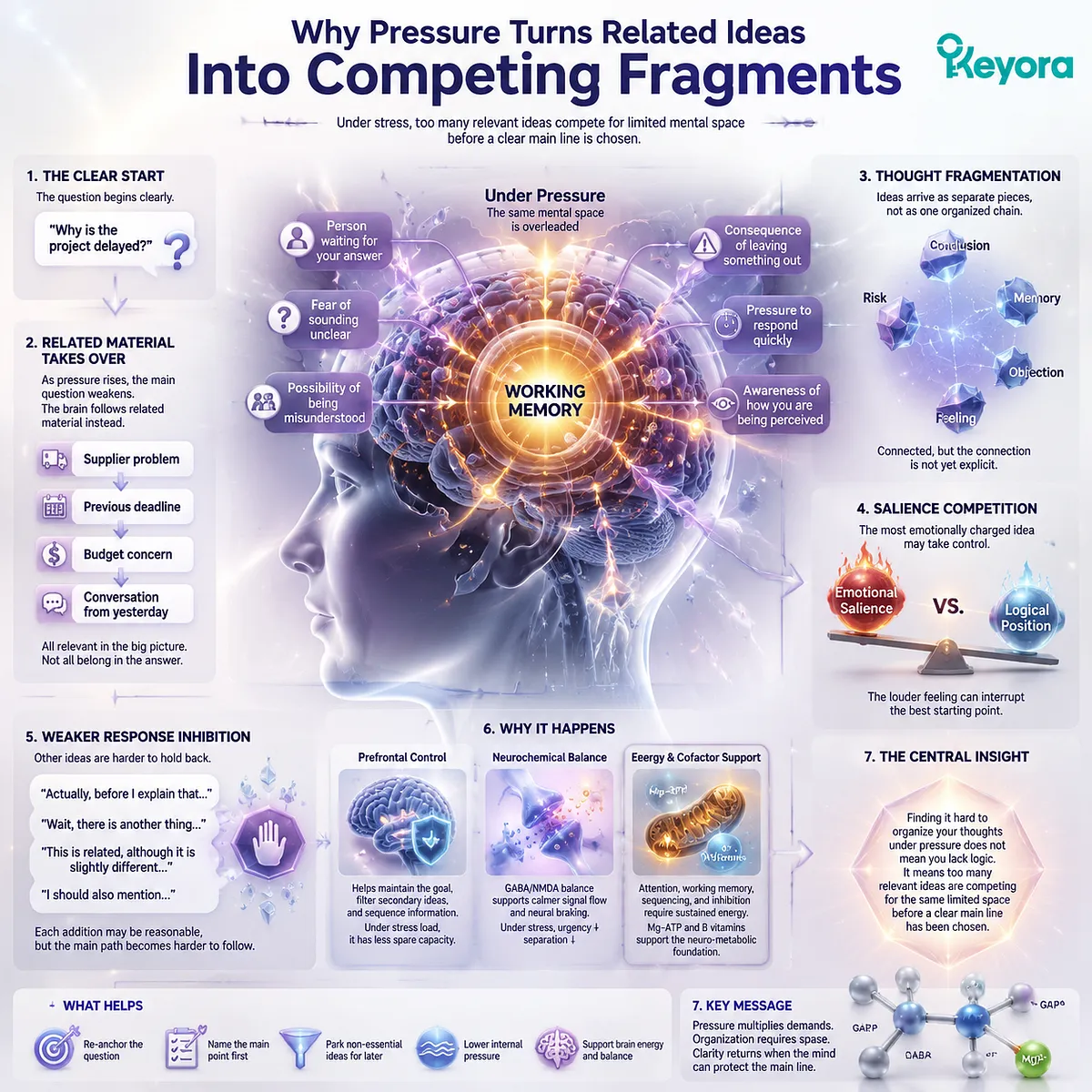
Under pressure, the same mental space is also carrying:
-
the person waiting for your answer;
-
the fear of sounding unclear;
-
the possibility of being misunderstood;
-
the consequence of leaving something out;
-
the pressure to respond quickly;
-
your awareness of how you are being perceived.
These demands compete with the thought structure itself.
The question may begin clearly:
“Why is the project delayed?”
But as pressure rises, the mental representation of that question may weaken.
Your brain starts following related material instead.
You remember a supplier problem.
That reminds you of a previous deadline.
The previous deadline reminds you of a budget concern.
The budget concern reminds you of a conversation from yesterday.
All of these thoughts may be relevant to the wider situation.
But relevance is not the same as belonging in the current answer.
Thought fragmentation also plays a role.
Under stress, ideas may appear as separate pieces rather than as one organized chain.
A conclusion appears.
Then a memory.
Then a risk.
Then a possible objection.
Then a feeling.
The pieces may be connected, but the connection is not yet explicit.
The brain has not had enough space to say:
“This is the main point.”
“This is supporting evidence.”
“This is a separate issue.”
“This can wait.”
Salience competition makes the problem harder.
Salience is the quality that makes a thought feel important or urgent.
Under pressure, the most emotionally charged idea may take control, even when it is not the best starting point.
A risk may feel louder than the main answer.
An embarrassing past mistake may feel more important than the current facts.
An exception may feel urgent because you are afraid of being challenged.
The thought with the strongest emotional signal can interrupt the thought with the strongest logical position.
Response inhibition is another part of clear organization.
To stay on one line, the brain must temporarily hold back other ideas.
It has to say:
“That is relevant, but not yet.”
“That detail belongs later.”
“That exception does not need to lead.”
“That is a separate question.”
Under pressure, this inhibitory control can become thinner.
Every idea tries to enter immediately.
That is why you may hear yourself saying:
“Actually, before I explain that…”
“Wait, there is another thing…”
“This is related, although it is slightly different…”
“I should also mention…”
Each addition may be reasonable, but the main path becomes harder to follow.
Prefrontal control normally helps maintain the goal, filter secondary ideas, and sequence information. Under stress load, it may have less spare capacity for these organizing functions.
At the nervous-system level, internal activation can make thoughts arrive with more urgency and less separation. GABA/NMDA activation balance can be understood as part of the broader background for calmer signal flow and neural braking.
Mg-ATP energy background and B vitamin cofactor context also belong to the wider neuro-metabolic picture because attention control, working-memory maintenance, sequencing, and inhibition all require sustained energy.
The central insight is this:
Finding it hard to organize your thoughts under pressure does not always mean you lack logic. Sometimes too many relevant ideas are competing for the same limited space before a clear main line has been chosen.
How to Build One Clear Line Through a Crowded Mind
The goal is not to organize everything, but to give one main point a clear path through the noise.
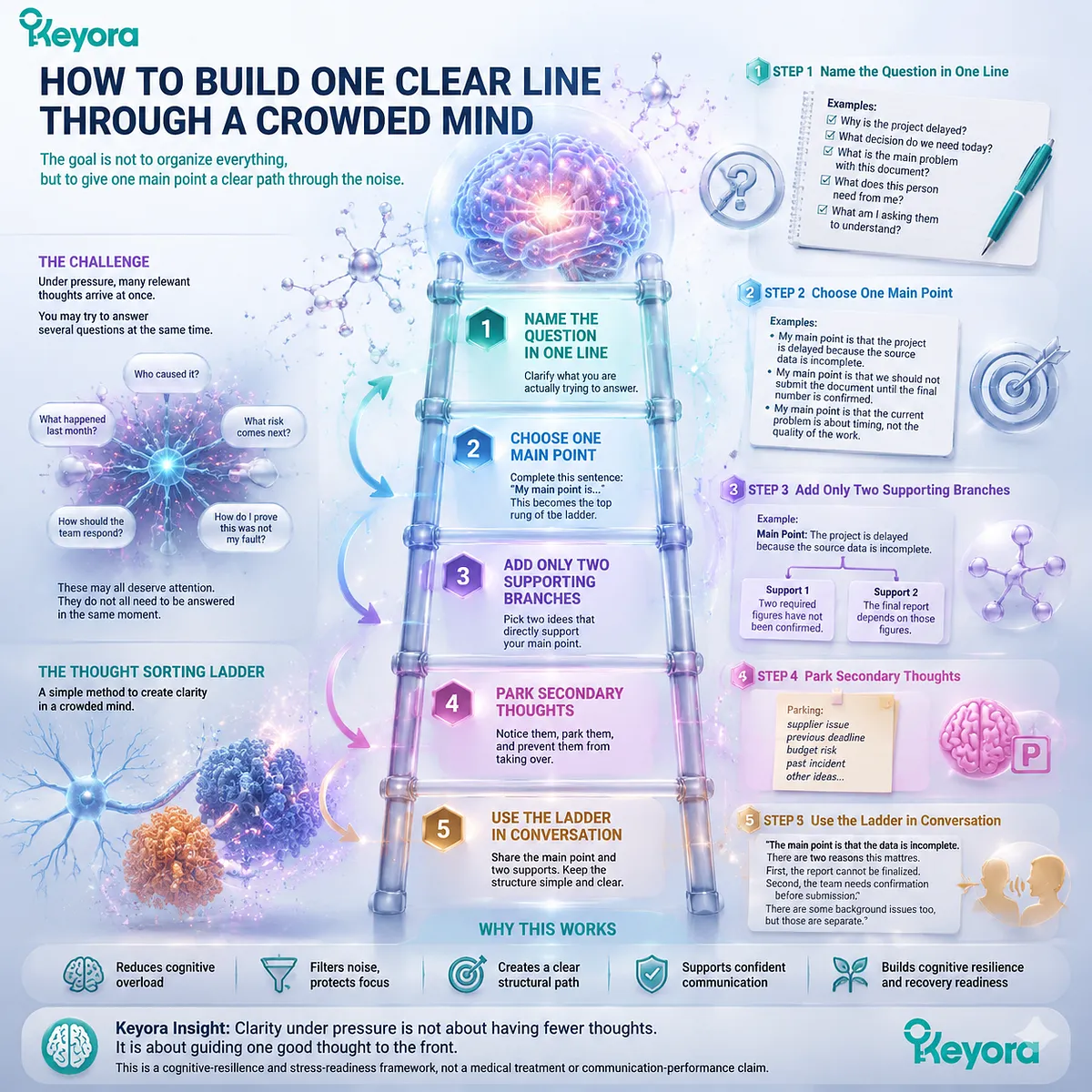
A helpful approach is The Thought Sorting Ladder.
This method does not require you to produce a perfect explanation immediately.
It gives your thoughts a temporary structure that is clear enough to use.
Step one: name the question in one line.
Before organizing the answer, identify what you are actually trying to answer.
Write or say:
“What am I trying to explain?”
Then reduce it to one sentence.
“Why is the project delayed?”
“What decision do we need today?”
“What is the main problem with this document?”
“What does this person need from me?”
“What am I asking them to understand?”
This step matters because a crowded mind often starts answering several questions at once.
You may begin with “Why is the project delayed?” but also try to answer:
Who caused it?
What happened last month?
What risk comes next?
How should the team respond?
How do I prove this was not my fault?
Those may all deserve attention.
They do not all need to be answered in the same moment.
Step two: choose one main point.
Complete this sentence:
“My main point is…”
For example:
“My main point is that the project is delayed because the source data is incomplete.”
Or:
“My main point is that we should not submit the document until the final number is confirmed.”
Or:
“My main point is that the current problem is about timing, not the quality of the work.”
This sentence becomes the top rung of the ladder.
It does not need to contain every qualification.
It only needs to give the answer a center.
Step three: add only two supporting branches.
Choose two ideas that directly support the main point.
For example:
Main point: The project is delayed because the source data is incomplete.
Support 1: Two required figures have not been confirmed.
Support 2: The final report depends on those figures.
Or use:
-
What caused it?
-
What needs to happen next?
Or:
-
Evidence
-
Consequence
Why only two?
Because pressure encourages expansion.
A strict limit protects the central line.
You can always add more after the main structure is clear.
Step four: park secondary thoughts.
Create a small mental or written parking area.
Write:
“Parking: supplier issue, previous deadline, budget risk.”
These thoughts are not being rejected.
They are being prevented from taking over the current answer.
You can return to them later if someone asks:
“What caused the missing data?”
“Is there a budget impact?”
“Has this happened before?”
This creates a new relationship with your thoughts.
You do not have to express an idea the moment it appears in order to keep it.
You can notice it, park it, and continue.
The Thought Sorting Ladder can also be used in conversation.
You might say:
“The main point is that the data is incomplete. There are two reasons this matters. First, the report cannot be finalized. Second, the team needs confirmation before submission. There are some background issues too, but those are separate.”
That response is not perfect.
It is structured.
And structure gives both you and the listener somewhere to stand.
Where Nutritional Support Fits
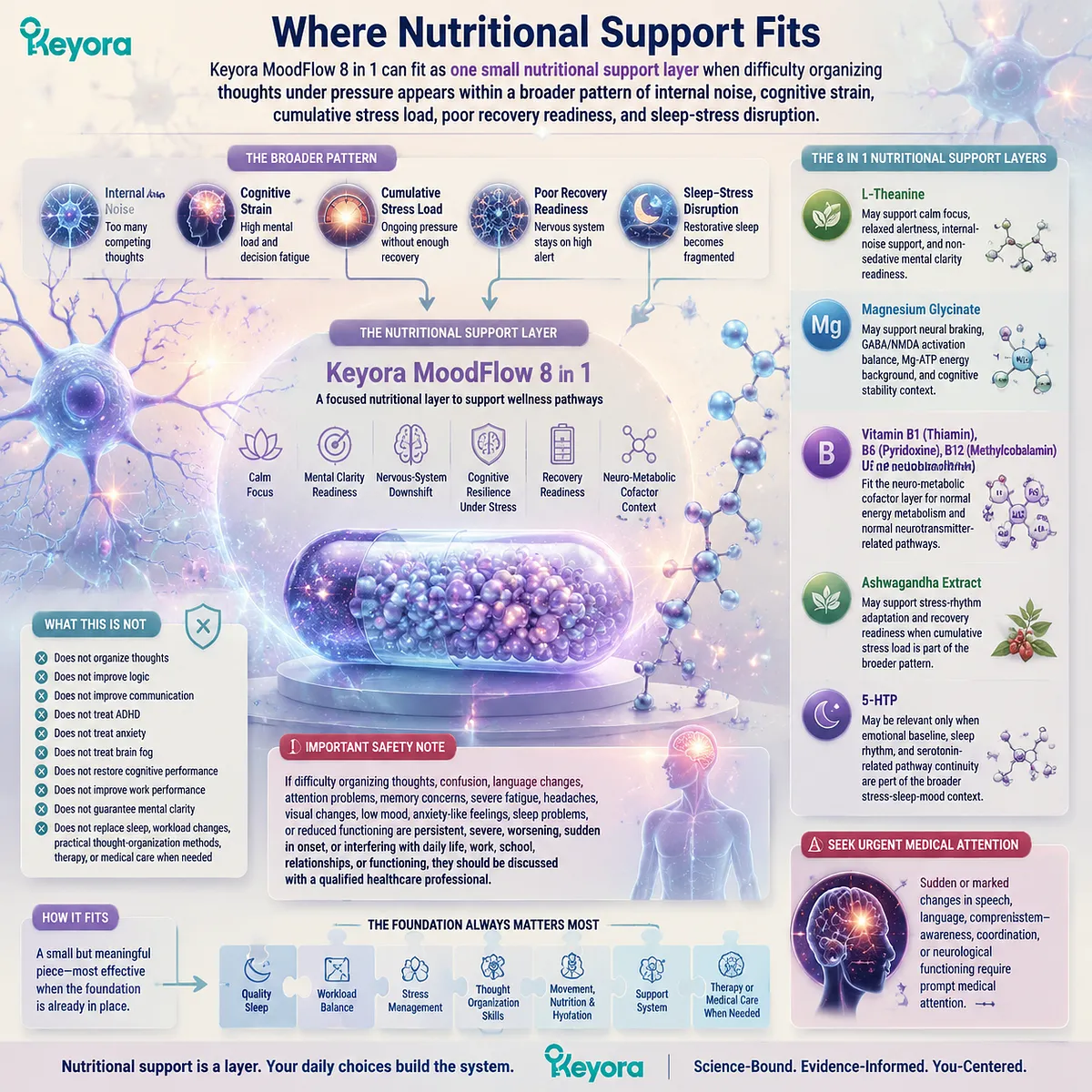
Keyora MoodFlow 8 in 1 can fit as one small nutritional support layer when difficulty organizing thoughts under pressure appears within a broader pattern of internal noise, cognitive strain, cumulative stress load, poor recovery readiness, and sleep-stress disruption.
Its role is narrower: supporting wellness pathways related to calm focus, mental clarity readiness, nervous-system downshift, cognitive resilience under stress, recovery readiness, and neuro-metabolic cofactor context.
-
L-Theanine may support calm focus, relaxed alertness, internal-noise support, and non-sedative mental clarity readiness.
-
Magnesium glycinate may support neural braking, GABA/NMDA activation balance, Mg-ATP energy background, and cognitive stability context.
-
B1, B6, and B12 fit the neuro-metabolic cofactor layer for normal energy metabolism and normal neurotransmitter-related pathways.
-
Ashwagandha may support stress-rhythm adaptation and recovery readiness when cumulative stress load is part of the broader pattern.
-
5-HTP may be relevant only when emotional baseline, sleep rhythm, and serotonin-related pathway continuity are part of the broader stress-sleep-mood context.
Keyora MoodFlow 8 in 1 does not organize thoughts, improve logic, improve communication, treat ADHD, treat anxiety, treat brain fog, restore cognitive performance, improve work performance, guarantee mental clarity, or replace sleep, workload changes, practical thought-organization methods, therapy, or medical care when needed.
If difficulty organizing thoughts, confusion, language changes, attention problems, memory concerns, severe fatigue, headaches, visual changes, low mood, anxiety-like feelings, sleep problems, or reduced functioning are persistent, severe, worsening, sudden in onset, or interfering with daily life, work, school, relationships, or functioning, they should be discussed with a qualified healthcare professional.
Sudden or marked changes in speech, language, comprehension, awareness, coordination, or neurological functioning require prompt medical attention.
Closing Summary
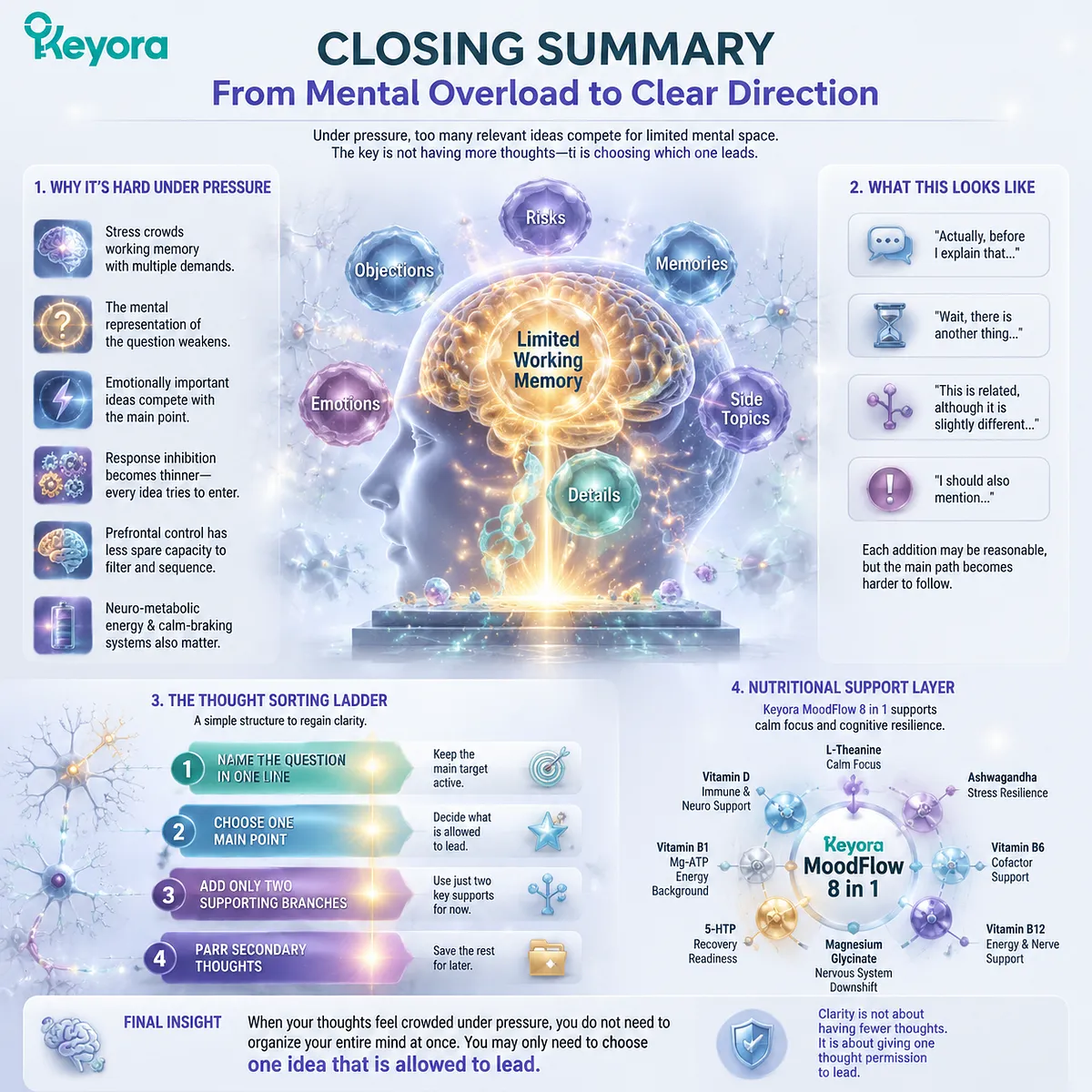
It can be hard to organize your thoughts under pressure because stress can crowd working memory, weaken the mental representation of the question, and make emotionally important ideas compete with the main point.
You may have plenty of relevant thoughts. The difficulty may be deciding which one leads, which two support it, and which details can wait.
The practical path is The Thought Sorting Ladder: name the question in one line, choose one main point, add only two supporting branches, and park secondary thoughts instead of forcing them into the current answer.
Keyora MoodFlow 8 in 1 belongs only as a small nutritional support layer for calm focus, mental clarity readiness, stress resilience, nervous-system downshift, cognitive resilience, recovery readiness, Mg-ATP energy background, and B vitamin cofactor context.
When your thoughts feel crowded under pressure, you do not need to organize your entire mind at once. You may only need to choose one idea that is allowed to lead.
This article is for educational and informational purposes only. It does not provide medical advice, diagnosis, treatment, cure, prevention, disease outcome claims, hormone restoration claims, fertility outcome claims, or formula-specific clinical efficacy claims.