
Why Do I Make More Small Work Mistakes Near the End of a Long Workday?
Keyora Research Q&A Library
This is part of the Keyora Research Q&A Series, derived from Keyora Nutritional Neurology Series .
Within the Keyora Nutritional Neurology framework, this Q&A translates complex nutrient–brain mechanisms into reader-friendly, evidence-bound answers, focusing on stress resilience, sleep quality, calm mood support, cognitive wellness, and the broader interaction between nutrition, neurochemistry, and daily nervous-system function.
First published by Keyora Research Journal: www.keyorahealth.com

Direct Answer
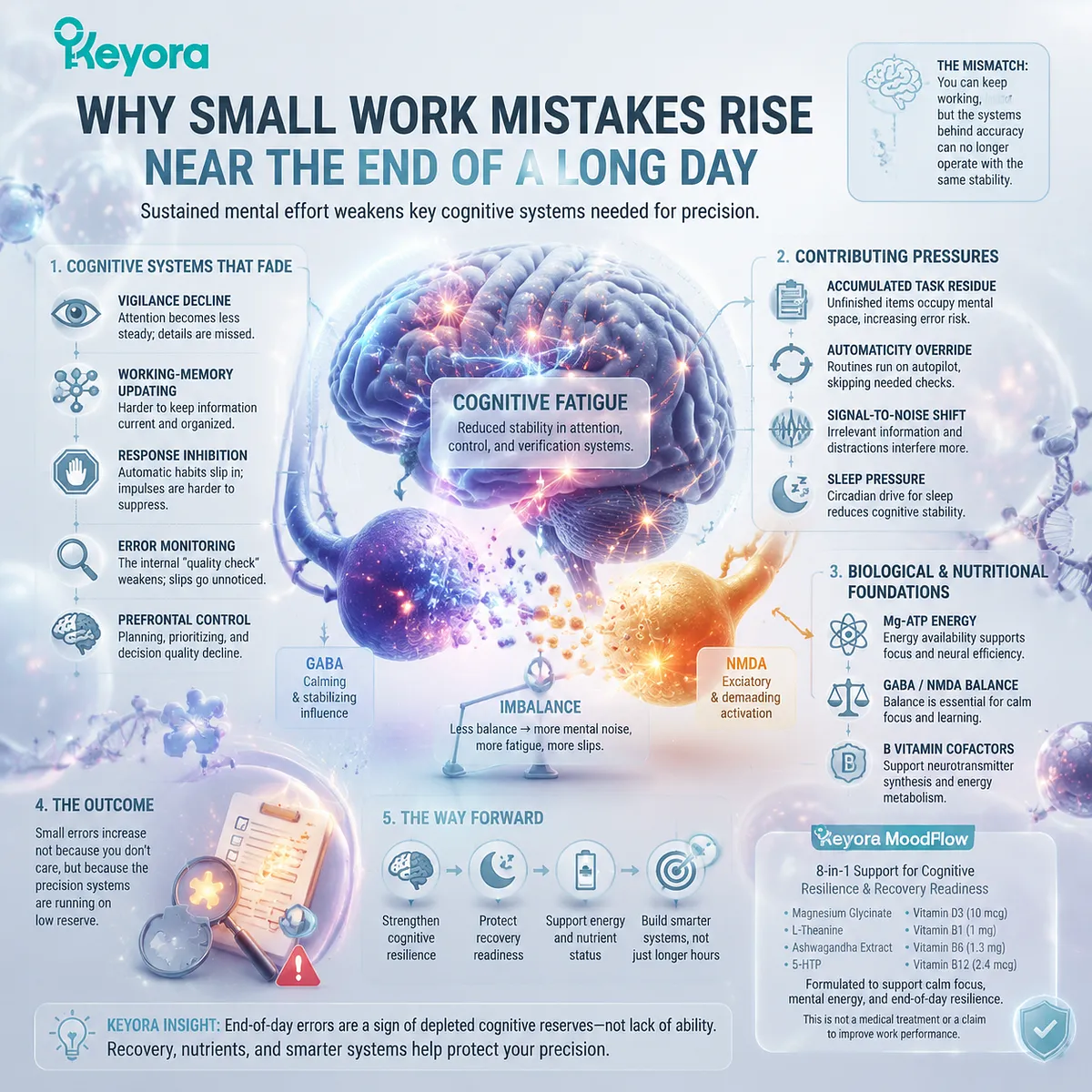
Small work mistakes may increase near the end of a long day because sustained mental effort can weaken vigilance, reduce checking consistency, and leave less cognitive capacity for routine precision.
The mismatch is this: you may still be able to continue working, but the systems that track details, update task status, inhibit automatic responses, and verify the final result may no longer be operating with the same stability.
This can involve cognitive fatigue, vigilance decline, working-memory updating, accumulated task residue, automaticity, response inhibition, error monitoring, prefrontal control, signal-to-noise balance, sleep pressure, GABA/NMDA activation balance, Mg-ATP energy background, B vitamin cofactor context, cognitive resilience, and recovery readiness.
In the Keyora MoodFlow framework, this is understood as a cognitive-resilience and recovery-readiness question, not a medical treatment or work-performance claim.
Why Familiar Tasks Start Producing Small Errors Late in the Day
You may still know exactly how to do the work while having less capacity left to protect every small detail.
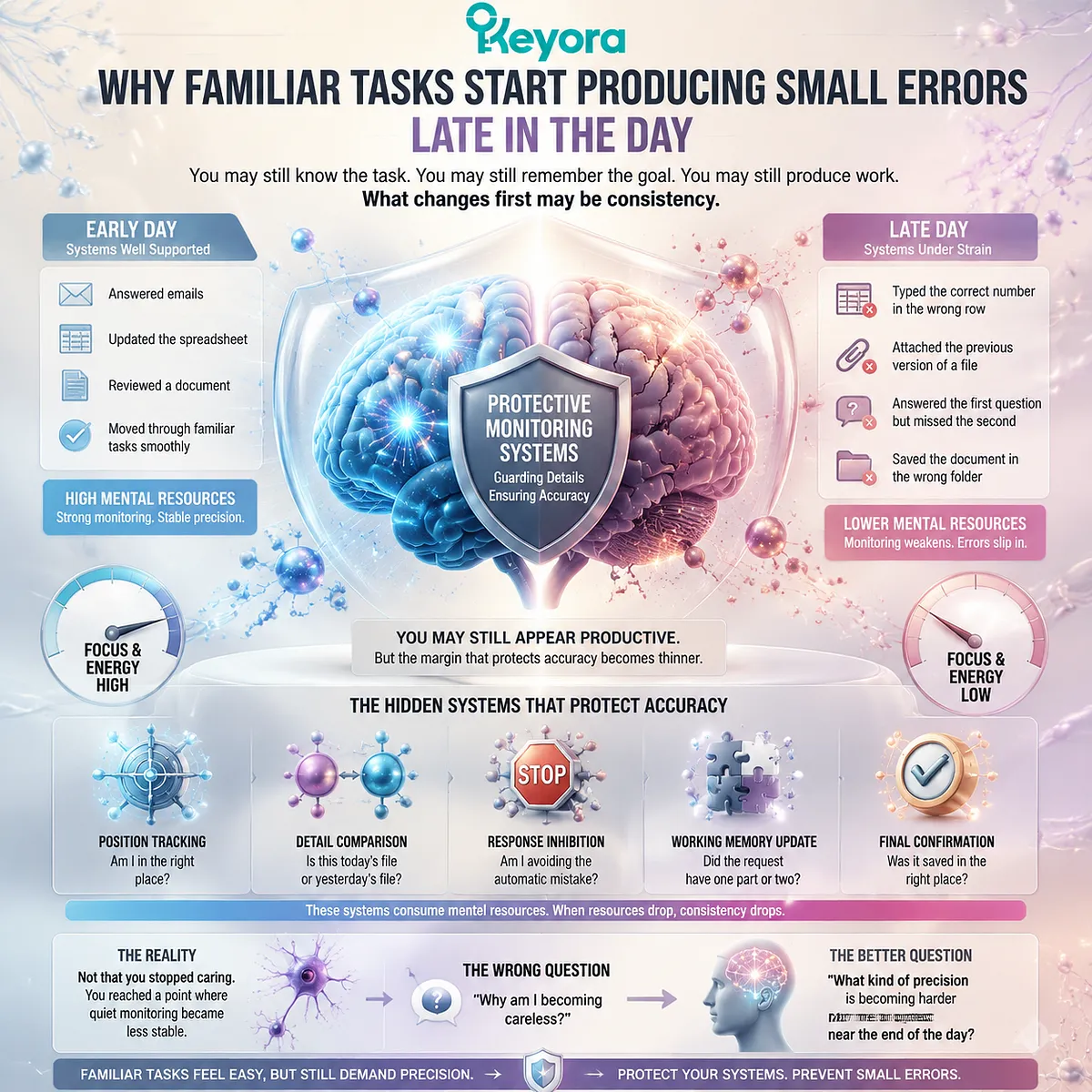
The first half of the day went reasonably well.
You answered emails.
You updated the spreadsheet.
You reviewed a document.
You moved through familiar tasks without much difficulty.
Near the end of the day, the work still looks manageable.
Then the small mistakes begin.
You type the correct number into the wrong row.
You attach the previous version of a file.
You answer the first question in an email but miss the second.
You save the document, but not in the folder where the team expects it.
None of these mistakes feels dramatic.
But together they create a painful question:
“Why am I making errors in tasks I know how to do?”
You may still be sitting upright. You may still be replying. You may still appear productive. From the outside, nothing may look especially wrong.
Inside, however, the systems that protect precision may already be tired.
This is important because people often imagine fatigue as a complete inability to work.
They expect exhaustion to look obvious: falling asleep, staring blankly, or being unable to continue.
But cognitive fatigue can appear more quietly.
You may still know the task.
You may still remember the goal.
You may still produce work.
What changes first may be consistency.
The main action gets completed, but the small protective actions become less reliable.
You write the email but forget the attachment.
You update the file but overlook the version name.
You fill in the form but place one item in the wrong field.
You complete the report but miss a question in the original request.
These are not signs that you suddenly stopped understanding your job.
They may show that the margin protecting accuracy has become thinner.
Familiar tasks are especially deceptive because they feel inexpensive.
You have done them many times, so you assume they require almost no cognitive effort. But even routine work needs the brain to monitor position, compare details, suppress the wrong habitual response, and confirm that the result matches the current situation.
A familiar process still asks:
Is this today’s file or yesterday’s file?
Is this the correct row?
Did this message contain one request or two?
Was this version saved in the right place?
Did anything change from the usual process?
When your mental resources are lower, the brain may continue performing the routine while checking these distinctions less consistently.
That is why an error can look obvious afterward.
You may see the wrong file and think:
“How did I not notice that?”
The answer may not be that you failed to care. You may have cared very much. You may simply have reached a point where the visible task remained possible, while the quieter monitoring around it had become less stable.
A more useful question is not:
“Why am I becoming careless?”
It is:
“What kind of precision is becoming harder for me to protect near the end of the day?”
Why a Long Day Weakens the Systems That Protect Precision
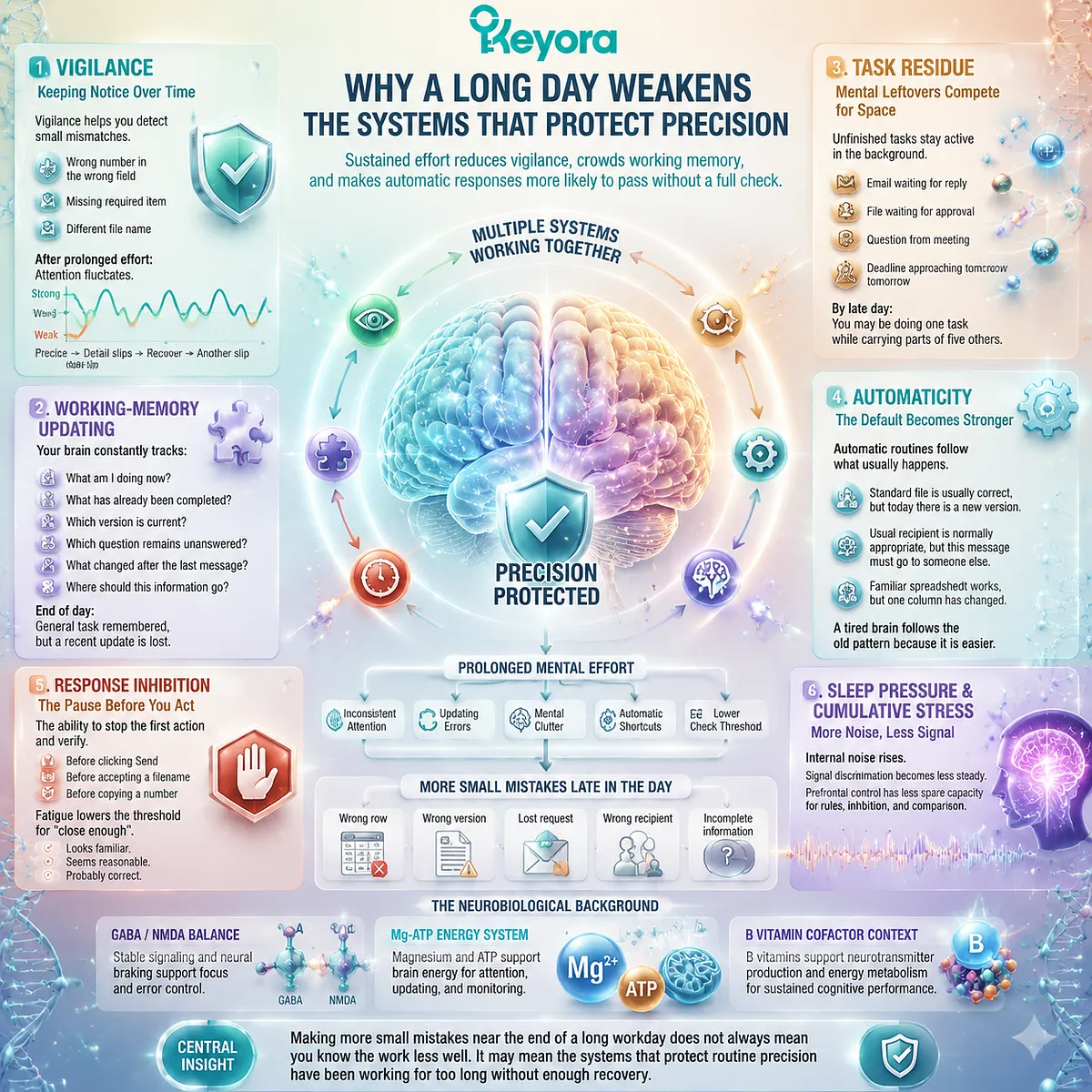
Sustained effort can reduce vigilance, crowd working memory, and make automatic responses more likely to pass without a full check.
Precision depends on several mental systems working together.
One is vigilance.
Vigilance is the ability to keep noticing what matters over time, especially when the work is repetitive or familiar. It helps you detect that one number is in the wrong field, one required item is missing, or one file name differs from the expected version.
After prolonged mental effort, vigilance may become less consistent.
You do not stop seeing everything.
Instead, attention begins to fluctuate.
For a few minutes, you are precise. Then one detail passes through. You recover. Then another small mismatch escapes notice.
This is why late-day mistakes may feel random.
The person is still trying. The task is still familiar. But the quality of monitoring is no longer equally strong from one moment to the next.
Working-memory updating also matters.
Throughout the day, your brain repeatedly tracks:
What am I doing now?
What has already been completed?
Which version is current?
Which question remains unanswered?
What changed after the last message?
Where should this information go?
This updating happens constantly, often without conscious effort.
By the end of a long workday, the system may become more fragile.
You may remember the general task but lose one recent update.
You know the spreadsheet needs changing, but forget which row has already been corrected.
You know the document was revised, but select the earlier version.
You know the email contains multiple requests, but preserve only the first one.
Task residue adds another layer.
During the day, many tasks do not close neatly.
One email is waiting for a reply.
One file is waiting for approval.
One meeting raised a question that still needs action.
One deadline is approaching tomorrow.
Even while you work on the current task, pieces of those unfinished tasks may remain active in the background.
Each piece takes a small amount of mental space.
By late afternoon or evening, you may be doing one task while mentally carrying parts of five others.
The current task then has to compete with all that residue.
Automaticity also increases when the brain is tired.
Automaticity is not always harmful. It allows you to perform familiar actions with less conscious effort.
But automatic routines are built around what usually happens.
Today’s task may contain a small exception.
The standard file is usually correct, but today there is a new version.
The usual recipient is normally appropriate, but this message must go to someone else.
The familiar spreadsheet layout usually works, but one column has changed.
A tired brain may follow the old pattern because it is easier, while the new detail receives less checking.
Response inhibition can weaken too.
Response inhibition is the ability to stop the first available action long enough to verify whether it is correct.
It is the pause before clicking Send.
The moment before accepting the suggested filename.
The small hesitation before copying a number into the familiar field.
When fatigue increases, the brain may accept “close enough” more easily.
The file name looks familiar.
The number appears reasonable.
The email seems complete.
The save location is probably correct.
That does not mean the brain has stopped working. It means the threshold for a final check may have become lower.
Sleep pressure and cumulative stress can make this more noticeable. Internal noise may rise while signal discrimination becomes less steady. Prefrontal control may have less spare capacity for maintaining rules, inhibiting automatic actions, and comparing the current result with the intended result.
At the nervous-system level, GABA/NMDA activation balance can be understood as part of the broader background for stable signaling and neural braking.
Mg-ATP energy background and B vitamin cofactor context also fit the broader neuro-metabolic picture because sustained attention, working-memory updating, and error monitoring require ongoing energy.
The central insight is this:
Making more small mistakes near the end of a long workday does not always mean you know the work less well. It may mean the systems that protect routine precision have been working for too long without enough recovery.
How to Protect Accuracy When Your Workday Is Nearly Over
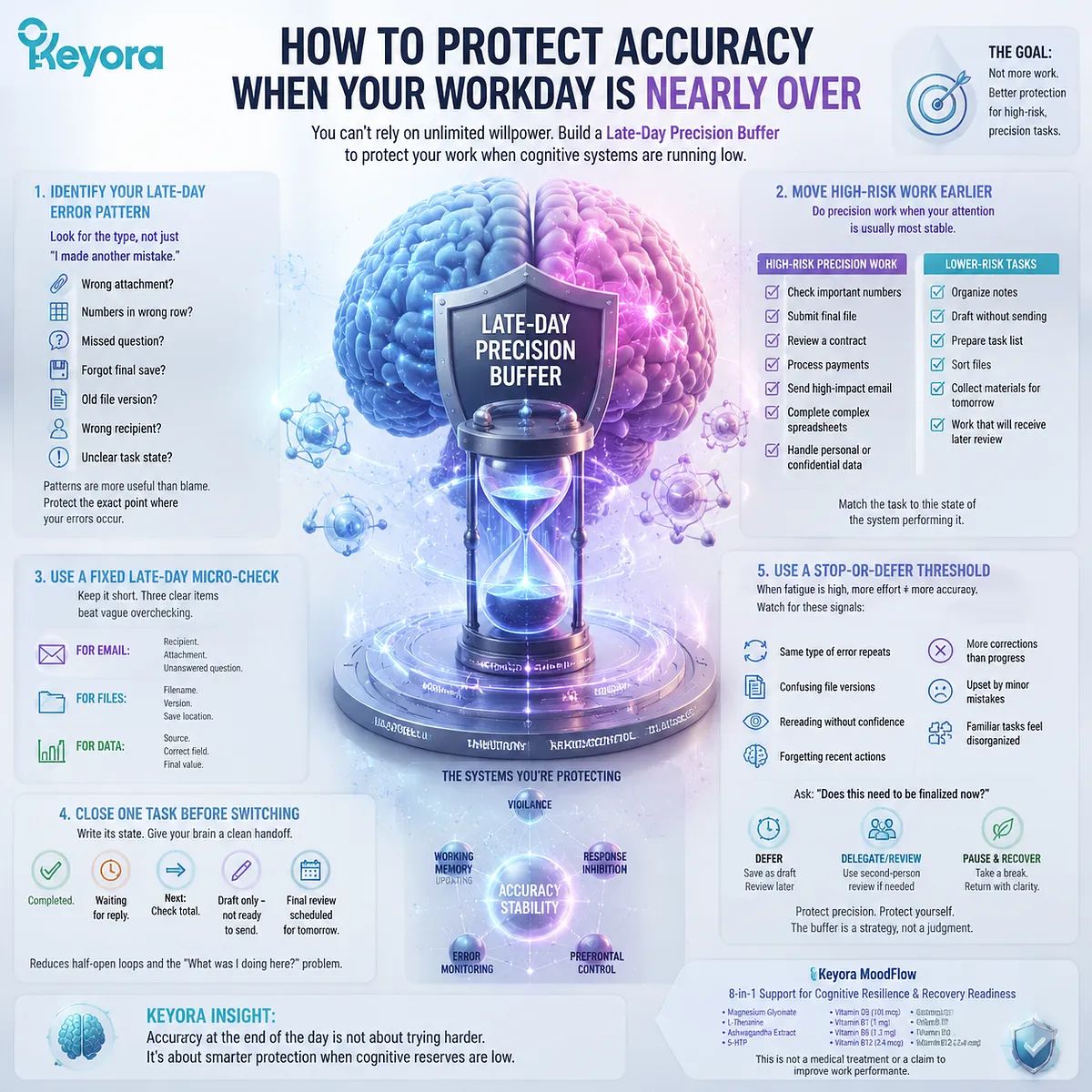
The goal is not to demand unlimited concentration, but to add a precision buffer around the work most vulnerable to fatigue.
A helpful approach is The Late-Day Precision Buffer.
This is not a productivity system designed to squeeze more work from a tired brain.
It is a way to reduce avoidable errors when your internal checking systems are becoming less consistent.
Step one: identify your late-day error pattern.
Do not record only:
“I made another mistake.”
Look for the type.
Do you choose the wrong attachment?
Do numbers move into the wrong row?
Do you miss the second question in an email?
Do you forget the final save?
Do you use the old file version?
Do you send to the wrong recipient?
Do you leave tasks in an unclear state?
Patterns are more useful than blame.
Once you know your most common late-day error, you can protect the exact point where it occurs.
Step two: move high-risk precision work earlier when possible.
Not everyone works best in the morning, and not everyone controls their schedule.
The principle is not “important work must happen early.”
The principle is:
Place precision-sensitive work in the part of your day when your attention is usually most stable.
This may include:
-
checking important numbers;
-
submitting a final file;
-
reviewing a contract;
-
processing payment information;
-
sending a high-impact email;
-
completing a complex spreadsheet;
-
handling personal or confidential data.
Lower-risk tasks can sometimes remain for later:
-
organizing notes;
-
drafting without sending;
-
preparing a task list;
-
sorting files;
-
collecting materials for tomorrow;
-
completing work that will receive a later review.
This is not avoidance.
It is matching the task to the state of the system performing it.
Step three: use a fixed late-day micro-check.
Late in the day, avoid the vague instruction:
“Be more careful.”
A tired brain needs something concrete.
For email:
Recipient.
Attachment.
Unanswered question.
For files:
Filename.
Version.
Save location.
For data:
Source.
Correct field.
Final value.
Keep the check short.
A long checklist may become another task that attention cannot reliably sustain. Three clear items are often more useful than a general feeling that you should inspect everything again.
Step four: close one task before switching.
Before leaving a task, write its state:
“Completed.”
“Waiting for reply.”
“Next: check total.”
“Draft only — not ready to send.”
“Final review scheduled for tomorrow.”
This reduces the number of half-open tasks that working memory must carry.
It also prevents the return problem:
“What was I doing here?”
“Did I finish this?”
“Which version was current?”
A visible task state gives your brain a clean handoff.
Step five: use a stop-or-defer threshold.
There is a point where demanding more concentration stops being a precision strategy.
Watch for signals such as:
-
making the same type of error repeatedly;
-
confusing file versions;
-
rereading the same number without gaining confidence;
-
forgetting actions completed minutes earlier;
-
producing more corrections than progress;
-
becoming unusually upset by minor mistakes;
-
feeling that familiar tasks no longer stay organized.
At that point, ask:
“Does this need to be finalized now?”
A non-urgent task may be saved as a draft.
A high-impact email may be written now and reviewed later.
An important number may be checked after a break.
A formal task may need the second-person review already built into the professional process.
The aim is not to stop working at the first sign of tiredness.
The aim is to stop treating a fatigue-affected state as the ideal moment for irreversible precision.
The Late-Day Precision Buffer protects the task without shaming the person doing it.
Where Nutritional Support Fits
Keyora MoodFlow 8 in 1 can fit as one small nutritional support layer when late-day work mistakes appear within a broader pattern of cumulative stress load, internal noise, cognitive strain, poor recovery readiness, and sleep-stress disruption.
Its role is narrower: supporting wellness pathways related to calm focus, mental clarity readiness, nervous-system downshift, cognitive resilience under stress, recovery readiness, and neuro-metabolic cofactor context.
-
L-Theanine may support calm focus, relaxed alertness, internal-noise support, and non-sedative mental clarity readiness.
-
Magnesium glycinate may support neural braking, GABA/NMDA activation balance, Mg-ATP energy background, and cognitive stability context.
-
B1, B6, and B12 fit the neuro-metabolic cofactor layer for normal energy metabolism and normal neurotransmitter-related pathways.
-
Ashwagandha may support stress-rhythm adaptation and recovery readiness when cumulative stress load is part of the broader pattern.
-
5-HTP may be relevant only when emotional baseline, sleep rhythm, and serotonin-related pathway continuity are part of the broader stress-sleep-mood context.
Keyora MoodFlow 8 in 1 does not prevent work mistakes, improve work accuracy, increase productivity, restore cognitive performance, treat mental fatigue, treat burnout, improve attention or memory as a treatment claim, or replace sleep, breaks, workload changes, workplace systems, or medical care when needed.
If increasing work mistakes, confusion, attention problems, memory concerns, severe fatigue, headaches, visual changes, low mood, anxiety-like feelings, sleep problems, or reduced functioning are persistent, severe, worsening, sudden in onset, or interfering with daily life, work, school, relationships, or functioning, they should be discussed with a qualified healthcare professional.
Persistent or marked changes in cognition or work accuracy can have more than one possible cause, including insufficient sleep, high workload, medication effects, vision problems, nutritional or medical issues, mood-related concerns, or neurological factors. An article cannot determine the cause.

Closing Summary
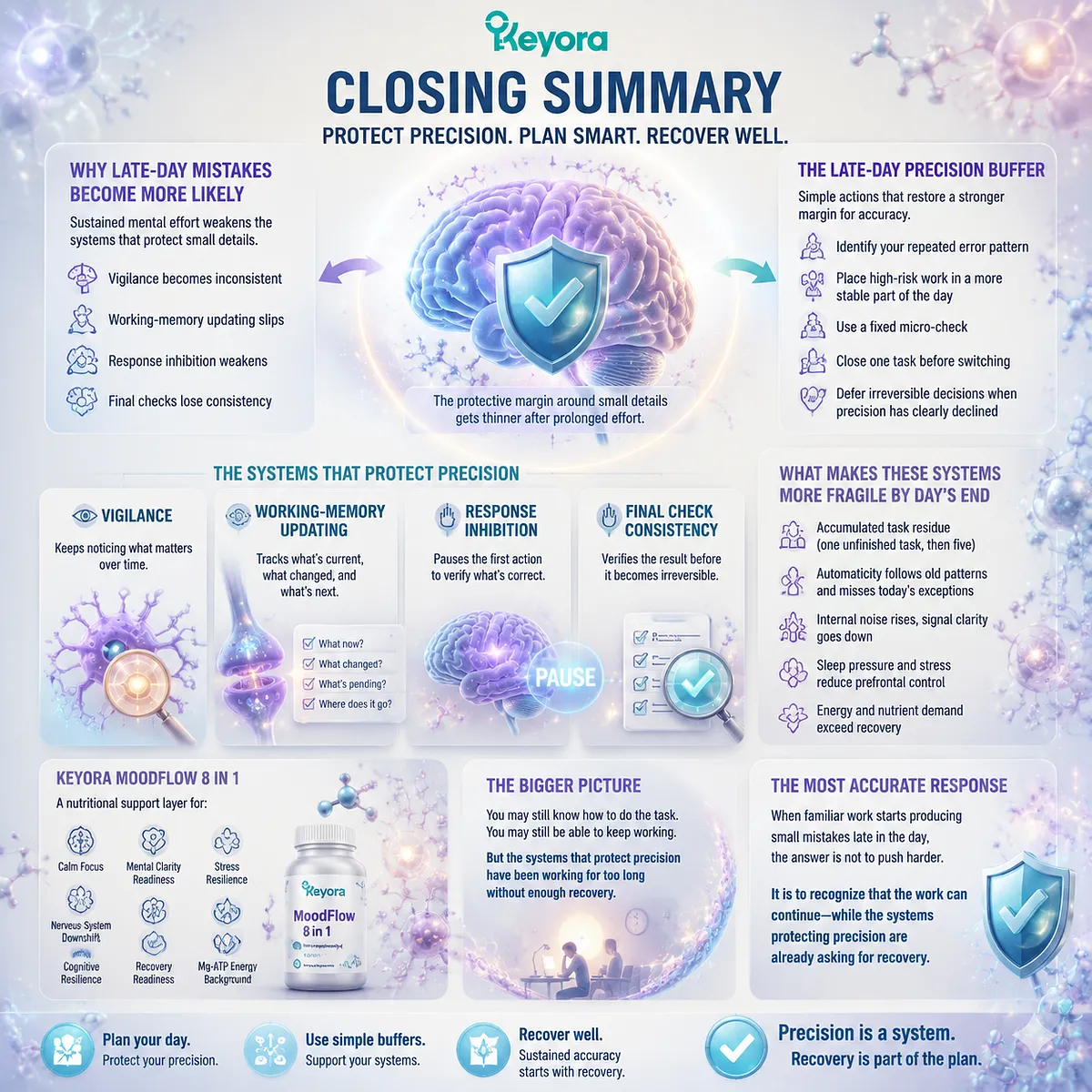
Small work mistakes may increase near the end of a long day because sustained mental effort can weaken vigilance, working-memory updating, response inhibition, and the consistency of final checks.
You may still know how to do the task. You may still be able to continue working. But the protective margin around small details may have become thinner.
The practical path is The Late-Day Precision Buffer: identify your repeated error pattern, place high-risk work in a more stable part of the day when possible, use a fixed micro-check, close one task before switching, and defer irreversible decisions when precision has clearly declined.
Keyora MoodFlow 8 in 1 belongs only as a small nutritional support layer for calm focus, mental clarity readiness, stress resilience, nervous-system downshift, cognitive resilience, recovery readiness, Mg-ATP energy background, and B vitamin cofactor context.
When familiar work starts producing small mistakes late in the day, the answer is not always to criticize yourself into concentrating harder. Sometimes the more accurate response is to recognize that the work can continue while the systems protecting precision are already asking for recovery.
This article is for educational and informational purposes only. It does not provide medical advice, diagnosis, treatment, cure, prevention, disease outcome claims, hormone restoration claims, fertility outcome claims, or formula-specific clinical efficacy claims.