
Why Do I Misread Emails or Documents When I’m Mentally Tired?
Keyora Research Q&A Library
This is part of the Keyora Research Q&A Series, derived from Keyora Nutritional Neurology Series .
Within the Keyora Nutritional Neurology framework, this Q&A translates complex nutrient–brain mechanisms into reader-friendly, evidence-bound answers, focusing on stress resilience, sleep quality, calm mood support, cognitive wellness, and the broader interaction between nutrition, neurochemistry, and daily nervous-system function.
First published by Keyora Research Journal: www.keyorahealth.com
Direct Answer
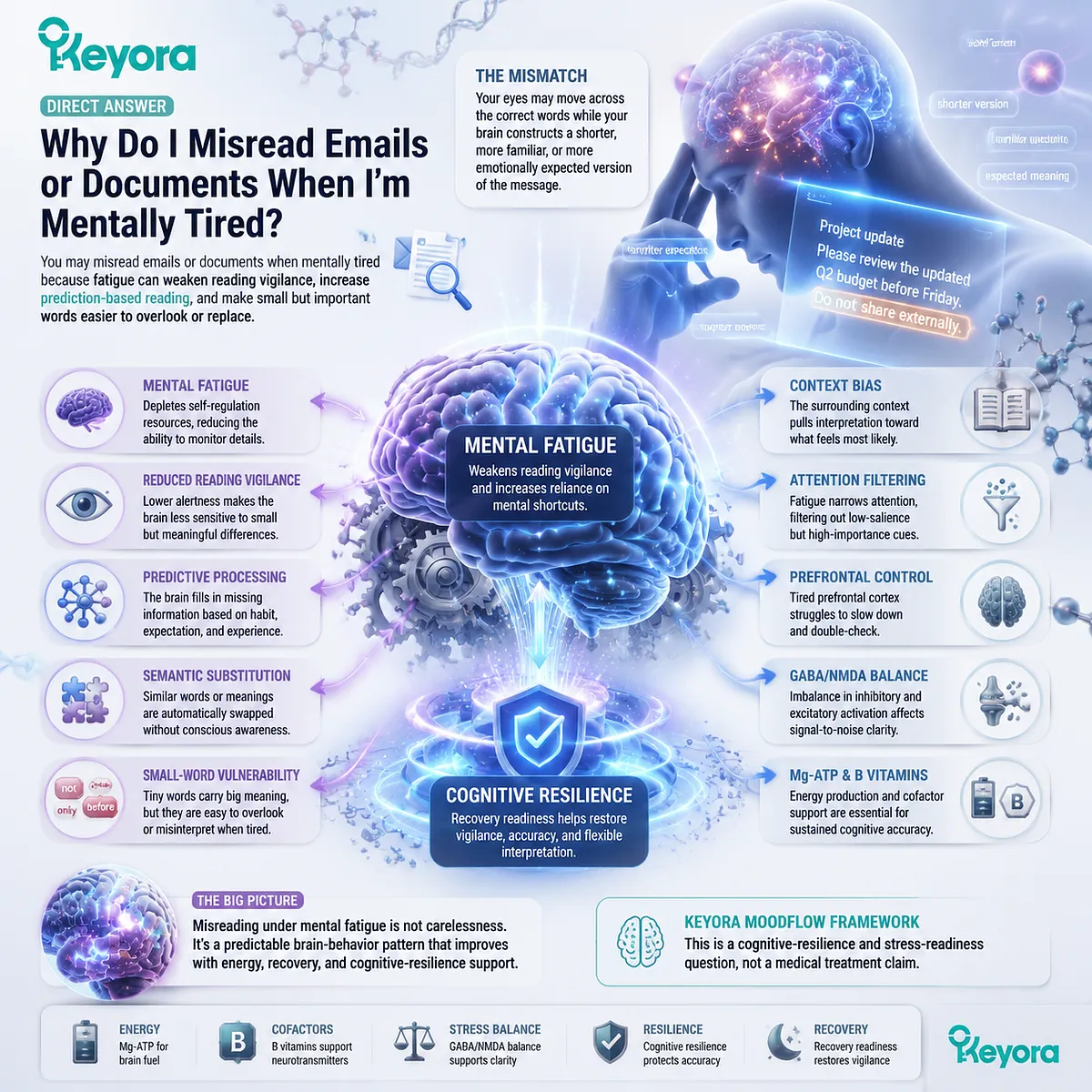
You may misread emails or documents when mentally tired because fatigue can weaken reading vigilance, increase prediction-based reading, and make small but important words easier to overlook or replace.
The mismatch is this: your eyes may move across the correct words while your brain constructs a shorter, more familiar, or more emotionally expected version of the message.
This can involve mental fatigue, reduced reading vigilance, predictive processing, semantic substitution, small-word vulnerability, context bias, attention filtering, prefrontal control, GABA/NMDA activation balance, Mg-ATP energy background, B vitamin cofactor context, cognitive resilience, and recovery readiness.
In the Keyora MoodFlow framework, this is understood as a cognitive-resilience and stress-readiness question, not a medical treatment claim.
Why the Words Can Be There but the Meaning Comes Out Wrong
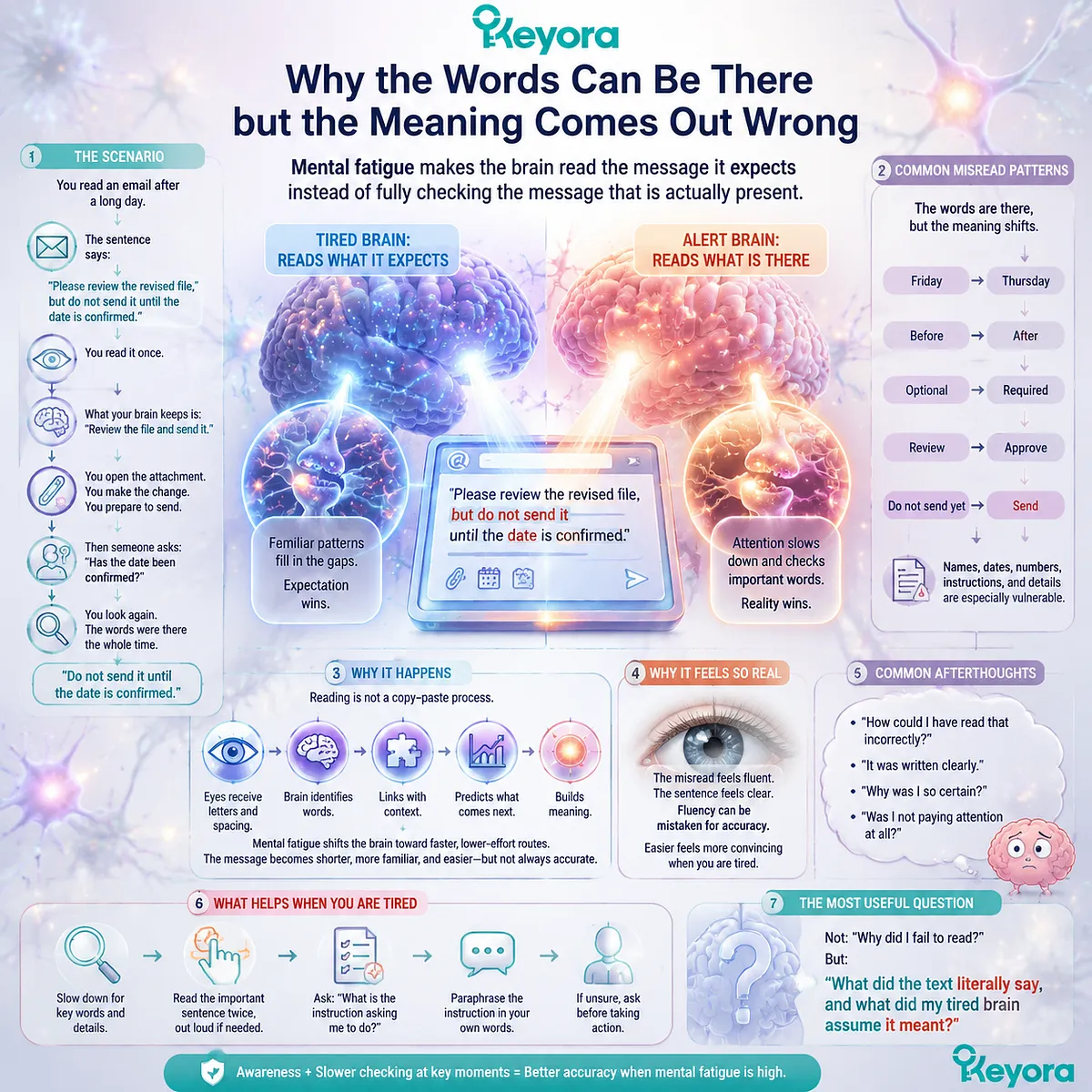
Mental fatigue can make the brain read the message it expects instead of fully checking the message that is actually present.
You read the email near the end of a long day.
The sentence says:
“Please review the revised file, but do not send it until the date is confirmed.”
You read it once.
What your brain keeps is:
“Review the file and send it.”
You open the attachment. You make the change. You prepare to send the message.
Then someone asks:
“Has the date been confirmed?”
You look at the email again.
The words were there the whole time:
“Do not send it until the date is confirmed.”
You did not decide to ignore the instruction. Your eyes passed over it. You may even remember looking directly at the sentence.
But your tired brain built a shorter and more familiar version of the message.
This can happen with dates, names, instructions, reports, contracts, task requests, meeting notes, or short messages.
Friday becomes Thursday.
“Before” becomes “after.”
“Optional” feels like “required.”
“Review” becomes “approve.”
“Do not send yet” is reduced to “send.”
The mistake can be difficult to understand afterward because the original words look obvious once someone points them out.
You may think:
“How could I have read that incorrectly?”
“It was written clearly.”
“Why was I so certain?”
“Was I not paying attention at all?”
But reading is not a perfect copy-and-paste process.
Your eyes receive patterns of letters and spacing. Your brain then identifies words, links them with context, predicts what is likely to come next, and builds meaning.
Most of the time, this process is efficient and useful. It allows you to read quickly without analyzing every letter separately.
Mental fatigue can change the balance.
Instead of carefully checking what each important word contributes, the brain may rely more heavily on the sentence it expects to see.
A familiar work email may be compressed into a familiar instruction.
A standard request may be interpreted according to what usually happens next.
A message from someone you find intimidating may sound more critical than the actual wording.
The words are still on the screen, but the interpretation begins to come from expectation as much as from the text itself.
This is why a misread can feel fluent.
The sentence may not feel confusing. It may feel completely clear because the brain has produced a smooth, familiar meaning.
Fluency can be mistaken for accuracy.
When you are tired, a fast interpretation may feel easier and therefore more convincing. That does not mean you lack reading ability. It may mean your brain is using a lower-effort route through the information.
A more useful question is not:
“Why did I fail to read?”
It is:
“What did the text literally say, and what did my tired brain assume it meant?”
Why a Tired Brain Predicts More and Checks Less
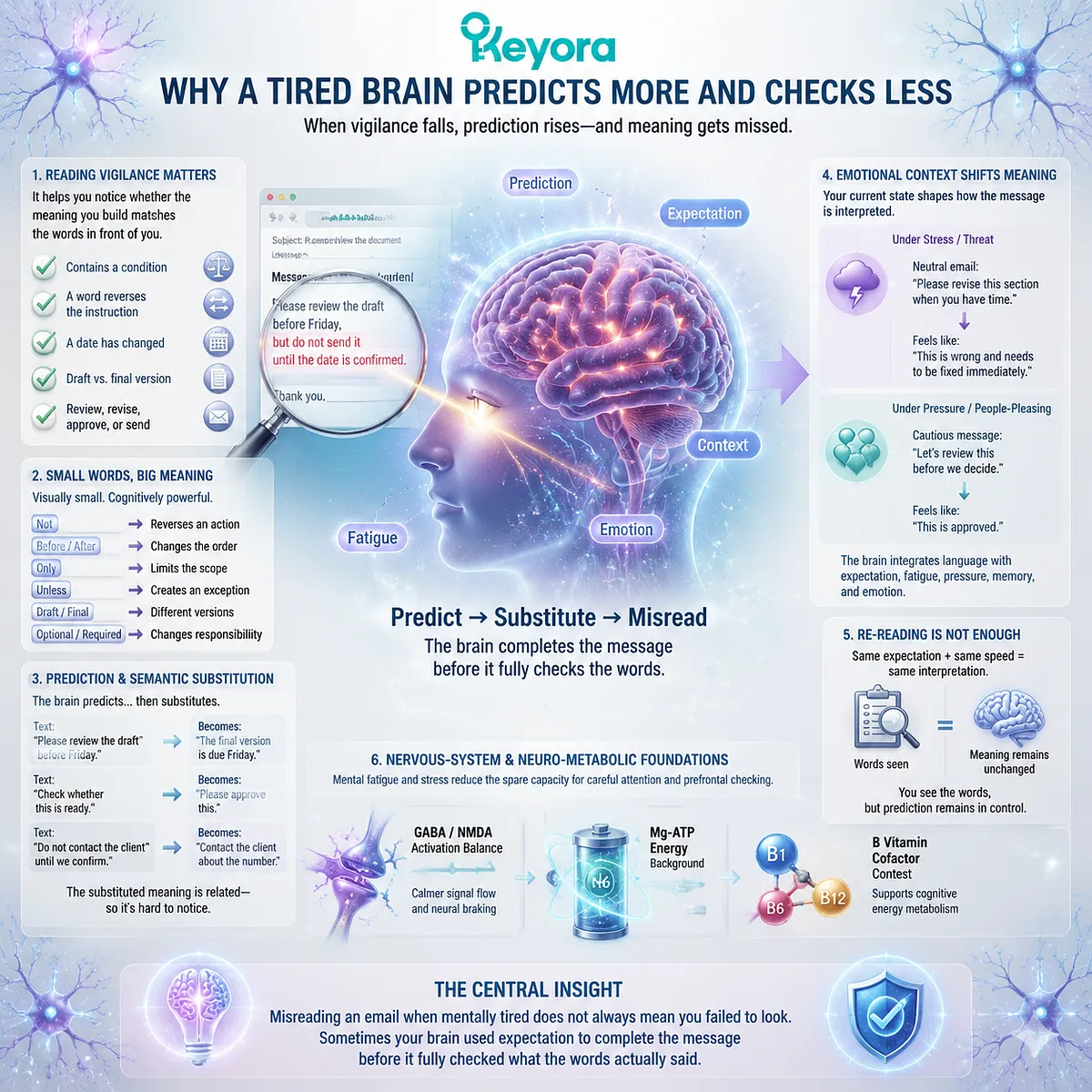
When reading vigilance falls, small words, conditions, and exceptions can disappear inside a faster predicted meaning.
Reading vigilance is the ongoing process of checking whether the meaning you are building matches the words in front of you.
It helps you notice:
-
whether a sentence contains a condition;
-
whether one word reverses the instruction;
-
whether a date has changed;
-
whether the file is a draft or a final version;
-
whether the request is to review, revise, approve, or send.
When mental energy is lower, this checking process may become less consistent.
You may still read the main nouns and actions.
You see “file,” “review,” “date,” and “send.”
But the connecting words may receive less attention.
That matters because small words can carry large instructions.
“Not” can reverse an action.
“Before” and “after” can change the order.
“Only” can limit who or what is included.
“Unless” can create an exception.
“Draft” and “final” can refer to different versions.
“Optional” and “required” can change the level of responsibility.
These words are visually small, but cognitively powerful.
A tired brain may preserve the general topic while weakening the relationships that make the message precise.
Predictive processing also becomes important.
Your brain is always making informed guesses about what comes next. If you have read many similar emails, it already knows the usual pattern.
“Please review the document and…”
The brain may predict:
“…send it back.”
If the actual sentence says:
“…do not send it until the date is confirmed,”
the predicted version can compete with the written version.
Mental fatigue can make the prediction easier to accept because checking every word requires more effort.
Semantic substitution may then occur.
This means the brain replaces the exact message with a simpler meaning that fits the context.
“Please review the draft before Friday” may become:
“The final version is due Friday.”
“Can you check whether this is ready?” may become:
“Please approve this.”
“Do not contact the client until we confirm the number” may become:
“Contact the client about the number.”
The substituted meaning is not random. It is usually related to the original text. That is why it can be hard to notice.
Emotional context can shape the substitution too.
Suppose you are already worried that your manager is unhappy.
A neutral email saying:
“Please revise this section when you have time”
may feel like:
“This is wrong and needs to be fixed immediately.”
The text may not contain urgency or criticism, but your current emotional state helps fill in the tone.
The same thing can happen in the opposite direction.
If you want a task to be finished, you may read a cautious message as approval.
If you are afraid of disappointing someone, you may read a request as a warning.
The brain is not only reading language. It is integrating language with expectation, fatigue, pressure, memory, and emotion.
This also explains why simply rereading the sentence may not solve the problem.
If you reread it with the same expectation and at the same speed, the brain may construct the same interpretation again.
You see the original words, but the predicted meaning remains in control.
At the nervous-system level, mental fatigue and stress can reduce the spare capacity available for careful attention filtering and prefrontal checking. GABA/NMDA activation balance can be understood as part of the background for calmer signal flow and neural braking.
Mg-ATP energy background and B vitamin cofactor context also belong to the broader neuro-metabolic picture because sustained reading, attention control, interpretation, and error monitoring all require energy.
The central insight is this:
Misreading an email when mentally tired does not always mean you failed to look. Sometimes your brain used expectation to complete the message before it fully checked what the words actually said.
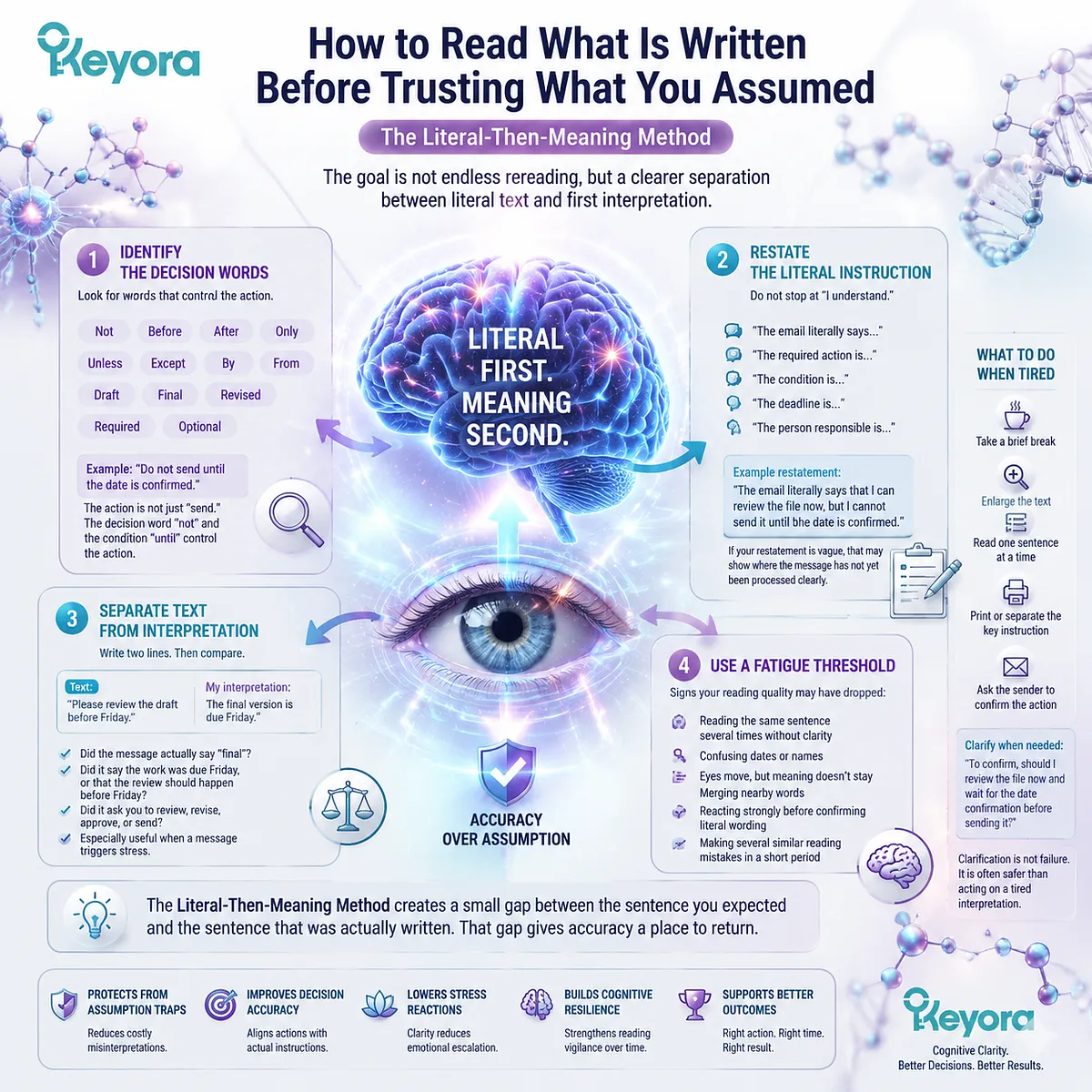
How to Read What Is Written Before Trusting What You Assumed
The goal is not endless rereading, but a clearer separation between literal text and first interpretation.
A helpful approach is The Literal-Then-Meaning Method.
This method is not about reading every message painfully slowly. It is for situations where one word, condition, date, or action could meaningfully change what happens next.
Step one: identify the decision words.
Do not give every word the same level of attention.
Look specifically for words that control the action:
Not.
Before.
After.
Only.
Unless.
Except.
By.
From.
Draft.
Final.
Revised.
Required.
Optional.
You can highlight them, underline them, or repeat them quietly.
For example:
“Do not send until the date is confirmed.”
The action is not just “send.”
The decision word “not” and the condition “until” control the action.
Step two: restate the literal instruction.
After reading, do not stop at:
“I understand.”
Say or write:
“The email literally says…”
“The required action is…”
“The condition is…”
“The deadline is…”
“The person responsible is…”
For example:
“The email literally says that I can review the file now, but I cannot send it until the date is confirmed.”
This forces the condition back into the meaning.
If your restatement is vague, that may show where the message has not yet been processed clearly.
Step three: separate text from interpretation.
Write two lines:
Text: “Please review the draft before Friday.”
My interpretation: “The final version is due Friday.”
Then compare them.
Did the message actually say “final”?
Did it say the work was due Friday, or that the review should happen before Friday?
Did it ask you to review, revise, approve, or send?
This step is especially useful when a message triggers stress.
You can write:
Text: “Can we discuss this tomorrow?”
My interpretation: “They are unhappy with my work.”
The interpretation may eventually prove correct or incorrect. The important point is that it is an interpretation, not a direct quotation from the message.
Step four: use a fatigue threshold.
Sometimes the most accurate reading strategy is to recognize that your reading quality has dropped.
Signs may include:
-
reading the same sentence several times without gaining clarity;
-
repeatedly confusing dates or names;
-
noticing that your eyes move but the meaning does not stay;
-
merging nearby words;
-
reacting strongly before confirming the literal wording;
-
making several similar reading mistakes in a short period.
At that point, forcing more effort may not be the best answer.
You might take a brief break, enlarge the text, read one sentence at a time, print or separate the key instruction, or ask the sender to confirm the important action.
For a non-urgent document, you may return after rest.
For an urgent message, you can send a precise clarification:
“To confirm, should I review the file now and wait for the date confirmation before sending it?”
Clarification is not failure.
It is often safer than acting on a tired interpretation.
The Literal-Then-Meaning Method creates a small gap between the sentence you expected and the sentence that was actually written.
That gap gives accuracy a place to return.
Where Nutritional Support Fits
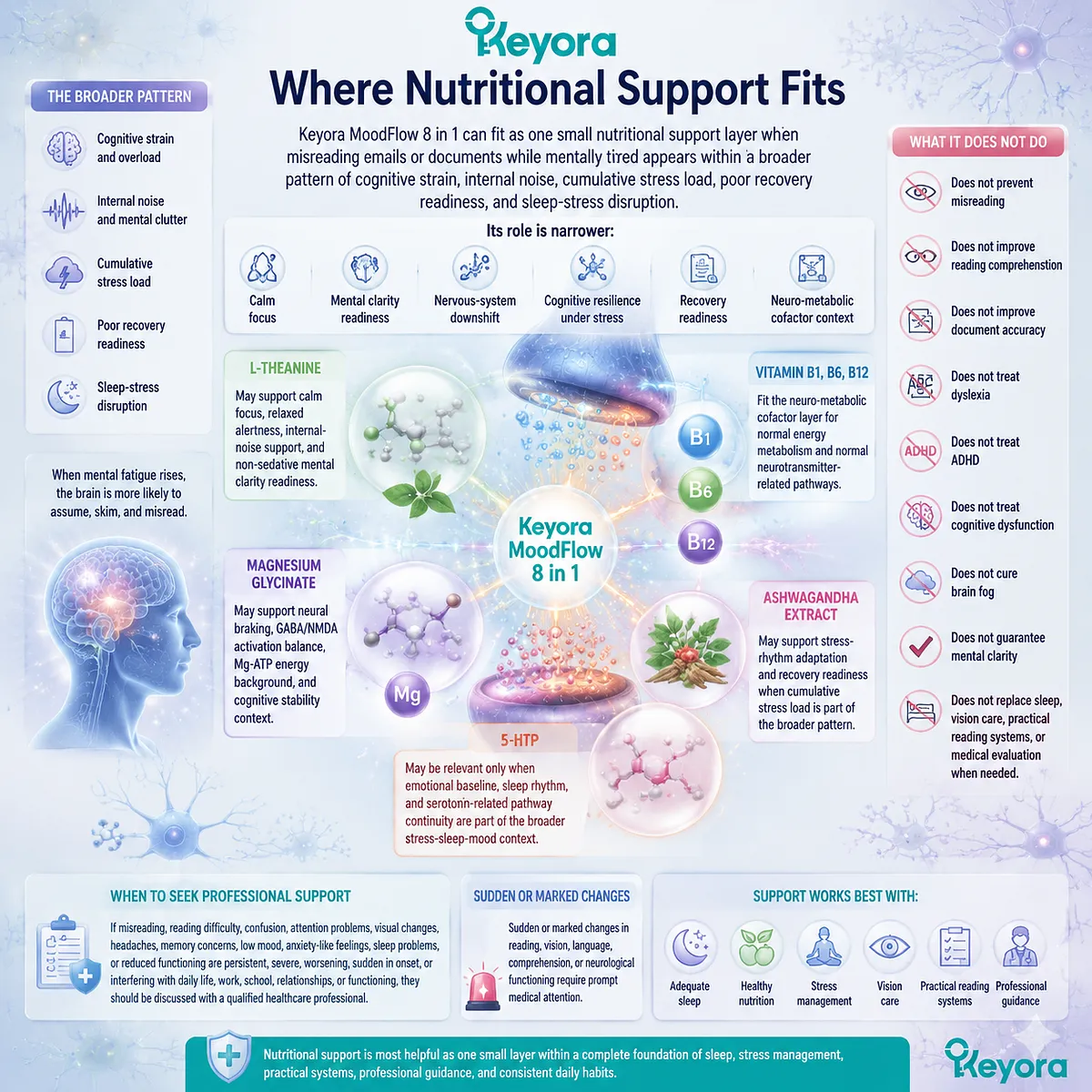
Keyora MoodFlow 8 in 1 can fit as one small nutritional support layer when misreading emails or documents while mentally tired appears within a broader pattern of cognitive strain, internal noise, cumulative stress load, poor recovery readiness, and sleep-stress disruption.
Its role is narrower: supporting wellness pathways related to calm focus, mental clarity readiness, nervous-system downshift, cognitive resilience under stress, recovery readiness, and neuro-metabolic cofactor context.
-
L-Theanine may support calm focus, relaxed alertness, internal-noise support, and non-sedative mental clarity readiness.
-
Magnesium glycinate may support neural braking, GABA/NMDA activation balance, Mg-ATP energy background, and cognitive stability context.
-
B1, B6, and B12 fit the neuro-metabolic cofactor layer for normal energy metabolism and normal neurotransmitter-related pathways.
-
Ashwagandha may support stress-rhythm adaptation and recovery readiness when cumulative stress load is part of the broader pattern.
-
5-HTP may be relevant only when emotional baseline, sleep rhythm, and serotonin-related pathway continuity are part of the broader stress-sleep-mood context.
Keyora MoodFlow 8 in 1 does not prevent misreading, improve reading comprehension, improve document accuracy, treat dyslexia, treat ADHD, treat cognitive dysfunction, cure brain fog, guarantee mental clarity, or replace sleep, vision care, practical reading systems, or medical evaluation when needed.
If misreading, reading difficulty, confusion, attention problems, visual changes, headaches, memory concerns, low mood, anxiety-like feelings, sleep problems, or reduced functioning are persistent, severe, worsening, sudden in onset, or interfering with daily life, work, school, relationships, or functioning, they should be discussed with a qualified healthcare professional.
Sudden or marked changes in reading, vision, language, comprehension, or neurological functioning require prompt medical attention.
Closing Summary
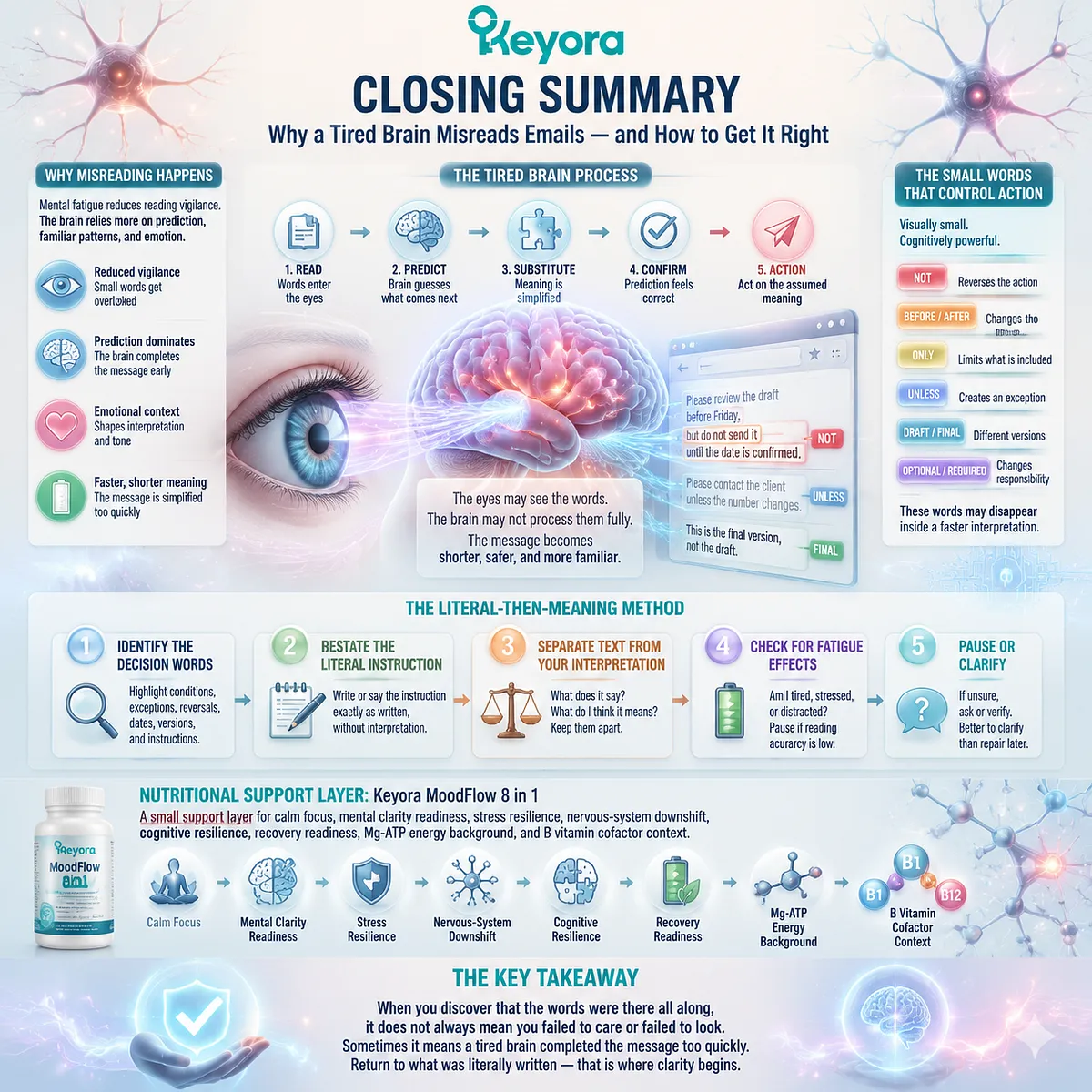
You may misread emails or documents when mentally tired because fatigue can reduce reading vigilance and make the brain rely more heavily on prediction, familiar patterns, and emotional context.
The eyes may pass over the correct words while the brain creates a shorter or more expected message. Small words such as “not,” “before,” “only,” “unless,” “draft,” and “final” can disappear inside that faster interpretation, even though they control the entire action.
The practical path is The Literal-Then-Meaning Method: identify the decision words, restate the literal instruction, separate the text from your interpretation, and recognize when fatigue has lowered reading accuracy enough to require a pause or clarification.
Keyora MoodFlow 8 in 1 belongs only as a small nutritional support layer for calm focus, mental clarity readiness, stress resilience, nervous-system downshift, cognitive resilience, recovery readiness, Mg-ATP energy background, and B vitamin cofactor context.
When you discover that the words were there all along, it does not always mean you failed to care or failed to look. Sometimes it means a tired brain completed the message too quickly, and the next helpful step is to return to what was literally written.
This article is for educational and informational purposes only. It does not provide medical advice, diagnosis, treatment, cure, prevention, disease outcome claims, hormone restoration claims, fertility outcome claims, or formula-specific clinical efficacy claims.