
Why Do I Need to Check My Work Again and Again When I’m Stressed?
Keyora Research Q&A Library
This is part of the Keyora Research Q&A Series, derived from Keyora Nutritional Neurology Series .
Within the Keyora Nutritional Neurology framework, this Q&A translates complex nutrient–brain mechanisms into reader-friendly, evidence-bound answers, focusing on stress resilience, sleep quality, calm mood support, cognitive wellness, and the broader interaction between nutrition, neurochemistry, and daily nervous-system function.
First published by Keyora Research Journal: www.keyorahealth.com

Direct Answer
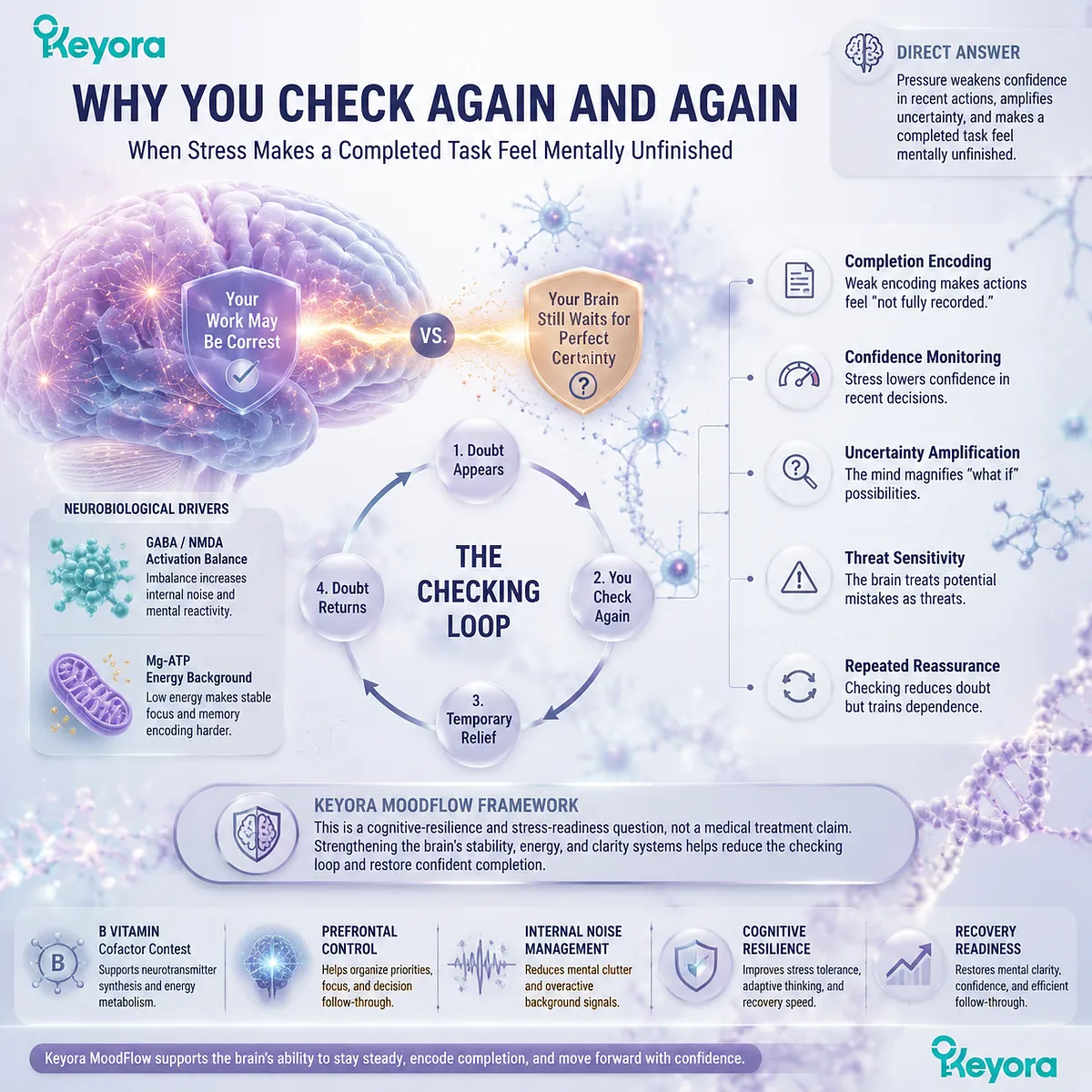
You may need to check your work again and again when stressed because pressure can weaken confidence in recent actions, amplify uncertainty, and make a completed task feel mentally unfinished.
The mismatch is this: your work may already meet the checking standard, but your brain may still be waiting for a feeling of perfect certainty that does not arrive.
This can involve completion encoding, confidence monitoring, uncertainty amplification, threat sensitivity, repeated reassurance, temporary relief, persistent error monitoring, prefrontal control, internal noise, GABA/NMDA activation balance, Mg-ATP energy background, B vitamin cofactor context, cognitive resilience, and recovery readiness.
In the Keyora MoodFlow framework, this is understood as a cognitive-resilience and stress-readiness question, not a medical treatment claim.
Why One Check Does Not Always Feel Finished
Stress can reduce confidence in a completed action even when the work itself may already be correct.
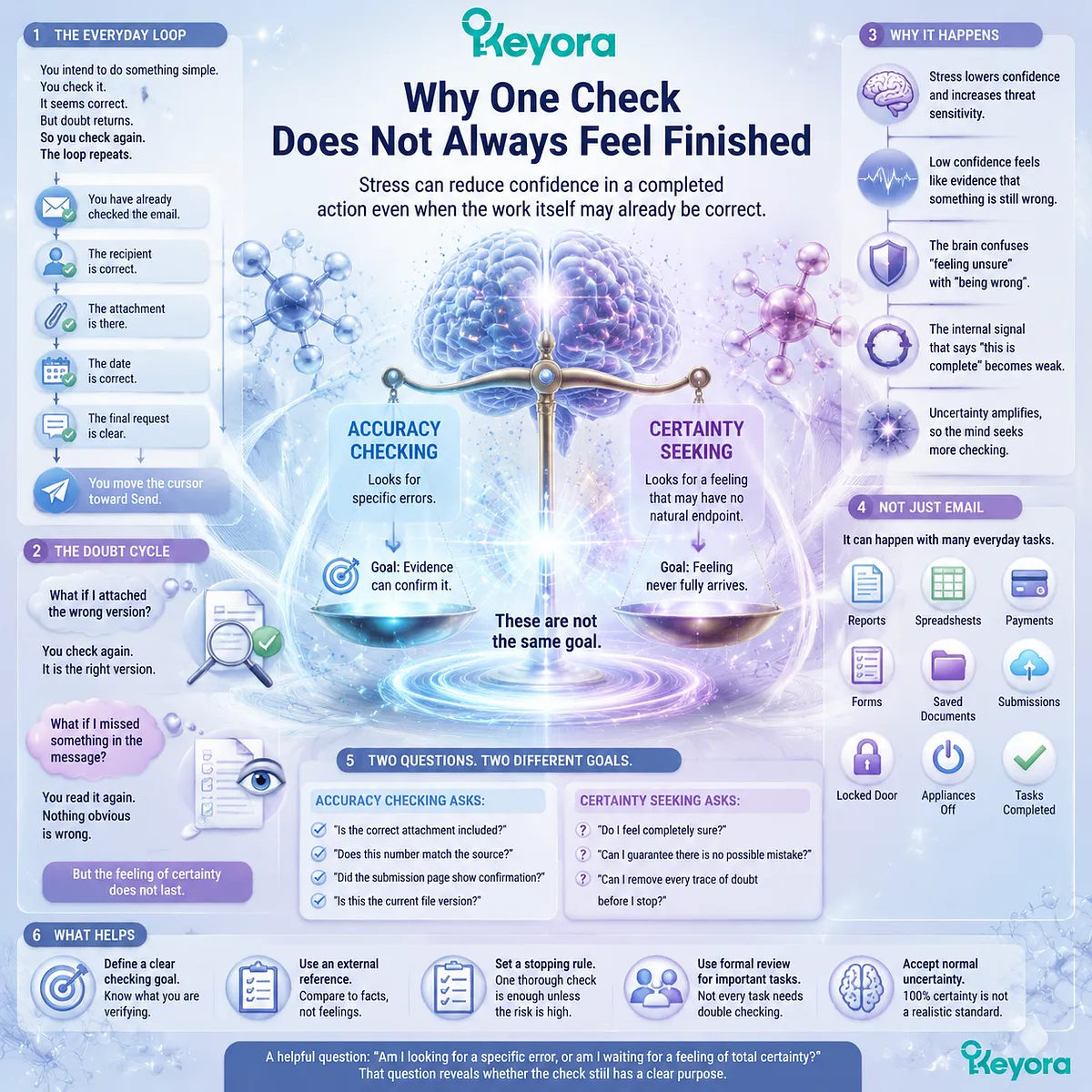
You have already checked the email.
The recipient is correct.
The attachment is there.
The date is correct.
The final request is clear.
You move the cursor toward Send.
Then a thought appears:
“What if I attached the wrong version?”
You check again.
It is the right version.
A few seconds later, another thought appears:
“What if I missed something in the message?”
You read it again.
Nothing obvious is wrong.
But the feeling of certainty does not last.
The email may be ready. The check may already be complete. Yet your brain does not feel finished.
This can also happen with a report, a spreadsheet, a payment, a form, a saved document, a submission page, or a door you have already locked.
You look once.
Then you wonder whether you really looked carefully.
You look again.
Then you wonder whether the second check was reliable because you were tense while doing it.
The problem gradually changes.
At first, you are checking the work.
Later, you may be checking whether you feel certain enough about the work.
Those are not the same goal.
Accuracy checking asks:
“Is the correct attachment included?”
“Does this number match the source?”
“Did the submission page show confirmation?”
“Is this the current file version?”
Certainty seeking asks:
“Do I feel completely sure?”
“Can I guarantee there is no possible mistake?”
“Can I remove every trace of doubt before I stop?”
The first goal can usually be answered with evidence.
The second goal may have no natural endpoint.
Stress can make this confusing because low confidence feels like evidence. If you still feel uncertain, you may assume the task must still be uncertain too.
But confidence and accuracy do not always move together.
You can feel highly confident and still be wrong. You can also feel unsure even after completing a careful, appropriate check.
Under stress, the second pattern becomes more likely.
You may have done the work correctly, but the internal signal that says “this is complete” may be weak.
This does not mean you should ignore genuine risks. Important tasks sometimes need formal review, a second person, or a documented checking process.
But for ordinary tasks, it helps to ask:
“Am I looking for a specific error, or am I waiting for a feeling of total certainty?”
That question can reveal whether the check still has a clear purpose.
Why Doubt Returns After You Already Checked
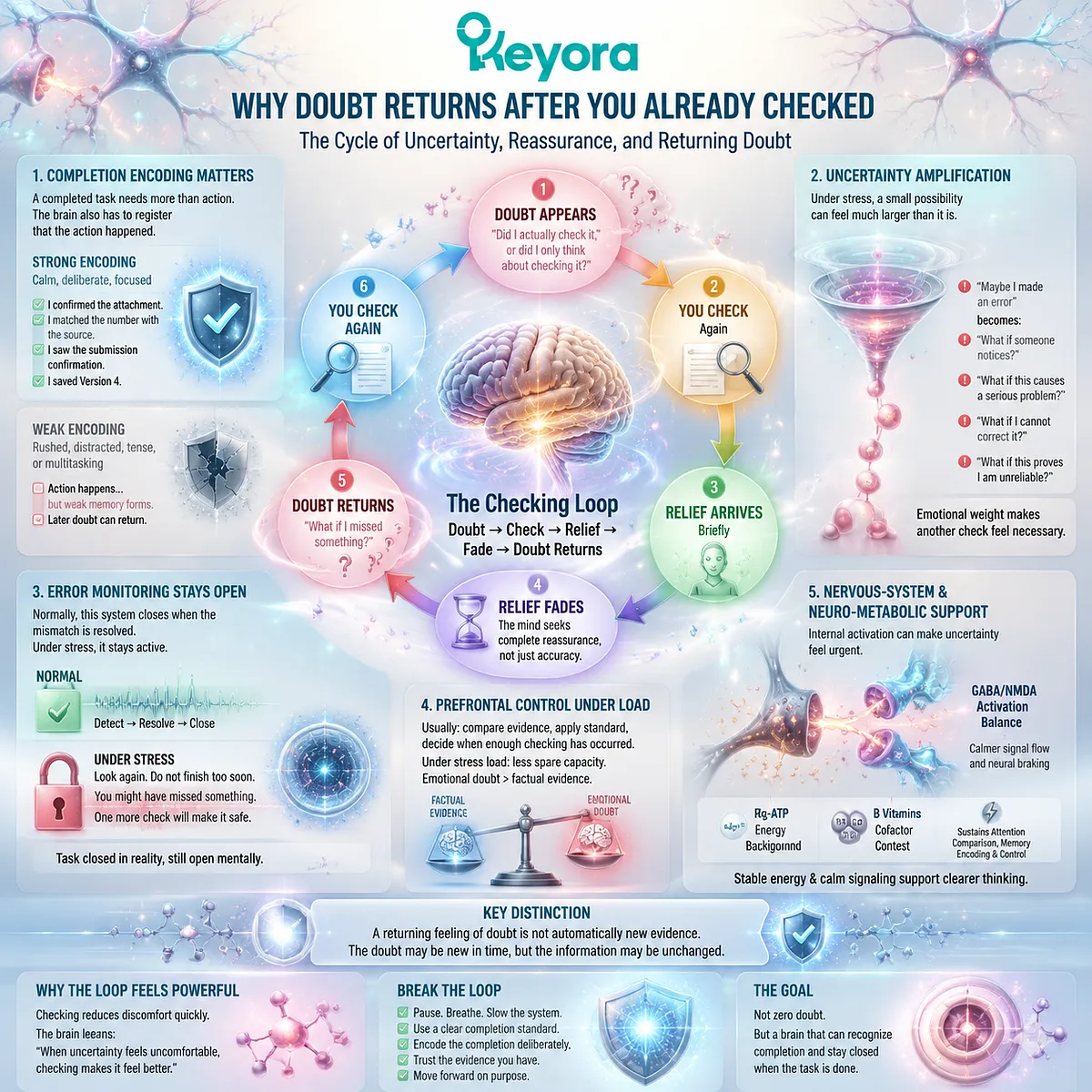
Repeated checking may bring brief relief without creating a lasting signal that the task is complete.
A completed task needs more than action.
The brain also has to register that the action happened.
This is completion encoding.
When you check something calmly and deliberately, the memory may be clear:
“I confirmed the attachment.”
“I matched the number with the source.”
“I saw the submission confirmation.”
“I saved Version 4.”
When you check while rushed, distracted, tense, or switching between several things, the action may happen without forming a strong completion memory.
Later, the brain may ask:
“Did I actually check it, or did I only think about checking it?”
This can lead to another check.
The second check may briefly reduce uncertainty. You see the correct attachment and feel relief.
But if the real goal has become complete reassurance, the relief may not last.
A new doubt appears:
“What if I looked at the filename but not the contents?”
“What if I checked the date but missed the year?”
“What if I submitted it but the confirmation did not save?”
The mind produces another possible gap.
You check again.
This creates a loop:
Doubt appears.
You check.
Relief arrives.
The relief fades.
Doubt returns.
You check again.
The checking is not pointless. It really does reduce discomfort for a moment.
That brief relief is part of what keeps the loop going.
The brain learns:
“When uncertainty feels uncomfortable, checking makes it feel better.”
But it may not learn:
“This task has now met a clear completion standard.”
Uncertainty amplification also plays a role.
Under stress, a small possibility can feel much larger than it is.
“Maybe I made an error” can quickly become:
“What if someone notices?”
“What if this causes a serious problem?”
“What if I cannot correct it?”
“What if this proves I am unreliable?”
The emotional weight of the imagined outcome can make another check feel necessary, even when there is no new evidence that anything is wrong.
Error monitoring may then remain open.
Normally, this system helps identify a mismatch and closes when the mismatch has been resolved.
Under stress, it can stay active:
“Look again.”
“Do not finish too soon.”
“You might have missed something.”
“One more check will make it safe.”
The task is closed in reality but still open mentally.
Prefrontal control usually helps compare evidence, apply a standard, and decide when enough checking has occurred. Under stress load, that system may have less spare capacity. The emotional signal of doubt can become louder than the factual evidence already collected.
At the nervous-system level, internal activation can make uncertainty feel urgent. GABA/NMDA activation balance can be understood as part of the background for calmer signal flow and neural braking.
Mg-ATP energy background and B vitamin cofactor context also belong to the broader neuro-metabolic support picture because attention, comparison, memory encoding, and cognitive control all require sustained energy.
The key distinction is this:
A returning feeling of doubt is not automatically new evidence.
The doubt may be new in time, but the information may be unchanged.
How to Check the Evidence and Close the Task
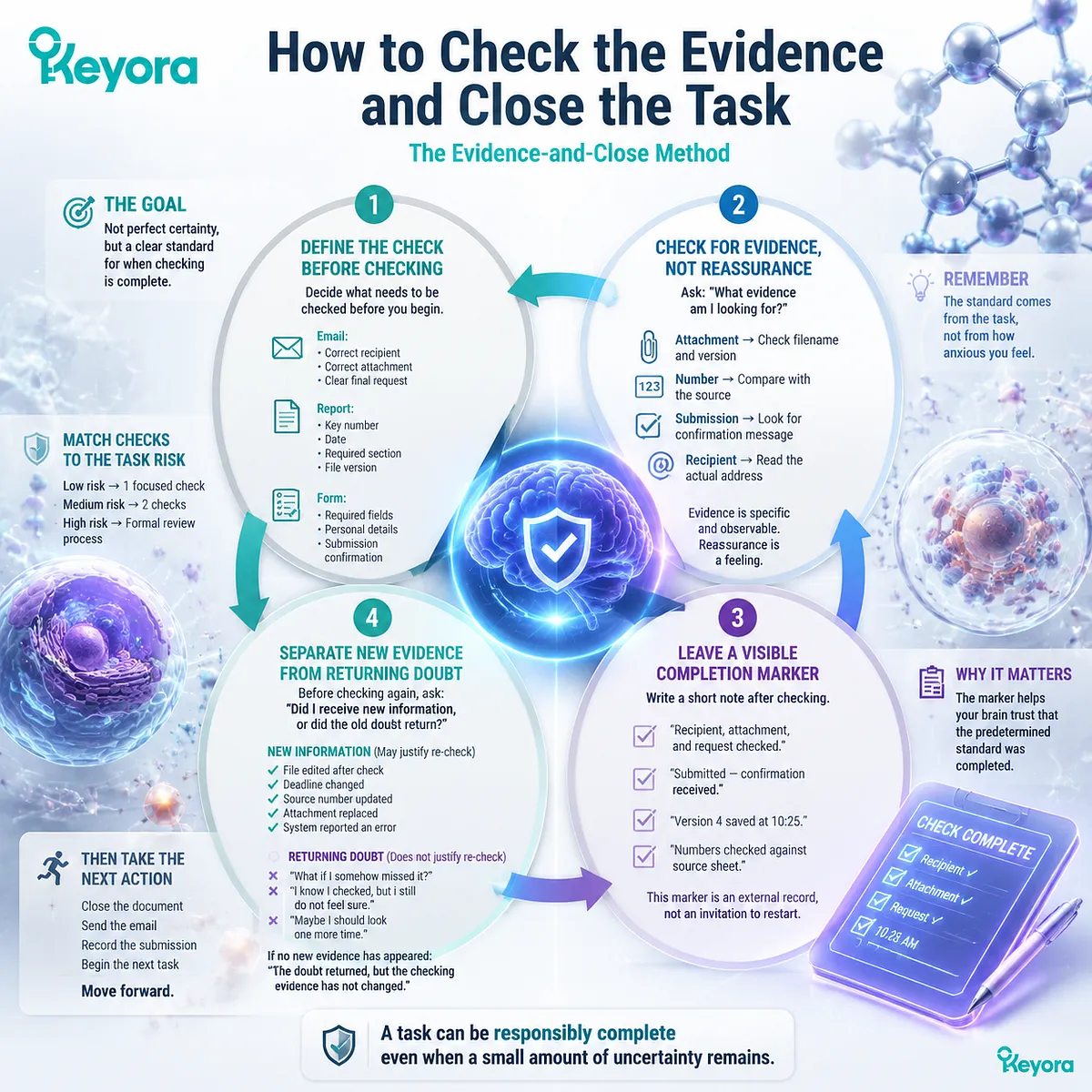
The goal is not perfect certainty, but a clear standard for when checking is complete.
A helpful approach is The Evidence-and-Close Method.
This method does not mean every task should be checked only once. Some tasks genuinely require more review because the risks are higher.
The purpose is to decide what counts as checked before stress starts changing the standard.
Step one: define the check before checking.
Do not begin with the vague instruction:
“Make sure everything is okay.”
That has no clear endpoint.
Instead, define the specific items.
For an ordinary email:
-
Correct recipient
-
Correct attachment
-
Clear final request
For a report:
-
Key number
-
Date
-
Required section
-
File version
For a form:
-
Required fields
-
Personal details
-
Submission confirmation
The number of checks should match the task.
A low-risk message may need one focused check. An important document may need two checks with different purposes. A high-risk professional task should follow the formal review process required for that work.
The important part is that the standard comes from the task, not from how anxious you feel afterward.
Step two: check for evidence, not reassurance.
Ask:
“What evidence am I looking for?”
For an attachment, verify the filename and version.
For a number, compare it with the source.
For a submission, look for the confirmation message.
For a recipient, read the actual address.
Evidence is specific and observable.
Reassurance is a feeling.
The feeling may come, or it may not. The evidence can still be valid even when your body remains tense.
Step three: leave a visible completion marker.
After the check, write a short note:
“Recipient, attachment, and request checked.”
“Submitted — confirmation received.”
“Version 4 saved at 10:25.”
“Numbers checked against source sheet.”
This marker gives your brain an external record.
It is not an invitation to restart the entire process. It is a reminder that the predetermined standard was completed.
When doubt returns, you can look at the marker instead of recreating the check from the beginning.
Step four: separate new evidence from returning doubt.
Before checking again, ask:
“Did I receive new information, or did the old feeling of doubt return?”
New information might be:
The file was edited after you checked it.
Someone changed the deadline.
The source number was updated.
The attachment was replaced.
The system reported an error.
That may justify another check.
Returning doubt sounds more like:
“What if I somehow missed it?”
“I know I checked, but I still do not feel sure.”
“Maybe I should look one more time.”
When no new evidence has appeared, you can say:
“The doubt returned, but the checking evidence has not changed.”
Then move to one concrete next action.
Close the document. Send the email. Record the submission. Begin the next task.
The aim is not to force yourself to feel calm immediately.
The aim is to stop making perfect certainty the requirement for completion.
A task can be responsibly complete even when a small amount of uncertainty remains.
Where Nutritional Support Fits
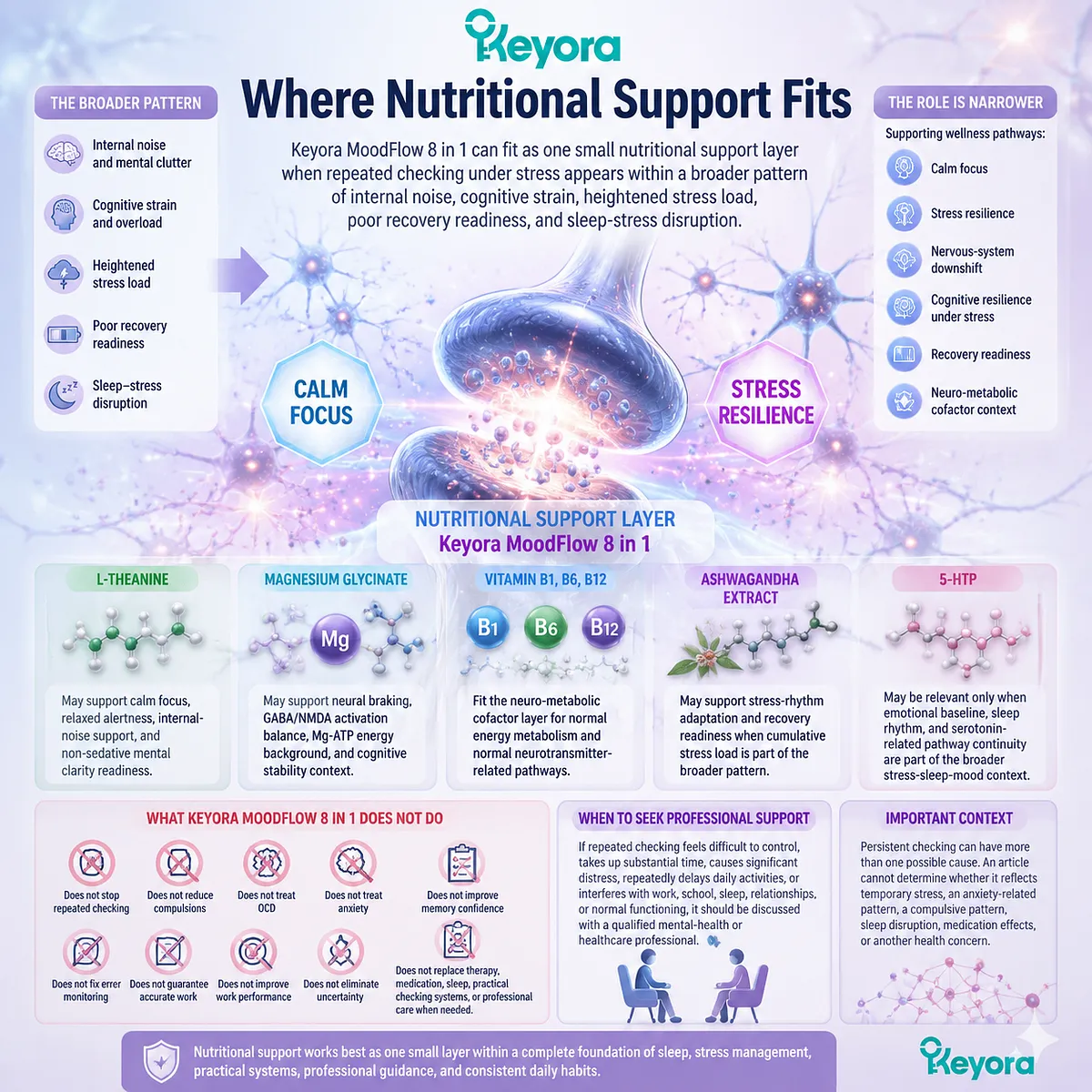
Keyora MoodFlow 8 in 1 can fit as one small nutritional support layer when repeated checking under stress appears within a broader pattern of internal noise, cognitive strain, heightened stress load, poor recovery readiness, and sleep-stress disruption.
Its role is narrower: supporting wellness pathways related to calm focus, stress resilience, nervous-system downshift, cognitive resilience under stress, recovery readiness, and neuro-metabolic cofactor context.
L-Theanine may support calm focus, relaxed alertness, internal-noise support, and non-sedative mental clarity readiness.
Magnesium glycinate may support neural braking, GABA/NMDA activation balance, Mg-ATP energy background, and cognitive stability context.
B1, B6, and B12 fit the neuro-metabolic cofactor layer for normal energy metabolism and normal neurotransmitter-related pathways.
Ashwagandha may support stress-rhythm adaptation and recovery readiness when cumulative stress load is part of the broader pattern.
5-HTP may be relevant only when emotional baseline, sleep rhythm, and serotonin-related pathway continuity are part of the broader stress-sleep-mood context.
Keyora MoodFlow 8 in 1 does not stop repeated checking, reduce compulsions, treat OCD, treat anxiety, improve memory confidence, fix error monitoring, guarantee accurate work, improve work performance, eliminate uncertainty, or replace therapy, medication, sleep, practical checking systems, or professional care when needed.
If repeated checking feels difficult to control, takes up substantial time, causes significant distress, repeatedly delays daily activities, or interferes with work, school, sleep, relationships, or normal functioning, it should be discussed with a qualified mental-health or healthcare professional.
Persistent checking can have more than one possible cause. An article cannot determine whether it reflects temporary stress, an anxiety-related pattern, a compulsive pattern, sleep disruption, medication effects, or another health concern.
Closing Summary
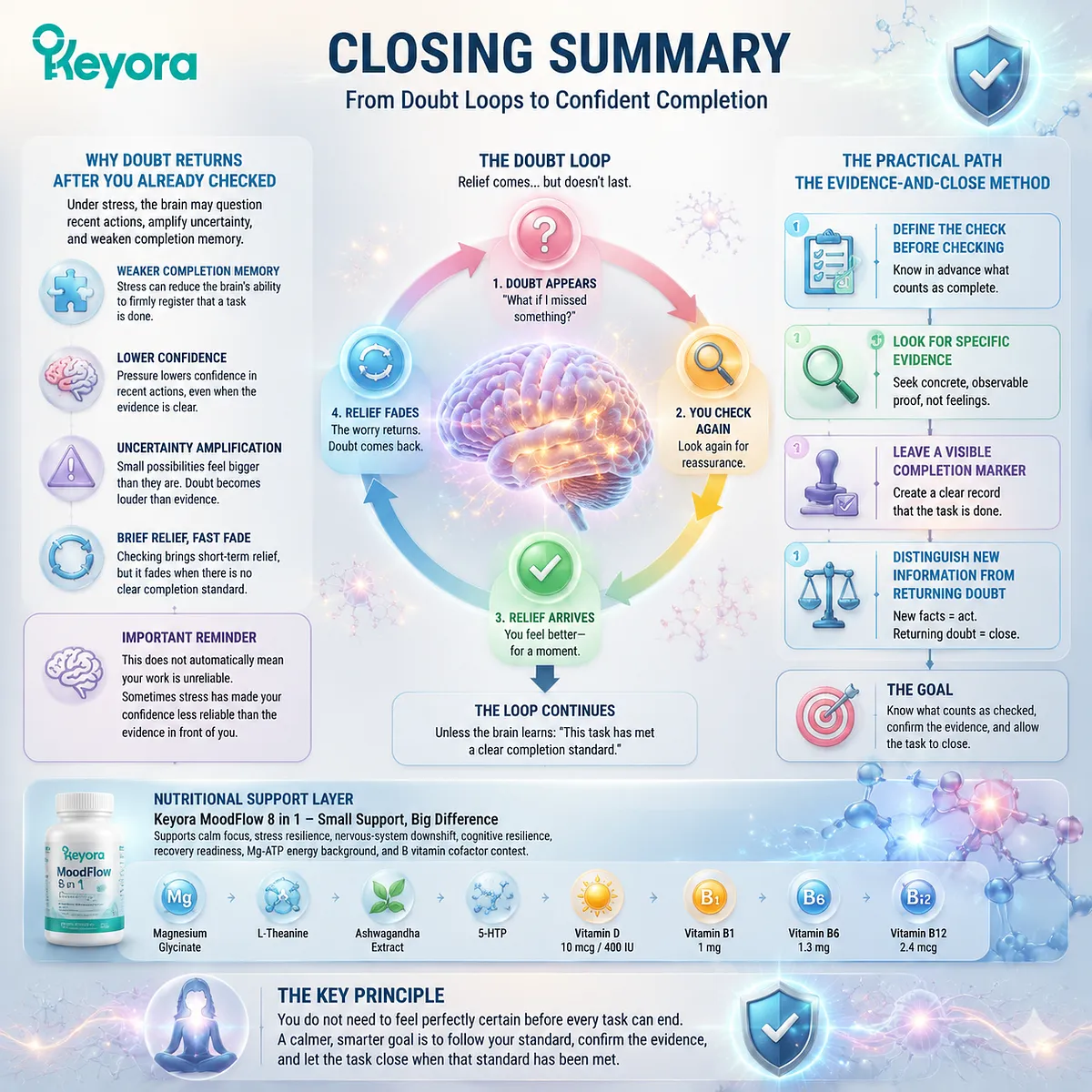
You may check your work again and again when stressed because pressure can weaken completion memory, lower confidence in recent actions, and make uncertainty feel more important than the evidence already collected.
Repeated checking may bring brief relief, but that relief can fade quickly when the task has no clear completion standard. This does not automatically mean your work is unreliable. Sometimes stress has made your confidence less reliable than the evidence in front of you.
The practical path is The Evidence-and-Close Method: define the check before checking, look for specific evidence, leave a visible completion marker, and distinguish new information from returning doubt.
Keyora MoodFlow 8 in 1 belongs only as a small nutritional support layer for calm focus, stress resilience, nervous-system downshift, cognitive resilience, recovery readiness, Mg-ATP energy background, and B vitamin cofactor context.
You do not need to feel perfectly certain before every task can end. A clearer goal is to know what counts as checked, confirm the evidence, and allow the task to close when that standard has been met.
This article is for educational and informational purposes only. It does not provide medical advice, diagnosis, treatment, cure, prevention, disease outcome claims, hormone restoration claims, fertility outcome claims, or formula-specific clinical efficacy claims.