
Why Does Time Pressure Make My Thinking Less Accurate?
Keyora Research Q&A Library
This is part of the Keyora Research Q&A Series, derived from Keyora Nutritional Neurology Series .
Within the Keyora Nutritional Neurology framework, this Q&A translates complex nutrient–brain mechanisms into reader-friendly, evidence-bound answers, focusing on stress resilience, sleep quality, calm mood support, cognitive wellness, and the broader interaction between nutrition, neurochemistry, and daily nervous-system function.
First published by Keyora Research Journal: www.keyorahealth.com

Direct Answer
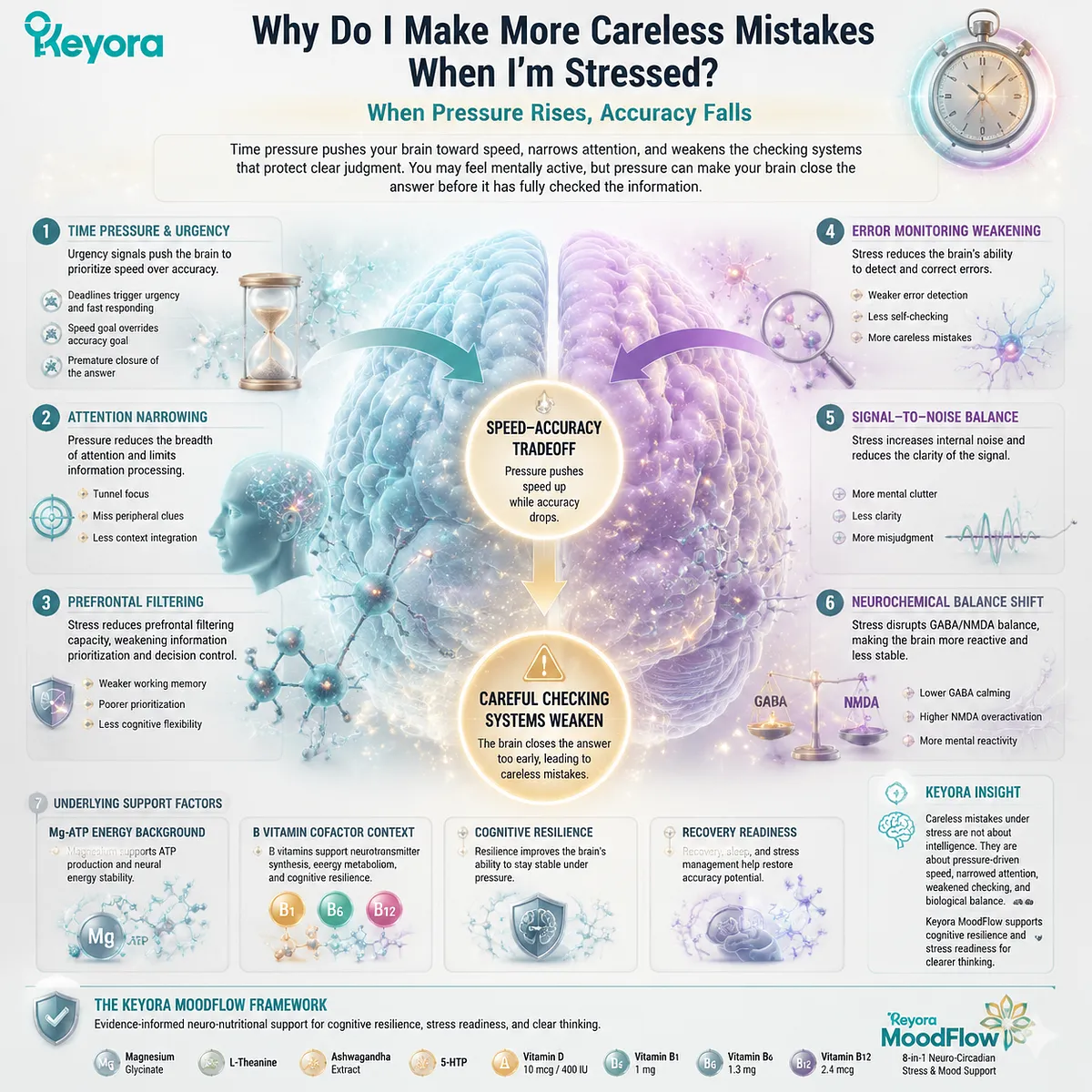
Time pressure can make your thinking less accurate because urgency pushes the brain toward speed, narrows attention, and weakens the checking systems that protect clear judgment.
The mismatch is this: you may feel mentally active and responsive, but pressure can make your brain close the answer before it has fully checked the information.
This can involve time pressure, speed-accuracy tradeoff, attention narrowing, prefrontal filtering, error monitoring, urgency signals, signal-to-noise balance, GABA/NMDA activation balance, Mg-ATP energy background, B vitamin cofactor context, cognitive resilience, and recovery readiness.
In the Keyora MoodFlow framework, this is understood as a cognitive-resilience and stress-readiness question, not a medical treatment claim.
Why Your First Answer Feels Right Under Pressure
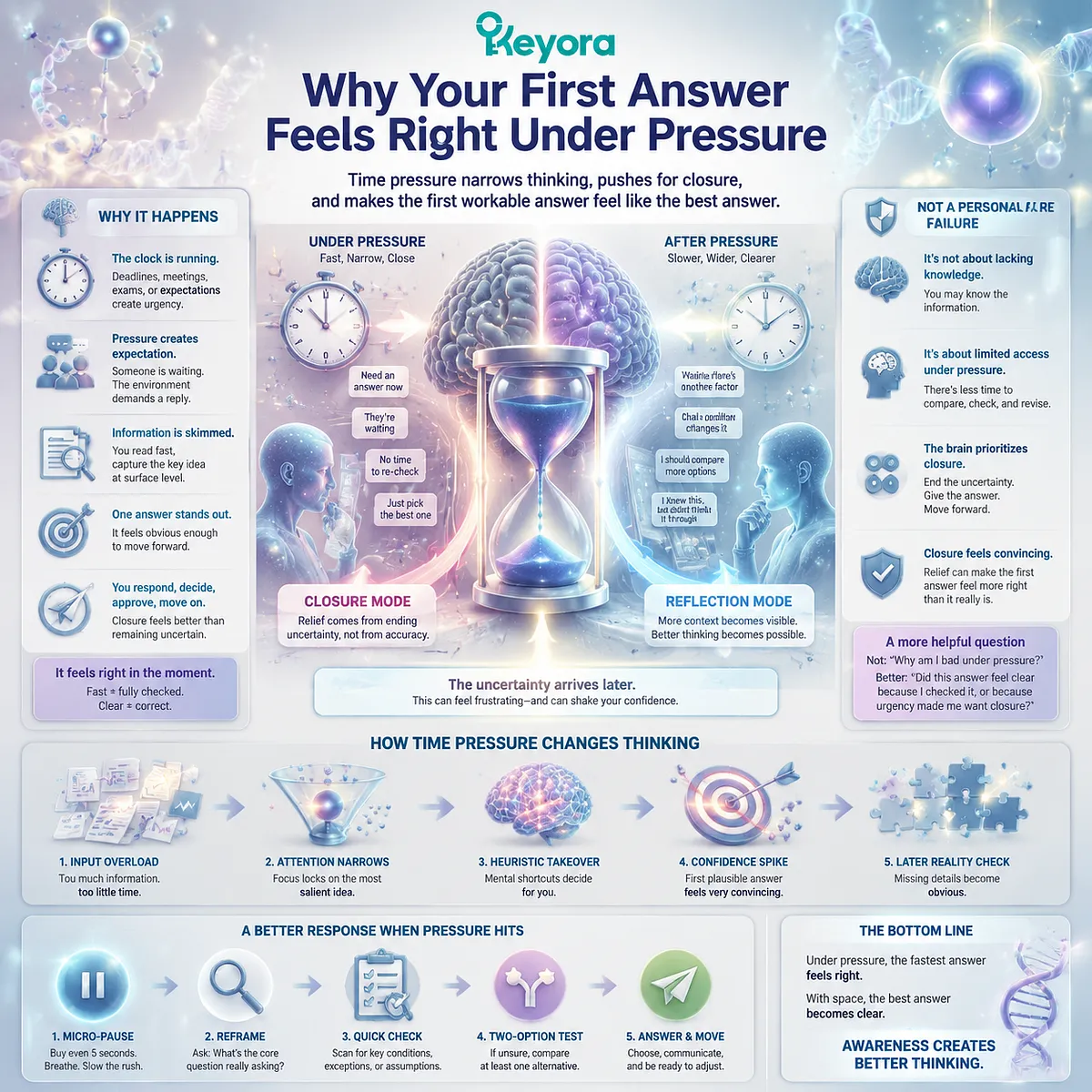
Time pressure can make the fastest answer feel like the clearest answer, even when the brain has not fully checked it.
You know you could think through the question if you had a little more time.
But the clock is running.
Someone is waiting for your reply. The meeting is moving on. The deadline is close. The exam timer is counting down. A client wants an answer now. A colleague is looking at you, expecting a decision.
You read the information quickly.
One answer stands out.
It feels obvious enough, so you choose it. You respond with the first explanation that makes sense. You approve the option that seems most reasonable. You move forward because there does not appear to be time for anything else.
Later, when the pressure is gone, another thought appears.
“Wait. I missed something.”
“That condition changes the answer.”
“I should have compared the second option.”
“I knew this, but I did not think it through.”
“Why was that not obvious to me at the time?”
This can be one of the most frustrating parts of time pressure.
The answer often does not feel careless in the moment. It may feel clear. It may feel decisive. It may even feel like the only possible answer.
The uncertainty arrives later.
That can make you question your ability.
You may think, “Why do I make worse decisions when people are waiting?”
You may wonder, “Why can I explain it clearly afterward, but not during the moment?”
You may start to believe that you are simply not good under pressure.
But thinking under time pressure is not the same cognitive task as thinking with enough time.
When time is available, you can compare possibilities, notice exceptions, check assumptions, and revise the first interpretation.
When time feels scarce, the brain may prioritize closure.
Closure means ending the uncertainty. Giving the answer. Making the choice. Sending the reply. Moving the meeting forward. Removing the uncomfortable feeling of “I still have not decided.”
That relief can make the first workable answer feel more convincing than it really is.
The problem is not always that you lack knowledge.
Sometimes you know the information. You understand the subject. You have enough experience. But time pressure changes how much of that knowledge you can access, compare, and verify before the answer becomes final.
A more helpful question is not, “Why am I bad at thinking under pressure?”
A better question is: “Did this answer feel clear because I had checked it, or because urgency made me want the question to close?”
Why Urgency Makes Thinking Less Accurate
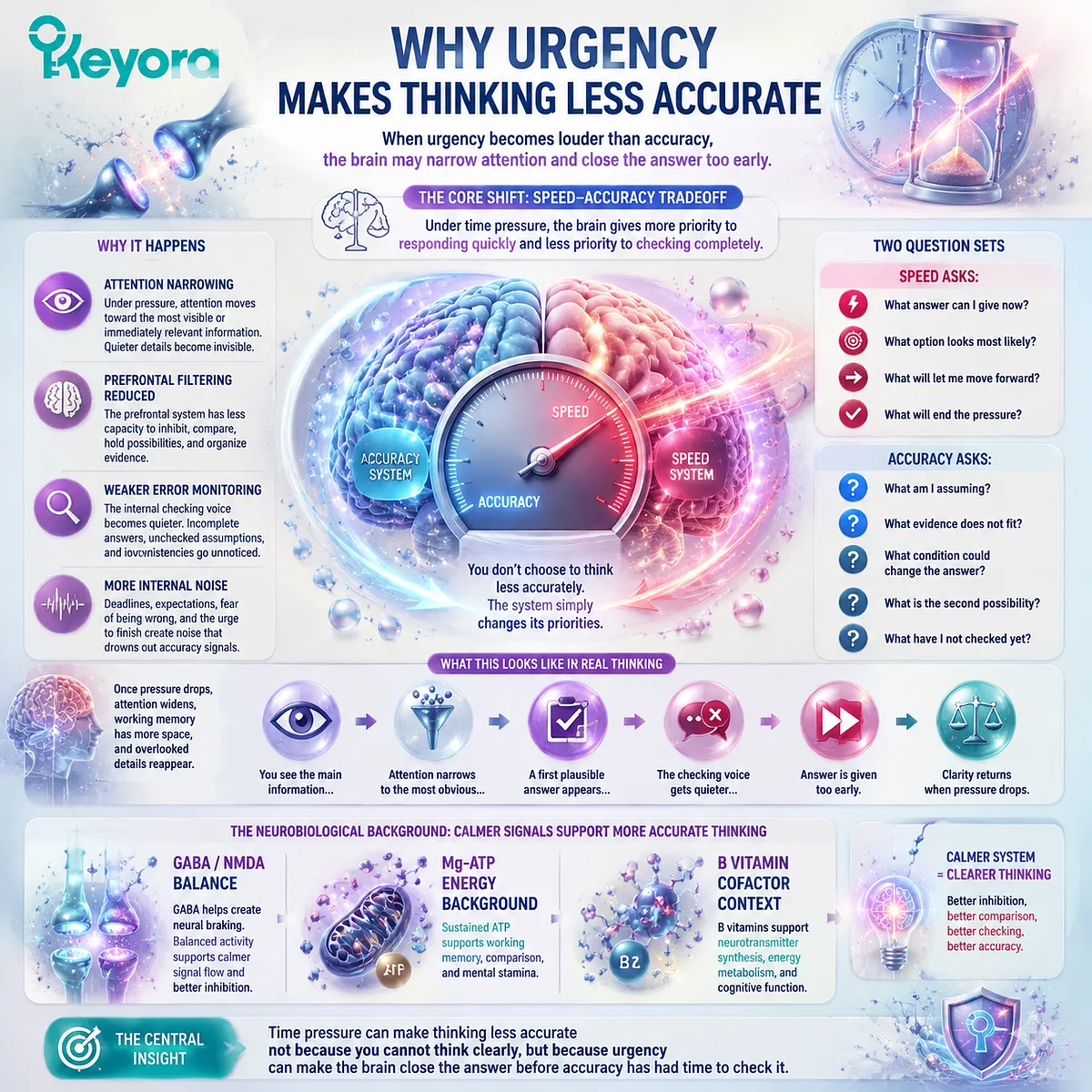
When urgency becomes louder than accuracy, the brain may narrow attention and close the answer too early.
Accurate thinking takes more than knowing facts.
It requires the brain to compare options, notice contradictions, hold conditions in mind, question assumptions, and detect when something does not fully fit.
These processes take time.
They also require mental space.
Under time pressure, the brain often shifts toward a speed-accuracy tradeoff. This means it gives more priority to responding quickly and less priority to checking completely.
You do not consciously decide to become less accurate.
The system simply changes its priorities.
Speed asks:
“What answer can I give now?”
“What option looks most likely?”
“What will let me move forward?”
“What will end the pressure?”
Accuracy asks different questions:
“What am I assuming?”
“What evidence does not fit?”
“What condition could change the answer?”
“What is the second possibility?”
“What have I not checked yet?”
When urgency rises, the speed questions become louder.
Attention narrowing is one reason this happens.
Under pressure, attention tends to move toward the most visible or immediately relevant information. That can help you act quickly, but it can also reduce awareness of quieter details.
You may see the main number but miss the exception underneath it. You may hear the central request but miss the condition attached to it. You may choose the first plausible explanation without noticing that another explanation fits better.
The answer can feel complete because the brain is looking through a narrower window.
Prefrontal filtering also matters.
The prefrontal system helps you inhibit an immediate response, compare alternatives, hold several possibilities, and organize evidence. When pressure rises, this system may have less available capacity.
The first answer appears.
Normally, another part of the brain might pause and ask, “Is that fully correct?”
Under time pressure, that pause can become shorter.
This is also where error monitoring becomes weaker.
Error monitoring is not only about spotting a typo or a wrong number. It is also the internal process that detects when a conclusion feels incomplete, when an assumption has not been tested, or when a piece of information does not fit.
Under pressure, the internal checking voice may become quieter.
You may not hear:
“Something is missing.”
“That answer is too quick.”
“You have not considered the other condition.”
You may only hear:
“Answer now.”
Urgency signals also affect signal-to-noise balance.
The deadline, the person waiting, the fear of being wrong, and the desire to finish all create internal noise. That noise competes with slower accuracy signals.
The quieter signals may still be present, but they do not become strong enough to guide the final answer.
This explains why clarity often returns later.
Once the pressure drops, attention widens. Working memory has more space. The checking system becomes available again. Another possibility appears. The overlooked condition becomes visible.
You may think, “Why did I not see that before?”
Often, it was not because you lacked the ability to see it. The conditions for seeing it had changed.
At the nervous-system level, high activation can make thinking feel fast but less stable. GABA/NMDA activation balance can be understood as part of the background for calmer signal flow and neural braking.
Mg-ATP energy background and B vitamin cofactor context also belong to the broader neuro-metabolic picture because comparison, inhibition, working memory, and error checking all require sustained cognitive energy.
The central insight is this:
Time pressure can make thinking less accurate not because you cannot think clearly, but because urgency can make the brain close the answer before accuracy has had time to check it.
How to Protect Accuracy Before You Answer
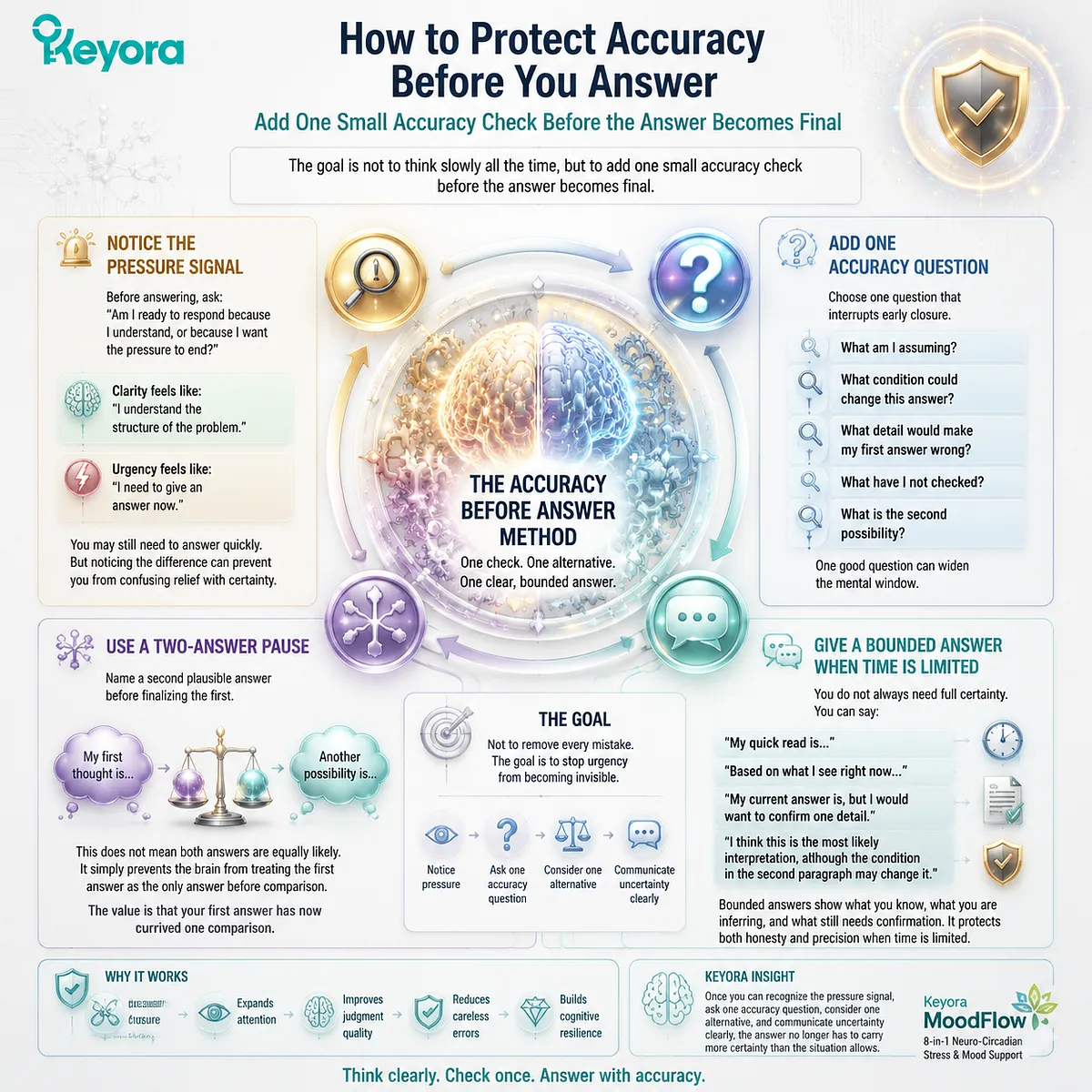
The goal is not to think slowly all the time, but to add one small accuracy check before the answer becomes final.
A helpful approach is The Accuracy Before Answer Method.
This is not a method for delaying every decision.
Some situations truly require a fast response. The purpose is to create one small point of calibration before urgency turns the first answer into the final answer.
Step one: notice the pressure signal.
Before answering, ask:
“Am I ready to respond because I understand, or because I want the pressure to end?”
The two feelings can seem similar.
Clarity feels like: “I understand the structure of the problem.”
Urgency feels like: “I need to give an answer now.”
You may still need to answer quickly. But noticing the difference can prevent you from confusing relief with certainty.
Step two: add one accuracy question.
Do not create a long checklist. Choose one question that interrupts early closure.
“What am I assuming?”
“What condition could change this answer?”
“What detail would make my first answer wrong?”
“What have I not checked?”
“What is the second possibility?”
One good question can widen the mental window.
For example, if your first answer depends on one number, ask whether the number is current.
If your first interpretation depends on one person’s responsibility, ask whether the instruction clearly assigns that responsibility.
If your answer assumes the deadline is fixed, ask whether there is an exception.
The goal is not endless doubt. The goal is one accuracy check.
Step three: use a two-answer pause.
When possible, name a second plausible answer before finalizing the first.
“My first thought is…”
“Another possibility is…”
This does not mean both answers are equally likely. It simply prevents the brain from treating the first answer as the only answer before comparison has happened.
You may discover that the first answer still makes the most sense.
That is fine.
The value is that it has now survived one comparison.
Step four: give a bounded answer when time is limited.
You do not always need to pretend to have full certainty.
You can say:
“My quick read is…”
“Based on what I see right now…”
“My current answer is, but I would want to confirm one detail.”
“I think this is the most likely interpretation, although the condition in the second paragraph may change it.”
This is not weakness.
It is accurate communication.
A bounded answer shows what you know, what you are inferring, and what still needs confirmation. It protects both honesty and precision when time is limited.
The goal is not to remove every mistake.
The goal is to stop urgency from becoming invisible.
Once you can recognize the pressure signal, ask one accuracy question, consider one alternative, and communicate uncertainty clearly, the answer no longer has to carry more certainty than the situation allows.
Where Nutritional Support Fits
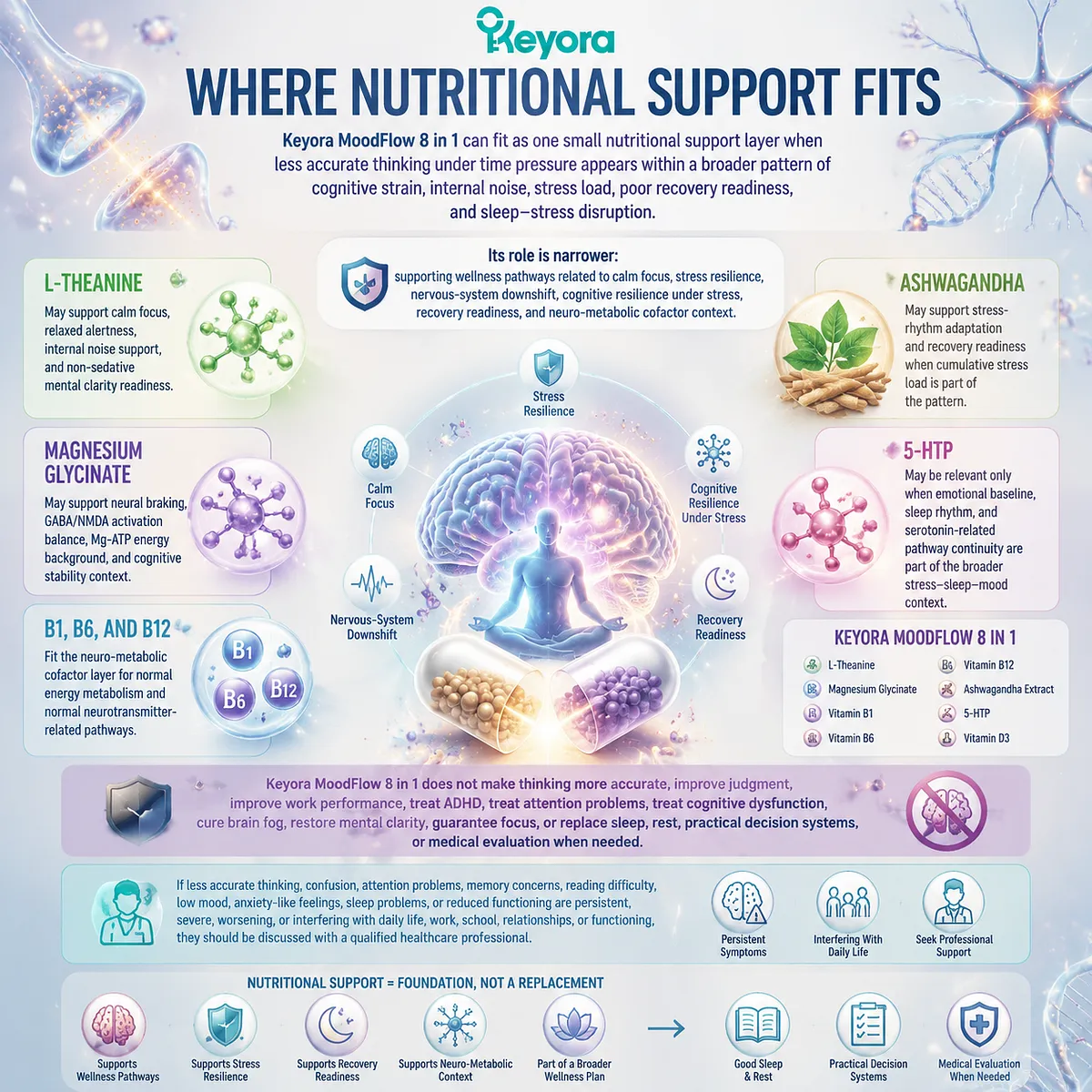
Keyora MoodFlow 8 in 1 can fit as one small nutritional support layer when less accurate thinking under time pressure appears within a broader pattern of cognitive strain, internal noise, stress load, poor recovery readiness, and sleep-stress disruption.
Its role is narrower: supporting wellness pathways related to calm focus, stress resilience, nervous-system downshift, cognitive resilience under stress, recovery readiness, and neuro-metabolic cofactor context.
-
L-Theanine may support calm focus, relaxed alertness, internal noise support, and non-sedative mental clarity readiness.
-
Magnesium glycinate may support neural braking, GABA/NMDA activation balance, Mg-ATP energy background, and cognitive stability context.
-
B1, B6, and B12 fit the neuro-metabolic cofactor layer for normal energy metabolism and normal neurotransmitter-related pathways.
-
Ashwagandha may support stress-rhythm adaptation and recovery readiness when cumulative stress load is part of the pattern.
-
5-HTP may be relevant only when emotional baseline, sleep rhythm, and serotonin-related pathway continuity are part of the broader stress-sleep-mood context.
Keyora MoodFlow 8 in 1 does not make thinking more accurate, improve judgment, improve work performance, treat ADHD, treat attention problems, treat cognitive dysfunction, cure brain fog, restore mental clarity, guarantee focus, or replace sleep, rest, practical decision systems, or medical evaluation when needed.
If less accurate thinking, confusion, attention problems, memory concerns, reading difficulty, low mood, anxiety-like feelings, sleep problems, or reduced functioning are persistent, severe, worsening, or interfering with daily life, work, school, relationships, or functioning, they should be discussed with a qualified healthcare professional.
Closing Summary
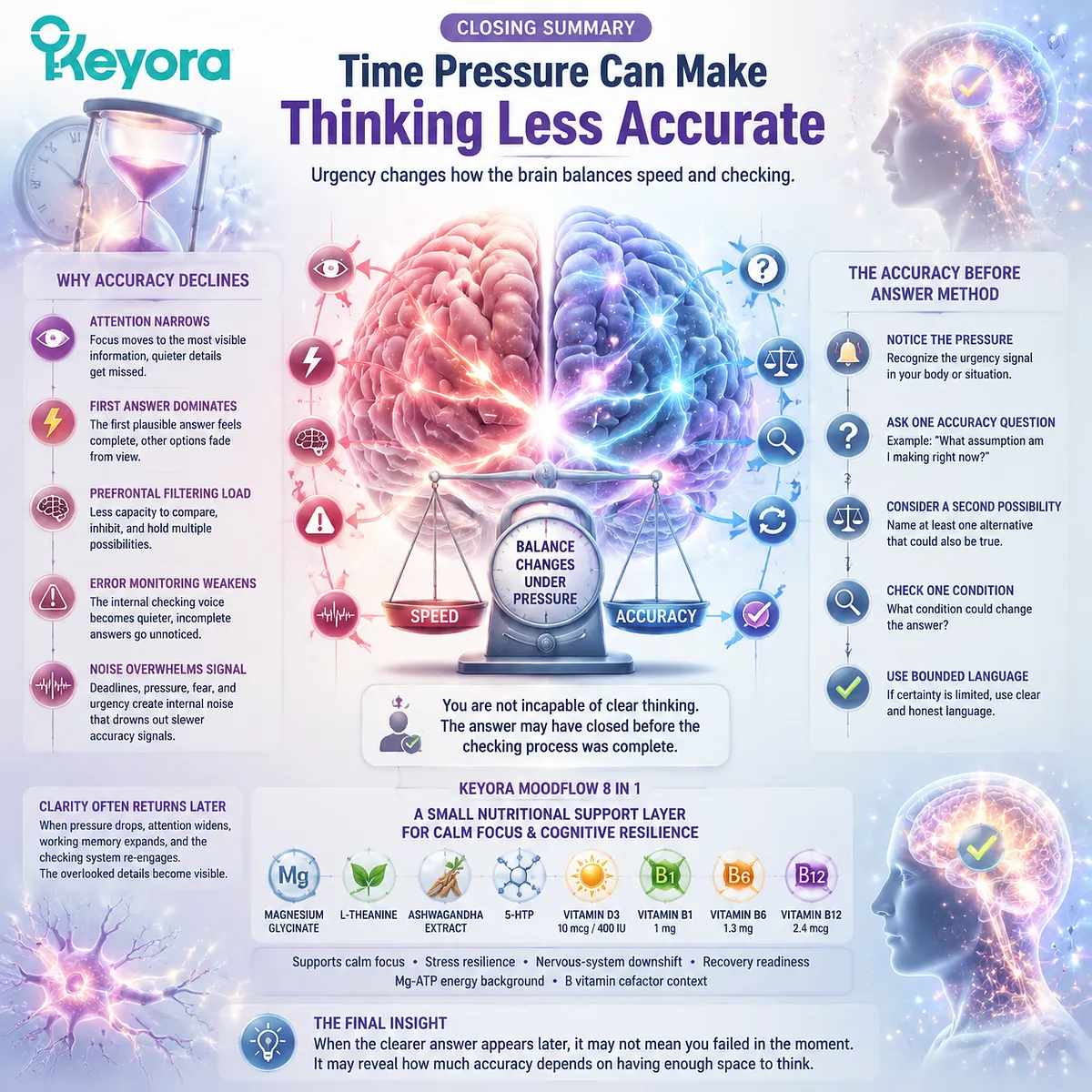
Time pressure can make your thinking less accurate because urgency changes how the brain balances speed and checking.
Attention may narrow. The first answer may feel more convincing. Prefrontal filtering and error monitoring may have less time to compare assumptions, conditions, and alternatives. This does not mean you are incapable of clear thinking. It may mean the answer closed before the checking process was complete.
The practical path is The Accuracy Before Answer Method: notice the pressure signal, ask one accuracy question, consider a second possibility, and use bounded language when certainty is limited.
Keyora MoodFlow 8 in 1 belongs only as a small nutritional support layer for calm focus, stress resilience, nervous-system downshift, cognitive resilience, recovery readiness, Mg-ATP energy background, and B vitamin cofactor context.
When the clearer answer appears later, it may not mean you failed in the moment. It may reveal how much accuracy depends on having enough space to think.
This article is for educational and informational purposes only. It does not provide medical advice, diagnosis, treatment, cure, prevention, disease outcome claims, hormone restoration claims, fertility outcome claims, or formula-specific clinical efficacy claims.