
Why Do I Skip Steps When I’m Rushing?
Keyora Research Q&A Library
This is part of the Keyora Research Q&A Series, derived from Keyora Nutritional Neurology Series .
Within the Keyora Nutritional Neurology framework, this Q&A translates complex nutrient–brain mechanisms into reader-friendly, evidence-bound answers, focusing on stress resilience, sleep quality, calm mood support, cognitive wellness, and the broader interaction between nutrition, neurochemistry, and daily nervous-system function.
First published by Keyora Research Journal: www.keyorahealth.com

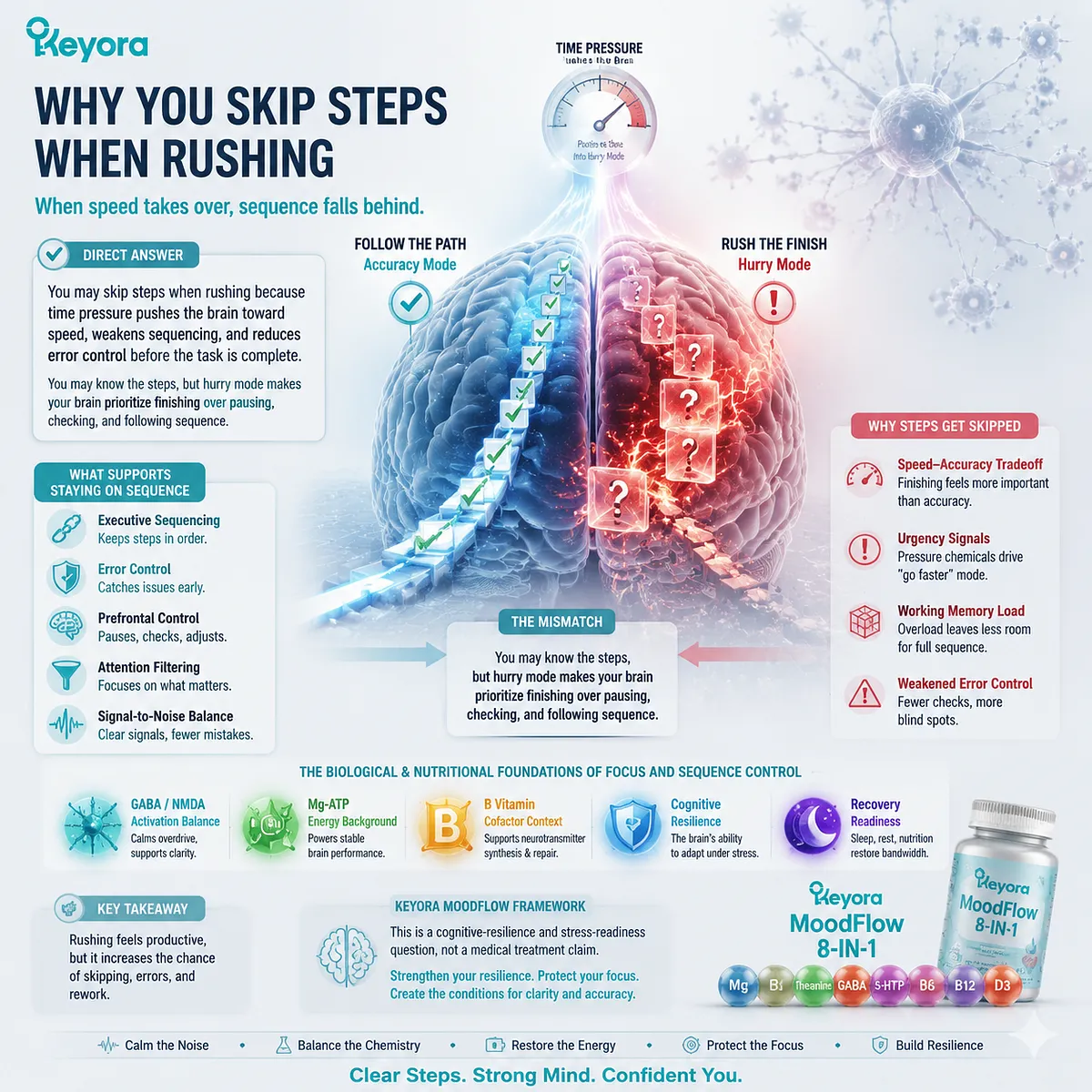
Direct Answer
You may skip steps when rushing because time pressure can push the brain toward speed, weaken sequencing, and reduce error control before the task is complete.
The mismatch is this: you may know the steps, but hurry mode can make your brain prioritize finishing over pausing, checking, and following sequence.
This can involve time pressure, speed-accuracy tradeoff, executive sequencing, error control, urgency signals, working memory load, prefrontal control, attention filtering, signal-to-noise balance, GABA/NMDA activation balance, Mg-ATP energy background, B vitamin cofactor context, cognitive resilience, and recovery readiness.
In the Keyora MoodFlow framework, this is understood as a cognitive-resilience and stress-readiness question, not a medical treatment claim.
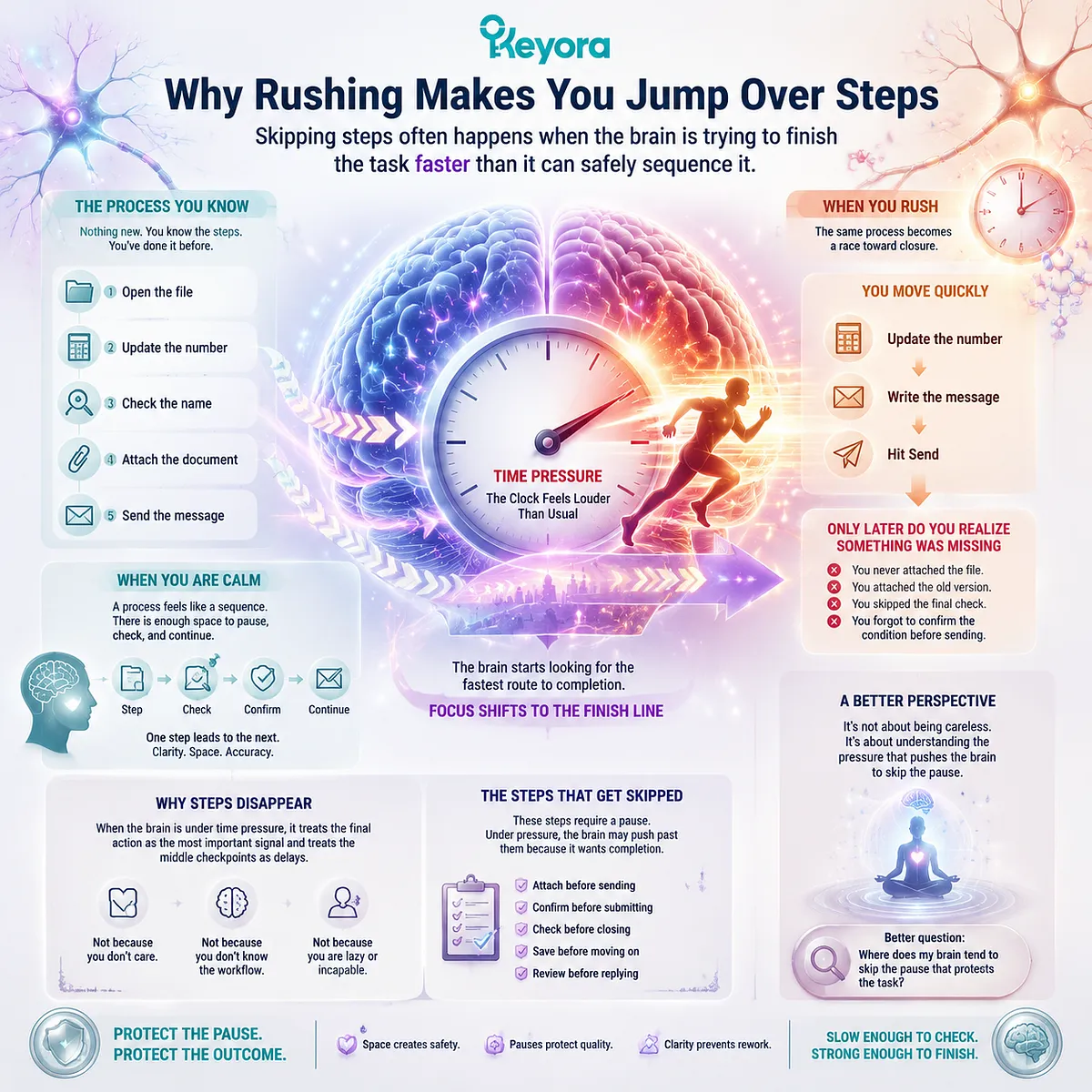
Why Rushing Makes You Jump Over Steps
Skipping steps often happens when the brain is trying to finish the task faster than it can safely sequence it.
You know the steps.
Open the file.
Update the number.
Check the name.
Attach the document.
Send the message.
Nothing about the process is new. You have done it before. You understand what should happen.
But someone is waiting.
The deadline is close. The clock feels louder than usual. Your body wants the task to be over. Your mind starts looking for the fastest route to completion.
So you move quickly.
You update the number. You write the message. You hit send.
Only later do you realize something was missing.
You never attached the file.
Or you attached the old version.
Or you skipped the final check.
Or you forgot to confirm the condition before sending.
That moment can feel especially frustrating because you did know the step. It was not hidden. It was not complicated. It was not beyond your ability.
You just moved past it.
This is why skipping steps while rushing can feel so personal. You may think, “How did I forget that?” You may wonder, “Why do I make the same kind of mistake when I’m in a hurry?” You may feel embarrassed because the skipped step looks obvious afterward.
But rushing changes the state of the task.
When you are calm, a process can feel like a sequence. One step leads to the next. There is enough space to pause, check, and continue.
When you are rushed, the same process can become a race toward closure. The brain starts to focus on the finish line. It wants the relief of being done.
That is where steps disappear.
Not because you do not care.
Not because you do not know the workflow.
Not because you are lazy or incapable.
Sometimes the brain under time pressure treats the final action as the most important signal and treats the middle checkpoints as delays.
The skipped step is often the step that required a pause.
Attach before sending.
Confirm before submitting.
Check before closing.
Save before moving on.
Review before replying.
These are not difficult steps, but they interrupt speed. Under pressure, the brain may push past them because it wants completion.
A better question is not, “Why am I so careless when I rush?”
A more useful question is: “Where does my brain tend to skip the pause that protects the task?”
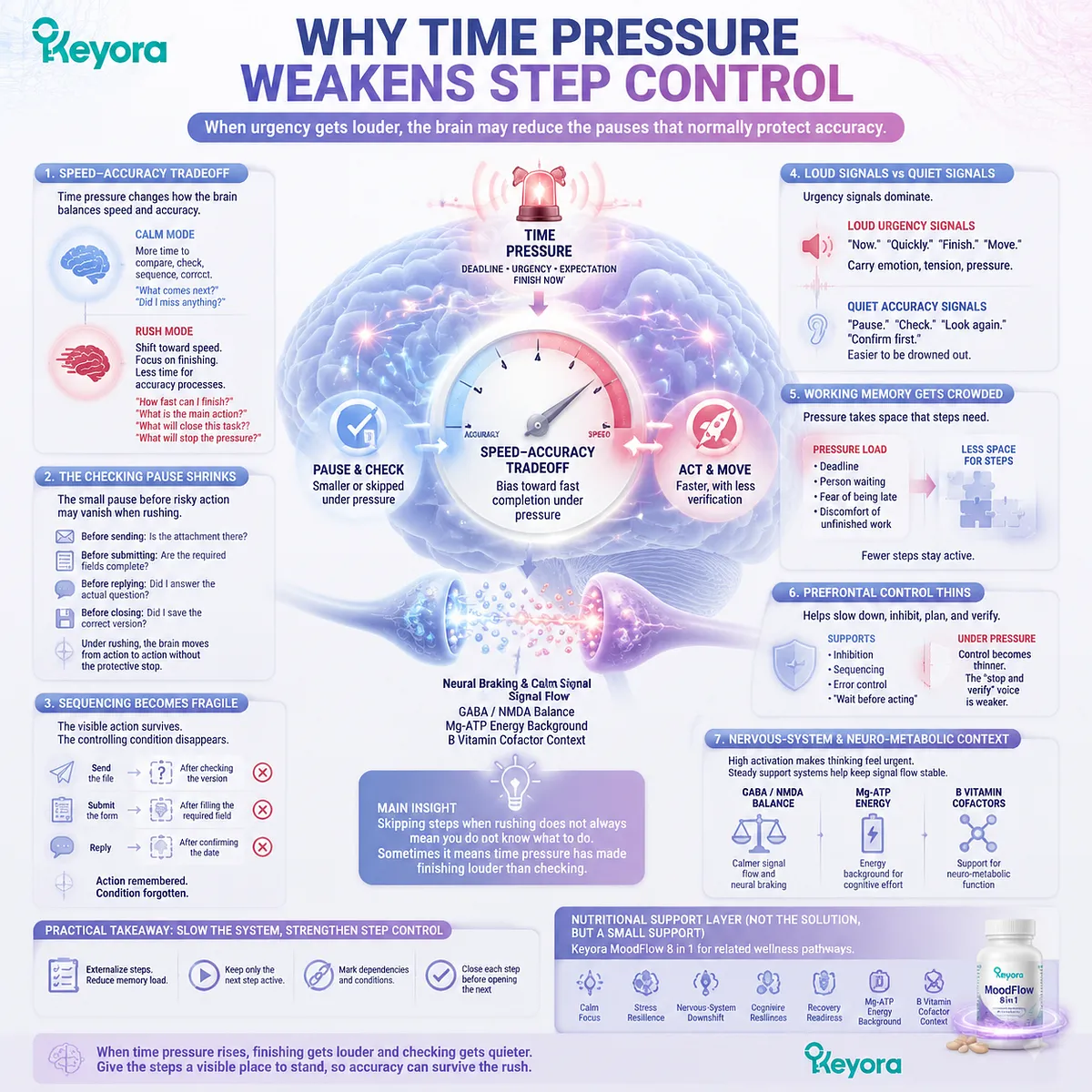
Why Time Pressure Weakens Step Control
When urgency gets louder, the brain may reduce the pauses that normally protect accuracy.
Time pressure changes how the brain balances speed and accuracy.
When there is no rush, the brain can spend more time comparing, checking, sequencing, and correcting. It can ask, “What comes next?” and “Did I miss anything?” before moving forward.
When time pressure rises, the brain may shift into a different mode.
It asks, “How fast can I finish?”
“What is the main action?”
“What will close this task?”
“What will stop the pressure?”
That shift is called a speed-accuracy tradeoff. It does not mean you consciously choose to be inaccurate. It means the system becomes biased toward fast completion, and accuracy processes may receive less time and less attention.
One of the first things to shrink is the checking pause.
A checking pause is the small moment before a risky action when the brain compares intention with reality.
Before sending: Is the attachment there?
Before submitting: Are the required fields complete?
Before replying: Did I answer the actual question?
Before closing: Did I save the correct version?
Under calm conditions, this pause may happen naturally.
Under rushing, it may vanish.
The brain moves from action to action without the small stop that normally protects the sequence.
Executive sequencing also becomes less stable. Multi-step work depends on the brain holding the order of actions: first this, then that, only after this condition, not before that confirmation.
When urgency is high, the brain may remember the visible action but lose the controlling step around it. You may remember “send the file” but lose “after checking the version.” You may remember “submit the form” but lose “after filling the required field.” You may remember “reply” but lose “after confirming the date.”
The action survives. The condition disappears.
Urgency signals are loud. They carry emotion, body tension, and pressure. They say, “Now.” “Quickly.” “Finish.” “Move.”
Accuracy signals are quieter. They say, “Pause.” “Check.” “Look again.” “Confirm first.”
When internal pressure is high, the loud signal can dominate the quiet one.
Working memory also plays a role. To avoid skipping a step, the brain has to hold the current action, the next action, the condition, and the final goal at the same time. Rushing fills working memory with pressure: the deadline, the person waiting, the fear of being late, the discomfort of unfinished work.
The task steps then have less space to stay active.
Prefrontal control helps slow the system down enough to follow sequence. It supports inhibition, planning, error control, and “wait before acting.” Under pressure, this control can become thinner. You may still be moving and thinking, but the part that says “stop and verify” may be less available.
At the nervous-system level, high activation can make thinking feel urgent rather than steady. GABA/NMDA activation balance can be understood as part of the background for calmer signal flow and neural braking. Mg-ATP energy background and B vitamin cofactor context belong to the broader neuro-metabolic support picture because sequencing, inhibition, and error control all require energy and stable cognitive effort.
The main insight is this: skipping steps when rushing does not always mean you do not know what to do. Sometimes it means time pressure has made finishing louder than checking.
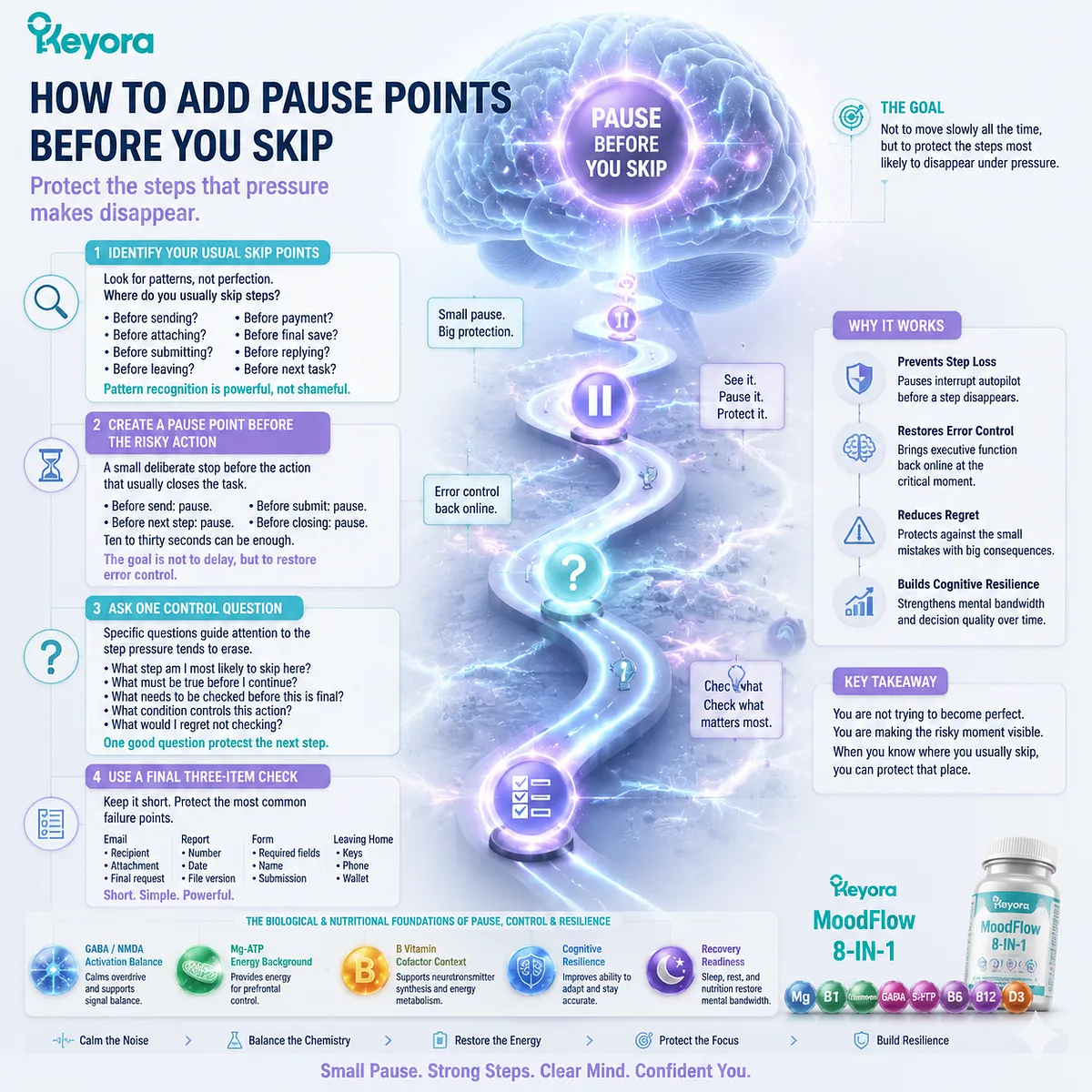
How to Add Pause Points Before You Skip
The goal is not to move slowly all the time, but to protect the steps most likely to disappear under pressure.
A helpful approach is The Pause Point Method.
This method is not about doing everything slowly. It is not about becoming overly cautious. It is about placing small pauses at the exact points where skipping a step would cost the most.
Step one: identify your usual skip points.
Do not begin with self-criticism. Begin with pattern recognition.
Where do you usually skip steps?
Before sending?
Before attaching?
Before submitting?
Before payment?
Before final save?
Before replying?
Before leaving the house?
Before moving to the next task?
Most people have predictable skip points. One person always forgets the attachment. Another submits before checking the date. Another replies before answering the final question. Another closes the file before saving the correct version.
Seeing the pattern is not shameful. It is useful.
Step two: create a pause point before the risky action.
A pause point is a small deliberate stop before the action that usually closes the task.
Before send: pause.
Before submit: pause.
Before next step: pause.
Before closing the task: pause.
This pause does not need to be long. Ten to thirty seconds can be enough.
The purpose is not to delay. The purpose is to bring error control back online before the point of no return.
Step three: ask one control question.
Do not ask a vague question like, “Is everything okay?”
That question is too broad for a rushed brain.
Ask something more specific:
“What step am I most likely to skip here?”
“What must be true before I continue?”
“What needs to be checked before this is final?”
“What condition controls this action?”
“What would I regret not checking?”
A good control question points attention toward the step that pressure tends to erase.
Step four: use a final three-item check.
When you are rushing, the checklist must be short. A long checklist becomes another burden.
For an email, the three items might be:
Recipient.
Attachment.
Final request.
For a report:
Number.
Date.
File version.
For a form:
Required fields.
Name.
Submission confirmation.
For leaving the house:
Keys.
Phone.
Wallet.
The point is not to check everything. The point is to protect the most common failure points.
The Pause Point Method works because it does not fight the whole rushing state. It places a small speed bump before the brain crosses the line too quickly.
You are not trying to become perfect. You are making the risky moment visible.
When you know where you usually skip, you can protect that place.
Where Nutritional Support Fits
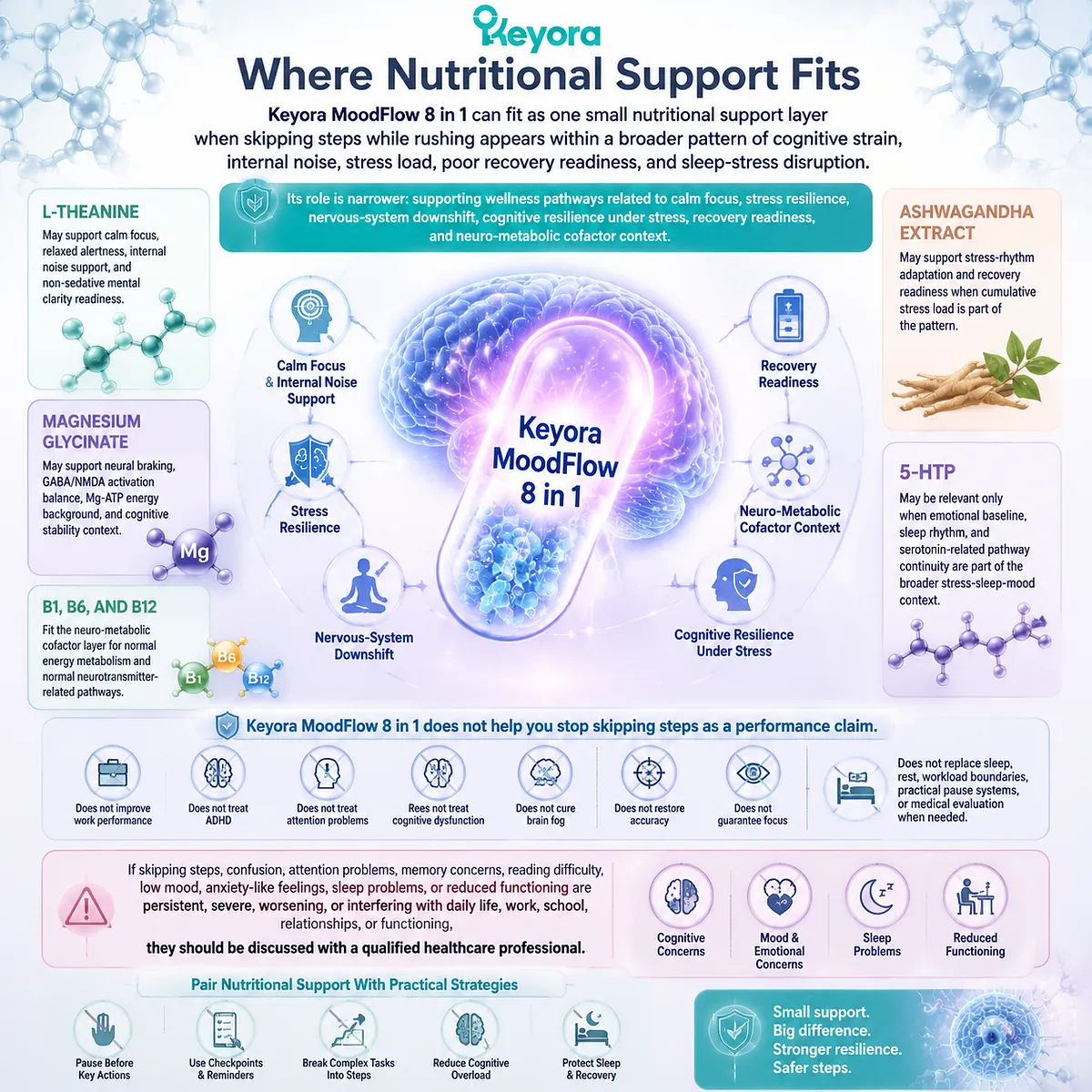
Keyora MoodFlow 8 in 1 can fit as one small nutritional support layer when skipping steps while rushing appears within a broader pattern of cognitive strain, internal noise, stress load, poor recovery readiness, and sleep-stress disruption.
Its role is narrower: supporting wellness pathways related to calm focus, stress resilience, nervous-system downshift, cognitive resilience under stress, recovery readiness, and neuro-metabolic cofactor context.
-
L-Theanine may support calm focus, relaxed alertness, internal noise support, and non-sedative mental clarity readiness.
-
Magnesium glycinate may support neural braking, GABA/NMDA activation balance, Mg-ATP energy background, and cognitive stability context.
-
B1, B6, and B12 fit the neuro-metabolic cofactor layer for normal energy metabolism and normal neurotransmitter-related pathways.
-
Ashwagandha may support stress-rhythm adaptation and recovery readiness when cumulative stress load is part of the pattern.
-
5-HTP may be relevant only when emotional baseline, sleep rhythm, and serotonin-related pathway continuity are part of the broader stress-sleep-mood context.
Keyora MoodFlow 8 in 1 does not help you stop skipping steps as a performance claim. It does not improve work performance, treat ADHD, treat attention problems, treat cognitive dysfunction, cure brain fog, restore accuracy, guarantee focus, or replace sleep, rest, workload boundaries, practical pause systems, or medical evaluation when needed.
If skipping steps, confusion, attention problems, memory concerns, reading difficulty, low mood, anxiety-like feelings, sleep problems, or reduced functioning are persistent, severe, worsening, or interfering with daily life, work, school, relationships, or functioning, they should be discussed with a qualified healthcare professional.
Closing Summary
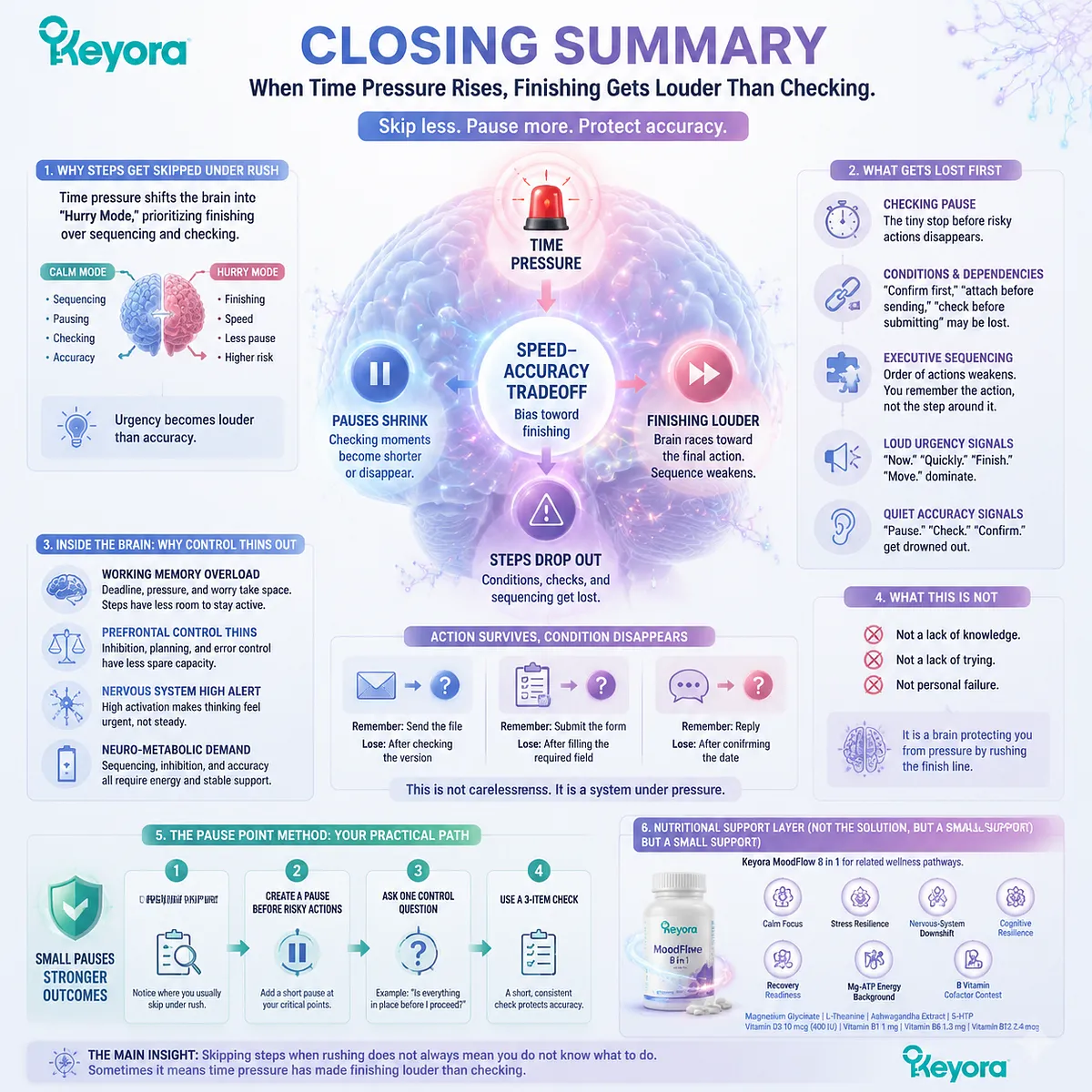
You may skip steps when rushing because time pressure can make the brain prioritize finishing over sequencing, pausing, and checking.
Urgency can become louder than accuracy. The brain may move quickly toward the final action while losing the quieter signals that say “confirm first,” “attach before sending,” or “check before submitting.” This does not mean you are careless or incapable. It may mean your hurry mode needs better pause points.
The practical path is The Pause Point Method: identify your usual skip points, create a pause before risky actions, ask one control question, and use a short three-item check.
Keyora MoodFlow 8 in 1 belongs only as a small nutritional support layer for related wellness pathways, including calm focus, stress resilience, nervous-system downshift, cognitive resilience, recovery readiness, Mg-ATP energy background, and B vitamin cofactor context.
Skipping steps when rushing does not always mean you do not know what to do. Sometimes it means time pressure has made finishing louder than checking.
This article is for educational and informational purposes only. It does not provide medical advice, diagnosis, treatment, cure, prevention, disease outcome claims, hormone restoration claims, fertility outcome claims, or formula-specific clinical efficacy claims.