
Why Is It Hard to Hold Several Steps in Mind Under Stress?
Keyora Research Q&A Library
This is part of the Keyora Research Q&A Series, derived from Keyora Nutritional Neurology Series .
Within the Keyora Nutritional Neurology framework, this Q&A translates complex nutrient–brain mechanisms into reader-friendly, evidence-bound answers, focusing on stress resilience, sleep quality, calm mood support, cognitive wellness, and the broader interaction between nutrition, neurochemistry, and daily nervous-system function.
First published by Keyora Research Journal: www.keyorahealth.com

Direct Answer
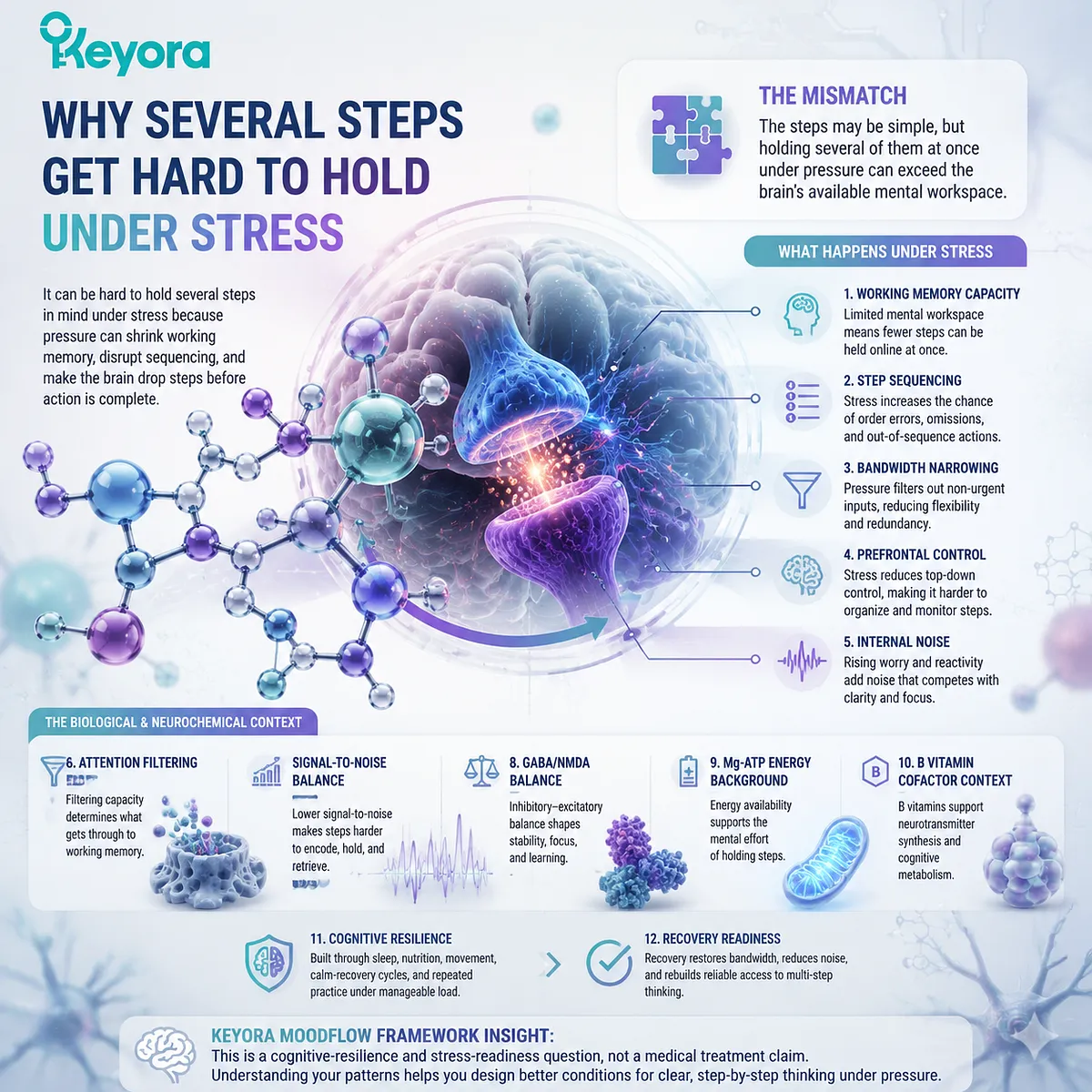
It can be hard to hold several steps in mind under stress because pressure can shrink working memory, disrupt sequencing, and make the brain drop steps before action is complete.
The mismatch is this: the steps may be simple, but holding several of them at once under pressure can exceed the brain’s available mental workspace.
This can involve working memory capacity, step sequencing, bandwidth narrowing, prefrontal control, internal noise, attention filtering, signal-to-noise balance, GABA/NMDA activation balance, Mg-ATP energy background, B vitamin cofactor context, cognitive resilience, and recovery readiness.
In the Keyora MoodFlow framework, this is understood as a cognitive-resilience and stress-readiness question, not a medical treatment claim.
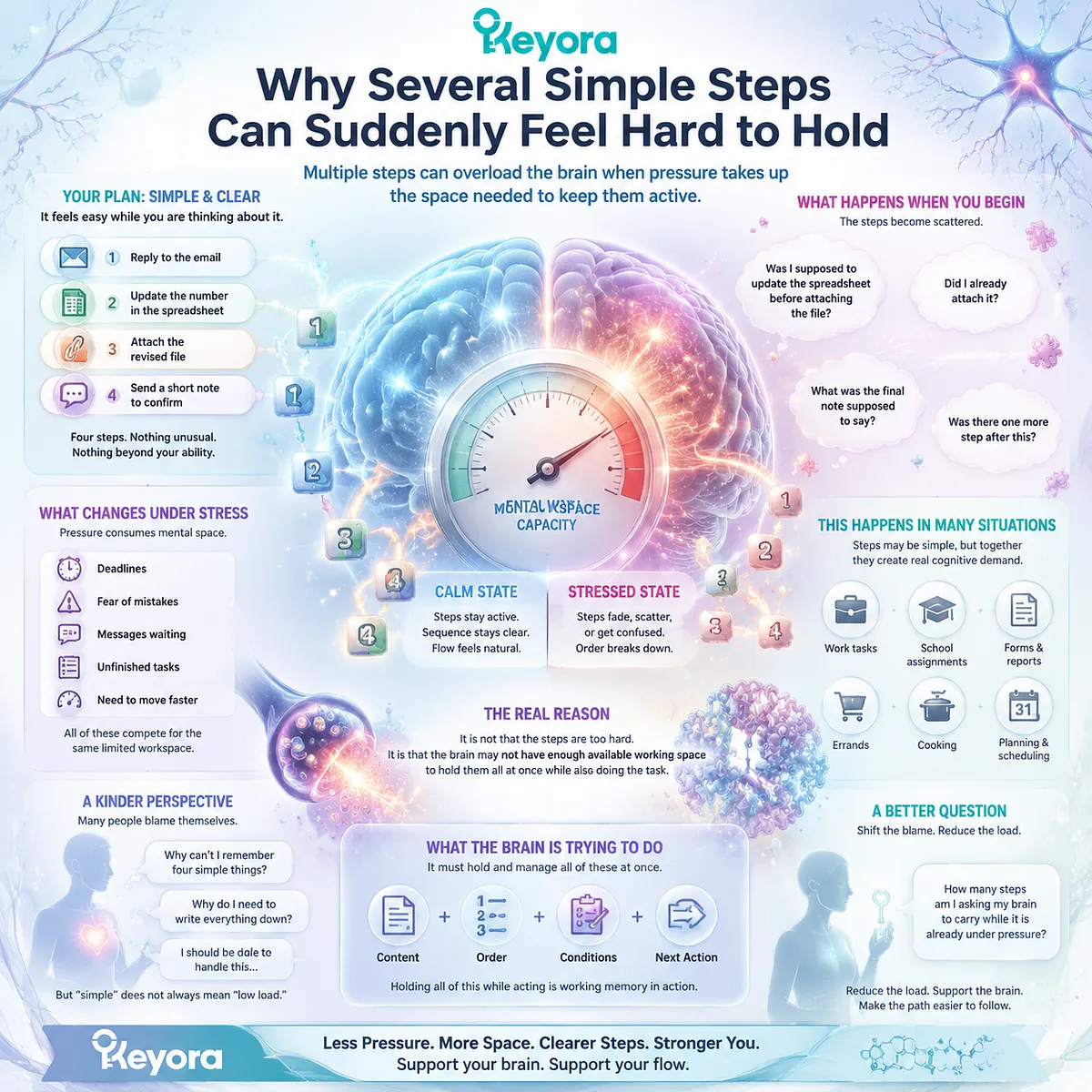
Why Several Simple Steps Can Suddenly Feel Hard to Hold
Multiple steps can overload the brain when pressure takes up the space needed to keep them active.
You tell yourself the plan.
First, reply to the email.
Then update the number in the spreadsheet.
Then attach the revised file.
Then send a short note to confirm.
It feels simple while you are thinking about it.
Four steps. Nothing unusual. Nothing beyond your ability. You can picture the task clearly for a moment.
Then you begin.
You reply to the email, and suddenly the rest of the plan becomes less clear.
“Was I supposed to update the spreadsheet before attaching the file?”
“Did I already attach it?”
“What was the final note supposed to say?”
“Was there one more step after this?”
The steps were there a minute ago. Now they feel scattered.
This can happen with work tasks, school assignments, forms, reports, errands, cooking, planning, scheduling, or any situation where you need to keep several actions in order. The steps may be individually easy, but together they ask the brain to hold a small stack of information while also doing the task.
That is where stress changes the experience.
When you are calm, a few steps may sit in your mind easily. You can move through them without thinking too much. The sequence feels natural.
When you are stressed, the same steps may feel slippery. You may hold the first one strongly, but the second one fades. You may remember the last step but forget the middle condition. You may start doing one action and lose the order of the others.
This does not mean the steps are too hard.
It means the brain may not have enough available working space to hold them all at once.
Many people blame themselves in this moment.
They think, “Why can’t I remember four simple things?”
They wonder, “Why do I need to write everything down?”
They feel frustrated because the task looks small from the outside.
But “simple” does not always mean “low load.”
Several simple steps can still create a real cognitive demand because the brain has to hold the content, order, conditions, and next action all at the same time.
A better question is not, “Why am I so forgetful?”
A more helpful question is: “How many steps am I asking my brain to carry while it is already under pressure?”
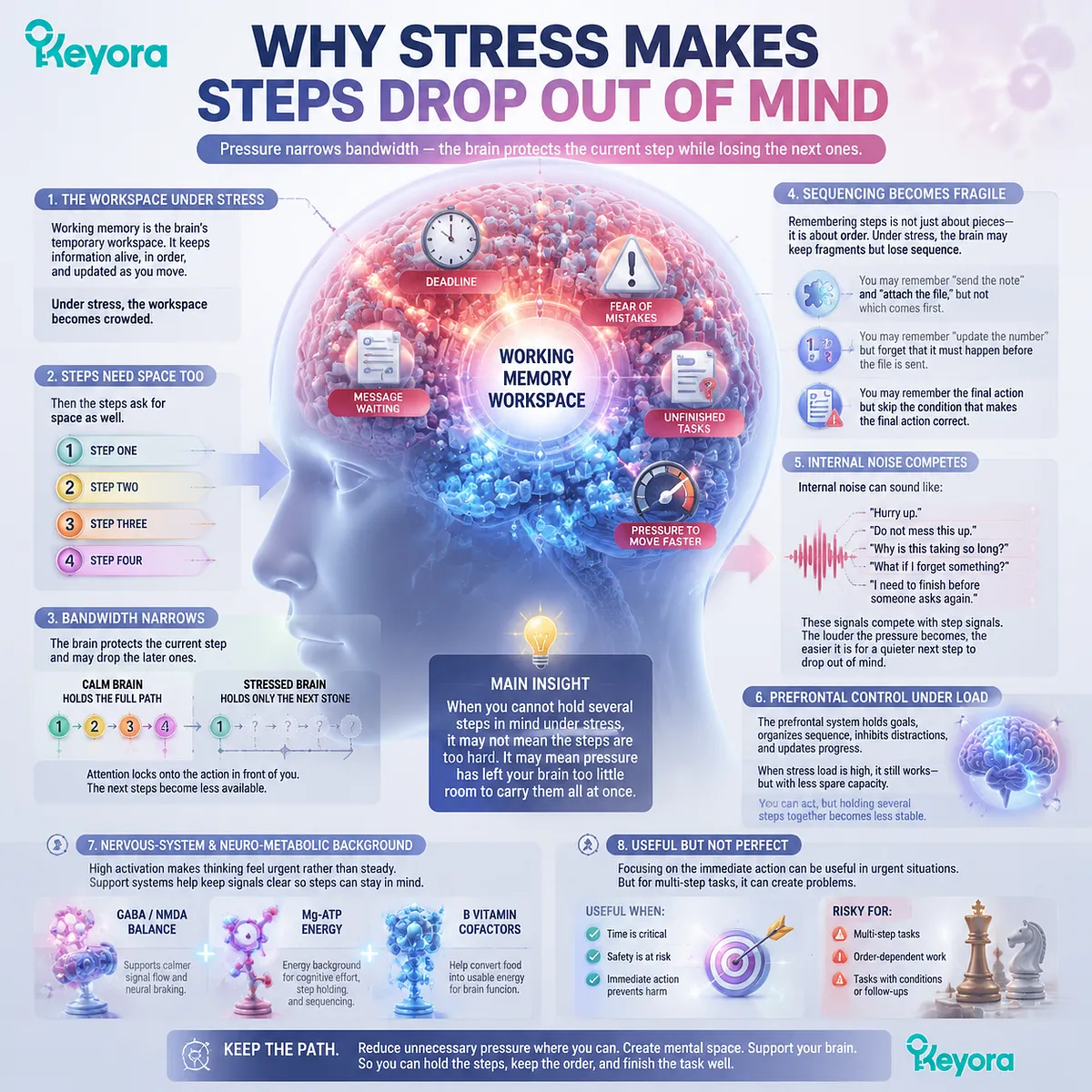
Why Stress Makes Steps Drop Out of Mind
Pressure can narrow bandwidth so the brain protects the current step while losing the next ones.
Working memory is the brain’s temporary workspace.
It is where you hold information while you are using it. When you keep several steps in mind, working memory is doing active labor. It is not simply storing a list. It is keeping the steps alive, keeping them in order, and updating them as you move.
Under stress, that workspace becomes more crowded.
The deadline takes space. The fear of making a mistake takes space. The message waiting for your reply takes space. The unfinished task in the background takes space. The pressure to move faster takes space.
Then the steps ask for space too.
Step one. Step two. Step three. Step four.
If the mental workspace is already crowded, the brain may protect the current step and drop the later ones.
This is why you may feel clear at the beginning but lose the sequence once you start. Your attention locks onto the action in front of you. That can help you complete the immediate step, but it may make the next steps less available.
Stress narrows bandwidth.
A calm brain may hold the full path. A pressured brain may hold only the next stone.
This is not always a bad thing. In urgent situations, focusing on the immediate action can be useful. But for multi-step tasks, it can create problems. You may complete one step while losing the step stack that gave the task its structure.
Sequencing also becomes more fragile.
Remembering several steps is not just about remembering the pieces. It is about remembering the order. Under stress, the brain may keep fragments but lose sequence.
You may remember “send the note” and “attach the file,” but not which comes first. You may remember “update the number” but forget that it must happen before the file is sent. You may remember the final action but skip the condition that makes the final action correct.
Internal noise makes this harder.
Internal noise can sound like: “Hurry up.”
“Do not mess this up.”
“Why is this taking so long?”
“What if I forget something?”
“I need to finish before someone asks again.”
These signals compete with the step signals. The louder the pressure becomes, the easier it is for a quieter next step to drop out of mind.
Prefrontal control is also part of the process. The prefrontal system helps hold goals, organize sequence, inhibit distractions, and update progress. When stress load is high, this system may still work, but with less spare capacity. You may be able to act, but holding several steps together becomes less stable.
At the nervous-system level, high activation can make thinking feel urgent rather than steady. GABA/NMDA activation balance can be understood as part of the background for calmer signal flow and neural braking. Mg-ATP energy background and B vitamin cofactor context also belong to the broader neuro-metabolic support picture because step holding, sequencing, and cognitive effort all require energy.
The main insight is simple.
When you cannot hold several steps in mind under stress, it may not mean the steps are too hard. It may mean pressure has left your brain too little room to carry them all at once.
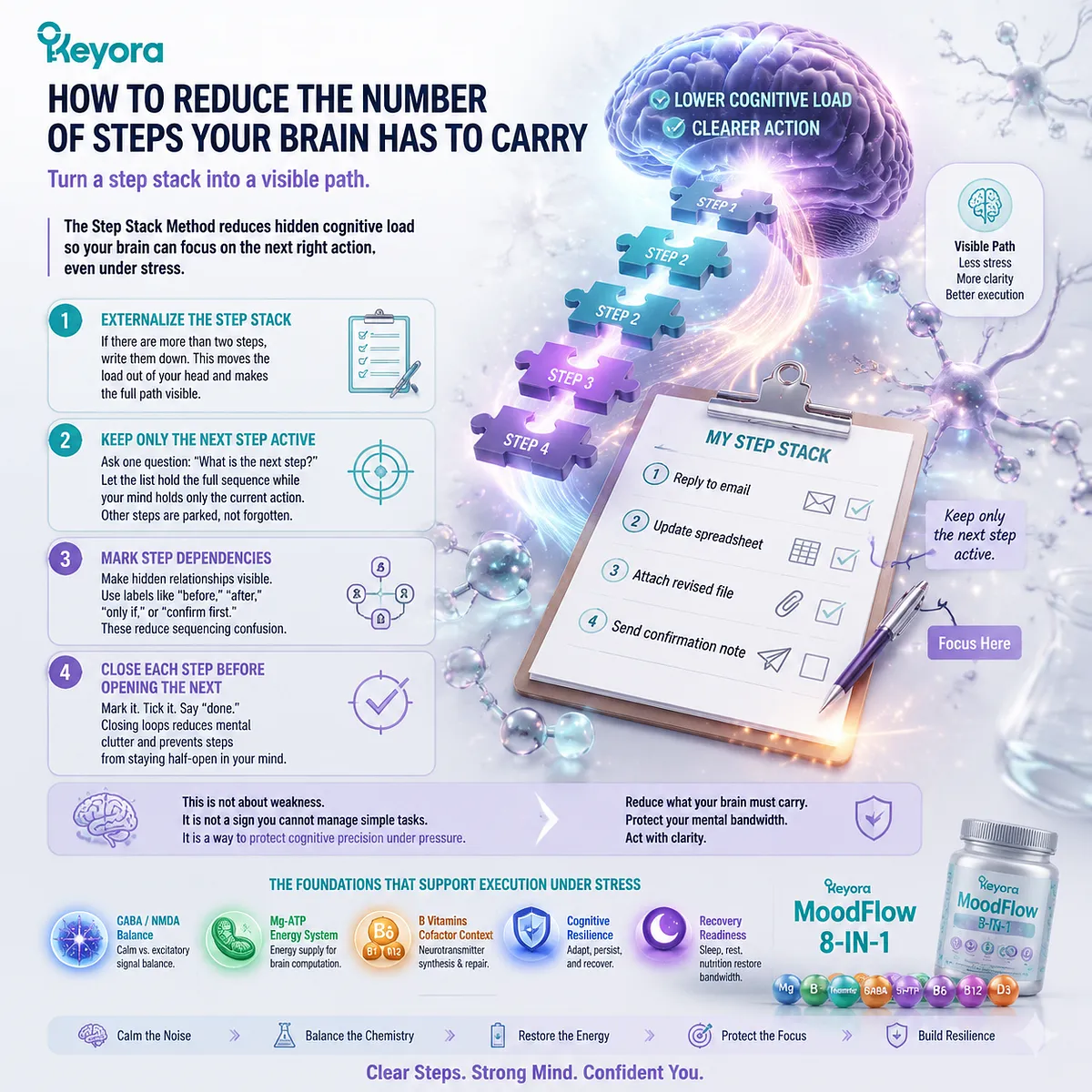
How to Reduce the Number of Steps Your Brain Has to Carry
The goal is not to hold everything in your head, but to turn a step stack into a visible path.
A helpful approach is The Step Stack Method.
This method is not about becoming more organized for the sake of productivity. It is about reducing the hidden burden on working memory when stress is already taking up space.
Step one: externalize the step stack.
If there are more than two steps, do not rely only on mental holding when you are stressed. Write the steps down.
-
Reply to email.
-
Update spreadsheet.
-
Attach revised file.
-
Send confirmation note.
This may look simple, but it changes the task. The steps are no longer floating inside your head. They are visible.
Now your brain does not need to spend as much energy keeping the whole stack alive.
Step two: keep only the next step active.
When you see the full list, do not stare at all of it at once. Ask one question:
“What is the next step?”
That question protects attention. It lets the external list hold the full sequence while your mind holds only the current action.
The other steps are not forgotten. They are parked somewhere visible.
Step three: mark step dependencies.
Some steps depend on other steps.
Update the number before attaching the file.
Confirm the date before sending.
Check the total before replying.
Save the document before uploading.
These dependencies are easy to lose under pressure because they are not always separate actions. Sometimes they are hidden relationships between actions.
Make them visible.
Write “before,” “after,” “only if,” or “confirm first.” These small labels reduce sequencing confusion.
Step four: close each step before opening the next.
When one step is complete, mark it.
Tick it off. Say “done.” Move to the next visible step. Do not leave all the steps half-open in your mind.
A small closing action tells the brain, “This part is finished.” That reduces the feeling that everything must be carried at once.
This method is not about weakness. It is not a sign that you cannot manage simple tasks. It is a way to protect cognitive precision under pressure.
When your brain is loaded, the kindest strategy is often not to demand more internal capacity. It is to reduce how much your brain must carry internally.
The Step Stack Method turns a mental burden into a visible path.
You still do the work. But the list holds the sequence, so your mind can focus on the step in front of you.
Where Nutritional Support Fits
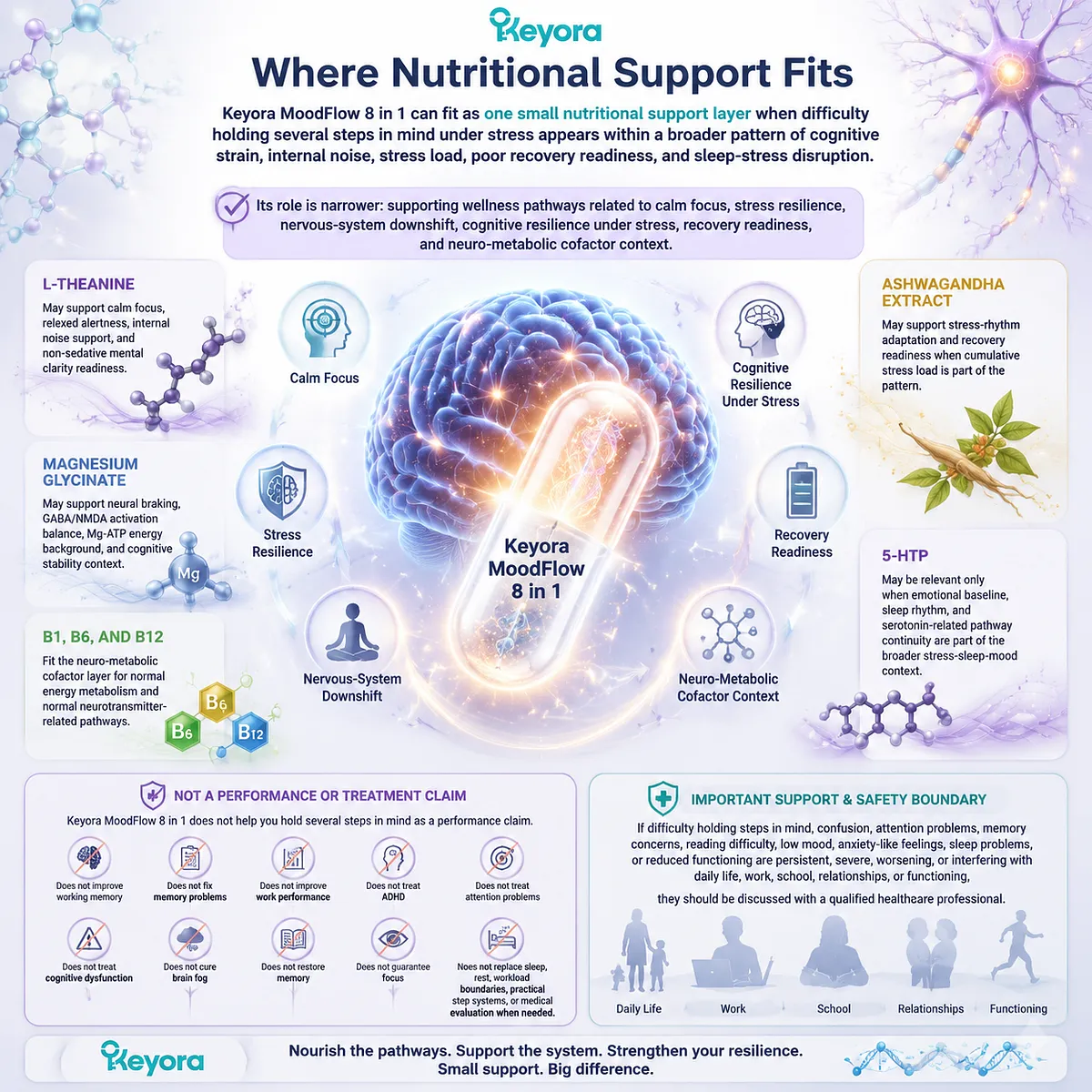
Keyora MoodFlow 8 in 1 can fit as one small nutritional support layer when difficulty holding several steps in mind under stress appears within a broader pattern of cognitive strain, internal noise, stress load, poor recovery readiness, and sleep-stress disruption.
Its role is narrower: supporting wellness pathways related to calm focus, stress resilience, nervous-system downshift, cognitive resilience under stress, recovery readiness, and neuro-metabolic cofactor context.
-
L-Theanine may support calm focus, relaxed alertness, internal noise support, and non-sedative mental clarity readiness.
-
Magnesium glycinate may support neural braking, GABA/NMDA activation balance, Mg-ATP energy background, and cognitive stability context.
-
B1, B6, and B12 fit the neuro-metabolic cofactor layer for normal energy metabolism and normal neurotransmitter-related pathways.
-
Ashwagandha may support stress-rhythm adaptation and recovery readiness when cumulative stress load is part of the pattern.
-
5-HTP may be relevant only when emotional baseline, sleep rhythm, and serotonin-related pathway continuity are part of the broader stress-sleep-mood context.
Keyora MoodFlow 8 in 1 does not help you hold several steps in mind as a performance claim. It does not improve working memory, fix memory problems, improve work performance, treat ADHD, treat attention problems, treat cognitive dysfunction, cure brain fog, restore memory, guarantee focus, or replace sleep, rest, workload boundaries, practical step systems, or medical evaluation when needed.
If difficulty holding steps in mind, confusion, attention problems, memory concerns, reading difficulty, low mood, anxiety-like feelings, sleep problems, or reduced functioning are persistent, severe, worsening, or interfering with daily life, work, school, relationships, or functioning, they should be discussed with a qualified healthcare professional.
Closing Summary
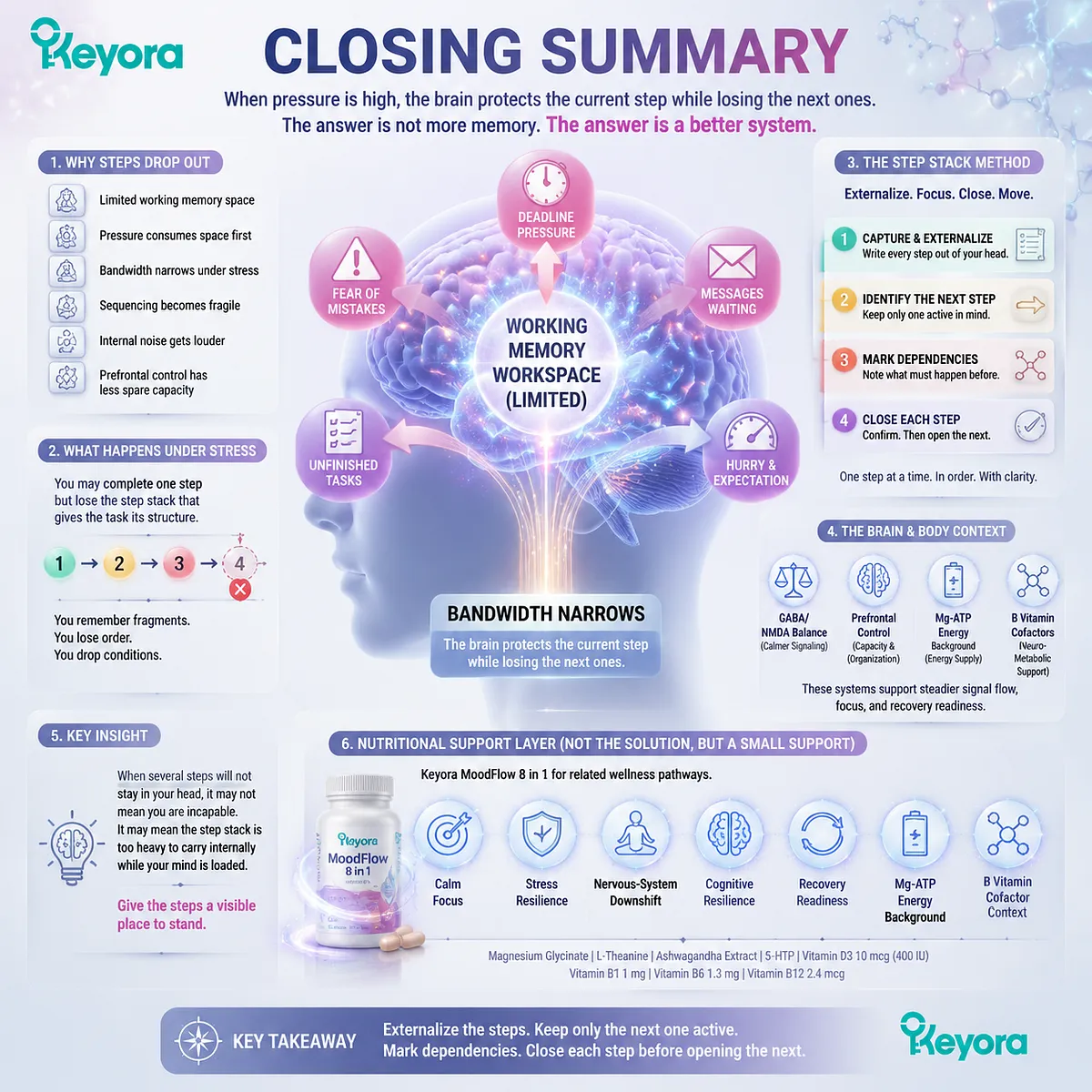
It can be hard to hold several steps in mind under stress because working memory has limited space, and pressure uses part of that space before the task even begins.
Stress can narrow bandwidth, disrupt sequencing, increase internal noise, and make the brain protect the current step while losing the next ones. This does not mean you are incapable or not trying. It may mean the step stack is too heavy to carry internally while your mind is loaded.
The practical path is The Step Stack Method: externalize the steps, keep only the next step active, mark dependencies, and close each step before opening the next.
Keyora MoodFlow 8 in 1 belongs only as a small nutritional support layer for related wellness pathways, including calm focus, stress resilience, nervous-system downshift, cognitive resilience, recovery readiness, Mg-ATP energy background, and B vitamin cofactor context.
When several steps will not stay in your head, the answer is not always to force more memory. Sometimes the answer is to give the steps a visible place to stand.
This article is for educational and informational purposes only. It does not provide medical advice, diagnosis, treatment, cure, prevention, disease outcome claims, hormone restoration claims, fertility outcome claims, or formula-specific clinical efficacy claims.