
Why Is It Hard to Understand Complex Information When I’m Under Pressure?
Keyora Research Q&A Library
This is part of the Keyora Research Q&A Series, derived from Keyora Nutritional Neurology Series .
Within the Keyora Nutritional Neurology framework, this Q&A translates complex nutrient–brain mechanisms into reader-friendly, evidence-bound answers, focusing on stress resilience, sleep quality, calm mood support, cognitive wellness, and the broader interaction between nutrition, neurochemistry, and daily nervous-system function.
First published by Keyora Research Journal: www.keyorahealth.com

Direct Answer
You may find it hard to understand complex information under pressure because stress can narrow mental bandwidth and make it harder to organize relationships between ideas.
The mismatch is this: you may understand each sentence, but your brain may not have enough stable space to connect the parts into a clear structure.
This can involve cognitive load, working memory compression, relationship mapping, attention filtering, stress arousal, signal-to-noise balance, prefrontal control, GABA/NMDA activation balance, Mg-ATP energy background, B vitamin cofactor context, cognitive resilience, and recovery readiness.
In the Keyora MoodFlow framework, this is understood as a cognitive-resilience and stress-readiness question, not a medical treatment claim.
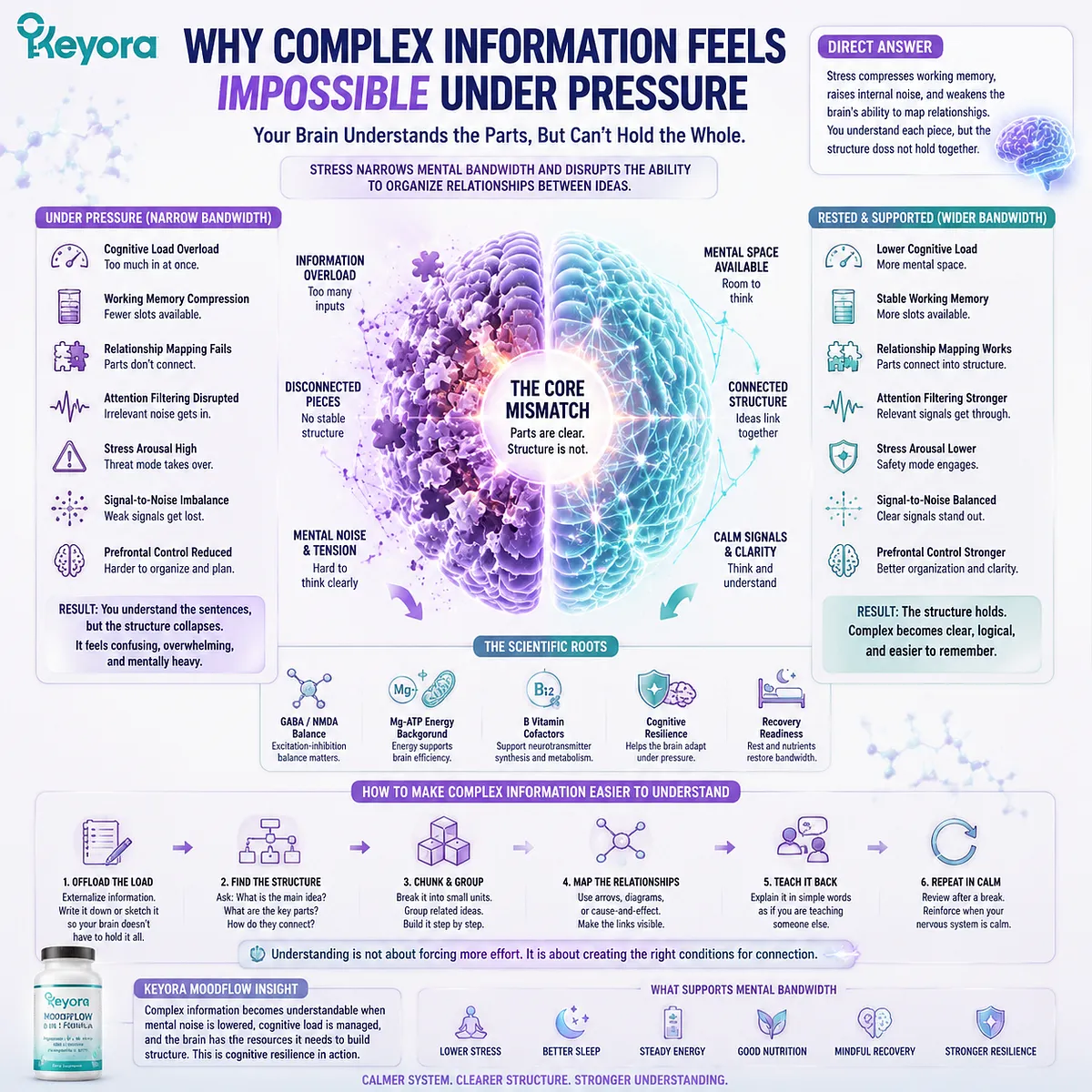
Why Complex Information Feels Harder Under Pressure
Complex information becomes harder when the brain has to hold too many relationships while pressure is rising.
You open a long email before a meeting.
There are dates, names, conditions, numbers, exceptions, and several people mentioned. The words are not unfamiliar. The sentences are not impossible. You can read each part.
But after reading the whole message, you still do not know what the real request is.
You scroll back up. Then down again. You start making small guesses.
“Is this asking me to approve something?”
“Do I need to reply today?”
“Does this condition apply to me or to someone else?”
“Which part is the main point?”
“Why does this feel harder than it should?”
This is the confusing part: you may understand the individual pieces, but the whole thing does not become clear.
That experience can happen with a work document, contract, policy update, project brief, research paper, school assignment, financial report, technical instruction, meeting summary, or client request. It can also happen in conversation when someone explains a complex situation quickly and expects you to respond immediately.
You may feel as if your brain is holding fragments instead of structure.
One sentence says what changed. Another gives an exception. Another mentions a deadline. Another names a person responsible. Another adds a condition that changes the meaning of the first sentence. Each part may make sense by itself, but together they feel tangled.
It is easy to blame yourself.
You may think, “Why can’t I understand this?”
You may wonder, “Am I not smart enough?”
You may feel embarrassed if someone else explains it in one sentence and suddenly it becomes obvious.
But complex understanding is not the same as simple reading.
Simple reading asks, “What does this sentence say?”
Complex understanding asks, “How do all these parts relate to each other?”
That second question requires more mental space.
Your brain has to hold several pieces at once. It has to compare them, rank them, connect them, and decide which ones are main points and which ones are conditions. It has to notice if one sentence changes the meaning of another. It has to keep the purpose of the task in mind while also building the structure of the information.
Under pressure, that structure-building process can become much harder.
This does not mean you are incapable. It may mean the pressure around the information is taking up the very space needed to understand it.
A useful question is not, “Why am I bad at complex information?”
A more helpful question is: “What relationships is my brain being asked to hold right now, and is pressure making those relationships harder to see?”
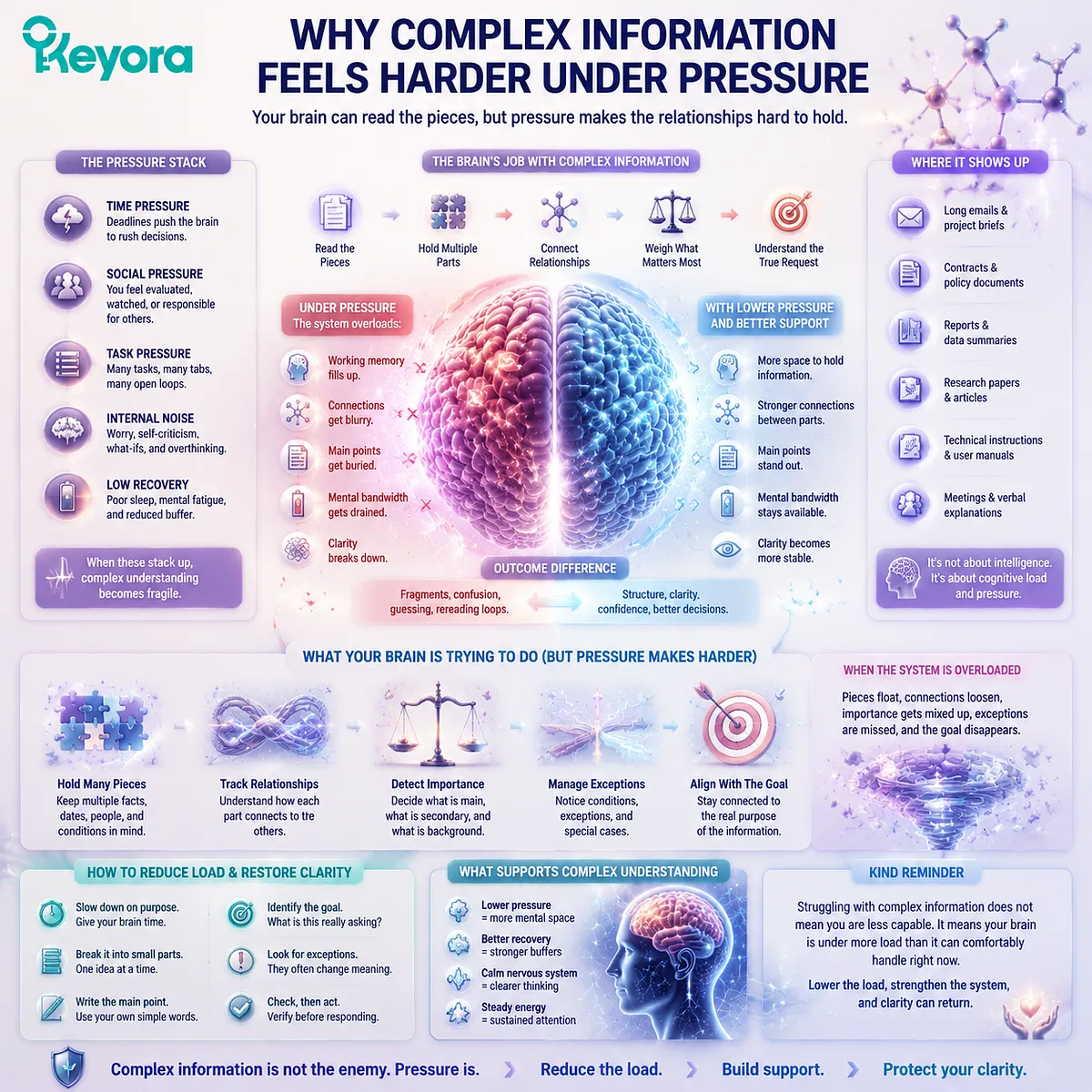
Why Stress Makes Relationships Between Ideas Harder to Hold
Pressure can compress working memory and make the brain grab fragments before it can build structure.
Complex information is difficult because it contains relationships.
A deadline is not just a date. It may depend on another team’s update.
A number is not just a number. It may change the budget, timeline, or decision.
An instruction is not just an action. It may apply only if a condition is met.
An exception is not just extra information. It may change the rule.
When information feels complex, the hard part is often not the facts. It is how the facts connect.
Stress makes this harder because it compresses working memory.
Working memory is the mental space that temporarily holds information while you use it. To understand complex information, your brain needs to hold multiple pieces at once: who, what, when, why, what changed, what depends on what, and what action is required.
When pressure rises, some of that space gets occupied by urgency.
You may be thinking about the deadline, the person waiting, the possibility of misunderstanding, the fear of making a mistake, the meeting starting soon, or the need to answer quickly. Those pressures are not separate from the reading process. They enter the same mental room.
Then the complex information arrives and asks for space too.
There may not be enough room to hold everything clearly.
That is when the brain starts grabbing fragments. You notice one date. You notice one name. You notice one sentence that sounds important. But the relationship between the parts stays unclear.
This is also why complex information can feel easier after someone else summarizes it.
The other person has already reduced the structure for you. They have turned many moving parts into one relationship. Once the structure is visible, your brain can say, “Oh, now I understand.”
The problem was not that you could not understand. The problem was that the structure had not formed yet.
Stress also narrows attention. Under pressure, the brain often wants immediate action. It asks, “What should I do?” before it has fully answered, “What does this mean?”
That order creates confusion.
If you try to decide before you understand the structure, every piece of information can feel urgent. The deadline feels urgent. The exception feels urgent. The number feels urgent. The person’s name feels urgent. Everything seems important because the brain has not yet separated main signal from background signal.
This is the signal-to-noise problem.
Internal noise makes complex information harder to organize. Worry, rushing, self-monitoring, fear of being wrong, and pressure to respond all compete with the information itself. The mind becomes busier at the exact moment it needs to become more organized.
Prefrontal control is also involved. The prefrontal system helps sort, sequence, compare, and organize information. When stress load is high, that organizing capacity may feel thinner. You may still be able to read, but sorting relationships becomes harder.
At the nervous-system level, high activation can make thinking feel urgent but less stable. GABA/NMDA activation balance can be understood as part of the background for calmer signal flow and neural braking. Mg-ATP energy background and B vitamin cofactor context also belong to the broader support picture because complex thinking requires energy, sequencing, and cognitive endurance.
The main insight is this: complex information may feel impossible under pressure not because you cannot understand it, but because stress leaves your brain less room to hold the relationships that make it make sense.
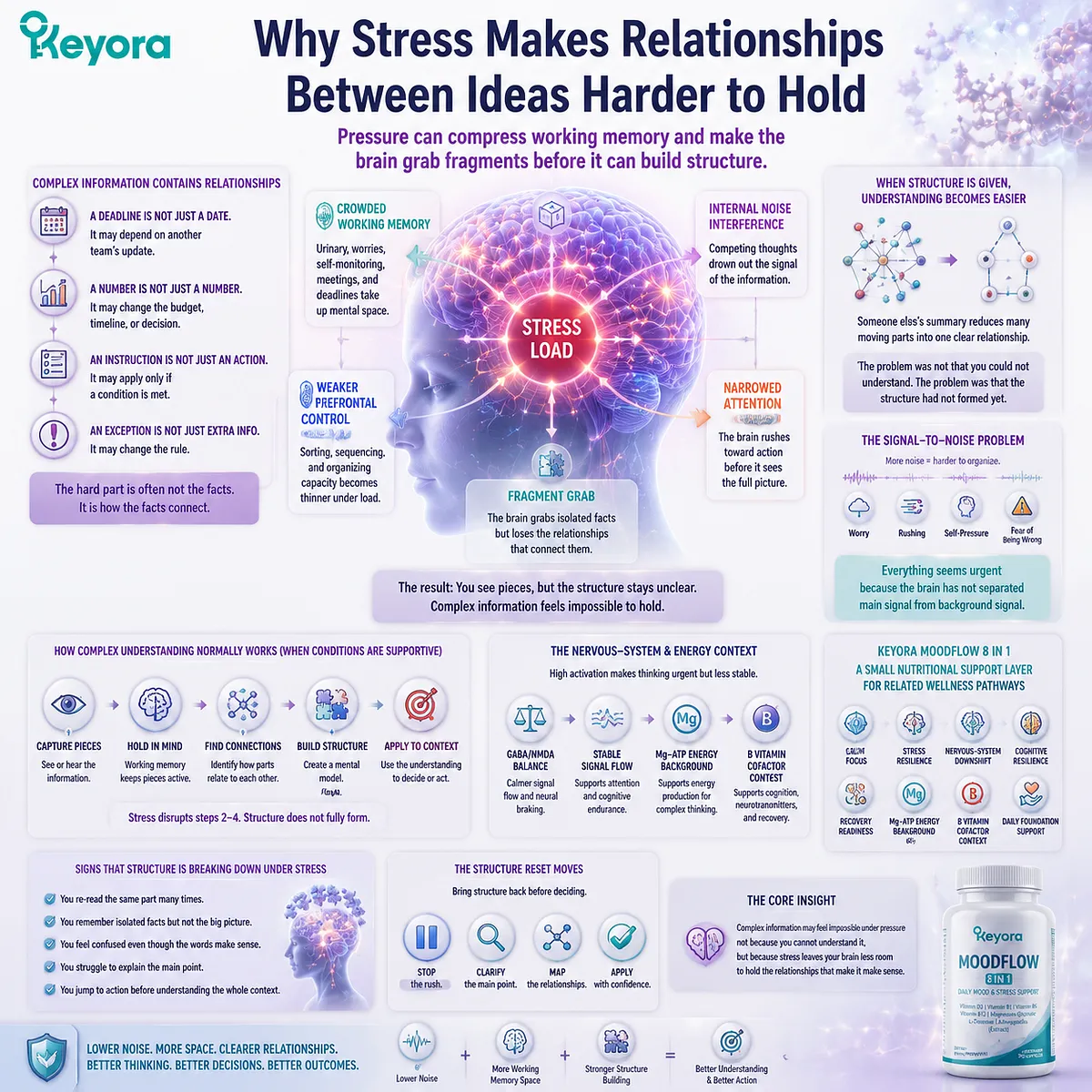
How to Understand Complex Information One Layer at a Time
The goal is not instant understanding, but turning complexity into layers your brain can hold.
A helpful approach is The Layered Understanding Method.
This method is not about forcing faster comprehension. It is not about becoming more efficient under pressure. It is about giving the brain a way to separate complexity into pieces it can actually hold.
Step one: name the type of complexity.
Before trying to understand everything, ask: “What makes this complex?”
Is it complex because there are too many people?
Too many dates?
Too many conditions?
Too many exceptions?
Unfamiliar terms?
Unclear responsibility?
Several steps mixed together?
A decision attached to the information?
This question changes the experience.
Instead of “I cannot understand this,” you begin to see, “This is hard because there are three timelines and two exceptions,” or “This is hard because I do not know who owns the next step.”
That is already progress. You have moved from self-blame to structure.
Step two: separate facts from relationships.
Facts are what the information states.
A deadline.
A person.
A number.
A requirement.
A document.
A change.
A meeting time.
Relationships explain how those facts connect.
If this happens, then that follows.
This must happen before that.
This depends on that.
This is the exception.
This person is responsible for that part.
This number changes the earlier decision.
Complexity often comes from relationships, not from the facts themselves.
If you only collect facts, the information may still feel scattered. If you identify relationships, the structure begins to appear.
Step three: build a one-line structure.
After reading, try to complete one sentence:
“This information is mainly saying that…”
Or:
“The main relationship is…”
For example:
“This information is mainly saying that the client needs approval before Friday, but only if the updated numbers change the original budget.”
Or:
“The main relationship is that Team A cannot move forward until Team B confirms the final date.”
This sentence does not need to capture every detail. It needs to create a stable frame. Once the frame exists, the smaller details have somewhere to attach.
Step four: delay judgment until the structure is clear.
Do not try to understand, decide, reply, and solve at the same time.
First ask: “Do I understand the structure?”
Then ask: “What should I do about it?”
This separation is important. Pressure often pushes you to act before the information is organized. But complex understanding needs a short space before judgment.
You can even write two lines:
Meaning: “This is saying that…”
Action: “So I need to…”
That small separation can reduce confusion.
The goal is not instant understanding. The goal is to turn complexity into layers your brain can hold.
When the structure becomes visible, the pressure often drops. You may still need to think carefully. You may still need to ask a follow-up question. But the information no longer feels like a wall.
It becomes a map.
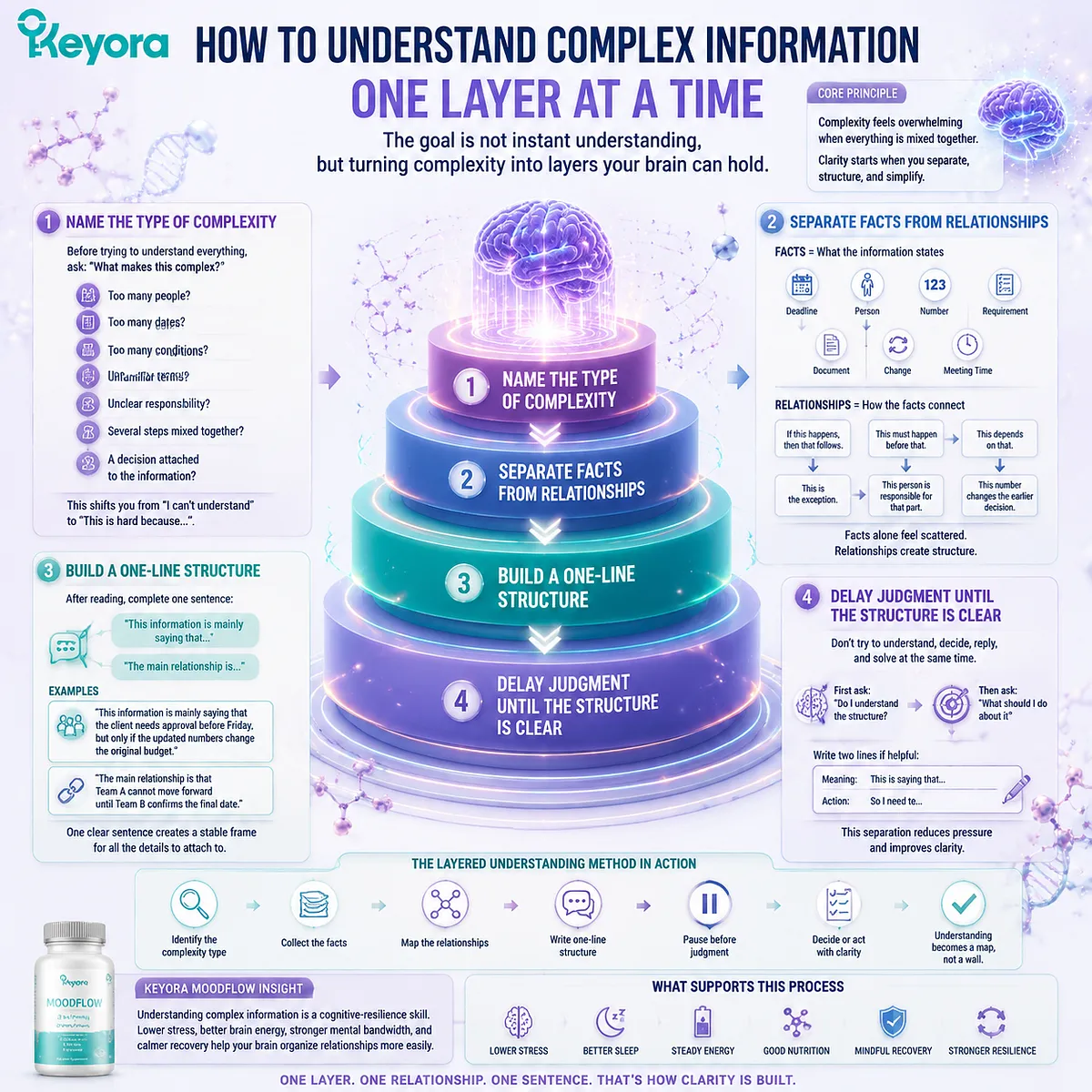
Where Nutritional Support Fits
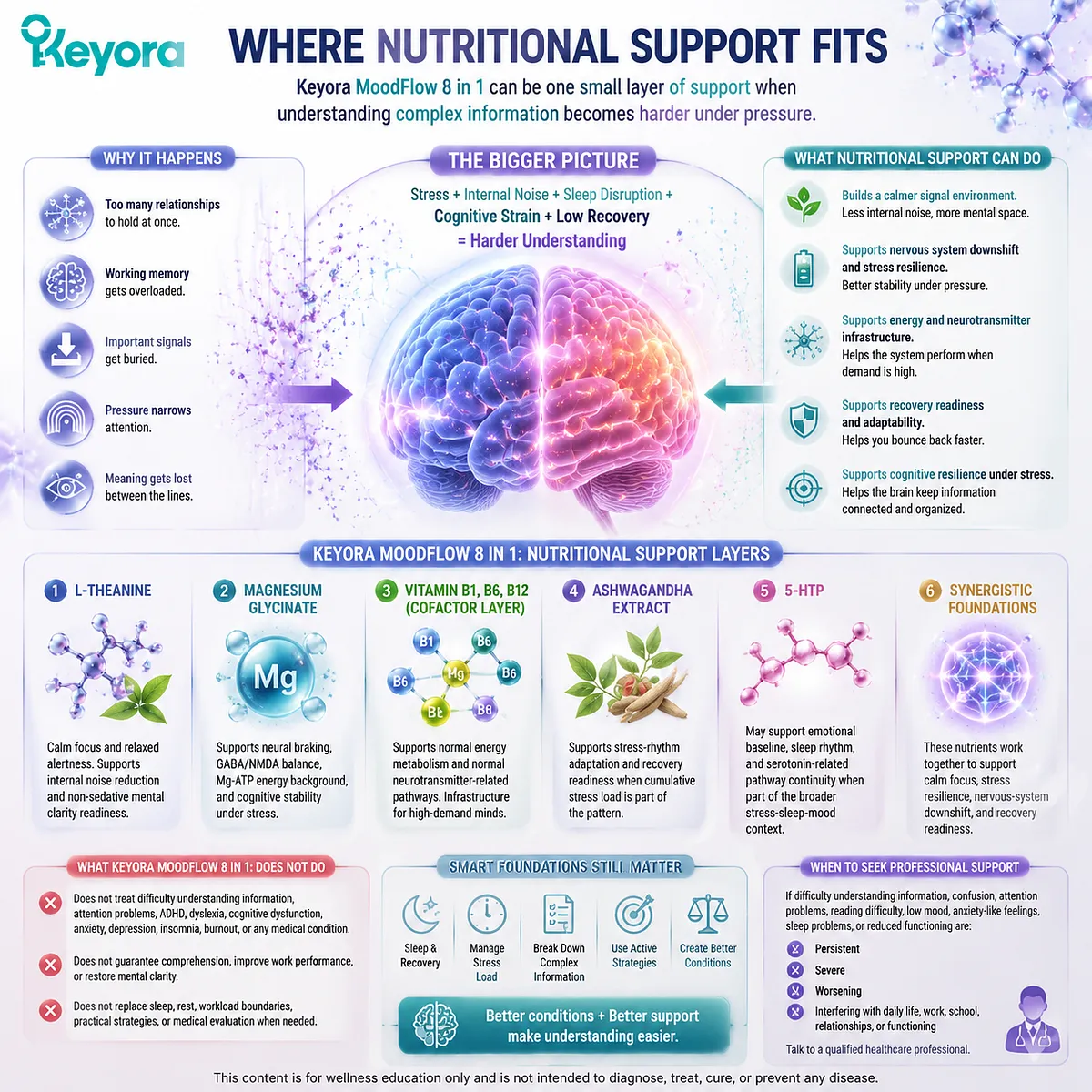
Keyora MoodFlow 8 in 1 can fit as one small nutritional support layer when difficulty understanding complex information under pressure appears within a broader pattern of cognitive strain, stress load, internal noise, sleep disruption, and reduced recovery readiness.
Its role is narrower: supporting wellness pathways related to calm focus, stress resilience, nervous-system downshift, cognitive resilience under stress, recovery readiness, and neuro-metabolic cofactor context.
-
L-Theanine may support calm focus, relaxed alertness, internal noise support, and non-sedative mental clarity readiness.
-
Magnesium glycinate may support neural braking, GABA/NMDA activation balance, Mg-ATP energy background, and cognitive stability context.
-
B1, B6, and B12 fit the neuro-metabolic cofactor layer for normal energy metabolism and normal neurotransmitter-related pathways.
-
Ashwagandha may support stress-rhythm adaptation and recovery readiness when cumulative stress load is part of the pattern.
-
5-HTP may be relevant only when emotional baseline, sleep rhythm, and serotonin-related pathway continuity are part of the broader stress-sleep-mood context.
Keyora MoodFlow 8 in 1 does not treat difficulty understanding information, attention problems, ADHD, dyslexia, cognitive dysfunction, anxiety, depression, insomnia, burnout, or any medical condition. It does not guarantee comprehension, improve work performance, restore mental clarity, or replace sleep, rest, workload boundaries, practical information-processing strategies, or medical evaluation when needed.
If difficulty understanding information, confusion, attention problems, reading difficulty, low mood, anxiety-like feelings, sleep problems, or reduced functioning are persistent, severe, worsening, or interfering with daily life, work, school, relationships, or functioning, they should be discussed with a qualified healthcare professional.
Closing Summary
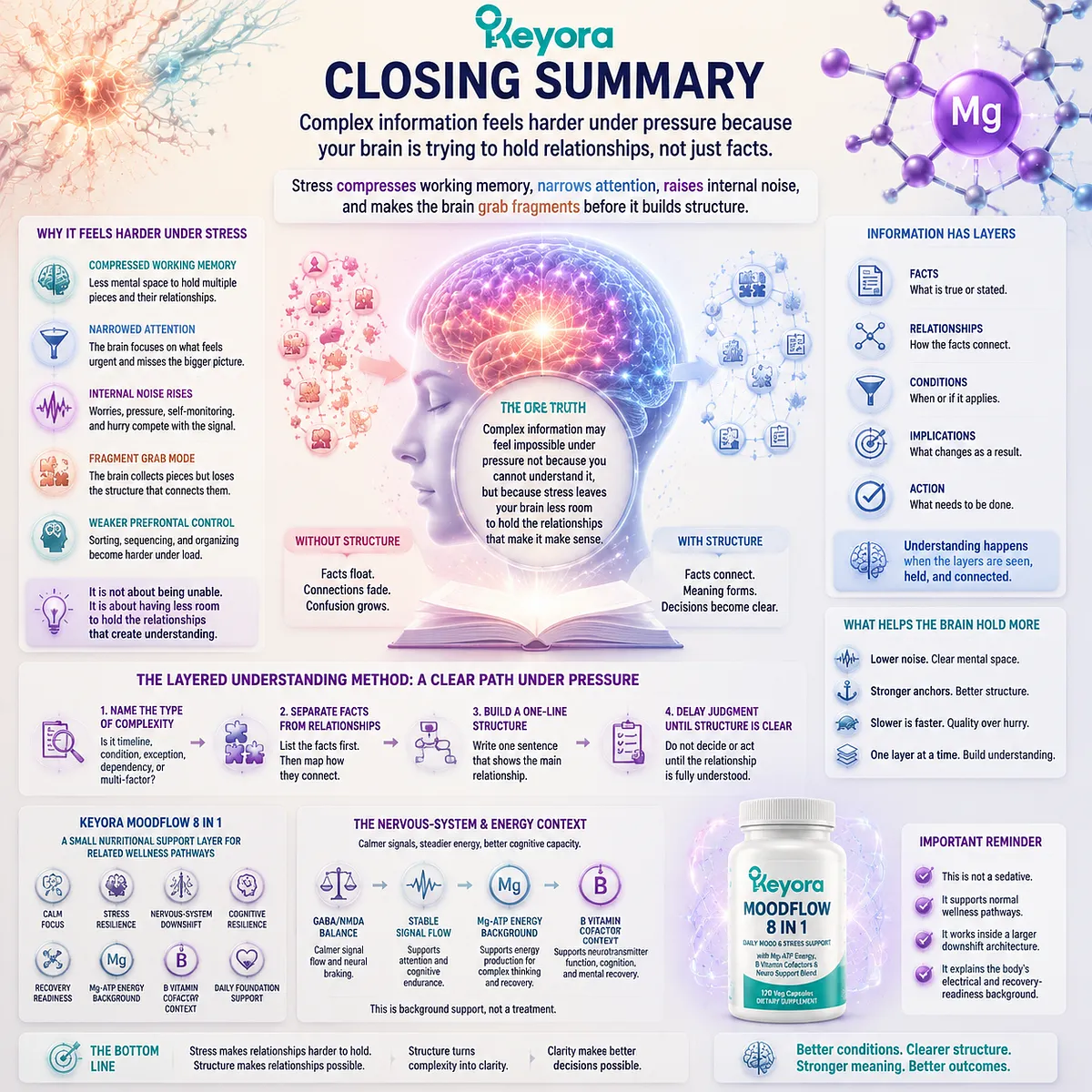
Complex information can feel harder to understand under pressure because your brain is not only reading facts. It is trying to hold relationships between facts.
Stress can compress working memory, narrow attention, raise internal noise, and make the brain grab fragments before it has built structure. This does not mean you are unintelligent or incapable. It may mean the information needs to be separated into layers before it can become clear.
The practical path is The Layered Understanding Method: name the type of complexity, separate facts from relationships, build a one-line structure, and delay judgment until the structure is clear.
Keyora MoodFlow 8 in 1 belongs only as a small nutritional support layer for related wellness pathways, including calm focus, stress resilience, nervous-system downshift, cognitive resilience, recovery readiness, Mg-ATP energy background, and B vitamin cofactor context.
Complex information may feel impossible under pressure not because you cannot understand it, but because stress leaves your brain less room to hold the relationships that make it make sense.
This article is for educational and informational purposes only. It does not provide medical advice, diagnosis, treatment, cure, prevention, disease outcome claims, hormone restoration claims, fertility outcome claims, or formula-specific clinical efficacy claims.