
Why Do I Make More Careless Mistakes When I’m Stressed?
Keyora Research Q&A Library
This is part of the Keyora Research Q&A Series, derived from Keyora Nutritional Neurology Series .
Within the Keyora Nutritional Neurology framework, this Q&A translates complex nutrient–brain mechanisms into reader-friendly, evidence-bound answers, focusing on stress resilience, sleep quality, calm mood support, cognitive wellness, and the broader interaction between nutrition, neurochemistry, and daily nervous-system function.
First published by Keyora Research Journal: www.keyorahealth.com

Direct Answer
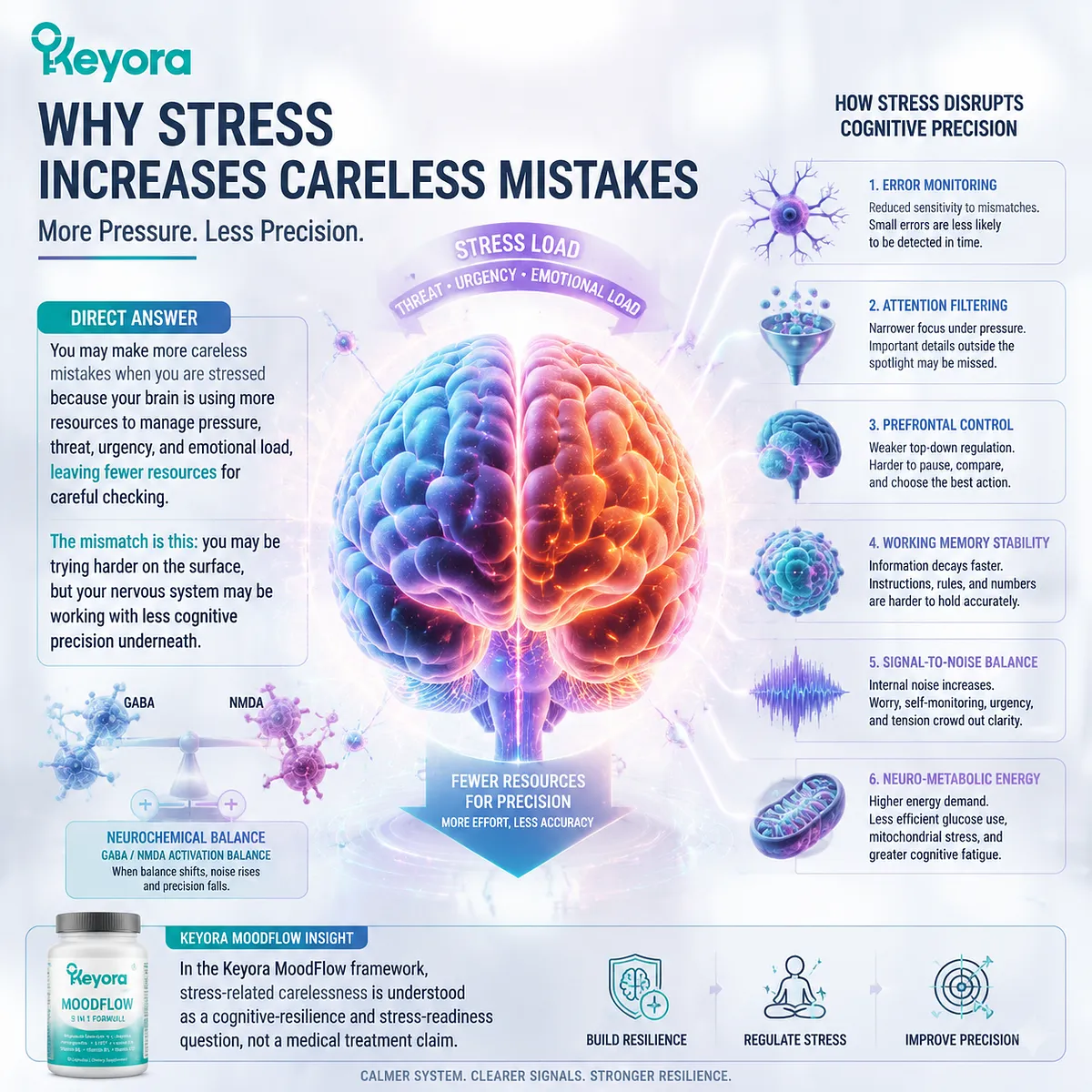
You may make more careless mistakes when you are stressed because your brain is using more resources to manage pressure, threat, urgency, and emotional load, leaving fewer resources for careful checking.
The mismatch is this: you may be trying harder on the surface, but your nervous system may be working with less cognitive precision underneath.
Stress can affect error monitoring, attention filtering, prefrontal control, working memory stability, signal-to-noise balance, GABA/NMDA activation balance, and neuro-metabolic energy context. That is why small errors may appear before you consciously realize how overloaded you are.
In the Keyora MoodFlow framework, this is understood as a cognitive-resilience and stress-readiness question, not a medical treatment claim.
Why Careless Mistakes Increase Under Stress
Careless mistakes are often a signal of reduced cognitive precision, not reduced intelligence or effort.
You may notice it in small, frustrating ways.
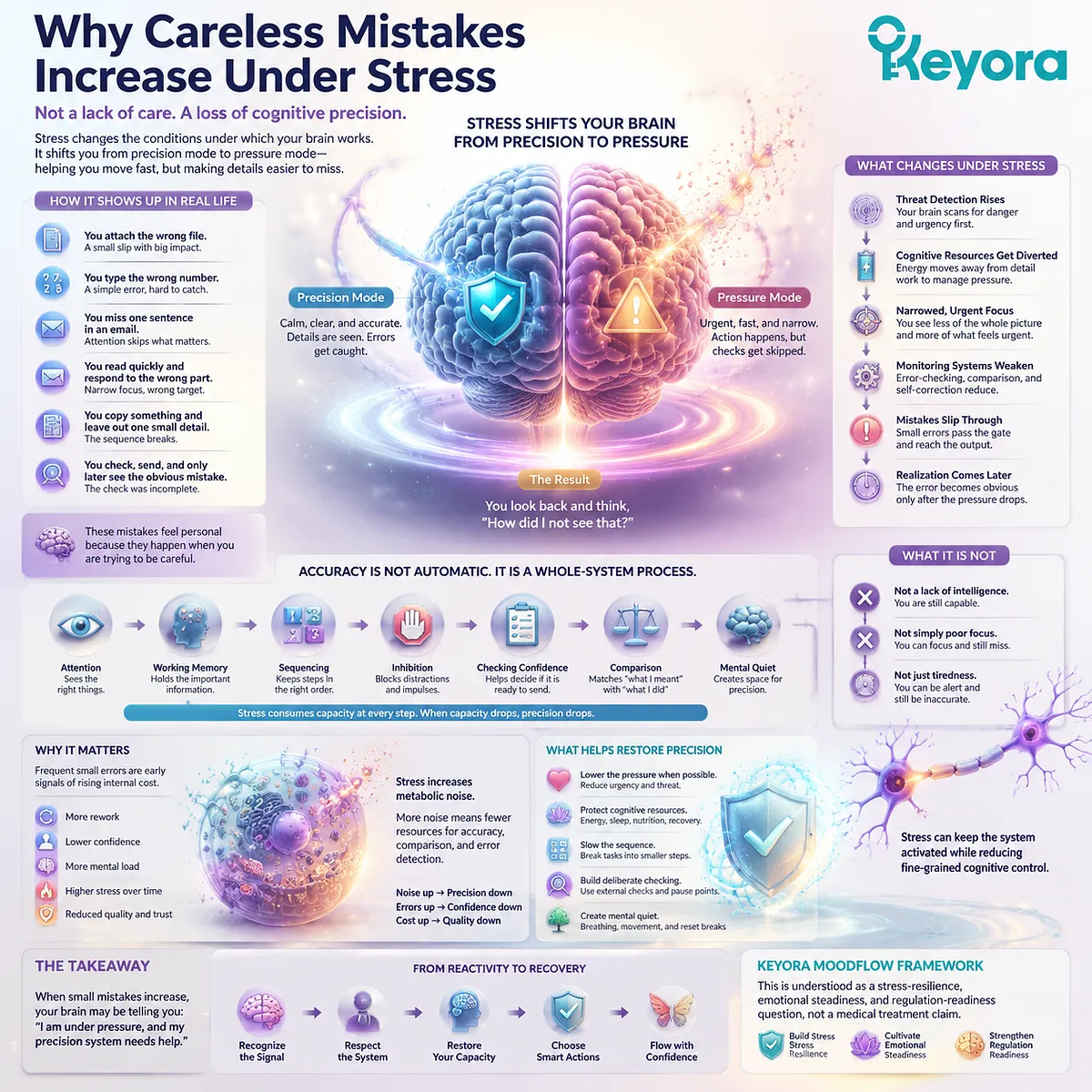
You attach the wrong file. You type the wrong number. You miss one sentence in an email. You read a message quickly and respond to the wrong part. You copy something from one place to another and leave out one small detail. You check a document, send it, and only later see the obvious mistake.
The painful part is that these mistakes often happen when you are trying to be careful.
You may think, “I know better than this.”
You may ask, “Why am I making such simple mistakes?”
You may feel embarrassed because the error looks small from the outside, even though the inner pressure felt large.
This is why careless mistakes under stress can feel so personal. They seem to attack your identity. A person who usually sees details suddenly misses them. A person who normally produces clean work suddenly sends something messy. A person who cares about quality suddenly looks careless.
But the word “careless” can be misleading.
Many stress-related mistakes are not caused by a lack of care. They happen because care requires cognitive resources. Accuracy is not automatic. It depends on attention, working memory, sequencing, inhibition, checking confidence, and enough mental quiet to compare “what I meant to do” with “what I actually did.”
When stress rises, your brain may shift from precision mode into pressure mode.
Pressure mode is useful when something urgent needs action. It helps you move, decide, respond, and protect yourself from falling behind. But it is not always good for slow accuracy. It may push you to finish, send, answer, or move on before the checking system has fully completed its work.
That is why the mistake may feel strange afterward. You look at it later and think, “How did I not see that?”
You did not miss it because you became less capable. You missed it because stress changed the conditions under which your capability was operating.
This topic is different from general focus difficulty. The problem is not only “I cannot focus.” Sometimes you can focus intensely and still make mistakes. Stress can create a narrowed, urgent kind of focus that helps you push through the task but reduces the wider monitoring needed to catch details.
It is also different from simple tiredness. You may be alert, active, and highly engaged, yet still inaccurate. That is because stress can keep the system activated while reducing fine-grained cognitive control.
The most important insight is this: when your work starts showing small errors, your brain may be telling you that the internal cost of performance is rising.
The Mechanism Behind Stress-Related Careless Mistakes
Stress can make the brain faster, narrower, and less stable before it feels obviously overloaded.
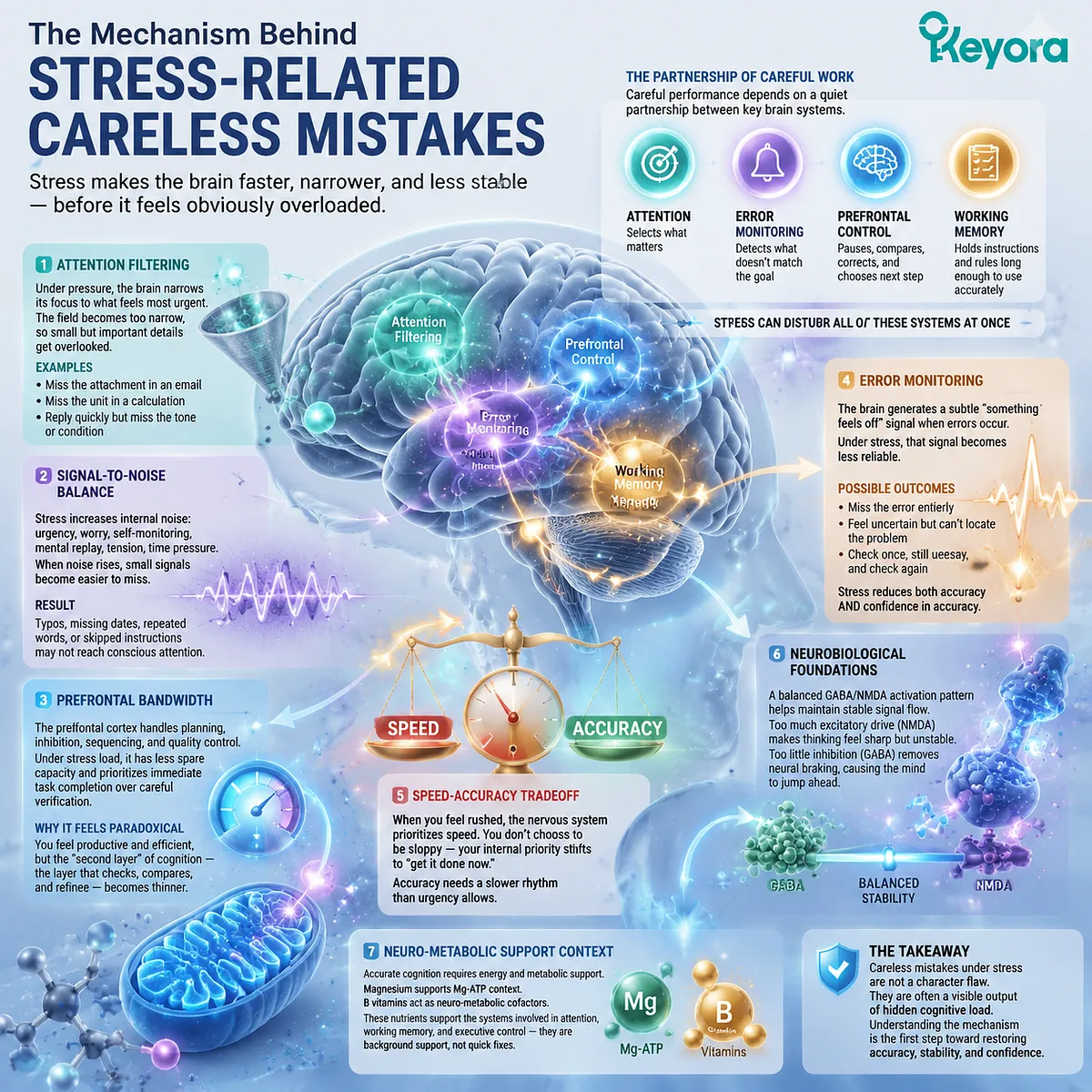
Careful work depends on a quiet partnership between attention and error monitoring.
Attention helps you select what matters. Error monitoring helps you notice when something does not match the goal. Prefrontal control helps you pause, compare, correct, and choose the next step. Working memory holds the instruction, number, sentence, or rule in mind long enough to apply it accurately.
Stress can disturb all of these systems at once.
The first mechanism is attention filtering. Under pressure, the brain tries to decide what is most urgent. That can be helpful, but it can also narrow the field too much. You may lock onto the main task while missing small details around it.
For example, you may focus on finishing the email but miss the attachment. You may focus on the main calculation but miss the unit. You may focus on replying quickly but miss the tone or condition in the original message.
The second mechanism is signal-to-noise balance. Stress increases internal noise: urgency, self-monitoring, worry about consequences, mental replay, emotional tension, and time pressure. When the background noise rises, small signals become easier to miss.
A typo, a missing date, a repeated word, or one skipped instruction may not be loud enough to reach conscious attention.
The third mechanism is prefrontal bandwidth. The prefrontal cortex is heavily involved in planning, inhibition, sequencing, and quality control. Under stress load, that system may still function, but with less spare capacity. It may prioritize immediate task completion over careful verification.
This is why stress can make you feel both productive and error-prone.
You are doing things. You are moving forward. But the “second layer” of cognition — the layer that checks, compares, and refines — may be thinner than usual.
The fourth mechanism is error monitoring. Normally, the brain generates a subtle internal signal when something feels off. Under stress, that signal may become less reliable. Sometimes you miss the error entirely. Sometimes you feel uncertain but do not know where the problem is. Sometimes you check once, still feel uneasy, and check again.
Stress can reduce both accuracy and confidence in accuracy.
The fifth mechanism is the speed-accuracy tradeoff. When you feel rushed, the nervous system may choose speed. This does not mean you consciously decide to be sloppy. It means the internal priority shifts toward “get it done now.” Accuracy often needs a slower rhythm than urgency allows.
This is also where nervous-system activation matters.
A balanced GABA/NMDA activation pattern helps the brain maintain steadier signal flow. Too much excitatory drive can make thinking feel sharp but unstable, like a system running hot. Without enough neural braking, the mind may jump ahead before the checking process is complete.
Neuro-metabolic context matters too. Accurate cognition requires energy. The brain needs enough metabolic support for attention, working memory, and executive control. Magnesium’s role in Mg-ATP context and B vitamins’ role as neuro-metabolic cofactors are relevant here as background support systems, not as quick fixes.
Careless mistakes under stress are therefore not a character flaw. They are often a visible output of hidden cognitive load.
How MoodFlow Supports Cognitive Precision Pathways
The goal is not forced perfection, but better stress-readiness for the systems that support accurate work.
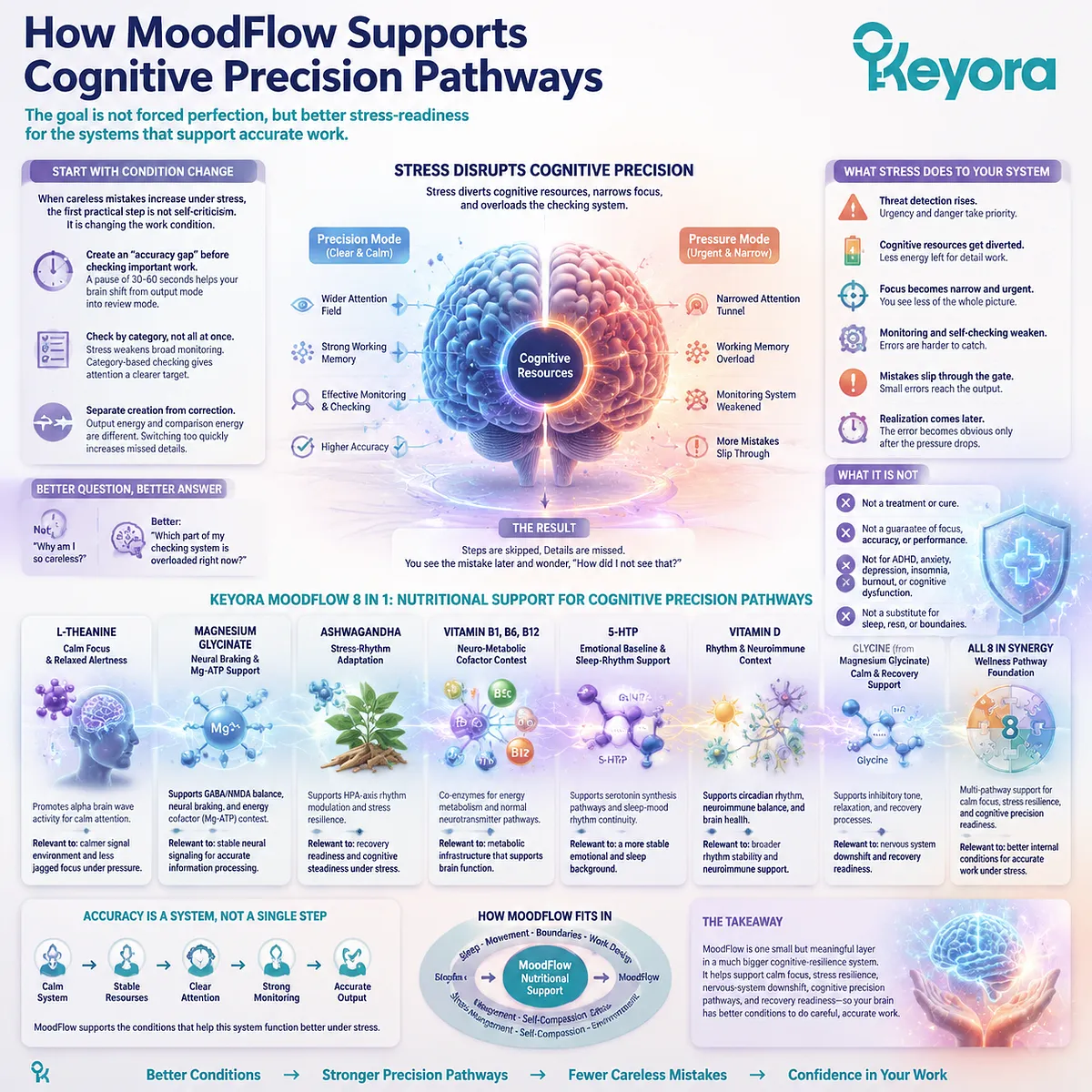
When careless mistakes increase under stress, the first practical step is not self-criticism. It is changing the work condition.
A stressed brain needs fewer hidden demands.
Before sending important work, create a small “accuracy gap.” This means placing a short pause between finishing and checking. Even thirty to sixty seconds can help the brain move from output mode into review mode.
Do not check everything at once. Check by category.
One pass for names.
One pass for numbers.
One pass for attachments.
One pass for dates.
One pass for instructions.
This matters because stress weakens broad monitoring. A category-based check reduces the demand on working memory and gives attention a clearer target.
When possible, separate creation from correction. Writing, replying, calculating, and designing require output energy. Checking requires comparison energy. Under stress, switching between the two too quickly can increase missed details.
A useful question is not, “Why am I so careless?”
A better question is, “Which part of my checking system is overloaded right now?”
In the Keyora MoodFlow framework, nutritional support fits as one small layer within a broader cognitive-resilience system.
-
L-Theanine is relevant to calm focus and relaxed alertness. Its role is not to sedate the mind, but to support a calmer signal environment where attention may feel less jagged under pressure.
-
Magnesium glycinate is relevant to neural braking, GABA/NMDA context, and Mg-ATP background. For stress-related cognitive precision, this matters because accuracy depends on stable neural signaling, not only motivation.
-
Ashwagandha is relevant to stress-rhythm adaptation and HPA-axis rhythm context. When stress load keeps the system in a high-demand state, recovery readiness and cognitive steadiness may become harder to maintain.
-
B1, B6, and B12 provide neuro-metabolic cofactor context. In this article, they should be understood as infrastructure support for energy metabolism and normal neurotransmitter-related pathways, not as a direct solution for mistakes.
-
5-HTP may be relevant when emotional baseline and sleep-rhythm continuity are part of the broader stress pattern. A more stable stress-sleep-mood background can indirectly support clearer work conditions.
-
Vitamin D belongs to the broader rhythm and neuroimmune context of the formula.
Keyora MoodFlow 8 in 1 should not be framed as treating careless mistakes, cognitive dysfunction, ADHD, anxiety, depression, insomnia, or burnout. It does not guarantee focus, accuracy, or work performance.
Its role is narrower and safer: supporting wellness pathways related to calm focus, stress resilience, nervous-system downshift, cognitive resilience under stress, neuro-metabolic cofactor context, and recovery readiness.
Closing Summary
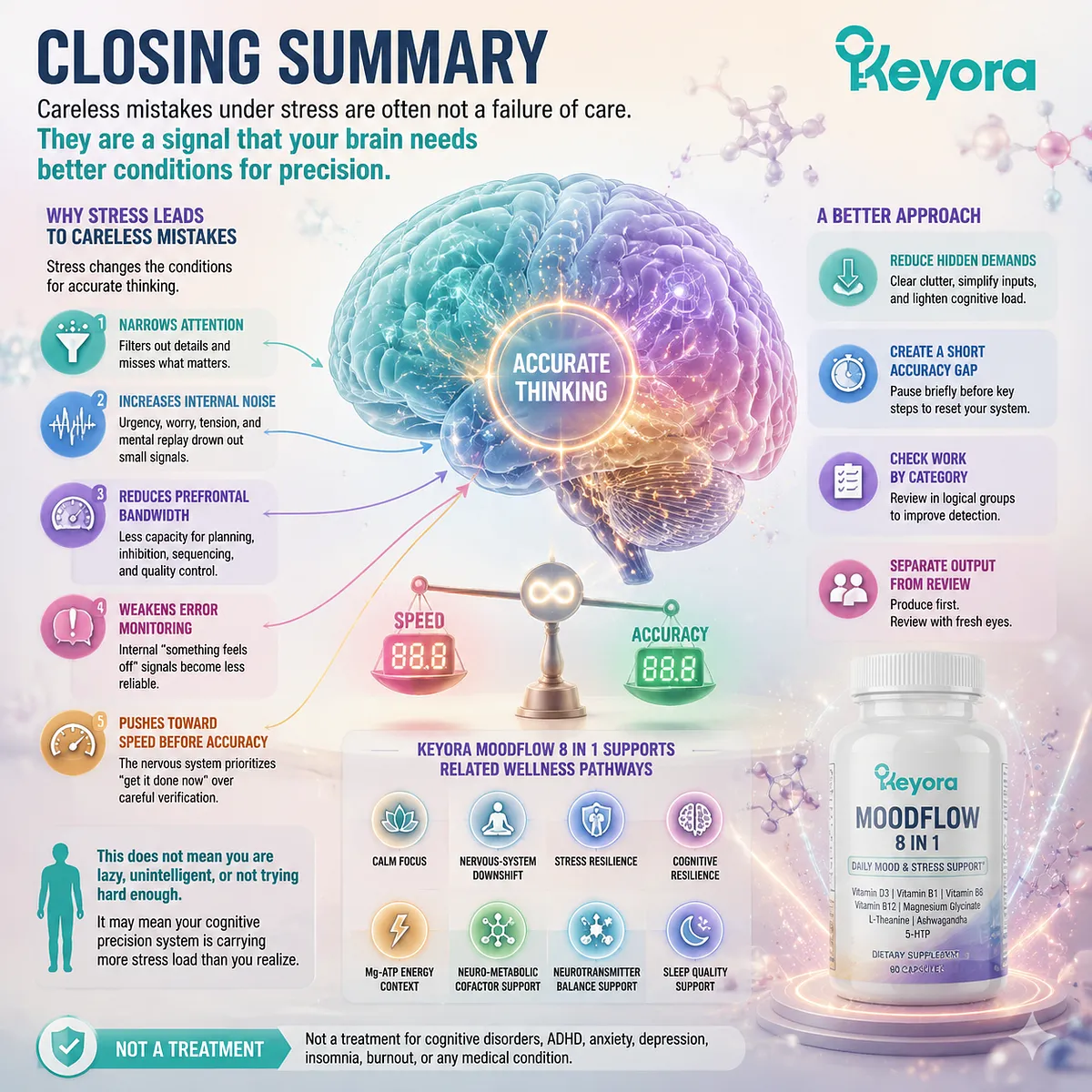
You may make more careless mistakes when stressed because stress changes the conditions for accurate thinking. It can narrow attention, increase internal noise, reduce prefrontal bandwidth, weaken error monitoring, and push the brain toward speed before accuracy.
This does not mean you are lazy, unintelligent, or not trying hard enough. It may mean your cognitive precision system is carrying more stress load than you realize.
A better approach is to reduce hidden demands, create a short accuracy gap, check work by category, and separate output from review.
Keyora MoodFlow 8 in 1 can support related wellness pathways such as calm focus, nervous-system downshift, stress resilience, cognitive resilience, Mg-ATP energy context, and neuro-metabolic cofactor support. It is not a treatment for cognitive disorders, ADHD, anxiety, depression, insomnia, burnout, or any medical condition.
Careless mistakes under stress are often not a failure of care. They are a signal that your brain needs better conditions for precision.
This article is for educational and informational purposes only. It does not provide medical advice, diagnosis, treatment, cure, prevention, disease outcome claims, hormone restoration claims, fertility outcome claims, or formula-specific clinical efficacy claims.