
Why Do I Feel the Need to Stay Productive Even When I Need a Break?
Keyora Research Q&A Library
This is part of the Keyora Research Q&A Series, derived from Keyora Nutritional Neurology Series .
Within the Keyora Nutritional Neurology framework, this Q&A translates complex nutrient–brain mechanisms into reader-friendly, evidence-bound answers, focusing on stress resilience, sleep quality, calm mood support, cognitive wellness, and the broader interaction between nutrition, neurochemistry, and daily nervous-system function.
First published by Keyora Research Journal: www.keyorahealth.com
Direct Answer
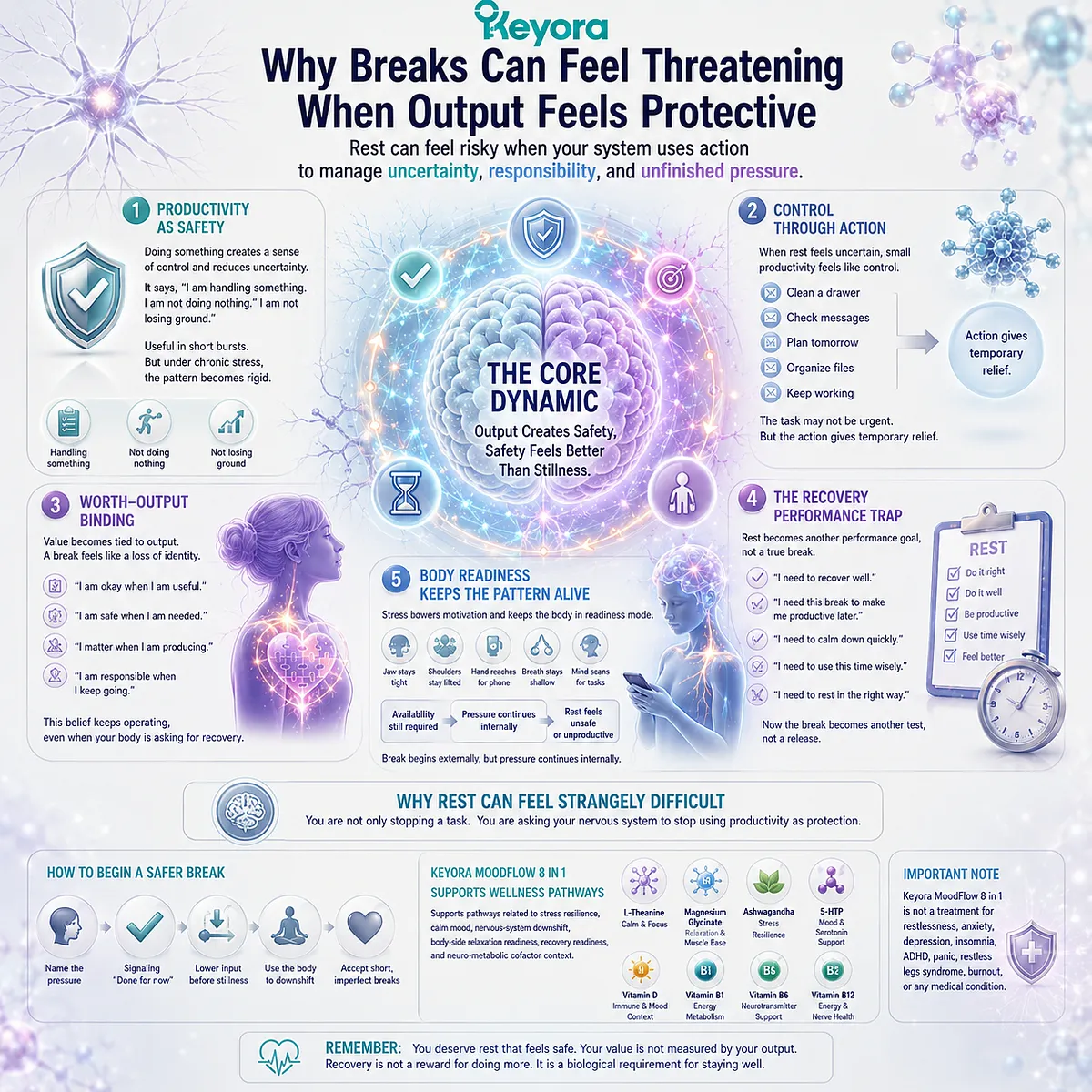
You may feel the need to stay productive even when you need a break because your stress system may have learned to treat output as proof of safety, control, worth, and responsibility. The urge to keep doing does not always mean you truly have energy left. Sometimes it means stopping feels unsafe.
The mismatch is this: your body may need recovery, but your internal pressure system may still believe that doing more is the safest choice. Productivity can become a way to manage uncertainty, avoid guilt, feel useful, and prove that you are not falling behind.
This can involve productivity as safety, control through action, worth-output binding, recovery performance pressure, body readiness, nervous-system downshift difficulty, body-side relaxation readiness, and neuro-metabolic cofactor context.
In the Keyora MoodFlow framework, the need to stay productive during stress is understood as a stress-resilience and recovery-readiness question, not a burnout, anxiety, depression, insomnia, chronic fatigue, ADHD, or medical treatment claim.
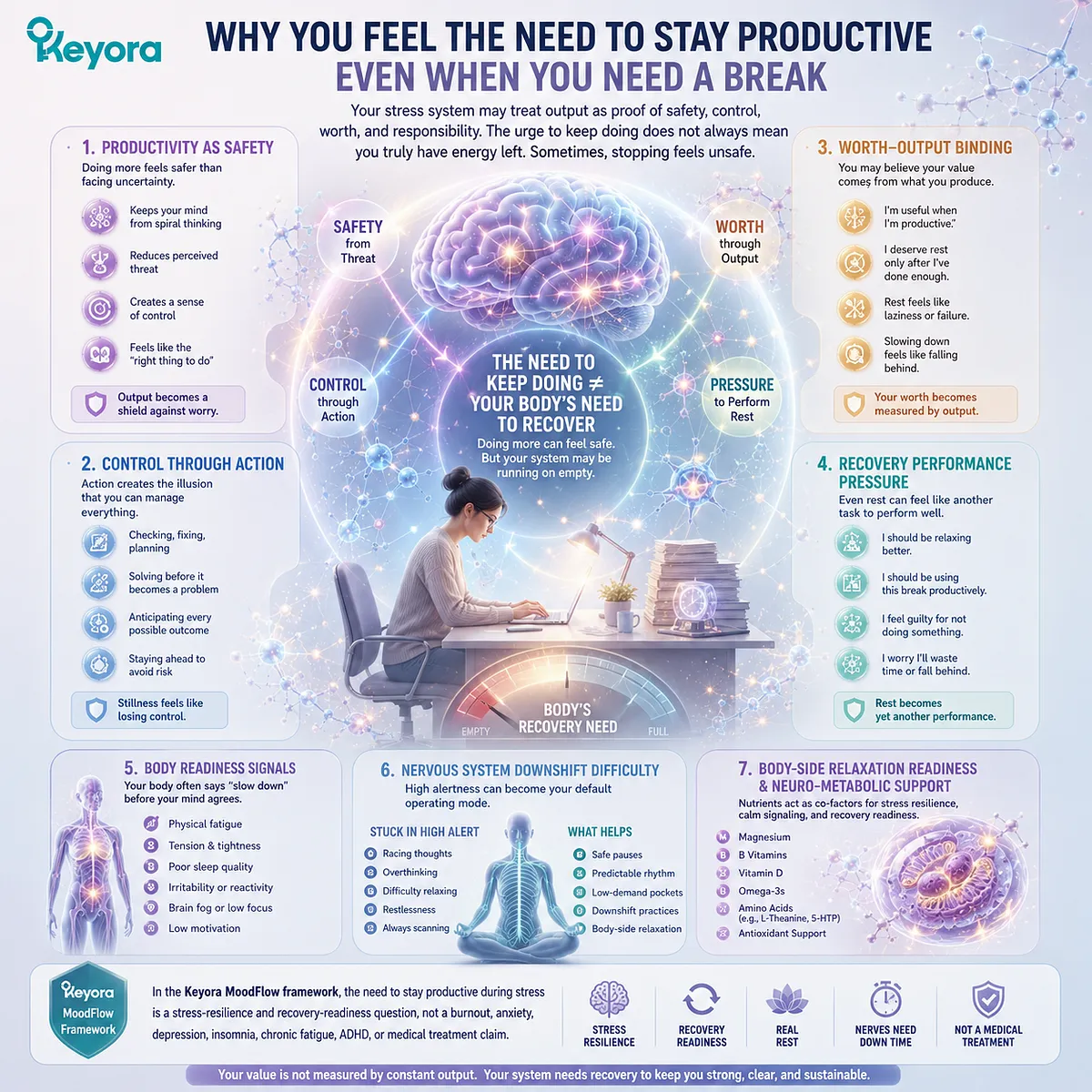
Why You May Want to Stay Productive Even When You Need Rest
The urge to keep doing can appear when productivity has become a signal of safety, control, and worth.
You know you need a break.
Your body knows it too.
Your shoulders feel tight. Your eyes are tired. Your thoughts are slower than they were earlier. Your attention keeps breaking. You reread the same sentence. You open a message and stare at it longer than necessary. You are no longer working with clarity. You are only pushing yourself to keep moving.
A part of you says:
“I should stop.”
But another part immediately answers:
“Just finish this first.”
“Reply to one more message.”
“Organize this file.”
“Make tomorrow’s plan.”
“Watch something useful.”
“Clean one more thing.”
“Rest is fine, but do not waste time.”
So the break never really begins.
You may sit down, but open a learning video. You may lie down, but start planning the next week. You may say you are resting, but still check messages. You may choose a “light task” because doing absolutely nothing feels too exposed.
The confusing part is that you may not even feel motivated.
You may be exhausted.
You may not want to continue.
But staying productive still feels safer than fully stopping.
Then you may wonder:
“Why do I keep doing things when I need rest?”
“Why does stopping make me uncomfortable?”
“Why do I feel better only when I am useful?”
“Why do I turn breaks into another task?”
What if the need to stay productive is not always real motivation?
What if productivity has become your nervous system’s way of feeling safe?
What if a break feels threatening because it removes the proof that you are still in control?
For a stressed system, output can start to feel like protection.
When you are doing something, there is proof.
Proof that you are responsible.
Proof that you are trying.
Proof that you are not falling behind.
Proof that you are useful.
Proof that you are still managing.
When you stop, that proof becomes quiet.
And for a system that has learned to rely on output, quiet can feel risky.
You may not be driven by energy.
You may be driven by a pressure loop that equates doing with safety.
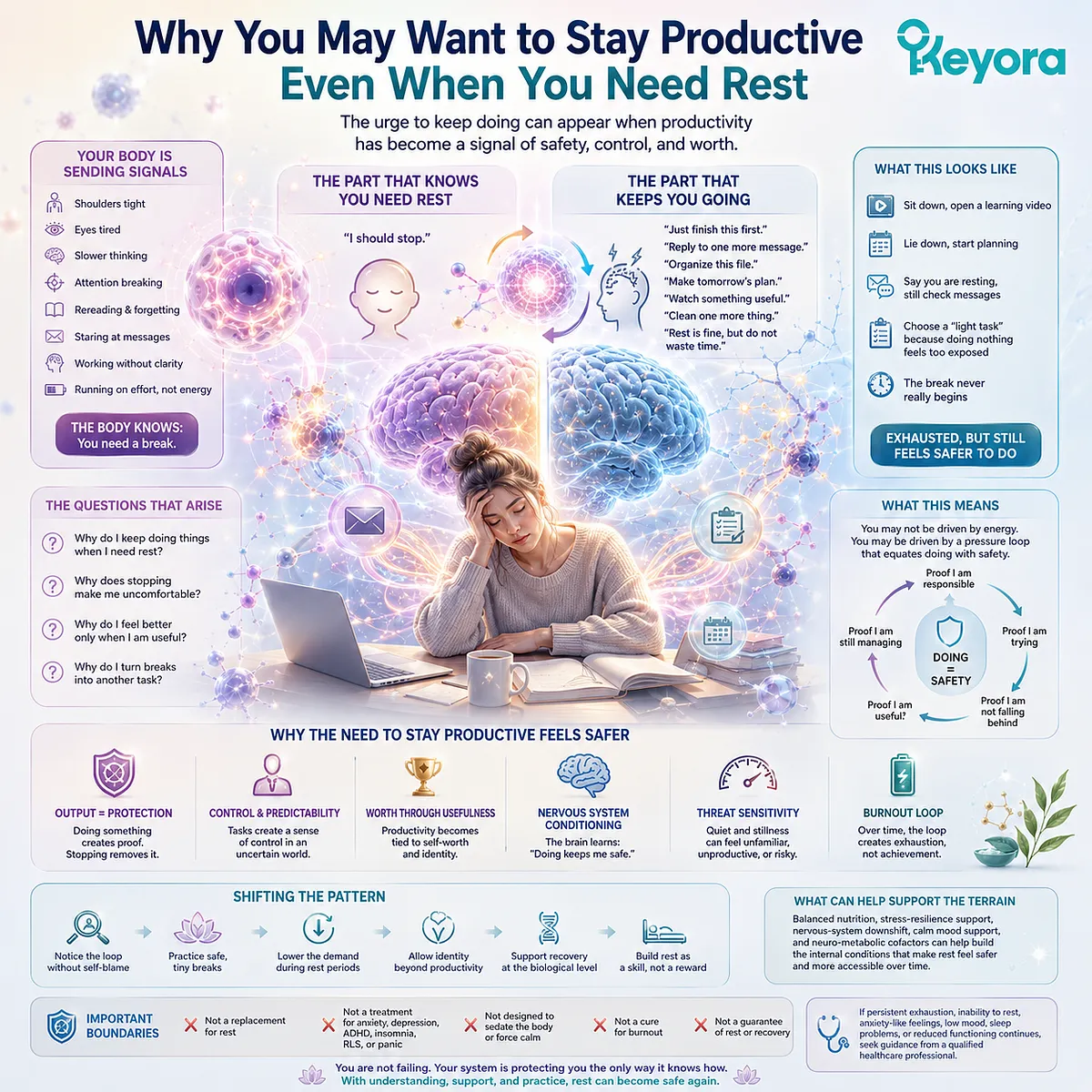
Why Breaks Can Feel Threatening When Output Feels Protective
Rest can feel risky when your system uses action to manage uncertainty, responsibility, and unfinished pressure.
The first mechanism is productivity as safety.
When life feels uncertain, doing something can create a small sense of control. Even if the task is minor, it gives the mind a place to go. It says, “I am handling something. I am not doing nothing. I am not losing ground.”
This can be useful in short bursts.
But under chronic stress, the pattern can become rigid.
You may begin to feel unsafe unless you are producing, improving, answering, planning, fixing, organizing, or preparing.
The second mechanism is control through action.
When rest feels uncertain, small productivity can feel like control.
You may clean a drawer because a larger life problem feels unsolved.
You may check messages because waiting feels uncomfortable.
You may plan tomorrow because today felt chaotic.
You may organize files because your mind wants a sense of order.
You may keep working because stopping would let you feel how tired you really are.
The task may not be urgent.
But the action gives temporary relief.
The third mechanism is worth-output binding.
If you have been praised for being responsible, efficient, helpful, high-achieving, available, or strong, it can become hard to separate your value from your output.
Then a break can feel like a loss of identity.
Not because you truly become less valuable when you rest.
But because the system has learned:
“I am okay when I am useful.”
“I am safe when I am needed.”
“I matter when I am producing.”
“I am responsible when I keep going.”
That belief can keep operating even when your body is asking for recovery.
The fourth mechanism is the recovery performance trap.
Sometimes people do try to rest, but they turn rest into another performance goal.
“I need to recover well.”
“I need this break to make me productive later.”
“I need to calm down quickly.”
“I need to use this time wisely.”
“I need to rest in the right way.”
When recovery becomes another performance goal, the break no longer feels like a break.
It becomes another test.
The fifth mechanism is body readiness.
This connects the whole pattern: stress can lower motivation, keep the body tense, and make rest feel unsafe or unproductive.
You may want to stop, but your body may still be in readiness mode.
The jaw stays tight.
The shoulders stay lifted.
The hand reaches for the phone.
The breath stays shallow.
The mind scans for unfinished tasks.
The body behaves as if availability is still required.
So even when the break begins externally, the pressure state continues internally.
That is why rest can feel strangely difficult. You are not only stopping a task. You are asking your nervous system to stop using productivity as protection.
How to Take a Break Without Turning It Into Another Task
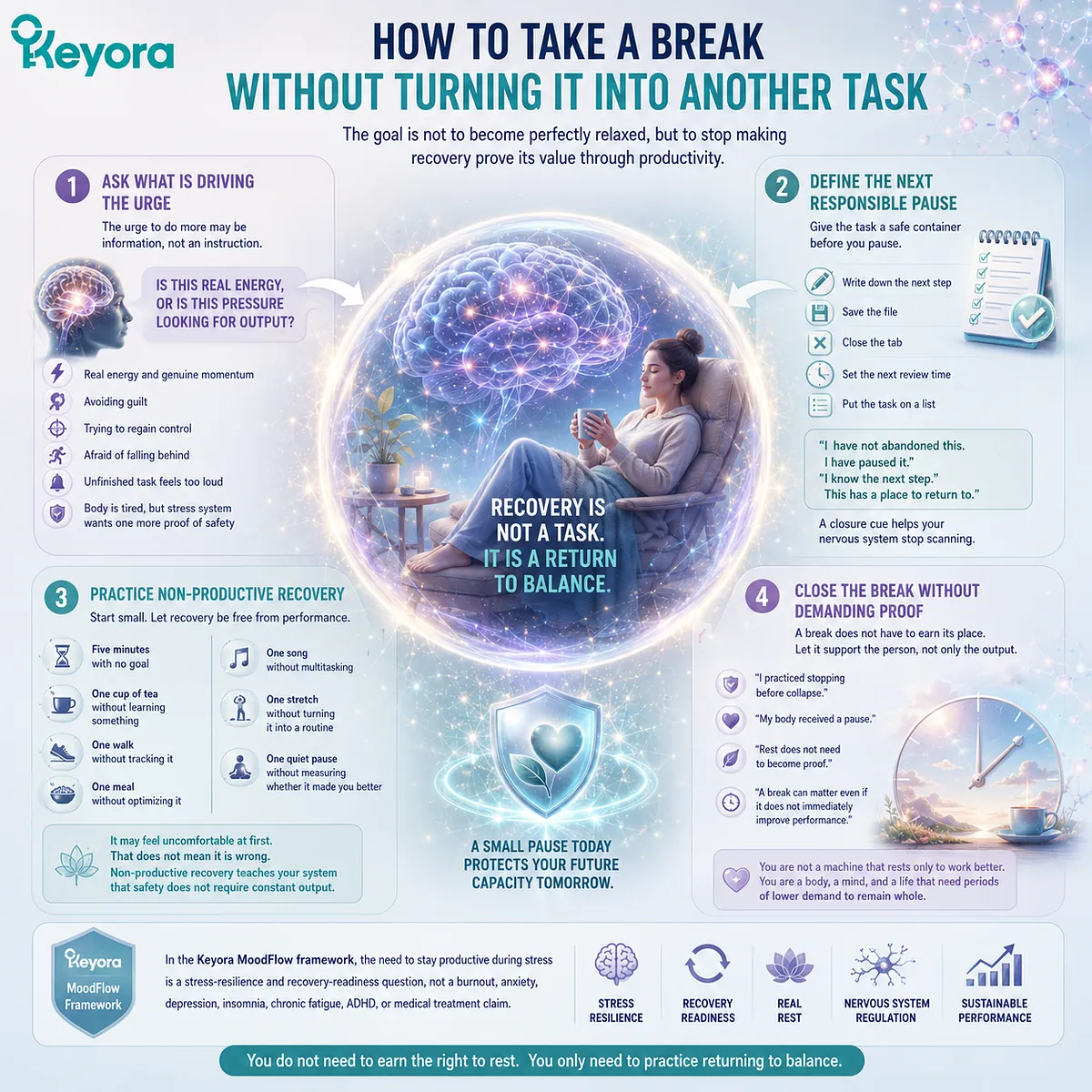
The goal is not to become perfectly relaxed, but to stop making recovery prove its value through productivity.
The first step is to ask what is driving the urge.
When you feel the need to keep doing, pause and ask:
“Is this real energy, or is this pressure looking for output?”
This question is not meant to shame you.
It helps you separate different signals.
Sometimes you truly have energy and want to continue.
Sometimes you are avoiding guilt.
Sometimes you are trying to regain control.
Sometimes you are afraid of falling behind.
Sometimes the unfinished task feels too loud.
Sometimes your body is tired, but your stress system wants one more proof that you are still safe.
The urge to do more may be information, not an instruction.
The second step is to define the next responsible pause.
Many people cannot rest because stopping feels like abandonment. So give the task a safe container before you pause.
Write down the next step.
Save the file.
Close the tab.
Set the next review time.
Put the task on a list instead of holding it in your body.
Tell yourself:
“I have not abandoned this. I have paused it.”
“I know the next step.”
“This has a place to return to.”
This is not productivity disguised as rest. It is a closure cue that helps the nervous system stop scanning.
The third step is to practice non-productive recovery.
Start small.
Five minutes with no goal.
One cup of tea without learning something.
One walk without tracking it.
One meal without optimizing it.
One song without multitasking.
One stretch without turning it into a routine.
One quiet pause without measuring whether it made you better.
This may feel uncomfortable at first.
That does not mean it is wrong.
Non-productive recovery is not useless. It teaches the system that safety does not require constant output.
The fourth step is to close the break without demanding proof.
After a pause, do not immediately ask:
“Was that useful?”
“Am I more productive now?”
“Did I recover enough?”
“Did I deserve that?”
Try saying:
“I practiced stopping before collapse.”
“My body received a pause.”
“Rest does not need to become proof.”
“A break can matter even if it does not immediately improve performance.”
This is important because a break does not have to earn its place by making you more productive immediately.
Recovery is allowed to support the person, not only the output.
You are not a machine that rests only to work better.
You are a body, a mind, and a life that need periods of lower demand to remain whole.
Where Nutritional Support Fits
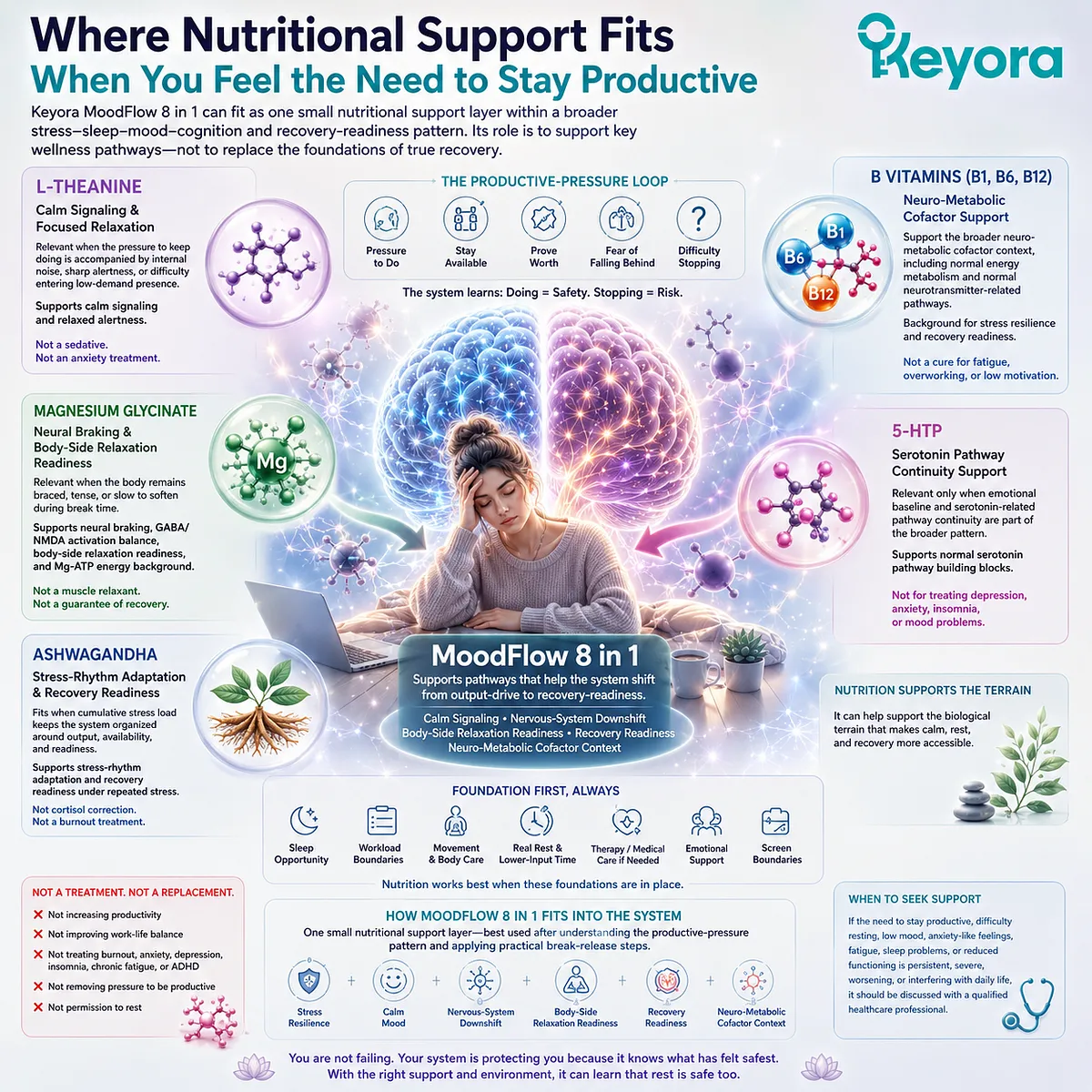
Keyora MoodFlow 8 in 1 can fit as one small nutritional support layer when the need to stay productive appears within a broader stress-sleep-mood-cognition and recovery-readiness pattern. It should not be framed as increasing productivity, improving work-life balance, treating burnout, treating anxiety, treating depression, treating insomnia, treating chronic fatigue, treating ADHD, removing productivity pressure, or creating permission to rest.
Its role is narrower: supporting wellness pathways involved in stress resilience, calm mood, nervous-system downshift, body-side relaxation readiness, recovery readiness, and neuro-metabolic cofactor context.
-
L-Theanine may be relevant when the pressure to keep doing is accompanied by internal noise, sharp alertness, or difficulty entering low-demand presence. In the MoodFlow framework, it supports calm signaling and relaxed alertness without being framed as sedation, anxiety treatment, or productivity support.
-
Magnesium glycinate may be relevant when the body remains braced, tense, or slow to soften during break time. It supports neural braking, GABA/NMDA activation balance, body-side relaxation readiness, and Mg-ATP energy background. This is not a claim that it relaxes the body like a drug or guarantees recovery.
-
Ashwagandha may fit when cumulative stress load keeps the system organized around output, availability, and readiness. Its role is stress-rhythm adaptation and recovery readiness under repeated stress, not cortisol correction or burnout treatment.
-
B vitamins may support the broader neuro-metabolic cofactor context, including normal energy metabolism and normal neurotransmitter-related pathways. This belongs to the background of stress resilience and recovery readiness, not a cure for fatigue, overworking, or low motivation.
-
5-HTP may be relevant only when emotional baseline and serotonin-related pathway continuity are part of the broader pattern. It should not be framed as treating depression, anxiety, insomnia, or mood problems.
MoodFlow belongs after the reader understands the productive-pressure loop and the practical break-release method. Nutrition can support the terrain. It cannot replace real rest, sleep opportunity, workload boundaries, movement, therapy, medical care, emotional support, or lifestyle foundations.
If the need to stay productive, difficulty resting, low mood, anxiety-like feelings, fatigue, sleep problems, or reduced functioning is persistent, severe, worsening, or interfering with daily life, it should be discussed with a qualified healthcare professional.
Closing Summary
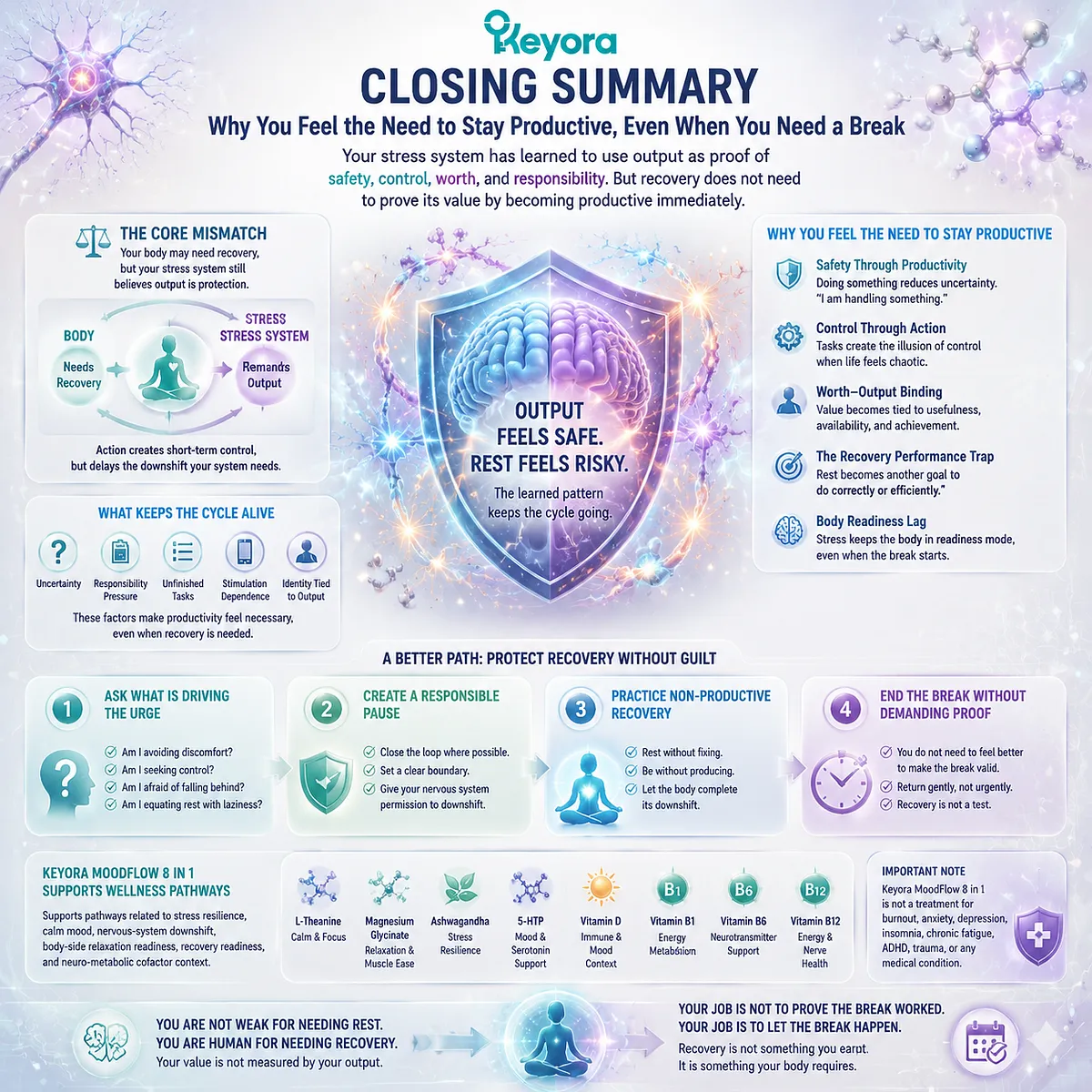
You may feel the need to stay productive even when you need a break because productivity can become a stress signal for safety, control, worth, and responsibility. The urge to keep doing does not always mean you have real energy available.
The deeper mismatch is that your body may need recovery while your stress system still believes output is protection. Action can create short-term control, but it can also delay the downshift your system needs.
A better path begins by asking what is driving the urge, creating a responsible pause, practicing non-productive recovery, and ending the break without demanding proof that it improved your performance.
Keyora MoodFlow 8 in 1 can support wellness pathways related to stress resilience, calm mood, nervous-system downshift, body-side relaxation readiness, recovery readiness, and neuro-metabolic cofactor context. It is not a treatment for burnout, anxiety, depression, insomnia, chronic fatigue, ADHD, trauma, or any medical condition.
You may feel the need to stay productive even when you need a break because your stress system has learned to use output as proof of safety, control, worth, and responsibility.
But recovery does not need to prove its value by becoming productive immediately.
This article is for educational and informational purposes only. It does not provide medical advice, diagnosis, treatment, cure, prevention, disease outcome claims, hormone restoration claims, fertility outcome claims, or formula-specific clinical efficacy claims.