
Why Do I Feel Restless When I Try to Relax?
Keyora Research Q&A Library
This is part of the Keyora Research Q&A Series, derived from Keyora Nutritional Neurology Series .
Within the Keyora Nutritional Neurology framework, this Q&A translates complex nutrient–brain mechanisms into reader-friendly, evidence-bound answers, focusing on stress resilience, sleep quality, calm mood support, cognitive wellness, and the broader interaction between nutrition, neurochemistry, and daily nervous-system function.
First published by Keyora Research Journal: www.keyorahealth.com

Direct Answer
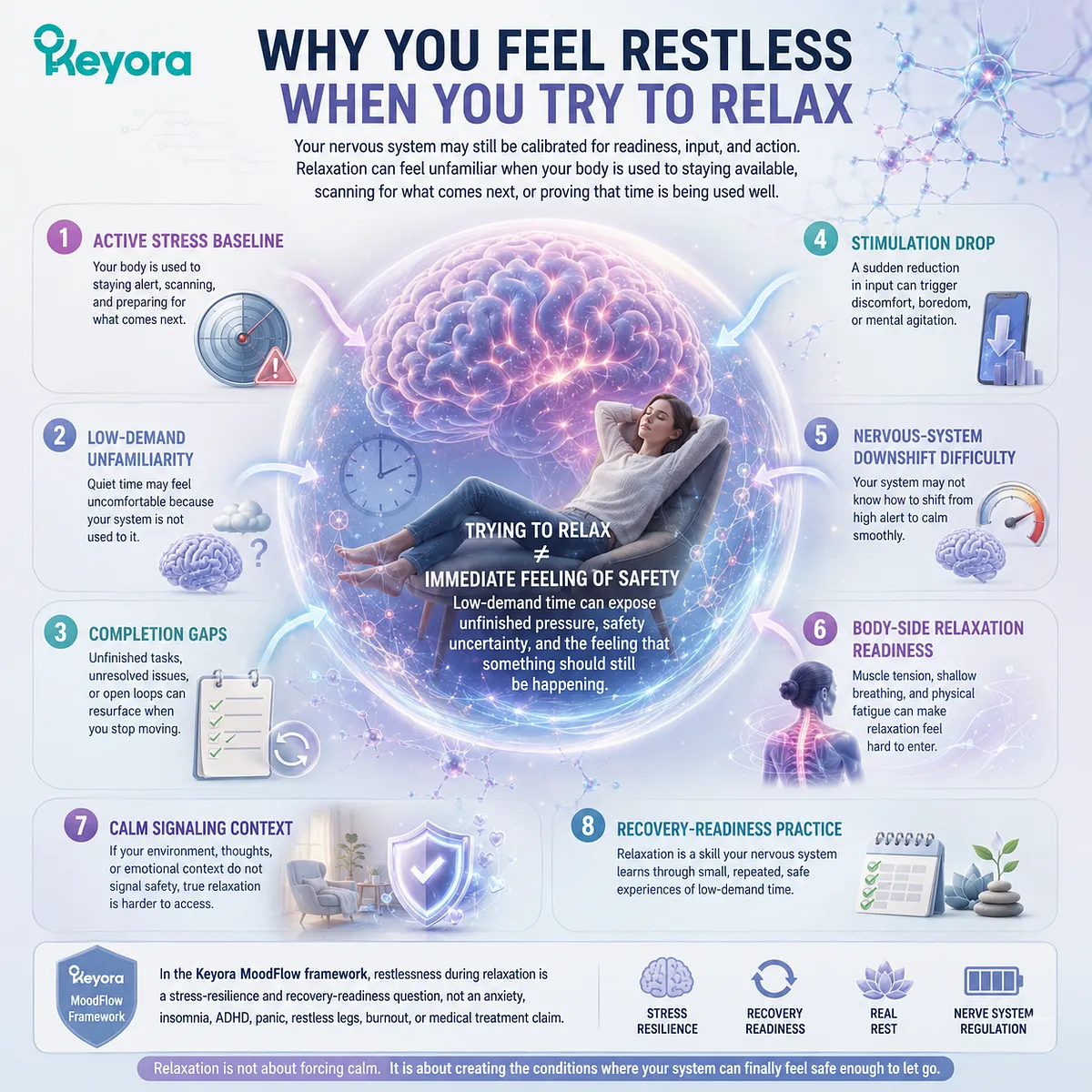
You may feel restless when you try to relax because your nervous system may still be calibrated for readiness, input, and action. Relaxation can feel unfamiliar when your body is used to staying available, scanning for what comes next, or proving that time is being used well.
The mismatch is this: trying to relax does not always make the system feel safe immediately. Low-demand time can expose unfinished pressure, safety uncertainty, performance expectations around rest, and the feeling that something should still be happening.
This can involve relaxation-attempt restlessness, active stress baseline, low-demand unfamiliarity, completion gaps, stimulation drop, nervous-system downshift difficulty, body-side relaxation readiness, calm signaling context, and recovery-readiness practice.
In the Keyora MoodFlow framework, restlessness during relaxation is understood as a stress-resilience and recovery-readiness question, not an anxiety, insomnia, ADHD, panic, restless legs, burnout, or medical treatment claim.
Why Trying to Relax Can Make You Feel Restless
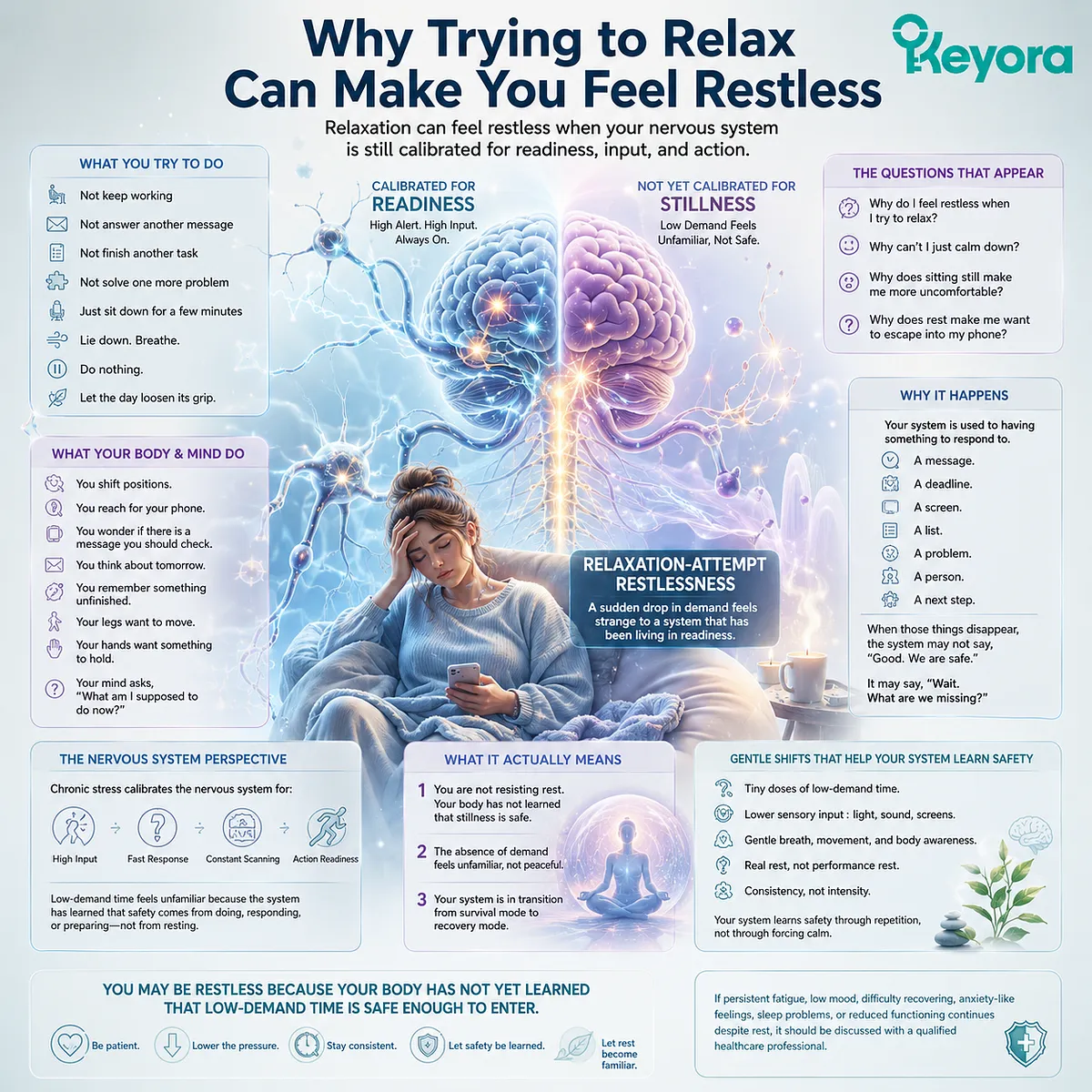
Relaxation can feel restless when your nervous system is still calibrated for readiness, input, and action.
You decide to relax.
Not keep working.
Not answer another message.
Not finish another task.
Not solve one more problem.
Just sit down for a few minutes. Lie down. Listen to something soft. Breathe. Do nothing. Let the day loosen its grip.
At first, the idea sounds simple.
But then your body starts to feel uncomfortable.
You shift positions.
You reach for your phone.
You put it down.
You wonder whether there is a message you should check.
You think about tomorrow.
You remember something unfinished.
Your legs want to move.
Your hands want something to hold.
Your mind starts asking, “What am I supposed to do now?”
The strange part is that you were trying to relax.
You were not trying to pressure yourself.
You were not trying to become more productive.
You were not trying to create another task.
But somehow relaxation itself starts to feel like a task you are failing.
You may think:
“Why do I feel restless when I try to relax?”
“Why can’t I just calm down?”
“Why does sitting still make me more uncomfortable?”
“Why does rest make me want to escape into my phone?”
This can feel discouraging because you are already making an effort to rest. You are not ignoring recovery. You are trying to enter it.
But what if relaxation feels restless because your system is used to readiness?
What if your body does not yet recognize stillness as safe?
What if the absence of demand feels unfamiliar rather than peaceful?
A stressed system can become used to having something to respond to.
A message.
A deadline.
A screen.
A list.
A problem.
A person.
A next step.
When those things disappear, the system may not immediately say, “Good. We are safe.”
It may say, “Wait. What are we missing?”
This is relaxation-attempt restlessness.
The attempt to relax creates a sudden drop in demand, and that drop can feel strange to a system that has been living in readiness.
You may not be restless because you do not want rest.
You may be restless because your body has not yet learned that low-demand time is safe enough to enter.
Why Low-Demand Time Can Feel Unsafe or Unfinished
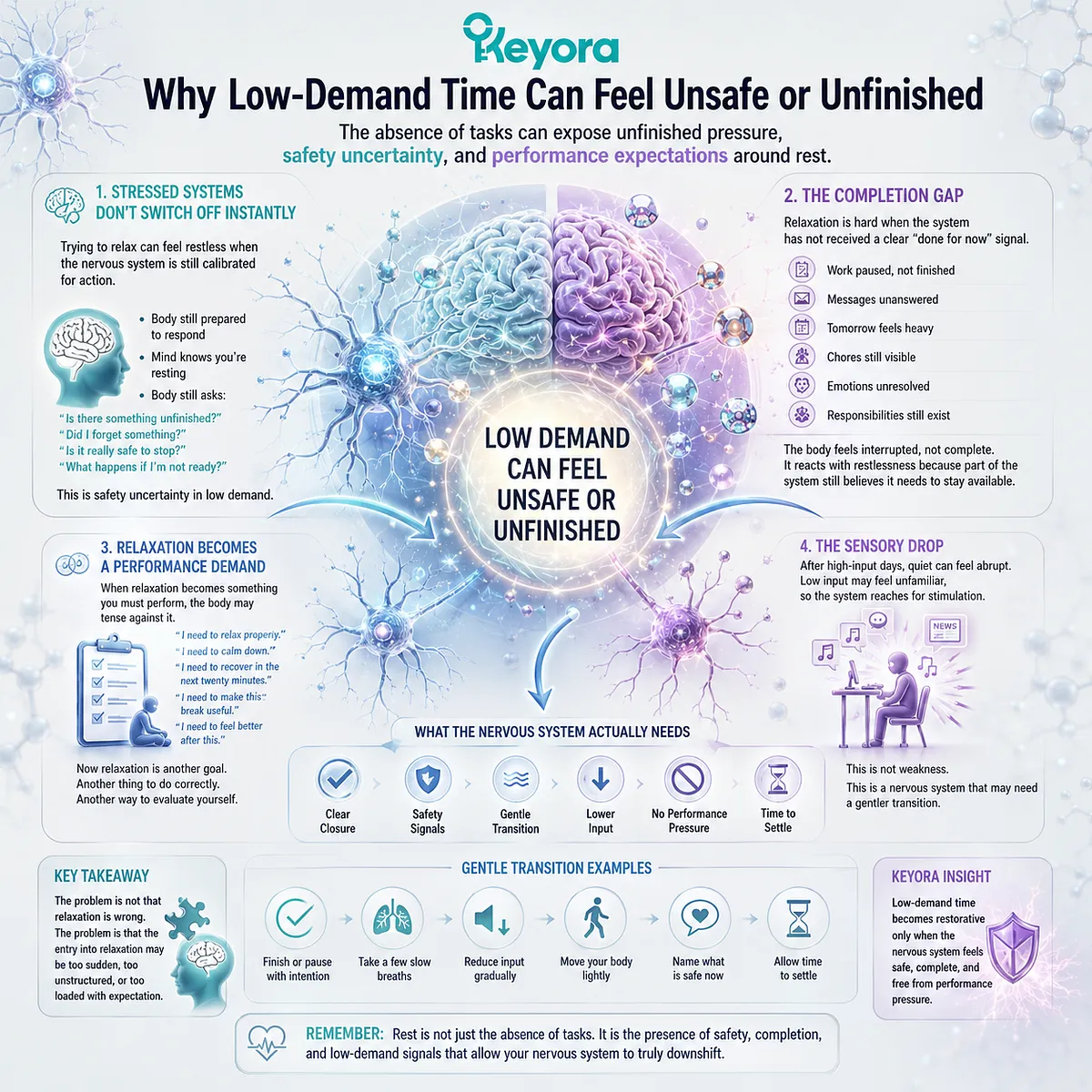
The absence of tasks can expose unfinished pressure, safety uncertainty, and performance expectations around rest.
Relaxation is often described as if it should happen instantly.
Sit down.
Close your eyes.
Take a breath.
Feel calm.
But many stressed systems do not move that quickly from pressure to ease.
Trying to relax can feel restless when the nervous system is still calibrated for action. The body may still be prepared to respond, even if the task is no longer in front of you.
Your mind may know that you are resting.
Your body may still be asking:
“Is there something unfinished?”
“Did I forget something?”
“Is it really safe to stop?”
“What happens if I am not ready?”
This is safety uncertainty in low demand.
For a system that has been under pressure, stillness does not always feel like relief at first. It can feel like losing the structure that usually tells you what to do next.
Another mechanism is the completion gap.
Many people try to relax before their nervous system has received a clear “done for now” signal.
The work may be paused, but not finished.
The message may be unanswered.
Tomorrow may still feel heavy.
The chore may still be visible.
The emotional conversation may still be unresolved.
The responsibility may still exist.
So when you sit down to relax, the body does not feel complete. It feels interrupted.
It may react with restlessness because part of the system still believes it needs to stay available.
Relaxation can also become a performance demand.
You may tell yourself:
“I need to relax properly.”
“I need to calm down.”
“I need to recover in the next twenty minutes.”
“I need to make this break useful.”
“I need to feel better after this.”
Now relaxation is no longer low demand.
It has become another goal.
Another thing to do correctly.
Another way to evaluate yourself.
When relaxation becomes something you must perform, the body may tense against it.
There is also the sensory drop.
If your day has been full of screens, messages, noise, work, tasks, conversations, and rapid input, then quiet can feel abrupt. Your system may reach for stimulation because low input feels unfamiliar.
This does not mean you are weak.
It does not mean you are bad at rest.
It means your nervous system may need a gentler transition.
The problem is not that relaxation is wrong.
The problem is that the entry into relaxation may be too sudden, too unstructured, or too loaded with expectation.
How to Enter Relaxation Without Forcing Stillness
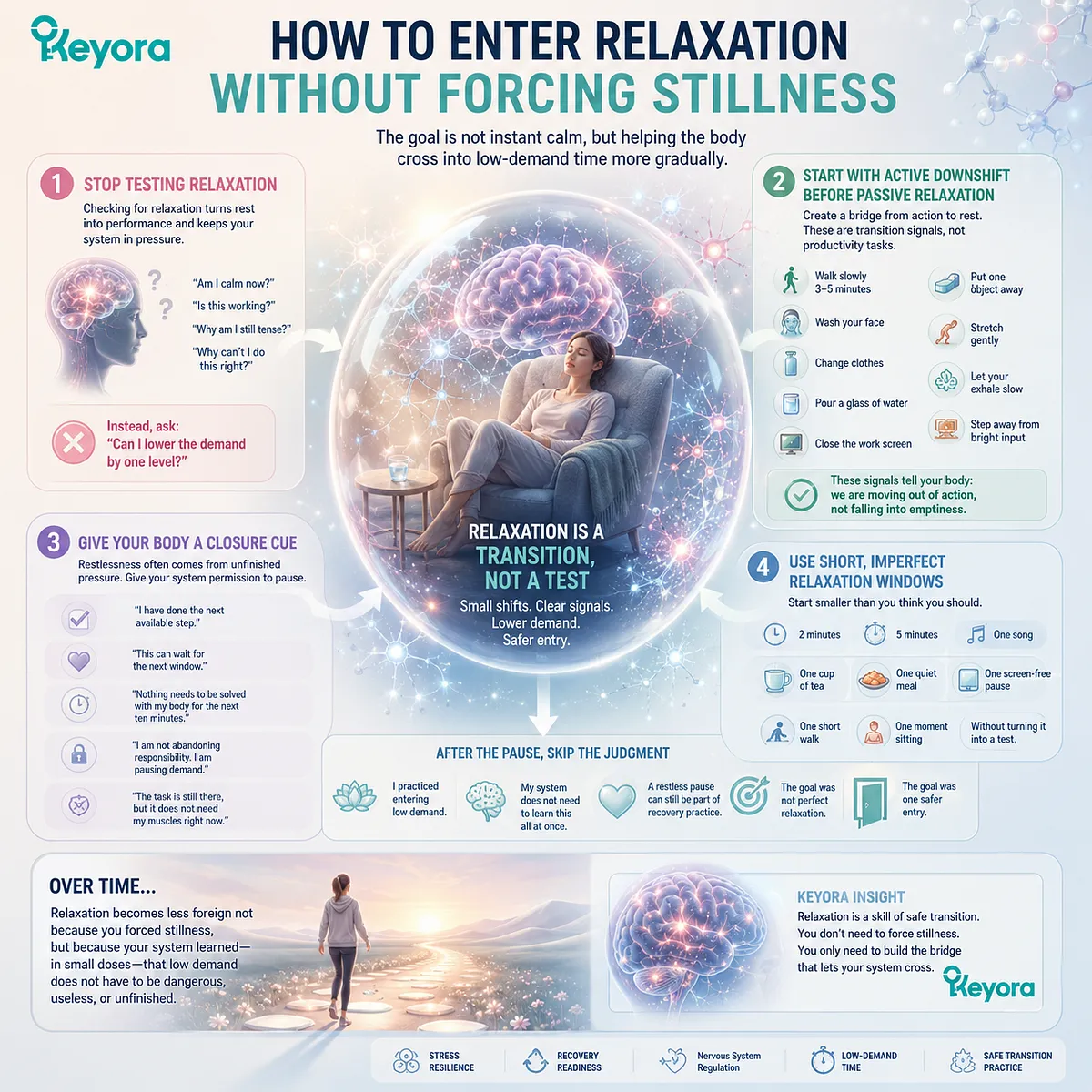
The goal is not instant calm, but helping the body cross into low-demand time more gradually.
When you feel restless while trying to relax, the first step is to stop testing whether you are relaxed yet.
That test often makes things worse.
“Am I calm now?”
“Is this working?”
“Why am I still tense?”
“Why can’t I do this right?”
Checking for relaxation can turn rest into performance.
Instead of asking, “Am I relaxed yet?” try asking:
“Can I lower the demand by one level?”
That is a much softer question.
It does not require instant peace. It only asks for one small shift.
The second step is to start with active downshift before passive relaxation.
Do not jump directly from pressure into complete stillness.
Give the body a bridge.
Walk slowly for three to five minutes.
Wash your face.
Change clothes.
Pour a glass of water.
Close the work screen.
Put one object away.
Stretch gently.
Let your exhale slow down.
Step away from bright input for a few minutes.
These are not productivity tasks. They are transition signals.
They tell the body: we are moving out of action, not falling into emptiness.
The third step is to give the body a closure cue.
Before trying to relax, say something that marks the pause.
“I have done the next available step.”
“This can wait for the next window.”
“Nothing needs to be solved with my body for the next ten minutes.”
“I am not abandoning responsibility. I am pausing demand.”
“The task is still there, but it does not need my muscles right now.”
This matters because restlessness often comes from unfinished pressure.
The body may need to hear that stopping for a moment is not the same as losing control.
The fourth step is to use short, imperfect relaxation windows.
Start smaller than you think you should.
Two minutes.
Five minutes.
One song.
One cup of tea.
One quiet meal.
One screen-free pause.
One short walk.
One moment sitting without turning it into a test.
At the end, do not judge the pause by whether you became fully calm.
Try saying:
“I practiced entering low demand.”
“My system does not need to learn this all at once.”
“A restless pause can still be part of recovery practice.”
“The goal was not perfect relaxation. The goal was one safer entry.”
This removes the pressure to succeed at resting.
Over time, relaxation may become less foreign.
Not because you forced yourself to be still.
But because your system learned, in small doses, that low demand does not have to be dangerous, useless, or unfinished.
Where Nutritional Support Fits
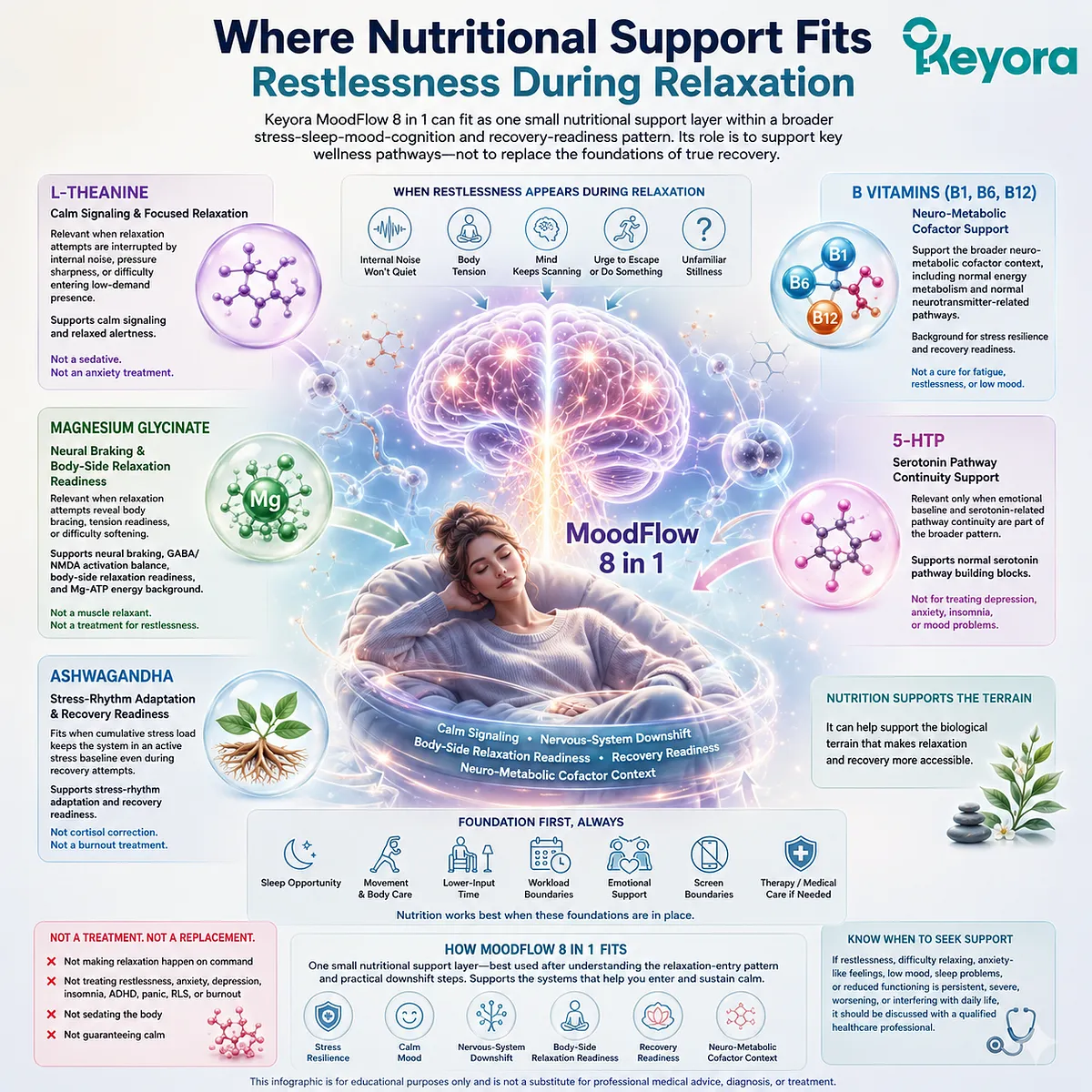
Keyora MoodFlow 8 in 1 can fit as one small nutritional support layer when restlessness during relaxation appears within a broader stress-sleep-mood-cognition and recovery-readiness pattern. It should not be framed as making relaxation happen on command, treating restlessness, treating anxiety, treating depression, treating insomnia, treating ADHD, treating panic, treating restless legs syndrome, curing burnout, sedating the body, or guaranteeing calm.
Its role is narrower: supporting wellness pathways involved in stress resilience, calm mood, nervous-system downshift, body-side relaxation readiness, recovery readiness, and neuro-metabolic cofactor context.
-
L-Theanine may be relevant when trying to relax is interrupted by internal noise, pressure sharpness, or difficulty entering low-demand presence. In the MoodFlow framework, it supports calm signaling and relaxed alertness without being framed as sedation or anxiety treatment.
-
Magnesium glycinate may be relevant when relaxation attempts reveal body bracing, tension readiness, or difficulty softening. It supports neural braking, GABA/NMDA activation balance, body-side relaxation readiness, and Mg-ATP energy background. This is not a claim that it relaxes muscles like a drug or treats restlessness.
-
Ashwagandha may fit when cumulative stress load keeps the system in an active stress baseline even during recovery attempts. Its role is stress-rhythm adaptation and recovery readiness, not cortisol correction or burnout treatment.
-
B vitamins may support the broader neuro-metabolic cofactor context, including normal energy metabolism and normal neurotransmitter-related pathways. This belongs to the background of stress resilience and recovery readiness, not a cure for fatigue, restlessness, or emotional distress.
-
5-HTP may be relevant only when emotional baseline and serotonin-related pathway continuity are part of the broader pattern. It should not be framed as treating depression, anxiety, insomnia, or mood problems.
-
MoodFlow belongs after the reader understands the relaxation-entry pattern and practical downshift steps. Nutrition can support the terrain. It cannot replace therapy, medical care, sleep, movement, workload boundaries, emotional support, screen boundaries, or lifestyle foundations.
If restlessness, difficulty relaxing, anxiety-like feelings, low mood, sleep problems, or reduced functioning is persistent, severe, worsening, or interfering with daily life, it should be discussed with a qualified healthcare professional.
Closing Summary
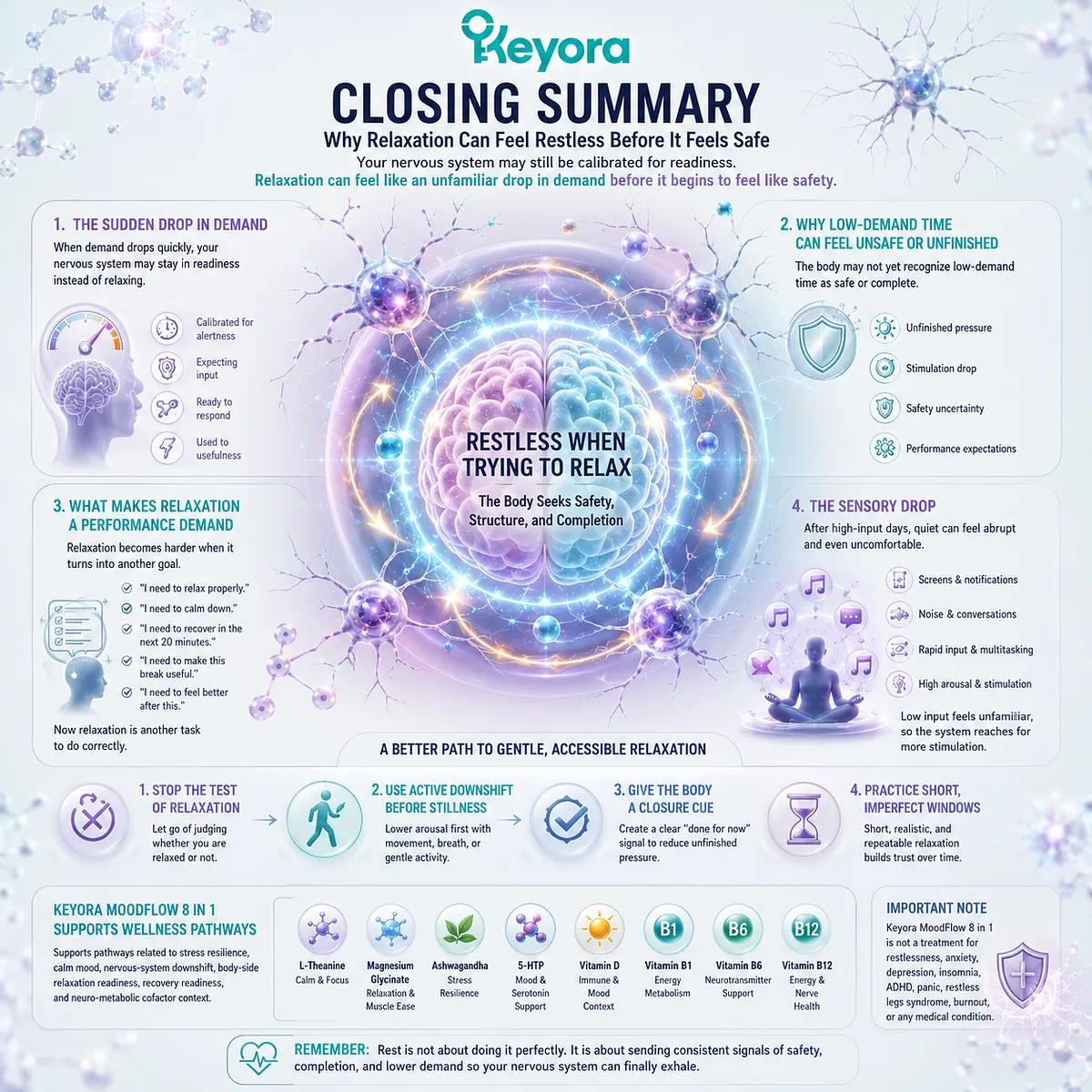
You may feel restless when you try to relax because relaxation can create a sudden drop in demand. If your nervous system is still calibrated for readiness, input, usefulness, and action, that drop may feel unfamiliar instead of immediately peaceful.
The deeper mismatch is that the body may not yet recognize low-demand time as safe or complete. Unfinished pressure, stimulation drop, safety uncertainty, and performance expectations around rest can all make relaxation feel harder to enter.
A better path begins by stopping the test of whether you are relaxed, using active downshift before passive stillness, giving the body a closure cue, and practicing short, imperfect relaxation windows.
Keyora MoodFlow 8 in 1 can support wellness pathways related to stress resilience, calm mood, nervous-system downshift, body-side relaxation readiness, recovery readiness, and neuro-metabolic cofactor context. It is not a treatment for restlessness, anxiety, depression, insomnia, ADHD, panic, restless legs syndrome, burnout, or any medical condition.
You may feel restless when you try to relax because your nervous system is still calibrated for readiness.
Relaxation may feel like an unfamiliar drop in demand before it begins to feel like safety.
This article is for educational and informational purposes only. It does not provide medical advice, diagnosis, treatment, cure, prevention, disease outcome claims, hormone restoration claims, fertility outcome claims, or formula-specific clinical efficacy claims.