
Why Do I Feel Guilty When I Rest?
Keyora Research Q&A Library
This is part of the Keyora Research Q&A Series, derived from Keyora Nutritional Neurology Series .
Within the Keyora Nutritional Neurology framework, this Q&A translates complex nutrient–brain mechanisms into reader-friendly, evidence-bound answers, focusing on stress resilience, sleep quality, calm mood support, cognitive wellness, and the broader interaction between nutrition, neurochemistry, and daily nervous-system function.
First published by Keyora Research Journal: www.keyorahealth.com

Direct Answer
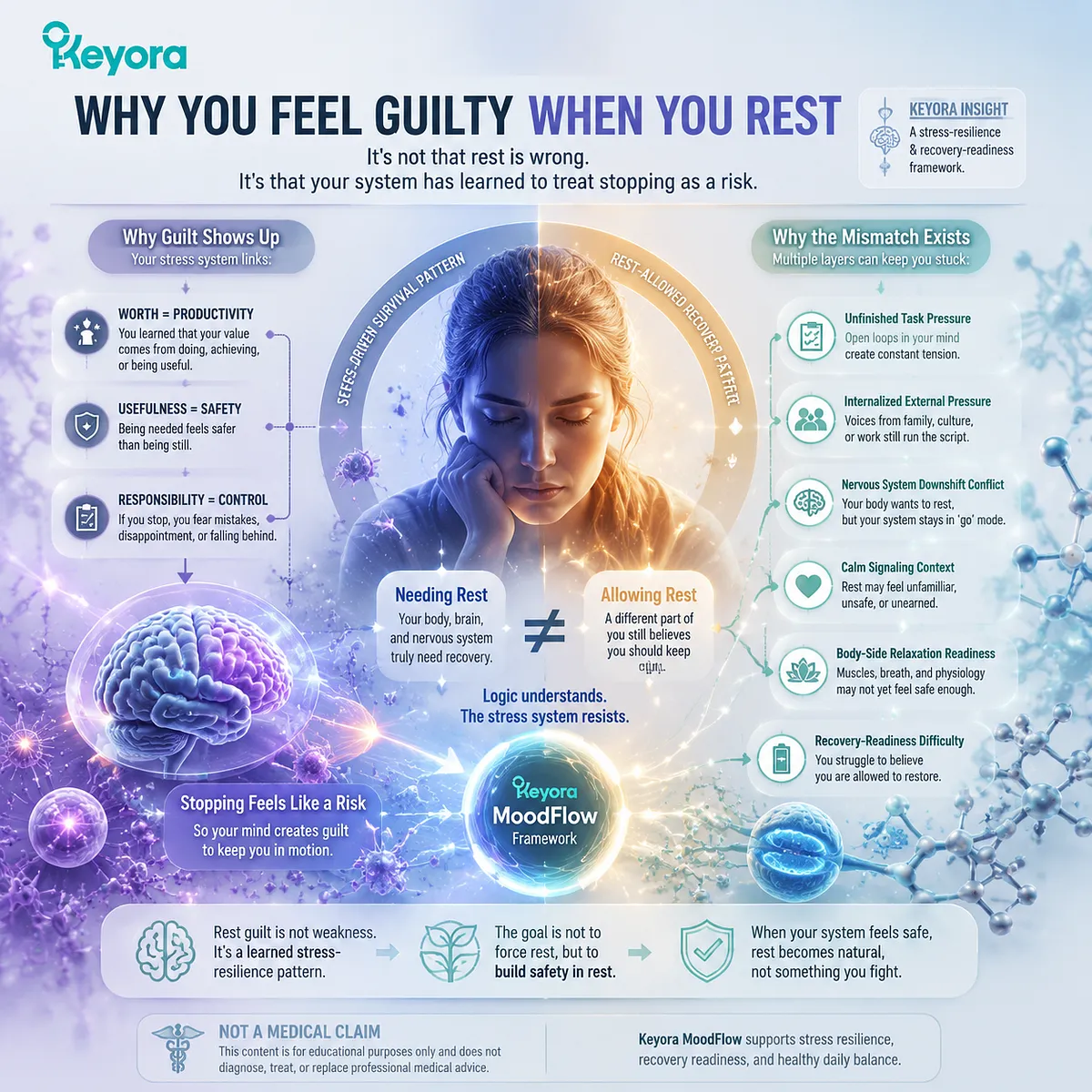
You may feel guilty when you rest because your stress system has learned to connect worth, safety, and responsibility with staying useful, productive, or available. The guilt does not automatically mean rest is wrong. It may mean your body and mind have been trained to treat stopping as a risk.
The mismatch is this: needing rest and feeling allowed to rest are not the same. You may understand logically that your body needs a break, while another part of you still believes you should be doing more, catching up, responding, improving, or proving that you are not falling behind.
This can involve a productivity-worth link, usefulness as safety, unfinished task pressure, internalized external pressure, nervous-system downshift conflict, calm signaling context, body-side relaxation readiness, and recovery-readiness difficulty.
In the Keyora MoodFlow framework, rest guilt is understood as a stress-resilience and recovery-readiness question, not an anxiety, burnout, depression, trauma, insomnia, or medical treatment claim.
Why Rest Can Trigger Guilt Instead of Relief
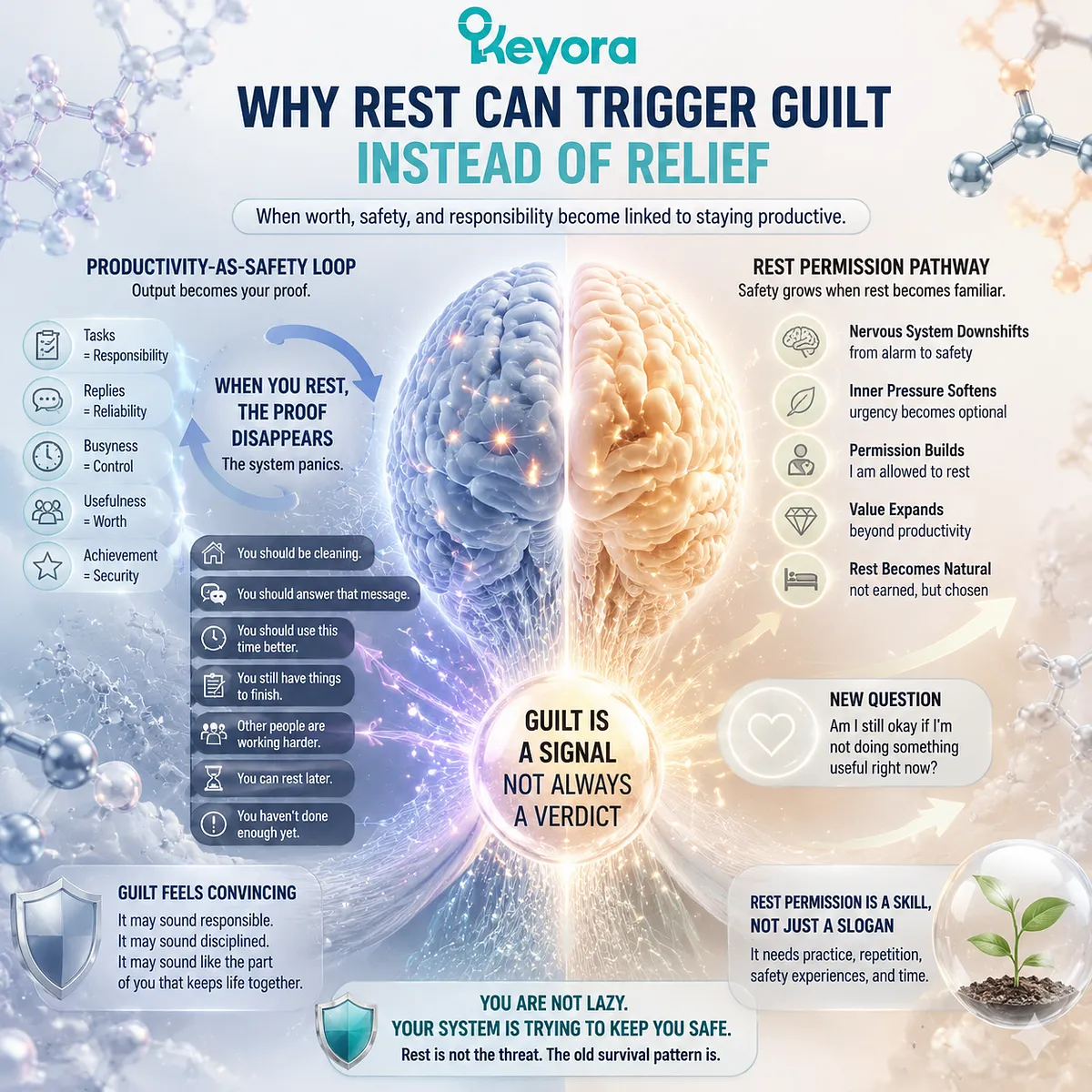
Rest can feel wrong when your system has learned to connect worth, safety, and responsibility with staying productive.
You finally sit down.
There is no meeting starting in the next minute. No message that must be answered immediately. No one is standing in front of you asking for something. Your body is tired, and a part of you knows you need to stop.
But after only a few minutes, another voice appears.
“You should be cleaning.”
“You should answer that message.”
“You should use this time better.”
“You still have things to finish.”
“Other people are working harder.”
“You can rest later.”
“You have not done enough yet.”
Suddenly, rest no longer feels like rest.
You may be lying down, but not peacefully. You may be watching something, but not fully enjoying it. You may be eating, walking, sitting, or doing something slow, but your mind is calculating whether you have earned it.
You are not doing nothing.
You are fighting an invisible judgment.
This can be painful because the guilt may feel convincing. It may sound responsible. It may sound disciplined. It may sound like the part of you that keeps life together.
So you may assume:
“If I feel guilty, maybe I really should not be resting.”
But guilt is a signal, not always a verdict.
What if guilt is not proof that rest is wrong?
What if your system has learned to feel safe only when you are useful?
What if resting feels uncomfortable because output has become your way of proving you are okay?
For many people, productivity becomes more than productivity. It becomes a safety signal.
When you are working, helping, replying, improving, organizing, studying, producing, or staying available, you may feel temporarily secure. You can tell yourself you are responsible. You are not falling behind. You are not disappointing anyone. You are still in control.
But when you rest, that proof disappears for a while.
Then the system panics.
It asks:
“Am I still okay if I am not doing something useful?”
“Am I still responsible if I pause?”
“Am I still valuable if I am not producing?”
This is why rest guilt is not solved by simply saying, “You deserve rest.”
That sentence may be true, but the nervous system may not believe it yet.
Rest permission often needs practice, not just a slogan.
Why Guilt Keeps the Body and Mind in Work Mode
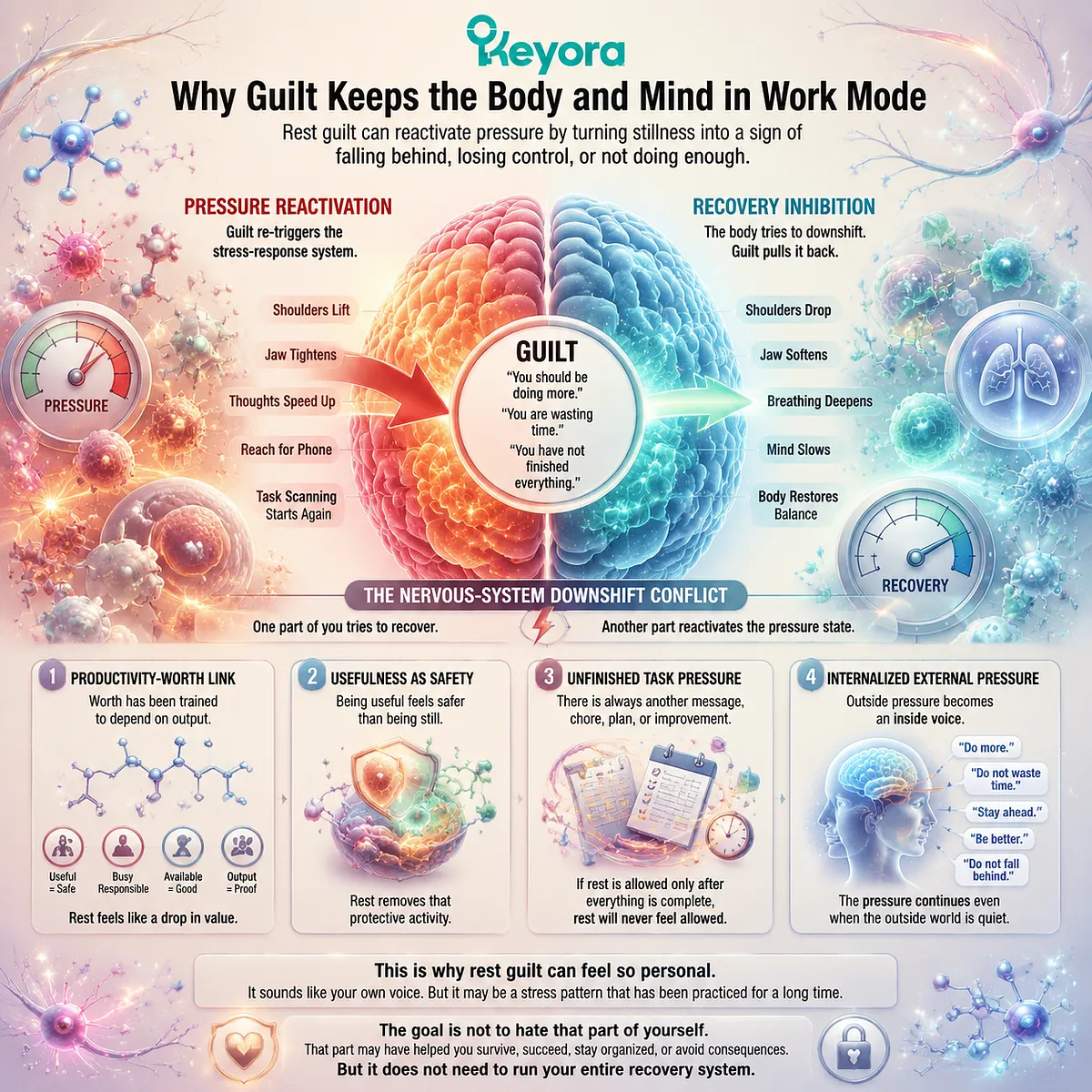
Rest guilt can reactivate pressure by turning stillness into a sign of falling behind, losing control, or not doing enough.
Rest is supposed to help the body downshift.
But guilt can pull the system back into pressure.
You sit down, and guilt says, “You should be doing more.”
You lie down, and guilt says, “You are wasting time.”
You take a break, and guilt says, “You have not finished everything.”
The body hears this as demand.
So instead of softening, you may become tense again. Your shoulders may lift. Your jaw may tighten. Your thoughts may speed up. Your hand may reach for the phone. Your mind may start scanning tasks.
This is the nervous-system downshift conflict.
One part of you tries to recover.
Another part reactivates the pressure state.
The first mechanism is the productivity-worth link.
Rest can feel guilty when worth has been trained to depend on output. If you have been praised for being helpful, responsible, high-performing, efficient, or always available, it can become difficult to separate who you are from what you produce.
Then rest feels like a drop in value.
Not because it is true.
Because the system has learned a narrow equation:
Useful equals safe.
Busy equals responsible.
Available equals good.
Output equals proof.
The second mechanism is usefulness as safety.
For a stressed system, being useful can start to feel safer than being still. If you are doing something, you may feel less exposed to criticism, uncertainty, or the fear of falling behind.
Rest removes that protective activity.
So guilt rushes in to push you back toward usefulness.
The third mechanism is unfinished task pressure.
Most people do not reach a clean finish line every day. There is always another message, another chore, another plan, another improvement, another thing that could be done.
If rest is allowed only after everything is complete, rest will almost never feel allowed.
The fourth mechanism is internalized external pressure.
At first, pressure may come from outside: deadlines, expectations, school, work, family, social comparison, or responsibility.
Over time, those voices can become internal.
Nobody may be telling you to keep going in that exact moment. But inside, you still hear:
“Do more.”
“Do not waste time.”
“Stay ahead.”
“Be better.”
“Do not fall behind.”
That internal pressure can continue even when the outside world is quiet.
This is why rest guilt can feel so personal. It sounds like your own voice. But it may be a stress pattern that has been practiced for a long time.
The goal is not to hate that part of yourself.
That part may have helped you survive, succeed, stay organized, or avoid consequences.
But it does not need to run your entire recovery system.
How to Practice Rest Without Letting Guilt Lead
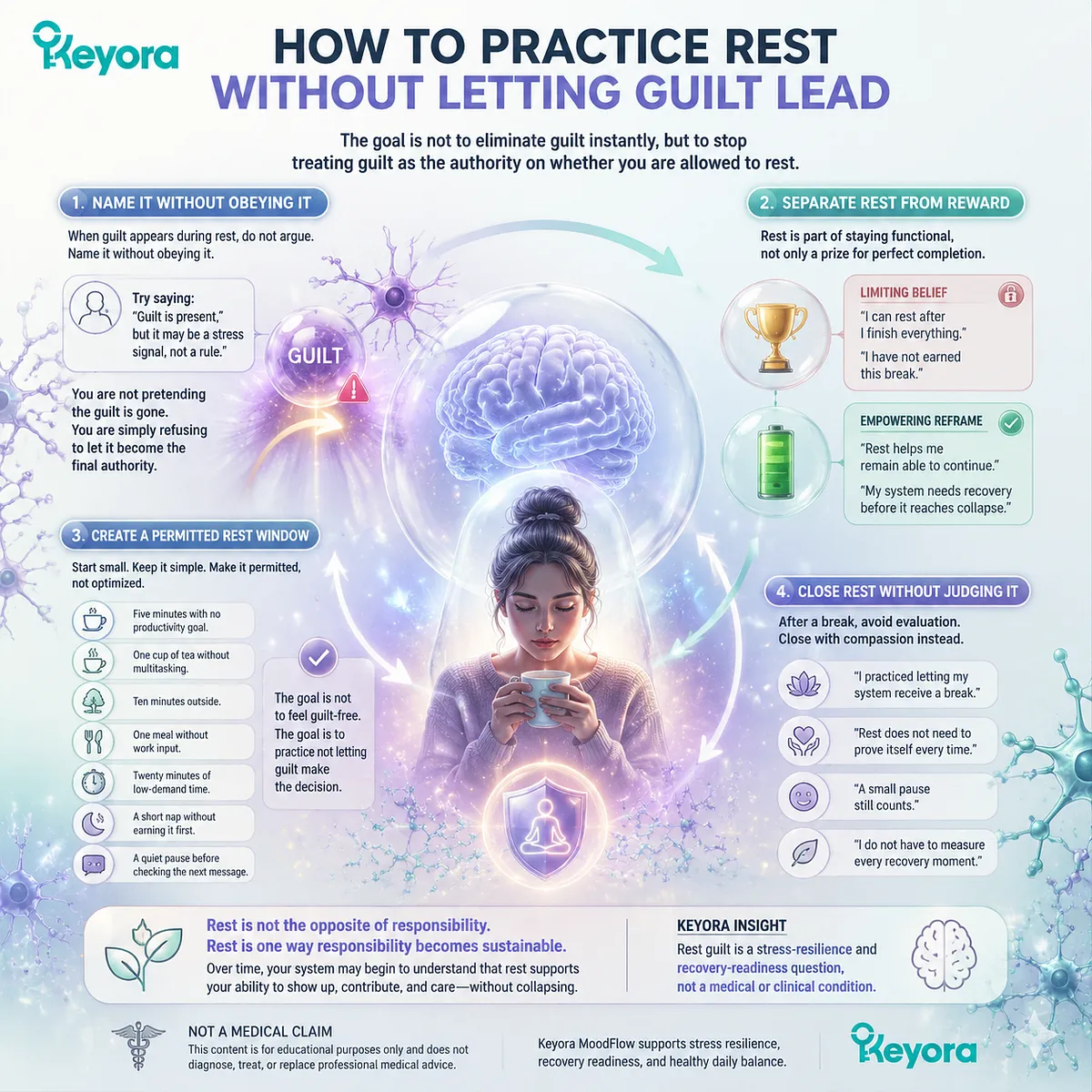
The goal is not to eliminate guilt instantly, but to stop treating guilt as the authority on whether you are allowed to rest.
When guilt appears during rest, the first step is not to argue with it.
Arguing can keep you trapped in the same pressure loop.
Instead, name it without obeying it.
Try saying:
“Guilt is present, but it may be a stress signal, not a rule.”
This creates space.
You are not pretending the guilt is gone. You are simply refusing to let it become the final authority.
The second step is to separate rest from reward.
Many people treat rest as something they can only receive after perfect completion.
But rest is not only a prize for finishing everything.
Rest is part of staying functional.
Your body does not need to be fully drained before it is allowed to recover. Your mind does not need to break before it is allowed to pause. Your nervous system does not need to prove suffering before it receives support.
Try replacing:
“I can rest after I finish everything.”
With:
“Rest helps me remain able to continue.”
Try replacing:
“I have not earned this break.”
With:
“My system needs recovery before it reaches collapse.”
The third step is to create a permitted rest window.
Start small.
Five minutes with no productivity goal.
One cup of tea without multitasking.
Ten minutes outside.
One meal without work input.
Twenty minutes of low-demand time.
A short nap without earning it first.
A quiet pause before checking the next message.
The key word is permitted.
Not optimized.
Not impressive.
Not perfectly mindful.
Permitted.
During that window, the goal is not to feel guilt-free. The goal is to practice not letting guilt make the decision.
The fourth step is to close rest without judging it.
After a break, many people immediately evaluate it.
“Did I recover enough?”
“Was that useful?”
“Did I waste time?”
“Should I have done something better?”
This turns rest back into performance.
Try closing with a different sentence:
“I practiced letting my system receive a break.”
“Rest does not need to prove itself every time.”
“A small pause still counts.”
“I do not have to measure every recovery moment.”
The goal is not guilt-free rest immediately.
The goal is learning that guilt does not have to be in charge.
Over time, your system may begin to understand something important:
Rest is not the opposite of responsibility.
Rest is one way responsibility becomes sustainable.
Where Nutritional Support Fits
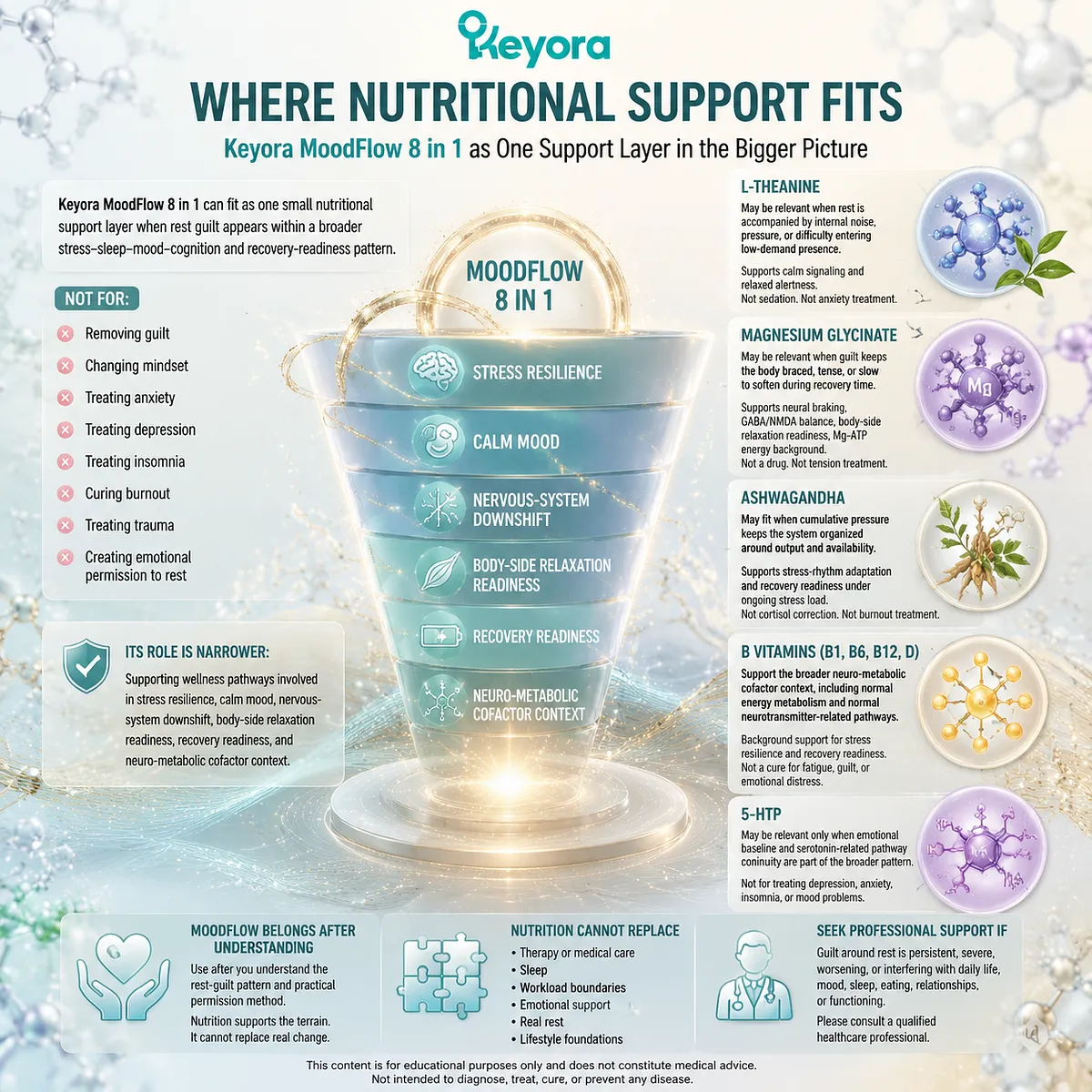
Keyora MoodFlow 8 in 1 can fit as one small nutritional support layer when rest guilt appears within a broader stress-sleep-mood-cognition and recovery-readiness pattern. It should not be framed as removing guilt, changing mindset, treating anxiety, treating depression, treating insomnia, curing burnout, treating trauma, or creating emotional permission to rest.
Its role is narrower: supporting wellness pathways involved in stress resilience, calm mood, nervous-system downshift, body-side relaxation readiness, recovery readiness, and neuro-metabolic cofactor context.
-
L-Theanine may be relevant when rest is accompanied by internal noise, pressure, or difficulty entering low-demand presence. In the MoodFlow framework, it supports calm signaling and relaxed alertness without being framed as sedation or anxiety treatment.
-
Magnesium glycinate may be relevant when guilt keeps the body braced, tense, or slow to soften during recovery time. It supports neural braking, GABA/NMDA activation balance, body-side relaxation readiness, and Mg-ATP energy background. This is not a claim that it relaxes the body like a drug or treats tension.
-
Ashwagandha may fit when cumulative pressure keeps the system organized around output and availability. Its role is stress-rhythm adaptation and recovery readiness under ongoing stress load, not cortisol correction or burnout treatment.
-
B vitamins may support the broader neuro-metabolic cofactor context, including normal energy metabolism and normal neurotransmitter-related pathways. This belongs to the background of stress resilience and recovery readiness, not a cure for fatigue, guilt, or emotional distress.
-
5-HTP may be relevant only when emotional baseline and serotonin-related pathway continuity are part of the broader pattern. It should not be framed as treating depression, anxiety, insomnia, or mood problems.
MoodFlow belongs after the reader understands the rest-guilt pattern and practical permission method. Nutrition can support the terrain. It cannot replace therapy, medical care, sleep, workload boundaries, emotional support, real rest, or lifestyle foundations.
If guilt around rest is persistent, severe, worsening, or interfering with daily life, mood, sleep, eating, relationships, or functioning, it should be discussed with a qualified healthcare professional.
Closing Summary
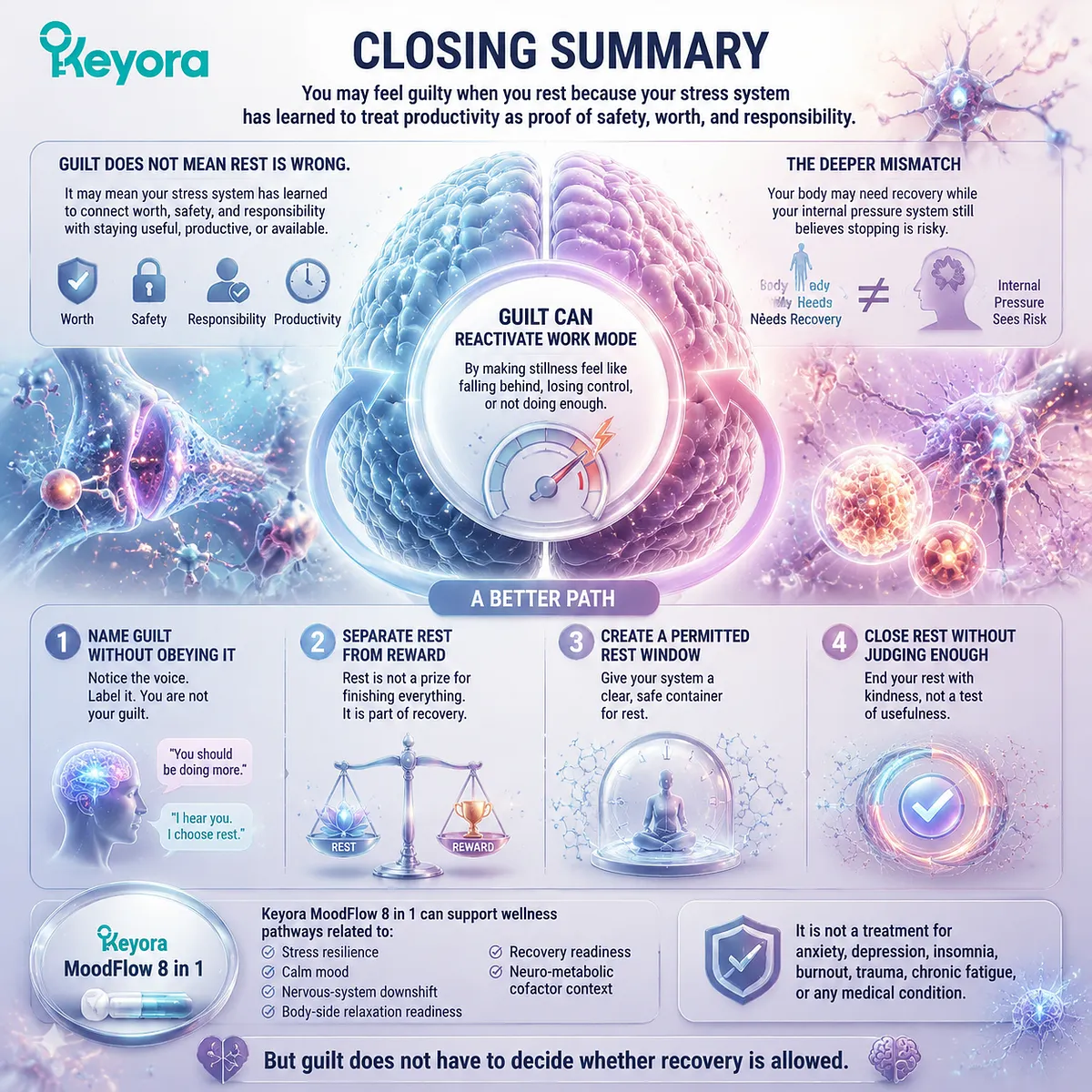
Feeling guilty when you rest does not mean rest is wrong. It may mean your stress system has learned to connect worth, safety, and responsibility with staying useful, productive, or available.
The deeper mismatch is that your body may need recovery while your internal pressure system still believes stopping is risky. Guilt can reactivate work mode by making stillness feel like falling behind, losing control, or not doing enough.
A better path begins by naming guilt without obeying it, separating rest from reward, creating a permitted rest window, and closing rest without judging whether it was useful enough.
Keyora MoodFlow 8 in 1 can support wellness pathways related to stress resilience, calm mood, nervous-system downshift, body-side relaxation readiness, recovery readiness, and neuro-metabolic cofactor context. It is not a treatment for anxiety, depression, insomnia, burnout, trauma, chronic fatigue, or any medical condition.
You may feel guilty when you rest because your stress system has learned to treat productivity as proof of safety, worth, and responsibility.
But guilt does not have to decide whether recovery is allowed.
This article is for educational and informational purposes only. It does not provide medical advice, diagnosis, treatment, cure, prevention, disease outcome claims, hormone restoration claims, fertility outcome claims, or formula-specific clinical efficacy claims.