
Why Does My Body Stay Tight Even After Work Is Over?
Keyora Research Q&A Library
This is part of the Keyora Research Q&A Series, derived from Keyora Nutritional Neurology Series .
Within the Keyora Nutritional Neurology framework, this Q&A translates complex nutrient–brain mechanisms into reader-friendly, evidence-bound answers, focusing on stress resilience, sleep quality, calm mood support, cognitive wellness, and the broader interaction between nutrition, neurochemistry, and daily nervous-system function.
First published by Keyora Research Journal: www.keyorahealth.com

Direct Answer
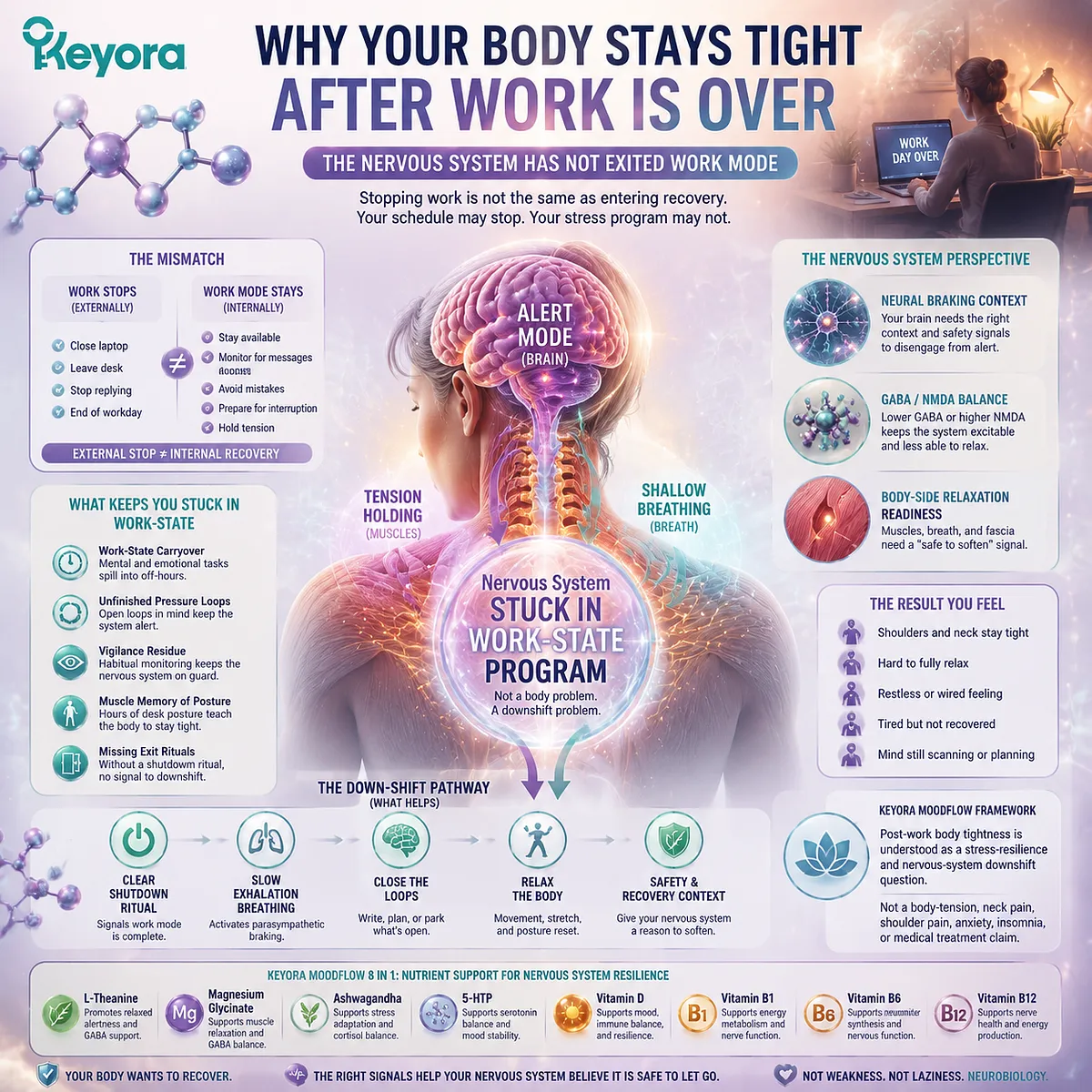
Your body may stay tight even after work is over because the workday can end externally before your nervous system has fully exited work mode. You may close the laptop, leave the desk, or stop answering messages, while your muscles, breath, posture, and attention still remain in a ready-to-respond state.
The mismatch is this: stopping work is not always the same as entering recovery. Your schedule may say the workday is over, but your body may still be running the work-state program: stay available, monitor for messages, avoid mistakes, prepare for interruption, and hold tension.
This can involve work-state carryover, unfinished pressure loops, vigilance residue, muscle memory of work posture, missing exit rituals, neural braking context, GABA/NMDA activation balance, body-side relaxation readiness, and recovery-readiness difficulty.
In the Keyora MoodFlow framework, post-work body tightness is understood as a stress-resilience and nervous-system downshift question, not a body-tension, neck pain, shoulder pain, anxiety, insomnia, or medical treatment claim.
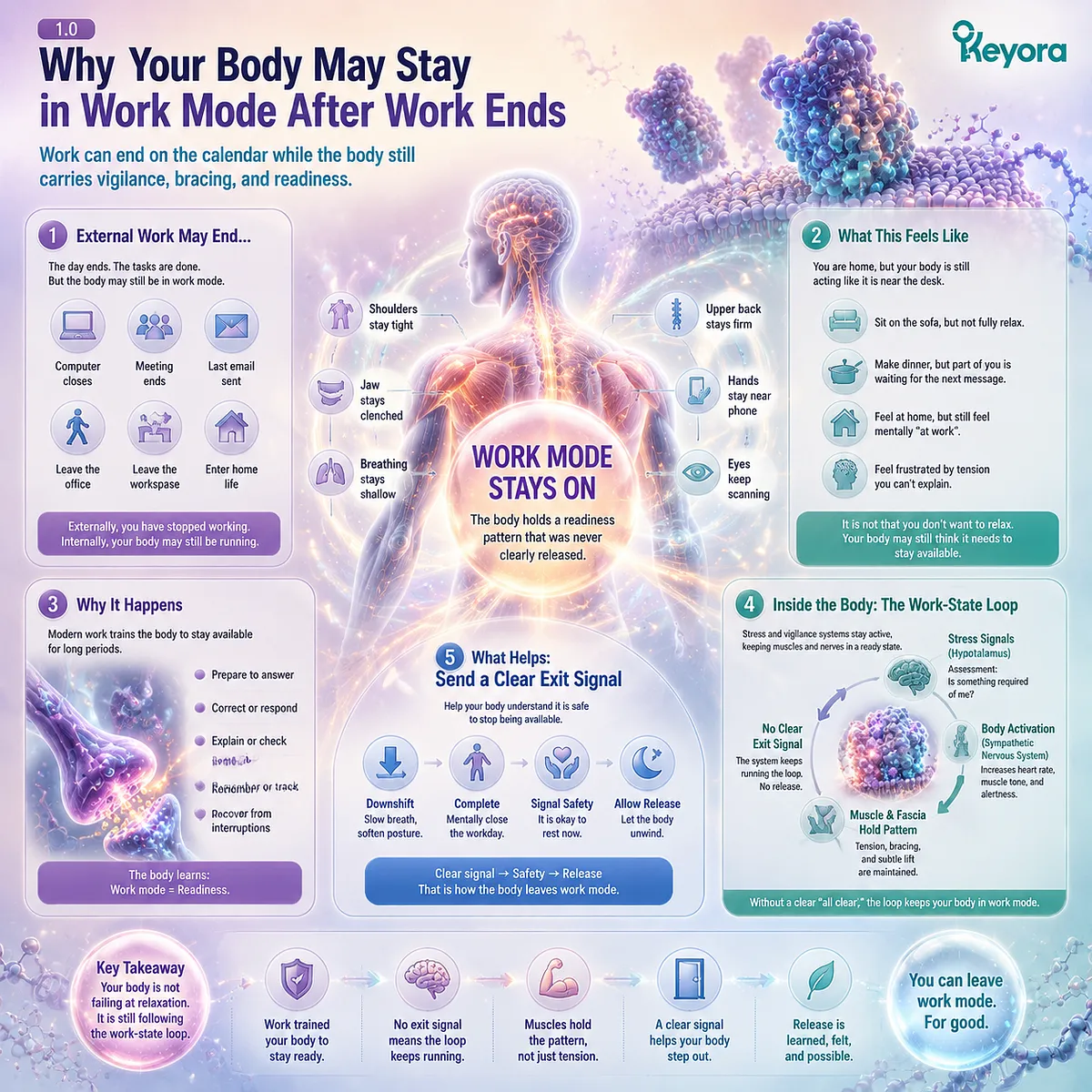
Why Your Body May Stay in Work Mode After Work Ends
Work can end on the calendar while the body still carries vigilance, bracing, and readiness.
Work is over.
At least, externally, it is over.
The computer is closed. The meeting has ended. The last email does not need an immediate reply. You leave the desk, walk out of the office, or move from your home workspace into the rest of the house.
On the outside, you have stopped working.
But your body has not fully stopped.
Your shoulders may still feel tight.
Your jaw may still be slightly clenched.
Your upper back may feel firm.
Your breathing may still be shallow.
Your hand may still want to check the phone.
Your eyes may still scan for notifications.
You may sit on the sofa, but not really sink into it. You may start dinner, but still feel as if part of you is waiting for the next message. You may be at home, but your body still feels like it is near the desk.
This can feel frustrating.
“Why is my body still tight after work?”
“Why do I feel like I haven’t really left the office?”
“Why can’t I just relax now?”
“Why does my body stay ready when nothing is happening?”
But what if your workday ended externally, but not internally?
What if your body still thinks it needs to stay available?
What if your muscles are holding a work-state signal that was never clearly released?
Modern work often asks the body to remain available for long periods. Even when you are sitting still, you may be preparing to answer, correct, respond, explain, check, remember, or recover from interruptions.
The body learns that work mode means readiness.
The shoulders prepare.
The jaw controls.
The eyes scan.
The hands stay near the phone, keyboard, or mouse.
The breath becomes smaller.
The upper body stays slightly lifted, as if it might need to respond at any moment.
When work ends, the mind may understand the schedule. But the body may need a clearer exit signal.
Without that signal, it may continue running the same pattern.
This is not because your body is failing at relaxation.
It may be because your body has not yet been told, in a way it can feel, that it is allowed to stop being available.
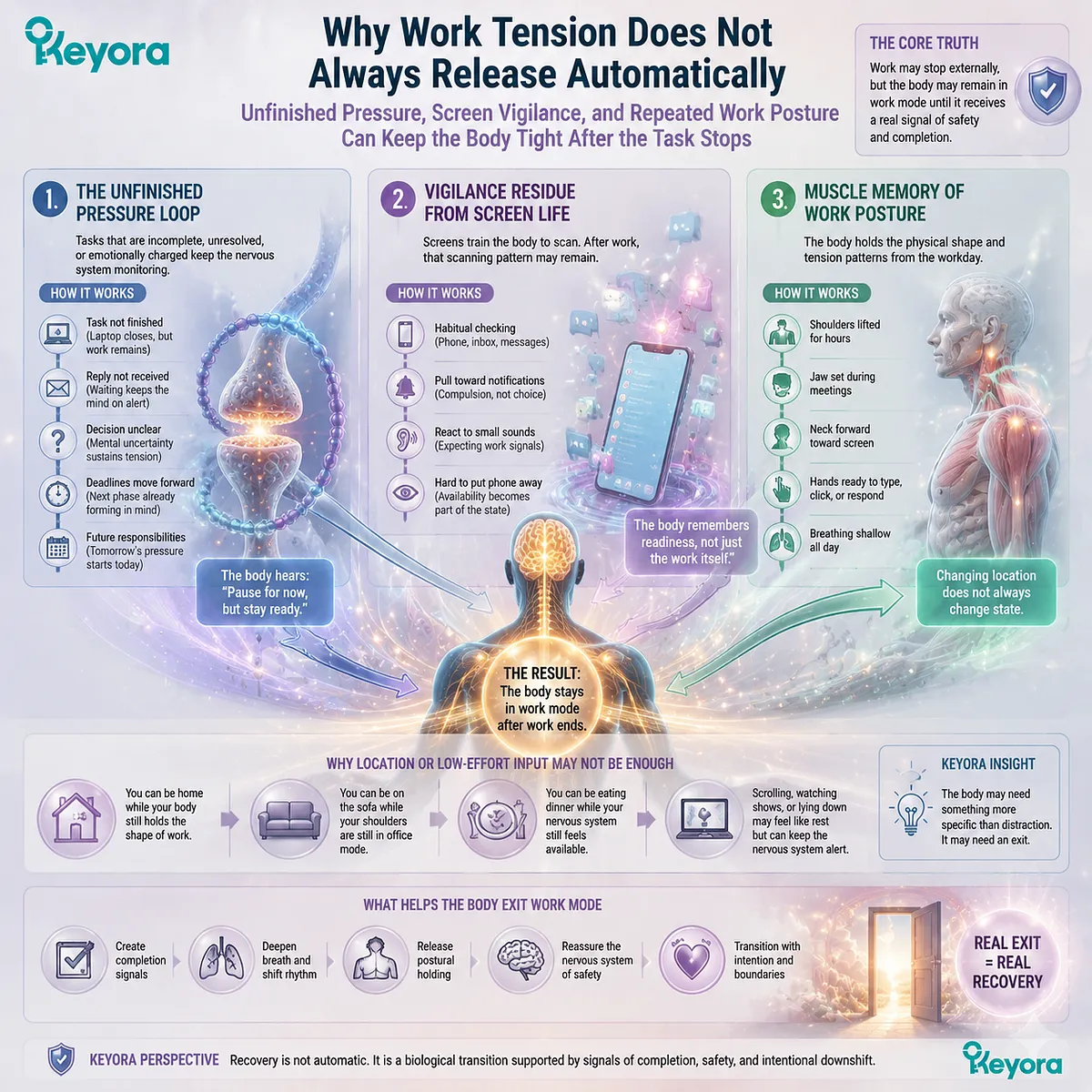
Why Work Tension Does Not Always Release Automatically
Unfinished pressure, screen vigilance, and repeated work posture can keep the body tight after the task stops.
One reason the body stays tight after work is that many workdays do not have clean endings.
A factory shift may end with a bell. A school day may end with a final class. But many modern workdays end in a blur.
The laptop closes, but the task is not finished.
The email is sent, but the reply has not arrived.
The meeting ends, but the decision is still unclear.
The deadline moves forward, but the next phase is already waiting.
Tomorrow’s responsibilities are already forming in your mind.
The body may not hear, “It is finished.”
It may only hear, “Pause for now, but stay ready.”
This is the unfinished pressure loop.
When a task is incomplete, unresolved, or emotionally charged, the nervous system may continue monitoring it. Even if you are no longer actively working, part of your body may stay prepared for the next update.
Another mechanism is vigilance residue.
During the workday, screens train the body to scan. Messages, calendar alerts, comments, notifications, and open tabs keep attention moving from one possible demand to another.
After work, that scanning pattern may remain.
You may check your phone without meaning to.
You may feel pulled toward your inbox.
You may react to small sounds as if they might be work-related.
You may feel uncomfortable putting the phone away because availability has become part of the body state.
The body is not only remembering the work. It is remembering the readiness.
A third mechanism is muscle memory of work posture.
If your shoulders were lifted for hours, they may not drop immediately.
If your jaw was set during meetings, it may stay firm.
If your neck was forward toward the screen, it may remain guarded.
If your hands were ready to type, click, or respond, they may keep that subtle tension.
If your breathing was shallow all day, it may not deepen just because the calendar says evening.
This is why changing location does not always change state.
You can be home while your body still holds the shape of work.
You can be on the sofa while your shoulders are still in office mode.
You can be eating dinner while your nervous system still feels available.
Low-effort input may not fully solve this. Scrolling, watching shows, or lying down can feel like rest, but if these activities keep the nervous system alert, the body may not truly downshift.
The body may need something more specific than distraction.
It may need an exit.
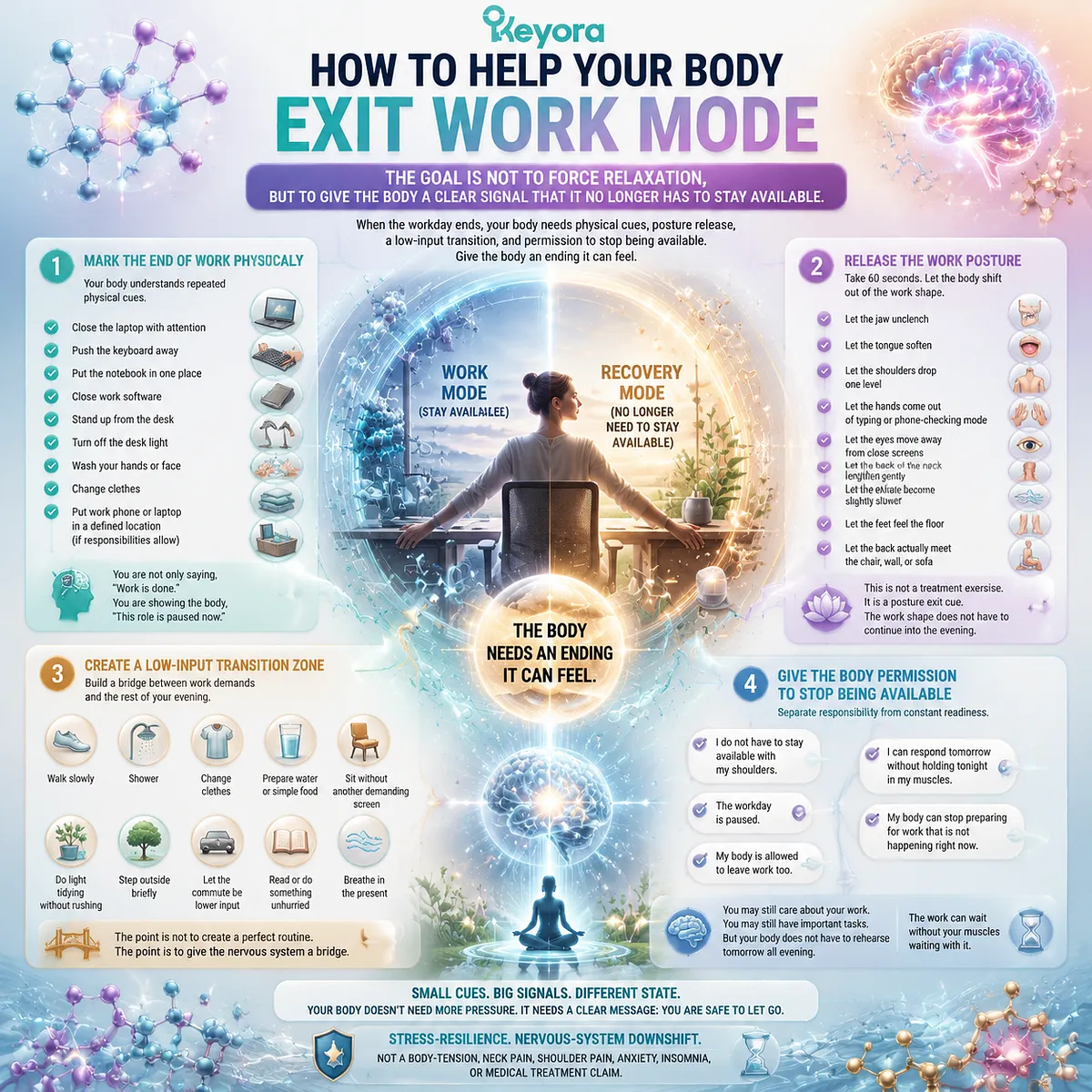
How to Help Your Body Exit Work Mode
The goal is not to force relaxation, but to give the body a clear signal that it no longer has to stay available.
When your body stays tight after work, try not to begin with the command, “Relax.”
That can turn recovery into another task.
Instead, begin by marking the end of work physically.
Your body needs an ending it can feel.
Close the laptop with attention.
Push the keyboard away.
Put the notebook in one place.
Close work software.
Stand up from the desk.
Turn off the desk light.
Wash your hands or face.
Change clothes.
Put your work phone or laptop in a defined location if your responsibilities allow it.
These small actions matter because the body often understands repeated physical cues better than abstract thoughts.
You are not only saying, “Work is done.”
You are showing the body, “This role is paused now.”
The second step is to release the work posture.
Take 60 seconds before moving into the next part of the evening.
Let the jaw unclench.
Let the tongue soften.
Let the shoulders drop one level.
Let the hands come out of typing or phone-checking mode.
Let the eyes move away from close screens.
Let the back of the neck lengthen gently.
Let the exhale become slightly slower.
Let the feet feel the floor.
Let the back actually meet the chair, wall, or sofa.
This is not a treatment exercise. It is a posture exit cue.
You are telling the body: the work shape does not have to continue into the evening.
The third step is to create a low-input transition zone.
Many people go directly from work screen to phone screen, from work pressure to household tasks, from meetings to messages, from one demand state to another. There is no between-state.
A transition zone does not have to be long.
Five to ten minutes can matter.
Walk slowly.
Shower.
Change clothes.
Prepare water or simple food.
Sit without opening another demanding screen.
Do light tidying without rushing.
Step outside briefly.
Let the commute be lower input when possible.
The point is not to create a perfect routine. The point is to give the nervous system a bridge.
The fourth step is to give the body permission to stop being available.
This may be the most important part.
Many people leave work physically but remain available in their muscles.
They hold tomorrow in their shoulders.
They hold unanswered messages in their jaw.
They hold responsibility in their breath.
Try saying:
“I do not have to stay available with my shoulders.”
“The workday is paused.”
“My body is allowed to leave work too.”
“I can respond tomorrow without holding tonight in my muscles.”
“My body can stop preparing for work that is not happening right now.”
These are not magic phrases. They are direction cues.
They help your body separate responsibility from constant readiness.
You may still care about your work. You may still have important tasks. You may still need to return tomorrow.
But your body does not have to rehearse tomorrow all evening.
The work can wait without your muscles waiting with it.
Where Nutritional Support Fits
Keyora MoodFlow 8 in 1 can fit as one small nutritional support layer when post-work body tightness appears within a broader stress-sleep-mood-cognition and body-tension pattern. It should not be framed as treating body tension, treating neck pain, treating shoulder pain, forcing relaxation, working like a sedative, relaxing muscles like a drug, fixing stress carryover, or replacing movement, stretching, ergonomic changes, physical therapy, dental care, therapy, medical care, or workload boundaries.
Its role is narrower: supporting wellness pathways involved in stress resilience, calm mood, nervous-system downshift, body-side relaxation readiness, recovery readiness, and neuro-metabolic cofactor context.
-
Magnesium glycinate may be relevant when post-work tension appears as body bracing, neuromuscular tension readiness, or difficulty softening after a workday. In the MoodFlow framework, it supports neural braking, GABA/NMDA activation balance, body-side relaxation readiness, and Mg-ATP energy background. This is not a claim that it treats muscle tightness, neck pain, or shoulder pain.
-
L-Theanine may be relevant when screen work leaves internal noise, alertness, or pressure sharpness after the workday ends. Its role is calm signaling and relaxed alertness, supporting downshift without being framed as sedation or anxiety treatment.
-
Ashwagandha may fit when repeated office pressure keeps the body in a stress-rhythm pattern. Its role is stress-rhythm adaptation and recovery readiness under cumulative pressure, not cortisol correction or medical treatment.
-
B vitamins may support the broader neuro-metabolic cofactor context, including normal energy metabolism and normal neurotransmitter-related pathways. This belongs to the background of stress resilience and recovery readiness, not a cure for fatigue, tension, or burnout.
MoodFlow belongs after the reader understands the work-mode carryover pattern and practical exit method. Nutrition can support the terrain. It cannot replace real transitions, rest, screen boundaries, movement, workload changes, emotional support, professional care, or lifestyle foundations.
Persistent, severe, one-sided, radiating, injury-related, worsening, or unexplained body tension or neck and shoulder pain should be evaluated by a qualified healthcare professional.
Persistent jaw pain, tooth wear, or bite problems should be discussed with a dental or medical professional.

Closing Summary
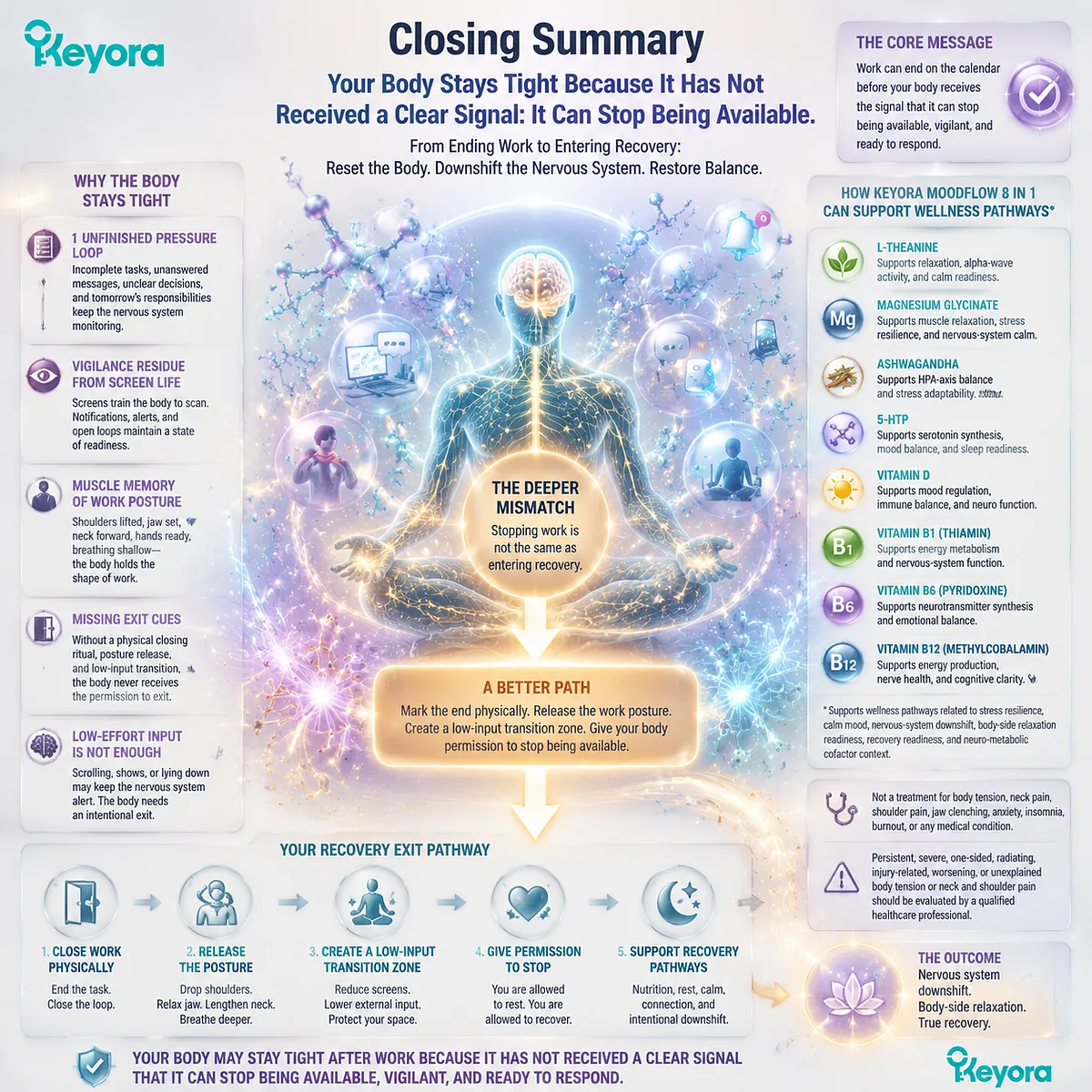
Your body may stay tight after work because the workday can end externally before your nervous system has fully exited work mode. The laptop may be closed, but your shoulders, jaw, breath, hands, and attention may still carry the posture of availability.
The deeper mismatch is that stopping work is not always the same as entering recovery. Unfinished pressure, screen vigilance, repeated work posture, and missing exit cues can keep the body running the work-state program into the evening.
A better path begins by marking the end of work physically, releasing the work posture, creating a low-input transition zone, and giving the body permission to stop being available.
Keyora MoodFlow 8 in 1 can support wellness pathways related to stress resilience, calm mood, nervous-system downshift, body-side relaxation readiness, recovery readiness, and neuro-metabolic cofactor context. It is not a treatment for body tension, neck pain, shoulder pain, jaw clenching, anxiety, insomnia, burnout, or any medical condition.
Persistent, severe, one-sided, radiating, injury-related, worsening, or unexplained body tension or neck and shoulder pain should be evaluated by a qualified healthcare professional.
Your body may stay tight after work because it has not received a clear signal that it can stop being available, vigilant, and ready to respond.
This article is for educational and informational purposes only. It does not provide medical advice, diagnosis, treatment, cure, prevention, disease outcome claims, hormone restoration claims, fertility outcome claims, or formula-specific clinical efficacy claims.