
Why Does Office Stress Show Up as Neck and Shoulder Tension?
Keyora Research Q&A Library
This is part of the Keyora Research Q&A Series, derived from Keyora Nutritional Neurology Series .
Within the Keyora Nutritional Neurology framework, this Q&A translates complex nutrient–brain mechanisms into reader-friendly, evidence-bound answers, focusing on stress resilience, sleep quality, calm mood support, cognitive wellness, and the broader interaction between nutrition, neurochemistry, and daily nervous-system function.
First published by Keyora Research Journal: www.keyorahealth.com

Direct Answer
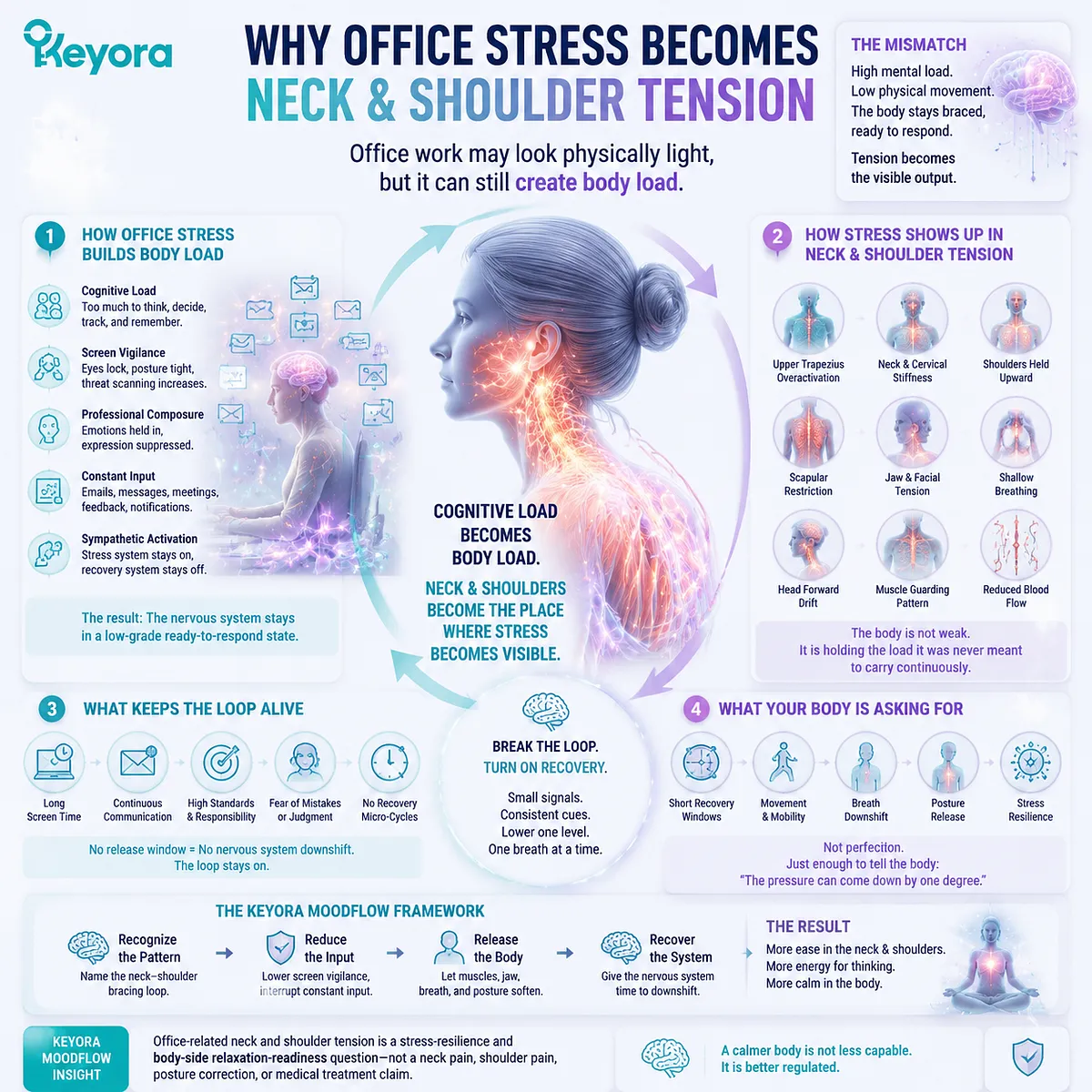
Office stress may show up as neck and shoulder tension because the body can turn cognitive load, screen vigilance, emotional control, and work pressure into a physical bracing pattern. Your neck and shoulders may become the place where office stress becomes visible in the body.
The mismatch is this: office work may look physically light, but it can still create body load. Emails, meetings, deadlines, messages, feedback, and constant screen focus can keep the nervous system in a low-grade ready-to-respond state.
This can involve cognitive load becoming body load, screen vigilance, professional composure, sympathetic activation, muscle guarding, missing recovery micro-cycles, neural braking context, and body-side relaxation readiness.
In the Keyora MoodFlow framework, office-related neck and shoulder tension is understood as a stress-resilience and body-side relaxation-readiness question, not a neck pain, shoulder pain, posture correction, or medical treatment claim.
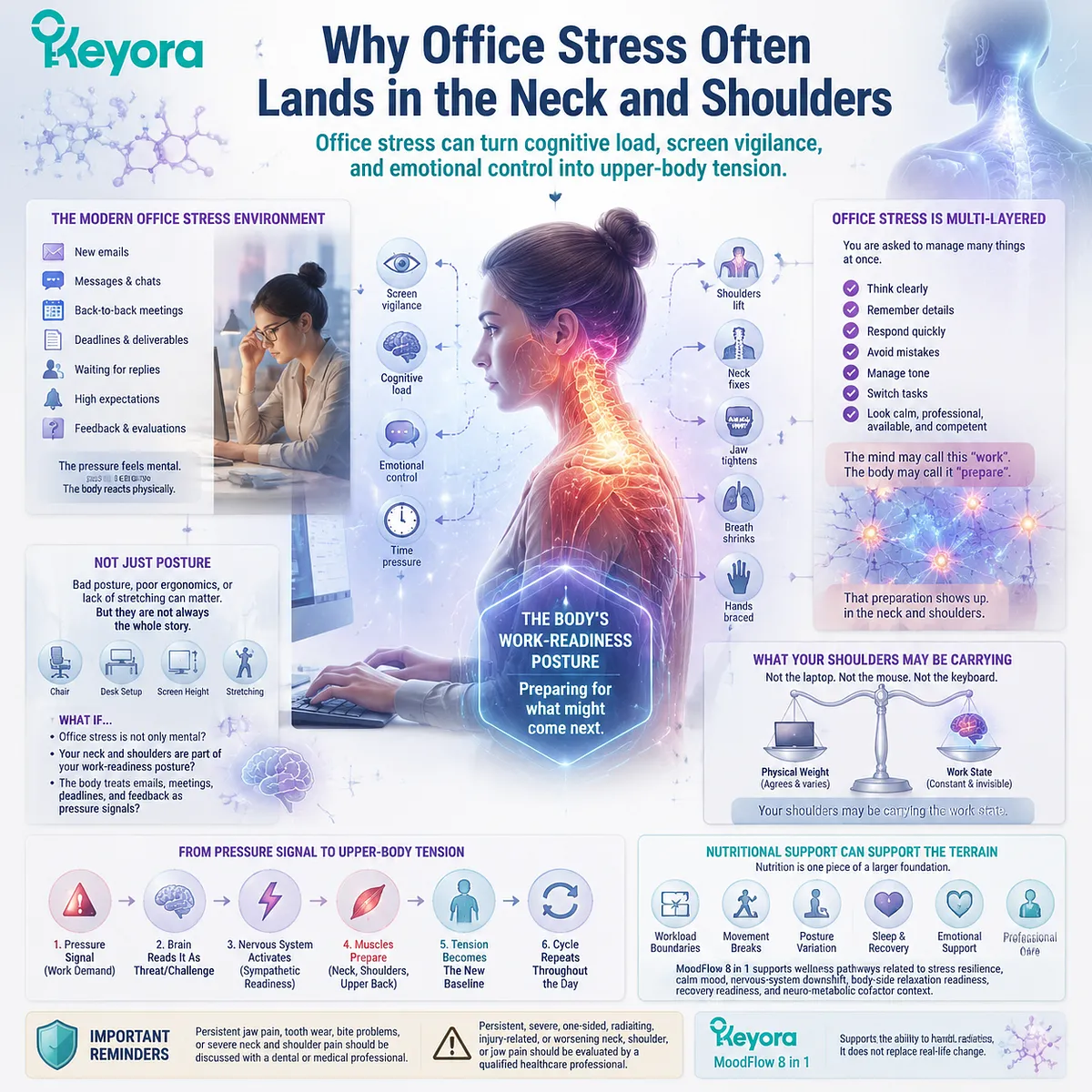
Why Office Stress Often Lands in the Neck and Shoulders
Office stress can turn cognitive load, screen vigilance, and emotional control into upper-body tension.
You open your computer.
The screen lights up. The inbox is waiting. A chat window shows a new message. The calendar says a meeting is starting soon. A document needs edits. Someone is waiting for a reply. A deadline is close enough that you can feel it before you name it.
You tell yourself to handle one thing at a time.
But your body may already be entering work mode.
Your shoulders lift slightly.
Your neck becomes more fixed.
Your eyes lock onto the screen.
Your jaw tightens a little.
Your breath becomes smaller.
Your hand moves to the mouse or keyboard as if it needs to be ready for whatever comes next.
You are not carrying a box.
You are not running.
You are not doing visible physical labor.
But your body feels as if it is holding weight.
This is why office stress can be so confusing. The pressure seems mental, yet the body responds physically. You may think the problem is only your posture, your chair, your desk setup, or your lack of stretching.
Those things can matter.
But they are not always the whole story.
What if office stress is not only mental?
What if your neck and shoulders are part of your work-readiness posture?
What if the body treats emails, meetings, deadlines, and feedback as pressure signals?
Office stress often asks you to manage several layers at once.
You have to think clearly.
You have to remember details.
You have to respond quickly.
You have to avoid mistakes.
You have to manage tone.
You have to switch tasks.
You have to look calm, professional, available, and competent, even when you feel overloaded.
The mind may call this “work.”
The body may call it “prepare.”
That preparation can show up in the neck and shoulders.
Your shoulders may not be carrying the laptop.
They may be carrying the work state.
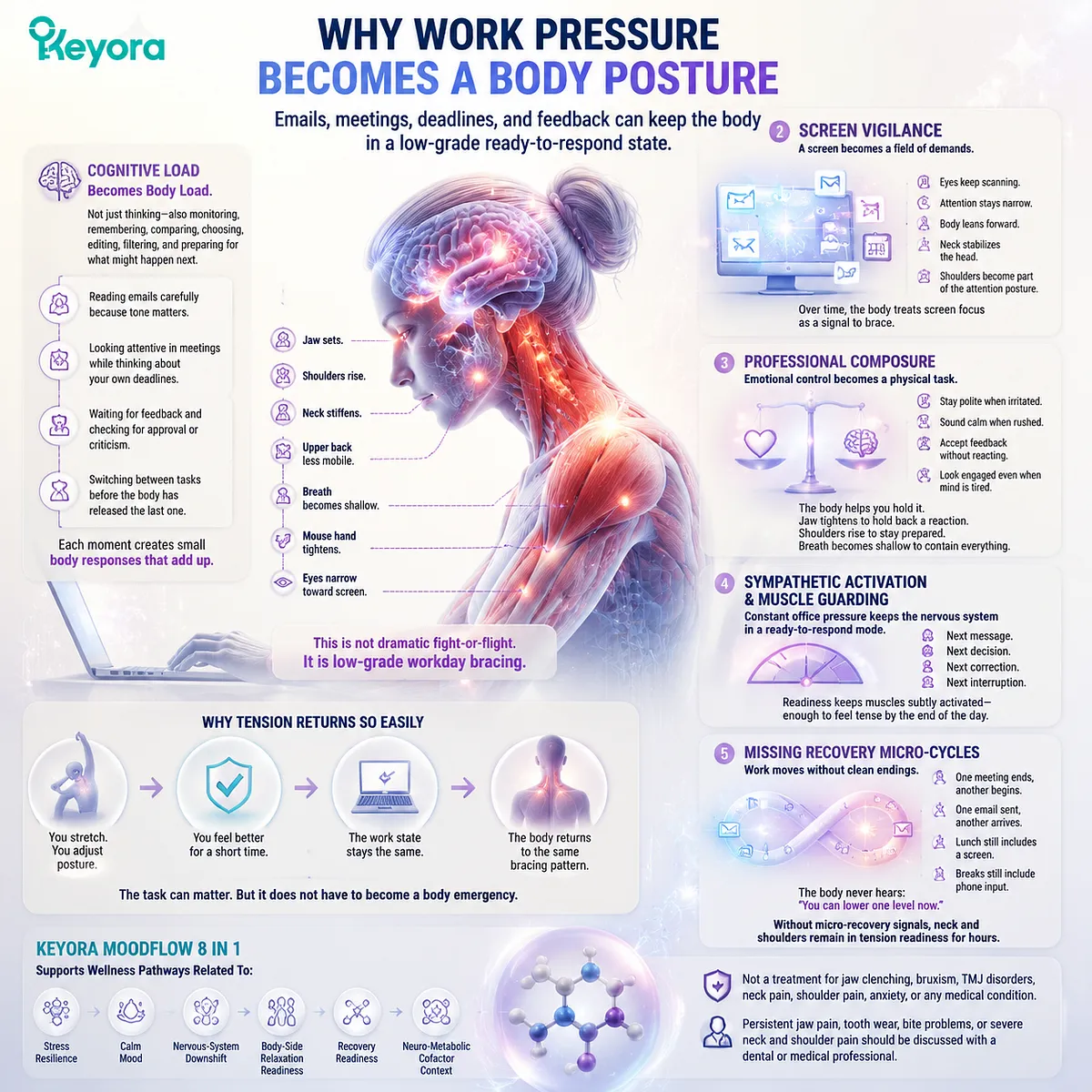
Why Work Pressure Becomes a Body Posture
Emails, meetings, deadlines, and feedback can keep the body in a low-grade ready-to-respond state.
One reason office stress becomes neck and shoulder tension is that cognitive load can become body load.
Cognitive load is not only thinking. It can include monitoring, remembering, comparing, choosing, editing, filtering, and preparing for what might happen next.
You may be reading an email carefully because the tone matters.
You may be in a meeting where you have to look attentive while also thinking about your own deadlines.
You may be waiting for feedback and checking for signs of approval or criticism.
You may be switching between tasks before your body has released the last one.
Each of these moments can create small body responses.
The jaw sets.
The shoulders rise.
The neck stiffens.
The upper back becomes less mobile.
The breath becomes shallow.
The mouse hand tightens.
The eyes narrow toward the screen.
This is not dramatic fight-or-flight. It is low-grade workday bracing.
The second mechanism is screen vigilance.
A screen is not only a screen during office work. It can become a field of demands: emails, Slack or Teams messages, notifications, comments, calendar reminders, dashboards, spreadsheets, and open tabs.
Your eyes keep scanning.
Your attention stays narrow.
Your body leans forward.
Your neck stabilizes your head.
Your shoulders become part of the attention posture.
Over time, the body can start treating screen focus as a signal to brace.
The third mechanism is professional composure.
Office stress often requires emotional control. You may need to stay polite when you are irritated. You may need to sound calm when you are rushed. You may need to accept feedback without reacting. You may need to look engaged even when your mind is tired.
That kind of control is not only mental.
The body may help you hold it.
Sometimes the jaw tightens because you are holding back a reaction.
Sometimes the shoulders rise because you are trying to stay prepared.
Sometimes the breath becomes shallow because your system is trying to keep everything contained.
The fourth mechanism is sympathetic activation and muscle guarding.
When office pressure feels constant, the nervous system may stay in a ready-to-respond mode. The body prepares for the next message, the next decision, the next correction, or the next interruption.
This readiness can keep muscles subtly activated.
Not enough to look dramatic.
Enough to feel tense by the end of the day.
The fifth mechanism is missing recovery micro-cycles.
Office work often moves without clean endings.
One meeting ends, and another window opens.
One email is sent, and another arrives.
One task is finished, but the next one is already waiting.
Lunch may still include a screen.
Breaks may still include phone input.
The body never hears, “You can lower one level now.”
Without those micro-recovery signals, the neck and shoulders may remain in tension readiness for hours.
This is why tension may return even after stretching or adjusting posture. If the work state remains the same, the body may return to the same bracing pattern.
The task can matter.
But it does not have to become a body emergency.
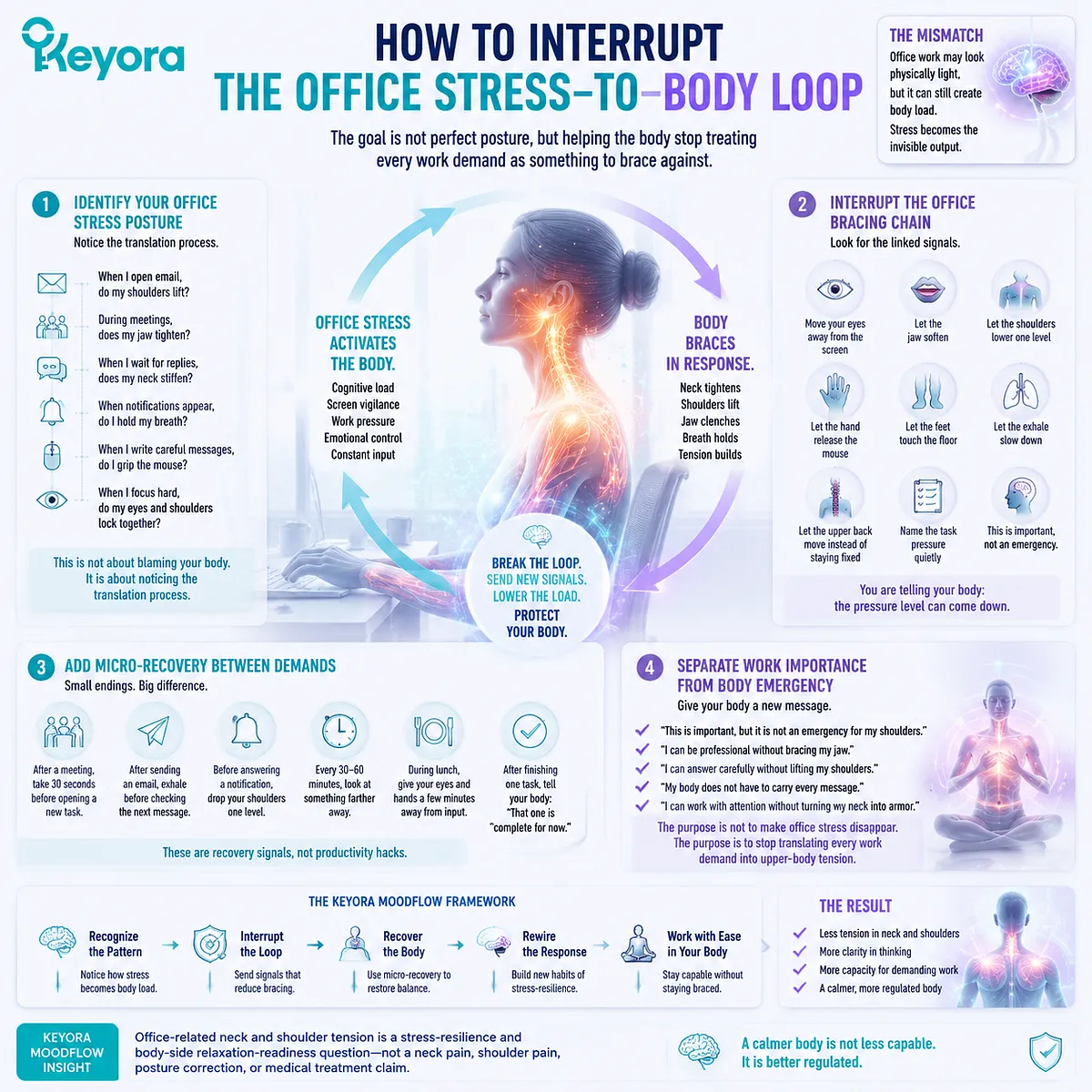
How to Interrupt the Office Stress-to-Body Loop
The goal is not perfect posture, but helping the body stop treating every work demand as something to brace against.
When office stress shows up in your neck and shoulders, it is easy to focus only on the tight area.
You may roll your shoulders, stretch your neck, press the sore place, or tell yourself to sit straighter.
These can be useful. But if the tension is part of an office stress posture, you may also need to interrupt the stress-to-body loop.
The first step is to identify your office stress posture.
Ask yourself:
When I open email, do my shoulders lift?
During meetings, does my jaw tighten?
When I wait for replies, does my neck stiffen?
When notifications appear, do I hold my breath?
When I write careful messages, do I grip the mouse?
When I focus hard, do my eyes and shoulders lock together?
This is not about blaming your body.
It is about noticing the translation process.
“My body may be entering work-readiness posture.”
The second step is to interrupt the office bracing chain.
Do not only tell the shoulders to relax. Look for the linked signals.
Move your eyes away from the screen for a few seconds.
Let the jaw soften.
Let the shoulders lower one level.
Let the hand release the mouse.
Let the feet touch the floor.
Let the exhale slow down.
Let the upper back move instead of staying fixed.
Name the task pressure quietly:
“This is an important email.”
“This is a demanding meeting.”
“This is feedback, not an emergency.”
Naming the pressure can help the body stop carrying it as unnamed threat.
The third step is to add micro-recovery between demands.
You may not have time for a long break. But the body often benefits from small endings.
After a meeting, take 30 seconds before opening a new task.
After sending an email, exhale before checking the next message.
Before answering a notification, drop your shoulders one level.
Every 30 to 60 minutes, look at something farther away.
During lunch, give your eyes and hands at least a few minutes away from work input.
After finishing one task, tell your body:
“That one is complete for now.”
These are not productivity hacks. They are recovery signals.
The fourth step is to separate work importance from body emergency.
Many people do not realize that their body treats every important task as if it must be physically braced for.
Try saying:
“This is important, but it is not an emergency for my shoulders.”
“I can be professional without bracing my jaw.”
“I can answer carefully without lifting my shoulders.”
“My body does not have to carry every message.”
“I can work with attention without turning my neck into armor.”
The purpose is not to make office stress disappear. The purpose is to stop translating every work demand into upper-body tension.
Your body may still need movement, stretching, ergonomic support, workload boundaries, and real recovery time.
But it may also need a new message during the workday:
The work matters, but my body does not have to brace against every part of it.
Where Nutritional Support Fits
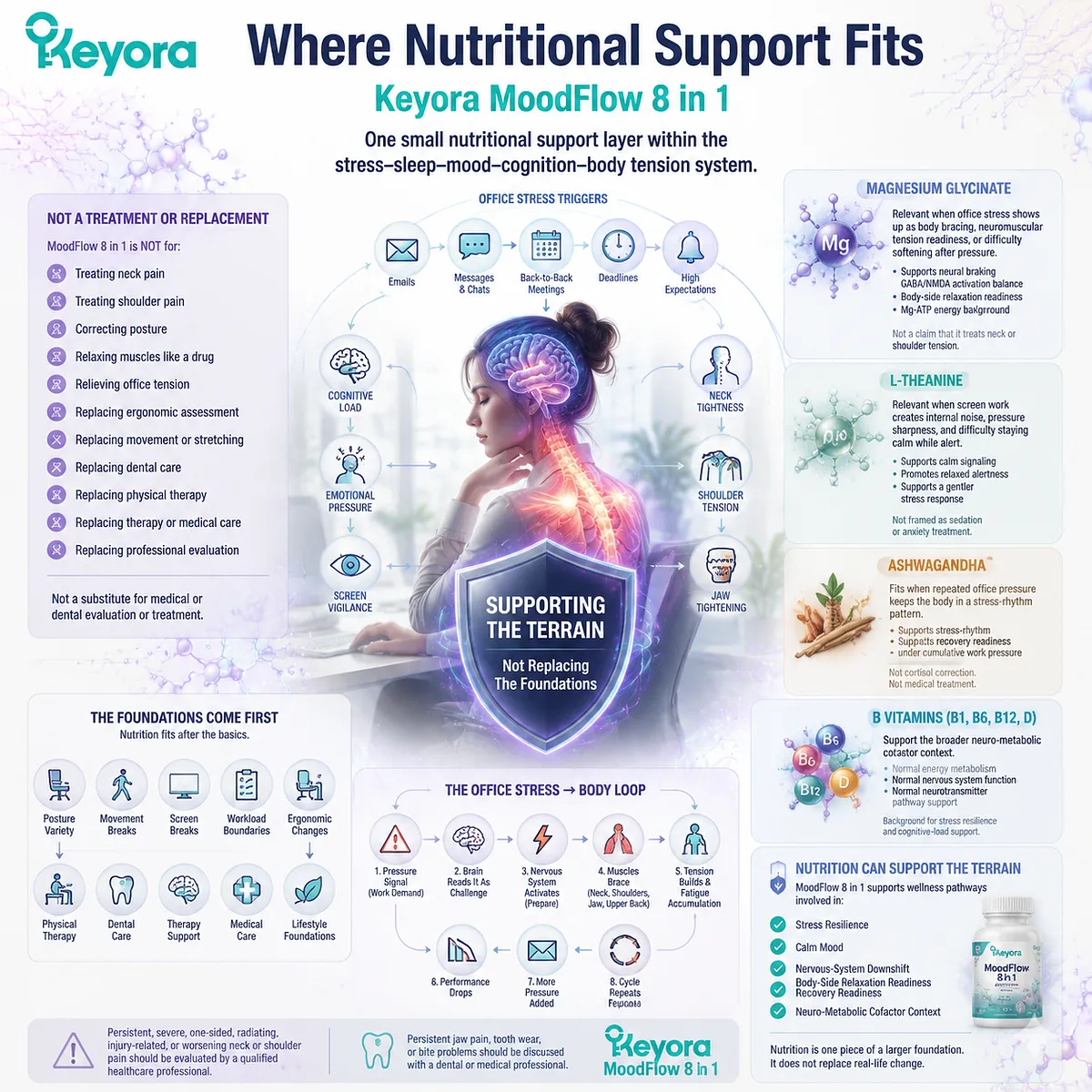
Keyora MoodFlow 8 in 1 can fit as one small nutritional support layer when office stress appears within a broader stress-sleep-mood-cognition and body-tension pattern. It should not be framed as treating neck pain, treating shoulder pain, correcting posture, relaxing muscles like a drug, relieving office tension, or replacing ergonomic assessment, movement, stretching, dental care, physical therapy, therapy, medical care, or professional evaluation.
Its role is narrower: supporting wellness pathways involved in stress resilience, calm mood, nervous-system downshift, body-side relaxation readiness, recovery readiness, and neuro-metabolic cofactor context.
-
Magnesium glycinate may be relevant when office stress shows up as body bracing, neuromuscular tension readiness, or difficulty softening after pressure. In the MoodFlow framework, it supports neural braking, GABA/NMDA activation balance, body-side relaxation readiness, and Mg-ATP energy background. This is not a claim that it treats neck or shoulder tension.
-
L-Theanine may be relevant when screen work creates internal noise, pressure sharpness, and difficulty staying calm while alert. Its role is calm signaling and relaxed alertness, not sedation or anxiety treatment.
-
Ashwagandha may fit when repeated office pressure keeps the body in a stress-rhythm pattern. Its role is stress-rhythm adaptation and recovery readiness under cumulative work pressure, not cortisol correction or medical treatment.
-
B vitamins may support the broader neuro-metabolic cofactor context, including normal energy metabolism and normal neurotransmitter-related pathways. This belongs to the background of stress resilience and cognitive-load support, not a cure for fatigue, tension, or burnout.
MoodFlow belongs after the reader understands the office stress-to-body loop and practical reset steps. Nutrition can support the terrain. It cannot replace posture variety, screen breaks, movement, workload boundaries, ergonomic changes, physical therapy, dental care, therapy, medical care, or lifestyle foundations.
Persistent, severe, one-sided, radiating, injury-related, or worsening neck or shoulder pain should be evaluated by a qualified healthcare professional.
Persistent jaw pain, tooth wear, or bite problems should be discussed with a dental or medical professional.
Closing Summary
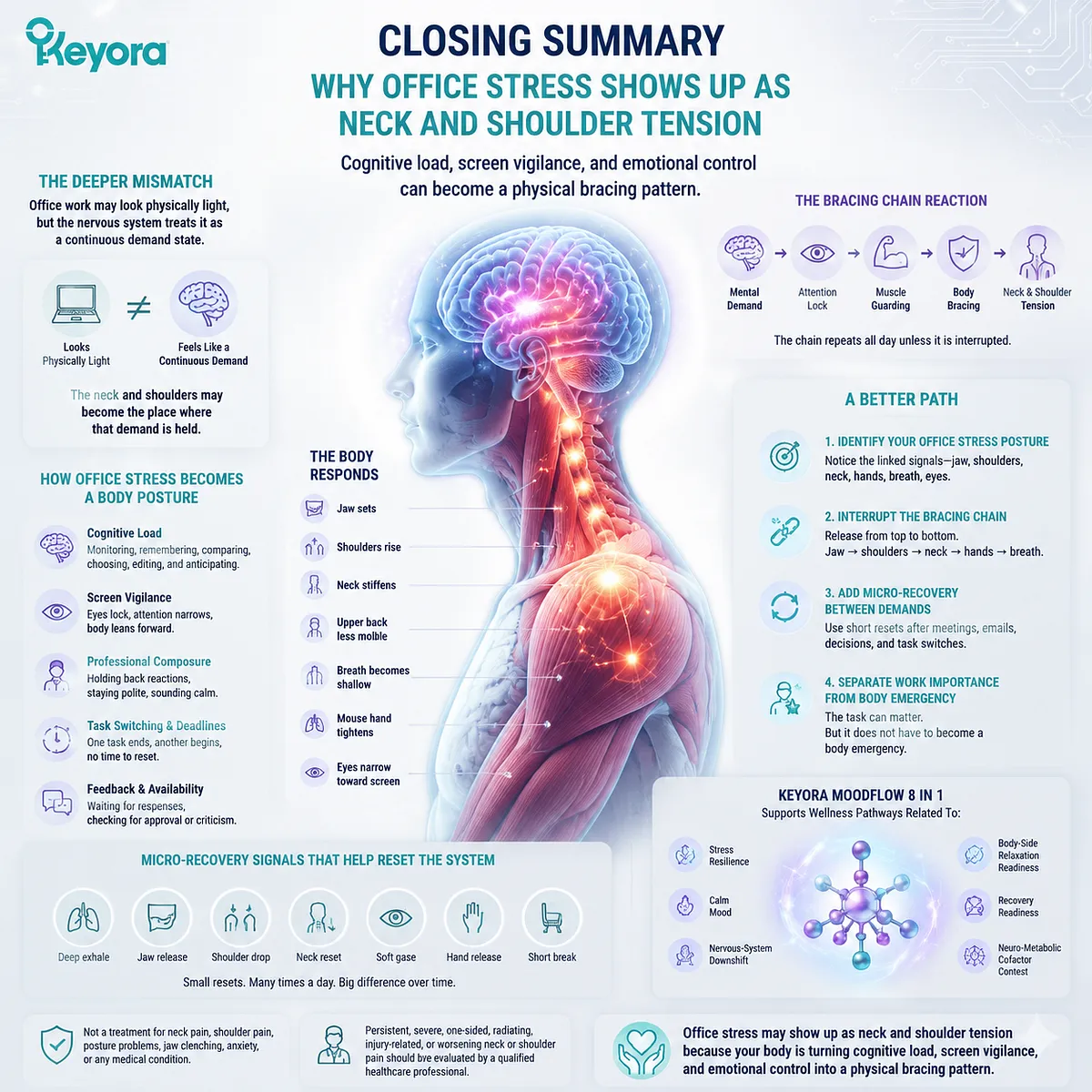
Office stress can show up as neck and shoulder tension because cognitive load does not stay only in the mind. Screen vigilance, professional composure, task switching, deadlines, feedback, and constant availability can all become part of a physical bracing pattern.
The deeper mismatch is that office work may look physically light while the nervous system treats it as a continuous demand state. The neck and shoulders may become the place where that demand is held.
A better path begins by identifying your office stress posture, interrupting the bracing chain, adding micro-recovery between demands, and separating work importance from body emergency.
Keyora MoodFlow 8 in 1 can support wellness pathways related to stress resilience, calm mood, nervous-system downshift, body-side relaxation readiness, recovery readiness, and neuro-metabolic cofactor context. It is not a treatment for neck pain, shoulder pain, posture problems, jaw clenching, anxiety, or any medical condition.
Persistent, severe, one-sided, radiating, injury-related, or worsening neck or shoulder pain should be evaluated by a qualified healthcare professional.
Office stress may show up as neck and shoulder tension because your body is turning cognitive load, screen vigilance, and emotional control into a physical bracing pattern.
This article is for educational and informational purposes only. It does not provide medical advice, diagnosis, treatment, cure, prevention, disease outcome claims, hormone restoration claims, fertility outcome claims, or formula-specific clinical efficacy claims.