
Why Does Sitting at a Desk Make My Shoulders Feel So Tense?
Keyora Research Q&A Library
This is part of the Keyora Research Q&A Series, derived from Keyora Nutritional Neurology Series .
Within the Keyora Nutritional Neurology framework, this Q&A translates complex nutrient–brain mechanisms into reader-friendly, evidence-bound answers, focusing on stress resilience, sleep quality, calm mood support, cognitive wellness, and the broader interaction between nutrition, neurochemistry, and daily nervous-system function.
First published by Keyora Research Journal: www.keyorahealth.com

Direct Answer
Sitting at a desk can make your shoulders feel tense because desk work is not just sitting. It often combines fixed posture, screen vigilance, shallow breathing, mouse and keyboard tension, deadline pressure, and a nervous system that stays ready to respond.
The mismatch is this: being physically still does not always mean your body is relaxed. You can sit in a chair for hours while your eyes, hands, jaw, breath, neck, and shoulders remain subtly braced for the next task, message, correction, or demand.
This can involve desk-related micro-bracing, screen vigilance, sympathetic activation, shallow upper-chest breathing, body-side tension readiness, GABA/NMDA activation balance, neural braking context, and recovery-readiness difficulty.
In the Keyora MoodFlow framework, desk-related shoulder tension is understood as a stress-resilience and body-side relaxation-readiness question, not a posture correction or shoulder pain treatment claim.
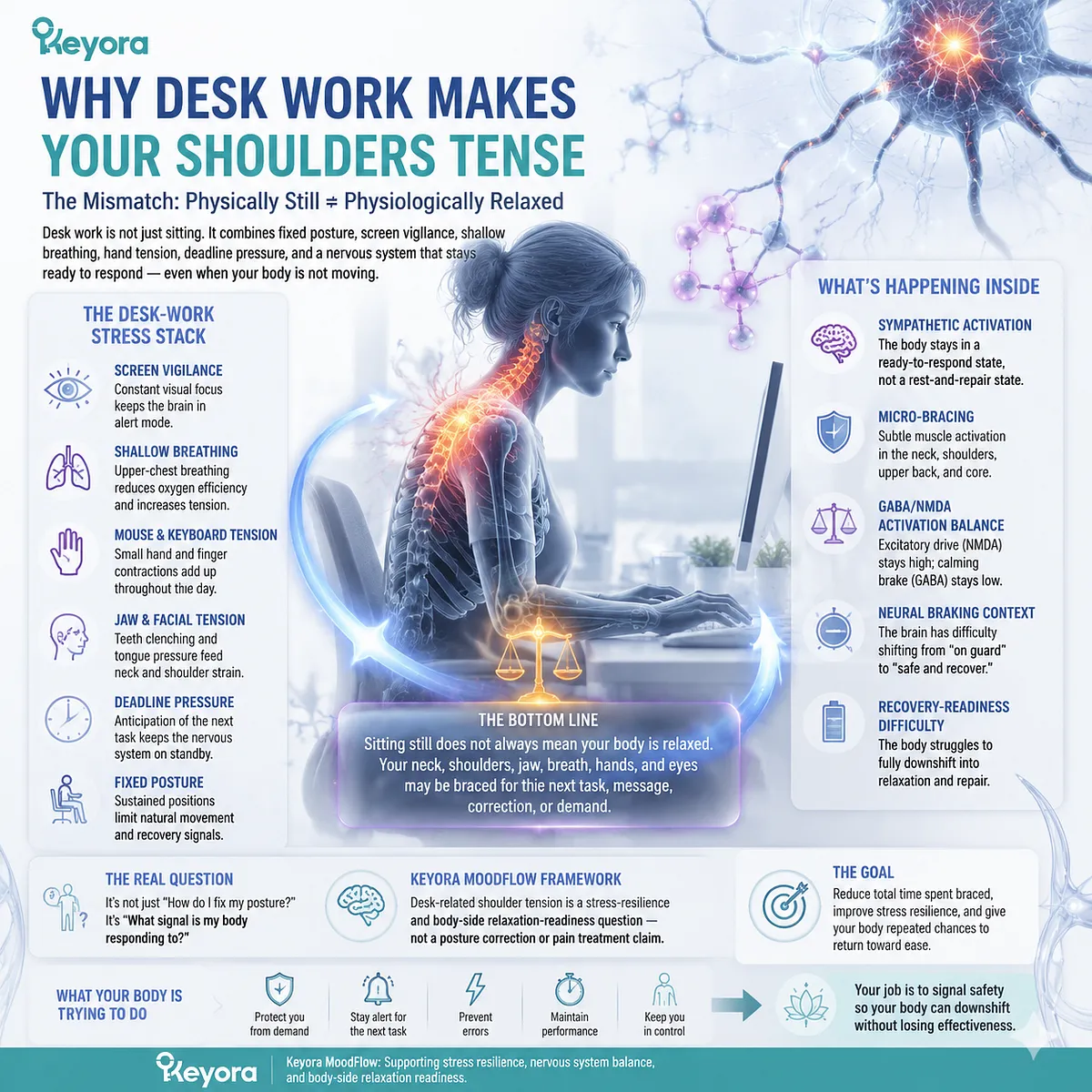
Why Desk Work Can Make Your Shoulders Feel Tense
Desk work can keep the upper body braced through screen vigilance, micro-posture holding, and stress activation.
You sit down at your desk.
At first, nothing feels unusual.
The computer turns on. The screen lights up. The mouse is near your hand. Your keyboard is in front of you. Maybe there is coffee beside the laptop, a notebook nearby, a few open tabs, and a list of things you are supposed to handle before the day is over.
You tell yourself you are only going to work for a while.
Then, sometime later, you notice your shoulders.
They are not dramatically lifted. They are not in pain in a way that stops you immediately. They are just tense, slightly raised, slightly locked, as if your upper body has been holding itself in place for a long time.
Your mouse hand may feel tight.
Your neck may feel shortened.
Your jaw may be lightly clenched.
Your eyes may feel fixed on the screen.
Your breathing may be smaller than usual.
You may only realize how tense you were when you finally stand up, roll your shoulders, or step away from the desk.
This can be frustrating because it does not seem to make sense.
You were not lifting boxes.
You were not exercising.
You were not doing anything that looked physically intense.
You were just sitting.
So the self-questioning begins.
“Is my posture that bad?”
“Do I need a better chair?”
“Are my shoulders weak?”
“Why does sitting at a desk make my body feel so tense?”
Posture, desk setup, chair height, screen position, and movement habits all matter. They should not be ignored. But desk-related shoulder tension is not always only a mechanical posture problem.
Sometimes the desk becomes a pressure zone.
The body learns that this is the place where emails arrive, mistakes must be avoided, messages must be answered, deadlines must be met, and attention must stay locked for long periods.
So when you sit down, your body may not simply sit.
It may prepare.
Your shoulders may lift slightly as if bracing. Your hands may grip the mouse or hover over the keyboard. Your head may lean forward toward the screen. Your chest may narrow. Your breathing may become shallow. Your eyes may stop moving freely and lock onto the task.
This is micro-bracing.
It is not one big movement. It is a collection of small holding patterns repeated over time.
And because each one is small, you may not notice it until your shoulders feel tense, tired, or difficult to drop.
What if the desk is not only a posture problem?
What if your shoulders are reacting to screen pressure and task vigilance?
What if your body is physically sitting still, but your nervous system is leaning forward into work?
That may be why your shoulders feel tense at the desk.
The desk may not be heavy, but the work state around it can still feel heavy to your body.
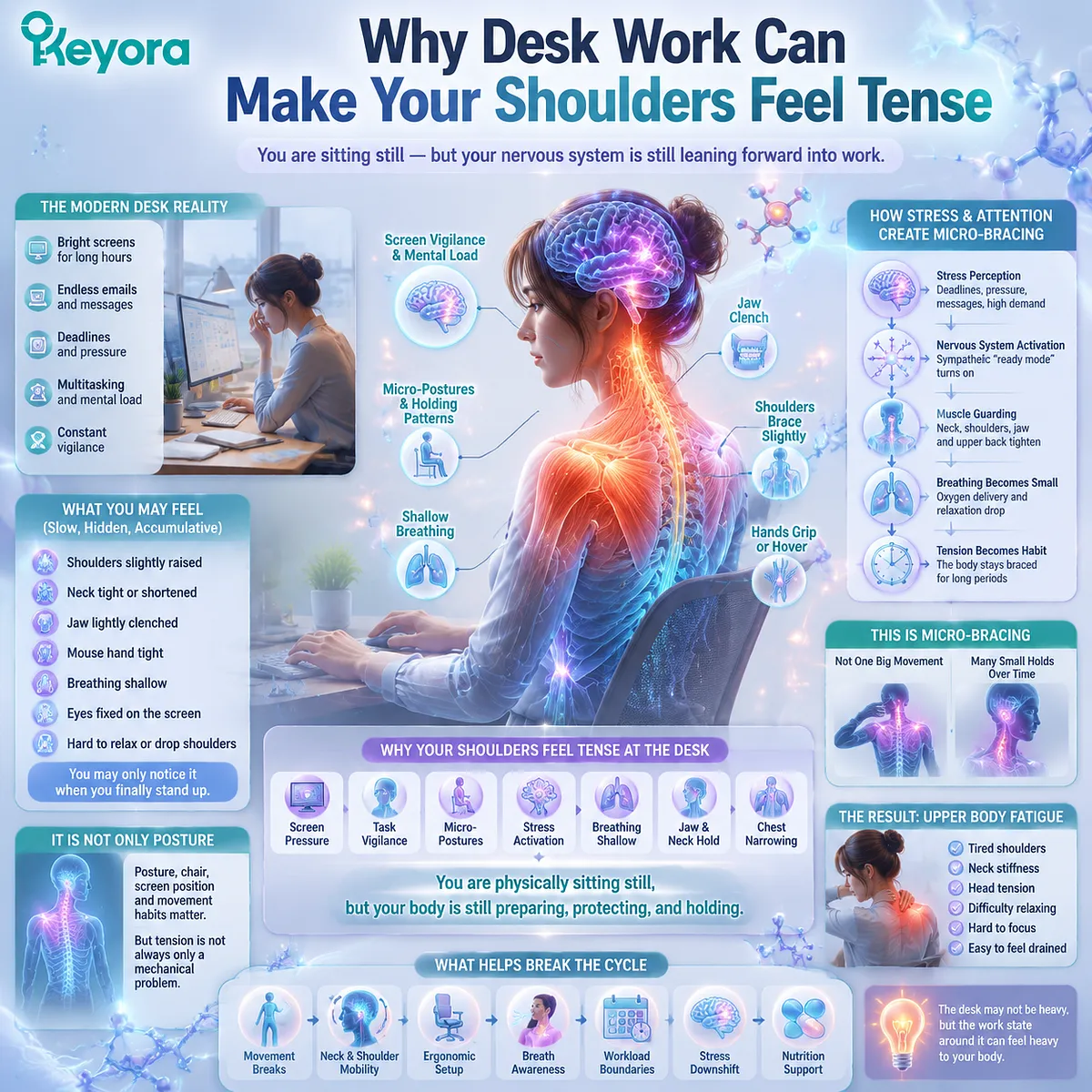
Why Sitting Still Is Not Always Relaxing
Your body can be physically still while your nervous system stays alert, guarded, and ready to respond.
One of the biggest misunderstandings about desk work is the idea that sitting means resting.
Sitting can be restful.
But sitting at a desk is often not the same as resting in a chair.
At a desk, your attention may be highly active. Your eyes scan details. Your mind tracks tasks. Your hands perform small repeated movements. Your body holds a narrow position while your brain jumps between messages, documents, deadlines, notifications, and decisions.
The outside looks still.
The inside may be busy.
This is why shoulder tension can build even without obvious physical effort.
The first mechanism is micro-posture holding.
When you work at a computer, your head may drift forward. Your shoulders may round or rise. Your arms may stay slightly lifted. Your wrist may stay fixed around the mouse. Your upper back may stop moving. Your chest may become smaller.
These positions do not always feel dramatic in the moment.
But if the body holds them for long enough, they become work.
The second mechanism is screen vigilance.
Screen work asks for constant monitoring. There may be emails, chat windows, calendar reminders, open tabs, spreadsheets, comments, edits, alerts, and small decisions waiting for your attention.
Even if no one is physically standing in front of you, the screen can create a feeling of being watched by tasks.
Your eyes stay focused.
Your forehead may tighten.
Your neck stabilizes your head.
Your shoulders become part of the attention posture.
This is not just seeing. It is vigilance.
The third mechanism is shallow breathing.
Under stress, many people breathe higher in the chest without realizing it. The breath becomes smaller, quicker, and less connected to the lower body. The upper chest, neck, and shoulder area may become more involved in the breathing pattern.
When this happens during desk work, the shoulders may never fully drop.
The body is not receiving a strong signal that it can soften.
The fourth mechanism is sympathetic activation.
A desk can look calm from the outside while your nervous system treats it as a demand zone.
You may be sitting, but your system may still be preparing to respond quickly, avoid mistakes, manage tone, meet expectations, and stay available.
This readiness can keep the upper body braced.
The fifth mechanism is body-side relaxation-readiness difficulty.
The shoulders do not automatically relax because you are seated. They relax more easily when the whole system receives enough downshift cues: softer breath, less vigilance, lower pressure, movement variation, and a sense that the next task is not an emergency.
If the work state never gives those cues, the shoulders may stay tense even in a good chair.
That is why changing posture can help but may not solve the whole pattern.
If the nervous system still reads the desk as pressure, the body may keep returning to tension.
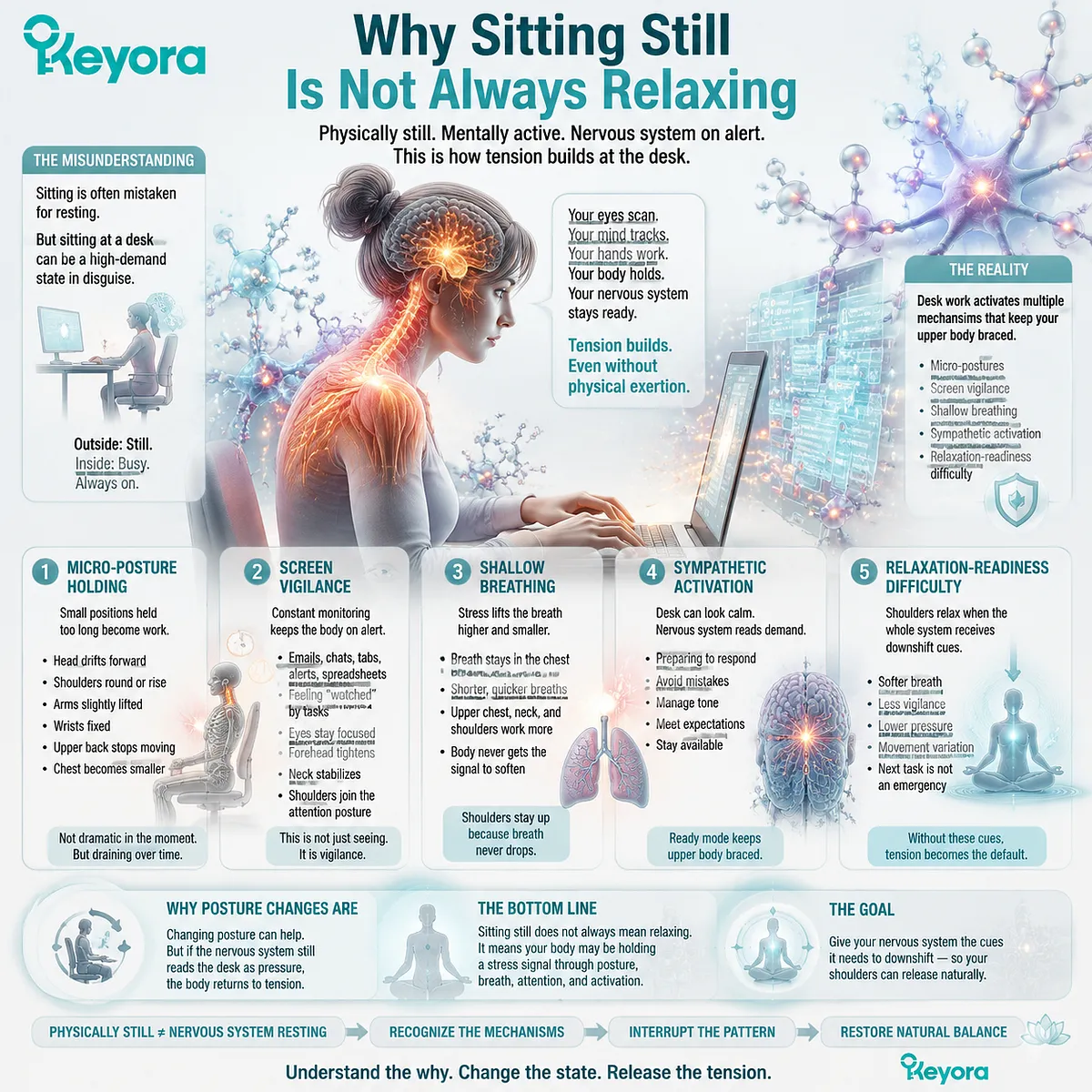
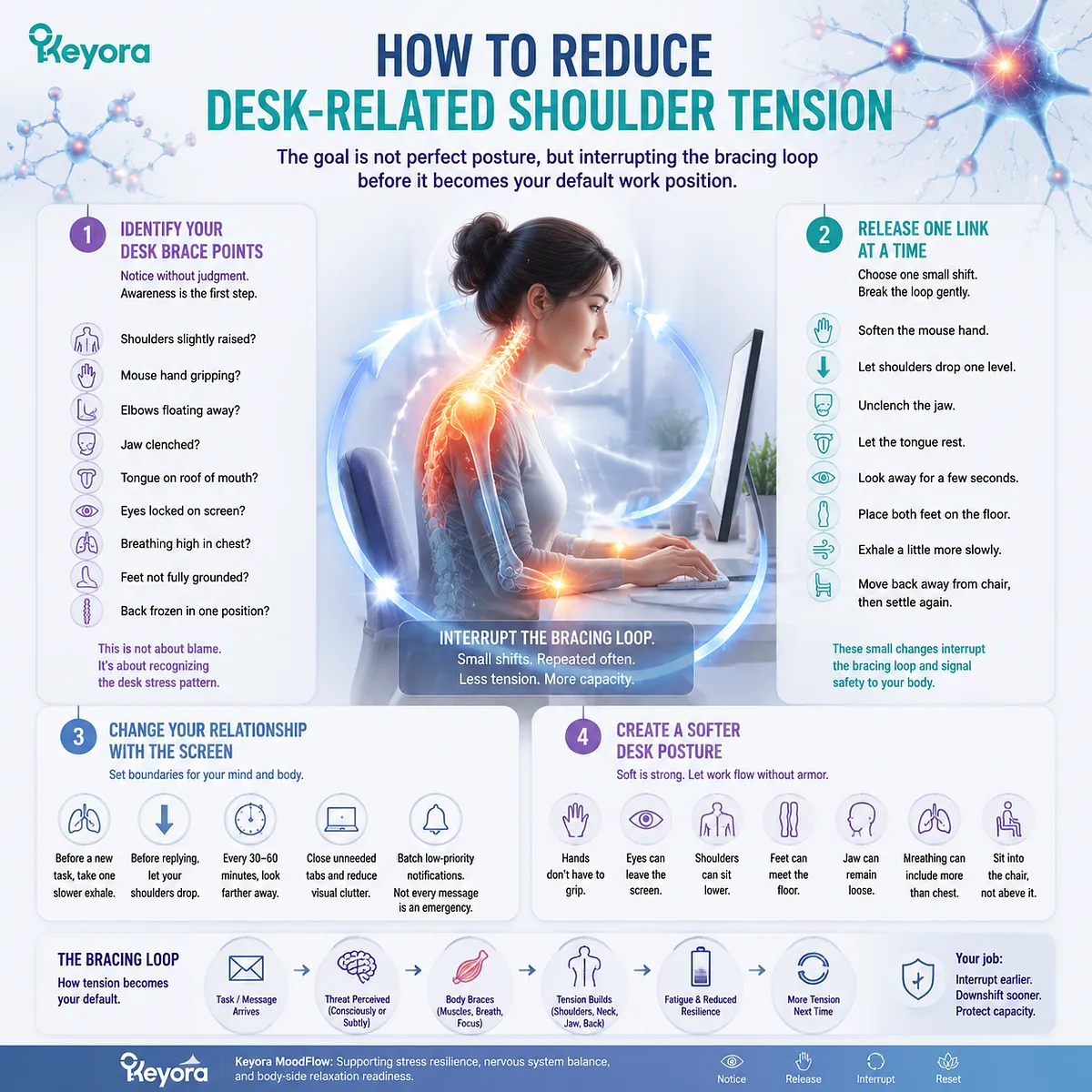
How to Reduce Desk-Related Shoulder Tension
The goal is not perfect posture, but interrupting the bracing loop before it becomes your default work position.
When your shoulders feel tense at the desk, it is easy to turn the solution into another performance demand.
“Sit perfectly.”
“Fix your posture.”
“Stop being tense.”
“Relax correctly.”
But if the body is already under pressure, turning posture into another task can add more tension.
A better first step is to identify your desk brace points.
Do not judge them. Just notice them.
Are your shoulders slightly raised?
Is your mouse hand gripping?
Are your elbows floating away from your body?
Is your jaw clenched?
Is your tongue pressed against the roof of your mouth?
Are your eyes locked on the screen?
Is your breathing high in your chest?
Are your feet floating, tucked, or not fully grounded?
Is your back frozen in one position?
This is not about blaming your posture. It is about recognizing the desk stress pattern.
The second step is to release one link at a time.
Do not demand full-body relaxation all at once.
Choose one small link.
Soften the mouse hand.
Let the shoulders drop one level.
Unclench the jaw.
Let the tongue rest.
Look away from the screen for a few seconds.
Place both feet on the floor.
Exhale a little more slowly.
Let your back move away from the chair and then settle again.
These small changes interrupt the bracing loop.
They tell the body that it does not have to hold the whole workday in the shoulders.
The third step is to change your relationship with the screen.
Screen work tends to pull the body forward. Not only physically, but mentally. Each new message can feel like a small demand. Each open tab can feel like unfinished pressure.
Try creating small screen boundaries.
Before opening a new task, take one slower exhale.
Before answering a message, let your shoulders drop.
Every 30 to 60 minutes, look at something farther away.
Close tabs that are no longer needed.
Batch low-priority notifications when possible.
Do not let every message become an emergency in your body.
The fourth step is to create a softer desk posture.
This does not mean perfect posture.
It means a posture that lets work continue without turning your shoulders into armor.
Your hands do not have to grip the mouse.
Your eyes can leave the screen sometimes.
Your shoulders can sit lower.
Your feet can meet the floor.
Your jaw can remain loose.
Your breathing can include more than the upper chest.
Your body can sit into the chair instead of hovering above the work.
You do not need to turn your desk into a relaxation space.
You only need to stop turning it into a constant bracing zone.
Desk work may always require attention. But attention does not have to mean tension every minute.
The more often you interrupt the bracing loop, the less your shoulders have to treat sitting at the desk as a stress posture.
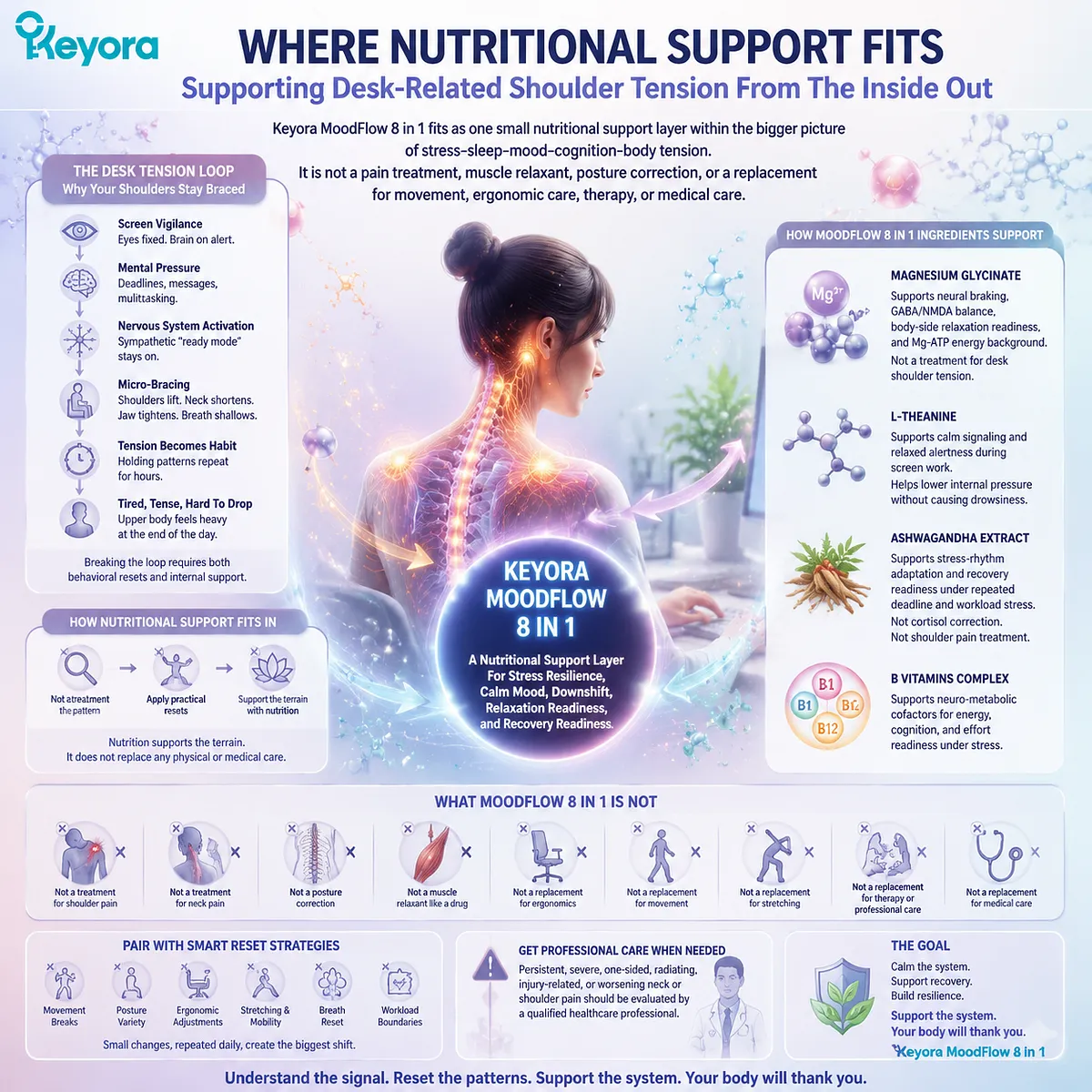
Where Nutritional Support Fits
Keyora MoodFlow 8 in 1 can fit as one small nutritional support layer when desk-related shoulder tension appears within a broader stress-sleep-mood-cognition and body-tension pattern. It should not be framed as treating shoulder pain, treating neck pain, correcting posture, relaxing muscles like a drug, or replacing ergonomic assessment, stretching, movement, physical therapy, dental care, or medical care.
Its role is narrower: supporting wellness pathways involved in stress resilience, calm mood, nervous-system downshift, body-side relaxation readiness, and recovery readiness.
-
Magnesium glycinate may be relevant when desk stress keeps the body braced, tense, or unable to soften. In the MoodFlow framework, it supports neural braking, GABA/NMDA activation balance, body-side relaxation readiness, and Mg-ATP energy background. This is not a claim that it treats desk shoulder tension; it is a wellness-support interpretation of the stress-body pathway.
-
L-Theanine may be relevant when screen work creates internal pressure, mental noise, or difficulty staying calm without becoming sleepy. Its role is calm signaling and relaxed alertness, especially for people who need to keep working while lowering the sense of internal strain.
-
Ashwagandha may fit when desk tension appears alongside repeated work pressure, deadline load, and difficulty recovering after a long day. Its role is stress-rhythm adaptation and recovery readiness under cumulative stress load, not cortisol correction or shoulder-pain treatment.
-
B vitamins may support the broader neuro-metabolic cofactor context when cognitive load, effort-readiness, and work stress are part of the larger pattern.
MoodFlow belongs after the reader understands the desk tension loop and practical reset steps. Nutrition can support the terrain. It cannot replace movement, posture variety, ergonomic improvements, workload boundaries, stretching, physical therapy, or professional evaluation when needed.
Persistent, severe, one-sided, radiating, injury-related, or worsening neck or shoulder pain should be evaluated by a qualified healthcare professional.
Closing Summary
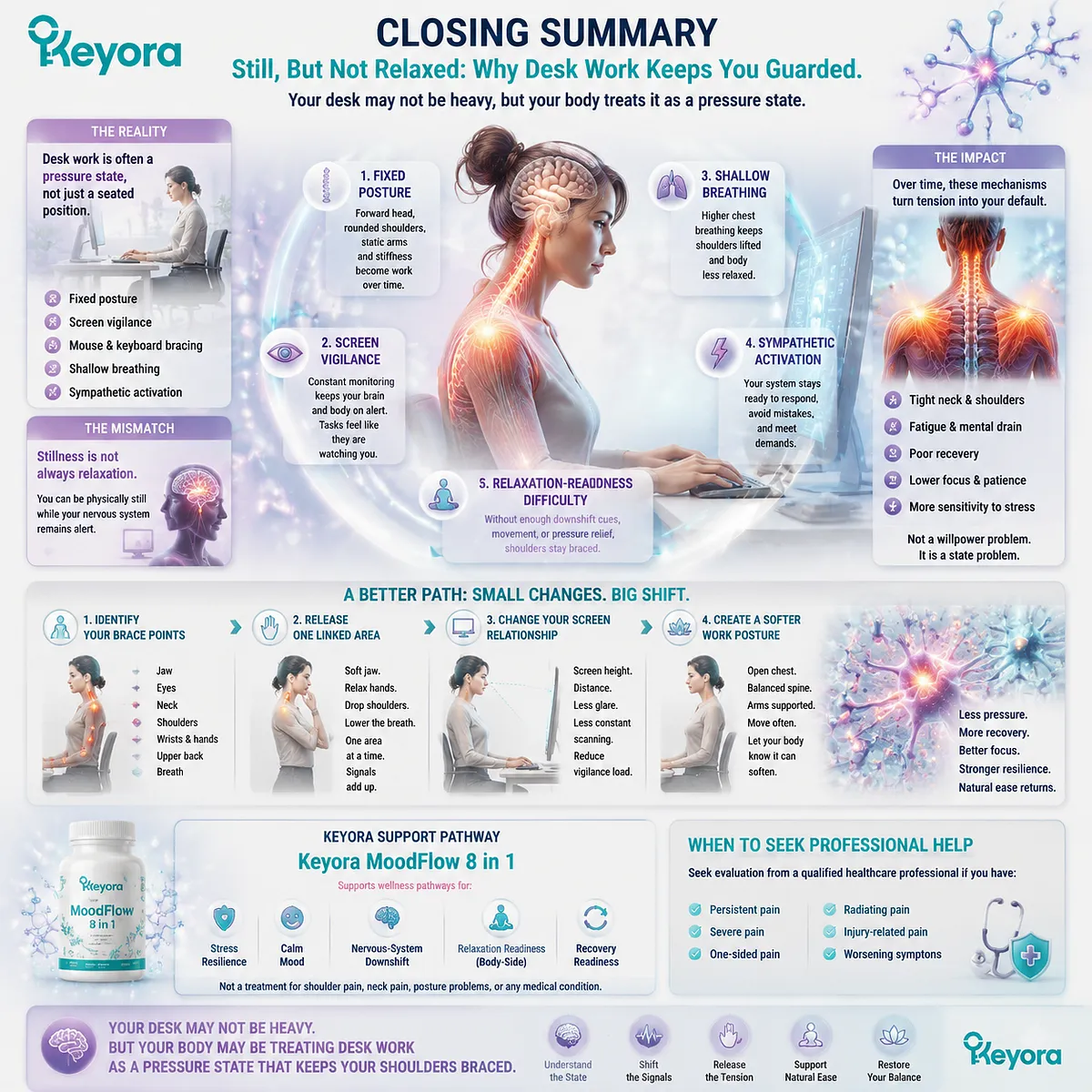
Sitting at a desk can make your shoulders feel tense because desk work is often a pressure state, not simply a seated position. Fixed posture, screen vigilance, mouse and keyboard bracing, shallow breathing, and sympathetic activation can keep the upper body subtly guarded.
The deeper mismatch is that stillness is not always relaxation. You can be physically still while your nervous system remains alert, your eyes locked on the screen, your breath shallow, and your shoulders prepared for demand.
A better path begins by identifying your desk brace points, releasing one linked area at a time, changing your screen relationship, and creating a softer work posture that does not turn your shoulders into armor.
Keyora MoodFlow 8 in 1 can support wellness pathways related to stress resilience, calm mood, nervous-system downshift, body-side relaxation readiness, and recovery readiness. It is not a treatment for shoulder pain, neck pain, posture problems, or any medical condition.
Persistent, severe, one-sided, radiating, injury-related, or worsening neck or shoulder pain should be evaluated by a qualified healthcare professional.
Your desk may not be heavy.
But your body may be treating desk work as a pressure state that keeps your shoulders braced.
This article is for educational and informational purposes only. It does not provide medical advice, diagnosis, treatment, cure, prevention, disease outcome claims, hormone restoration claims, fertility outcome claims, or formula-specific clinical efficacy claims.