
Why Do I Feel Unmotivated When I’m Stressed?
Keyora Research Q&A Library
This is part of the Keyora Research Q&A Series, derived from Keyora Nutritional Neurology Series .
Within the Keyora Nutritional Neurology framework, this Q&A translates complex nutrient–brain mechanisms into reader-friendly, evidence-bound answers, focusing on stress resilience, sleep quality, calm mood support, cognitive wellness, and the broader interaction between nutrition, neurochemistry, and daily nervous-system function.
First published by Keyora Research Journal: www.keyorahealth.com

Direct Answer
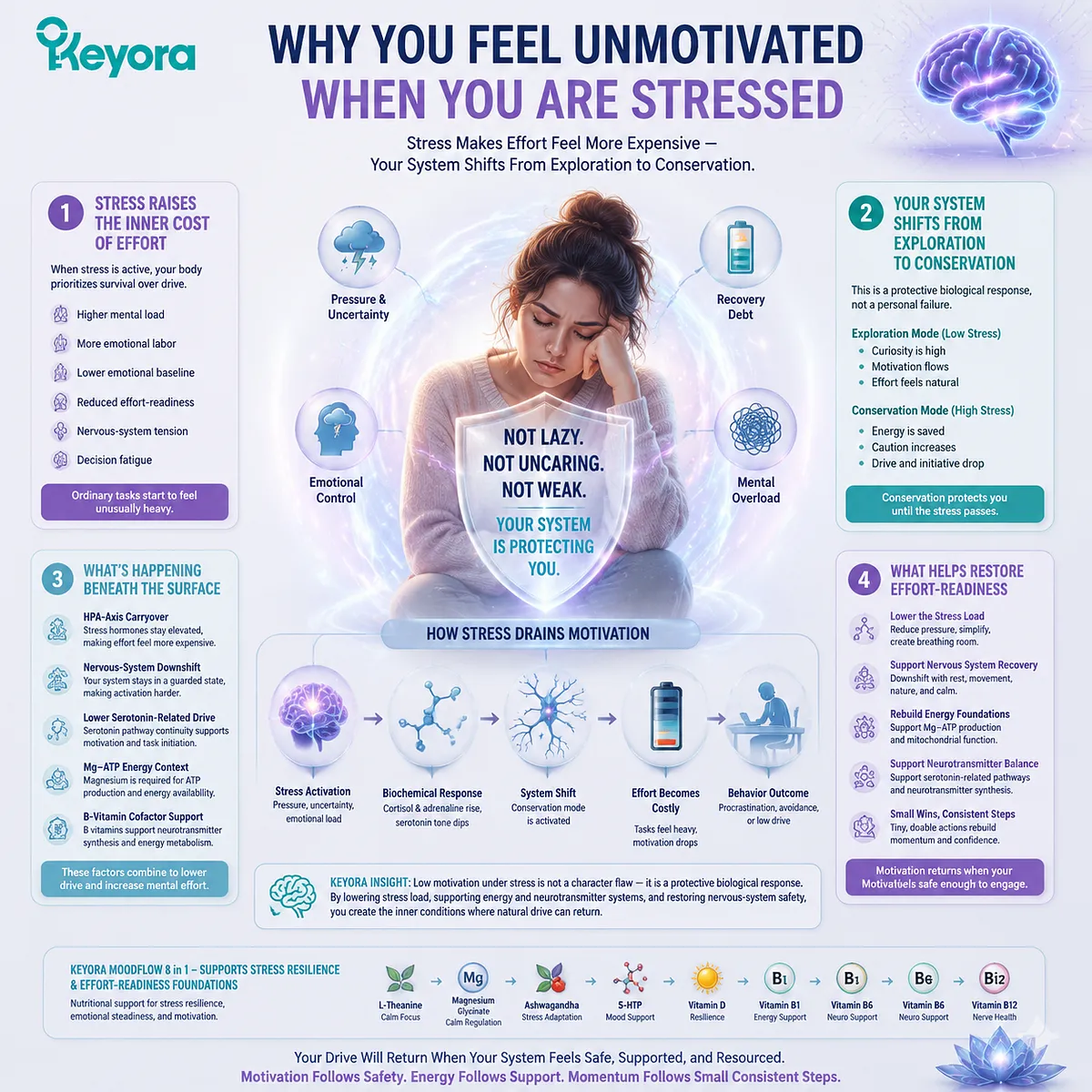
You may feel unmotivated when you are stressed because stress can make ordinary effort feel more expensive.
The issue is not always that you do not care, lack discipline, or have suddenly become lazy. It may be that your nervous system is already spending energy on pressure, uncertainty, emotional control, and recovery debt.
When stress stays active in the background, your body may shift toward conservation rather than exploration. Things that normally feel manageable can start to feel heavy. Even simple tasks may require more inner pushing than usual.
This can involve lower emotional baseline, reduced effort-readiness, HPA-axis stress rhythm carryover, nervous-system downshift difficulty, Mg-ATP energy context, B-vitamin cofactor support, and serotonin-related pathway continuity.
In the Keyora MoodFlow framework, stress-related low drive is understood as a stress-resilience and effort-readiness question, not a medical treatment claim.
Why Stress Can Make Motivation Feel Harder to Reach
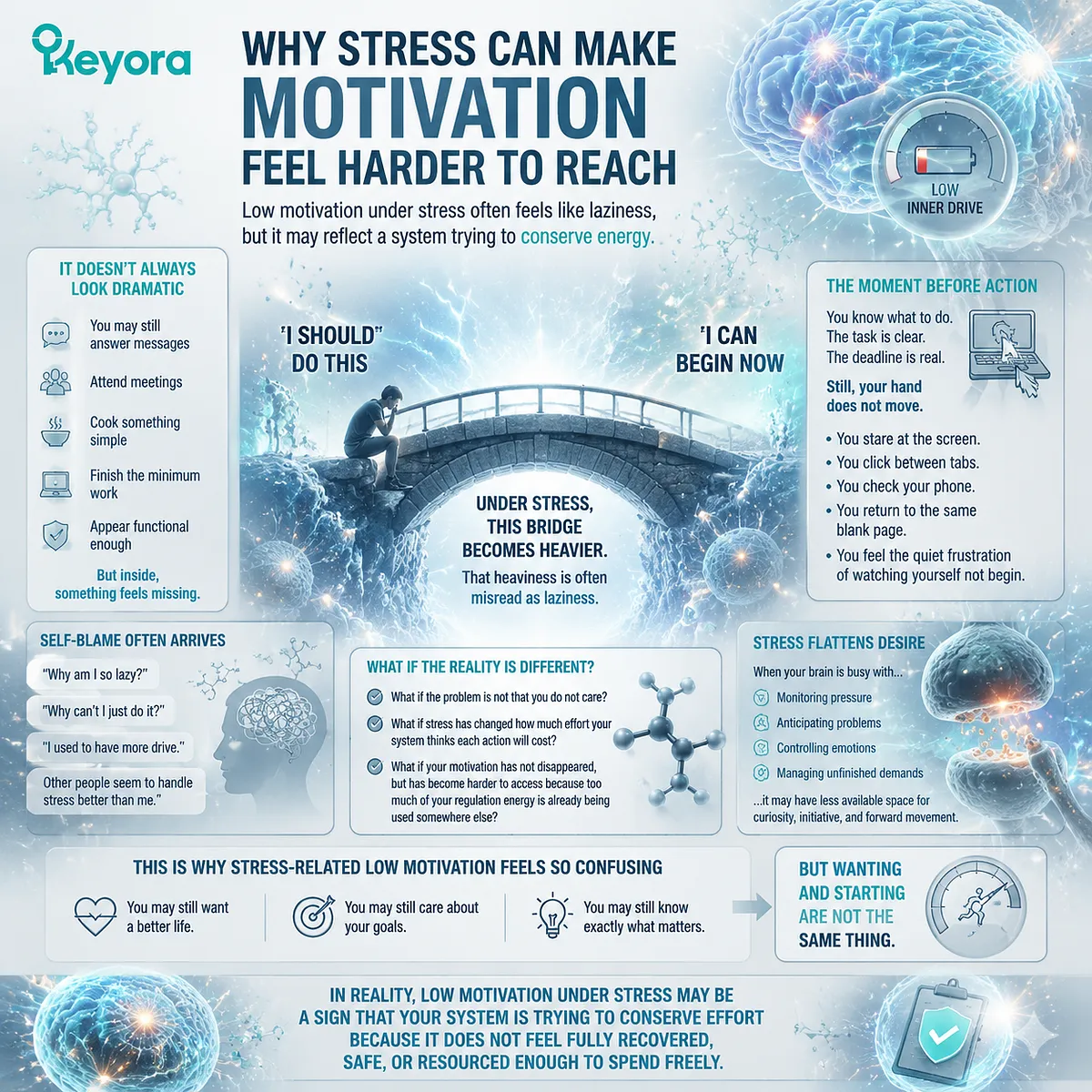
Low motivation under stress often feels like laziness, but it may reflect a system trying to conserve energy.
There is a particular kind of low motivation that does not feel dramatic from the outside.
You are not necessarily crying. You are not lying in bed all day. You may still answer messages, attend meetings, cook something simple, finish the minimum work, and appear functional enough that nobody notices anything is wrong.
But inside, something feels missing.
You open your laptop and look at the document. You know what needs to be done. The task is not confusing. The instructions are clear. The deadline is real.
Still, your hand does not move.
You stare at the screen, click between tabs, check your phone, return to the same blank page, and feel the quiet frustration of watching yourself not begin.
The hardest part may not be the task itself. The hardest part may be the moment before action, when you need to gather enough internal force to start.
This is when self-blame often arrives.
“Why am I so lazy?”
“Why can’t I just do it?”
“I used to have more drive.”
“Other people seem to handle stress better than me.”
But pause for a moment.
What if the problem is not that you do not care?
What if stress has changed how much effort your system thinks each action will cost?
What if your motivation has not disappeared, but has become harder to access because too much of your regulation energy is already being used somewhere else?
Stress does not only create urgency. It can also flatten desire.
When your brain is busy monitoring pressure, anticipating problems, controlling emotions, and managing unfinished demands, it may have less available space for curiosity, initiative, and forward movement.
This is why stress-related low motivation can feel so confusing. You may still want a better life. You may still care about your goals. You may still know exactly what matters.
But wanting and starting are not the same thing.
Under stress, the bridge between “I should do this” and “I can begin now” may become heavier.
That heaviness is often misread as laziness.
In reality, it may be a sign that your system is trying to conserve effort because it does not feel fully recovered, safe, or resourced enough to spend freely.
Why Your Drive Can Drop Even When You Still Care
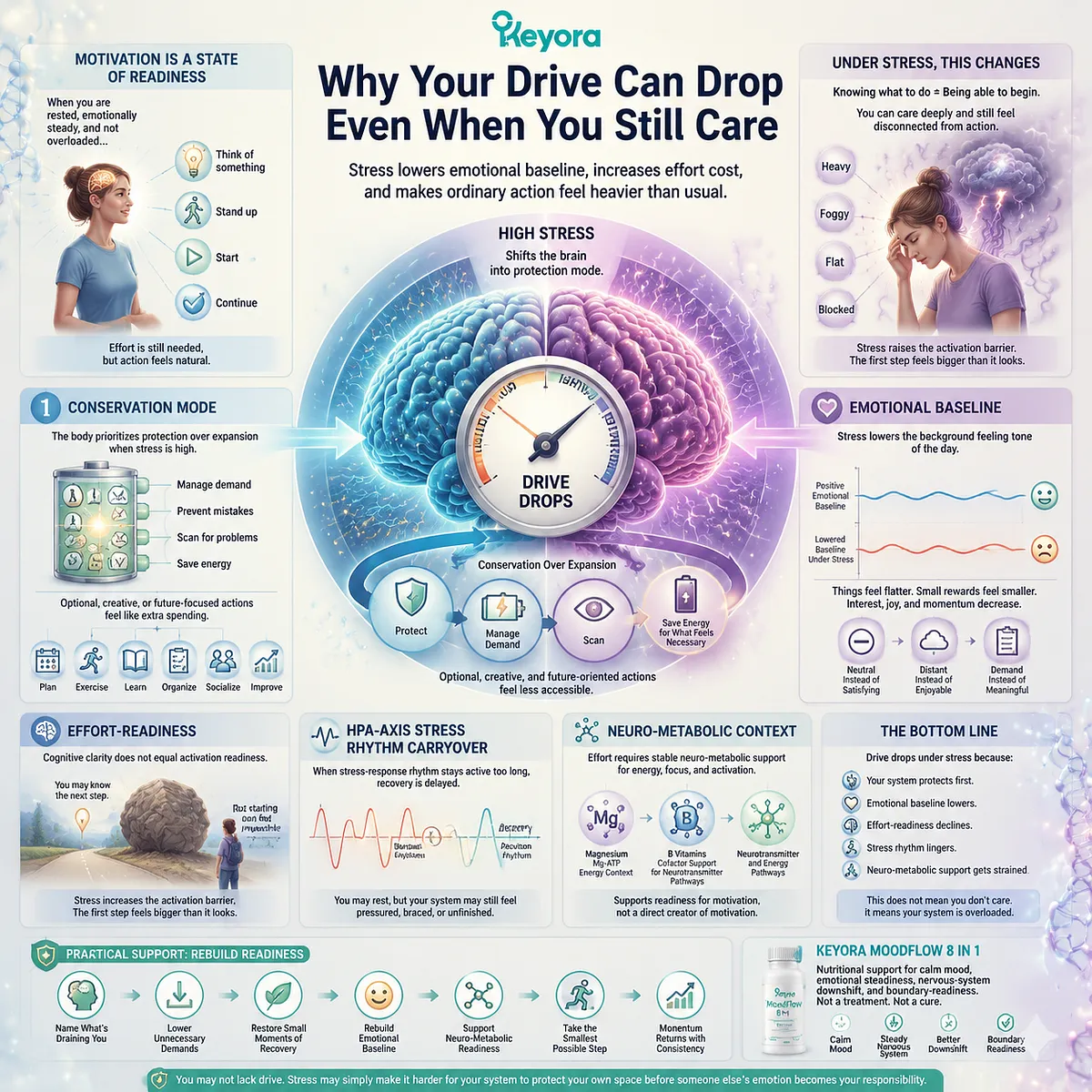
Stress can lower emotional baseline, increase effort cost, and make ordinary action feel heavier than usual.
Motivation is not only a personality trait. It is partly a state of readiness.
When you are well-rested, emotionally steady, and not overloaded, action can feel natural. You think of something, stand up, start, and continue. Effort is still required, but it does not feel like you have to drag yourself across the floor to begin.
Under stress, this changes.
The first mechanism is conservation mode.
When stress is high, the body often prioritizes protection over expansion. It becomes more focused on managing demand, preventing mistakes, scanning for problems, and saving energy for what feels necessary.
This can make optional, creative, or future-oriented actions feel less accessible.
You may not feel excited to plan, exercise, learn, organize, socialize, or improve things—not because those things do not matter, but because your system is treating them as extra spending.
The second mechanism is emotional baseline.
Stress can lower the background feeling tone of the day. Things do not necessarily feel terrible, but they may feel flatter. The small reward that usually comes from starting something may not arrive as easily.
A task that normally feels mildly satisfying may feel neutral. A hobby that usually feels enjoyable may feel distant. A goal that once felt meaningful may now feel like another demand.
This does not automatically mean something is wrong with your character.
It may mean your emotional baseline is carrying too much stress load to generate the same sense of interest, reward, or momentum.
The third mechanism is effort-readiness.
Knowing what to do is cognitive clarity. Being able to begin is activation readiness.
These are not identical.
You can know the next step and still feel unable to start it smoothly. You can understand the importance of a task and still feel as if your body refuses to move. You can care deeply and still feel strangely disconnected from action.
Stress can increase the activation barrier. It can make the first step feel bigger than it looks.
The fourth mechanism is HPA-axis stress rhythm carryover.
When your stress-response rhythm has been active for too long, your body may not quickly return to a state of flexible recovery. Even after a break, the internal rhythm may still feel pressured, braced, or unfinished.
This is one reason rest time does not always restore drive.
You may have stopped working, but your system may not have fully shifted into recovery. You may have sat down, but your body may still be holding the emotional cost of the day.
The fifth mechanism is neuro-metabolic context.
Effort requires energy, but not only in the simple “calories in, calories out” sense. Cognitive effort, emotional regulation, and task initiation depend on stable neuro-metabolic support. Magnesium-related Mg-ATP context, B-vitamin cofactor support, and normal neurotransmitter-related pathways all belong to this broader background of readiness.
This does not mean one nutrient “creates motivation.”
It means motivation is not only a mindset. It is connected to stress rhythm, energy use, emotional tone, nervous-system state, and recovery capacity.
When all of those are strained, drive can feel far away.
What Helps When Stress Lowers Your Drive
The goal is not to shame yourself into action, but to reduce the activation barrier enough to restart gently.
When motivation feels low, the instinct is often to push harder.
You may try to pressure yourself with harsher language.
“Stop being lazy.”
“Just do it.”
“You are wasting time.”
“Everyone else is moving forward.”
Sometimes this creates a short burst of action. But under stress, shame often increases the very load that is blocking you.
If stress has already made effort feel expensive, adding self-criticism can make the first step feel even more threatening.
A more useful question is not, “How do I force myself to feel motivated?”
A better question is, “How can I make starting feel less costly?”
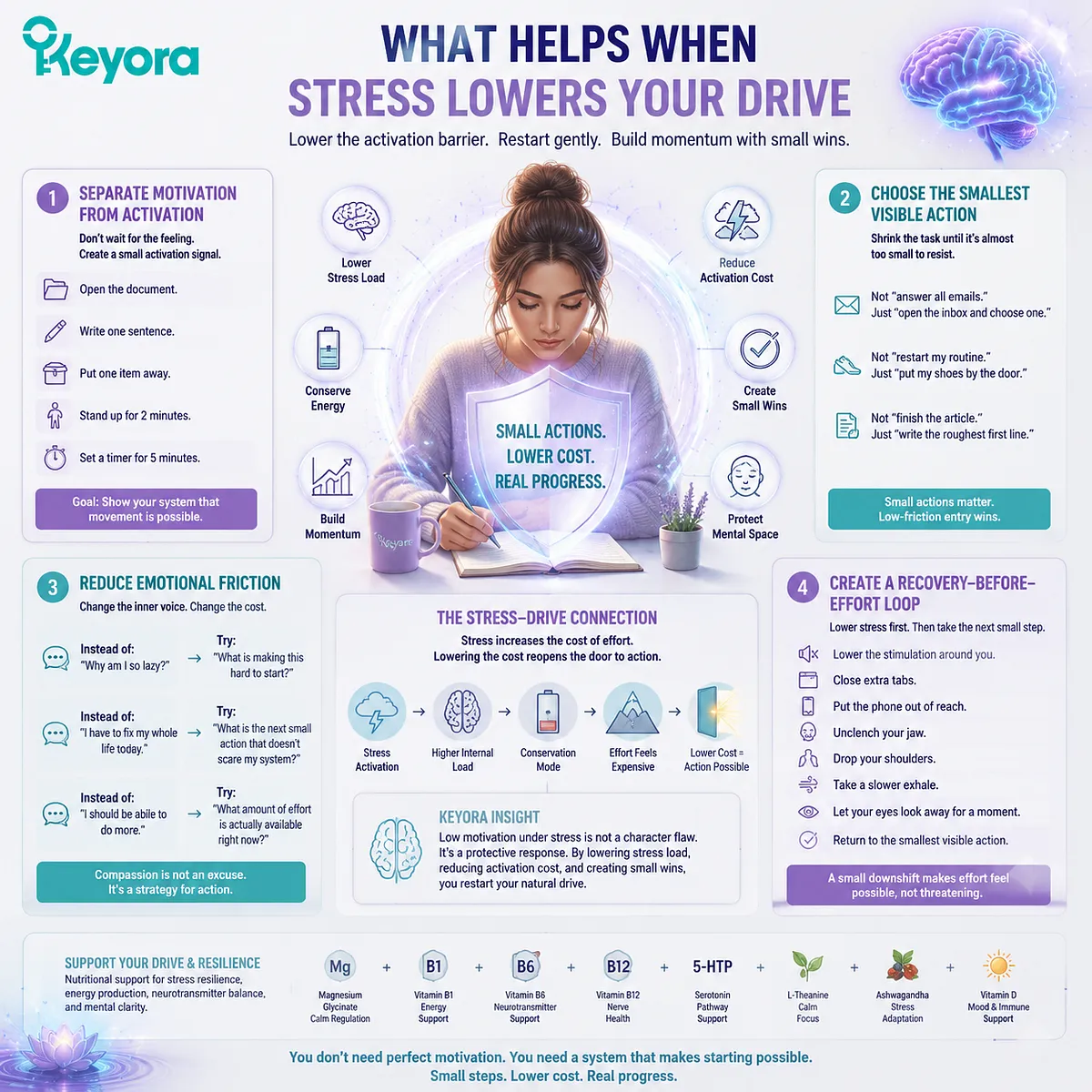
The first step is to separate motivation from activation.
Motivation is the feeling of wanting to do something. Activation is the ability to begin. Under stress, you may not feel motivated before you act. Waiting for the feeling to return can keep you stuck.
Instead, aim for a small activation signal.
Open the document.
Write one unfinished sentence.
Put one item in the right place.
Stand up for two minutes.
Set a timer for five minutes.
The goal is not to complete the whole task. The goal is to show your system that movement is possible without requiring a full emotional commitment.
The second step is to choose the smallest visible action.
A vague instruction like “be productive” is too heavy. “Clean the room” may be too large. “Work on the project” may feel endless.
Try shrinking the action until it is almost too small to resist.
Not “answer all emails.”
Just “open the inbox and choose one.”
Not “restart my routine.”
Just “put my shoes by the door.”
Not “finish the article.”
Just “write the roughest first line.”
Small actions matter because low motivation often responds better to low-friction entry than to emotional pressure.
The third step is to reduce emotional friction.
Listen to the way you speak to yourself before action.
Does your inner voice sound like a coach, or like someone standing over you with disappointment?
A stressed nervous system often does not respond well to contempt. It may shut down further.
Try replacing “Why am I so lazy?” with “What is making this hard to start?”
Try replacing “I have to fix my whole life today” with “What is the next small action that does not scare my system?”
Try replacing “I should be able to do more” with “What amount of effort is actually available right now?”
This is not making excuses. It is making action more possible.
The fourth step is to create a recovery-before-effort loop.
Sometimes you do not need a long rest. You need a short transition that tells your body the pressure level has changed.
Lower the stimulation around you.
Close extra tabs.
Put the phone out of direct reach.
Unclench your jaw.
Drop your shoulders.
Take a slower exhale.
Let your eyes look away from the screen for a moment.
Then return to the smallest visible action.
This sequence matters because stress-related low drive often lives in the space between pressure and activation. If your body is still braced, action may feel like another threat. A small downshift can make effort feel less expensive.
You are not trying to become a perfectly motivated person.
You are helping your system re-enter action without turning every task into a moral trial.
Where Nutritional Support Fits
Keyora MoodFlow 8 in 1 can fit as one small nutritional support layer when low motivation appears as part of a broader stress-sleep-mood-cognition pattern. It should not be understood as something that creates motivation, treats depression, cures burnout, guarantees productivity, or replaces mental health care.
Its role is narrower: supporting wellness pathways involved in calm mood, emotional steadiness, nervous-system downshift, effort-readiness background, and recovery readiness.
L-Theanine may be relevant when low drive is mixed with mental pressure, internal noise, or difficulty entering a calm-but-alert state. Its role in the MoodFlow framework is calm signaling and relaxed alertness, not sedation or forced motivation.
Magnesium glycinate may be relevant when stress makes the body feel tense, braced, or energetically strained. In this context, it supports neural braking, GABA/NMDA activation balance, body-side relaxation readiness, and Mg-ATP energy background.
B1, B6, and B12 support the neuro-metabolic cofactor context behind energy metabolism and normal neurotransmitter-related pathways. In practical terms, this belongs to the background infrastructure of effort-readiness, not an instant motivation switch.
5-HTP may be relevant only when emotional baseline and serotonin-related pathway continuity are central to the picture. In MoodFlow writing, this should be framed as support for normal serotonin-related pathways and sleep-mood continuity, not as depression treatment or mood correction.
Ashwagandha may also fit when stress rhythm carryover is prominent. Its role is stress-rhythm adaptation and recovery readiness under cumulative stress load, not cortisol correction or burnout treatment.
This is the correct place for nutritional support: after the reader has understood the experience, the stress mechanism, and the practical recovery path.
Food, sleep, movement, workload boundaries, emotional support, and professional care when needed all remain important. MoodFlow is not the whole answer. It is one optional support layer within a larger recovery-aware approach.

Closing Summary
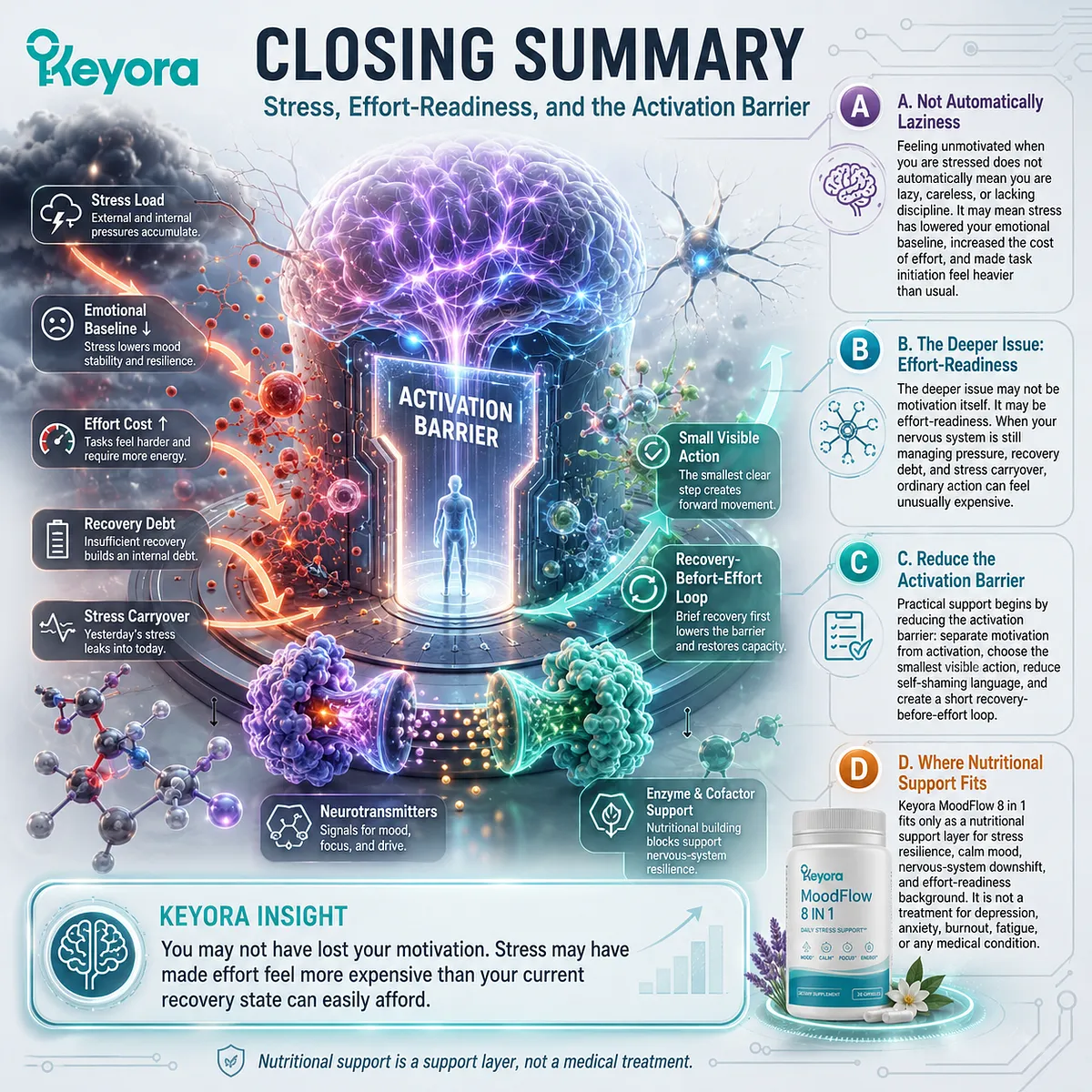
Feeling unmotivated when you are stressed does not automatically mean you are lazy, careless, or lacking discipline. It may mean stress has lowered your emotional baseline, increased the cost of effort, and made task initiation feel heavier than usual.
The deeper issue may not be motivation itself. It may be effort-readiness. When your nervous system is still managing pressure, recovery debt, and stress carryover, ordinary action can feel unusually expensive.
Practical support begins by reducing the activation barrier: separate motivation from activation, choose the smallest visible action, reduce self-shaming language, and create a short recovery-before-effort loop.
Keyora MoodFlow 8 in 1 fits only as a nutritional support layer for stress resilience, calm mood, nervous-system downshift, and effort-readiness background. It is not a treatment for depression, anxiety, burnout, fatigue, or any medical condition.
You may not have lost your motivation.
Stress may have made effort feel more expensive than your current recovery state can easily afford.
This article is for educational and informational purposes only. It does not provide medical advice, diagnosis, treatment, cure, prevention, disease outcome claims, hormone restoration claims, fertility outcome claims, or formula-specific clinical efficacy claims.