
Why Does Background Social Noise Feel Harder to Tolerate When I’m Stressed?
Keyora Research Q&A Library
This is part of the Keyora Research Q&A Series, derived from Keyora Nutritional Neurology Series .
Within the Keyora Nutritional Neurology framework, this Q&A translates complex nutrient–brain mechanisms into reader-friendly, evidence-bound answers, focusing on stress resilience, sleep quality, calm mood support, cognitive wellness, and the broader interaction between nutrition, neurochemistry, and daily nervous-system function.
First published by Keyora Research Journal: www.keyorahealth.com

Direct Answer
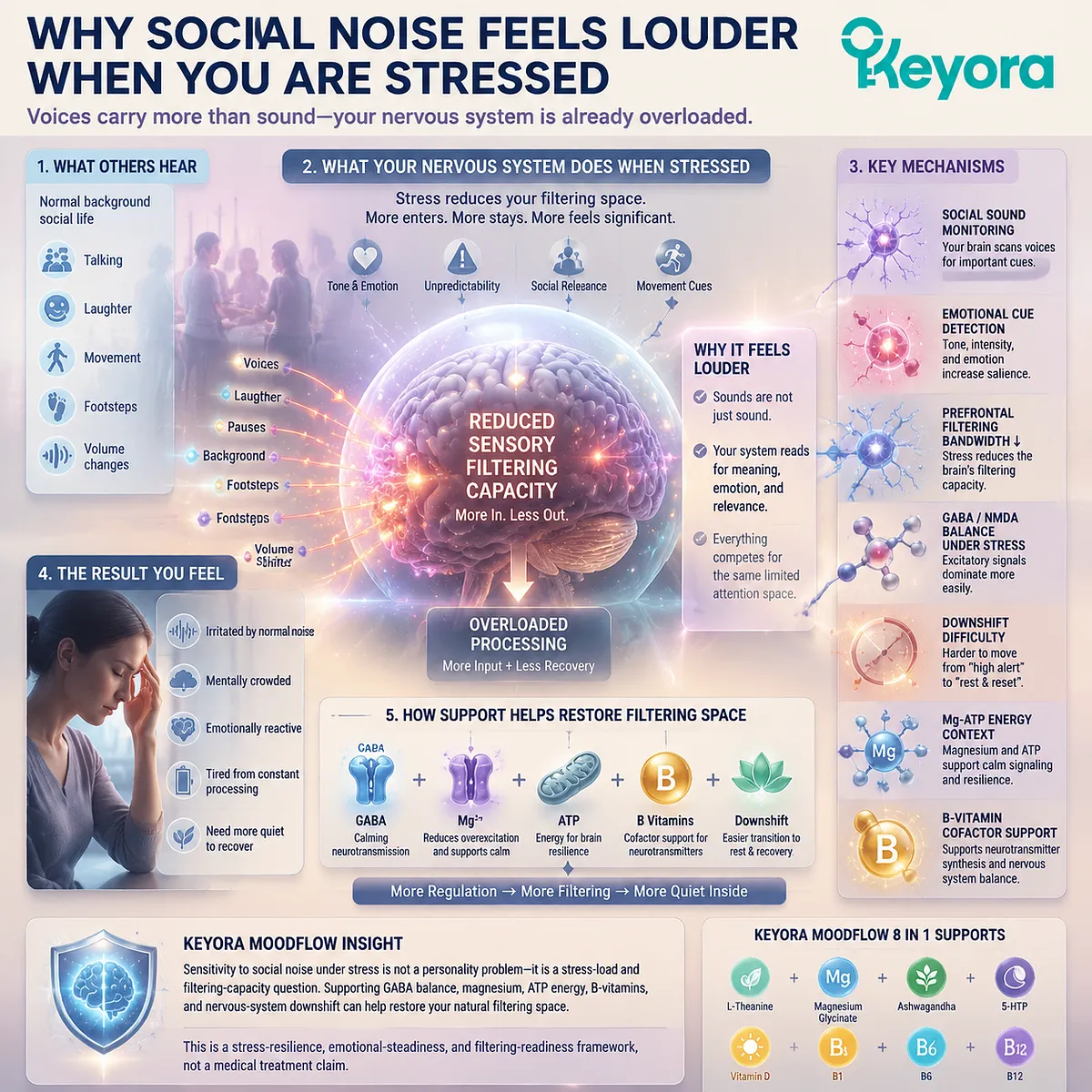
Background social noise can feel harder to tolerate when you are stressed because voices are not only sound.
They carry tone, emotion, movement, unpredictability, and possible social relevance.
Even when no one is speaking directly to you, your nervous system may still be filtering the voices, laughter, pauses, footsteps, and changes in volume around you.
The mismatch is this: from the outside, other people may simply be talking, laughing, moving, or living normally.
But inside a stressed system, those sounds may no longer stay in the background. They may feel like they are entering your attention, taking up space, and adding more input before your nervous system has had time to recover.
This does not mean you are too picky or that you dislike people. It may mean your filtering space is already low.
Mechanistically, this can involve reduced sensory filtering capacity, social sound monitoring, unpredictable noise vigilance, emotional cue detection, reduced prefrontal filtering bandwidth, GABA/NMDA activation balance, nervous-system downshift difficulty, Mg-ATP energy context, and B-vitamin cofactor support.
In the Keyora MoodFlow framework, this is understood as a stress-resilience, emotional-steadiness, and filtering-readiness question, not a medical treatment claim.
When Other People’s Voices Feel Like Too Much Input
Background voices can feel overwhelming when your nervous system no longer has enough space to keep them in the background.
You may be trying to finish something.
Or maybe you are not even trying to work. Maybe you are just trying to sit, breathe, eat, rest, or have a few minutes where no one needs anything from you.
Then you hear voices.
Someone is talking in the next room. Someone laughs suddenly. Someone is on the phone. People are chatting in the office. Family members are moving through the kitchen while the television is still on. A café is full of overlapping conversations. Someone’s voice rises, then drops, then rises again.
No one is directly talking to you.
No one is asking you to answer.
No one may be doing anything wrong.
But your body tightens anyway.
You may feel irritation rise before you understand why. You may feel the sound entering your head. You may lose your place in what you were doing. You may feel unable to relax because the voices keep changing. You may want silence so badly that you start to feel guilty for needing it.
Then the self-judgment begins.
“Why is this bothering me so much?”
“Why can’t I just tune it out?”
“Why am I irritated when nobody is doing anything wrong?”
“Why do I need quiet this badly?”
This is where many people misunderstand their own reaction. They assume the problem is that they are difficult, overly sensitive, controlling, or intolerant of others. They may feel ashamed because the people around them are only talking, laughing, or moving normally.
But background social noise is not always processed as neutral sound.
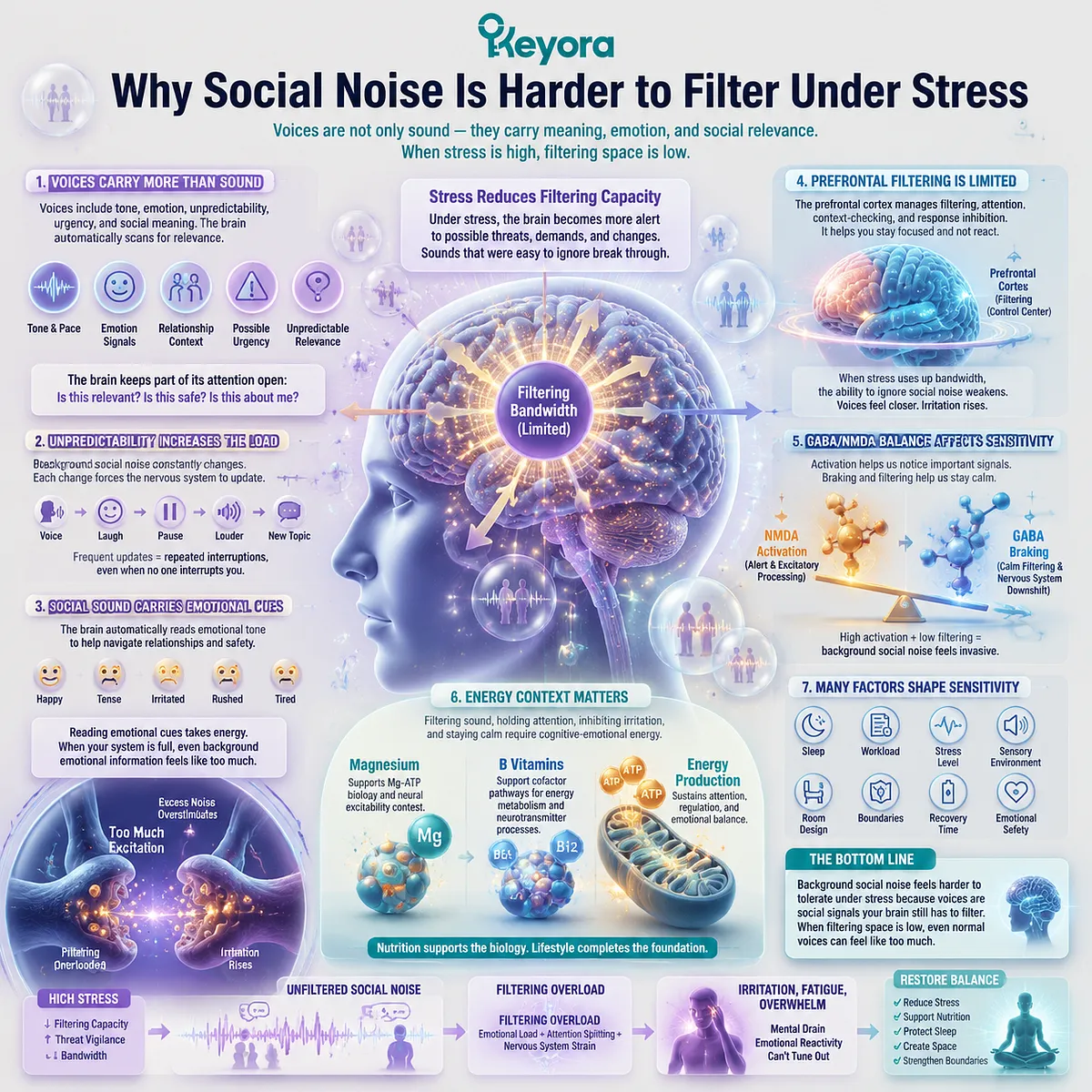
Human voices are biologically meaningful. The brain is built to notice them. A voice can signal connection, conflict, emotion, urgency, disagreement, laughter, frustration, or the possibility that someone may need you. Even when you are not part of the conversation, your nervous system may still listen for social relevance.
Is someone upset?
Is that about me?
Did someone call my name?
Is there tension in that tone?
Is someone coming toward me?
Do I need to respond?
Do I need to prepare?
Most of these questions may happen below conscious awareness. You may not be actively thinking them. But the nervous system may still be sorting the sound.
When stress is low, this sorting can happen quietly. Voices remain in the background. Laughter passes through. A conversation nearby does not feel like a demand. Your brain can say, “That is not relevant,” and return to what you were doing.
When stress is high, that filtering can weaken.
The same voice becomes harder to ignore. The same laughter feels sharper. The same movement feels more intrusive. The same overlapping conversation feels like too much signal.
This is not always about volume.
Sometimes the noise is not loud. It is unpredictable. Someone laughs suddenly. A chair moves. A voice gets brighter. Someone walks closer. A phone rings. A conversation stops and starts. Several voices overlap in a way your brain cannot easily organize.
That unpredictability keeps the nervous system alert.
You may not be angry at people. You may be exhausted from filtering them.
The deeper question is not only, “Why does this noise annoy me?”
A more accurate question is, “What kind of input is my nervous system trying to filter right now?”
Background voices.
Tone changes.
Unpredictable laughter.
Multiple people talking.
Movement in shared space.
Possible social relevance.
Emotional cues inside sound.
When you name the input, the shame softens. You can see that your reaction may not be about being difficult. It may be about having too little filtering space left for social-sensory information.
The voices may be in the background.
But your nervous system may not have enough capacity to keep them there.
Why Social Noise Is Harder to Filter Under Stress
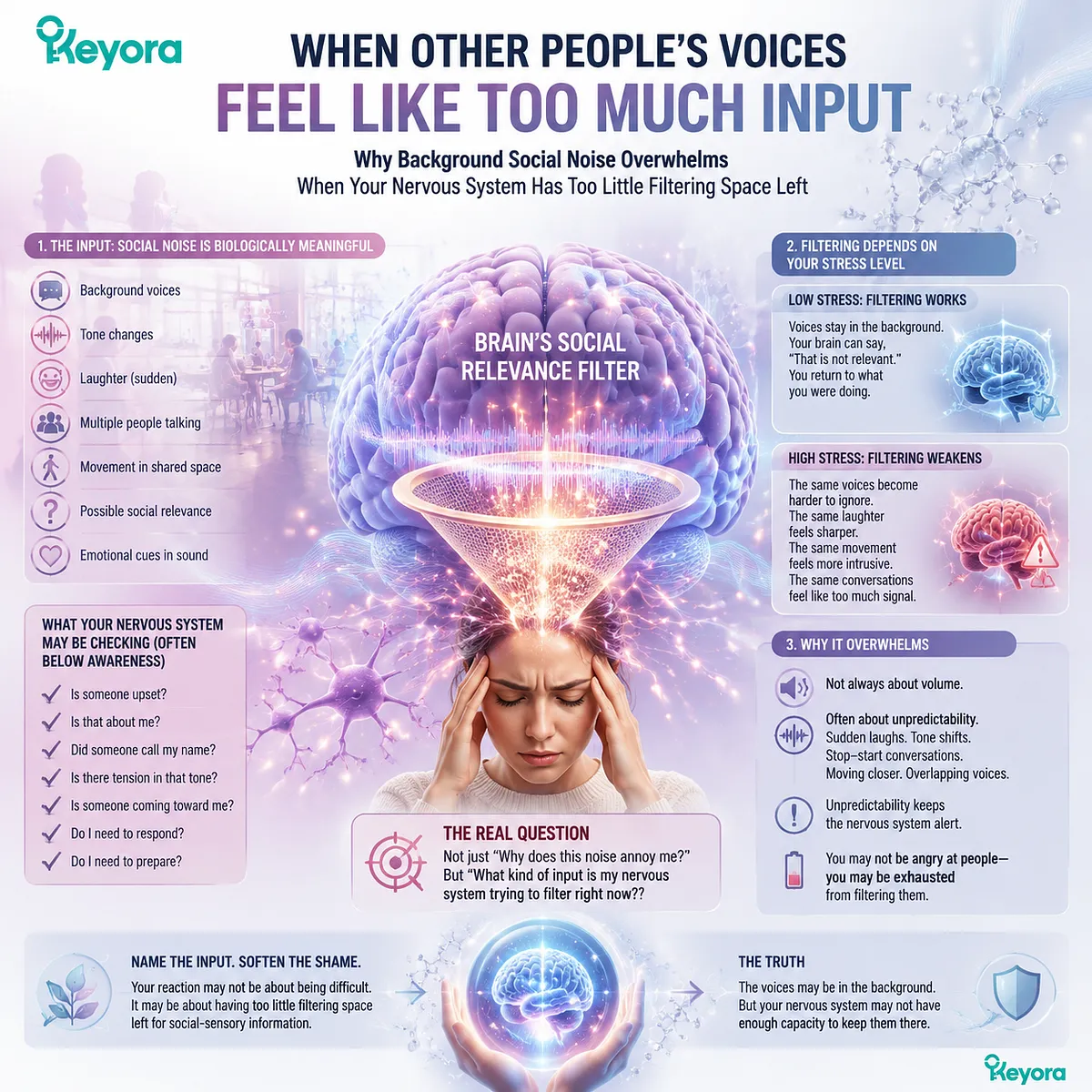
Voices are harder to ignore than ordinary noise because they carry tone, emotion, unpredictability, and possible social relevance.
Background social noise is difficult because it contains more than sound waves.
A fan, a refrigerator, or distant traffic may be annoying, but these sounds usually do not carry social meaning. Human voices are different. They contain tone, pace, emotion, relationship signals, possible urgency, and changing patterns.
The brain tends to prioritize voices because voices can matter.
A voice may call your name. A tone may signal conflict. A laugh may signal belonging or exclusion. A sudden silence may signal tension. A raised voice may signal urgency. A nearby conversation may become relevant at any moment.
So even when you are not participating, your brain may keep part of its attention open.
That is why background social noise can feel more invasive than mechanical noise. It asks the nervous system to decide again and again: Is this relevant? Is this safe? Is this emotional? Is this about me? Can I ignore it?
Stress makes this harder because stress reduces sensory filtering capacity.
Filtering is the ability to keep irrelevant input in the background. It is not passive. The brain has to actively decide that something does not need attention. Under stress, the system may become more alert to possible threats, demands, and changes in the environment.
This means sounds that were once easy to ignore can become harder to dismiss.
A conversation nearby may keep pulling your attention. A laugh may feel like a sudden spike. A voice through the wall may feel too close. Footsteps may feel like someone is about to interrupt. A phone conversation may become impossible to tune out.
Unpredictability increases the load.
Background social noise rarely stays smooth. It changes constantly. Voices overlap. Someone pauses. Someone laughs. Someone gets louder. Someone lowers their voice. A new person enters. A door opens. A chair moves. A topic shifts.
Each change can ask the nervous system to update.
When you are already stressed, those updates can feel like repeated interruptions, even if nobody is interrupting you directly.
Social sound also carries emotional cues.
A voice can sound happy, tense, irritated, rushed, warm, sarcastic, tired, excited, or disappointed. The brain may automatically read these cues because emotional sound helps humans navigate relationships and safety.
But reading emotional cues takes energy.
If your nervous system is already full, even background emotional information can feel like too much. You may not want to know whether someone is annoyed. You may not want to track whether a room feels tense. You may not want to hear five people’s emotional tones while trying to complete one task.
You may simply need less signal.
The prefrontal cortex helps with filtering, attention control, context-checking, and response inhibition. It helps you say, “That conversation is not about me,” or “I do not need to react,” or “I can stay focused.” It helps keep background noise in the background.
But prefrontal filtering bandwidth is limited.
When stress has already used much of that bandwidth, the ability to ignore social noise becomes weaker. The sound may keep breaking through. The body may become more irritated, not because the people are wrong, but because filtering has become too expensive.
GABA/NMDA balance can help explain why the sound feels more stimulating. The nervous system needs activation to notice important signals, but it also needs braking and filtering so that every voice, laugh, or movement does not feel urgent. NMDA-related activity can be understood as part of alert and excitatory processing. GABA-related tone helps support calm filtering and nervous-system downshift.
When activation is high and filtering feels limited, background social noise can feel like it is touching the body directly.
Energy context also matters. Filtering sound, holding attention, inhibiting irritation, and staying calm in a socially noisy space require cognitive-emotional energy. Magnesium participates in Mg-ATP biology and neural excitability context. B vitamins support cofactor pathways involved in energy metabolism and neurotransmitter-related processes.
This does not mean sensitivity to background social noise is only nutritional. Sleep, workload, stress level, sensory environment, room design, boundaries, recovery time, and emotional safety all matter.
But it does mean the experience is real.
Background social noise feels harder to tolerate under stress because voices are not only sound; they are social signals your brain still has to filter.
When filtering space is low, even normal voices can feel like too much.
What Helps When Background Social Noise Feels Too Much
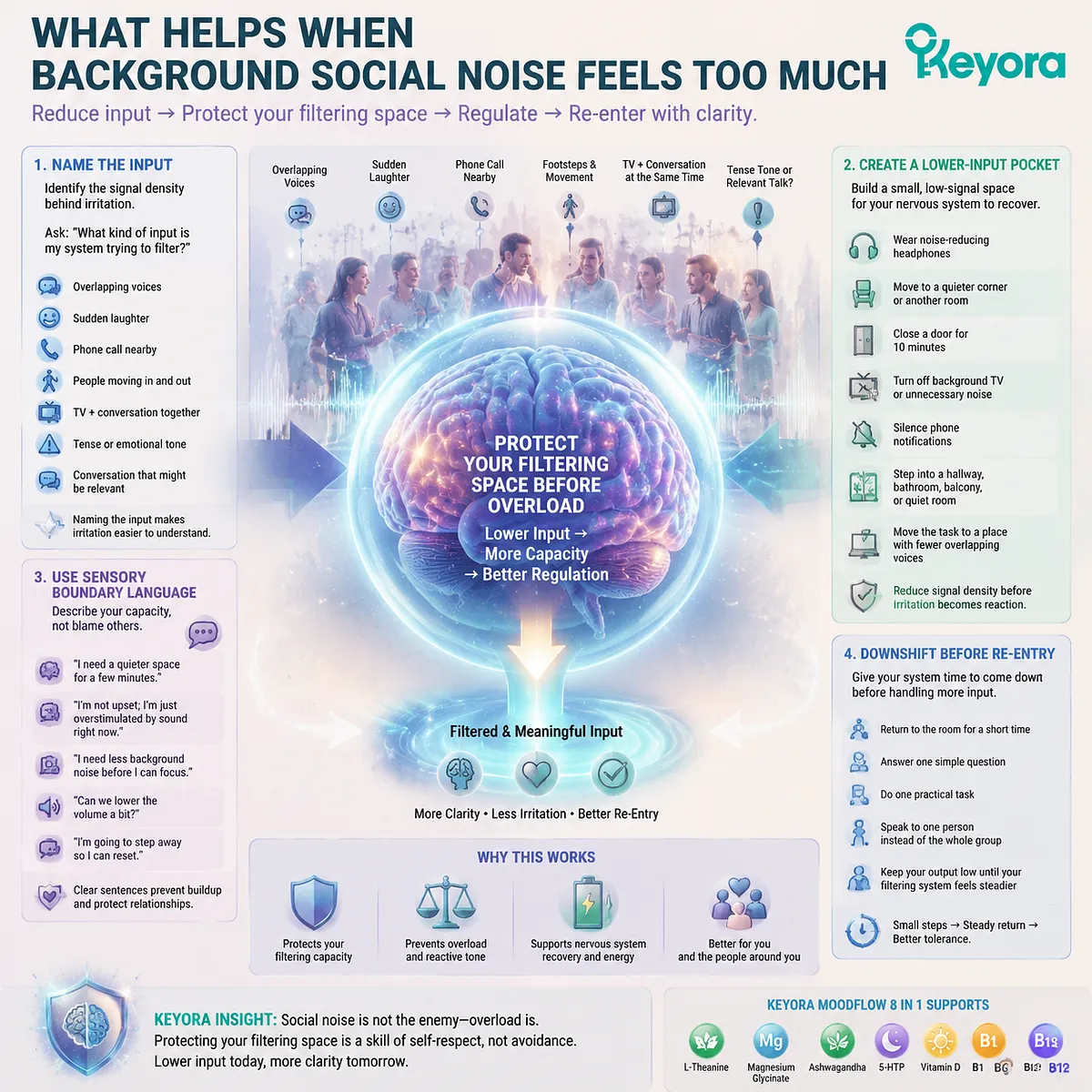
The goal is not to blame the noise, but to reduce input before your filtering system overloads.
When background social noise feels overwhelming, the first helpful step is not to decide that everyone around you is wrong.
It is also not to decide that you are impossible to live with.
Start by naming the input.
Instead of asking, “Why am I so annoyed?” ask, “What kind of input is my system trying to filter?”
Is it overlapping voices?
Sudden laughter?
A phone call nearby?
People walking in and out?
A television plus conversation at the same time?
A tone that sounds tense?
A conversation that might become relevant to you?
The answer matters because irritation often becomes easier to understand when you identify the signal density underneath it.
The second step is to create a lower-input pocket.
A lower-input pocket is a small space where the nervous system receives fewer signals for a short period. It does not have to be dramatic. It does not require everyone else to become silent forever. It simply gives your filtering system a chance to recover.
You might put on noise-reducing headphones.
You might move to a corner.
You might close a door for ten minutes.
You might turn off background television.
You might silence phone notifications.
You might step into a hallway, bathroom, balcony, or quiet room for a short reset.
You might move the task to a place where fewer voices overlap.
The point is not to escape life. The point is to reduce signal density before irritation becomes reaction.
This matters because many people wait too long. They try to tolerate the noise until their tone hardens, their body tightens, or they snap internally. By then, the nervous system has already moved from filtering into overload.
Earlier reduction is often kinder.
It is kinder to you, and it is kinder to the people around you.
The third step is to use sensory boundary language.
Many people avoid asking for quieter conditions because they do not want to sound controlling. Then they say nothing until the irritation leaks out. A small, clear sentence can prevent that.
Useful sentences include:
“I need a quieter space for a few minutes.”
“I’m not upset; I’m just overstimulated by sound right now.”
“I need less background noise before I can focus.”
“Can we lower the volume a bit?”
“I’m going to step away so I can reset.”
These sentences are helpful because they describe your capacity instead of blaming the people around you.
There is a difference between “You are too loud” and “I need less input right now.”
The first can feel like accusation.
The second explains regulation need.
The fourth step is to downshift before re-entry.
If background social noise has already overloaded your system, do not move directly from overload into a demanding conversation. Give the nervous system a chance to come down first.
Re-entry can be small.
Return to the room for a short time.
Answer one simple question.
Do one practical task.
Speak to one person instead of the whole group.
Keep your output low until your filtering system feels steadier.
You do not need to prove that you can tolerate unlimited background noise. The goal is not endless tolerance. The goal is to notice when filtering space is low and protect it before your body has to protest louder.
Where Nutritional Support Fits
Keyora MoodFlow 8 in 1 can fit as one small support layer when sensitivity to background social noise is part of a broader stress-sleep-mood-cognition pattern. It should not be understood as something that makes noisy environments disappear, forces tolerance, or replaces sensory boundaries.
Its role is narrower: supporting nutritional pathways involved in calm mood, emotional steadiness, nervous-system downshift, and filtering readiness when background social noise feels heavy.
For this topic, the most relevant layers are L-Theanine for calm filtering when social sound feels too sharp, magnesium glycinate for neural braking and body-side relaxation readiness after sound-related tension, Ashwagandha for stress-response adaptation when noise sensitivity is amplified by all-day stress carryover, and B1, B6, and B12 for neuro-metabolic support behind attention control, filtering, and response inhibition.
MoodFlow is not a treatment for anxiety, depression, insomnia, ADHD, burnout, chronic fatigue, neurological disease, sensory processing disorders, migraine, tinnitus, emotional dysregulation, cortisol problems, adrenal fatigue, thyroid disease, anemia, nutrient deficiency, hormonal disorders, or any medical condition.
In this article, Keyora uses “background social noise feels harder to tolerate when stressed” as a wellness-language entry point for explaining social-sensory filtering, input density, nervous-system downshift, and recovery readiness.
The deeper goal is not to force yourself to tolerate every sound.
It is to reduce input early enough that your nervous system does not have to turn normal background noise into a full-body stress signal.

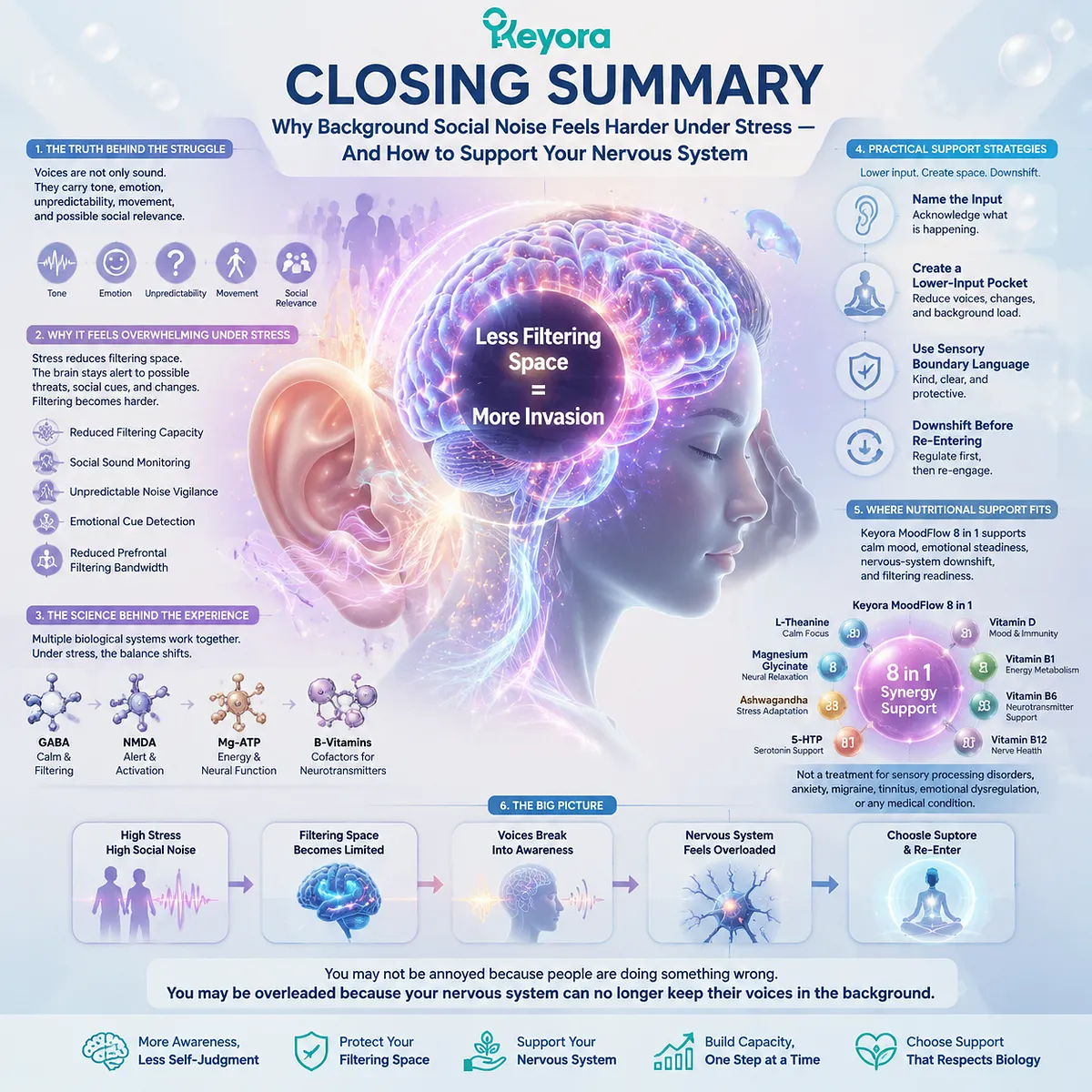
Closing Summary
Background social noise can feel harder to tolerate when you are stressed because voices are not only sound. They carry tone, emotion, unpredictability, movement, and possible social relevance.
This does not mean you are too picky, difficult, or that you dislike people. It may mean your nervous system has less space to filter voices, laughter, footsteps, conversation shifts, and emotional cues into the background.
Mechanistically, this can involve reduced sensory filtering capacity, social sound monitoring, unpredictable noise vigilance, emotional cue detection, reduced prefrontal filtering bandwidth, GABA/NMDA activation balance, nervous-system downshift difficulty, Mg-ATP energy context, and B-vitamin cofactor support.
Practical support begins by naming the input, creating a lower-input pocket, using sensory boundary language, and downshifting before re-entering social sound.
Keyora MoodFlow 8 in 1 fits only as a nutritional support layer for calm mood, emotional steadiness, nervous-system downshift, and filtering readiness. It is not a treatment for sensory processing disorders, anxiety, migraine, tinnitus, emotional dysregulation, or any medical condition.
You may not be annoyed because people are doing something wrong.
You may be overloaded because your nervous system can no longer keep their voices in the background.
This article is for educational and informational purposes only. It does not provide medical advice, diagnosis, treatment, cure, prevention, disease outcome claims, hormone restoration claims, fertility outcome claims, or formula-specific clinical efficacy claims.