
Why Do I Have Less Patience for Conversations Under Stress?
Keyora Research Q&A Library
This is part of the Keyora Research Q&A Series, derived from Keyora Nutritional Neurology Series .
Within the Keyora Nutritional Neurology framework, this Q&A translates complex nutrient–brain mechanisms into reader-friendly, evidence-bound answers, focusing on stress resilience, sleep quality, calm mood support, cognitive wellness, and the broader interaction between nutrition, neurochemistry, and daily nervous-system function.
First published by Keyora Research Journal: www.keyorahealth.com

Direct Answer
You may have less patience for conversations under stress because patience is not only a personality trait. It is a regulation capacity.
To stay patient, your nervous system has to listen, wait, filter emotion, inhibit first reactions, manage tone, and keep enough space between internal pressure and external response.
The mismatch is this: from the outside, a conversation may look normal. Someone is explaining, repeating, asking, or taking time to get to the point. But inside a stressed system, every extra sentence can feel like more input, more waiting, more emotional control, and more pressure not to sound impatient.
This does not mean you do not care about the person. It may mean your listening space is nearly gone.
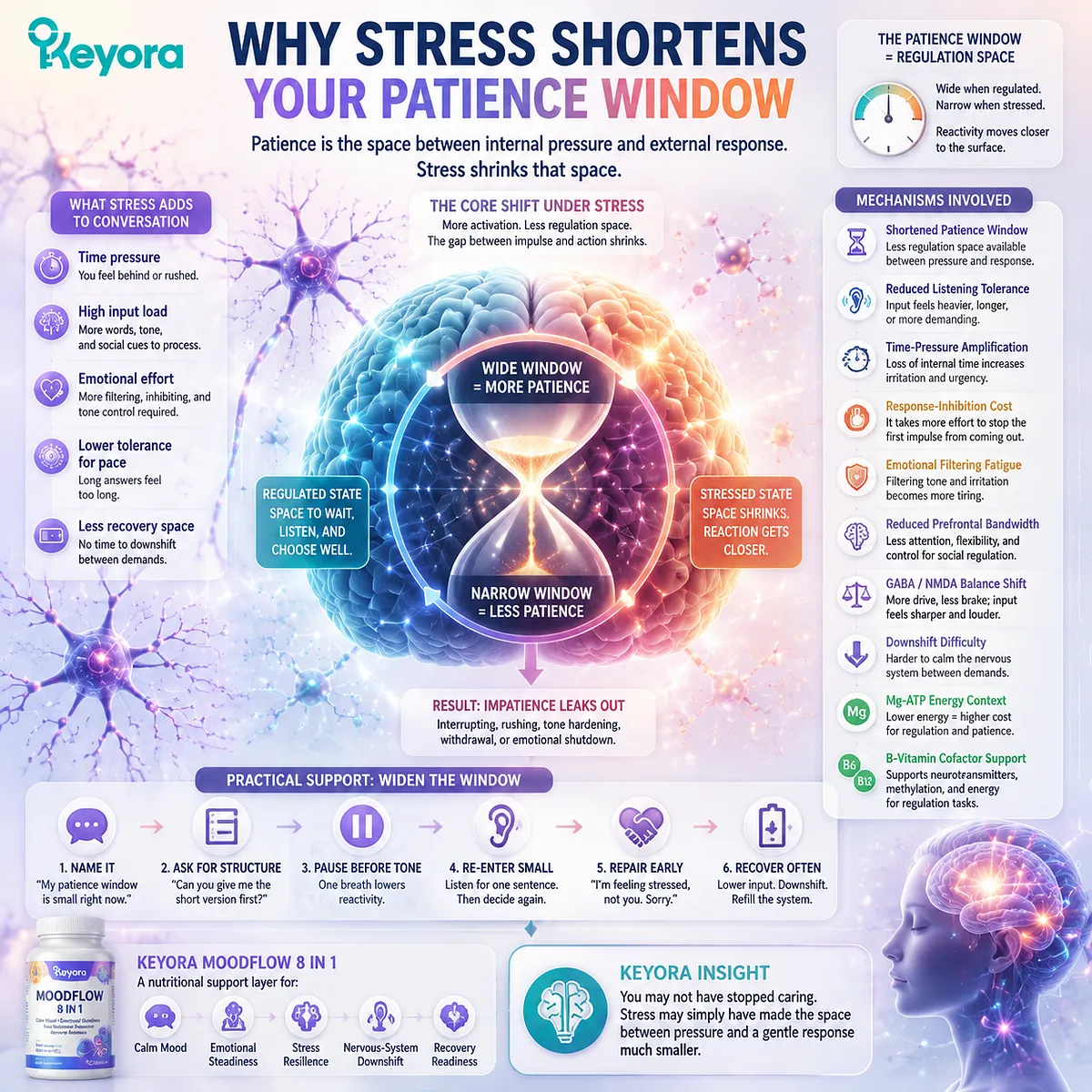
Mechanistically, this can involve a shortened patience window, reduced listening tolerance, time-pressure amplification, response-inhibition cost, emotional filtering fatigue, reduced prefrontal regulation bandwidth, GABA/NMDA activation balance, nervous-system downshift difficulty, Mg-ATP energy context, and B-vitamin cofactor support.
In the Keyora MoodFlow framework, this is understood as a stress-resilience, emotional-steadiness, and conversation-pacing-readiness question, not a medical treatment claim.
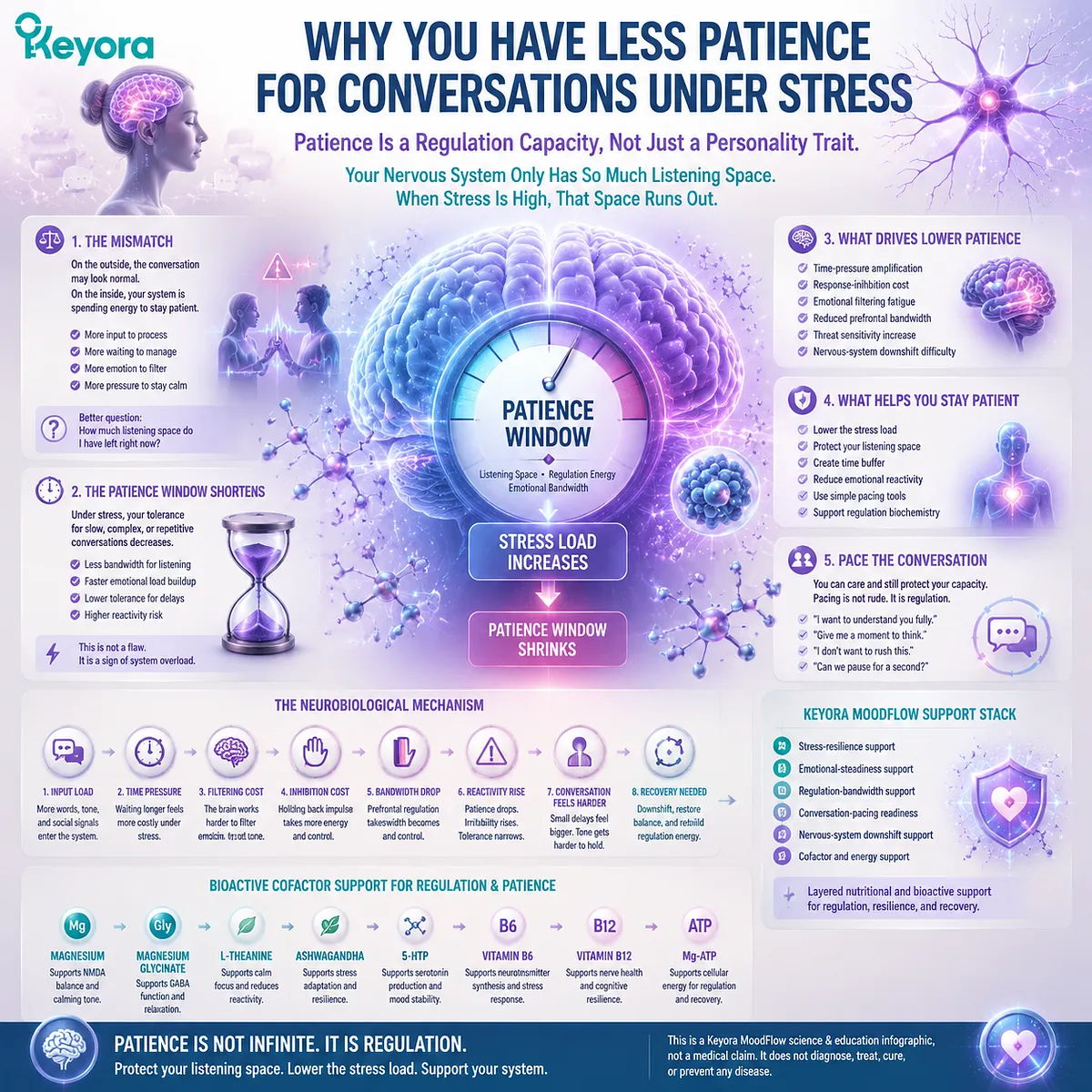
When You Care, but You Cannot Listen Much Longer
Less patience does not always mean less care; it may mean your listening space is nearly gone.
-
You may care about the person speaking.
-
You may know they are not trying to irritate you.
-
You may know they deserve to be heard.
-
You may even want to respond kindly.
But as they keep talking, something inside you begins to tighten.
-
They are explaining the background, but your mind wants the main point.
-
They repeat something you already understood, and your body reacts before you can stop it.
-
They tell a story slowly, and you feel yourself getting restless.
-
They ask one more question, and you feel a sharp internal “please, not now.”
On the outside, you may still look like you are listening.
Inside, your patience window is closing.
You may hear yourself thinking:
“Can you get to the point?”
“Why are we still talking about this?”
“I already understood.”
“I do not have space for this right now.”
“Please do not make this longer.”
Then shame may arrive almost immediately.
You may think, “Why am I so impatient?” or “Why am I like this with someone who did nothing wrong?” or “Why can’t I just listen?” You may worry that you are becoming cold, selfish, rude, or emotionally unavailable.
But less patience under stress is not always a sign of less love, less care, or less character.
Sometimes it is a sign of less available regulation space.
A conversation takes more work than people realize. You have to follow the meaning, tolerate the pace, wait through pauses, manage your own thoughts, hold back interruption, soften your face, keep your tone steady, and remember that the other person is not the same as the pressure you are carrying.
When you have enough capacity, this can feel natural.
When stress is high, every one of those steps becomes more expensive.
-
A long explanation may feel like too much input.
-
A repeated question may feel like a demand.
-
A slow story may feel like loss of control.
-
A person who needs emotional processing may feel like they are asking for energy you do not have left.
This is where misunderstanding happens.
The other person may think you are annoyed with them. You may think you are annoyed with them. But sometimes the deeper issue is not the person. It is the length, pace, timing, or amount of regulation the conversation requires.
You may not need the other person to disappear.
You may need the conversation to become smaller, clearer, or better paced.
That distinction matters.
Because if you believe the problem is “I am a bad person,” you may try to force yourself to keep listening until your tone finally breaks. But if you understand the problem as “my patience window is short right now,” you can intervene earlier.
The deeper question is not only, “Why do I have less patience?”
A more useful question is, “How much listening space do I actually have left?”
That question gives you a way to protect both yourself and the relationship.
You may still care.
You may simply need the conversation to slow down before your stress starts speaking for you.
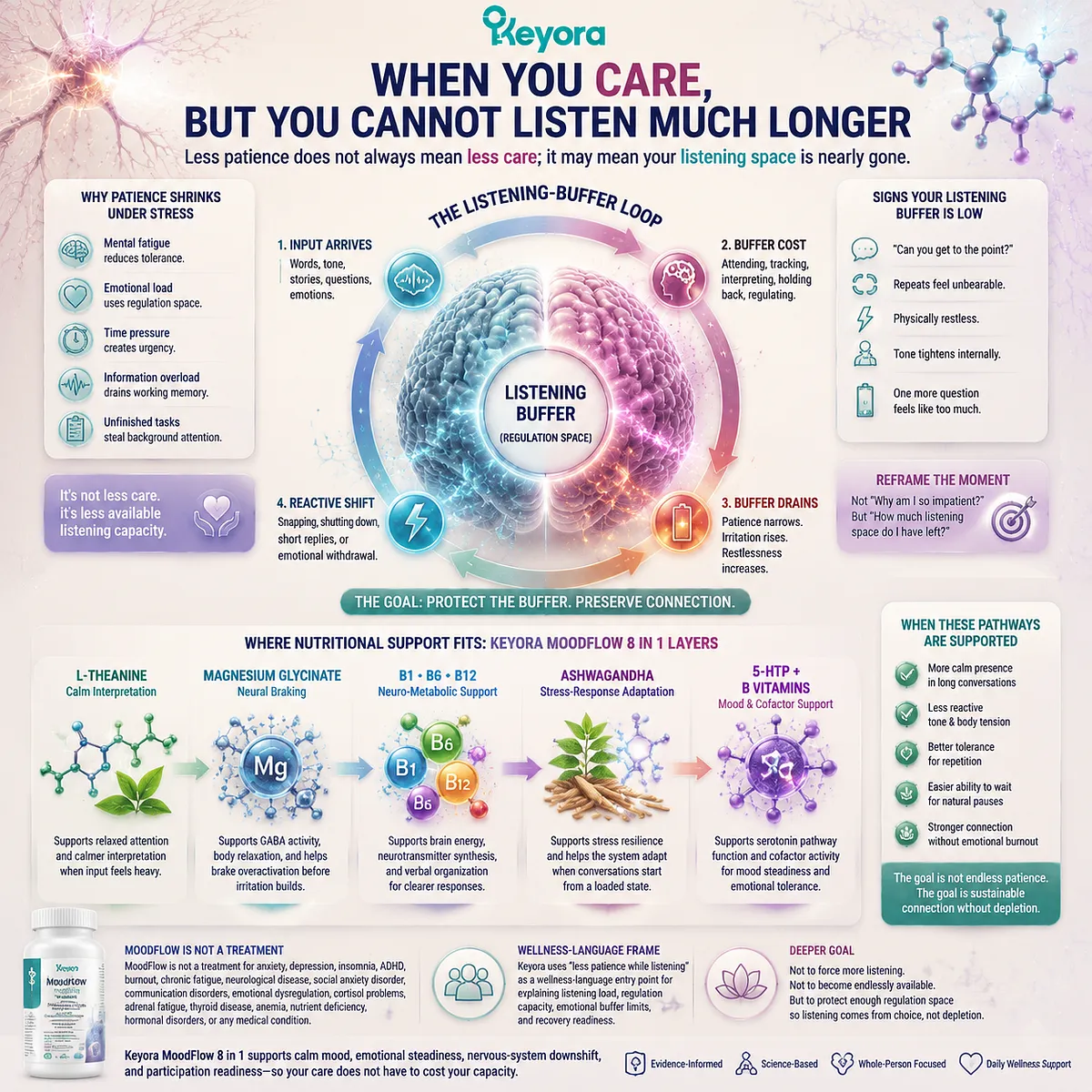
Why Stress Shortens the Patience Window
Patience is the space between internal pressure and external response, and stress can shrink that space.
Patience feels like a social virtue, but it is also a nervous-system function.
-
To be patient, you need enough space to wait before responding.
-
You need enough attention to keep listening.
-
You need enough inhibition to avoid cutting someone off.
-
You need enough emotional filtering to keep internal pressure from becoming external sharpness.
Under stress, that space becomes smaller.
This is why a conversation that would normally feel fine can suddenly feel hard to tolerate. The person may not be saying anything wrong. They may not be speaking for that long. But your system may already be carrying time pressure, fatigue, noise, unfinished tasks, emotional strain, or the effort of staying composed.
Then the conversation adds more input.
Each extra sentence asks for more listening. Each repeated point asks for more restraint. Each slow explanation asks you to remain present while part of you wants the moment to end.
Conversation length becomes harder to tolerate under stress because the brain is already trying to protect limited capacity.
-
When someone takes a long time to get to the point, the stressed brain may hear: “This is using time I do not have.”
-
When someone repeats themselves, the body may hear: “I have to process this again.”
-
When someone asks for emotional attention, the system may hear: “More is being required of me.”
This does not mean the other person is wrong.
It means stress changes the felt cost of input.
Time pressure makes impatience stronger. If you already feel behind, overloaded, or responsible for too many things, a conversation can start to feel like it is taking control of your remaining space. You may not only be listening to the person. You may also be thinking about what is not getting done while they speak.
That loss of internal time can create irritation.
Not because the person is bad.
Because your system feels trapped between the need to respond kindly and the need to regain control.
Response inhibition is another major mechanism.
When patience is available, you can notice your first reaction without acting on it.
You can feel, “I want this to end,” and still say, “I understand.” You can want to interrupt and still wait.
You can feel irritation and still choose a softer response.
But response inhibition requires energy.
Under stress, the first reaction gets closer to the surface. The urge to interrupt, shorten, correct, rush, or withdraw becomes harder to hold back. You may still know what a kind response would sound like, but the path to that response becomes narrower.
This is where prefrontal regulation bandwidth matters.
The prefrontal system helps with attention, inhibition, social judgment, perspective-taking, tone control, and flexible response. It helps you remember, “This person is not attacking me.
They are just explaining.” It helps you ask, “What do they need from me?” instead of reacting only to your own overload.
But prefrontal bandwidth is limited.
When stress has already used much of it, the patience window shortens. You may still be listening, but with less emotional padding. You may still care, but with less tolerance for slow, repetitive, or open-ended conversation.
GABA/NMDA balance can help explain why conversation input feels sharper. The nervous system needs activation to listen and respond, but it also needs braking and filtering so that each sentence does not feel like another demand. NMDA-related activity can be understood as part of alert and excitatory processing. GABA-related tone helps support calm filtering and nervous-system downshift.
When activation is high and filtering feels limited, conversation can become overstimulating even when the content is ordinary.
Energy context also matters. Listening, waiting, inhibiting first reactions, choosing tone, and staying relationally present require cognitive-emotional energy.
Magnesium participates in Mg-ATP biology and neural excitability context.
B vitamins support cofactor pathways involved in energy metabolism and neurotransmitter-related processes.
This does not mean impatience is only nutritional. Sleep, workload, hunger, communication style, relationship safety, sensory input, time pressure, and recovery space all matter.
But it does mean the experience is real.
You may have less patience for conversations under stress because patience is the space between internal pressure and external response.
When stress shrinks that space, even ordinary conversation can feel too long.
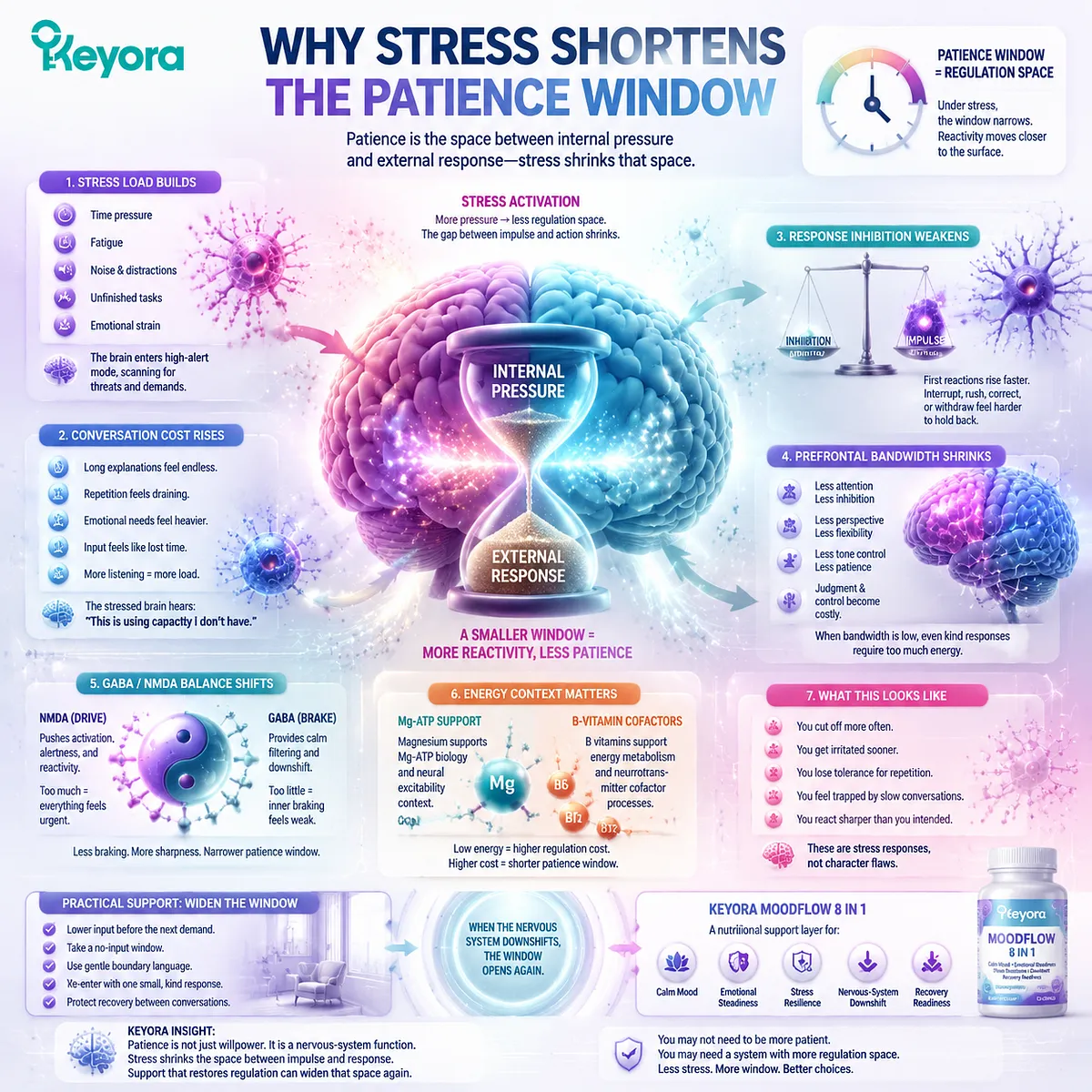
What Helps When Your Patience for Conversation Gets Short
The goal is not to force endless tolerance, but to slow the conversation before impatience becomes your tone.
When your patience for conversation gets short, the most helpful step is not to shame yourself into listening longer.
That often backfires.
You may force yourself to keep listening, but your body keeps tightening. You may try to look patient, but your tone becomes flatter. You may keep saying “mm-hmm,” but inside you are getting closer to a sharp response.
Instead of forcing tolerance, name the patience window.
You can say to yourself:
“I care, but I have limited listening space right now.”
“This conversation is longer than my system can process well.”
“I need to pace this before my tone changes.”
This changes the problem from a moral failure into a capacity signal.
The next step is to ask for structure, not silence.
Many people wait until they are overwhelmed and then respond in a way that sounds dismissive: “Can you just get to the point?” or “I don’t have time for this.” The need underneath may be real, but the delivery can hurt the relationship.
A softer approach is to request structure before impatience becomes tone.
Useful sentences include:
“Can you give me the main point first?”
“Can we do this one part at a time?”
“I want to follow, but I need the short version first.”
“Can we pause and come back to the details?”
“Tell me what you need from me first.”
These sentences do not tell the other person to stop mattering. They help the conversation become more manageable.
That is the difference between rejection and pacing.
Rejection says, “I do not want to hear you.”
Pacing says, “I want to stay with this, but I need it in a form my nervous system can process.”
The third step is to use a pause before your tone hardens.
Tone often changes before people realize they are near their limit. The voice becomes shorter. The face becomes still. The replies become flat. The body leans away. The mind starts wishing the conversation would end.
That is the moment to pause, not after the hurtful sentence has already been said.
Useful pause sentences include:
“I’m getting overloaded, and I don’t want to respond sharply.”
“I need a short pause so I can keep listening well.”
“I want to be fair to you, but I need a minute.”
“I’m not dismissing you. I just need to slow down.”
These sentences are protective because they tell the truth without blaming the other person.
They also protect your values. If you care about being kind, a pause can help your care reach your words before irritation does.
The fourth step is to re-enter with a smaller listening task.
Do not move from a shortened patience window into a long, unstructured conversation. That is too much for a stressed system.
Make the conversation smaller.
-
One question.
-
One decision.
-
One short explanation.
-
One practical answer.
-
One topic at a time.
For example:
“Let’s handle the main decision first.”
“Can we talk about one part now and the rest later?”
“I can listen for five minutes, but I may need a break after that.”
“Tell me the part you most need help with.”
This is not coldness. It is conversation pacing.
It allows you to stay connected without pretending you have unlimited capacity.
The fifth step is to repair early if impatience leaks out.
Even with good awareness, stress sometimes comes through. You may sound sharper than intended. You may interrupt. You may respond too quickly.
A small repair can prevent the moment from becoming a bigger wound.
You can say:
“That came out sharper than I meant.”
“I’m overloaded, not angry at you.”
“I do want to listen. I just need this slower.”
“I’m sorry for the tone. I need a minute and then I can come back.”
Repair is not weakness.
It is relational regulation after your nervous system reaches its limit.
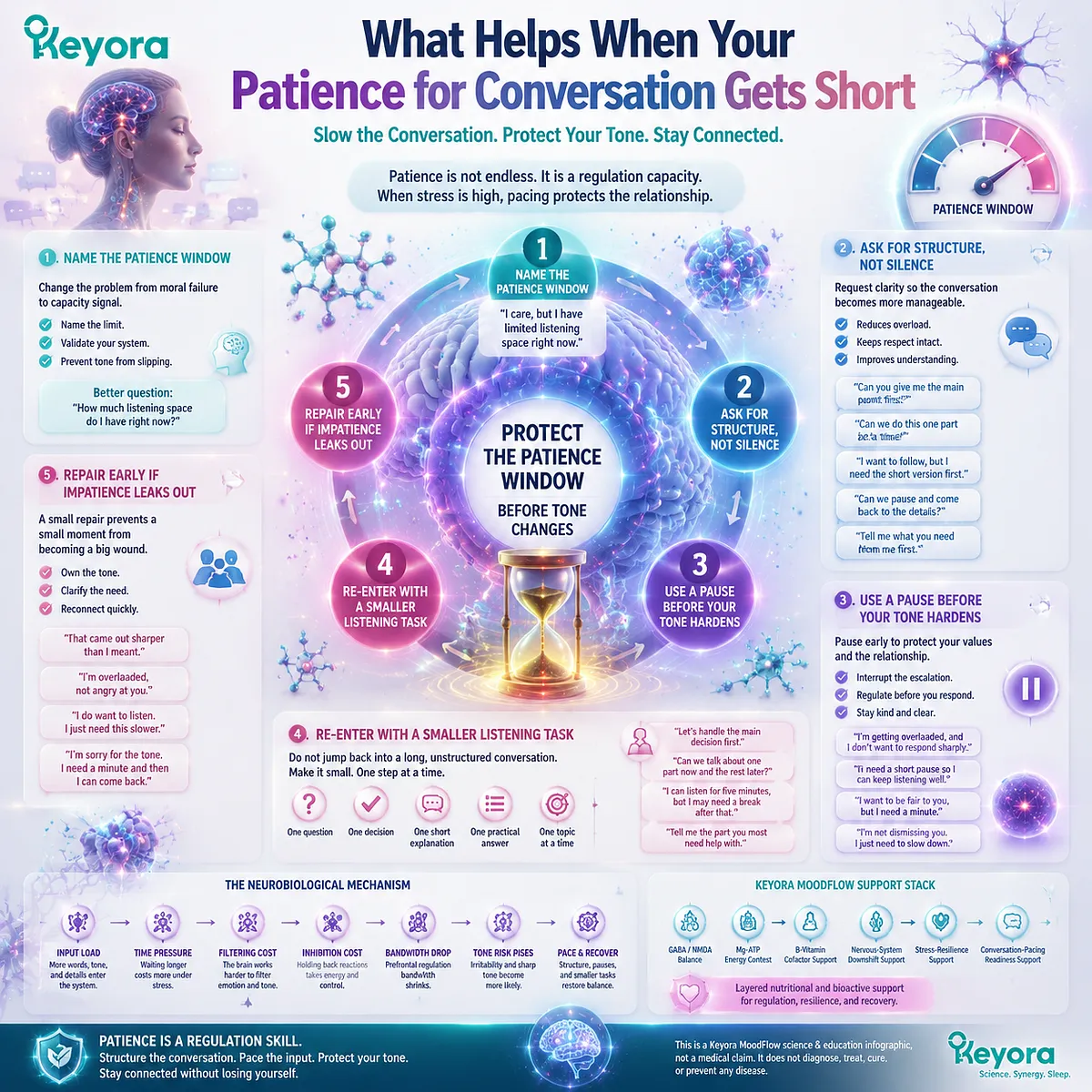
Where Nutritional Support Fits
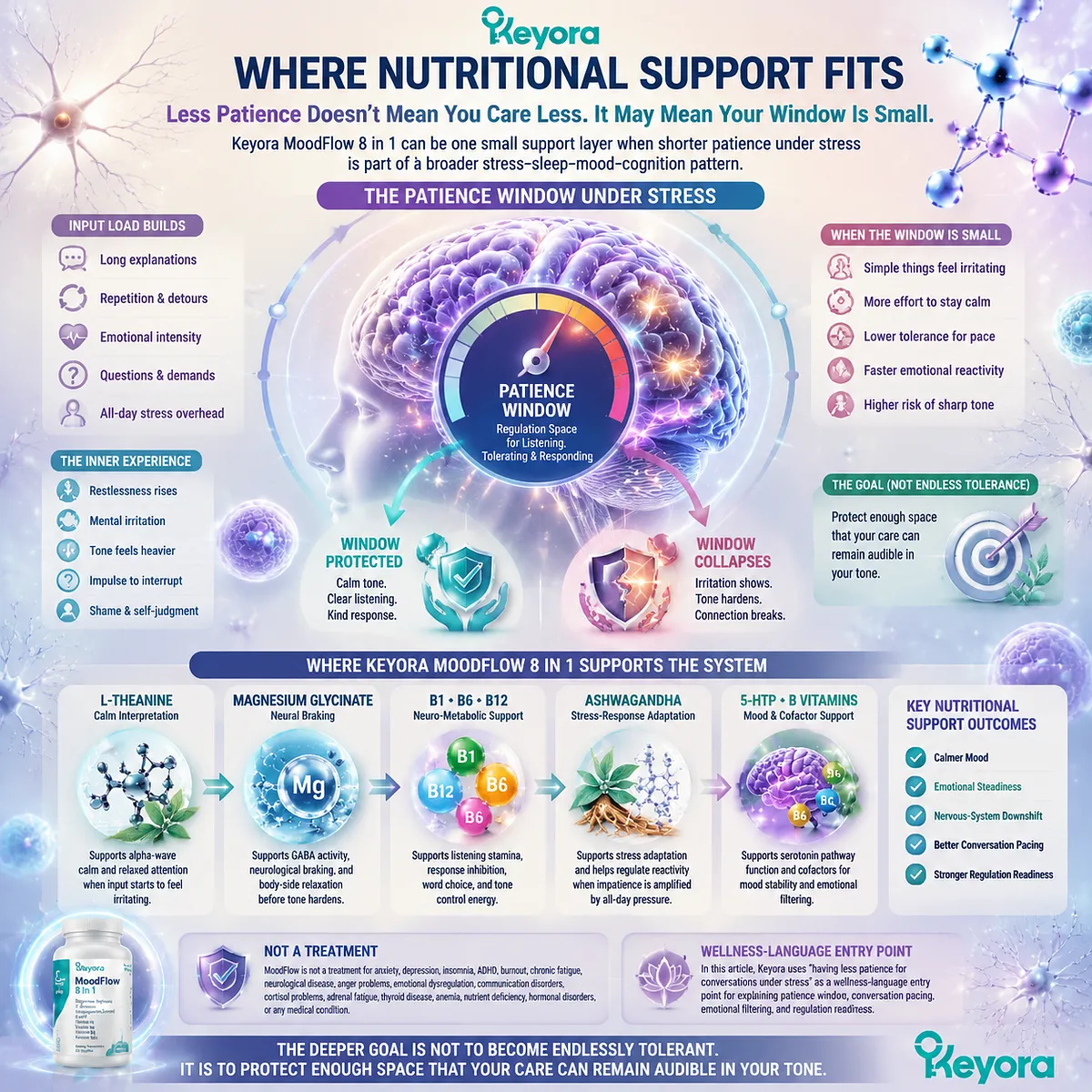
Keyora MoodFlow 8 in 1 can fit as one small support layer when shorter patience under stress is part of a broader stress-sleep-mood-cognition pattern. It should not be understood as something that creates unlimited patience, makes someone tolerate every conversation, or replaces communication boundaries.
Its role is narrower: supporting nutritional pathways involved in calm mood, emotional steadiness, nervous-system downshift, and conversation pacing readiness when stress has shortened the patience window.
For this topic, the most relevant layers are L-Theanine for calm interpretation when conversation input starts to feel irritating, magnesium glycinate for neural braking and body-side relaxation readiness when tone is about to harden, Ashwagandha for stress-response adaptation when impatience is amplified by all-day pressure, and B1, B6, and B12 for neuro-metabolic support behind listening, inhibition, word choice, and tone control.
MoodFlow is not a treatment for anxiety, depression, insomnia, ADHD, burnout, chronic fatigue, neurological disease, anger problems, emotional dysregulation, communication disorders, cortisol problems, adrenal fatigue, thyroid disease, anemia, nutrient deficiency, hormonal disorders, or any medical condition.
In this article, Keyora uses “having less patience for conversations under stress” as a wellness-language entry point for explaining patience window, conversation pacing, emotional filtering, and regulation readiness.
The deeper goal is not to become endlessly tolerant.
It is to protect enough space that your care can remain audible in your tone.
Closing Summary
Having less patience for conversations under stress does not mean you are uncaring, rude, or suddenly becoming a worse person. It may mean your patience window has shortened because stress has used up the regulation space needed to keep listening gently.
Conversation requires more than hearing words. It requires waiting, filtering, inhibiting first reactions, managing tone, tolerating pace, and staying relationally present. Under stress, those tasks become more expensive.
Mechanistically, this can involve a shortened patience window, reduced listening tolerance, time-pressure amplification, response-inhibition cost, emotional filtering fatigue, reduced prefrontal regulation bandwidth, GABA/NMDA activation balance, nervous-system downshift difficulty, Mg-ATP energy context, and B-vitamin cofactor support.
Practical support begins by naming your patience window, asking for structure, pausing before your tone hardens, re-entering with a smaller listening task, and repairing early if impatience leaks out.
Keyora MoodFlow 8 in 1 fits only as a nutritional support layer for calm mood, emotional steadiness, nervous-system downshift, and conversation pacing readiness. It is not a treatment for anger problems, emotional dysregulation, anxiety, depression, or any medical condition.
You may not have stopped caring.
Stress may simply have made the space between pressure and a gentle response much smaller.
This article is for educational and informational purposes only. It does not provide medical advice, diagnosis, treatment, cure, prevention, disease outcome claims, hormone restoration claims, fertility outcome claims, or formula-specific clinical efficacy claims.