
Why Does Social Pressure Make My Mood Shift So Quickly?
Keyora Research Q&A Library
This is part of the Keyora Research Q&A Series, derived from Keyora Nutritional Neurology Series .
Within the Keyora Nutritional Neurology framework, this Q&A translates complex nutrient–brain mechanisms into reader-friendly, evidence-bound answers, focusing on stress resilience, sleep quality, calm mood support, cognitive wellness, and the broader interaction between nutrition, neurochemistry, and daily nervous-system function.
First published by Keyora Research Journal: www.keyorahealth.com
Direct Answer
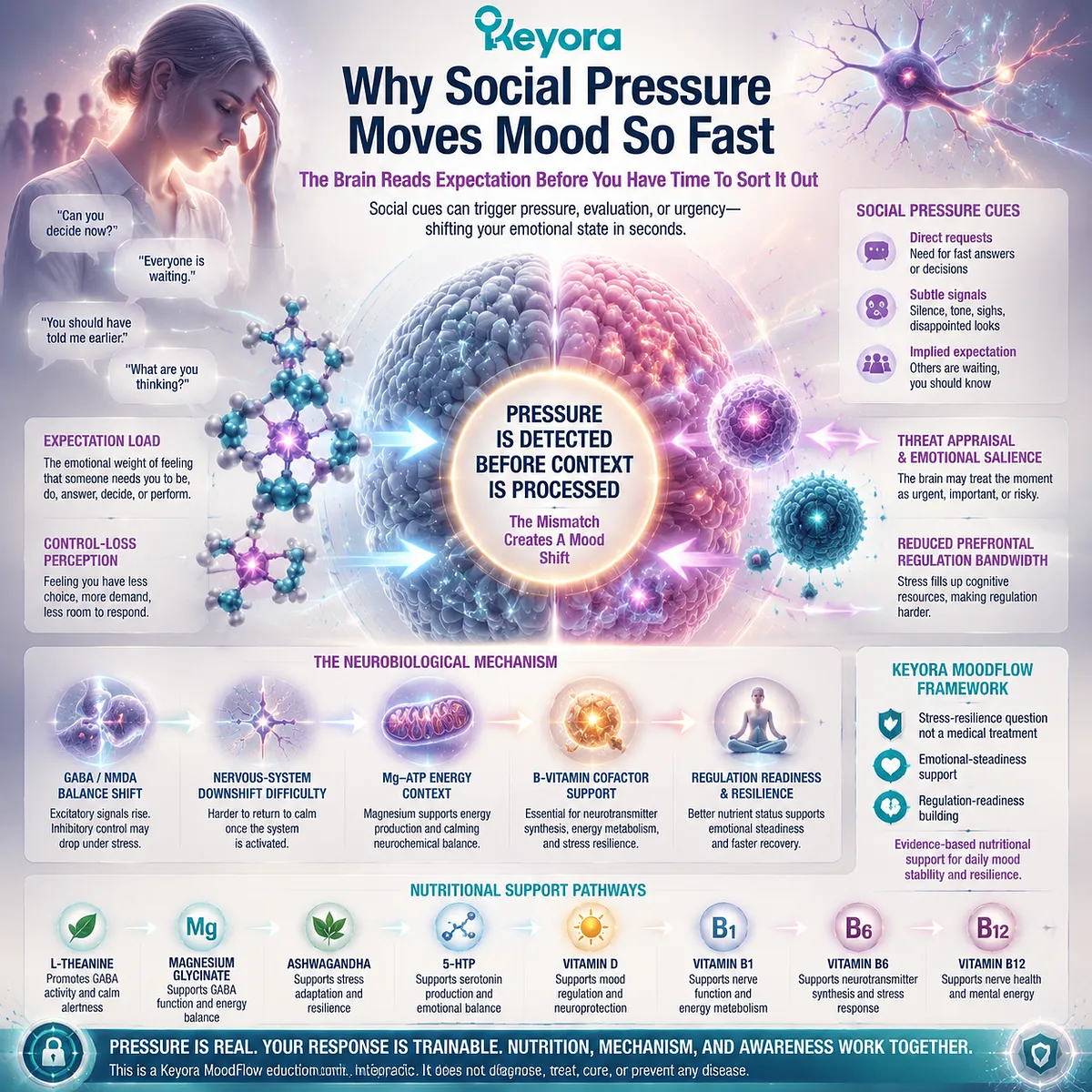
Social pressure can make your mood shift quickly because your nervous system may read other people’s expectations as immediate emotional demand.
A request, a waiting silence, a disappointed tone, or a need for a fast answer can make your body feel that you must respond, perform, explain, decide, or protect yourself right away.
The mismatch is this: from the outside, the situation may look small. Someone asks what you want to do.
Someone waits for your answer.
Someone says, “Everyone is waiting.”
But inside a stressed system, that moment may feel like pressure, evaluation, loss of control, or the sudden responsibility to manage someone else’s reaction.
This does not mean your mood changed for no reason. It may mean your body detected a pressure cue before your mind had time to sort out what was actually being asked.
Mechanistically, this can involve social pressure cues, expectation load, control-loss perception, threat appraisal, emotional salience, reduced prefrontal regulation bandwidth, GABA/NMDA activation balance, nervous-system downshift difficulty, Mg-ATP energy context, and B-vitamin cofactor support.
In the Keyora MoodFlow framework, this is understood as a stress-resilience, emotional-steadiness, and regulation-readiness question, not a medical treatment claim.
When Someone’s Expectation Changes Your Mood in Seconds
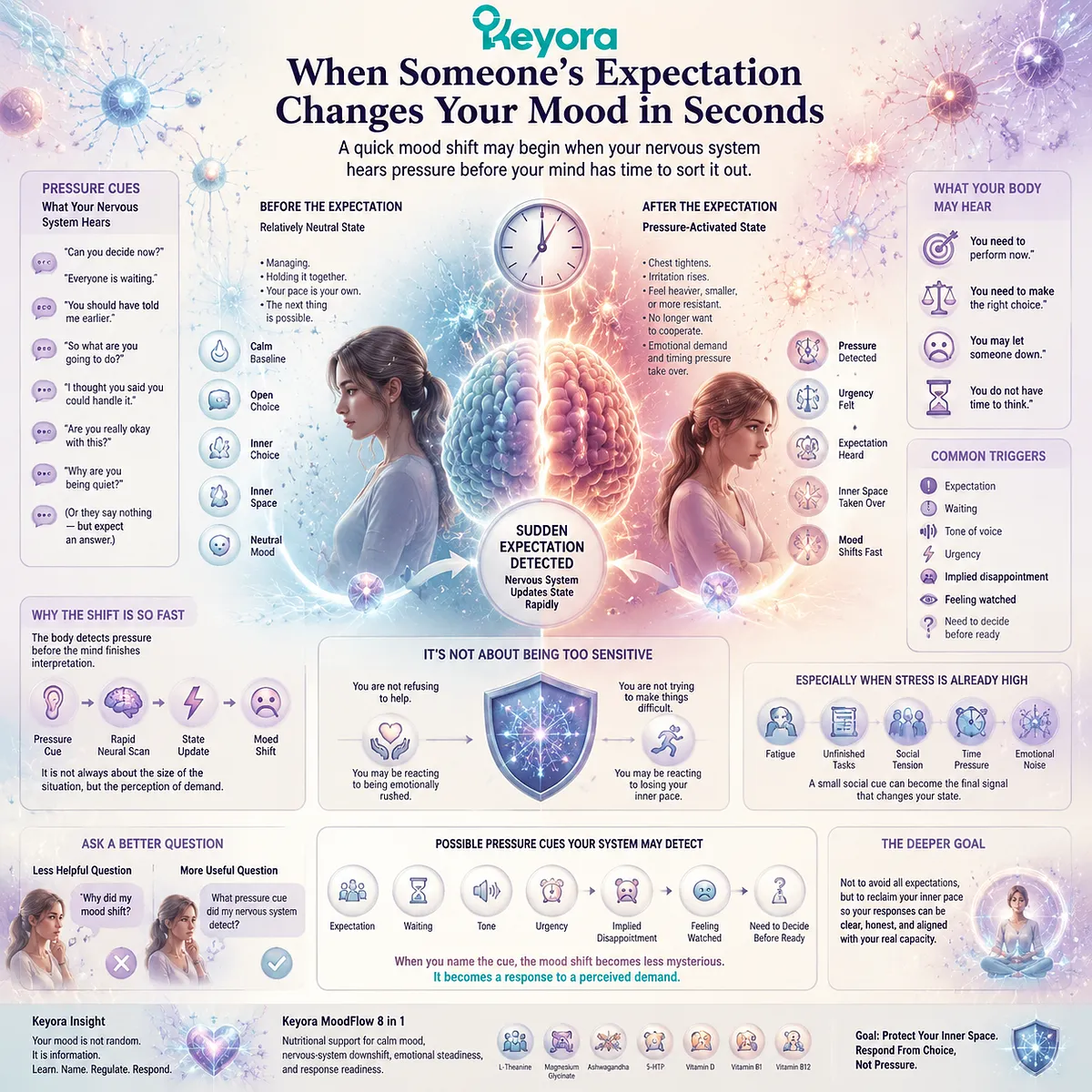
A quick mood shift may begin when your nervous system hears pressure before your mind has time to sort it out.
You may be okay one moment.
Not perfect. Not fully rested. Maybe not in the best mood. But you are managing. You are doing the next thing. You are holding yourself together.
Then someone says something.
“Can you decide now?”
“Everyone is waiting.”
“You should have told me earlier.”
“So what are you going to do?”
“I thought you said you could handle it.”
“Are you really okay with this?”
“Why are you being quiet?”
Or maybe they do not say much at all. They just look at you. They wait. They pause. They become silent in a way that makes you feel that an answer is expected.
And suddenly your mood changes.
You may feel your chest tighten. You may feel irritation rise. You may feel smaller, heavier, or more resistant. You may no longer want to cooperate, even though you were willing a few seconds ago. You may feel pressured, cornered, or emotionally pushed.
Then another thought appears: “Why did my mood change so fast?”
This is where self-judgment often begins.
You may think you are too sensitive. You may think you are difficult. You may think your mood is unstable. You may tell yourself, “They only asked a question. Why did I react like that?”
But the important question is not only what they said.
It is what your nervous system heard.
Sometimes the body does not hear a simple question. It hears expectation. It hears urgency. It hears disappointment. It hears, “You need to perform now.” It hears, “You need to make the right choice.” It hears, “You may let someone down.” It hears, “You do not have time to think.”
That is why the shift can be so fast.
The mood does not always change because the situation is objectively large. It changes because the body detects pressure and rapidly updates its state.
Before the pressure cue, you may have felt relatively neutral.
After the pressure cue, the situation feels different. Now there is emotional demand. Now there is timing pressure. Now someone may be waiting on you. Now your answer may affect how someone sees you. Now your pace is no longer fully yours.
That loss of pace matters.
Many people can handle a decision when they have room. They can answer when they have time. They can cooperate when they do not feel pushed. But when another person’s expectation suddenly enters, the same task can feel heavier.
You may not be refusing to help.
You may be reacting to being emotionally rushed.
You may not be trying to make things difficult.
You may be reacting to the sudden feeling that your inner space has been taken over by someone else’s demand.
This is especially common when stress is already high. If your system is already carrying fatigue, unfinished tasks, social tension, time pressure, or emotional noise, a small social cue can become the final signal that changes your state.
The deeper question is not only, “Why did my mood shift?”
A more useful question is, “What pressure cue did my nervous system detect?”
Was it the expectation?
The waiting?
The tone?
The urgency?
The implied disappointment?
The feeling of being watched?
The need to decide before you were ready?
When you can name the cue, the mood shift becomes less mysterious.
It becomes a response to a perceived demand.
Why Social Pressure Moves Mood So Fast
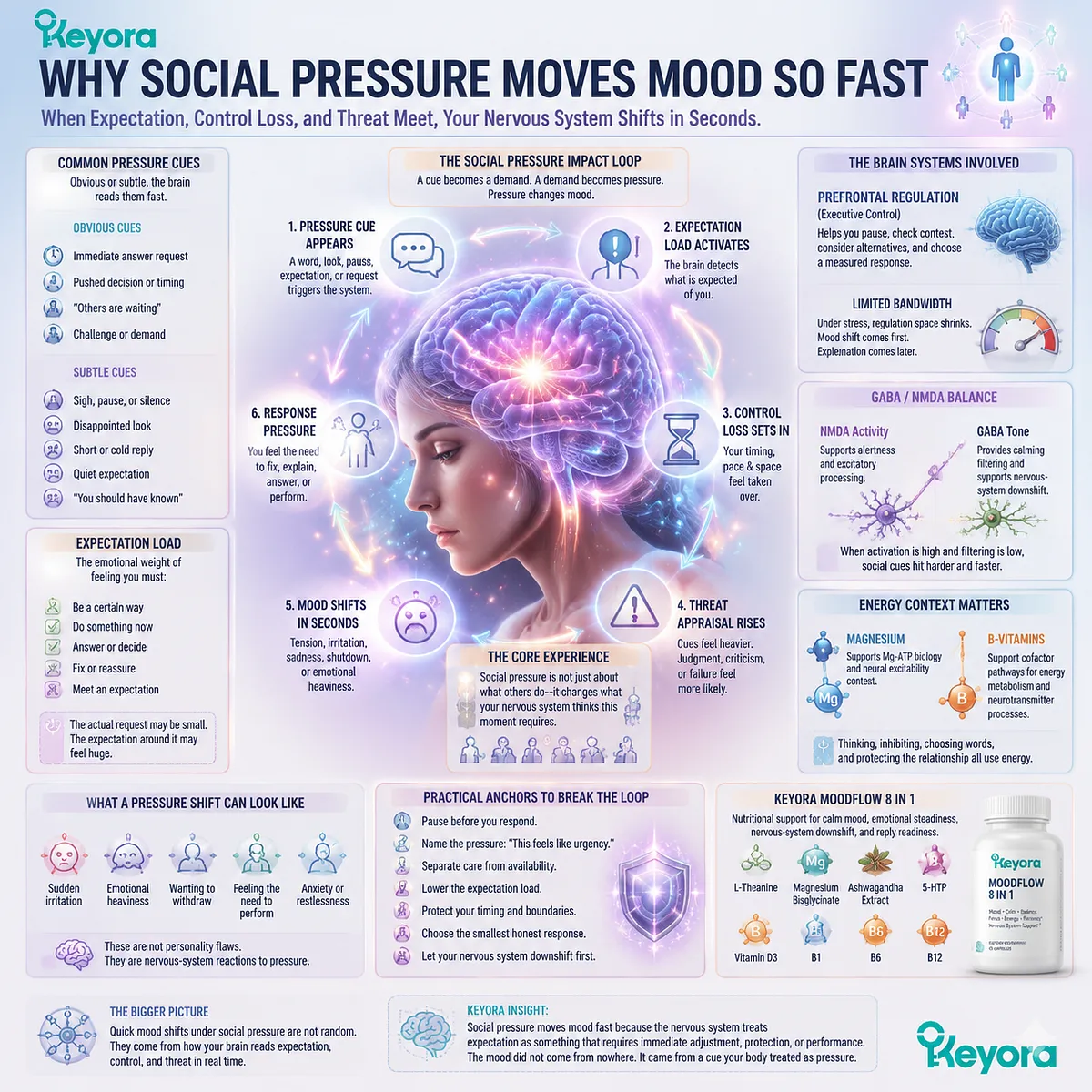
Social pressure can feel powerful because it changes your sense of safety, control, and emotional demand all at once.
Social pressure moves mood quickly because it is not only external pressure. It also changes what the nervous system thinks the moment requires.
A pressure cue can be obvious: someone asks for an immediate answer, pushes for a decision, challenges your timing, or says others are waiting.
But a pressure cue can also be subtle. A sigh. A pause. A disappointed look. A short reply. A quiet expectation. A sentence that implies you should have known better.
These cues matter because humans are social. The brain is built to monitor other people’s reactions, expectations, and emotional signals.
In many situations, belonging, safety, cooperation, approval, and conflict avoidance depend on reading those signals quickly.
So when social pressure appears, the brain may rapidly ask: Is someone disappointed?
Am I being evaluated?
Do I need to fix this?
Am I delaying people?
Did I fail to meet an expectation?
Do I have to respond now?
That is expectation load.
Expectation load is the emotional weight of feeling that someone needs you to be, do, answer, decide, or perform in a certain way.
Sometimes the actual request is small. But the expectation around it feels large.
A person says, “Can you decide now?” The decision may be ordinary. But the expectation says, “Your answer is needed immediately.”
A person says, “I thought you could handle it.” The words may be brief. But the expectation says, “You were supposed to manage this better.”
A person waits silently. The silence may not be hostile. But the expectation says, “You are being watched until you respond.”
That is why mood can shift so fast. The nervous system moves from ordinary functioning into social demand management.
Control loss is another major part of the shift.
Before the pressure, you may have had your own pace. You could think, decide, recover, or respond in your own time. After the pressure, it may feel as if someone else has taken control of the timing.
Now you must answer before you are ready.
Now you must explain before you have organized your thoughts.
Now you must reassure before you have settled your own body.
Now you must perform steadiness before you feel steady.
This loss of control can create irritation, shutdown, sadness, resistance, or sudden emotional heaviness. The emotion may look like a mood shift, but underneath it may be the body trying to protect a sense of space.
Threat appraisal also plays a role.
Under stress, the brain may give more emotional importance to social cues. A request may feel like pressure. A comment may feel like criticism. A pause may feel like judgment. A question may feel like evaluation.
This does not mean your interpretation is always wrong. Sometimes social pressure is real. Sometimes people do push, expect, criticize, or rush. But when stress is high, the space between cue and conclusion becomes smaller.
The body reacts before the full context has been checked.
That is where prefrontal regulation bandwidth matters.
The prefrontal system helps you pause, check context, consider alternative meanings, choose a response, and keep one pressure cue from becoming the whole emotional story. It helps you think, “They are asking for an answer, but I can still take a moment.” Or, “Their disappointment is uncomfortable, but it does not mean I failed completely.”
But when pressure is already high, that regulation space may be limited.
The mood shift comes first. The explanation comes later.
GABA/NMDA balance can help explain the intensity. The nervous system needs activation to respond to social demands, but it also needs braking and filtering so that every cue does not become urgent. NMDA-related activity can be understood as part of alert and excitatory processing. GABA-related tone helps support calm filtering and nervous-system downshift.
When activation is already high, a social pressure cue can push the system quickly into tension, irritation, withdrawal, or emotional heaviness.
Energy context also matters. Interpreting social pressure, suppressing a first reaction, choosing words, and protecting the relationship all require cognitive-emotional energy. Magnesium participates in Mg-ATP biology and neural excitability context. B vitamins support cofactor pathways involved in energy metabolism and neurotransmitter-related processes.
This does not mean quick mood shifts are only nutritional. Sleep, boundaries, workload, relationship safety, communication patterns, food timing, sensory load, and recovery space all matter.
But it does mean the shift is not imaginary.
Social pressure can shift mood quickly because the nervous system reads expectation as something that requires immediate adjustment, protection, or performance.
The mood did not come from nowhere.
It came from a cue your body treated as pressure.
What Helps When Social Pressure Changes Your Mood Quickly
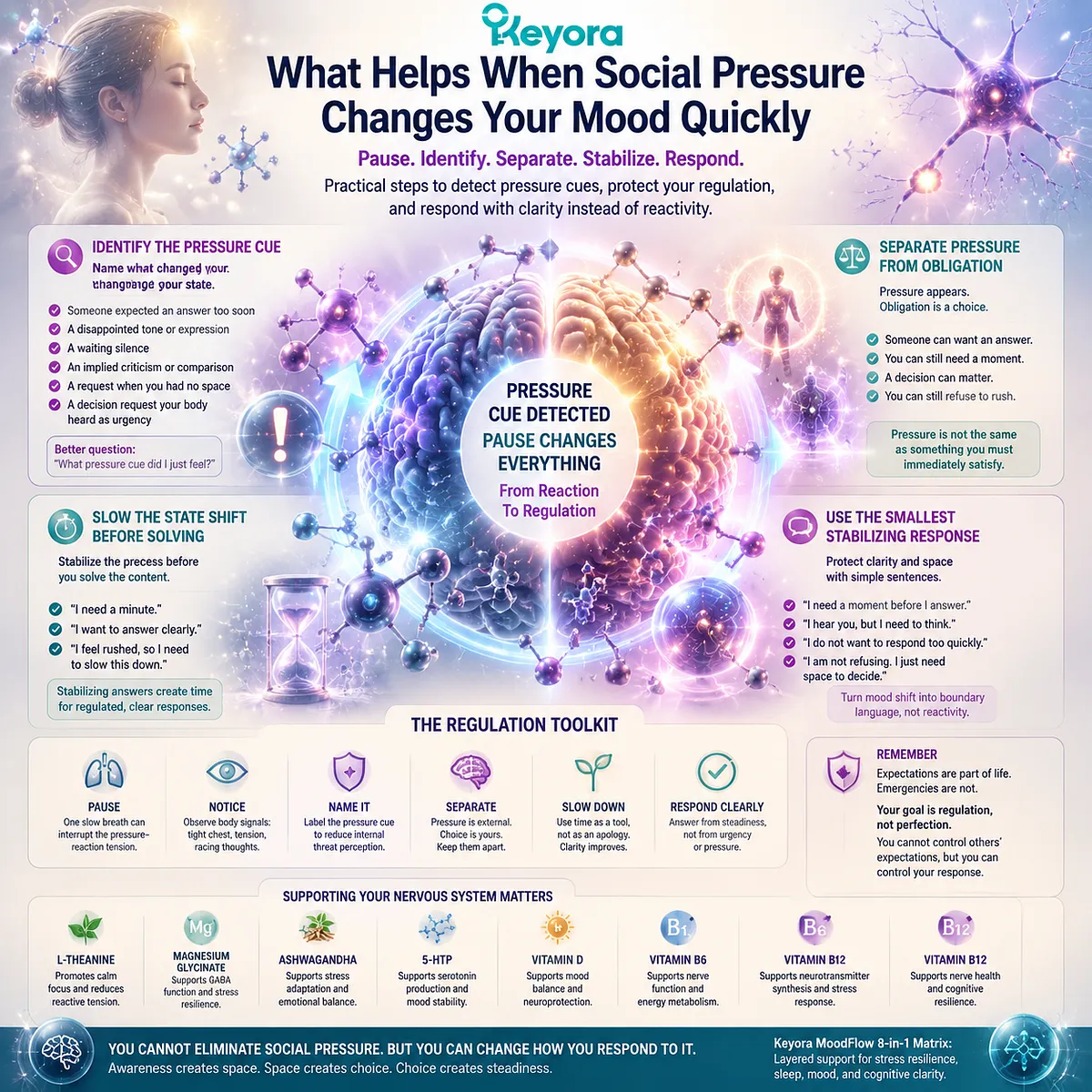
The first step is not to blame the mood shift, but to identify the pressure cue that changed your state.
When social pressure changes your mood quickly, the most helpful first step is not to force yourself back into a “better mood.”
That often creates more pressure.
Instead, pause long enough to ask: What changed the state?
Not, “Why am I like this?”
Not, “Why am I so sensitive?”
Not, “Why can’t I handle normal things?”
A better question is: “What pressure cue did I just feel?”
Maybe someone expected an answer before you were ready.
Maybe someone sounded disappointed.
Maybe someone waited silently.
Maybe someone implied you should have done better.
Maybe someone needed you while you had no space left.
Maybe someone asked for a decision, but your body heard urgency.
Naming the pressure cue changes the problem.
Now the issue is not “my mood is bad.” The issue is “my nervous system detected expectation, urgency, or evaluation.”
That difference matters because it gives you something to work with.
The next step is to separate pressure from obligation.
Just because pressure appears does not mean you must immediately satisfy it. A person can want an answer, and you can still need a moment. Someone can feel disappointed, and you can still slow down. A decision can matter, and you can still refuse to rush the response.
Useful sentences are simple:
“I need a moment before I answer.”
“I hear you, but I need to think.”
“I do not want to respond too quickly.”
“Give me a minute to sort this out.”
“I am not refusing. I just need space to decide.”
These sentences work because they do not argue with the pressure. They slow it down.
They create a small boundary between the cue and your reaction.
The third step is to slow the state shift before solving the situation.
When mood changes quickly, the body often wants to solve everything immediately. Explain. Defend. Decide. Apologize. Push back. Withdraw. Say yes. Say no. End the pressure fast.
But fast relief is not always the same as a clear response.
Sometimes the most helpful move is to answer the process before answering the content.
Instead of forcing a decision, you can say:
“I need a minute.”
Instead of explaining everything, you can say:
“I want to answer clearly.”
Instead of reacting to the pressure, you can say:
“I feel rushed, so I need to slow this down.”
These are not perfect answers. They are stabilizing answers.
They let the other person know something is happening while giving your nervous system time to return from immediate pressure to real choice.
The fourth step is to use the smallest stabilizing response.
When social pressure shifts your mood, do not begin with a full explanation of your entire emotional state. That may be too much, too soon, especially if your system is already activated.
Begin with the smallest sentence that protects both clarity and space.
“I can respond, but not if I feel rushed.”
“I want to think before I decide.”
“I am feeling pressured, so I need a pause.”
“I can talk about this, but I need a calmer pace.”
“I am not ignoring this. I just need a moment.”
These sentences do something important.
They turn mood shift into boundary language.
Instead of letting the pressure push you into irritation, silence, or emotional shutdown, they help you describe the process: pressure is here, and I need space before I respond.
This is not selfish.
It is regulation.
The goal is not to make other people stop having expectations. Expectations are part of relationships, families, work, and daily life.
The goal is to stop treating every expectation as an emergency.
Where Nutritional Support Fits
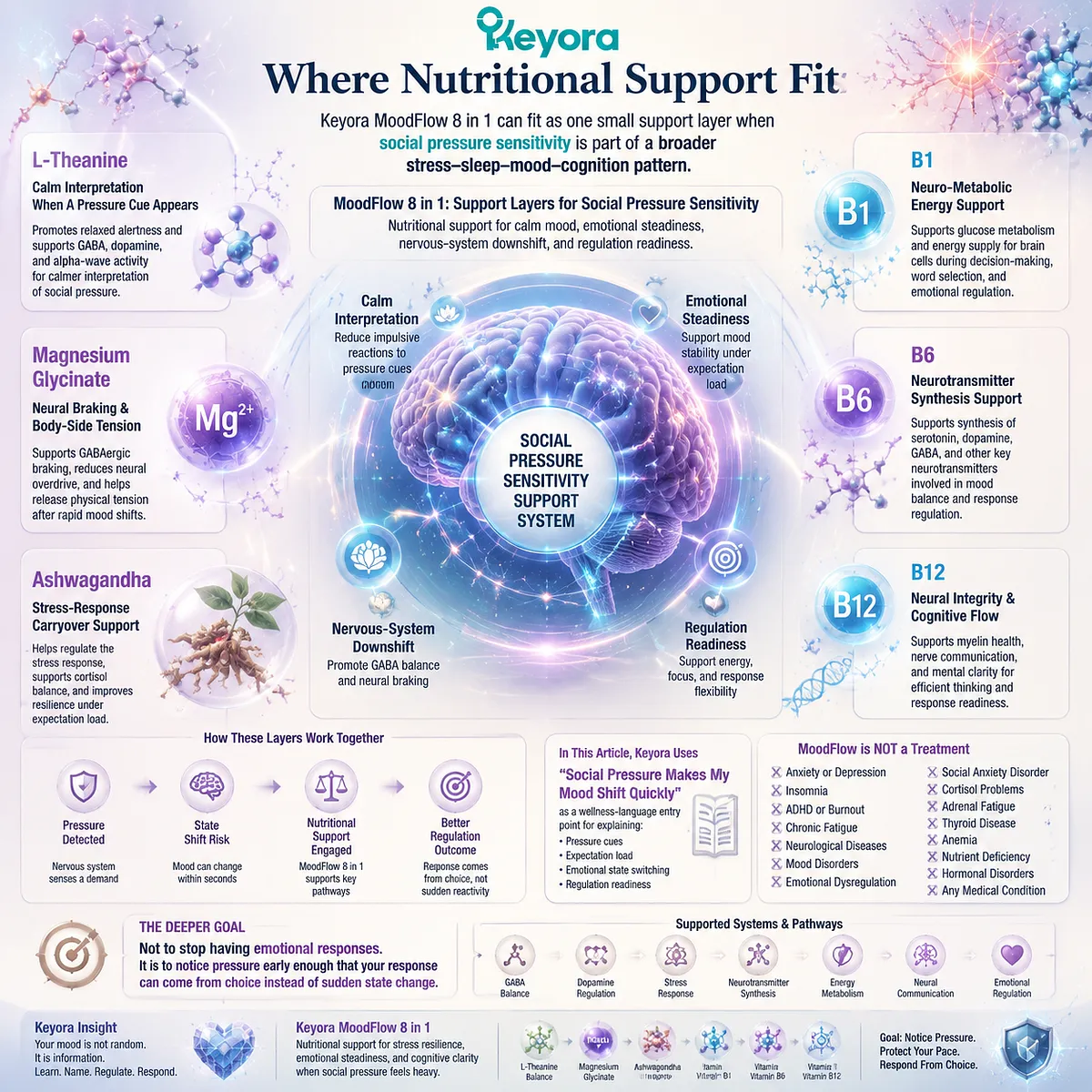
Keyora MoodFlow 8 in 1 can fit as one small support layer when social pressure sensitivity is part of a broader stress-sleep-mood-cognition pattern. It should not be understood as something that stops social pressure, prevents emotional reactions, or forces mood stability.
Its role is narrower: supporting nutritional pathways involved in calm mood, emotional steadiness, nervous-system downshift, and regulation readiness when social pressure feels heavy.
For this topic, the most relevant layers are L-Theanine for calm interpretation when a pressure cue appears, magnesium glycinate for neural braking and body-side tension after rapid mood shifts, Ashwagandha for stress-response carryover under expectation load, and B1, B6, and B12 for neuro-metabolic support behind response selection and emotional regulation effort.
MoodFlow is not a treatment for anxiety, depression, insomnia, ADHD, burnout, chronic fatigue, neurological disease, mood disorders, emotional dysregulation, social anxiety disorder, cortisol problems, adrenal fatigue, thyroid disease, anemia, nutrient deficiency, hormonal disorders, or any medical condition.
In this article, Keyora uses “social pressure makes my mood shift quickly” as a wellness-language entry point for explaining pressure cues, expectation load, emotional state switching, and regulation readiness.
The deeper goal is not to stop having emotional responses.
It is to notice pressure early enough that your response can come from choice instead of sudden state change.
Closing Summary
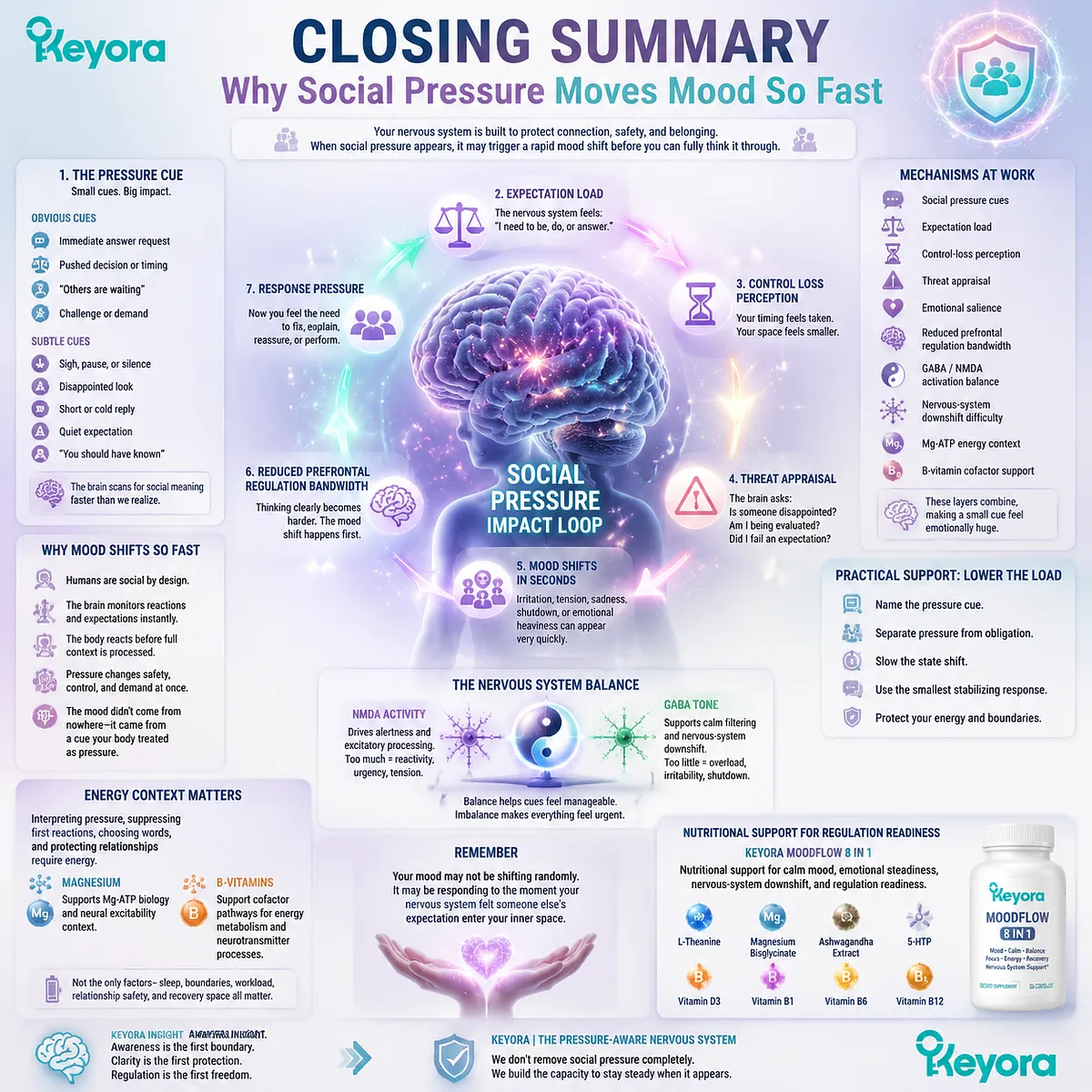
Social pressure can make your mood shift quickly because your nervous system may read expectation, waiting, urgency, disappointment, or evaluation as something that requires immediate adjustment, protection, or performance.
This does not mean your mood changed for no reason. It may mean your body detected a pressure cue before your mind had time to check the full context.
Mechanistically, this can involve social pressure cues, expectation load, control-loss perception, threat appraisal, emotional salience, reduced prefrontal regulation bandwidth, GABA/NMDA activation balance, nervous-system downshift difficulty, Mg-ATP energy context, and B-vitamin cofactor support.
Practical support begins by naming the pressure cue, separating pressure from obligation, slowing the state shift, and using the smallest stabilizing response before trying to solve the whole situation.
Keyora MoodFlow 8 in 1 fits only as a nutritional support layer for calm mood, emotional steadiness, nervous-system downshift, and regulation readiness. It is not a treatment for mood disorders, anxiety, depression, emotional dysregulation, or any medical condition.
Your mood may not be shifting randomly.
It may be responding to the moment your nervous system felt someone else’s expectation enter your inner space.
This article is for educational and informational purposes only. It does not provide medical advice, diagnosis, treatment, cure, prevention, disease outcome claims, hormone restoration claims, fertility outcome claims, or formula-specific clinical efficacy claims.