
Why Do I Feel Tense Before Replying to Messages When I’m Stressed?
Keyora Research Q&A Library
This is part of the Keyora Research Q&A Series, derived from Keyora Nutritional Neurology Series .
Within the Keyora Nutritional Neurology framework, this Q&A translates complex nutrient–brain mechanisms into reader-friendly, evidence-bound answers, focusing on stress resilience, sleep quality, calm mood support, cognitive wellness, and the broader interaction between nutrition, neurochemistry, and daily nervous-system function.
First published by Keyora Research Journal: www.keyorahealth.com

Direct Answer
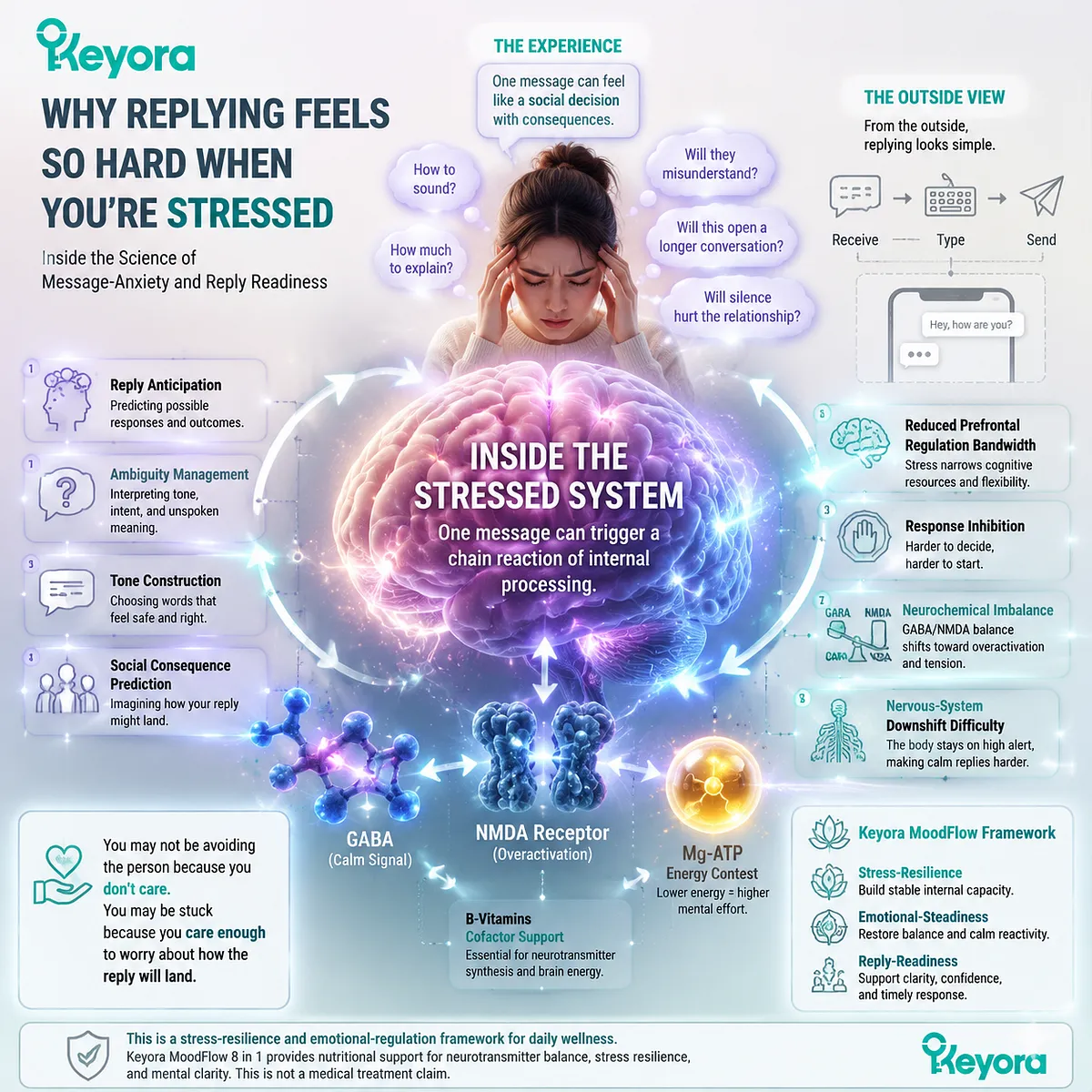
You may feel tense before replying to messages when you are stressed because a message can start to feel like more than words.
It can feel like a social decision with consequences: how to sound, how much to explain, whether the other person will misunderstand, whether replying will open a longer conversation, and whether silence will hurt the relationship.
The mismatch is this: from the outside, replying may look simple.
You type a sentence and send it. But inside a stressed system, one message can become a whole chain of prediction, tone construction, social obligation, and response pressure.
You may not be avoiding the person because you do not care.
You may be stuck because you care enough to worry about how the reply will land.
Mechanistically, this can involve reply anticipation, ambiguity management, tone construction, social consequence prediction, reduced prefrontal regulation bandwidth, response inhibition, GABA/NMDA activation balance, nervous-system downshift difficulty, Mg-ATP energy context, and B-vitamin cofactor support.
In the Keyora MoodFlow framework, this is understood as a stress-resilience, emotional-steadiness, and reply-readiness question, not a medical treatment claim.
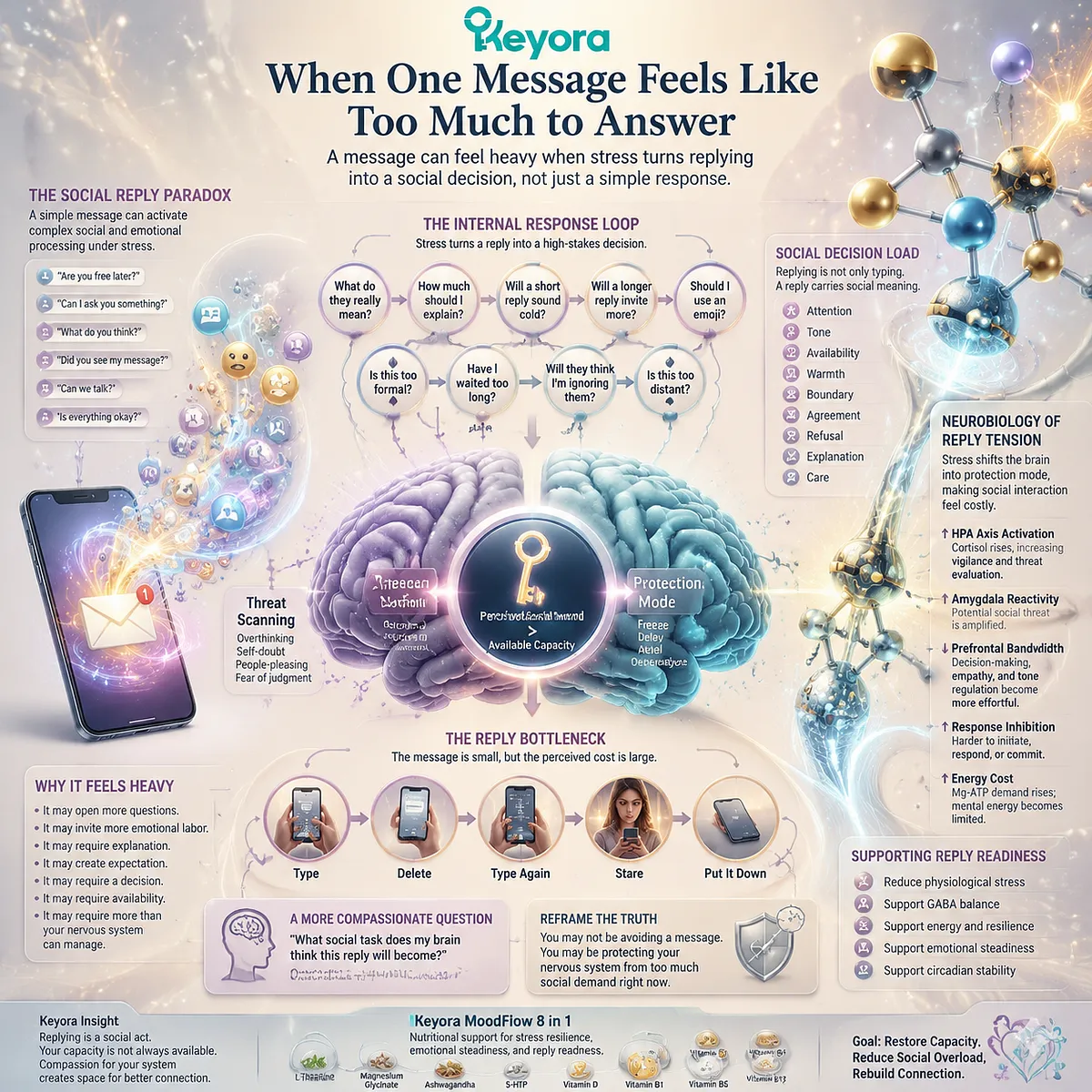
When One Message Feels Like Too Much to Answer
A message can feel heavy when stress turns replying into a social decision, not just a simple response.
You may know this moment before anything has even happened.
Your phone lights up. You see a name on the screen. It is not someone you hate. It may be someone you care about, someone you respect, someone you do not want to disappoint, or someone you genuinely want to answer well.
Still, your body tightens before you open the message.
You may leave it unread for a while, not because you do not care, but because opening it feels like starting something you are not ready to manage. Or you may open it and then freeze. The words are there. The message may not even be long. But your mind does not move easily toward a reply.
It begins calculating.
What do they really mean?
How much do I need to explain?
Will a short answer sound cold?
Will a longer answer invite more questions?
Should I use an emoji?
Is this too formal?
Is this too distant?
Have I already waited too long?
Will they think I am ignoring them?
The message may say something simple.
“Are you free later?”
“Can I ask you something?”
“What do you think?”
“Did you see my message?”
“Can we talk?”
“Is everything okay?”
But under stress, the reply can feel larger than the question.
This is where many people start judging themselves. They think, “Why am I so bad at replying?” or “Why can’t I just answer?” or “Why do I avoid messages from people I actually like?” They may label themselves lazy, rude, avoidant, unreliable, or socially difficult.
But replying is not always only typing.
A reply has a social function. It signals attention, tone, availability, warmth, boundary, agreement, refusal, explanation, or care. A few words can carry more meaning than the words themselves.
That is why replying can feel tense when you are already stressed.
You are not only deciding what to say. You may be deciding how much of yourself is available.
You may want to answer, but not start a long conversation. You may want to be kind, but not over-explain. You may want to say no, but not hurt the person. You may want to say yes, but not commit to more than you can handle. You may want to be honest, but not sound cold.
So you type.
Then delete.
Then type again.
Then stare at the message.
Then put the phone down.
The tension is not always about the message itself. It is about everything the message might open.
A reply can become a doorway: into more questions, more emotional labor, more explanation, more expectation, more decisions, or more pressure to be available.
This is especially true when stress has already reduced your mental space. A low-stress version of you may answer easily. A loaded version of you may need much more effort to produce the same sentence.
That does not mean your care disappeared.
It may mean your care is trapped behind decision load.
The deeper question is not only, “Why am I not replying?”
A more compassionate question is, “What social task does my brain think this reply will become?”
When you ask it that way, the tension starts to make sense.
You may not be avoiding a message.
You may be trying to avoid getting pulled into more than your nervous system can manage right now.
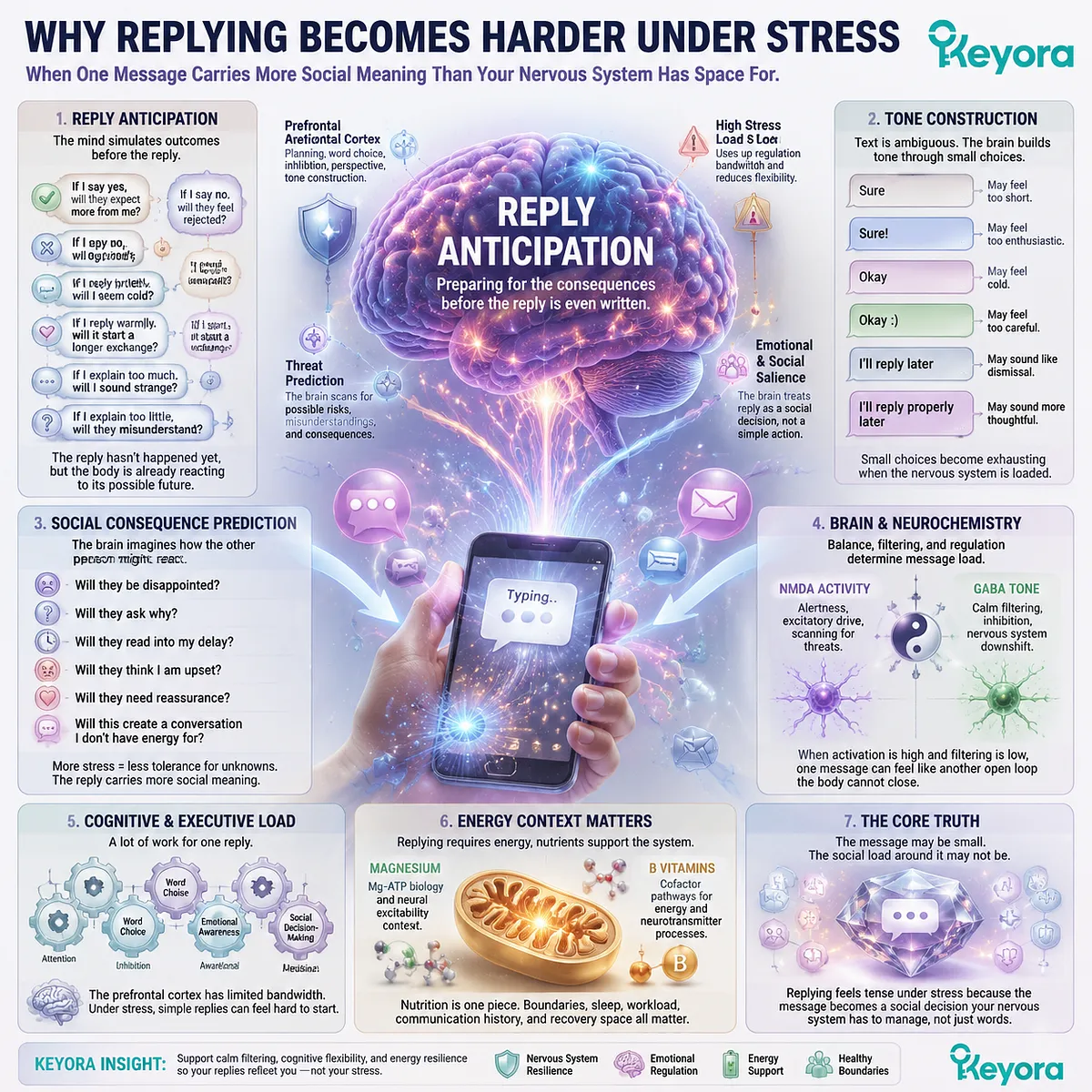
Why Replying Becomes Harder Under Stress
Under stress, the brain may treat a reply as something to manage, predict, and protect.
Replying becomes harder under stress because the brain starts preparing for the consequences of the reply before the reply is even written.
This is reply anticipation.
Instead of simply answering, the mind begins simulating possible outcomes. If I say yes, will they expect more from me? If I say no, will they feel rejected? If I answer briefly, will I seem cold? If I answer warmly, will it start a longer exchange? If I explain too much, will I sound strange? If I explain too little, will they misunderstand?
The reply has not happened yet, but the body is already reacting to its possible future.
That prediction process can be useful. It helps people communicate carefully. It helps protect relationships. It helps prevent unnecessary conflict.
But under stress, prediction can become heavy.
The brain may overestimate the risk of misunderstanding. It may see too many possible consequences. It may try to solve the whole relationship through one message. The reply becomes less like communication and more like a test.
Text messages are also ambiguous.
In face-to-face conversation, tone, facial expression, timing, and body language help carry meaning. In text, much of that information is missing. So the brain has to build tone through wording, punctuation, length, timing, and sometimes emoji.
That is tone construction.
“Sure” may feel too short.
“Sure!” may feel too enthusiastic.
“Okay” may feel cold.
“Okay :)” may feel too careful.
“I’ll reply later” may sound like dismissal.
“I’ll reply properly later” may sound more thoughtful.
These choices may seem small, but they can become exhausting when the nervous system is already loaded. The person is not only typing. They are designing how the reply will be felt.
This is why one message can become a miniature writing task.
A stressed brain may ask: How do I sound kind but not too available? Clear but not harsh? Honest but not heavy? Brief but not dismissive? Boundaried but not rude?
That is a lot of work for one reply.
Social consequence prediction adds another layer.
The brain may imagine how the other person will react. Will they be disappointed? Will they ask why? Will they read into my delay? Will they think I am upset? Will they need reassurance? Will this create a conversation I do not have energy for?
The more stressed you are, the harder it can be to tolerate those unknowns.
This is not because you are incapable of texting. It is because the reply is carrying more social meaning than usual.
The prefrontal cortex helps with this kind of communication. It supports planning, word choice, inhibition, perspective-taking, emotional regulation, and decision-making. It helps you choose a sentence that is honest, kind, and appropriate.
But prefrontal regulation bandwidth is limited.
When stress has already used much of that space, the system may struggle to organize a simple response. You may know what you mean but not know how to say it. You may know you should reply but feel unable to start. You may want to keep the relationship safe but not have enough energy to perform warmth.
GABA/NMDA balance also helps explain why messages can feel activating. The nervous system needs alertness to respond, but it also needs braking and filtering so that every social signal does not feel urgent. NMDA-related activity can be understood as part of alert and excitatory processing. GABA-related tone helps support calm filtering and nervous-system downshift.
When activation is already high, one message can feel like another open loop the body cannot close.
You may feel tense if you do not reply.
You may feel tense if you do reply.
That is the trap.
Energy context matters too. Writing a message requires attention, wording, inhibition, emotional awareness, and social decision-making. Magnesium participates in Mg-ATP biology and neural excitability context. B vitamins support cofactor pathways involved in energy metabolism and neurotransmitter-related processes.
This does not mean reply tension is only nutritional. Boundaries, relationship expectations, workload, sleep, fear of conflict, digital habits, communication history, and recovery space all matter.
But it does mean the experience is real.
Replying feels tense under stress because the message becomes more than words; it becomes a social decision your nervous system has to manage.
The message may be small.
The social load around it may not be.
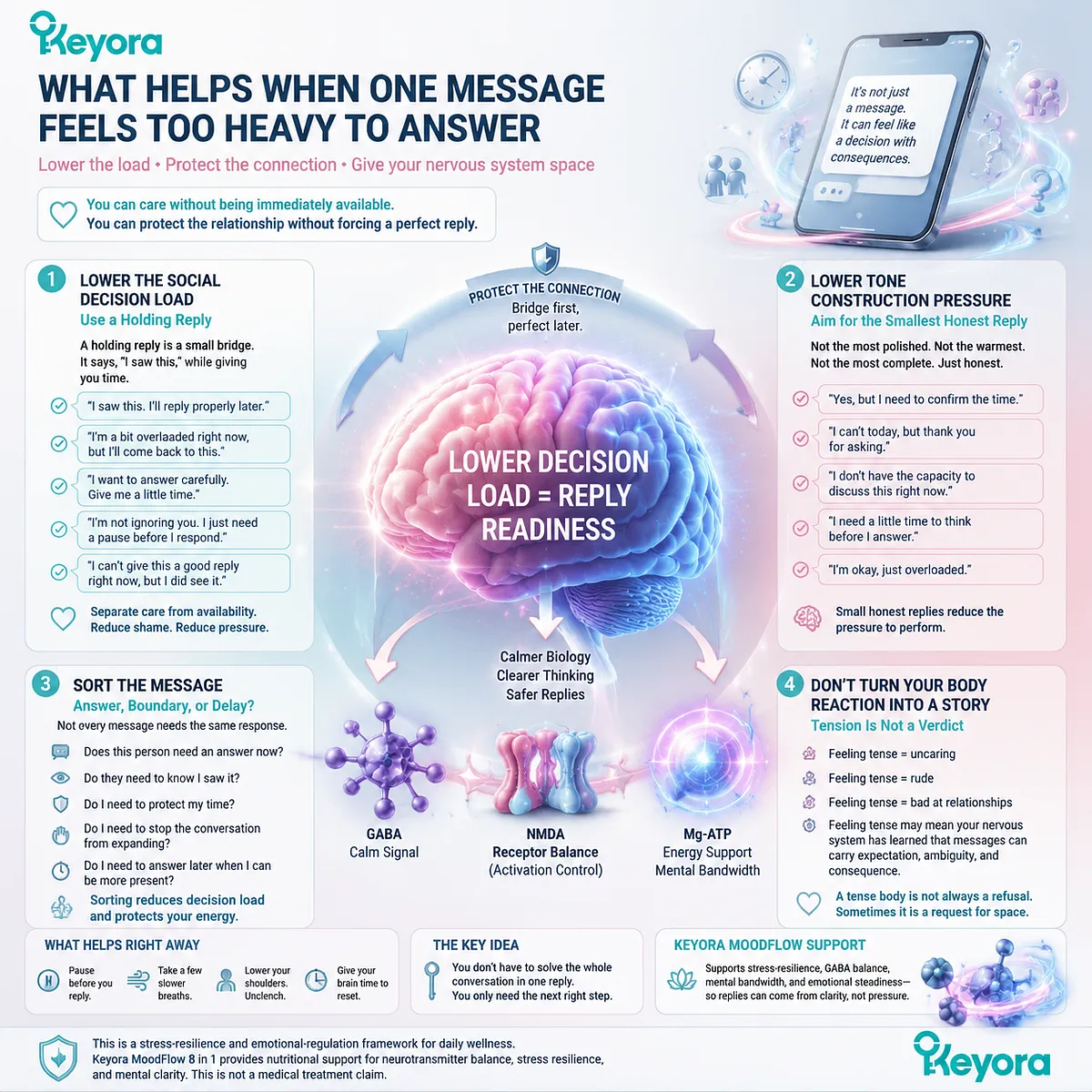
What Helps When One Message Feels Too Heavy to Answer
The first step is not to force a perfect reply, but to lower the social decision load.
When replying feels tense, the solution is not always to push yourself into the perfect answer. Sometimes trying to craft the perfect answer is what keeps the tension alive.
A more helpful first step is to reduce the size of the task.
You do not always need to solve the whole conversation in one reply. You may only need to keep the connection open while giving your nervous system more time.
This is where a holding reply can help.
A holding reply is not the final answer. It is a small bridge. It tells the other person, “I saw this,” while giving you permission not to complete the entire social task immediately.
For example:
“I saw this. I’ll reply properly later.”
“I’m a bit overloaded right now, but I’ll come back to this.”
“I want to answer carefully. Give me a little time.”
“I’m not ignoring you. I just need a pause before I respond.”
“I can’t give this a good reply right now, but I did see it.”
These sentences are useful because they separate two things that often get tangled together: care and availability.
You can care without being immediately available.
You can respect someone without answering perfectly right away.
You can protect a relationship without forcing your nervous system to respond before it has space.
That distinction can reduce shame.
Many people think, “If I cared, I would reply immediately.” But in real life, immediate availability and genuine care are not the same thing. Sometimes a rushed reply creates more misunderstanding than a delayed, honest one.
The second helpful step is to lower tone construction pressure.
Not every message needs the perfect wording. Under stress, aim for the smallest honest reply. Not the most polished reply. Not the warmest possible reply. Not the most complete explanation. The smallest honest reply.
That might be:
“Yes, but I need to confirm the time.”
“I can’t today, but thank you for asking.”
“I don’t have the capacity to discuss this right now.”
“I need a little time to think before I answer.”
“I’m okay, just overloaded.”
These replies do not solve everything. But they reduce the pressure to perform a version of yourself that your nervous system cannot access in that moment.
The third step is to decide whether the message needs an answer, a boundary, or a delay.
Some messages need information.
Some need reassurance.
Some need a clear no.
Some can wait.
Some do not need a response at all.
When your stress is high, your brain may treat every message as equally urgent. It can help to pause and ask: What is the smallest real need here?
Does this person need an answer now?
Do they need to know I saw it?
Do I need to protect my time?
Do I need to stop the conversation from expanding?
Do I need to answer later when I can be more present?
This kind of sorting reduces decision load.
The fourth step is to stop making your first body reaction into a full story about yourself.
Feeling tense before replying does not mean you are uncaring. It does not mean you are rude. It does not mean you are bad at relationships. It may mean your nervous system has learned that messages can carry expectation, ambiguity, and consequence.
A tense body is not always a refusal.
Sometimes it is a request for space.
Where Nutritional Support Fits
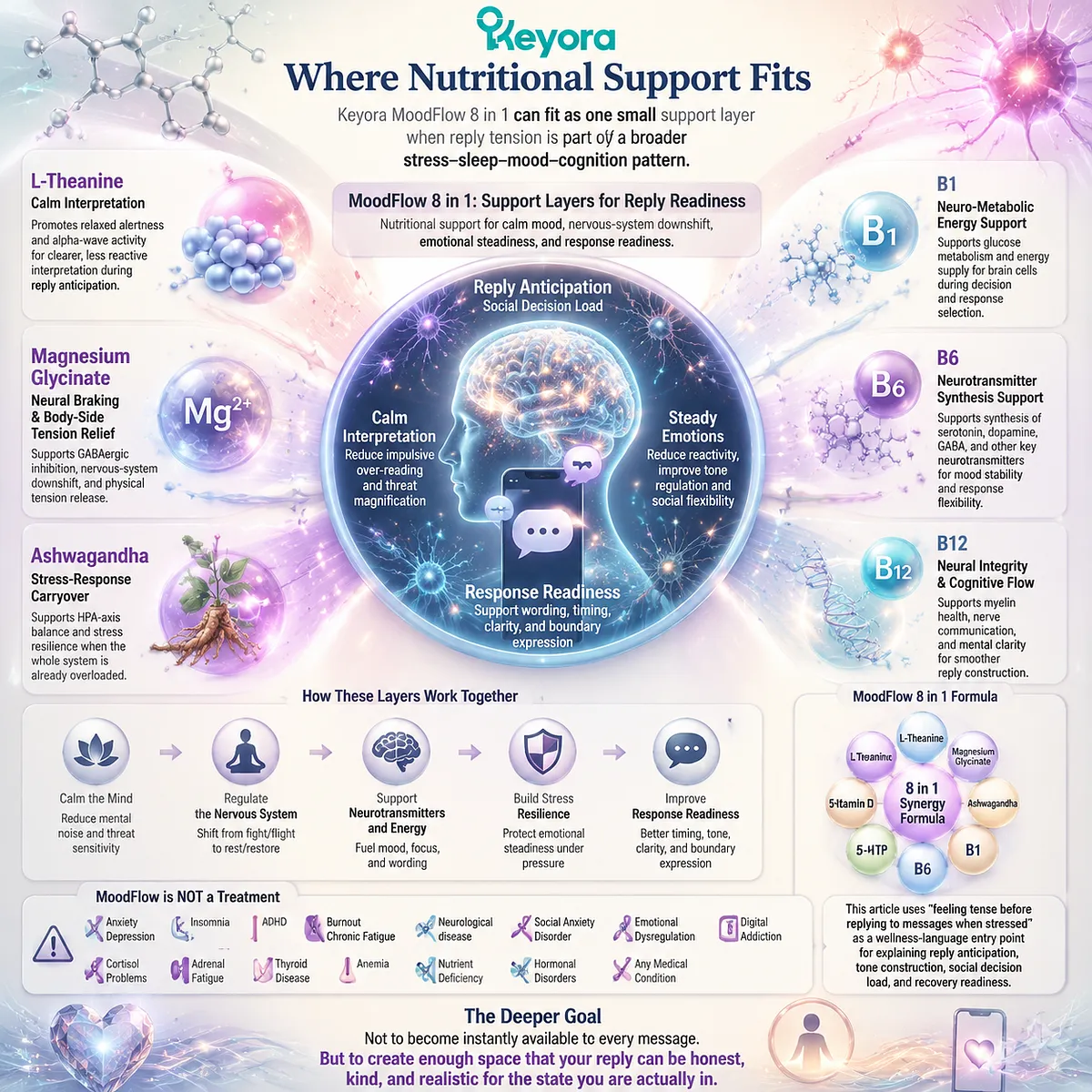
Keyora MoodFlow 8 in 1 can fit as one small support layer when reply tension is part of a broader stress-sleep-mood-cognition pattern. It should not be understood as something that makes replying easy, removes social pressure, or replaces boundary-setting.
Its role is narrower: supporting nutritional pathways involved in calm mood, nervous-system downshift, emotional steadiness, and response readiness.
For this topic, the most relevant layers are L-Theanine for calm interpretation during reply anticipation, magnesium glycinate for neural braking and body-side tension, B1, B6, and B12 for neuro-metabolic support behind wording and response selection, and Ashwagandha for stress-response carryover when a message feels heavy because the whole system was already loaded.
MoodFlow is not a treatment for anxiety, depression, insomnia, ADHD, burnout, chronic fatigue, neurological disease, social anxiety disorder, emotional dysregulation, digital addiction, cortisol problems, adrenal fatigue, thyroid disease, anemia, nutrient deficiency, hormonal disorders, or any medical condition. In this article, Keyora uses “feeling tense before replying to messages when stressed” as a wellness-language entry point for explaining reply anticipation, tone construction, social decision load, and recovery readiness.
The deeper goal is not to become instantly available to every message.
It is to create enough space that your reply can be honest, kind, and realistic for the state you are actually in.
Closing Summary
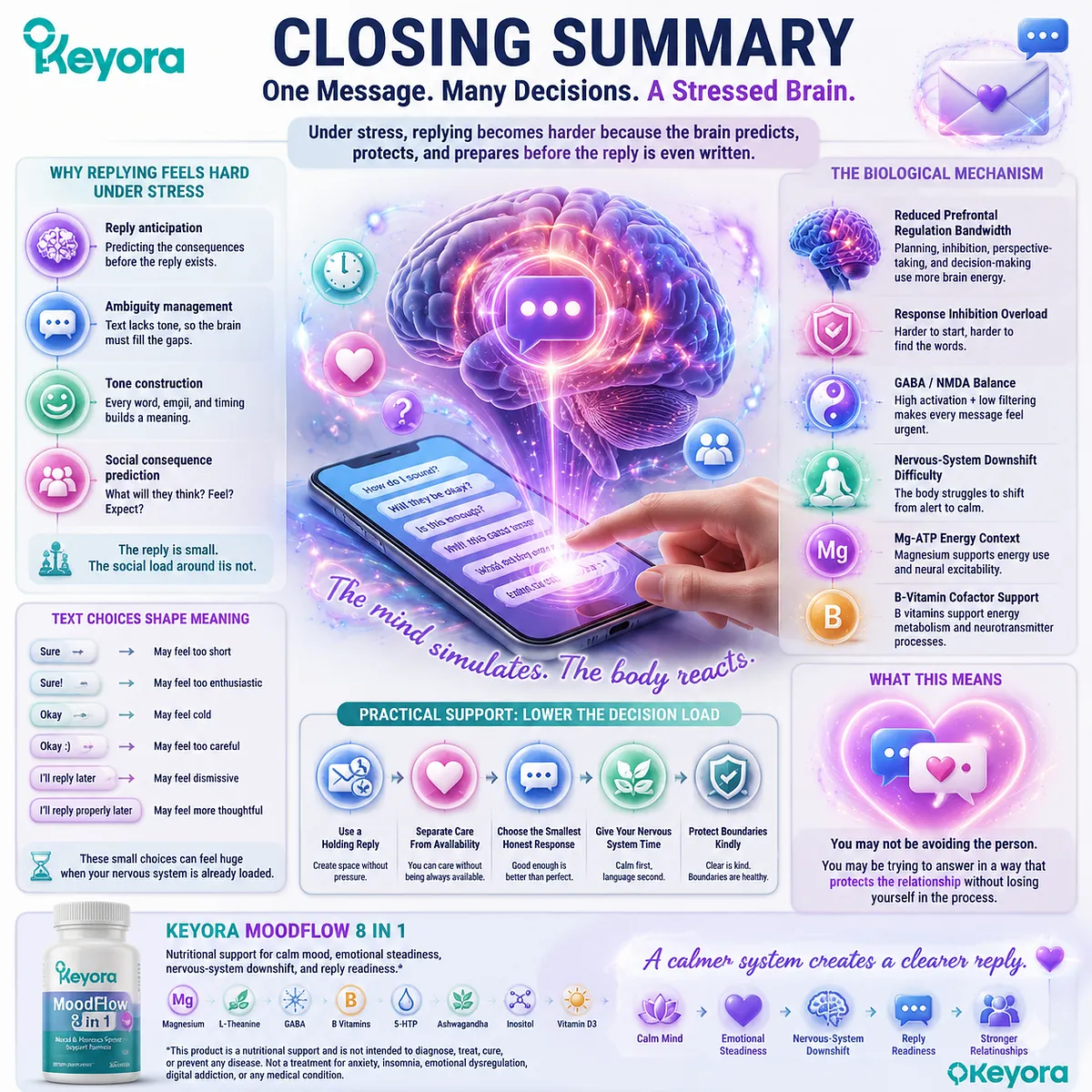
Feeling tense before replying to messages when you are stressed does not mean you are lazy, rude, or uncaring. It may mean that one message has become more than a message. It has become a social decision involving tone, timing, explanation, availability, and possible consequences.
Under stress, the brain may predict too much, overwork the wording, worry about ambiguity, and treat the reply as something that must protect the relationship perfectly. That is why even a simple answer can feel heavy.
Mechanistically, this can involve reply anticipation, ambiguity management, tone construction, social consequence prediction, reduced prefrontal regulation bandwidth, response inhibition, GABA/NMDA activation balance, nervous-system downshift difficulty, Mg-ATP energy context, and B-vitamin cofactor support.
Practical support begins by lowering the decision load: use a holding reply, separate care from availability, choose the smallest honest response, and give your nervous system time before turning pressure into language.
Keyora MoodFlow 8 in 1 fits only as a nutritional support layer for calm mood, emotional steadiness, nervous-system downshift, and reply readiness. It is not a treatment for anxiety, insomnia, emotional dysregulation, digital addiction, or any medical condition.
You may not be avoiding the person.
You may be trying to answer in a way that protects the relationship without losing yourself in the process.
This article is for educational and informational purposes only. It does not provide medical advice, diagnosis, treatment, cure, prevention, disease outcome claims, hormone restoration claims, fertility outcome claims, or formula-specific clinical efficacy claims.