
Why Is It Hard to Respond Politely When My Nervous System Feels Loaded?
Keyora Research Q&A Library
This is part of the Keyora Research Q&A Series, derived from Keyora Nutritional Neurology Series .
Within the Keyora Nutritional Neurology framework, this Q&A translates complex nutrient–brain mechanisms into reader-friendly, evidence-bound answers, focusing on stress resilience, sleep quality, calm mood support, cognitive wellness, and the broader interaction between nutrition, neurochemistry, and daily nervous-system function.
First published by Keyora Research Journal: www.keyorahealth.com

Direct Answer
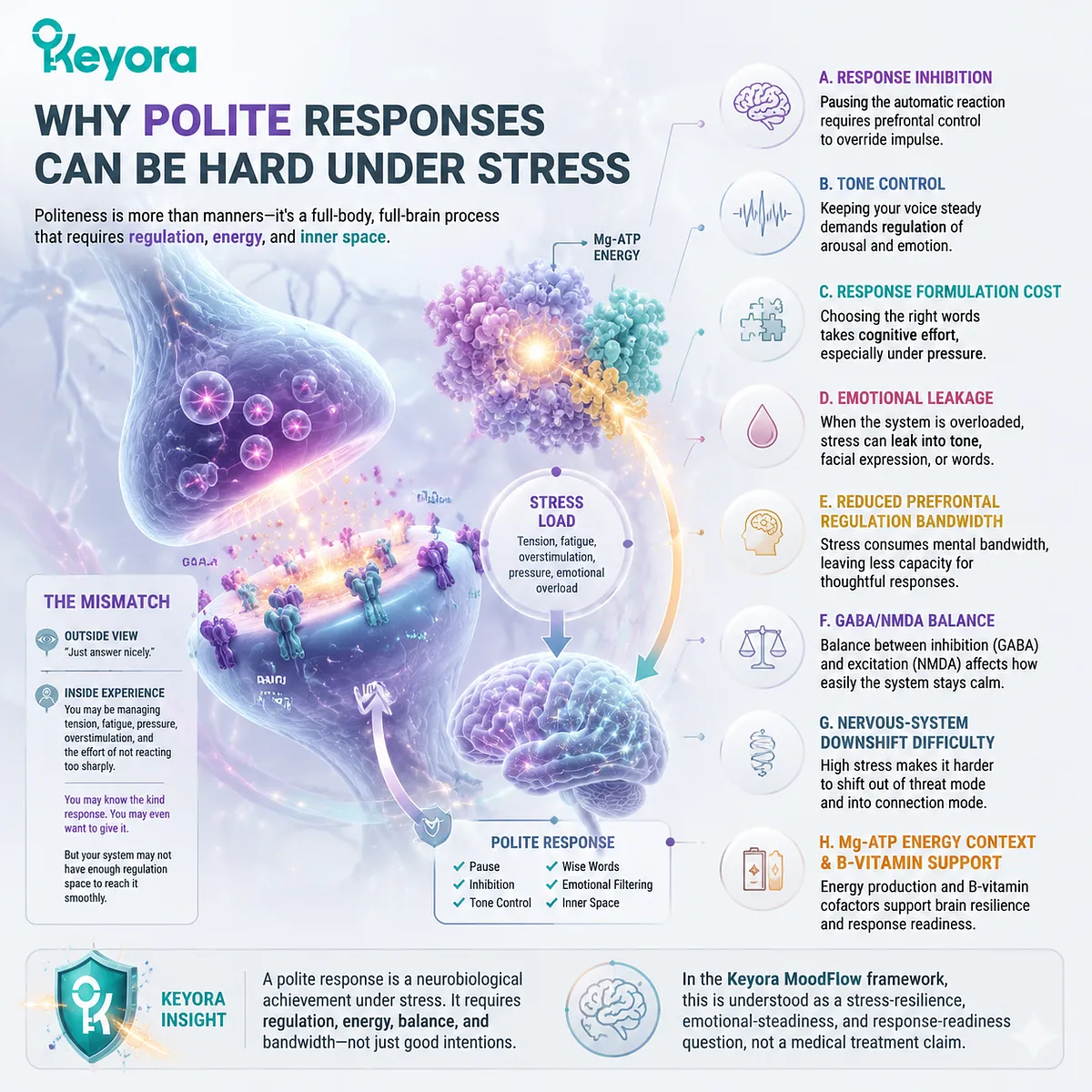
It can be hard to respond politely when your nervous system feels loaded because politeness is not only manners.
A polite response requires pause, inhibition, tone control, word choice, emotional filtering, and enough inner space to keep your stress from leaking directly into your voice.
The mismatch is this: from the outside, someone may think, “Just answer nicely.”
But inside, you may be trying to manage tension, fatigue, overstimulation, pressure, and the effort of not reacting too sharply.
You may know the kind response.
You may even want to give it.
But in that moment, your system may not have enough regulation space to reach it smoothly.
Mechanistically, this can involve response inhibition, tone control, response formulation cost, emotional leakage, reduced prefrontal regulation bandwidth, GABA/NMDA activation balance, nervous-system downshift difficulty, Mg-ATP energy context, and B-vitamin cofactor support.
In the Keyora MoodFlow framework, this is understood as a stress-resilience, emotional-steadiness, and response-readiness question, not a medical treatment claim.
When You Know the Polite Response but Cannot Reach It
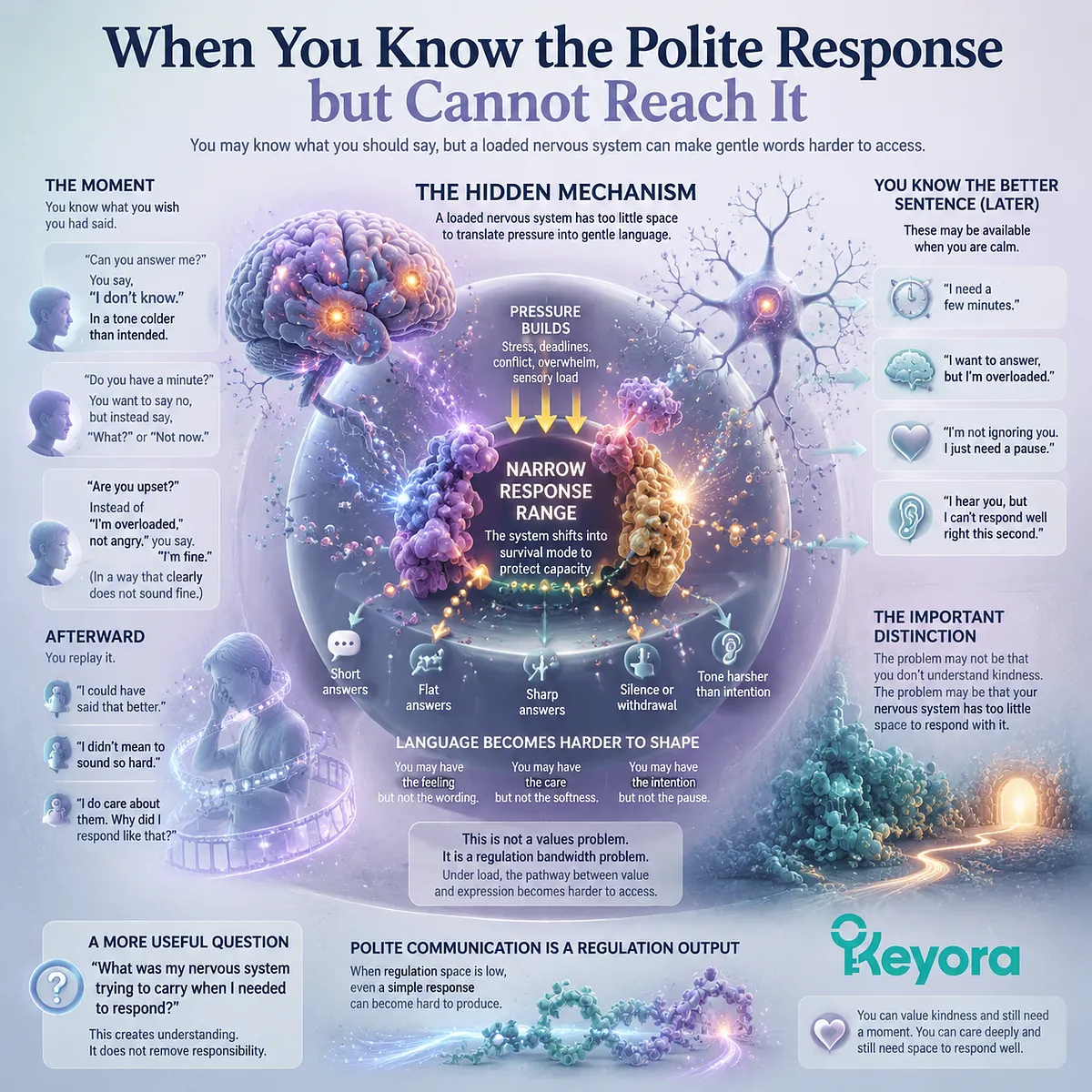
You may know what you should say, but a loaded nervous system can make gentle words harder to access.
There are moments when you know exactly how you wish you had responded.
Maybe someone asks, “Can you answer me?” and you say, “I don’t know,” in a tone that sounds colder than you intended.
Maybe someone says, “Do you have a minute?” and your whole body wants to say no, but the only words that come out are, “What?” or “Not now.”
Maybe someone asks, “Are you upset?” and instead of explaining, “I’m overloaded, not angry,” you say, “I’m fine,” in a way that clearly does not sound fine.
Then afterward, you replay it.
You think, “I could have said that better.”
You think, “I didn’t mean to sound so hard.”
You think, “I do care about them. Why did I respond like that?”
This kind of moment can create shame because politeness is often treated as a simple moral choice. Be kind. Be respectful. Use a better tone. Say it nicely.
Of course, how we speak matters. Other people can be affected by our tone, words, and timing. But when the nervous system is loaded, the ability to produce a polite response is not always as simple as knowing what politeness looks like.
You may know the better sentence.
“I need a few minutes.”
“I want to answer, but I’m overloaded.”
“I’m not ignoring you. I just need a pause.”
“I hear you, but I can’t respond well right this second.”
Those sentences may be available later. They may be obvious when you are calm. But in the loaded moment, they can feel far away.
That is the important distinction.
The problem may not be that you do not understand kindness. The problem may be that your nervous system has too little space to translate pressure into gentle language quickly.
A loaded nervous system often has a narrow response range. It may move toward short answers, flat answers, sharp answers, silence, withdrawal, or a tone that sounds harsher than your actual intention.
This does not make the response ideal. But it helps explain why it happens.
When pressure rises inside, language becomes harder to shape. You may have the feeling but not the wording. You may have the care but not the softness. You may have the intention but not the pause.
This is why some people say things they do not fully mean when stressed. Not because their values disappear, but because the pathway between value and expression becomes harder to access.
A person can value kindness and still struggle to sound kind under load.
A person can care about someone and still need a moment before responding.
A person can understand politeness and still find polite language difficult when their system is already tight, tired, or overstimulated.
The deeper question is not only, “Why was I rude?”
A more useful question is, “What was my nervous system trying to carry when I needed to respond?”
That question does not remove responsibility. It creates understanding.
It helps you see that polite communication is not just a social rule. It is a regulation output. And when regulation space is low, even a simple response can become hard to produce.
Why Politeness Takes More Regulation Than People Realize
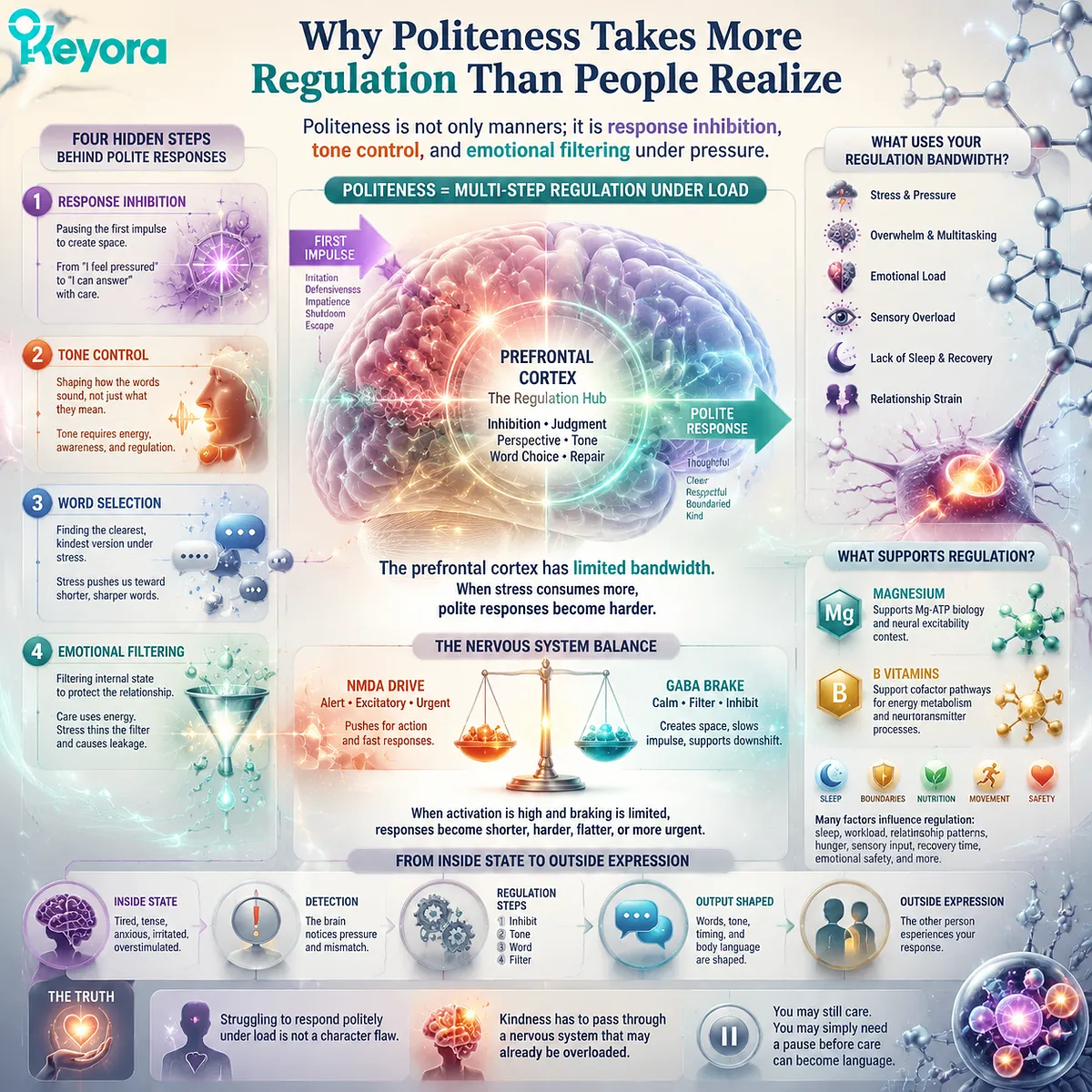
Politeness is not only manners; it is response inhibition, tone control, and emotional filtering under pressure.
Polite responses require several hidden steps.
The first is response inhibition.
When someone asks a question at the wrong moment, your first reaction may not be your best reaction. The first reaction may be irritation, defensiveness, impatience, shutdown, or the urge to escape the conversation.
Politeness does not mean those first reactions never appear. It means the nervous system has enough space to pause before they become the final response.
That pause is important.
It is the space between “I feel pressured” and “I can answer with care.” It is the space between “I want this to stop” and “I need a minute.” It is the space between a sharp tone and a clearer boundary.
When the nervous system is loaded, that pause can shrink.
The second hidden step is tone control.
A sentence is not only its words. “I need time” can sound gentle, firm, cold, irritated, afraid, or dismissive depending on tone. A person may choose polite words, but if the body is tense, the voice may still carry pressure.
That is why someone can say the right thing in a way that still feels harsh.
Tone control requires energy. It requires awareness of the other person, awareness of your own internal state, and enough regulation to soften the delivery.
When you are loaded, tone may leak before you can shape it.
The third step is word selection.
Under stress, you may know the general meaning you want to express, but not the cleanest version of it. You may know you need space, but not know how to ask for it without sounding rejecting. You may know you are overwhelmed, but not know how to explain that without starting a longer conversation.
So the brain reaches for shorter words.
“Fine.”
“Whatever.”
“Later.”
“Stop.”
“I don’t know.”
These may not express the full truth. They may simply be the quickest words available to a system with very little space.
The fourth step is emotional filtering.
When people speak politely, they often filter their internal state. They do not pour every feeling into the sentence. They may be tired, tense, anxious, irritated, or overstimulated, but they try to respond in a way that protects the relationship.
This emotional filtering is not fake. It is often a form of care.
But care still uses energy.
If your internal activation is high, the boundary between inside state and outside expression becomes thinner. More of the stress may leak into the voice, face, posture, timing, or wording.
This is emotional leakage.
You may not intend to sound cold, but fatigue leaks through. You may not intend to sound irritated, but tension leaks through. You may not intend to sound dismissive, but your need to escape the conversation leaks through.
The prefrontal cortex is central to this process because it supports inhibition, word choice, social judgment, perspective-taking, tone control, and repair awareness. It helps you think, “How can I say this in a way that is true and kind?”
But prefrontal regulation bandwidth is limited.
When stress has already consumed much of that bandwidth, polite response becomes harder to generate. Not because politeness is unimportant, but because the system has less available room for the extra steps politeness requires.
GABA/NMDA balance can help explain the body side of this. The nervous system needs activation to respond, but it also needs braking and filtering to slow the first impulse and create space. NMDA-related activity can be understood as part of alert and excitatory processing. GABA-related tone helps support calm filtering and nervous-system downshift.
When activation is high and braking feels limited, responses can become shorter, harder, flatter, or more urgent.
Energy context also matters. Choosing words, inhibiting a first reaction, modulating tone, and staying socially aware all require cognitive-emotional energy. Magnesium participates in Mg-ATP biology and neural excitability context. B vitamins support cofactor pathways involved in energy metabolism and neurotransmitter-related processes.
This does not mean polite communication is only nutritional. Sleep, workload, emotional safety, relationship patterns, boundaries, hunger, sensory input, and recovery time all matter.
But it does mean that struggling to respond politely under load is not simply a character flaw.
Polite responses become harder under stress because kindness has to pass through a nervous system that may already be overloaded.
You may still care.
You may simply need a pause before care can become language.
How MoodFlow Supports Response Readiness
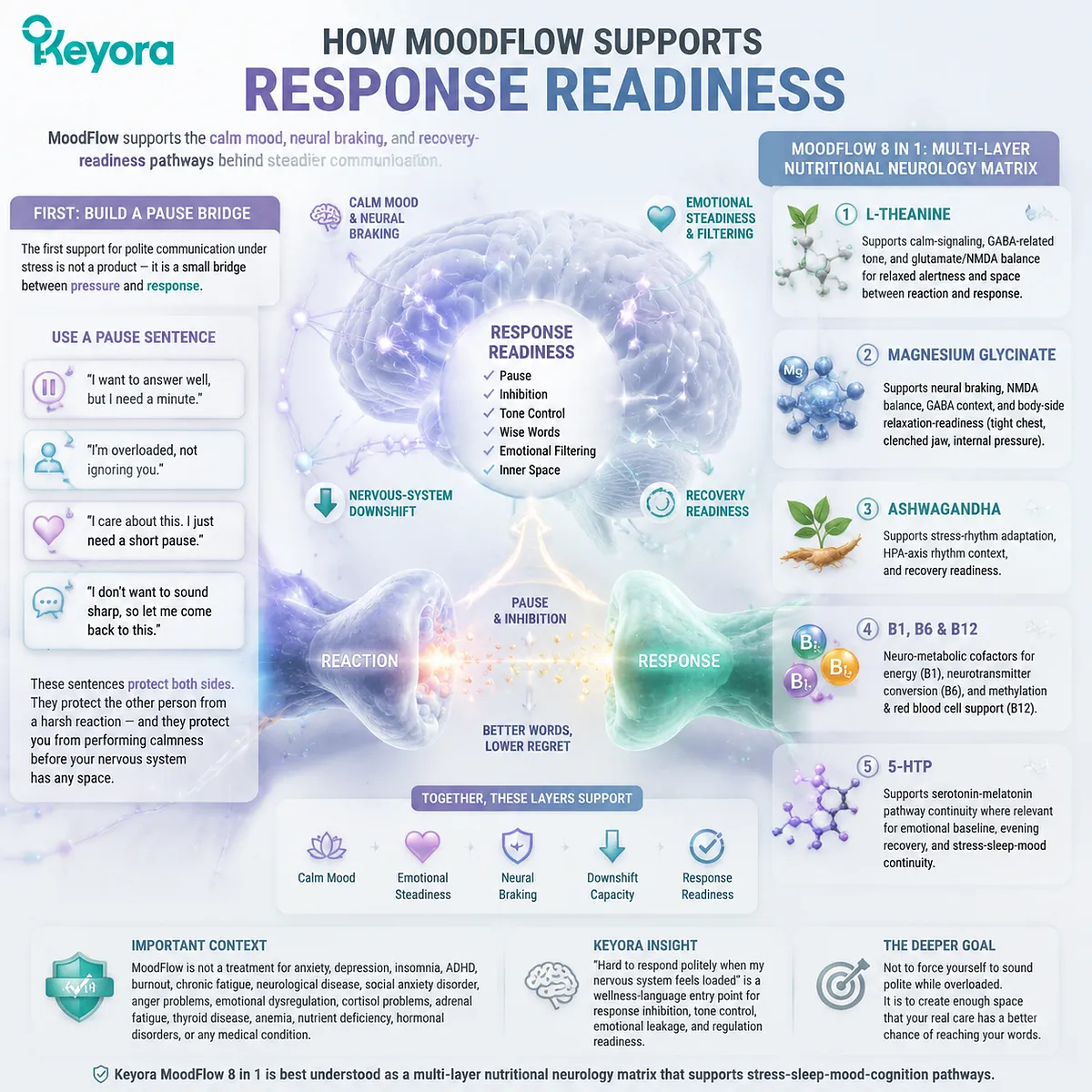
MoodFlow supports the calm mood, neural braking, and recovery-readiness pathways behind steadier communication.
The first support for polite communication under stress is not a product. It is building a small bridge between pressure and response.
Instead of forcing a perfect reply, the first step may be a pause sentence:
“I want to answer well, but I need a minute.”
“I’m overloaded, not ignoring you.”
“I care about this. I just need a short pause.”
“I don’t want to sound sharp, so let me come back to this.”
These sentences are useful because they protect both sides. They protect the other person from a reaction that may come out too hard, and they protect you from having to perform calmness before your nervous system has any space.
Nutritional support can sit beside these practical communication steps.
Keyora MoodFlow 8 in 1 is best understood here as a multi-layer nutritional neurology matrix that supports stress-sleep-mood-cognition pathways.
L-Theanine supports the calm-signaling layer.
L-Theanine is commonly positioned around relaxed alertness, GABA-related tone, glutamate/NMDA balance, and non-sedative calm.
For polite response difficulty, this layer supports the space between first reaction and final response. The goal is not to erase emotion, but to support steadier interpretation and calmer output.
Magnesium glycinate supports the neural braking and body-side relaxation-readiness layer.
Magnesium is relevant to NMDA receptor activity, GABA-related context, nervous-system excitability, and Mg-ATP energy biology.
For loaded communication, this layer speaks to the body side of harsh responses: tight chest, clenched jaw, internal pressure, and the feeling that words may come out too quickly or too sharply.
Ashwagandha supports the stress-rhythm adaptation layer.
Ashwagandha is positioned in the MoodFlow framework around HPA-axis rhythm context, stress-response adaptation, and recovery readiness.
This matters because difficulty responding politely often begins before the conversation. Stress-response carryover may already be present, and the conversation simply reveals how loaded the system has become.
B1, B6, and B12 provide neuro-metabolic cofactor support.
B1 supports energy metabolism context. B6 is relevant to neurotransmitter-related conversion pathways. B12 supports methylation context.
Response inhibition, word selection, tone control, social judgment, and repair awareness all depend on neuro-metabolic infrastructure.
5-HTP supports serotonin-melatonin pathway continuity where relevant.
In this article, 5-HTP is not the main focus. It belongs to the broader substrate-continuity layer supporting normal neurotransmitter-related pathways.
Where polite response difficulty connects with emotional baseline, evening recovery, or stress-sleep-mood continuity, serotonin-melatonin pathway continuity can help explain why recovery timing matters.
Together, these layers support calm mood, emotional steadiness, nervous-system downshift, and response readiness when polite communication feels harder under stress.
MoodFlow is not a treatment for anxiety, depression, insomnia, ADHD, burnout, chronic fatigue, neurological disease, social anxiety disorder, anger problems, emotional dysregulation, cortisol problems, adrenal fatigue, thyroid disease, anemia, nutrient deficiency, hormonal disorders, or any medical condition.
In this article, Keyora uses “hard to respond politely when my nervous system feels loaded” as a wellness-language entry point for explaining response inhibition, tone control, emotional leakage, and regulation readiness.
The deeper goal is not to force yourself to sound polite while overloaded.
It is to create enough space that your real care has a better chance of reaching your words.
Closing Summary
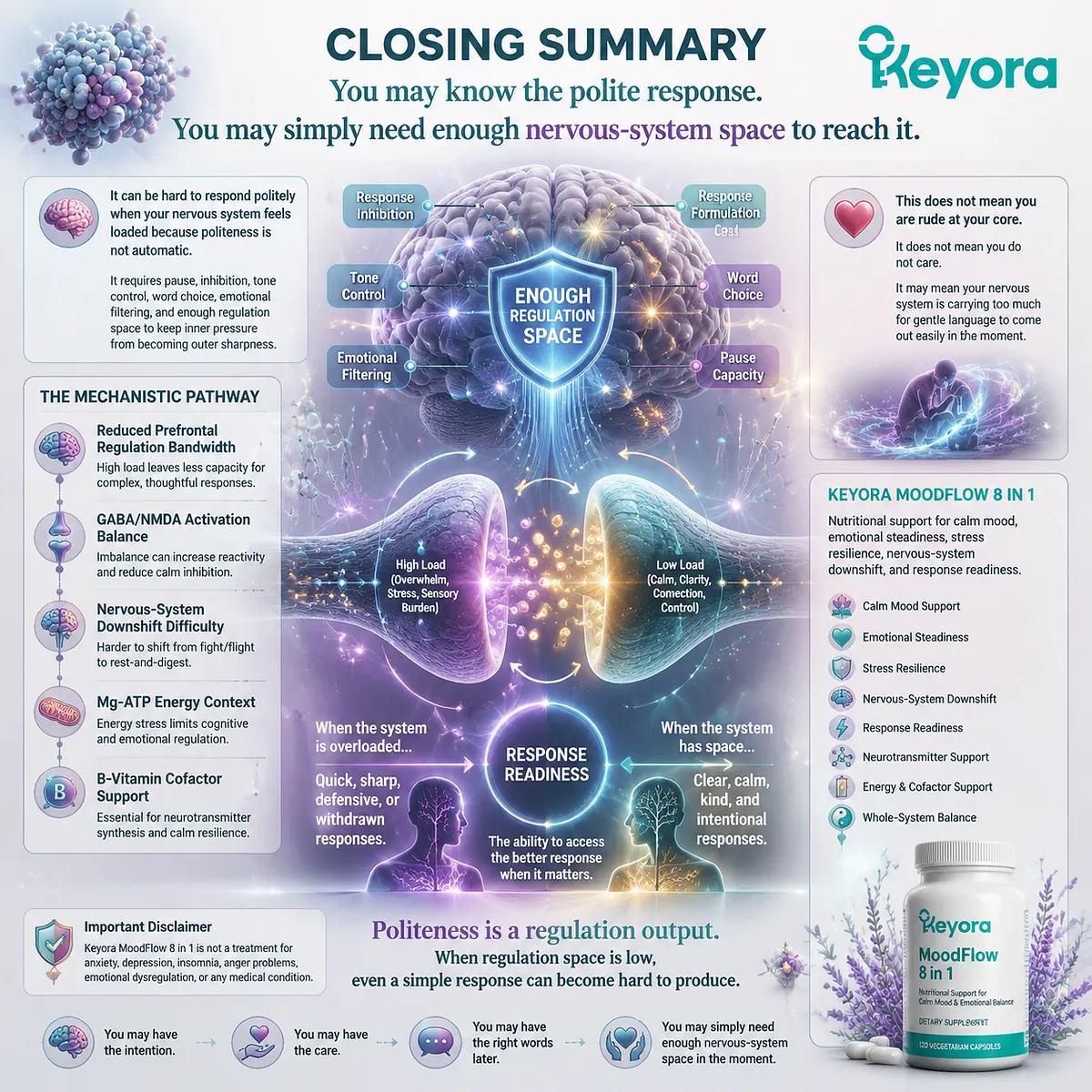
It can be hard to respond politely when your nervous system feels loaded because politeness is not automatic. It requires pause, inhibition, tone control, word choice, emotional filtering, and enough regulation space to keep inner pressure from becoming outer sharpness.
This does not mean you are rude at your core. It does not mean you do not care. It may mean your nervous system is carrying too much for gentle language to come out easily in the moment.
Mechanistically, this can involve response inhibition, tone control, response formulation cost, emotional leakage, reduced prefrontal regulation bandwidth, GABA/NMDA activation balance, nervous-system downshift difficulty, Mg-ATP energy context, and B-vitamin cofactor support.
Keyora MoodFlow 8 in 1 fits as nutritional support for calm mood, emotional steadiness, stress resilience, nervous-system downshift, and response readiness. It is not a treatment for anxiety, depression, insomnia, anger problems, emotional dysregulation, or any medical condition.
You may know the polite response.
You may simply need enough nervous-system space to reach it.
This article is for educational and informational purposes only. It does not provide medical advice, diagnosis, treatment, cure, prevention, disease outcome claims, hormone restoration claims, fertility outcome claims, or formula-specific clinical efficacy claims.