
Why Do Interruptions Make Me Feel So Tense When I’m Under Stress?
Keyora Research Q&A Library
This is part of the Keyora Research Q&A Series, derived from Keyora Nutritional Neurology Series .
Within the Keyora Nutritional Neurology framework, this Q&A translates complex nutrient–brain mechanisms into reader-friendly, evidence-bound answers, focusing on stress resilience, sleep quality, calm mood support, cognitive wellness, and the broader interaction between nutrition, neurochemistry, and daily nervous-system function.
First published by Keyora Research Journal: www.keyorahealth.com

Direct Answer
Interruptions can make you feel tense when you are under stress because they break the fragile control your brain is using to stay organized.
You may not be simply “annoyed.”
You may be trying very hard to hold your focus, your mood, your timing, and your next step together.
The mismatch is this: from the outside, an interruption may look small.
Someone says, “Quick question,” or “Do you have a second?” But inside, it can feel like your mental thread has been cut, your body has been pulled out of rhythm, and one more social demand has arrived before you had space to recover.
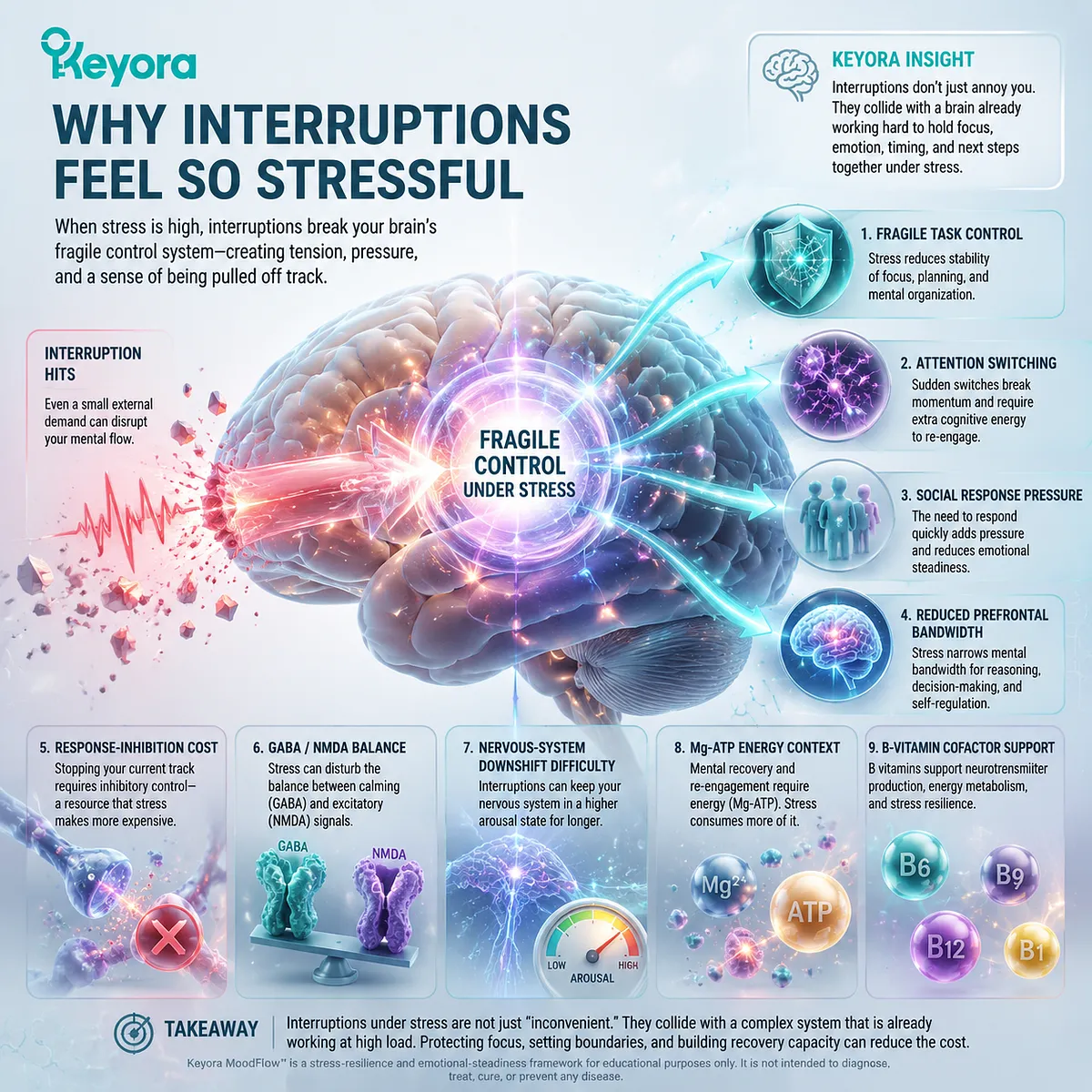
Mechanistically, this can involve fragile task control, sudden attention switching, social response pressure, reduced prefrontal regulation bandwidth, response-inhibition cost, GABA/NMDA activation balance, nervous-system downshift difficulty, Mg-ATP energy context, and B-vitamin cofactor support.
In the Keyora MoodFlow framework, this is understood as a stress-resilience, emotional-steadiness, and interruption-recovery-readiness question, not a medical treatment claim.
When a “Quick Question” Feels Like a Sudden Jolt
Interruptions can feel tense when they break the small amount of control you were using to stay steady.
You may know this moment.
You are trying to finish something. Maybe it is not even a difficult task, but it has already taken effort to begin. You had to gather your thoughts, ignore other distractions, push through internal noise, and tell yourself, “Just finish this one thing first.”
You finally find the thread.
Then someone says your name.
“Can I ask you something?”
“Quick question.”
“Do you have a second?”
“Can you look at this?”
“Wait, before you continue…”
The words may be ordinary. The person may not be rude. The request may not even take long. But your body reacts as if something sharp has entered the room.
-
Your shoulders rise.
-
Your jaw tightens.
-
Your chest feels harder.
-
Your tone may almost change before you can stop it.
-
Your mind loses the sentence it was holding.
-
You may feel a sudden wave of tension, not because the interruption is huge, but because it arrived at the exact moment you were using energy to stay organized.
This is the part many people misunderstand.
They think, “Why am I so irritated by a simple question?” or “Why can’t I just pause and answer?” Some people quickly judge themselves as impatient, difficult, rude, or bad at dealing with people.
But under stress, an interruption is not only a break in focus. It can feel like a break in control.
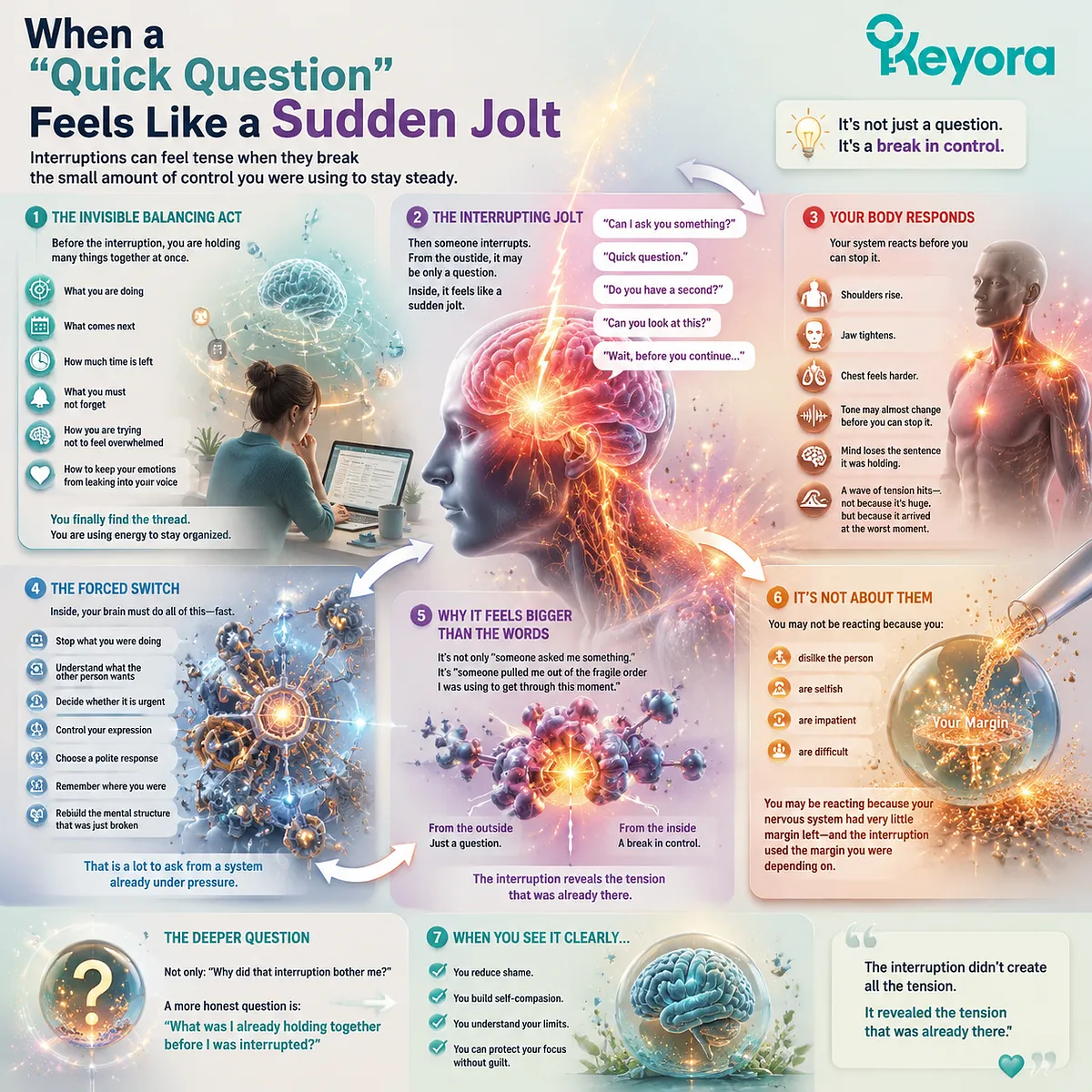
You may have been holding many invisible things at once: what you were doing, what comes next, how much time is left, what you must not forget, how you are trying not to feel overwhelmed, and how to keep your emotions from leaking into your voice.
Then someone interrupts.
From the outside, they may see only a question. Inside, your system experiences a forced switch.
That forced switch has a cost.
You have to stop what you were doing. You have to understand what the other person wants. You have to decide whether it is urgent. You have to control your expression. You have to choose a polite response. You have to remember where you were. Then you have to rebuild the mental structure that was just broken.
That is a lot to ask from a system already under pressure.
This is why the interruption may feel larger than the words themselves.
It is not only “someone asked me something.” It is “someone pulled me out of the fragile order I was using to get through this moment.”
This difference matters because it reduces shame. You may not be reacting because you dislike the person. You may not be reacting because you are selfish. You may be reacting because your nervous system had very little margin left, and the interruption used the margin you were depending on.
The deeper question is not only, “Why did that interruption bother me?”
A more honest question is, “What was I already holding together before I was interrupted?”
When you ask it that way, the experience becomes clearer.
The interruption did not create all the tension. It revealed the tension that was already there.
Why Interruptions Feel Sharper Under Stress
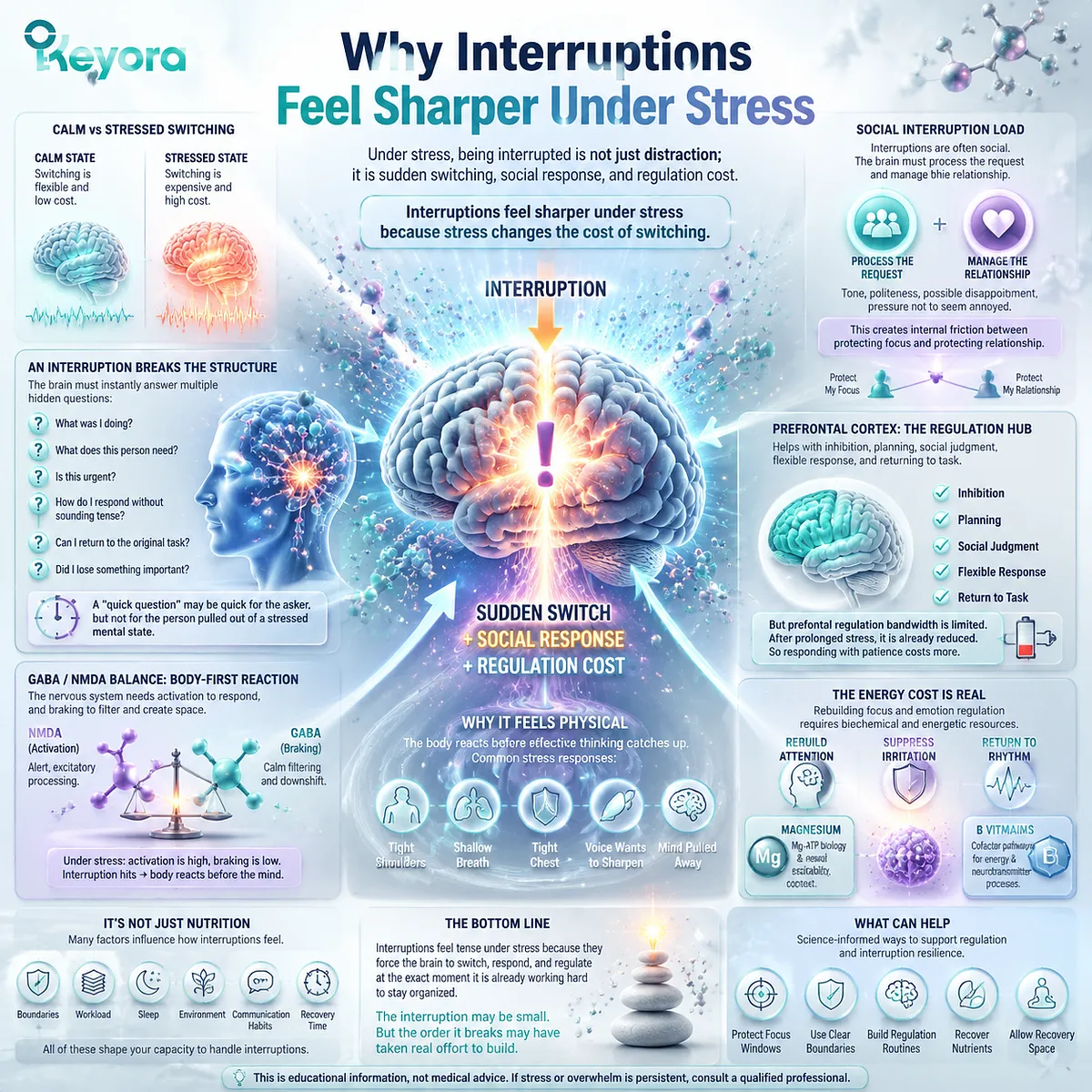
Under stress, being interrupted is not just distraction; it is sudden switching, social response, and regulation cost.
Interruptions feel sharper under stress because stress changes the cost of switching.
When you are calm, switching attention may not feel difficult. Someone asks a question. You pause, answer, return to the task, and continue. The brain has enough space to move between inputs without losing stability.
Under stress, the same switch becomes more expensive.
Your brain may already be using effort to hold a task sequence together. It may be trying to remember what comes next, suppress background worries, ignore noise, manage time pressure, or keep emotion from rising. In that state, focus is not effortless. It is being actively maintained.
An interruption breaks that structure.
The brain has to quickly answer several hidden questions: What was I doing? What does this person need? Is this urgent? How do I respond without sounding tense? Can I return to the original task? Did I lose something important?
That is why a “quick question” may not feel quick.
It may be quick for the person asking, but not quick for the person being pulled out of a stressed mental state.
Another reason interruptions feel tense is that they are often social.
If a machine makes a sound, you may be able to ignore it. But when a person interrupts, the brain adds another layer: relationship management. You are not only processing input. You are also managing tone, politeness, possible disappointment, and the pressure not to seem annoyed.
This creates social interruption load.
You may want to say, “Not now,” but you also do not want to hurt someone. You may want to finish your thought, but you also do not want to seem dismissive. You may need space, but you also feel pulled to respond immediately.
That tension creates internal friction.
One part of you wants to protect your focus. Another part wants to protect the relationship. Under stress, holding both at the same time can feel difficult.
The prefrontal cortex is important here because it helps with inhibition, planning, social judgment, flexible response, and returning to task. It helps you pause before reacting. It helps you say, “Give me five minutes,” instead of letting tension come out in your voice.
But prefrontal regulation bandwidth is limited.
After prolonged pressure, that bandwidth may already be reduced. So when interruption arrives, the ability to inhibit the first reaction and respond gently becomes more costly.
This does not mean you have no responsibility for your response. It means the pathway to a steady response may need more recovery space than you realized.
GABA/NMDA balance also helps explain the body-first reaction.
The nervous system needs activation to notice and respond, but it also needs braking to filter input and create space between stimulus and response.
NMDA-related activity can be understood as part of alert and excitatory processing. GABA-related tone helps support calm filtering and downshift.
Under stress, activation may already be high. Braking may feel less available. Then an interruption enters as a sudden signal, and the body reacts before reflective thinking catches up.
This is why the response can feel physical.
The shoulders tighten. The breath changes. The chest hardens. The voice wants to sharpen. The mind feels pulled away before it has agreed to move.
There is also an energy cost. Rebuilding attention after interruption takes effort. So does suppressing irritation, remembering the original task, and returning to a stable rhythm.
Magnesium participates in Mg-ATP biology and neural excitability context.
B vitamins support cofactor pathways involved in energy metabolism and neurotransmitter-related processes.
This does not mean interruption tension is only nutritional. Boundaries, workload, sleep, environment, communication habits, and recovery time all matter.
But it does mean the experience is not imaginary.
Interruptions feel tense under stress because they force the brain to switch, respond, and regulate at the exact moment it is already working hard to stay organized.
The interruption may be small.
But the order it breaks may have taken real effort to build.
How MoodFlow Supports Interruption Recovery Readiness
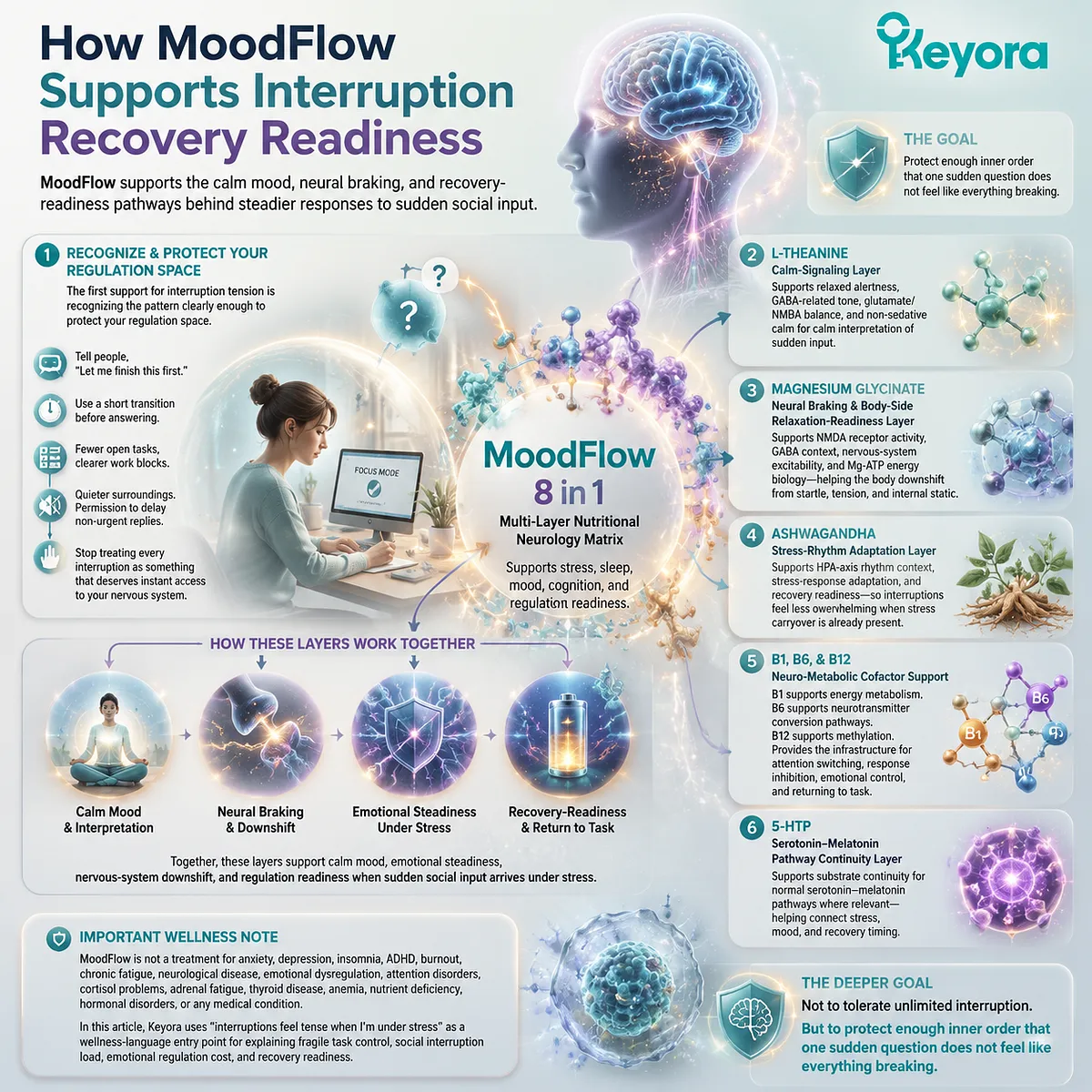
MoodFlow supports the calm mood, neural braking, and recovery-readiness pathways behind steadier responses to sudden social input.
The first support for interruption tension is not a supplement. It is recognizing the pattern clearly enough to protect your regulation space.
-
You may need to tell people, “Let me finish this first.”
-
You may need a short transition before answering.
-
You may need fewer open tasks, clearer work blocks, quieter surroundings, or permission to delay non-urgent replies.
-
You may need to stop treating every interruption as something that deserves instant access to your nervous system.
Nutritional support can sit beside those practical changes.
Keyora MoodFlow 8 in 1 is best understood here as a multi-layer nutritional neurology matrix that supports stress-sleep-mood-cognition pathways.
L-Theanine supports the calm-signaling layer.
L-Theanine is commonly positioned around relaxed alertness, GABA-related tone, glutamate/NMDA balance, and non-sedative calm.
For interruption stress, this layer supports the idea of calm interpretation: noticing sudden input without immediately feeling pulled into tension or urgency.
Magnesium glycinate supports the neural braking and body-side relaxation-readiness layer.
Magnesium is relevant to NMDA receptor activity, GABA-related context, nervous-system excitability, and Mg-ATP energy biology.
For interruptions, this layer speaks to the body side of being startled or pulled away: tight shoulders, chest pressure, internal static, and the sense that your system has been forced to switch before it was ready.
Ashwagandha supports the stress-rhythm adaptation layer.
Ashwagandha is positioned in the MoodFlow framework around HPA-axis rhythm context, stress-response adaptation, and recovery readiness.
This matters because interruptions often feel worse when stress-response carryover is already present. The interruption may not be the beginning of the tension. It may be the final signal that reveals how activated the system already was.
B1, B6, and B12 provide neuro-metabolic cofactor support.
B1 supports energy metabolism context. B6 is relevant to neurotransmitter-related conversion pathways. B12 supports methylation context.
Handling interruptions requires attention switching, response inhibition, emotional control, and returning to task. These processes depend on neuro-metabolic infrastructure.
5-HTP supports serotonin-melatonin pathway continuity where relevant.
In this article, 5-HTP is not the main focus. It belongs to the broader substrate-continuity layer supporting normal neurotransmitter-related pathways.
Where interruption stress affects evening recovery or emotional baseline, serotonin-melatonin pathway continuity can help explain why stress, mood, and recovery timing may connect.
Together, these layers support calm mood, emotional steadiness, nervous-system downshift, and regulation readiness when sudden social input arrives under stress.
MoodFlow is not a treatment for anxiety, depression, insomnia, ADHD, burnout, chronic fatigue, neurological disease, emotional dysregulation, attention disorders, cortisol problems, adrenal fatigue, thyroid disease, anemia, nutrient deficiency, hormonal disorders, or any medical condition.
In this article, Keyora uses “interruptions feel tense when I’m under stress” as a wellness-language entry point for explaining fragile task control, social interruption load, emotional regulation cost, and recovery readiness.
The deeper goal is not to tolerate unlimited interruption.
It is to protect enough inner order that one sudden question does not feel like everything breaking.
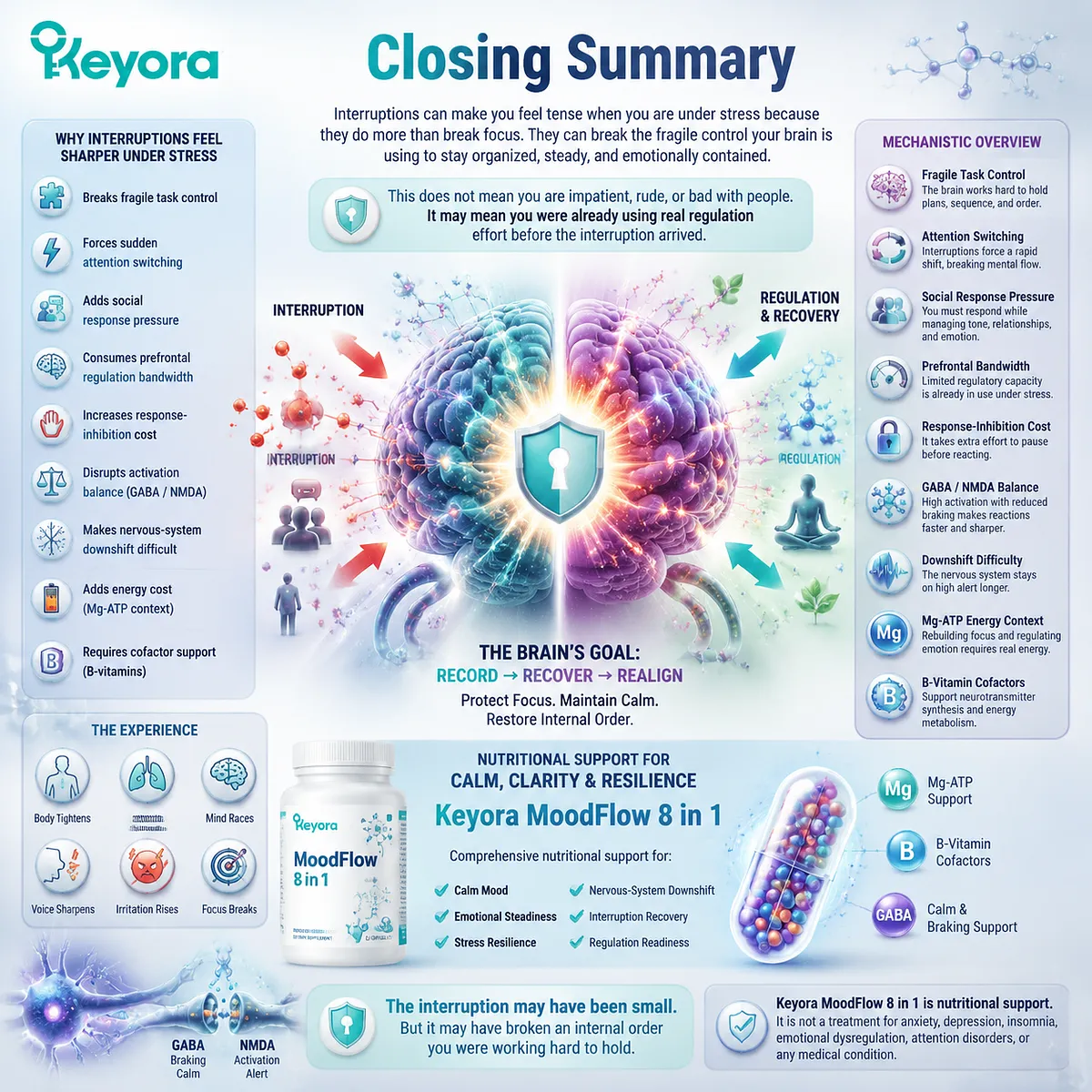
Closing Summary
Interruptions can make you feel tense when you are under stress because they do more than break focus. They can break the fragile control your brain is using to stay organized, steady, and emotionally contained.
This does not mean you are impatient, rude, or bad with people. It may mean you were already using real regulation effort before the interruption arrived.
Mechanistically, this can involve fragile task control, sudden attention switching, social response pressure, reduced prefrontal regulation bandwidth, response-inhibition cost, GABA/NMDA activation balance, nervous-system downshift difficulty, Mg-ATP energy context, and B-vitamin cofactor support.
Keyora MoodFlow 8 in 1 fits as nutritional support for calm mood, emotional steadiness, stress resilience, nervous-system downshift, and interruption recovery readiness. It is not a treatment for anxiety, depression, insomnia, emotional dysregulation, attention disorders, or any medical condition.
The interruption may have been small. But it may have broken an internal order you were working hard to hold.
This article is for educational and informational purposes only. It does not provide medical advice, diagnosis, treatment, cure, prevention, disease outcome claims, hormone restoration claims, fertility outcome claims, or formula-specific clinical efficacy claims.