
Why Do I Feel Defensive During Conversations When I’m Stressed?
Keyora Research Q&A Library
This is part of the Keyora Research Q&A Series, derived from Keyora Nutritional Neurology Series .
Within the Keyora Nutritional Neurology framework, this Q&A translates complex nutrient–brain mechanisms into reader-friendly, evidence-bound answers, focusing on stress resilience, sleep quality, calm mood support, cognitive wellness, and the broader interaction between nutrition, neurochemistry, and daily nervous-system function.
First published by Keyora Research Journal: www.keyorahealth.com

Direct Answer
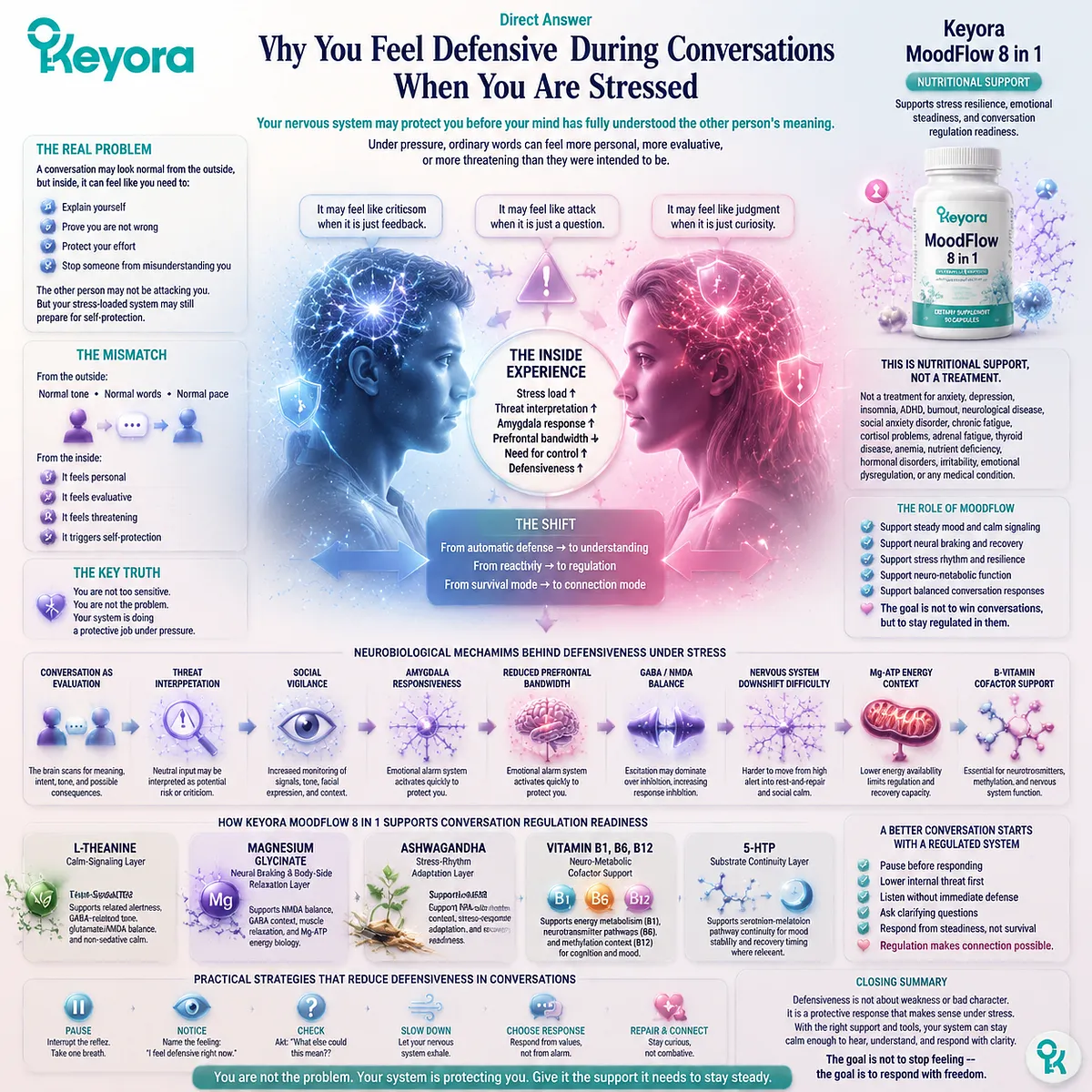
You may feel defensive during conversations when you are stressed because your nervous system may start protecting you before your mind has fully understood the other person’s meaning.
Under pressure, ordinary words can feel more personal, more evaluative, or more threatening than they were intended to be.
The mismatch is this: a conversation may look normal from the outside, but inside, it can feel like you need to explain yourself, prove you are not wrong, protect your effort, or stop someone from misunderstanding you.
The other person may not be attacking you. But your stress-loaded system may still prepare for self-protection.
Mechanistically, this can involve conversation-as-evaluation, threat interpretation, social vigilance, amygdala responsiveness, reduced prefrontal regulation bandwidth, GABA/NMDA activation balance, nervous-system downshift difficulty, Mg-ATP energy context, and B-vitamin cofactor support.
In the Keyora MoodFlow framework, this is understood as a stress-resilience, emotional-steadiness, and conversation-regulation-readiness question, not a medical treatment claim.
When a Normal Conversation Feels Like You Need to Protect Yourself
Defensiveness can appear when stress makes ordinary words feel personally loaded.
There are conversations that should not feel threatening, but somehow they do.
Someone asks, “Did you finish that?” and your body hears pressure. Someone says, “Why did you do it this way?” and your mind immediately starts preparing an explanation. Someone says, “Can we talk about this?” and before the conversation even begins, you feel yourself bracing.
The words may not be harsh. The other person may not be blaming you. They may simply be asking, clarifying, checking, or trying to understand.
Still, something inside you moves into protection.
You may feel your tone become firmer. You may want to explain every detail. You may feel misunderstood before the other person has finished speaking. You may start preparing a defense against an accusation that has not actually been made.
This can be confusing because part of you may know the conversation is ordinary. Another part of you feels like you are being judged.
That split can feel uncomfortable.
You may think, “Why am I reacting like this?” or “Why do I feel attacked when they may not be attacking me?” Some people quickly turn that confusion into self-criticism. They assume they are difficult, argumentative, immature, or bad at communication.
But defensiveness under stress is not always a personality flaw. Sometimes it is a nervous-system protection response.
Under pressure, conversation can stop feeling like simple exchange. It can start feeling like evaluation. A question may sound like a test. A suggestion may sound like criticism. A different opinion may sound like rejection. A reminder may sound like blame.
This does not mean the interpretation is always accurate. It means the body may be listening from a stressed state.
When you are calm, you may be able to hear the same words with more flexibility. “Why did you choose this?” may sound like curiosity. “Can we talk?” may sound like connection. “Next time, maybe we can try it differently” may sound like a practical adjustment.
But when you are stressed, the same words can feel loaded.
They can touch your effort, your competence, your intention, your belonging, or your fear of not doing enough. The conversation becomes less about the sentence itself and more about what the sentence might mean about you.
This is the hidden layer of defensiveness.
Often, people do not defend only an idea. They defend the self that feels at risk underneath the idea.
They defend their intention: “I wasn’t trying to do it wrong.”
They defend their effort: “I already tried so hard.”
They defend their competence: “I do know what I’m doing.”
They defend their belonging: “Please don’t see me as a problem.”
Seen this way, defensiveness becomes easier to understand. It may not begin as a desire to fight. It may begin as a desire not to be misread.
The deeper question is not only, “Why am I defensive?”
A more useful question is, “What part of me felt it had to be protected in that moment?”
That question creates space.
It helps you see that your reaction may have begun before the conversation was fully understood. The body may have moved into protection first, while the mind was still trying to process what was actually being said.
When that happens, the goal is not to shame yourself for reacting. The goal is to notice the protective pattern early enough to return to listening.

Why Stress Turns Conversation Into Self-Protection
Under stress, the nervous system may protect your intention before you fully understand the other person’s meaning.
Stress changes the way conversation is received.
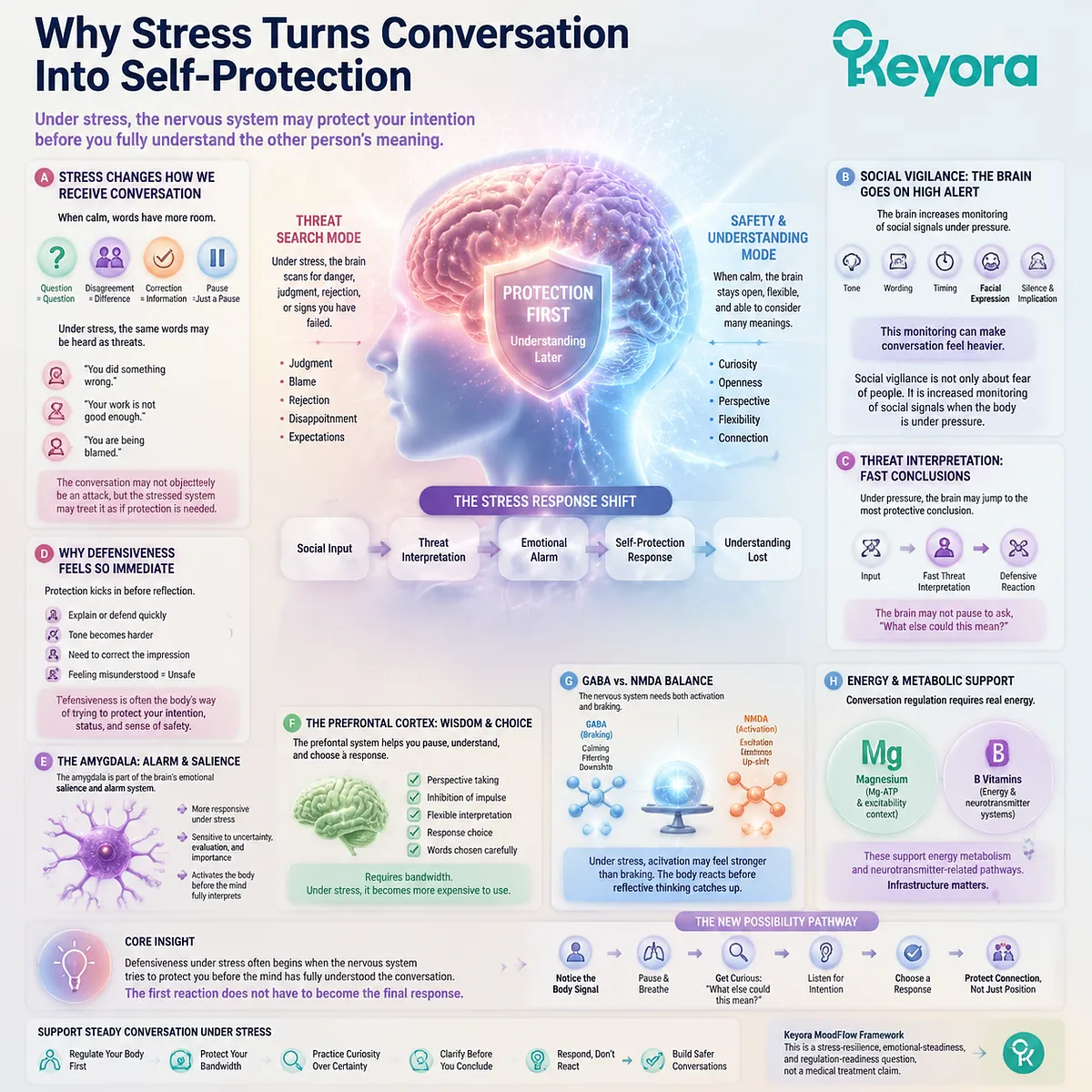
When the nervous system is calm, words have more room. A question can be a question. A disagreement can be a difference. A correction can be information. A pause can simply be a pause.
But when stress is high, the brain may search for what could go wrong. It may listen for judgment, blame, rejection, disappointment, or signs that you have failed to meet expectations.
This is social vigilance.
Social vigilance is not only about fear of people. It is the brain’s increased monitoring of social signals when the body is under pressure. Under stress, the brain may pay closer attention to tone, wording, timing, facial expression, silence, and implied meaning.
That monitoring can make conversation feel heavier.
A simple “Can you explain this?” may be heard as, “You did something wrong.” A practical “Let’s revisit this” may be felt as, “Your work is not good enough.” A neutral “I thought we agreed on something else” may become, “You are being blamed.”
The conversation may not objectively be an attack. But the stressed system may treat it as if protection is needed.
One reason is threat interpretation.
Under pressure, the brain may move faster from input to conclusion. It may not pause long enough to ask, “What else could this mean?” Instead, it may jump toward the interpretation that protects you from possible criticism or loss of control.
That is why defensiveness can feel so immediate.
You may start explaining before you know why. You may speak in a harder tone than you intended. You may feel the need to correct the other person’s impression quickly, because being misunderstood feels unsafe in that moment.
The amygdala can be understood as part of the brain’s emotional salience and alarm system. Under stress, it may become more responsive to signals that feel uncertain, evaluative, or personally important. Conversation often contains all three.
At the same time, the prefrontal cortex has to work harder.
The prefrontal system helps with perspective, inhibition, flexible interpretation, and response choice. It helps you hear the full sentence before reacting. It helps you separate “this person disagrees with me” from “this person is attacking me.” It helps you say, “Let me understand what you mean,” instead of immediately proving your position.
But those skills require bandwidth.
When stress has already used up much of that bandwidth, the pause becomes harder. The generous interpretation becomes harder. The soft response becomes harder. The ability to admit a small point without feeling globally wrong becomes harder.
This does not mean you lose responsibility for your words. It means the pathway to a steady response may require more support and more space under pressure.
GABA/NMDA balance offers another useful way to explain the body-first feeling.
The nervous system needs activation to respond to life, but it also needs braking to slow down, filter input, and create room between stimulus and response. NMDA-related activity is part of excitatory signaling and alert processing. GABA-related tone helps support calming, filtering, and downshift.
When stress is high, activation may feel stronger than braking. The body may react before reflective thinking catches up.
This is why defensiveness can feel physical.
The chest tightens. The jaw sets. The shoulders rise. The voice becomes sharper. The mind searches for evidence. The body prepares to protect your side of the story.
Energy context also matters. Conversation regulation is not effortless. Listening well, inhibiting a defensive response, understanding intention, choosing words, and staying emotionally flexible all require cognitive-emotional energy.
Magnesium participates in Mg-ATP biology and neural excitability context. B vitamins support cofactor pathways involved in energy metabolism and neurotransmitter-related processes. These do not “solve” defensiveness, but they help explain why steady conversation depends on biological infrastructure, not only good intentions.
The core insight is this: defensiveness under stress often begins when the nervous system tries to protect you before the mind has fully understood the conversation.
Once you see that, a new possibility appears.
The first reaction does not have to become the final response.
How MoodFlow Supports Conversation Regulation Readiness
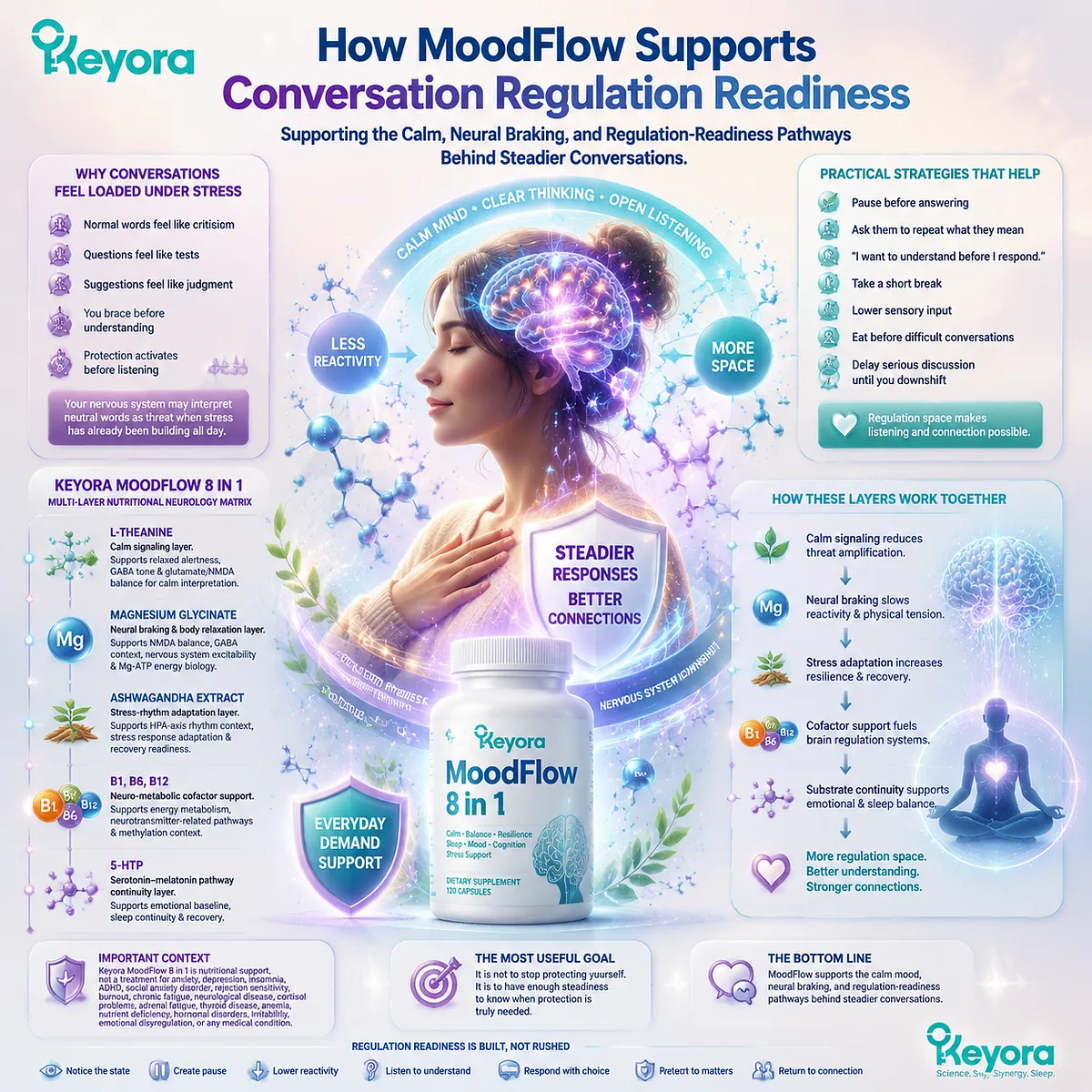
MoodFlow supports the calm mood, neural braking, and regulation-readiness pathways behind steadier conversations.
Once the experience is understood, support can be discussed without turning defensiveness into a personal failure or turning MoodFlow into a communication promise.
If you feel defensive during conversations when you are stressed, the goal is not to become passive, silent, or endlessly agreeable. Sometimes you do need to explain yourself. Sometimes you do need to set a boundary. Sometimes the other person really is being unfair.
The goal is not to remove self-protection.
The goal is to support enough regulation space so you can tell the difference between actual threat and stress-amplified interpretation.
That support may include pausing before answering, asking the other person to repeat what they mean, saying “I want to understand before I respond,” taking a short break, lowering sensory input, eating before difficult conversations, or delaying serious discussion until the body has downshifted.
Nutritional support can sit beside those practical strategies.
Keyora MoodFlow 8 in 1 is best understood here as a multi-layer nutritional neurology matrix that supports stress-sleep-mood-cognition pathways.
L-Theanine supports the calm-signaling layer.
L-Theanine is commonly positioned around relaxed alertness, GABA-related tone, glutamate/NMDA balance, and non-sedative calm.
In conversation defensiveness, this matters because the goal is not to feel numb. The goal is to stay clear enough to listen while reducing the feeling that every question requires immediate protection.
This layer supports calm interpretation: the ability to hear words with a little more space before the body turns them into threat.
Magnesium glycinate supports the neural braking and body-side relaxation-readiness layer.
Magnesium is relevant to NMDA receptor activity, GABA-related context, nervous-system excitability, and Mg-ATP energy biology. The glycinate form also fits a gentler daily-support logic.
For defensiveness, this layer speaks to the body side of protection: tight chest, clenched jaw, raised shoulders, internal static, and the feeling that your system is preparing to argue before you have chosen to.
Neural braking does not mean suppressing your voice. It means supporting the system’s ability to slow activation enough for a steadier response to become possible.
Ashwagandha supports the stress-rhythm adaptation layer.
In the MoodFlow framework, Ashwagandha is positioned around HPA-axis rhythm context, stress-response adaptation, and recovery readiness.
This matters because defensiveness often does not begin inside the conversation. It begins earlier, when stress has already placed the body in alert mode.
If the nervous system is already bracing, a normal conversation can feel like another evaluation. Ashwagandha belongs to the background support layer for stress resilience and recovery readiness.
B1, B6, and B12 provide neuro-metabolic cofactor support.
B1 supports energy metabolism context. B6 is relevant to neurotransmitter-related conversion pathways. B12 supports methylation context.
Steady conversation requires attention, inhibition, flexible thinking, tone control, and emotional interpretation. These processes depend on neuro-metabolic infrastructure.
This does not mean B vitamins treat defensiveness, irritability, fatigue, anxiety, or nutrient deficiency without clinical evaluation. It means they belong to the cofactor background of the body’s stress-mood-cognition support system.
5-HTP supports serotonin-melatonin pathway continuity where relevant.
In this article, 5-HTP is not the main focus. Its role is better understood as part of the broader substrate-continuity layer that supports normal neurotransmitter-related pathways.
Where conversation defensiveness is connected to emotional baseline, evening recovery, or stress-sleep-mood continuity, 5-HTP can be discussed as one part of MoodFlow’s broader pathway architecture.
It should not be framed as a way to erase emotional reactions or make people agreeable.
Together, these layers create a support logic: calm signaling, neural braking, stress-rhythm adaptation, neuro-metabolic cofactor support, and substrate continuity.
That is the correct role of MoodFlow in this conversation.
MoodFlow is not a treatment for anxiety, depression, insomnia, ADHD, social anxiety disorder, rejection sensitivity, burnout, chronic fatigue, neurological disease, cortisol problems, adrenal fatigue, thyroid disease, anemia, nutrient deficiency, hormonal disorders, irritability, emotional dysregulation, or any medical condition.
In this article, Keyora uses “feeling defensive during conversations when stressed” as a wellness-language entry point for explaining conversation threat interpretation, emotional regulation cost, nervous-system downshift, and regulation readiness.
The most useful goal is not to stop protecting yourself.
It is to have enough steadiness to know when protection is truly needed.
Closing Summary
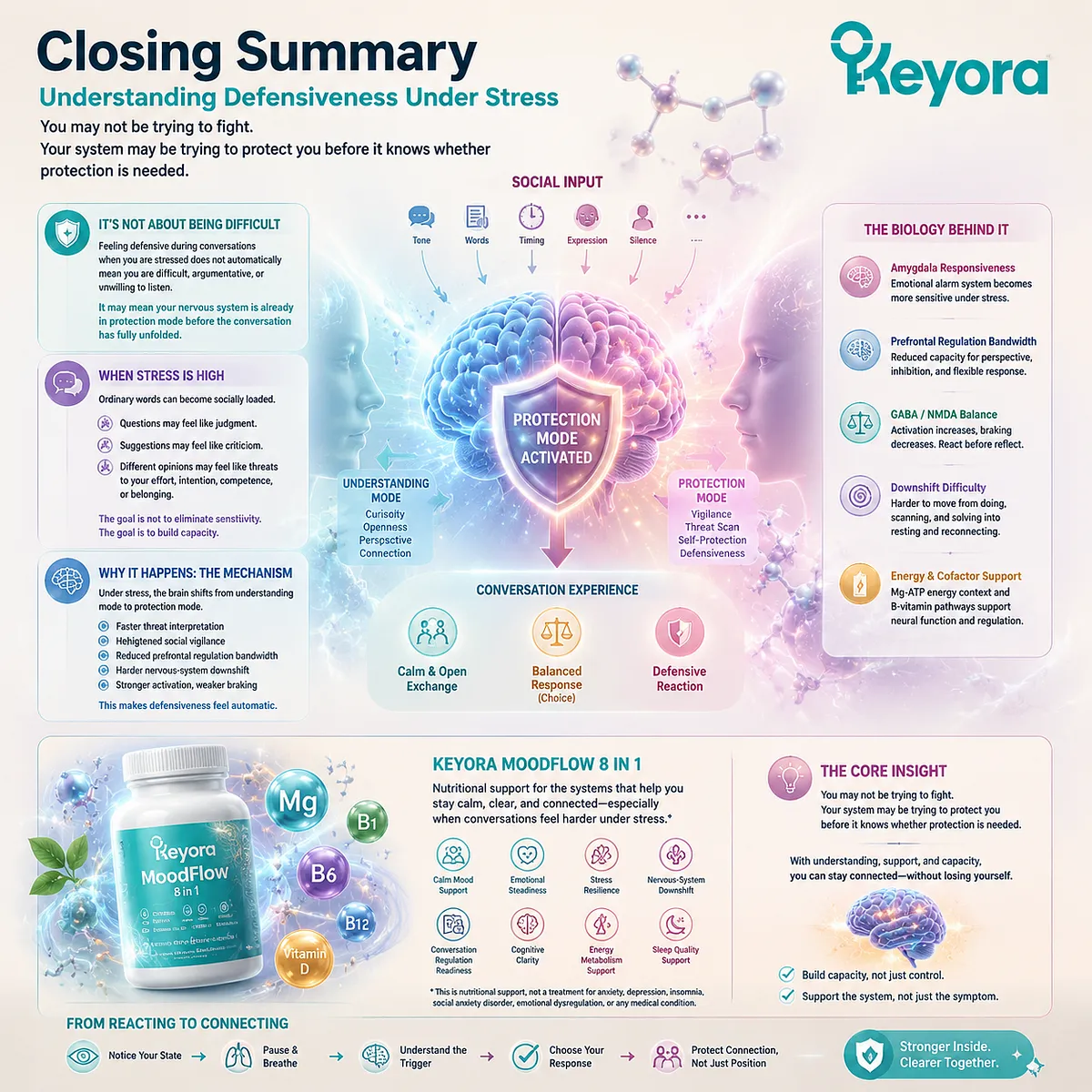
Feeling defensive during conversations when you are stressed does not automatically mean you are difficult, argumentative, or unwilling to listen. It may mean your nervous system is already in protection mode before the conversation has fully unfolded.
Under stress, ordinary words can become socially loaded.
Questions may feel like judgment.
Suggestions may feel like criticism.
Different opinions may feel like threats to your effort, intention, competence, or belonging.
Mechanistically, this can involve conversation-as-evaluation, threat interpretation, social vigilance, amygdala responsiveness, reduced prefrontal regulation bandwidth, GABA/NMDA activation balance, nervous-system downshift difficulty, Mg-ATP energy context, and B-vitamin cofactor support.
Keyora MoodFlow 8 in 1 fits as nutritional support for calm mood, emotional steadiness, stress resilience, nervous-system downshift, and conversation regulation readiness. It is not a treatment for anxiety, depression, insomnia, social anxiety disorder, emotional dysregulation, or any medical condition.
The deeper insight is this: you may not be trying to fight. Your system may be trying to protect you before it knows whether protection is needed.
This article is for educational and informational purposes only. It does not provide medical advice, diagnosis, treatment, cure, prevention, disease outcome claims, hormone restoration claims, fertility outcome claims, or formula-specific clinical efficacy claims.