
Why Do Small Requests Feel Like Too Much When I’m Stressed?
Keyora Research Q&A Library
This is part of the Keyora Research Q&A Series, derived from Keyora Nutritional Neurology Series .
Within the Keyora Nutritional Neurology framework, this Q&A translates complex nutrient–brain mechanisms into reader-friendly, evidence-bound answers, focusing on stress resilience, sleep quality, calm mood support, cognitive wellness, and the broader interaction between nutrition, neurochemistry, and daily nervous-system function.
First published by Keyora Research Journal: www.keyorahealth.com

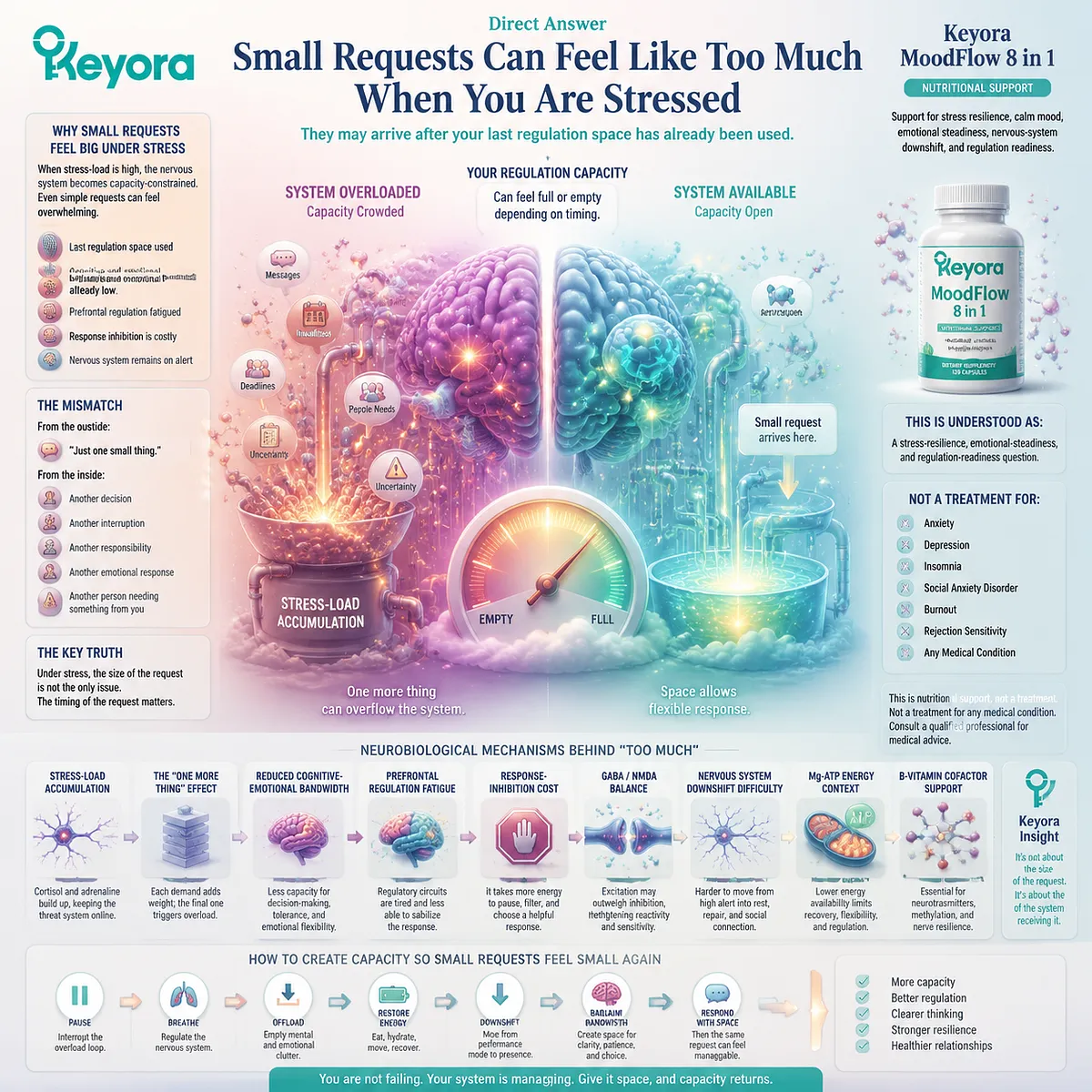
Direct Answer
Small requests can feel like too much when you are stressed because they may arrive after your last regulation space has already been used. The request may be simple, but the system receiving it may already be crowded.
The mismatch is this: from the outside, it may look like “just one small thing.”
But inside, it can feel like another decision, another interruption, another responsibility, another emotional response, or another person needing something from you.
Under stress, the size of the request is not the only issue. The timing of the request matters.
Mechanistically, this can involve stress-load accumulation, the “one more thing” effect, reduced cognitive-emotional bandwidth, prefrontal regulation fatigue, response-inhibition cost, GABA/NMDA activation balance, nervous-system downshift difficulty, Mg-ATP energy context, and B-vitamin cofactor support.
In the Keyora MoodFlow framework, this is understood as a stress-resilience, emotional-steadiness, and regulation-readiness question, not a medical treatment claim.
When “Just One Small Thing” Feels Like Too Much
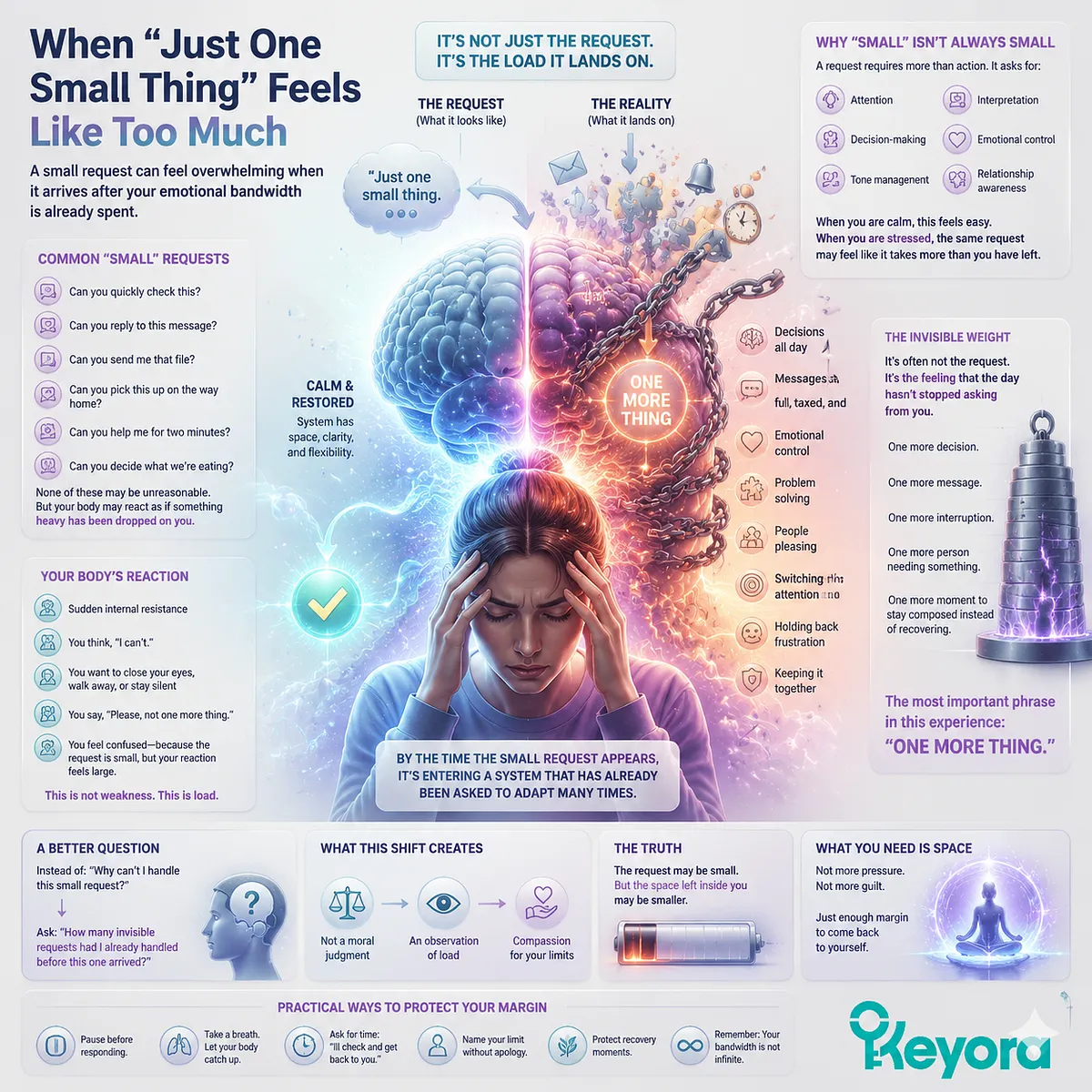
A small request can feel overwhelming when it arrives after your emotional bandwidth is already spent.
It often begins with something ordinary.
“Can you quickly check this?”
“Can you reply to this message?”
“Can you send me that file?”
“Can you pick this up on the way home?”
“Can you help me for two minutes?”
“Can you decide what we’re eating?”
None of these requests may be unreasonable. Some of them may truly take only a few minutes. The person asking may not be demanding, rude, or careless. They may simply need something small.
Still, your body may react as if something heavy has been dropped on you.
You may feel a sudden internal resistance. You may think, “I can’t.” You may want to close your eyes, walk away, stay silent, or say, “Please, not one more thing.” You may feel confused because the request is small, but your reaction feels large.
This is where many people start blaming themselves.
They may think they are selfish, impatient, unhelpful, or too easily overwhelmed. They may wonder why one small request feels impossible when they know, logically, that it is not a major task.
But the request itself may not be the full story.
A small request can feel like too much when it arrives after a long chain of previous demands. You may have spent the day making decisions, managing tasks, responding to people, switching attention, staying polite, solving problems, holding back frustration, and keeping yourself functional.
By the time the small request appears, it is not entering a fresh system.
It is entering a system that has already been asked to adapt many times.
That is why “small” is not always small.
A request does not only require action. It often requires attention, interpretation, decision-making, emotional control, tone management, and relationship awareness. Even a simple favor may ask the brain to stop what it is doing, understand what is needed, decide how to respond, and manage the other person’s expectation.
When you are calm, this may feel easy. You can answer, help, adjust, and move on.
When you are stressed, the same request may feel like it takes more than you have left.
The most important phrase in this experience is often “one more thing.”
Not one huge thing. Not one impossible thing. One more thing.
The nervous system may not be reacting only to the request. It may be reacting to the feeling that the day has not stopped asking from you. One more decision. One more message. One more interruption. One more person needing something. One more moment where you have to stay composed instead of recovering.
That is why the deeper question may not be, “Why can’t I handle this small request?”
A better question is, “How many invisible requests had I already handled before this one arrived?”
This shift matters.
It turns the experience from a moral judgment into an observation of load. Maybe you are not refusing life. Maybe your system is showing you that the margin is gone.
The request may be small.
But the space left inside you may be smaller.
Why Small Requests Become Big Demands Under Stress
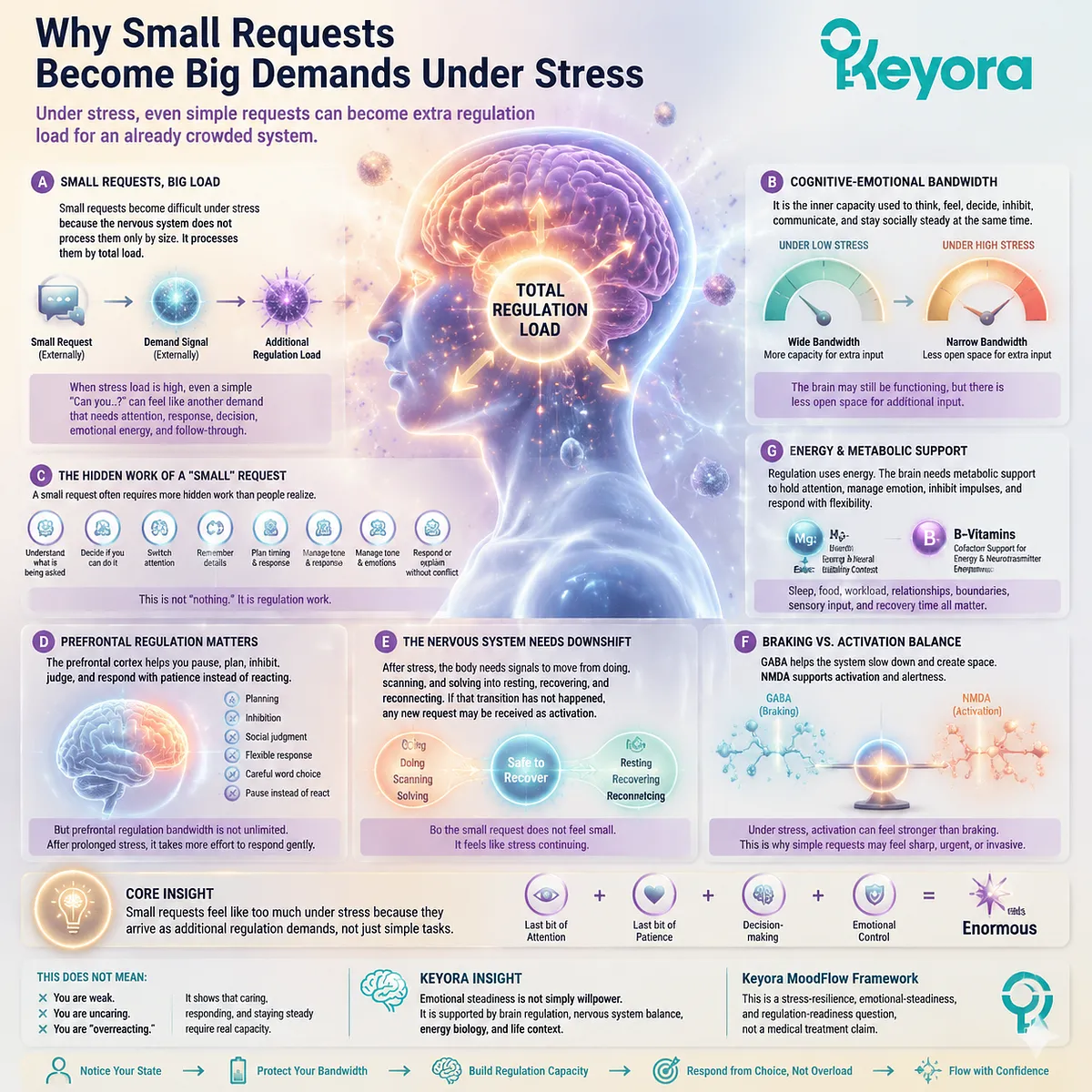
Under stress, even simple requests can become extra regulation load for an already crowded system.
Small requests become difficult under stress because the nervous system does not process them only by size. It processes them by total load.
A small task can feel manageable when your system has room. But when stress load is high, the same task may be categorized as another demand signal. It may feel like something else that needs attention, response, decision, emotional energy, and follow-through.
This is why the body can react so quickly.
Before you have time to think, “This is not a big deal,” your system may already feel the cost. Another shift of attention. Another expectation. Another chance to disappoint someone. Another moment where you must suppress your first reaction and respond appropriately.
That is cognitive-emotional bandwidth.
It is the inner capacity used to think, feel, decide, inhibit, communicate, and stay socially steady at the same time. Under stress, that bandwidth becomes narrower. The brain may still be functioning, but there is less open space for extra input.
A small request often requires more hidden work than people realize.
You have to understand what the person wants. You have to decide whether you can do it. You have to switch attention away from what you were already holding. You may have to remember details, plan timing, control your tone, and avoid sounding irritated. If you cannot do it, you may have to explain why without creating conflict.
That is not “nothing.”
It is regulation work.
The prefrontal cortex plays an important role here. It helps with planning, inhibition, social judgment, flexible response, and choosing words carefully. It helps you pause instead of reacting. It helps you answer with patience instead of letting the first internal feeling become the first external response.
But prefrontal regulation bandwidth is not unlimited.
After prolonged stress, decision load, social pressure, or sensory overload, the ability to pause and respond gently may become more expensive. You may still know what the “right” response is, but reaching it takes more effort.
This is why small requests can create a strange internal split.
One part of you may know the request is reasonable. Another part may feel almost unable to tolerate it. You may want to help and resist helping at the same time. You may care about the person and still feel pressure when they ask.
That does not make you uncaring.
It shows that caring also requires capacity.
The nervous system also needs a downshift process. After stress, the body needs signals that it can move from doing, scanning, and solving into resting, recovering, and reconnecting. If that transition has not happened, any new request may be received as activation.
In simple terms, the body has not yet reached “safe to recover.”
So the small request does not feel like a small request. It feels like stress continuing.
GABA/NMDA balance helps explain this in consumer-friendly language. The nervous system needs activation to respond to life, but it also needs braking to filter and soften input. NMDA-related activity is part of excitatory signaling and alertness. GABA-related tone helps the system slow down and create space between stimulus and response.
Under stress, activation can feel stronger than braking.
That is why a simple request may feel sharp, urgent, or invasive. It may not be because the request is objectively intense. It may be because your internal braking system is already working hard.
Energy biology also matters. Regulation uses energy. The brain needs metabolic support to hold attention, inhibit impulses, manage emotion, and respond with flexibility. Magnesium participates in Mg-ATP biology and neural excitability context. B vitamins support cofactor pathways involved in energy metabolism and neurotransmitter-related processes.
This does not mean a person feels overwhelmed by small requests only because of nutrition. Life context matters. Sleep, food, workload, relationship patterns, boundaries, sensory input, and recovery time all matter.
But it does mean emotional steadiness is not simply willpower.
The core insight is this: small requests feel like too much under stress because they arrive as additional regulation demands, not just simple tasks.
The request may be small.
But if it asks for the last bit of your attention, patience, decision-making, and emotional control, it can feel enormous.
How MoodFlow Supports Regulation Readiness
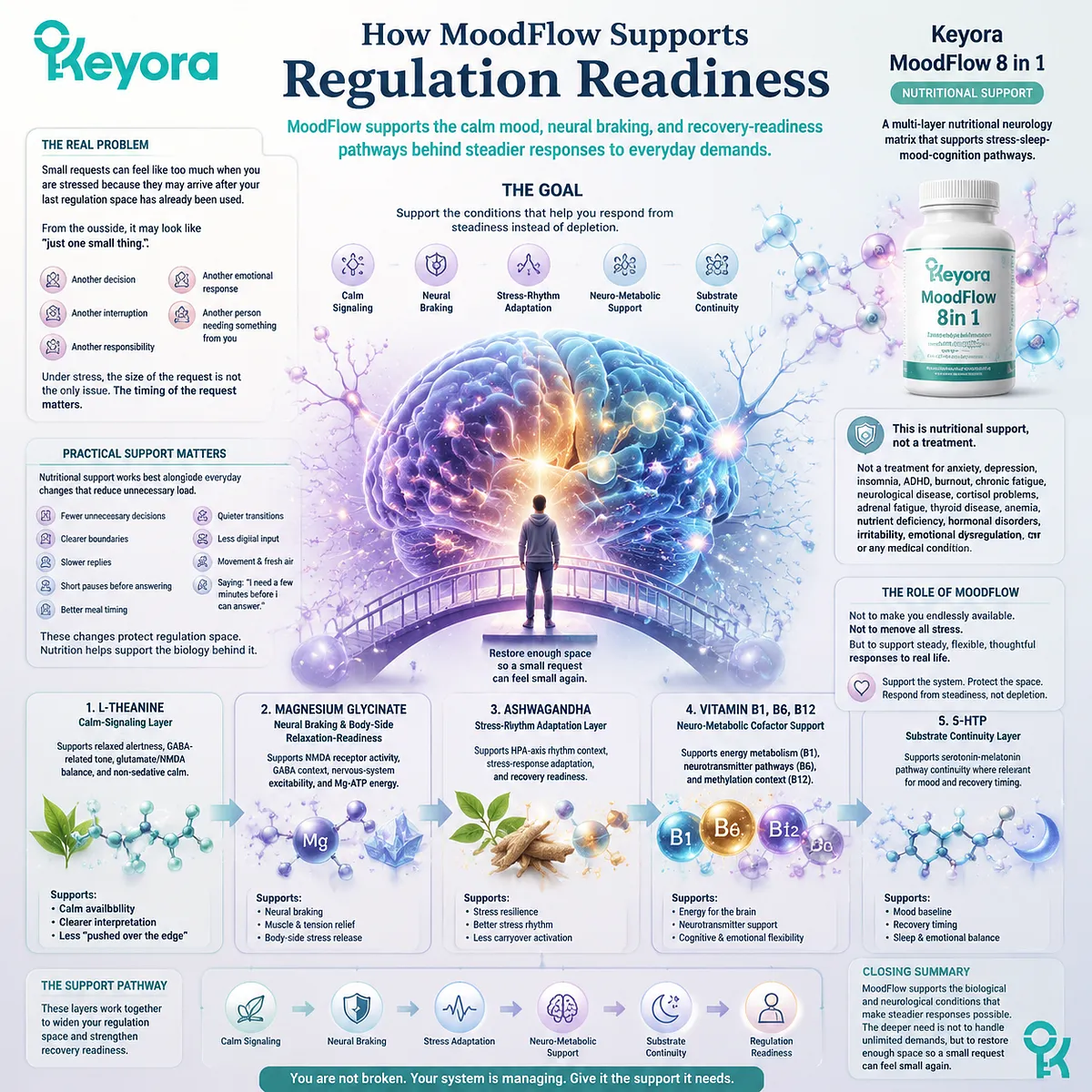
MoodFlow supports the calm mood, neural braking, and recovery-readiness pathways behind steadier responses to everyday demands.
Once the experience is understood, support can be discussed in a way that respects the real problem.
If small requests feel like too much when you are stressed, the goal is not to become endlessly available. The goal is not to say yes to everything with a smile. The goal is to understand why your system reaches the edge and to support the conditions that help you respond from steadiness instead of depletion.
That support may include practical changes: fewer unnecessary decisions, clearer boundaries, slower replies, short pauses before answering, better meal timing, quieter transitions, less digital input, or simply saying, “I need a few minutes before I can answer.”
Nutritional support can sit beside those changes.
Keyora MoodFlow 8 in 1 is best understood here as a multi-layer nutritional neurology matrix that supports stress-sleep-mood-cognition pathways.
L-Theanine supports the calm-signaling layer.
L-Theanine is commonly positioned around relaxed alertness, GABA-related tone, glutamate/NMDA balance, and non-sedative calm.
When small requests arrive under stress, many people do not need to be sedated or emotionally shut down. They need enough calm signaling to interpret the request without immediately feeling pushed over the edge.
This layer supports the idea of calm availability: being clear enough to respond, but not so activated that every new input feels like pressure.
Magnesium glycinate supports the neural braking and body-side relaxation-readiness layer.
Magnesium is relevant to NMDA receptor activity, GABA-related context, nervous-system excitability, and Mg-ATP energy biology. The glycinate form also fits a gentler daily-support logic.
For small-request overload, this layer speaks to the body side of stress: tense shoulders, clenched jaw, internal static, tight chest, and the feeling that one more ask is physically hard to receive.
Neural braking does not mean forcing yourself to be calm. It means supporting the system’s ability to slow activation enough for a more measured response to become possible.
Ashwagandha supports the stress-rhythm adaptation layer.
In the MoodFlow framework, Ashwagandha is positioned around HPA-axis rhythm context, stress-response adaptation, and recovery readiness.
This matters because small requests often feel too heavy when they arrive on top of stress-response carryover. The problem may not be the request alone. It may be the stress rhythm that was already active before the request appeared.
Ashwagandha belongs to the background layer of stress resilience: supporting the body’s ability to move through pressure without staying locked in a high-alert state.
B1, B6, and B12 provide neuro-metabolic cofactor support.
B1 supports energy metabolism context. B6 is relevant to neurotransmitter-related conversion pathways. B12 supports methylation context.
Responding to small requests requires attention, inhibition, decision-making, tone control, and emotional flexibility. These processes depend on neuro-metabolic infrastructure.
This does not mean B vitamins treat overwhelm, fatigue, irritability, or nutrient deficiency without clinical evaluation. It means they belong to the cofactor background of the body’s stress-mood-cognition support system.
5-HTP supports serotonin-melatonin pathway continuity where relevant.
In this article, 5-HTP is not the main focus. Its role is better understood as part of the broader substrate-continuity layer that supports normal neurotransmitter-related pathways.
Where small-request overload appears in the evening, or where emotional baseline and recovery timing are relevant, serotonin-melatonin pathway continuity can help explain why mood, stress, and recovery are connected.
It should not be framed as a way to erase emotional reactions or make people endlessly patient.
Together, these layers create a support logic: calm signaling, neural braking, stress-rhythm adaptation, neuro-metabolic cofactor support, and substrate continuity.
That is the correct role of MoodFlow in this conversation.
MoodFlow is not a treatment for anxiety, depression, insomnia, ADHD, burnout, chronic fatigue, neurological disease, cortisol problems, adrenal fatigue, thyroid disease, anemia, nutrient deficiency, hormonal disorders, irritability, emotional dysregulation, or any medical condition.
In this article, Keyora uses “small requests feel like too much when I’m stressed” as a wellness-language entry point for explaining stress load, emotional bandwidth, regulation cost, nervous-system downshift, and recovery readiness.
The deeper need is not to become a person who can handle unlimited demands.
The deeper need is to restore enough space that a small request can feel small again.
Closing Summary
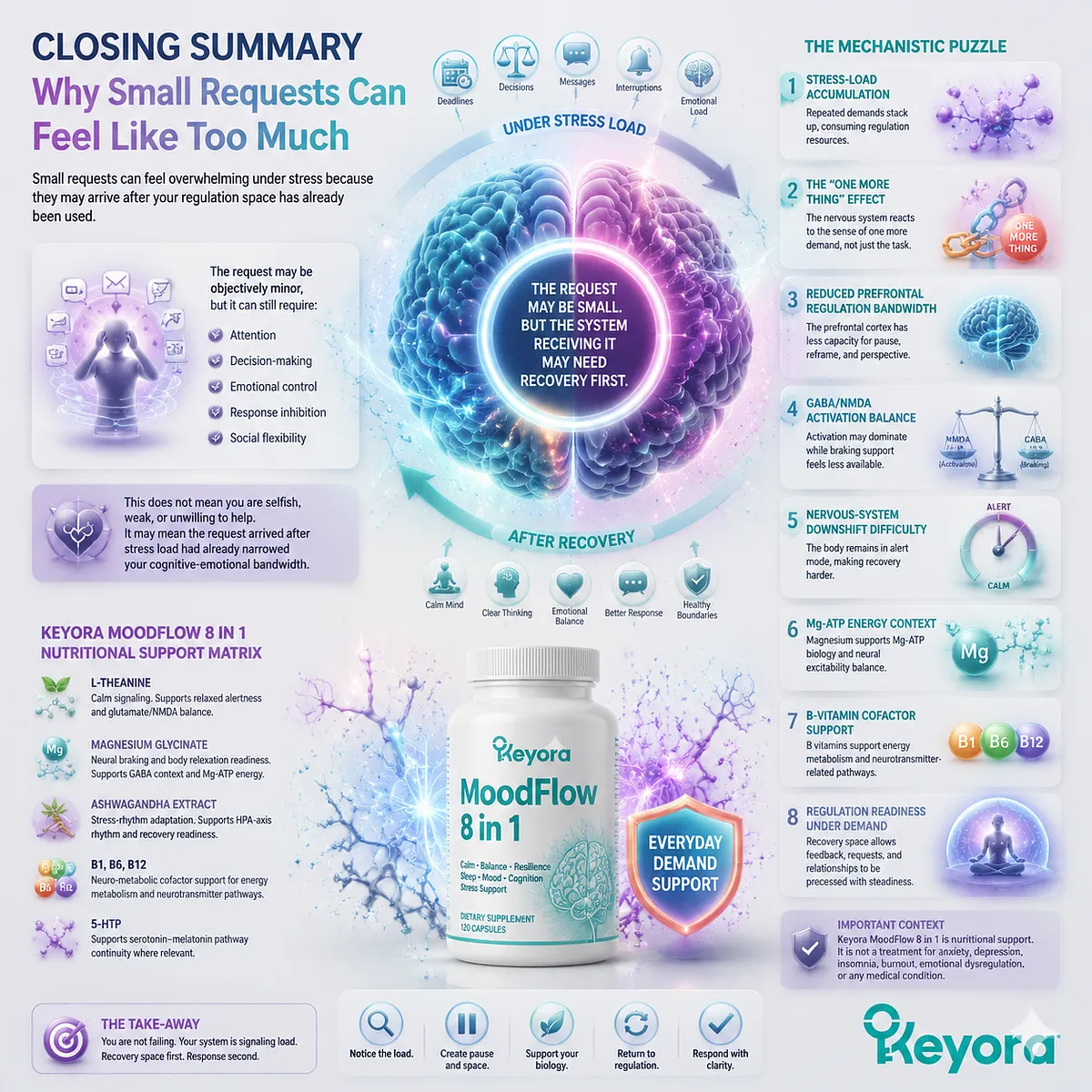
Small requests can feel like too much when you are stressed because they may arrive after your regulation space has already been used. The request may be objectively minor, but it can still require attention, decision-making, emotional control, response inhibition, and social flexibility.
This does not mean you are selfish, weak, or unwilling to help. It may mean the request arrived after stress load had already narrowed your cognitive-emotional bandwidth.
Mechanistically, this can involve stress-load accumulation, the “one more thing” effect, reduced prefrontal regulation bandwidth, GABA/NMDA activation balance, nervous-system downshift difficulty, Mg-ATP energy context, and B-vitamin cofactor support.
Keyora MoodFlow 8 in 1 fits as nutritional support for calm mood, emotional steadiness, stress resilience, nervous-system downshift, and regulation readiness under everyday demand load. It is not a treatment for anxiety, depression, insomnia, burnout, emotional dysregulation, or any medical condition.
The request may be small. But the system receiving it may need recovery first.
This article is for educational and informational purposes only. It does not provide medical advice, diagnosis, treatment, cure, prevention, disease outcome claims, hormone restoration claims, fertility outcome claims, or formula-specific clinical efficacy claims.