
Why Do I Feel Emotionally On Edge Around People After a Busy Day?
Keyora Research Q&A Library
This is part of the Keyora Research Q&A Series, derived from Keyora Nutritional Neurology Series .
Within the Keyora Nutritional Neurology framework, this Q&A translates complex nutrient–brain mechanisms into reader-friendly, evidence-bound answers, focusing on stress resilience, sleep quality, calm mood support, cognitive wellness, and the broader interaction between nutrition, neurochemistry, and daily nervous-system function.
First published by Keyora Research Journal: www.keyorahealth.com

Direct Answer
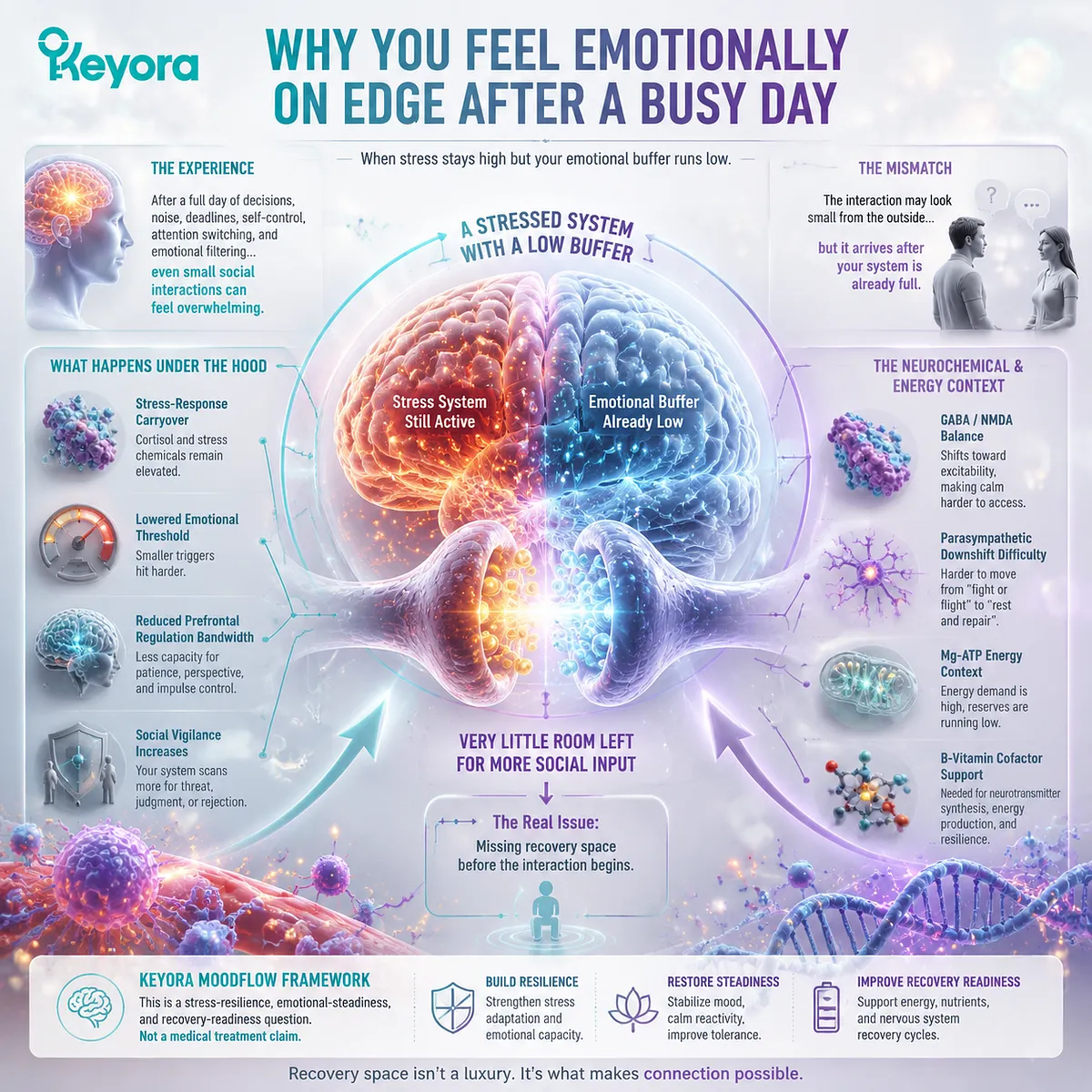
You may feel emotionally on edge around people after a busy day because your stress system may still be active while your emotional buffer is already low.
By the time another person speaks, asks something, needs a reply, or simply enters your space, your nervous system may have very little room left for more social input.
The mismatch is this: the interaction may look small from the outside, but it arrives after a full day of decisions, noise, deadlines, self-control, attention switching, and emotional filtering.
So the problem is not always the person in front of you. It may be the missing recovery space before that interaction begins.
Mechanistically, this can involve stress-response carryover, lowered emotional threshold, reduced prefrontal regulation bandwidth, social vigilance, GABA/NMDA activation balance, parasympathetic downshift difficulty, Mg-ATP energy context, and B-vitamin cofactor support.
In the Keyora MoodFlow framework, this is understood as a stress-resilience, emotional-steadiness, and recovery-readiness question, not a medical treatment claim.
When People Feel Like Too Much After the Day Is Already Full
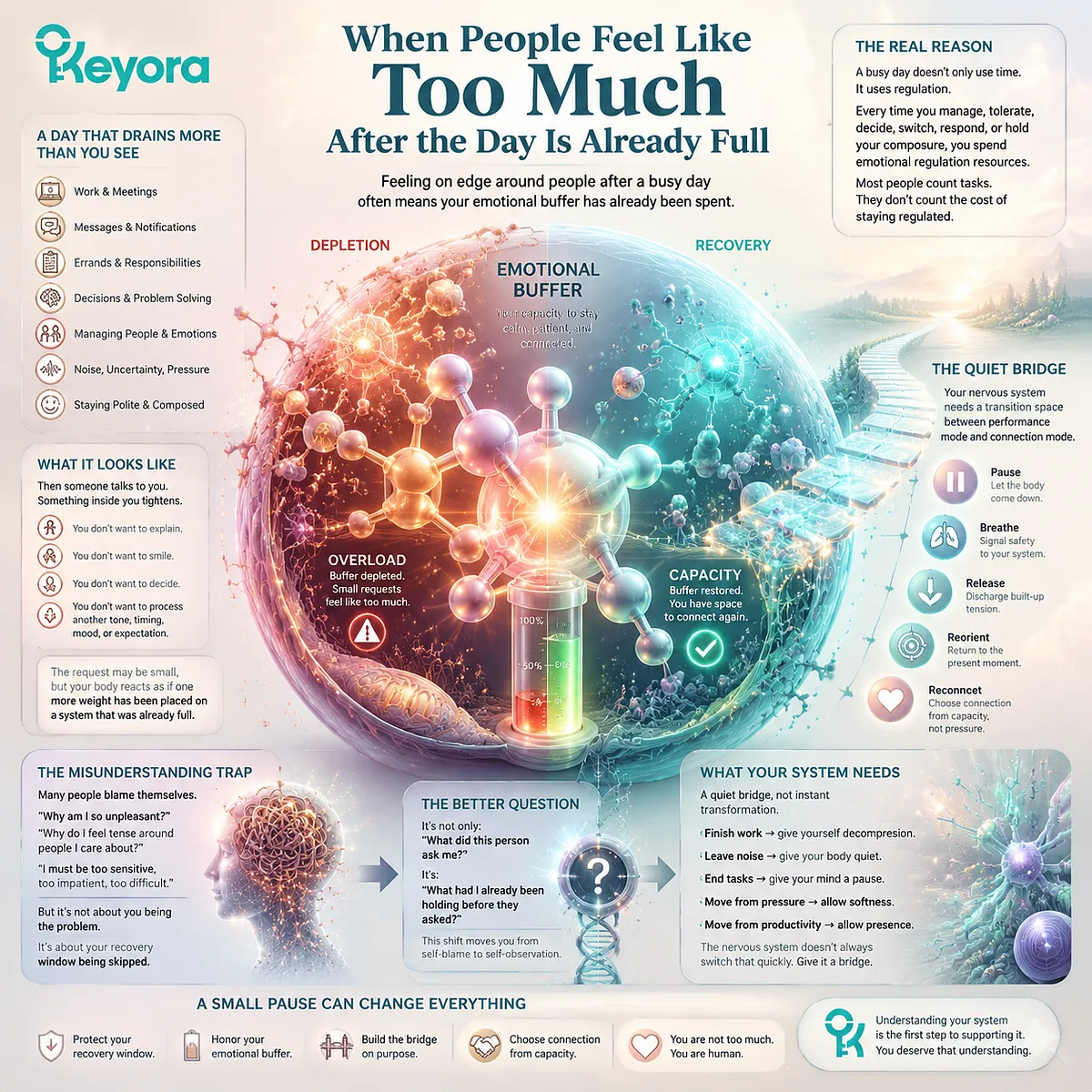
Feeling on edge around people after a busy day often means your emotional buffer has already been spent.
There is a specific kind of tension that appears at the end of a long day.
You may have finished work, school, meetings, errands, messages, or family responsibilities. From the outside, the demanding part of the day may seem over. But inside, your system may still feel full, tight, and easily disturbed.
Then someone talks to you.
It may be a family member asking what you want for dinner. It may be a coworker adding one more detail. It may be a friend sending a message. It may be your partner asking a simple question. None of these things is necessarily wrong, rude, or unreasonable.
Still, something inside you tightens.
You may not want to explain. You may not want to smile. You may not want to make another decision. You may not want to process another person’s tone, timing, mood, or expectation. The request may be small, but your body reacts as if one more weight has been placed on a system that was already carrying too much.
This is where many people misunderstand themselves.
They may think, “Why am I so unpleasant after a busy day?” or “Why do I feel tense around people I actually care about?” Some people start blaming their personality. They assume they are too sensitive, too impatient, too introverted, too difficult, or too emotionally weak.
But feeling emotionally on edge around people after a busy day is not always a sign that you dislike people. It is often a sign that your recovery window has been skipped.
A busy day does not only use time. It uses regulation.
Every time you stay polite under pressure, hold back irritation, make a decision, switch tasks, listen carefully, respond professionally, tolerate noise, manage uncertainty, or keep yourself composed, you spend emotional regulation resources.
Most people count tasks. They do not count the cost of staying regulated through those tasks.
That is why the final conversation of the day can feel strangely difficult. It may not be the biggest demand. It may simply be the demand that arrives after your buffer has already been reduced.
The question is not only, “What did this person ask me?”
A more revealing question is, “What had I already been holding before they asked?”
This shift matters. It helps move the experience away from self-blame and toward self-observation. Maybe the issue is not that you are becoming cold, rude, or socially broken. Maybe your nervous system had no transition space between performance mode and connection mode.
People often expect themselves to switch instantly.
-
They finish work and expect themselves to become warm.
-
They leave a noisy environment and expect themselves to become patient.
-
They answer messages all day and expect themselves to be emotionally available at night.
-
They move from pressure to family, from tasks to relationships, from productivity to tenderness, without any pause.
But the nervous system does not always switch that quickly.
Sometimes it needs a quiet bridge.
Without that bridge, other people can feel like pressure, even when they are not trying to pressure you.
Why a Busy Day Lowers Your Social-Emotional Threshold
Stress carryover can make ordinary social input feel sharper, louder, or more demanding than it really is.
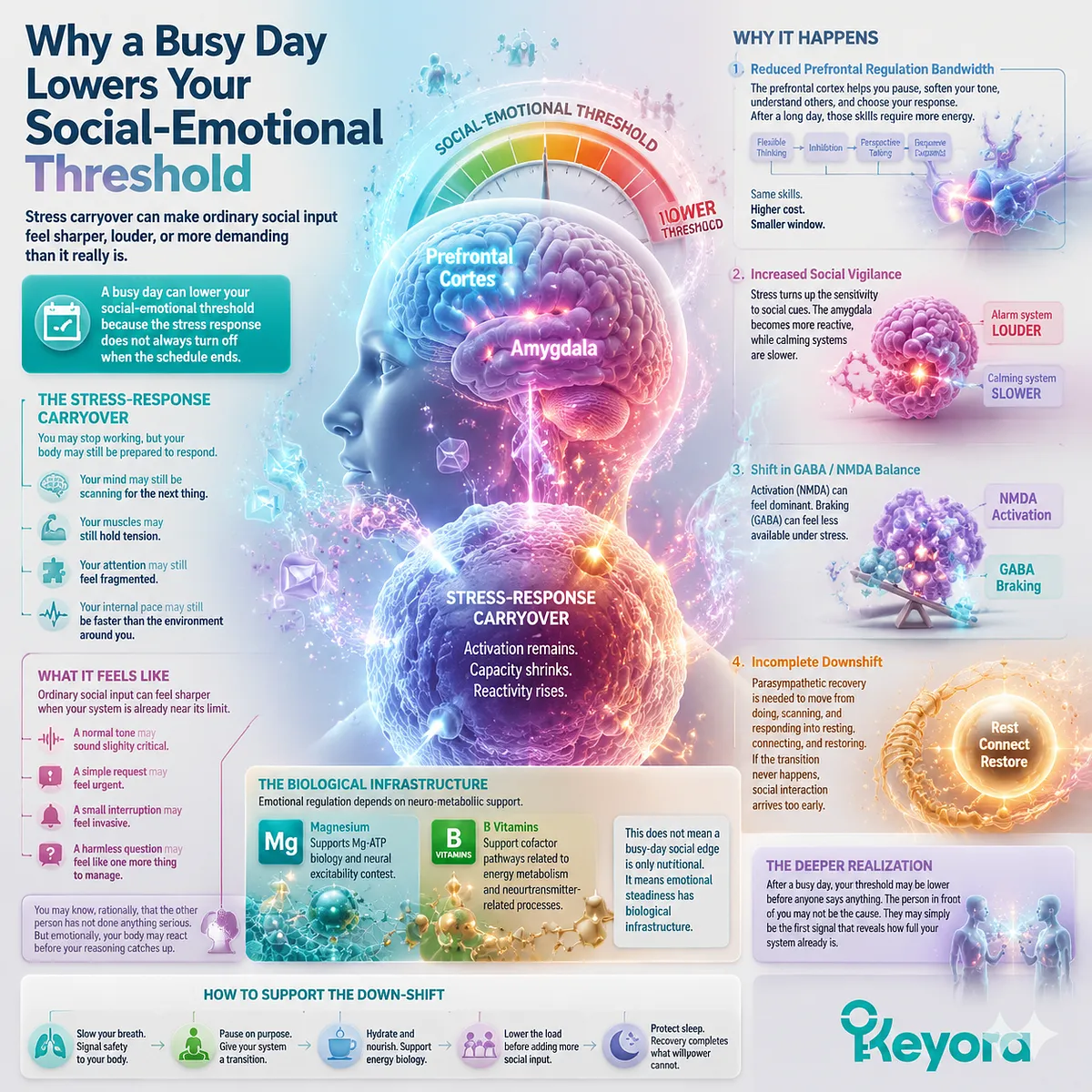
A busy day can lower your social-emotional threshold because the stress response does not always turn off when the schedule ends.
-
You may stop working, but your body may still be prepared to respond.
-
Your mind may still be scanning for the next thing.
-
Your muscles may still hold tension.
-
Your attention may still feel fragmented. Your internal pace may still be faster than the environment around you.
This is stress-response carryover.
It means the body is still carrying activation from previous demands. When another person enters your space, their voice, question, message, or emotional energy does not land on a neutral system. It lands on a system that may already be close to its limit.
That is why ordinary social input can feel sharper after a busy day.
-
A normal tone may sound slightly critical.
-
A simple request may feel urgent.
-
A small interruption may feel invasive.
-
A harmless question may feel like one more thing to manage.
You may know, rationally, that the other person has not done anything serious. But emotionally, your body may react before your reasoning catches up.
One reason is reduced prefrontal regulation bandwidth.
The prefrontal cortex helps with flexible thinking, perspective, inhibition, response selection, and social self-control. It helps you pause before speaking, soften your tone, understand another person’s intention, and choose a response that fits the relationship rather than the immediate feeling.
But those processes require energy.
After a long day, the ability to stay patient, warm, and socially flexible can feel more expensive. You may still be capable of it, but the cost is higher. The pause before reacting becomes harder to access. The gentle response takes more effort. The ability to interpret someone generously may feel thinner.
Another layer is social vigilance.
When you are stressed, your nervous system may become more alert to social cues. It may watch tone more closely, listen for disappointment, anticipate judgment, or prepare for another demand. This can make people feel more intense, even when the actual interaction is ordinary.
The amygdala, which helps the brain detect emotional salience and possible threat, may become more responsive under stress. At the same time, the regulatory systems that help you reframe the situation may be tired. In everyday language, the alarm system may be louder while the calming explanation is slower.
That does not mean you are making things up. It means your interpretation system is operating under load.
GABA/NMDA balance also matters. The nervous system needs both activation and braking. NMDA-related activity is connected with alertness and excitatory signaling, while GABA-related tone helps the system slow, filter, and soften. Under stress, the activation side can feel more dominant. The braking side may feel less available.
This is why being physically tired does not always mean you feel calm.
You can be exhausted and still internally tense. You can want rest and still feel reactive. You can love the people around you and still feel unable to receive more input. The issue is not simply tiredness. It is incomplete downshift.
Parasympathetic recovery is part of that downshift. The body needs signals that it is safe to move from doing, scanning, and responding into resting, connecting, and restoring. If that transition never happens, social interaction may arrive too early, before the system is ready.
Energy biology also sits underneath this experience. Emotional regulation is not just a mindset. It depends on neuro-metabolic support.
Magnesium participates in Mg-ATP biology and neural excitability context.
B vitamins support cofactor pathways related to energy metabolism and neurotransmitter-related processes.
This does not mean a busy-day social edge is only nutritional. It means emotional steadiness has biological infrastructure.
When that infrastructure is under pressure, social input can feel heavier than it looks.
The deeper realization is simple: after a busy day, your threshold may be lower before anyone says anything. The person in front of you may not be the cause. They may simply be the first signal that reveals how full your system already is.
How MoodFlow Supports Social Recovery Readiness
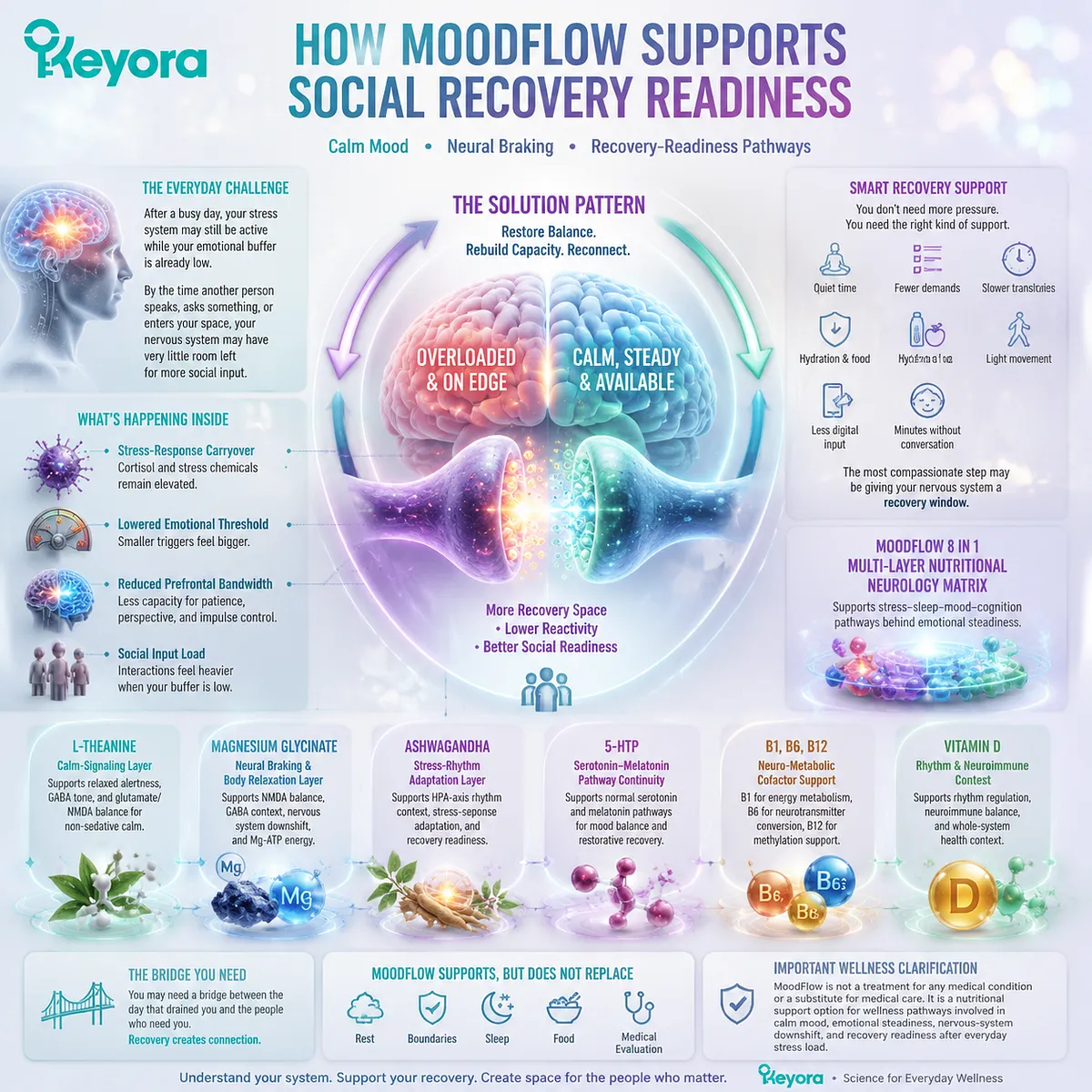
MoodFlow supports the calm mood, neural braking, and recovery-readiness pathways behind emotional steadiness.
Once the experience is understood clearly, support can be discussed without turning the article into product advertising.
If you feel emotionally on edge around people after a busy day, the goal is not to force yourself to become more socially available. The goal is to understand what your system needs in order to recover enough for social input to feel manageable again.
That support may include quiet time, fewer immediate demands, slower transitions, clearer boundaries, hydration, food, light movement, less digital input, or a few minutes without conversation.
Sometimes the most compassionate step is not to push through social pressure, but to give the nervous system a recovery window.
Nutritional support can sit beside that larger recovery picture.
Keyora MoodFlow 8 in 1 is best understood here as a multi-layer nutritional neurology matrix that supports stress-sleep-mood-cognition pathways.
L-Theanine supports the calm-signaling layer.
L-Theanine is commonly positioned around relaxed alertness, GABA-related tone, glutamate/NMDA balance, and non-sedative calm.
This matters because after a busy day, many people do not want to feel knocked out or dulled. They want to feel less internally sharp while still clear enough to be present.
In a social-pressure context, that distinction is important. The goal is not sedation. The goal is calm availability.
Magnesium glycinate supports the neural braking and body-side relaxation-readiness layer.
Magnesium is relevant to NMDA receptor activity, GABA-related context, nervous-system excitability, and Mg-ATP energy biology. The glycinate form is also valued for a gentler profile in daily-use contexts.
For someone who feels tense around people after a busy day, this layer speaks to the body side of the experience: tight shoulders, clenched jaw, internal static, and the feeling that even a normal conversation requires too much effort.
Ashwagandha supports the stress-rhythm adaptation layer.
In the MoodFlow framework, Ashwagandha is not treated as a generic calming herb. It is positioned around HPA-axis rhythm context, stress-response adaptation, and recovery readiness.
This is especially relevant when the emotional edge begins before the social interaction itself.
The person may not be reacting only to the conversation. They may be reacting from the whole day.
5-HTP supports serotonin-melatonin pathway continuity where relevant.
In this article, 5-HTP does not need to be the main focus. Its role is better understood as part of the broader substrate-continuity layer that supports normal neurotransmitter-related pathways.
Where emotional baseline and evening recovery are relevant, serotonin-melatonin pathway continuity can help explain why mood, stress, and recovery are connected rather than separate experiences.
B1, B6, and B12 provide neuro-metabolic cofactor support.
B1 supports energy metabolism context. B6 is relevant to neurotransmitter-related conversion pathways. B12 supports methylation context.
These cofactor roles remind us that emotional steadiness is not only about willpower. It also depends on the body’s ability to support the systems that regulate energy, signaling, and recovery.
Vitamin D belongs to the broader rhythm and neuroimmune context of the formula.
Vitamin D is included in the broader MoodFlow architecture as part of rhythm, neuroimmune, and whole-system support context.
It should not be framed as a direct solution for feeling socially tense after a busy day. Its role is better understood as part of the wider nutritional background that supports the body’s stress-sleep-mood-cognition environment.
Together, these layers create a support logic: calm signaling, neural braking, stress-rhythm adaptation, serotonin-melatonin pathway continuity, neuro-metabolic cofactor infrastructure, and broader rhythm context.
That is the correct place for MoodFlow in this conversation.
It is not the first answer.
It is not a replacement for rest, boundaries, sleep, food, or medical evaluation when needed.
It is a nutritional support option for the wellness pathways involved in calm mood, emotional steadiness, nervous-system downshift, and recovery readiness after everyday stress load.
MoodFlow is not a treatment for anxiety, depression, insomnia, ADHD, social anxiety disorder, burnout, chronic fatigue, neurological disease, cortisol problems, adrenal fatigue, thyroid disease, anemia, nutrient deficiency, hormonal disorders, or any medical condition.
In this article, Keyora uses “feeling emotionally on edge around people after a busy day” as a wellness-language entry point for explaining emotional threshold, stress-response carryover, social input load, and recovery readiness.
The most helpful insight may be this: if people feel like too much after a busy day, the problem may not be your lack of care. It may be your lack of transition.
You may need a bridge between the day that drained you and the people who need you.
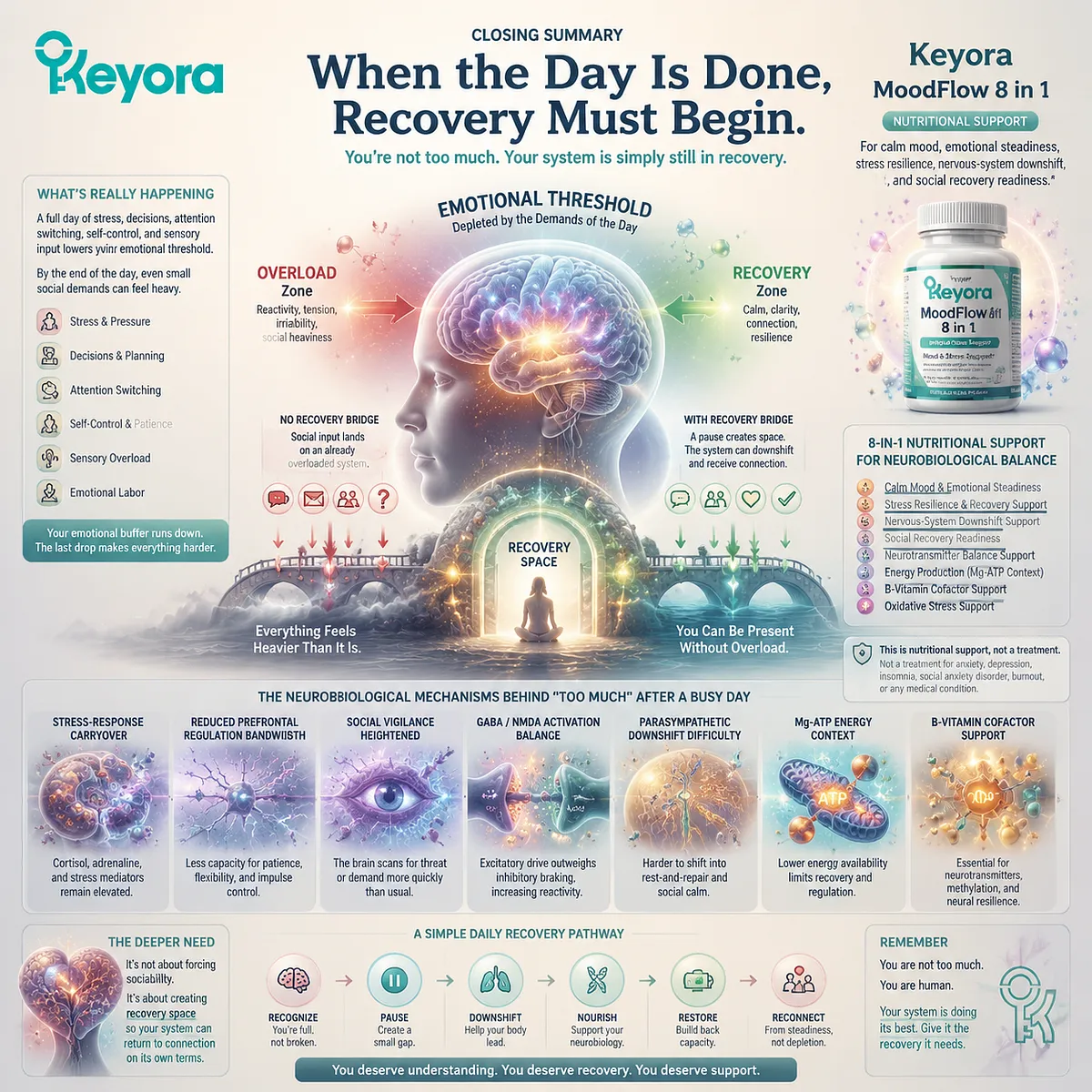
Closing Summary
Feeling emotionally on edge around people after a busy day does not automatically mean you are impatient, unfriendly, or bad at relationships. It may mean your emotional threshold has already been lowered by a full day of stress, decisions, attention switching, self-control, and sensory input.
When social interaction arrives before recovery happens, even ordinary voices, questions, messages, and requests can feel heavier than they are.
Mechanistically, this can involve stress-response carryover, reduced prefrontal regulation bandwidth, social vigilance, GABA/NMDA activation balance, parasympathetic downshift difficulty, Mg-ATP energy context, and B-vitamin cofactor support.
Keyora MoodFlow 8 in 1 fits as nutritional support for calm mood, emotional steadiness, stress resilience, nervous-system downshift, and social recovery readiness.
It is not a treatment for anxiety, depression, insomnia, social anxiety disorder, burnout, or any medical condition. The deeper need is not forced sociability, but recovery space.
This article is for educational and informational purposes only. It does not provide medical advice, diagnosis, treatment, cure, prevention, disease outcome claims, hormone restoration claims, fertility outcome claims, or formula-specific clinical efficacy claims.