
Why Do Social Interactions Feel Harder When I’m Stressed?
Keyora Research Q&A Library
This is part of the Keyora Research Q&A Series, derived from Keyora Nutritional Neurology Series .
Within the Keyora Nutritional Neurology framework, this Q&A translates complex nutrient–brain mechanisms into reader-friendly, evidence-bound answers, focusing on stress resilience, sleep quality, calm mood support, cognitive wellness, and the broader interaction between nutrition, neurochemistry, and daily nervous-system function.
First published by Keyora Research Journal: www.keyorahealth.com

Direct Answer
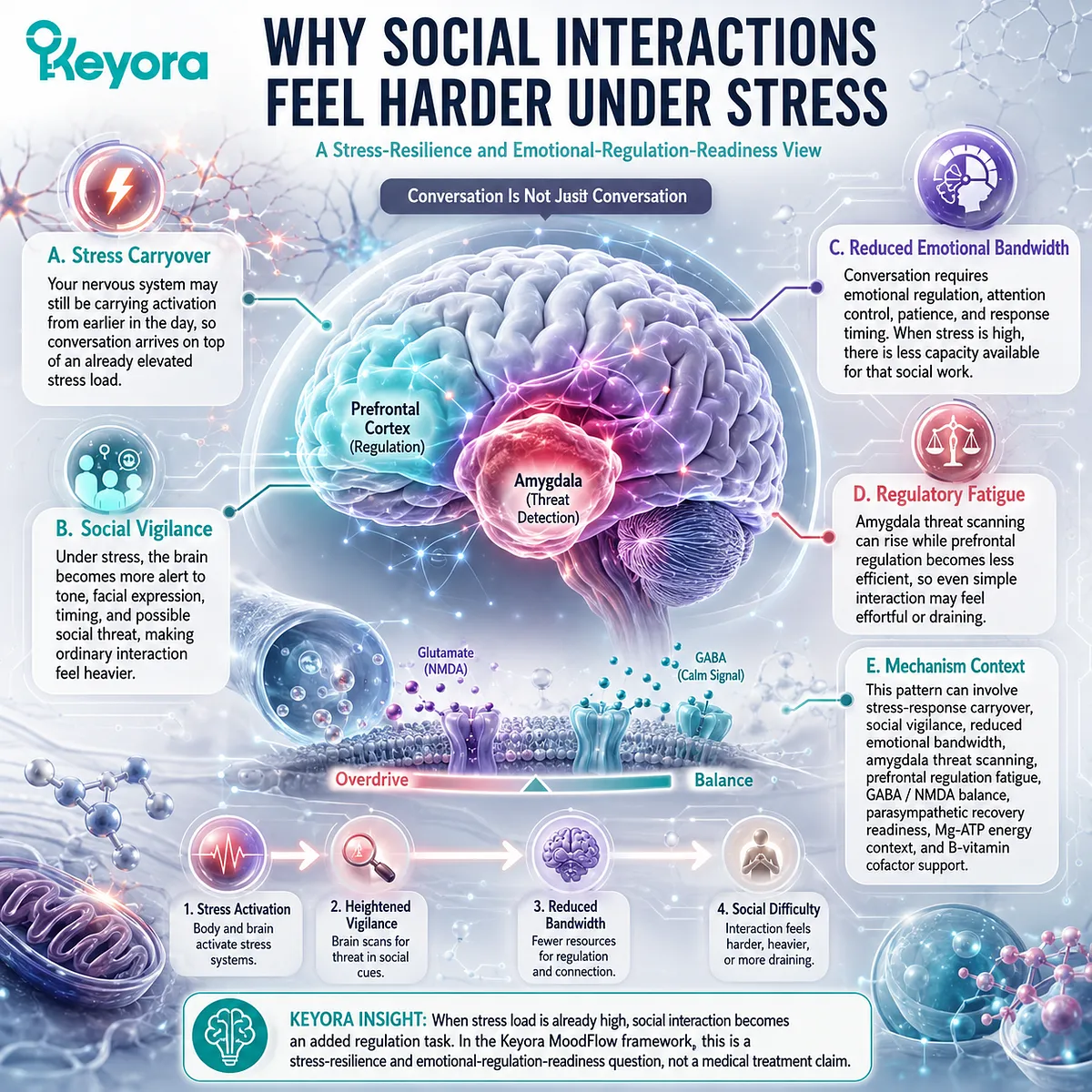
Social interactions can feel harder when you’re stressed because conversation is not just conversation.
It also requires emotional regulation, attention control, tone interpretation, response timing, patience, and the ability to stay open while another person is adding new input.
When your stress load is already high, the brain has less room for that social work.
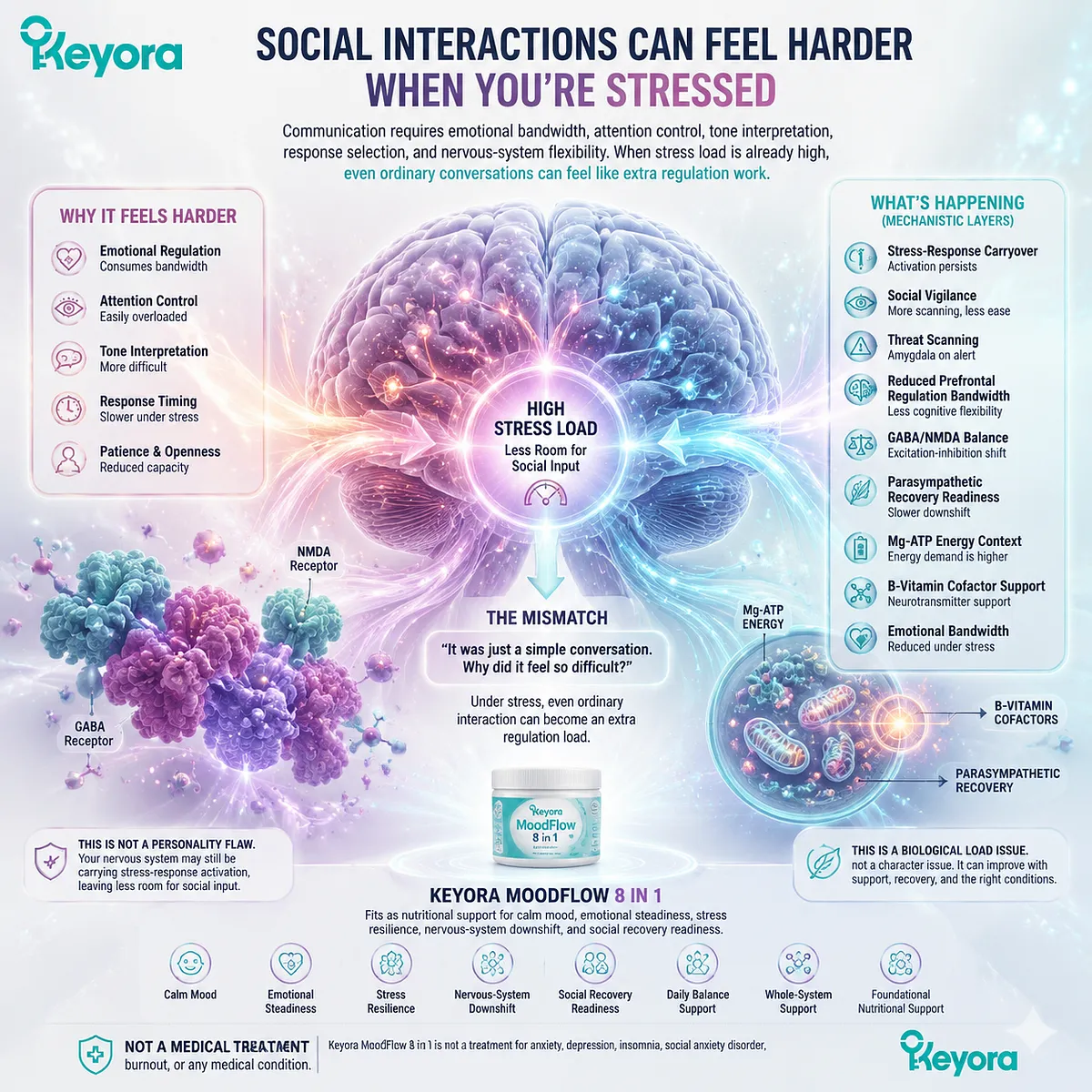
The mismatch is this: you may think, “It was just a simple conversation.
Why did it feel so difficult?”
But under stress, even ordinary interaction can become an extra regulation load. Your nervous system may still be carrying stress-response activation from earlier in the day, so another person’s voice, request, question, facial expression, or expectation can feel heavier than usual.
Mechanistically, this can involve stress-response carryover, social vigilance, reduced emotional bandwidth, amygdala threat scanning, prefrontal regulation fatigue, GABA/NMDA activation balance, parasympathetic recovery readiness, Mg-ATP energy context, and B-vitamin cofactor support.
In the Keyora MoodFlow framework, this is understood as a stress-resilience and emotional-regulation-readiness question, not a medical treatment claim.
When Talking to People Feels Like One More Task
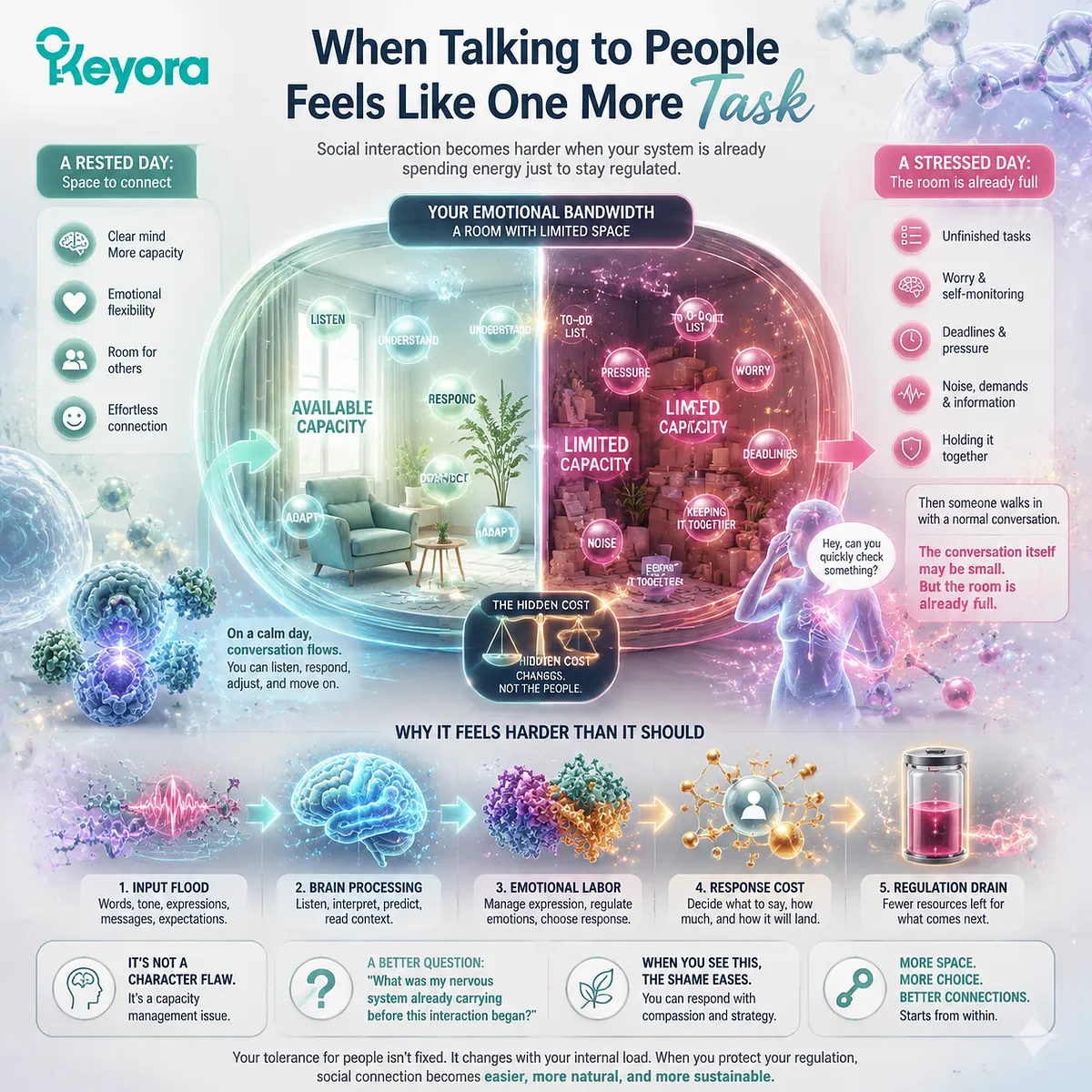
Social interaction becomes harder when your system is already spending energy just to stay regulated.
You may notice it most clearly at the end of a busy day.
Someone asks a normal question, and instead of answering naturally, you feel a small internal tightening. A message comes in, and your first reaction is not curiosity, but pressure. A coworker wants to “quickly check something,” and although the request is reasonable, your body reacts as if one more demand has been placed on an already full system.
Nothing dramatic has happened. No one has attacked you. The conversation may even be friendly.
Still, it feels harder than it should.
This is the confusing part for many people. They may think, “Why am I so easily affected by people today?” or “Why do I want everyone to leave me alone when I’m not actually angry at them?” Sometimes they blame their personality. Sometimes they assume they are becoming impatient, antisocial, cold, or emotionally weak.
But social difficulty under stress is not always a character problem. Often, it is a capacity problem.
Conversation requires more energy than people realize. To interact smoothly, you have to listen to words, read tone, notice facial expression, predict what the other person means, decide how much to say, manage your own expression, and choose a response that fits the relationship. You may also be trying not to sound irritated, not to disappoint someone, not to create conflict, and not to reveal how tired you feel.
That is emotional labor.
On a calm day, the same interaction may feel effortless. You can listen, respond, joke, adjust, and move on. But on a high-stress day, the same social input can land differently. It may feel too loud, too fast, too personal, too demanding, or simply too much.
This does not mean the people around you are necessarily doing something wrong. It also does not mean your reaction is fake. It means your inner regulation space may already be crowded.
Imagine your emotional bandwidth as a room. On a rested day, there is space for other people’s needs, questions, tone, and timing. On a stressed day, that room is already filled with unfinished tasks, pressure, self-monitoring, deadlines, noise, worry, and the effort of keeping yourself composed.
Then someone walks in with a normal conversation.
The conversation itself may be small. But the room is already full.
That is why the first useful question may not be, “Why am I bad at handling people?”
A better question is: “What was my nervous system already carrying before this interaction began?”
When readers see this clearly, the experience often becomes less shameful. Social interactions did not suddenly become impossible. The hidden cost changed.
The same conversation that once felt light may now require regulation resources you no longer have available in that moment.
Stress Changes the Way the Brain Receives Social Input
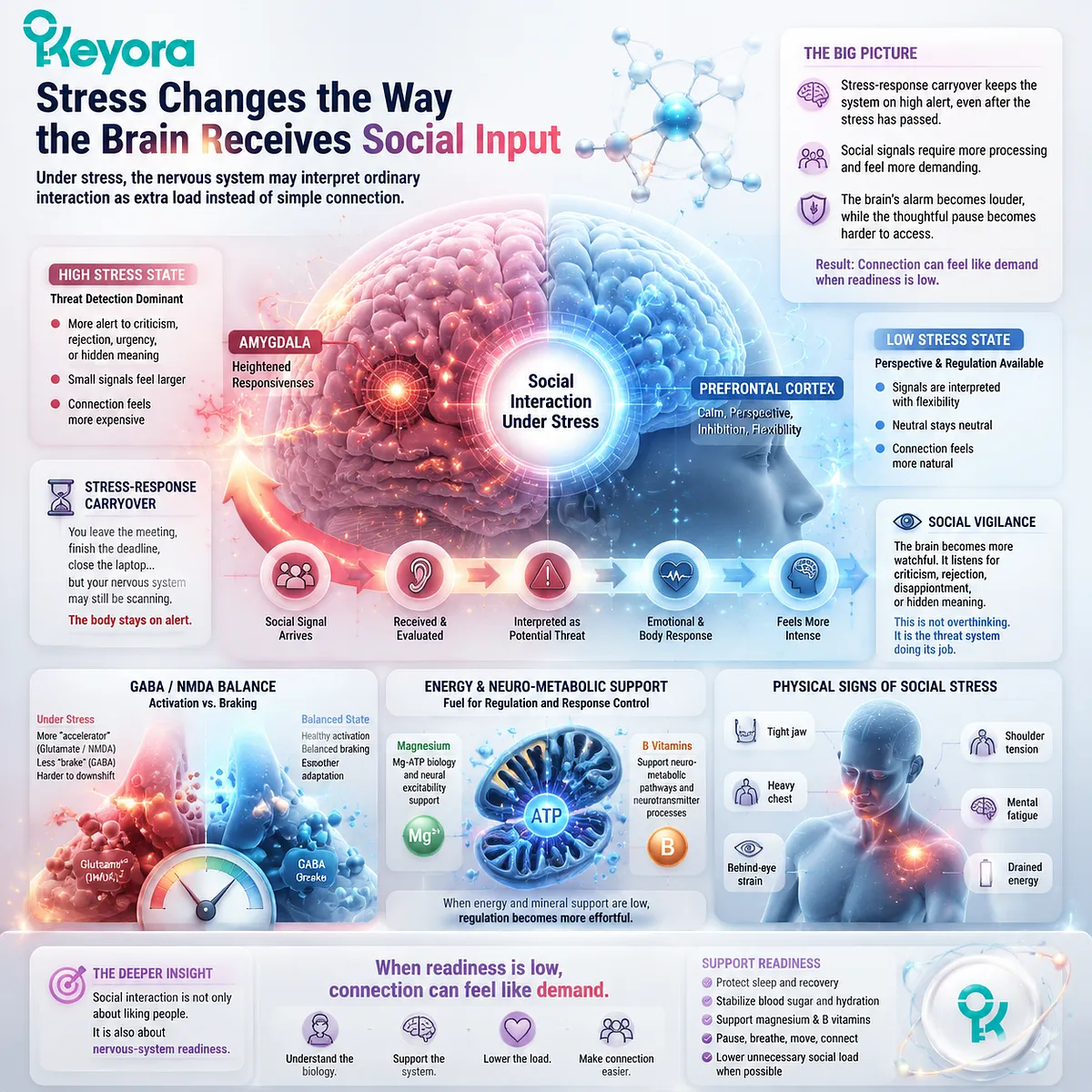
Under stress, the nervous system may interpret ordinary interaction as extra load instead of simple connection.
When stress is high, the body does not only feel “busy.” It shifts into a different operating mode.
The stress-response system is designed to help the body detect demands, protect energy, and respond quickly. This can be useful in short bursts. But when stress continues through the day, the system may stay slightly activated even after the original pressure has passed.
This is stress-response carryover.
You may leave the meeting, finish the deadline, close the laptop, or walk away from the difficult situation, but your nervous system may not immediately return to a calm baseline. The body may still be scanning. The mind may still be preparing. The emotional system may still be closer to its threshold.
In that state, social interaction can become more expensive.
One mechanism is social vigilance. Human beings are highly sensitive to social signals because relationships matter for safety, belonging, approval, and cooperation. When stress is low, the brain can interpret these signals with flexibility. A short reply may simply be a short reply. A neutral tone may simply be neutral. A question may simply be a question.
When stress is high, the brain may become more watchful. It may listen for criticism, rejection, disappointment, urgency, or hidden meaning. This does not mean the person is “overthinking on purpose.” It means the threat-detection system may be more active than usual.
The amygdala, often discussed in relation to emotional salience and threat detection, can become more responsive under stress. At the same time, the prefrontal cortex, which helps with perspective, inhibition, flexible thinking, and calm response selection, can feel less available when stress load is high.
In everyday language, this means the emotional alarm may become louder while the thoughtful pause becomes harder to access.
That is why social interactions may feel more intense. A small change in tone may feel sharper. A request may feel like pressure. A follow-up question may feel like criticism. A friendly conversation may still require too much monitoring.
Another layer is GABA/NMDA balance. In simple terms, the nervous system needs both activation and braking. Glutamate/NMDA-related activity is part of alertness, learning, and signal transmission. GABA-related tone helps the system soften, filter, and slow down when needed. Under stress, the “accelerator” side of the system may feel stronger, while the “brake” side may feel less accessible.
This does not mean something is broken. It means the nervous system may be less ready to downshift.
Energy also matters. Emotional regulation is not only psychological. It uses metabolic resources. The brain needs ATP-related energy availability, mineral support, and cofactor context to keep attention, inhibition, and response control working smoothly. Magnesium is involved in Mg-ATP biology and neural excitability context. B vitamins support neuro-metabolic pathways that help the brain manage energy and neurotransmitter-related processes.
This is why social stress can feel physical. You may feel tight in the jaw, heavy in the chest, tense in the shoulders, or drained behind the eyes. The body is not just “being dramatic.” It may be showing the cost of staying socially regulated while under load.
The deeper insight is this: social interaction is not only about liking people. It is also about nervous-system readiness.
When readiness is low, connection can feel like demand.
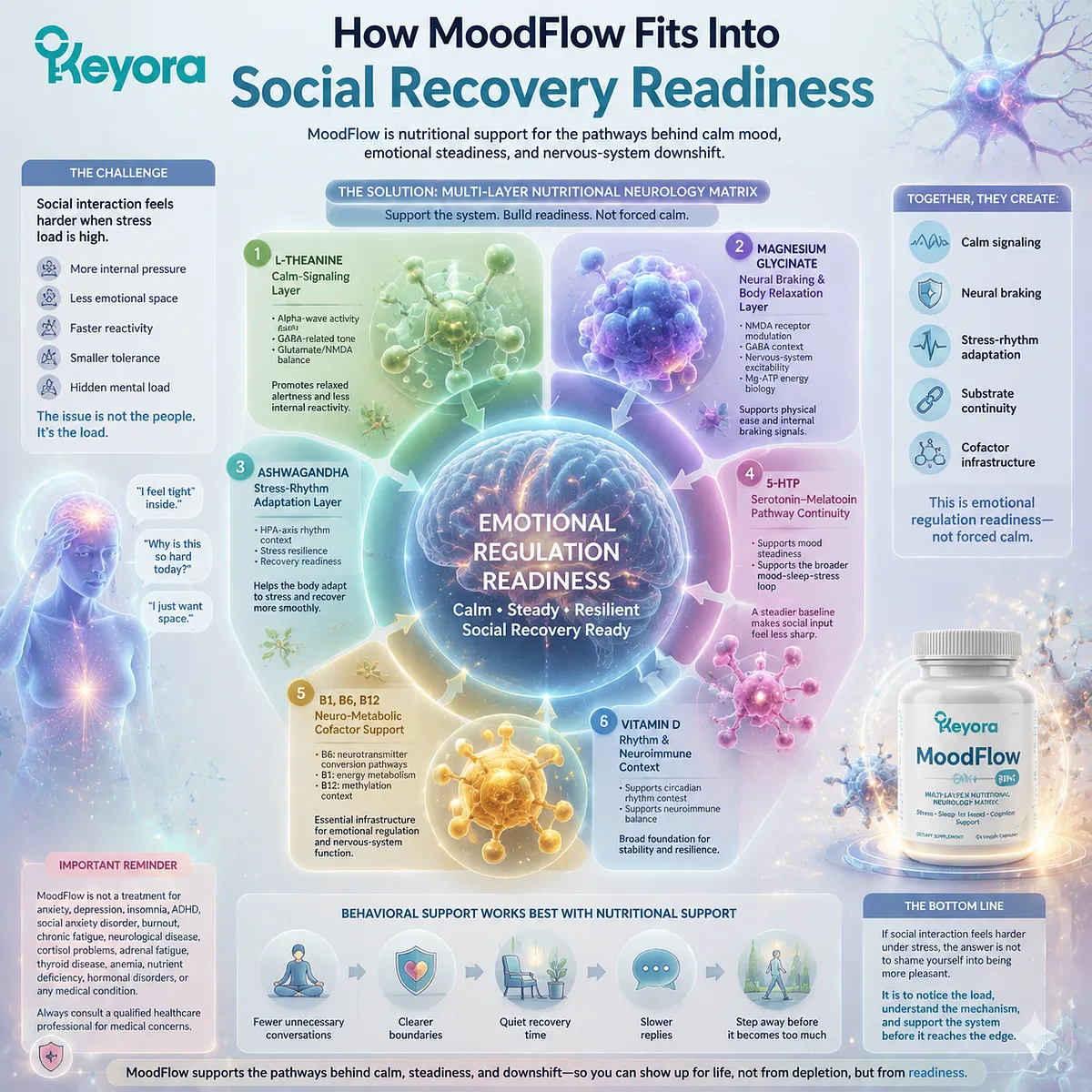
How MoodFlow Fits Into Social Recovery Readiness
MoodFlow is best understood as nutritional support for the pathways behind calm mood, emotional steadiness, and nervous-system downshift.
After the symptom and mechanism are understood, product support can be discussed more honestly.
Keyora MoodFlow 8 in 1 should not be framed as something that makes people “better at socializing” or “fixes” emotional reactions.
That would miss the real point. The more useful question is: what nutritional pathways may support the body’s ability to stay steady under everyday stress load?
In this context, MoodFlow is positioned as a multi-layer nutritional neurology matrix for stress-sleep-mood-cognition support.
For social interactions that feel harder during stress, the relevant idea is not forced calm. It is emotional regulation readiness.
L-Theanine supports the calm-signaling layer.
It is often discussed in relation to relaxed alertness, alpha-wave activity, GABA-related tone, and glutamate/NMDA balance. In a social-pressure context, this matters because people do not usually want to feel sedated around others. They want to feel present, clear, and less internally reactive.
Magnesium glycinate supports the neural braking and body-side relaxation-readiness layer.
Magnesium is relevant to NMDA receptor activity, GABA-related context, nervous-system excitability, and Mg-ATP energy biology. Glycinate form also brings a gentler, body-compatible positioning. In everyday terms, this layer speaks to the person who feels physically tense when social input piles on top of stress.
Ashwagandha supports the stress-rhythm adaptation layer.
Its role in the MoodFlow framework is not to erase stress, but to support stress resilience, HPA-axis rhythm context, and recovery readiness. This matters because many social reactions do not begin inside the conversation itself. They begin earlier, when the nervous system has been pushed for hours and has not yet come down.
5-HTP supports serotonin-melatonin pathway continuity where relevant.
In this topic, the main focus is not sleep, but emotional steadiness and the broader mood-sleep-stress loop. A stable emotional baseline can make social input feel less sharp, especially when stress has been compressing the system all day.
B1, B6, and B12 provide neuro-metabolic cofactor support.
B6 is relevant to neurotransmitter-related conversion pathways, B1 to energy metabolism, and B12 to methylation context. These are not glamorous roles, but they matter because emotional regulation depends on basic biological infrastructure.
Vitamin D sits in the broader rhythm and neuroimmune context of the formula.
Together, these layers create a support logic: calm signaling, neural braking, stress-rhythm adaptation, substrate continuity, and cofactor infrastructure. That is different from saying a product treats social stress. It does not.
MoodFlow is not a treatment for anxiety, depression, insomnia, ADHD, social anxiety disorder, burnout, chronic fatigue, neurological disease, cortisol problems, adrenal fatigue, thyroid disease, anemia, nutrient deficiency, hormonal disorders, or any medical condition.
In this article, Keyora uses “social interactions feel harder when I’m stressed” as a wellness-language entry point for explaining stress load, emotional regulation cost, nervous-system downshift, and social recovery readiness.
The goal is not to make people ignore their limits. Sometimes the best support is also behavioral: fewer unnecessary conversations, clearer boundaries, quiet recovery time, slower replies, or stepping away before social input becomes too much.
Nutritional support works best when it respects the person’s real life.
If social interaction feels harder under stress, the answer is not to shame yourself into being more pleasant. It is to notice the load, understand the mechanism, and support the system before it reaches the edge.
Closing Summary
Social interactions can feel harder when you’re stressed because communication requires emotional bandwidth, attention control, tone interpretation, response selection, and nervous-system flexibility. When stress load is already high, even ordinary conversations can feel like extra regulation work.
This does not mean you are unfriendly, weak, or socially broken. It may mean your nervous system is still carrying stress-response activation, leaving less room for social input.
Mechanistically, this can involve stress-response carryover, social vigilance, threat scanning, amygdala responsiveness, reduced prefrontal regulation bandwidth, GABA/NMDA activation balance, parasympathetic recovery readiness, Mg-ATP energy context, and B-vitamin cofactor support.
Keyora MoodFlow 8 in 1 fits as nutritional support for calm mood, emotional steadiness, stress resilience, nervous-system downshift, and social recovery readiness.
It is not a treatment for anxiety, depression, insomnia, social anxiety disorder, burnout, or any medical condition.
This article is for educational and informational purposes only. It does not provide medical advice, diagnosis, treatment, cure, prevention, disease outcome claims, hormone restoration claims, fertility outcome claims, or formula-specific clinical efficacy claims.