
How Can I Support Calm Thinking Without Feeling Slowed Down?
Keyora Research Q&A Library
This is part of the Keyora Research Q&A Series, derived from Keyora Nutritional Neurology Series .
Within the Keyora Nutritional Neurology framework, this Q&A translates complex nutrient–brain mechanisms into reader-friendly, evidence-bound answers, focusing on stress resilience, sleep quality, calm mood support, cognitive wellness, and the broader interaction between nutrition, neurochemistry, and daily nervous-system function.
First published by Keyora Research Journal: www.keyorahealth.com

Direct Answer
You can support calm thinking without feeling slowed down by supporting relaxed alertness, neural braking, and cognitive resilience rather than forcing sedation or stronger stimulation.
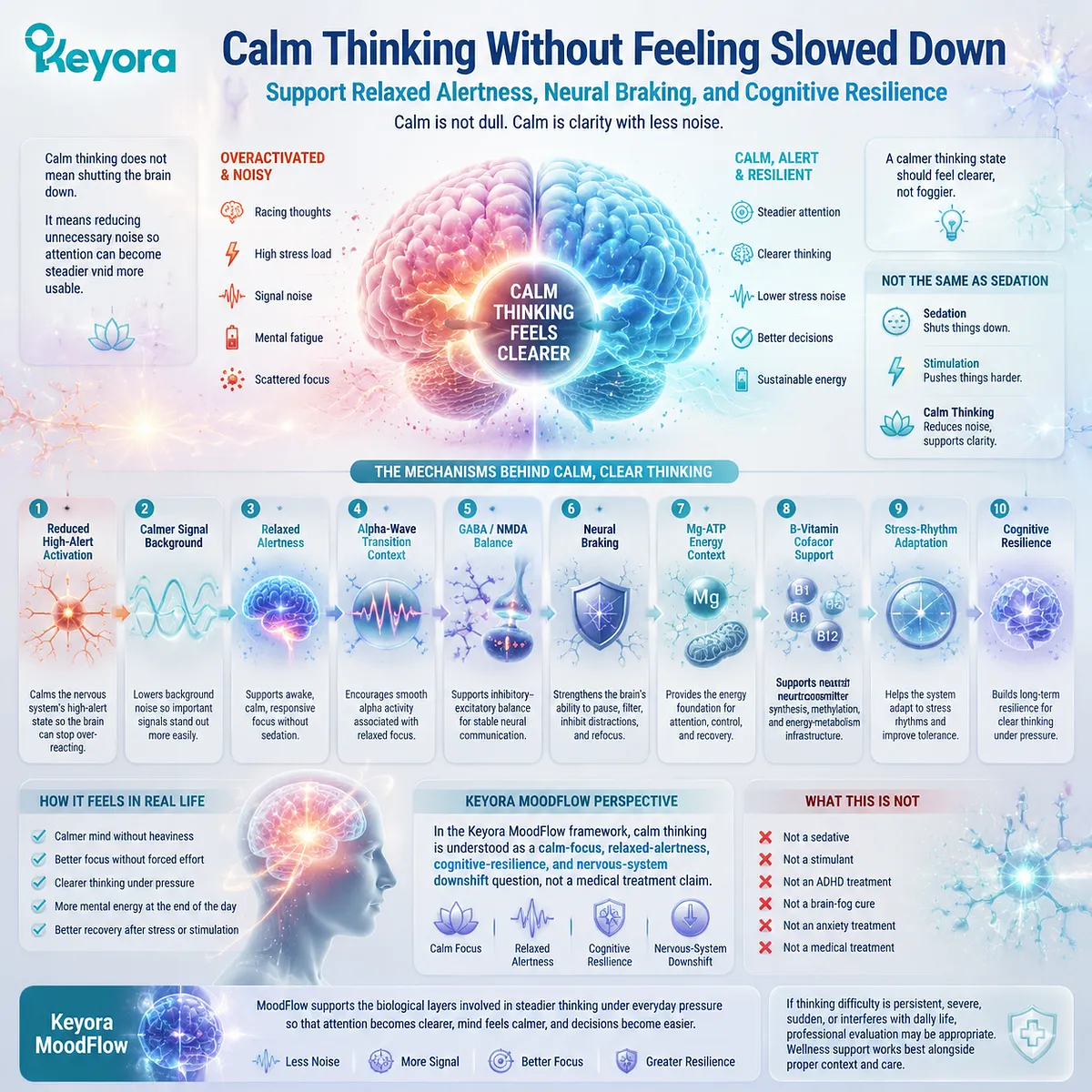
Calm thinking does not mean shutting the brain down.
It means reducing unnecessary noise so attention can become steadier and more usable.
Calm is not the same as dull.
When stress makes the mind feel fast, tense, scattered, or overactivated, the goal is not to make the brain do less. The goal is to help the brain waste less effort on stress noise.
A calmer thinking state should feel clearer, not foggier.
Mechanistically, calm thinking can involve reduced high-alert activation, calmer signal background, relaxed alertness, alpha-wave transition context, GABA/NMDA balance, neural braking, Mg-ATP energy context, B-vitamin cofactor support, stress-rhythm adaptation, and cognitive resilience.
In the Keyora MoodFlow framework, this is understood as a calm-focus, relaxed-alertness, cognitive-resilience, and nervous-system downshift question, not a medical treatment claim.
Why Calm Thinking Should Not Feel Like Mental Dulling
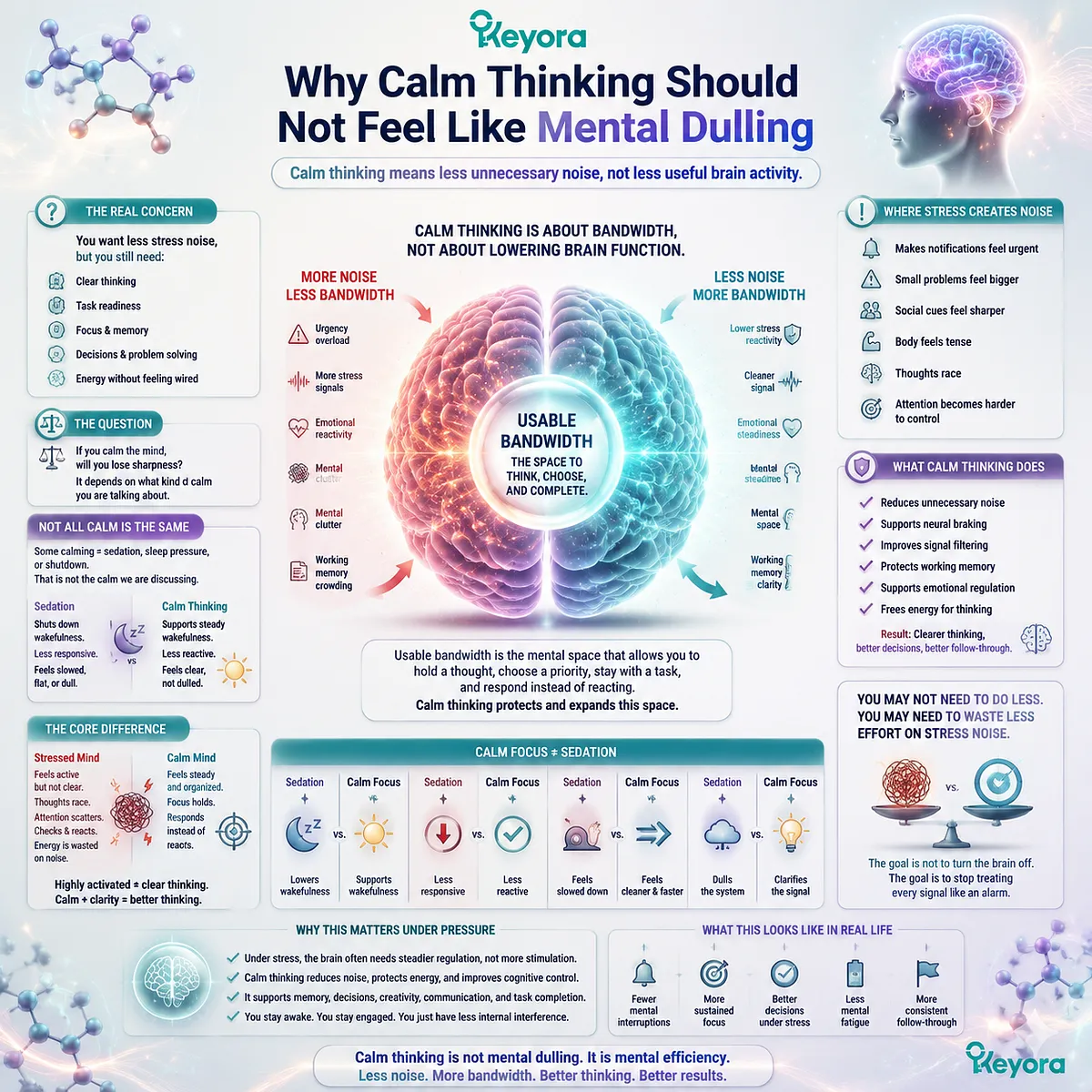
Calm thinking means less unnecessary noise, not less useful brain activity.
Many people want their mind to feel calmer, but they do not want to feel slowed down.
This is especially true during the day. You may need to work, study, write, speak, drive, meet people, make decisions, or solve problems. You may want less stress noise, but you still need clear thinking and task readiness.
You may not want to feel wired.
But you also do not want to feel sleepy, flat, dull, or mentally delayed.
This creates a real concern: if you calm the mind, will you lose sharpness?
The answer depends on what kind of calm you mean.
Some forms of calming are associated with sedation, sleep pressure, or shutdown. That is not the kind of calm thinking this article is discussing. Calm thinking means the mind is still awake, but less noisy. It means the system can stay engaged without being driven only by urgency, tension, or overstimulation.
Calm thinking should feel steadier, not dulled.
A stressed mind can feel active without being clear. Thoughts may move quickly, but not in an organized way. You may jump between tasks, check messages repeatedly, reread the same sentence, or feel like every input needs attention now.
That is not the same as good focus.
It is possible to be highly activated and still think poorly. It is also possible to be calmer and think more clearly because less energy is being spent on filtering stress signals.
The goal is not less brain function.
The goal is less unnecessary noise.
Stress can create noise in several ways. It can make notifications feel more urgent. It can make small problems feel bigger. It can make social cues feel sharper. It can make the body feel tense. It can make thoughts race while attention becomes harder to control.
When this happens, the brain may not need more pressure.
It may need more usable bandwidth.
Usable bandwidth is the mental space that allows you to hold a thought, choose a priority, stay with a task, and respond instead of reacting. Calm thinking supports this space by reducing the background demands that make cognition feel crowded.
This is why calm focus is different from sedation.
Sedation lowers wakefulness. Calm focus supports steadier wakefulness. Sedation may make you less responsive. Calm focus aims to make you less reactive. Sedation may feel like being slowed down. Calm focus should feel like having a cleaner signal.
You may not need your brain to do less.
You may need it to waste less effort on stress noise.
That distinction is central to understanding calm thinking during pressure. The goal is not to turn the brain off. The goal is to help it stop treating every signal like an alarm.
The Relaxed-Alertness Mechanism Behind Calm Focus
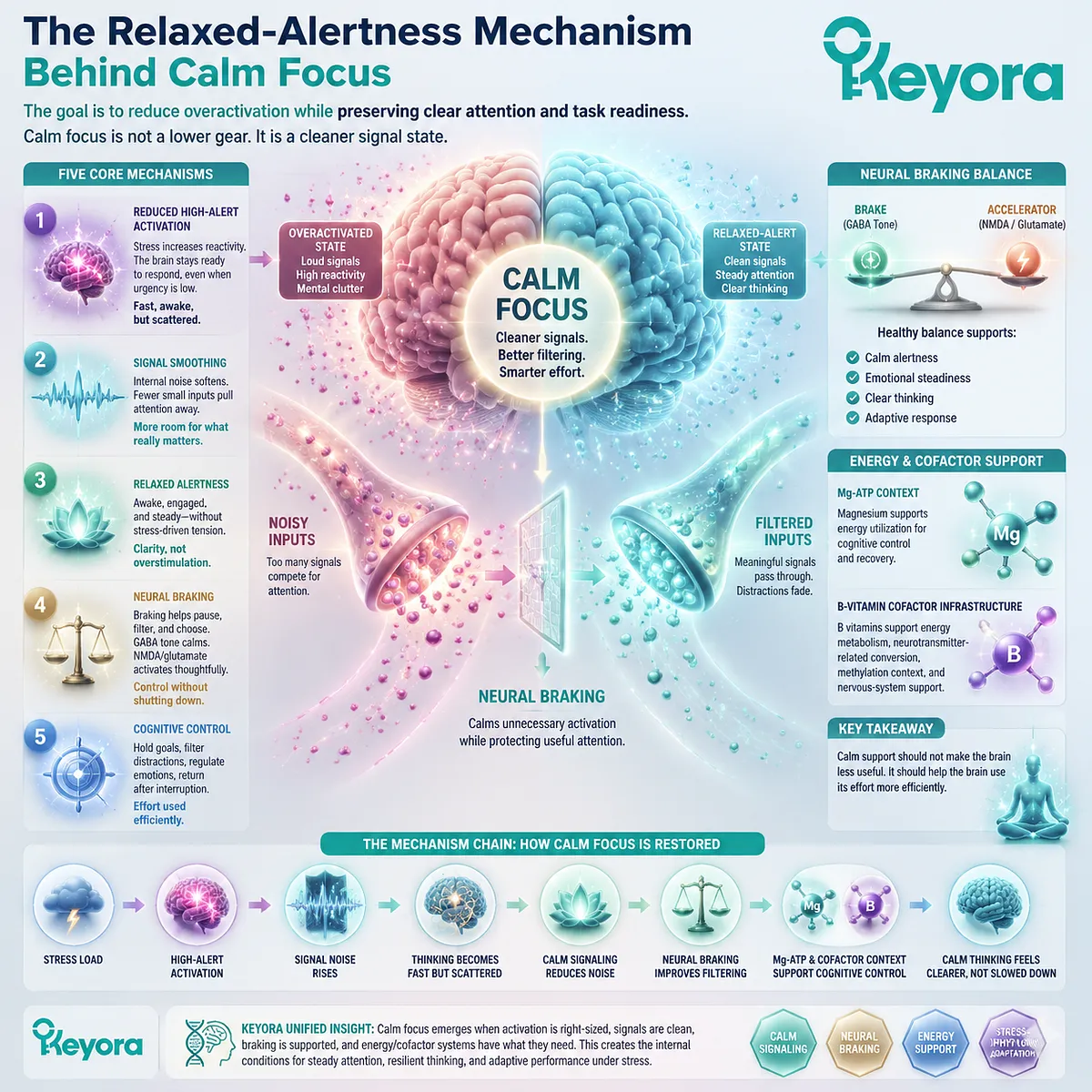
The goal is to reduce overactivation while preserving clear attention and task readiness.
Calm focus is not a lower gear.
It is a cleaner signal state.
The first mechanism is reduced high-alert activation.
When stress is high, the nervous system may become more responsive to possible demands. A message feels urgent. A sound feels irritating. A small delay feels frustrating. A task feels heavier than usual. The brain may stay ready to react, even when the situation does not require that much urgency.
This high-alert state can make thinking feel fast but scattered.
You may feel awake, but not organized. You may feel alert, but not clear. You may be active, but not steady.
Calm thinking requires reducing unnecessary activation without removing alertness.
The second mechanism is signal smoothing.
Signal smoothing means the internal background becomes less noisy. The brain does not have to respond as sharply to every small input. Attention has more room to stay with what matters. The system can notice distractions without being pulled into all of them.
This does not mean ignoring reality.
It means the brain becomes better able to separate meaningful signals from background noise.
The third mechanism is relaxed alertness.
Relaxed alertness is a useful way to describe calm thinking. The mind is awake, but not tense. Attention is available, but not forced. The system is engaged, but not driven only by stress.
This is different from stimulation.
Stimulation can raise alertness, but it does not always improve regulation. Under stress, more stimulation may make the system more active while still leaving it scattered. Relaxed alertness aims for steadier clarity rather than stronger activation.
The fourth mechanism is neural braking.
The nervous system needs both activation and braking. Activation helps you respond, move, and stay engaged. Braking helps you pause, filter, inhibit distractions, and choose a response. GABA-related calming tone and NMDA/glutamate activation balance help explain why the system can feel either steady, overactivated, or difficult to settle.
Calm thinking depends on braking that does not shut thinking down.
Good braking is not the same as stopping the car forever. It helps control speed, direction, and timing. In the brain, braking helps reduce unnecessary noise while preserving useful attention.
The fifth mechanism is cognitive control.
Clear thinking under stress requires the ability to hold a goal, filter distractions, regulate emotional reactions, and return to the task after interruption. These functions require energy and stability.
This is where Mg-ATP energy context and B-vitamin cofactor infrastructure become relevant in a wellness framework.
Magnesium’s role in Mg-ATP context helps explain why attention control and recovery require active energy support. B vitamins support neuro-metabolic infrastructure, including energy metabolism, neurotransmitter-related conversion, methylation context, and nervous-system support.
This does not mean calm thinking difficulty is caused by nutrient status.
It means calm thinking can be understood as a multi-layer wellness question involving signal quality, neural braking, energy context, cofactor infrastructure, and stress-rhythm adaptation.
The mechanism chain looks like this:
stress load → high-alert activation → signal noise rises → thinking becomes fast but scattered → calm signaling reduces unnecessary noise → neural braking improves filtering → Mg-ATP and cofactor context support cognitive control → calm thinking feels clearer instead of slowed down
In plain language, calm support should not make the brain less useful. It should help the brain use its effort more efficiently.
How MoodFlow Supports Calm Thinking Without Sedation
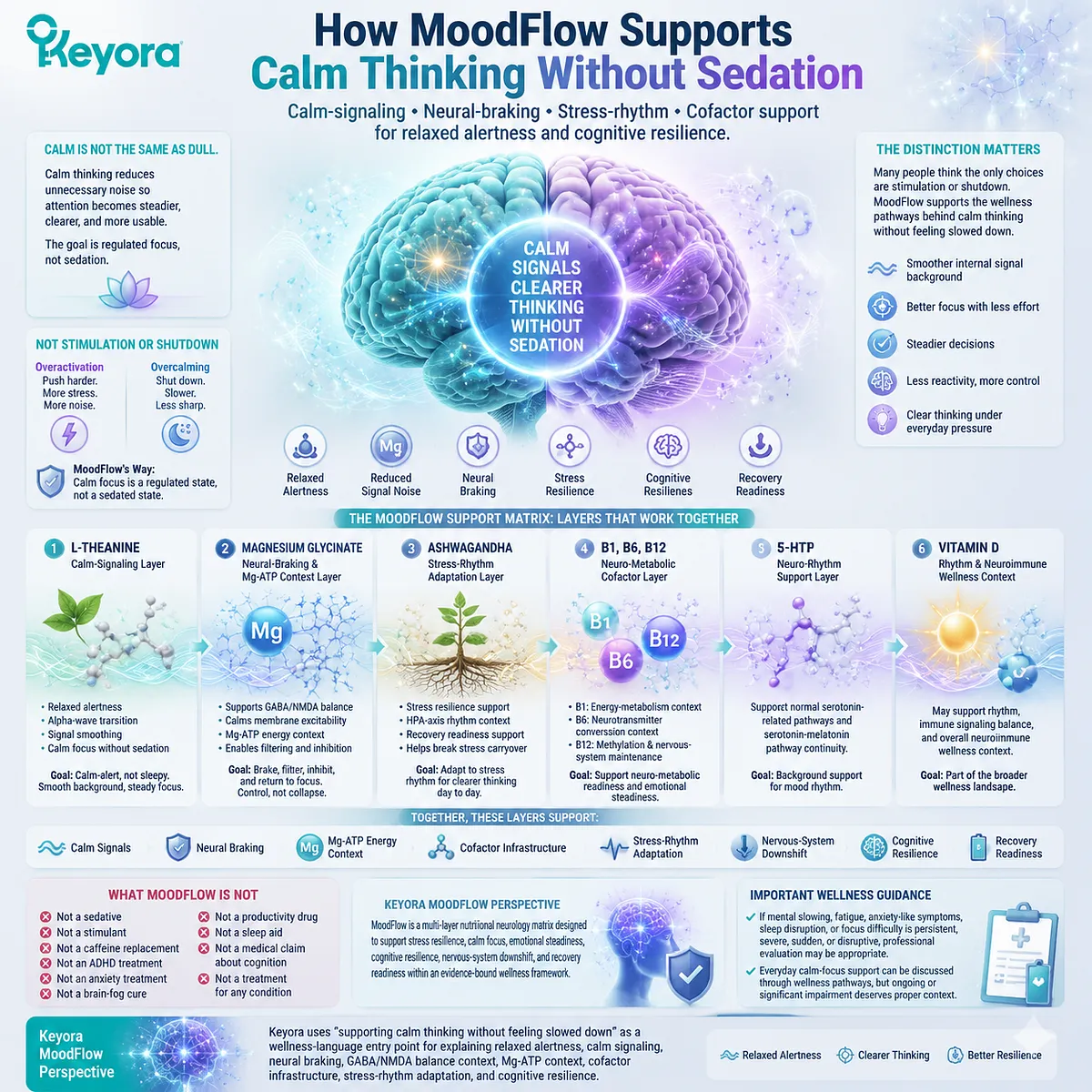
MoodFlow supports the calm-signaling, neural-braking, stress-rhythm, and cofactor layers involved in relaxed alertness and cognitive resilience.
Keyora MoodFlow approaches calm thinking without feeling slowed down as a calm-focus, relaxed-alertness, cognitive-resilience, and nervous-system downshift question.
The goal is not to sedate the brain, replace caffeine, treat anxiety, treat ADHD, treat brain fog, improve productivity, or make medical claims about cognition. The goal is to support the wellness pathways involved in steadier thinking under everyday pressure.
This distinction matters.
Many people think the only choices are stimulation or shutdown. Either push harder with more activation, or calm down so much that thinking feels slow. MoodFlow’s logic is different. It is built around the idea that calm focus can be a regulated state, not a sedated state.
L-Theanine supports the calm-signaling layer.
In the MoodFlow framework, L-Theanine is associated with relaxed alertness, alpha-wave transition, signal smoothing, and calm focus without sedation. This makes it especially relevant to the question of calm thinking without feeling slowed down.
L-Theanine helps explain why calm focus is different from sedation and different from stimulation.
The goal is not to make the brain sleepy. The goal is to support a smoother internal signal background, so alertness can feel steadier rather than sharper, rushed, or reactive.
Magnesium glycinate supports the neural-braking and Mg-ATP context layer.
Magnesium is relevant to GABA/NMDA activation balance, membrane excitability, and Mg-ATP energy context. In MoodFlow, magnesium glycinate is positioned as part of the neural braking and hardware-stabilizing layer.
Magnesium glycinate helps explain the braking layer that allows the brain to filter signal without shutting thinking down.
This is important because calm thinking requires control, not collapse. The brain still needs to notice, decide, and act. But it also needs to reduce unnecessary reactivity, inhibit distractions, and return to focus after interruptions.
Ashwagandha supports the stress-rhythm adaptation layer.
Calm thinking can be difficult when the stress rhythm has been high for too long. If the system carries stress from one task into the next, or from one day into the next, the mind may feel wired, pressured, and less able to settle into clear focus.
Ashwagandha is positioned in MoodFlow around stress resilience, HPA-axis rhythm context, and recovery readiness. In this article, that does not mean Ashwagandha fixes cortisol, treats burnout, repairs the HPA axis, or treats anxiety. It means Ashwagandha belongs to the stress-adaptation layer that helps explain why calm thinking is connected to broader stress rhythm.
B1, B6, and B12 support the neuro-metabolic cofactor layer.
The nervous system depends on normal metabolic and neurotransmitter-related infrastructure. B1 supports energy-metabolism context. B6 supports neurotransmitter-related conversion context, including pathways relevant to calming and mood-related signaling. B12 supports methylation context and nervous-system maintenance.
In MoodFlow, these B vitamins are not positioned as treatments for fatigue, brain fog, deficiency, depression, ADHD, cognitive dysfunction, or neurological disease. They are part of the cofactor background behind neuro-metabolic readiness, emotional steadiness, and cognitive resilience under everyday pressure.
5-HTP plays a background role in mood-rhythm support.
Because this article is about calm thinking and relaxed alertness, 5-HTP should not dominate the explanation. Its role is best understood as support for normal serotonin-related pathways and serotonin-melatonin pathway continuity within the broader MoodFlow architecture. This does not mean treating depression, correcting serotonin, forcing sleep, or slowing the brain.
Vitamin D may also be understood as part of broader rhythm and neuroimmune wellness context when relevant, but it should remain secondary.
Together, these layers explain why MoodFlow is not positioned as a sedative, stimulant, caffeine replacement, ADHD treatment, anxiety treatment, brain-fog cure, productivity drug, or sleep aid. It is a multi-layer nutritional neurology matrix designed to support stress resilience, calm focus, emotional steadiness, cognitive resilience, nervous-system downshift, and recovery readiness within an evidence-bound wellness framework.
MoodFlow is not a treatment for ADHD, anxiety, depression, insomnia, brain fog, cognitive dysfunction, burnout, chronic fatigue, neurological disease, caffeine sensitivity, cortisol problems, adrenal fatigue, thyroid disease, anemia, nutrient deficiency, hormonal disorders, or any medical condition.
In this article, Keyora uses “supporting calm thinking without feeling slowed down” as a wellness-language entry point for explaining relaxed alertness, calm signaling, neural braking, GABA/NMDA balance context, Mg-ATP context, cofactor infrastructure, stress-rhythm adaptation, and cognitive resilience under everyday pressure.
If mental slowing, fatigue, anxiety-like symptoms, sleep disruption, or focus difficulty is persistent, severe, sudden, or disruptive, professional evaluation may be appropriate.
Everyday calm-focus support can be discussed through wellness pathways, but ongoing or significant impairment deserves proper context.
Closing Summary
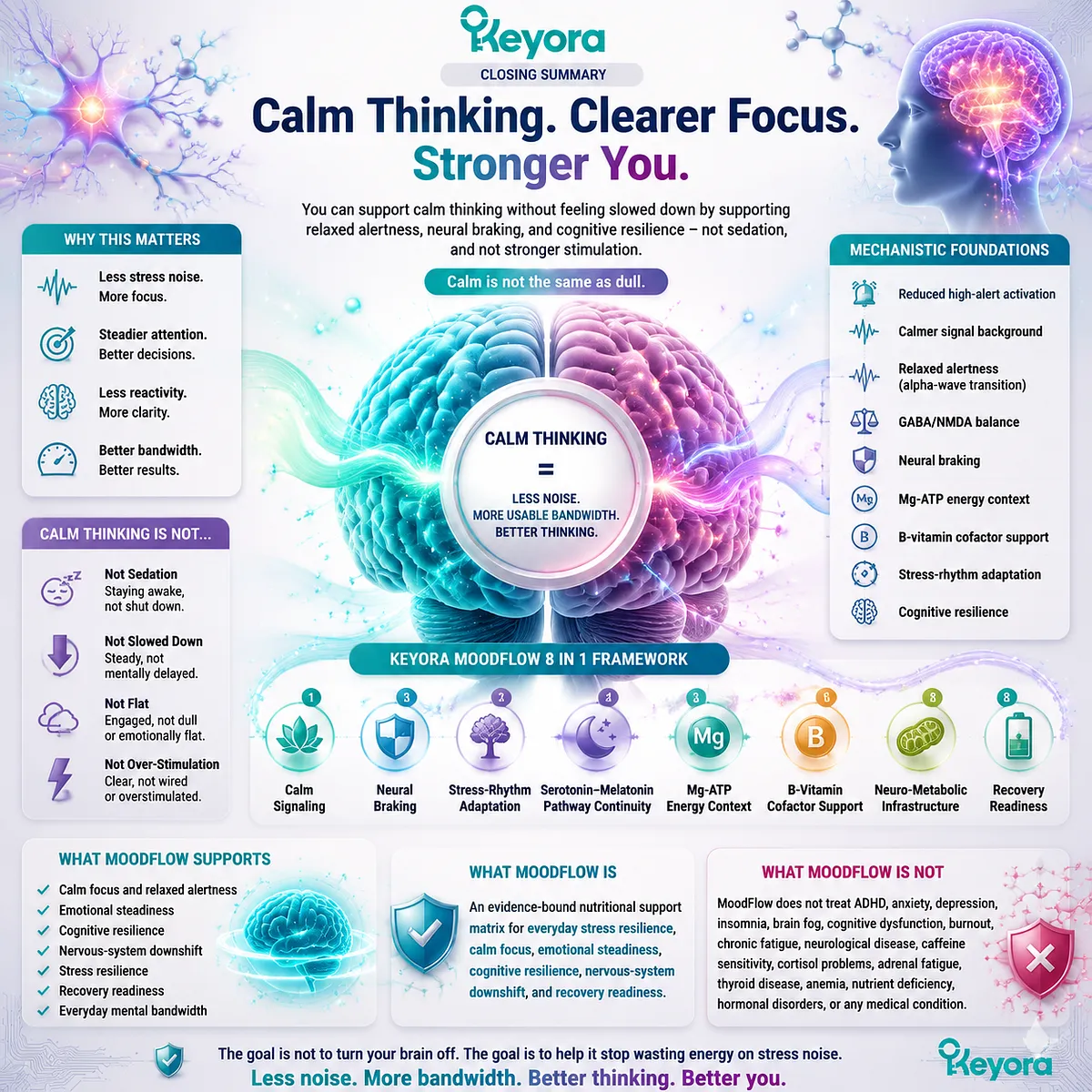
You can support calm thinking without feeling slowed down by supporting relaxed alertness, neural braking, and cognitive resilience rather than forcing sedation or stronger stimulation. Calm thinking does not mean shutting the brain down. It means reducing unnecessary noise so attention can become steadier and more usable.
Calm is not the same as dull.
Mechanistically, calm thinking may involve reduced high-alert activation, calmer signal background, relaxed alertness, alpha-wave transition context, GABA/NMDA balance, neural braking, Mg-ATP energy context, B-vitamin cofactor support, stress-rhythm adaptation, and cognitive resilience.
In the Keyora MoodFlow framework, this is understood as a calm-focus, relaxed-alertness, cognitive-resilience, and nervous-system downshift question. MoodFlow supports this picture through calm signaling, neural braking, stress-rhythm adaptation, serotonin-melatonin pathway continuity, and neuro-metabolic cofactor infrastructure.
MoodFlow does not treat ADHD, anxiety, depression, insomnia, brain fog, cognitive dysfunction, burnout, chronic fatigue, neurological disease, caffeine sensitivity, cortisol problems, adrenal fatigue, thyroid disease, anemia, nutrient deficiency, hormonal disorders, or any medical condition.
It is an evidence-bound nutritional support matrix for everyday stress resilience, calm focus, emotional steadiness, cognitive resilience, nervous-system downshift, and recovery readiness.
This article is for educational and informational purposes only. It does not provide medical advice, diagnosis, treatment, cure, prevention, disease outcome claims, hormone restoration claims, fertility outcome claims, or formula-specific clinical efficacy claims.